Playlist: Listen, my summer friends! ~ August


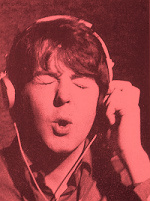

In the words of Moby Grape… listen, my friends! Yes, it’s the (hopefully) monthly playlist presented by George’s Journal just for you good people.
So, not to tempt fate and jinx it so it downpours every day in August (it couldn’t, could it?), this month – and this month only – I’ve spoiled you, folks, because, yup, here’s a super-dooper summer special of a playlist. Oh yes!
There may be one or two classics to be found here dotted in among different tunes you’re unfamiliar with or never heard before – or, of course, you may’ve heard them all before. All the same, why not sit back, listen away and knock your bucket and spade together to the tunes…
Click on the song titles to hear them
~~~
Martha And The Vandellas ~ Dancing In The Street
The Lovin’ Spoonful ~ Summer In The City
The Who ~ Summertime Blues
Love ~ Bummer In The Summer
Janis Joplin ~ Summertime
Cream ~ Sunshine Of Your Love
The Fifth Dimension ~ Aquarius/ Let The Sunshine In
The Isley Brothers ~ Summer Breeze
Starland Vocal Band ~ Afternoon Delight
The Style Council ~ Long Hot Summer
Glenn Frey ~ The Heat Is On
The Stranglers ~ Always The Sun
The Beach Boys ~ Kokomo
The global jukebox: Live Aid ~ July 13 1985

Freddie and the dreamers: Queen’s frontman leads a capacity Wembley Stadium in perhaps the most memorable – and magical – set at the extraordinary, unforgettable Live Aid event
All decades have defining moments. For instance, the ’50s have the wedding of Prince Rainier of Monaco and Grace Kelly, the ’60s have Jimi Hendrix playing the Star Spangled Banner at Woodstock, and the ’70s have the Israeli athletes’ kidnap at the Munich Olympics. As far as the ’80s go, one of its defining moments, unquestionably, has to be Live Aid – an event that, of course, celebrated its 25th anniversary a couple of weeks ago.
Live Aid was momentous, miraculous, inexplicable and unforgettable. It changed the music industry and charity-giving forever and brought the world together in a way that had never quite happened before. And, when you get down to it, it was all Michael Buerk’s fault.
One evening in the autumn of 1984, Bob Geldof, lead singer with moderately successful rock/ pop band The Boomtown Rats, was watching the BBC’s Nine O’ Clock News in bed with a cold, and witnessed a report that shook him and the entire British nation at large. In it, reporter Buerk not just broke the news that swathes of Ethiopia’s population were suffering from famine owing to record low rainfall, lack of government preparation in the face of this and insurgencies and counter-insurgencies in the north of the country, but he and his team managed to hammer the message home thanks to the shots of the human tragedy they couldn’t fail to capture on film. Geldof was as moved as the rest of the UK at what he’d seen, but unlike the rest of the UK, was also stirred into action.
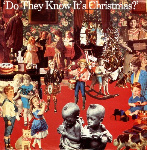


Back for more: the Band Aid single’s iconic cover art designed by Peter Blake (left); Geldof, Ure, Elton John, the BBC’s Janice Long and others at the June ’85 launch of Live Aid (centre); and the event’s ‘Global Jukebox’ promotional poster
What he did next has become notorious, of course, but needs to be recalled once more, as it was the first act in the Live Aid story. The charity single, the profits from which he planned would help feed the masses of starving Ethiopians, that he organised with Ultravox’s Midge Ure was Do They Know It’s Christmas? and, produced with the efforts – free of charge – from British rock and pop’s top alumni, it became an utter phenomenon. The song was released in late November 1984, outsold every single on the UK chart combined in its first week on release, remained at Number 1 for another four weeks (including taking the coveted Christmas Number 1 slot) and raised millions, as opposed to Geldof’s much more conservative target of a mere £70,000.
Band Aid, as the project was nattily entitled, necessarily created an aid programme, given that Geldof and Ure’s next immediate problem was working out where and how to dish out the dosh. Not only had they set up a charity (The Band Aid Charitable Trust) the day they recorded their song, they were now also running it. However, Geldof wasn’t content with just this. The Ethiopian famine was never going to be eradicated by one charity single – however big that was – and, unsurprisingly, the starving carried on into 1985. More aid was needed. Bob decided he had to push on, go further, do something bigger, really reach for the sky… if he could.
And one morning in June, together with entertainment promoter Harvey Goldsmith, he went live on the the BBC’s Radio 1 station to announce to the world that Live Aid would take place on 13 July, just weeks away. Billed as ‘the global jukebox’, the event would feature two concerts – if not more – that would run more or less simultaneously in the United States and at Wembley Stadium in London. During the same broadcast, Geldof regaled listeners with a long set-list, in alphabetical order, of artists who would definitely be performing on the day. The list was impressive, to the say least, but what punters didn’t know as they scrambled to buy tickets for the show was that a large number of the artists Geldof announced hadn’t agreed to perform – some of them were yet to be even contacted. Moreover, seconds before the broadcast began, he had been told that his team had just got through to representatives of The Who to discuss their involvement, and for Bob that was enough – he finished his set-list announcement by declaring he’d just been informed that The Who were reforming especially for the concert and would performing along with everybody else. On hearing the news both Roger Daltrey and Pete Townshend separately called Bob’s people to find out just what the hell was going on.
“It’s twelve noon in London, seven am in Philadelphia, and around the world it’s time for Live Aid!” ~ BBC broadcaster Richard Skinner’s memorable opening
But it was a clever game Geldof was playing. In order to get potential performers’ backsides into gear and make them commit, he knew he’d have to use unorthodox methods. In most cases he played them off against each other – he’d phone ‘artist A’ and tell them they had to be on the bill because ‘artist B’ was, and then phone ‘artist B’ and tell them they had to be on it because ‘artist A’ was. Eventually, with the aid of the behind-the-scenes contacts and fellow scheming of Goldsmith, his bloody-minded bullying paid off and the bill fell into place, but only around a fortnight before the event itself.
The watershed moment came when Dire Straits realised they were down to play Wembley Arena (a venue related to the stadium, but effectively across the road from it), so they told Geldof and co. they would be able to play Live Aid as long as their set allowed them to finish in time to get across to Wembley Arena and do the pre-arranged gig. Being able to allot Dire Straits a time, therefore, Geldof could then go to the others and tell them that not only did he have that highly respected band in the bag, but also the time they’d be on. The other artists now jumped at the chance to be involved and seek the best performance times for their own sets.
One performer proved to be elusive all along, however; the performer who for the Live Aid organisers was ‘the big one’ – the artist whose involvement, they believed, could make or break the event as he would lend the whole shebang genuine legitimacy in the eyes of political movers and shakers. Well, he was rock music royalty, after all, given he was Paul McCartney. When a delegation finally got an appointment set up to meet with him, Macca took them aback a little by saying he had no objection whatsoever about appearing (although he had effectively been on a performing hiatus since John Lennon’s death at the end of 1980). He claimed he had no alternative than to appear because ‘the management’ had ordered him to do so; after some confusion, he explained to Geldof’s representatives that ‘the management’ was his children.
If organising the Wembley side of Live Aid was like a bad dream, then getting the US side going was a proper nightmare. The idea of holding such a huge fund-raising concert in the States – especially it being co-ordinated with another concert in another country and the whole thing being run outside the States – was always an ambitious aim; from the start, Goldsmith felt it might prove to be a pipe-dream, but Geldof (always with the big picture in mind of the money that needed raising) was adamant it had to happen and persevered. The big problem was that nobody in the States really believed that the project could be pulled off – hardly Bob’s ‘just bloody do it’ attitude.
Things came to a head when Geldof and Goldsmith realised that controversial music promoter Bill Graham, Live Aid’s US organiser, was telling performers, whom he was supposed to be securing for the bill, that the whole thing would be a disaster and appearing on it woud damage their careers. Quite clearly his real interest was developing and talking up his own promotional projects, often at Live Aid’s expense. Unsurprisingly, Graham was given the heave-ho and eventually, with just one week to go to the event itself, the US side of things was sorted out and artists secured for its bill. Nevertheless, major names who were included in early Live Aid promotional material for the concert at Philadelphia’s JFK Stadium, but eventually didn’t materialise, included Rod Stewart, Stevie Wonder, Billy Joel, Boy George, Tears For Fears, Kris Kristofferson, Huey Lewis And The News and Paul Simon. The latter two acts have since claimed they pulled out owing to disagreements with Graham.
However, both concerts did end up with strong line-ups to say the least (a full list of both follows at the bottom of this blog), and now – with just days to go – the organisers could turn their attention to the logistical problems of getting the concerts up and running. Problems that needed to be overcome at Wembley included the stadium seeking payment for its use, while everyone else involved was doing it all gratis, given the cause. This stance left Bob fuming and a showdown with Wembley’s chief – that featured an f-word splattered tirade from the former – did little to find a compromise.

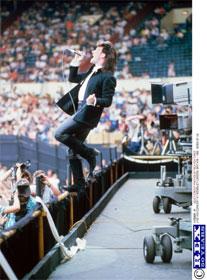
Royal salute, chanteur in boots: Geldof and his rock pals with Charles and Di as the day opens (left); later, Bono gets soulful before his infamous – and heroic – foray into the crowd (right)
Finally, one was reached, though, and thoughts quickly shifted to installing the revolving stage at the stadium, which had been boasted about in promotional material as state-of-the-art and, thus, quite the boon. In the event, it looked like it might be more of a boob, for, as it was being put in with a day to go, the thing clearly didn’t want to work properly. Eventually, though, it did work – sort of. Big blokes pulling on ropes to make the cogs go round, and in turn, the stage go round proved the answer. Like much to do with Live Aid, given the sort of event it was, arrangements for the stage were made on the fly – it was, in fact, a controversial stage design that dated back three years and on the one previous occasion it had been tried out for a concert in Sweden, it hadn’t work then either.
Aside from obvious logistics, the actual broadcasting – and the co-ordination necessary therein – of the day itself were enormous. A staggering total of 16 satellites were necessary to bounce images to TVs around the globe – easily ensuring Live Aid was, at the time, the world’s most ambitious satellite television broadcast (things had come a long way since The Beatles sang All You Need Is Love to world in 1967). The BBC were only too happy to take on television and radio duties in the UK, while the ABC network chiefly took on television duties in the States (albeit with commercial breaks and replaying major moments from both concerts in US prime-time whatever was happening live). In addition, the relatively new US phenomenon that was MTV broadcast the event on its cable-only channel. To its credit, unlike ABC, the Beeb tried to broadcast the best of both concerts live – per Geldof’s initial notion behind the ‘global’ event, so that viewers would see whatever was going on live wherever it was going on in the world. However, this sometimes proved impossible even for them, as, for instance, they had to miss Crosby, Stills & Nash’s reunion at JFK Stadium owing to covering what was going on at Wembley at that point. In spite of all that, the Beeb did supply a ‘clean feed’ to TV networks acoss Europe.
One idea that was dropped simply because it was too difficult to pull off was the novelty of Mick Jagger and David Bowie dueting on a song in the two different stadia; Jagger at JFK Stadium, Bowie at Wembley. Sadly, among several other mooted difficulties, the final nail in the coffin was the reality that the satellite feed to either stadium would lag a few seconds behind what happened in real-time, thus, no transatlantic co-performance would be possible unless one of the artists mimed, something neither of them were up for. Still this wasn’t actually the most outlandish idea proposed for the Jagger/ Bowie duet – some bright spark suggested they might be put in a rocket, blasted out into space and do it from there. Admittedly, the notion didn’t get beyond the brainstorming stage; although it didn’t stop Goldsmith vainly phoning NASA to check out its viability.


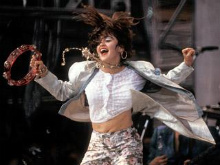
Other side of the pond: guitar gods Wood, Dylan and Richards rock out (left); Black Sabbath’s Ozzy Osbourne cools off (centre); and a fully-clothed Madonna gets into the groove (right)
In the end, unbeknown to Geldof (he was rather happy when he found out about it), Jagger and Bowie made up for the ruled-out on-the-day duet by recording a duet cover of Martha And The Vandellas’ Dancing In The Street, the proceeds from which would go to Live Aid. When released shortly after the event, it reached Number 1 in the UK charts (staying there for four weeks) and Number 7 in the US. Jagger and Bowie did perform at Live Aid, though, but separately; the former with others in Philadelphia, the latter in London.
Mind you, another outlandish and terribly gimmicky plan for the day did come off – and very well. Following completion of his set at Wembley (shared with Sting), Phil Collins was helicoptered by Noel Edmonds – yes, you read that right, Noel Edmonds – to Heathrow Airport, and flown on Concorde to Philadelphia where he performed another set at the JFK Stadium, all of nine hours after his UK one had finished. Not just that – like he did on the Band Aid single – he also played drums for others, namely for Eric Clapton and the Led Zeppelin reunion in Philadelphia. All didn’t quite go swimmingly, however. When interviewed on Concorde by the Beeb’s presenter at Wembley, the feedback was so awful Collins’ responses could barely be heard, while the baldy baladeer also scuffed an opening piano note of Against All Odds (Take A Look At Me Now) in his first set. Not that he was the only one, though. Later on, Simon Le Bon delivered an utterly unintended falsetto note at the JFK Stadium, while his band Duran Duran performed the very recently released hit A View To A Kill, the theme song from the Bond film of the same name. Media outlets were to enjoy themselves later by rather cruely referring to Le Bon’s slip as ‘the bum note heard around the world’.
In fact, cock-ups, perhaps unsurprisingly, ended up being the order of the day. While thankfully there weren’t any major problems with Wembley’s revolving stage, a fan at the front of the crowd was almost crushed to death during U2’s set. Critics for years lambasted frontman Bono’s seemingly self-indulgent behaviour when he went on a ‘walkabout’, not realising until recently the reason why he jumped down from the stage and pulled the girl out of the throng wasn’t actually because he wanted to be seen dancing with her. He had gestured to ushers to help her, but they hadn’t understood what he was meaning. And, yes, this all took place while he was crooning – just goes to show then, Bono really does want to save the world; he’ll even try and do it one person at a time. While he’s singing.
Also, during The Who’s performance of Won’t Get Fooled Again, with quite brilliant timing, the Beeb’s TV feed momentarily went down immediately following the word ‘fade’ as Roger Daltrey sang the line ‘Why don’t you all fade… away’. Less amusingly, though, as the Wembley leg approached its climax, Paul McCartney’s much anticipated set was jeopardised by yet more technical gremlins as the first two minutes of his performance of Let It Be ended up wordless because his mircophone wasn’t on. He later joked he’d contemplated changing lyrics in the song to ‘There will be some feedback, let it be’.
However, for the most part, of course, both concerts confounded the critics, as they proved to be huge successes. Far from looking upon their participation as possibly ruining their careers, as Bill Graham had ‘warned’ some it might, most of the artists saw the concerts as as a great opportunity to boost their careers, realising the potential global audience that would be watching on TVs all over the planet. And thus, they all went for it with gusto. Rather bizarrely, even back then, the Wembley gig was opened by ageing rockers Staus Quo. Yet, their opening song choice proved to be genius – Rocking All Over The World went down a storm with the crowd, who on a hot day were all cooped up in the stadium and excited beyond belief for what might come. More contemporary acts such as The Style Council, Dire Straits, Bryan Adams, Power Station, Run-DMC and Duran Duran (as mentioned) were no mugs either, using the event to showcase recent and/ or new tunes; while, in no need of any publicity herself, Madonna, one of the biggest draws of the JFK Stadium event, referred directly to her own publicity when, insinuating her recent disrobing for both Playboy and Penthouse magazines and making a nod to the day’s stifling heat, she memorably exclaimed: “I’m not taking s*** off today!”.
And, although Bono’s off-stage antics ensured they had to strike third song Pride (In The Name Of Love) from their set, U2 nonetheless lodged themselves firmly in music fans’ minds thanks to their Live Aid performance – one that was full of their frontman’s customary charisma. So much so, their apearance really helped push them down the road to rock superstardom, which, naturally, would be theirs come the end of the decade. Plus, in spite of the technical hitches, the ‘reunion’ sets of The Who, Led Zep and Crosby, Stills & Nash (and Young) proved quality highlights, while the two performances of Phil Collins, as well as those of the ever popular Elton John, Eric Clapton, Bob Dylan (with Keith Richards and Ronnie Wood) and – albeit separate – Bowie and Jagger were durable and dependable performances. Even Band Aid co-organiser Midge Ure got in on the act with Ultavox and Geldof himself with The Boomtown Rats (as if anyone was actually going to stop him, mind). In fact, another the of day’s most memorable moments came when, towards the end of the song I Don’t Like Mondays, Bob stopped dead after the line ‘And the lesson today is how to die’. The double meaning he intended this line to take on by pausing in this way, given the day’s cause, wasn’t lost on the Wembley crowd as they applauded the thought – and probably Geldof’s organisation of the whole thing – before singing out the rest of the song themselves.
“F*** the address, let’s get the numbers!” ~ how an angry Bob Geldof really used the f-bomb (instead of the misquoted ‘Give us your f***ing money!’) live on British teatime TV, when his interviewer suggested repeating the address money could be sent to, instead of repeating the phone numbers that could more immediately and reliably bring in donations
In spite of all this, though, such huge musical events as these always seem to boast star turns (take Hendrix at Woodstock), and Live Aid in ’85 was no exception. There was a band that wasn’t for a second overawed by the magnitude of the day and, thus, did more than turn out a professional, entertaining performance; quite simply, they took the thing by the scruff of the neck and rocked Wembley’s socks off. And, at the time at least, it was somewhat surprising that that band was Queen. It seems rather bizarre now, but Queen’s popularity had waned a little by the mid-’80s; not only had their following in the States subsided from its ’70s high, but they were also reeling from the controversy their performing in the apartheid-locked South Africa the previous year had created. Yet, you can’t keep a good band down – not least the most grandiose and theatrical of the greats – and Queen grabbed Live Aid by the jugular. It was an event made for them, and they were made for it.
Right from the off, as they were introduced in a wonderfully random manner by comedians Smith and Jones dressed up as policemen ‘complaining’ about the noise, they were greeted by a roar. Lead singer Freddie Mercury led his band bounding on to the stage and, sitting at the piano, quickly launched into the all-time classic Bohemian Rhapsody. This was followed up by the ebullient Radio Ga Ga, and it was during this tune that it happened – Mercury the frontman with the charisma of a thousand Robert Plants captured the stadium’s capacity crowd of 72,000 people, every last one of them, and didn’t let go. The moment you realise – and he realises – he’s got them in the palm of his hand is when every single person appears too be hand-clapping in unison during the first chorus; just watch this blog’s second youtube clip – I defy the hairs on the back of your neck not to stand on end. It’s electric stuff, truly. After all, the majority of the crowd weren’t necessarily Queen fans; they were there for the event itself and all the acts combined.
Following Radio Ga Ga, Mercury indulged himself by getting the crowd to repeat his vocal training pastiche – something he would always do at Queen concerts – but they were with him all the way. As they were through the rest of the set: Hammer To Fall, Crazy Little Thing Called Love, We Will Rock You and We Are The Champions – the lines of the last two, the crowd seemed to sing word for word. To say this set was a bravura perormance doesn’t do it justice. In a 2005 poll conducted by British television’s Channel 4, Queen’s Live Aid appearance was voted the greatest ever live gig – and surely rightfully so.
However, Live Aid really really did turn out to be such an extraordinary event that, one could argue, these few minutes of magic were topped by something even more powerful and moving. It came immediately after David Bowie’s set (which followed Queen’s); in fact, he introduced it – and one might say it’s to blame for all the oh-so obvious guilt-inducing musical montages that every telly charity-a-thon worth its salt is chockful of nowadays. Edited together by Canadian Broadcasting Corporation engineer Colin Dean, it was a video film that showed images of starving, diseased and – perhaps even – dying people as a result of the Ethiopean famine, the vast majority of them children. And over the top of it was played The Cars’ hit song Drive.
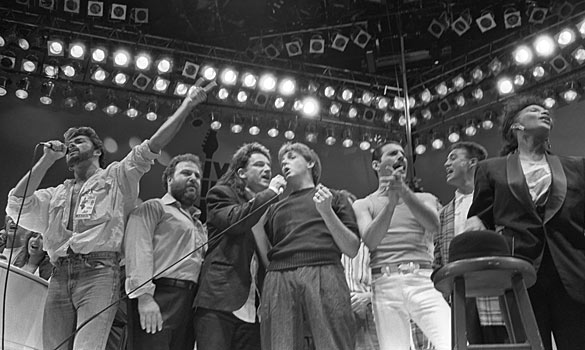
It’s only rock ‘n’ roll, but they like it: (from left) George Michael, Harvey Goldsmith, Bono, Paul McCartney and Freddie Mercury enjoy themselves during the Wembley gig’s big finish
Dean has since explained that he had been listening to the song and, only semi-seriously, wondered whether it may fit the video he had to cut together, yet soon he found himself mirroring images to lines in the song. The way the video was constructed then, and thus the way it sought to manipulate the emotions was about as subtle as Spielberg had done in making E.T., but the effect was devastating. As it was broadcast – and simultaneously played on the stadium’s big screens – the bouyant, bouncing festival atmosphere in Wembley was cut to pieces; it was a sudden, unequivocal reminder to the revellers what the day was really all about, just as it proved to be for all those watching at home . Apparently, the rate at which punters phoned in to give money increased dramatically in the minutes afterwards. So, this video (which actually owed its place in the bill to Bowie suggesting he cut a song from his set so it could fit in the schedule) had played its part perfectly and all these years on it’s still so memorable. Honestly, I can’t think of, or hear, the wonderful Drive by The Cars without my mind immediately flooding back to those images, and I very much doubt I’m alone in that either.
In the event, it was all worth it – the video and all the acts at the Wembley and JFK Stadiums, and all the frenzied flapping that had gone on before to pull it off. Live Aid was watched, live, in 60 countries by an estimated 2 billion people. And thanks to their combined dipping into the kitty, a final figure of £150 million was raised – and, let’s not forget, that’s £150 million in 1985 money. One has to wonder how Bill Graham and the naysayers felt after that. Deservedly so, Geldof was given a honoury knighthood and – before that – was hoistered on the shoulders of Pete Townshend and Macca at the end of an inevitable rendition of Do They Know It’s Christmas? at the close of the Wembley concert.
Twenty years later in 2005, Bob and co. felt it worth another go and put on Live 8, which if anything was even bigger – unlike in ’85, there were eight concerts all over the world, in addition to the two mega-gigs in the UK and the US (although, admittedly, back in ’85 there were also token efforts held in Australia, Germany, Holland, Yugoslavia and Russia). But, given Live 8’s purpose was to raise awareness – not dosh – about general poverty in order to put pressure on politicians to eradicate African and Third World debt, the aim seemed less pointed and immediate than its predecessor. Cynicism abounded about whether it could make a difference – and, sadly, five years on, the global recession looks to have put paid to much of the work it did in forcing the West’s hand to help out Africa’s finances.
The truth, then, is that Live Aid was a real one-off. A wonderful and, for the most part, selfless event that came slap-bang halfway through one of the greediest and selfish decades the world has ever known. Looking back, there’s something terrifically ironic and pleasing about a bunch of New Romantics with all their mullets, hair lacquer and crazy long jackets coming together with their synthesizers, guitars and drum-machines and asking the world to help out a country’s population that was staring into the abyss. And it worked; for one day, the world really was united and did exactly what it should do. Queen and co. promised ‘we will rock you’ and the world responded. Sometimes when the will is there, it can be – and is – that gloriously simple… 
Live Aid set-lists (artist start-times – in BST – in brackets):
Wembley Stadium
- Coldstream Guards – Royal Salute/ God Save the Queen (12:00);
- Status Quo – Rockin’ All Over the World/ Caroline/ Don’t Waste My Time (12:02);
- The Style Council – You’re The Best Thing/Big Boss Groove/ Internationalists/ Walls Come Tumbling Down (12:19);
- The Boomtown Rats – I Don’t Like Mondays/ Drag Me Down/ Rat Trap/ For He’s A Jolly Good Fellow (sung by the audience) (12:44);
- Adam Ant – Vive Le Rock (13:00);
- Ultravox – Reap the Wild Wind/ Dancing with Tears in My Eyes/ One Small Day/ Vienna (13:16);
- Spandau Ballet – Only When You Leave/ Virgin/ True (13:47);
- Elvis Costello – All You Need Is Love (14:07);
- Nik Kershaw – Wide Boy/ Don Quixote/ The Riddle/ Wouldn’t It Be Good (14:22);
- Sade – Why Can’t We Live Together/ Your Love Is King/ Is It A Crime (14:55);
- Sting and Phil Collins (with Branford Marsalis) – Roxanne/ Driven To Tears/ Against All Odds (Take a Look at Me Now)/ Message in a Bottle/ In the Air Tonight/ Long Long Way To Go/ Every Breath You Take” (15:18);
- Howard Jones – Hide and Seek (15:50)
- Bryan Ferry (with David Gilmour on guitar) – Sensation/ Boys And Girls/ Slave To Love/ Jealous Guy (16:07);
- Paul Young – Do They Know It’s Christmas? (intro)/ Come Back And Stay/ That’s the Way Love Is (with Alison Moyet)/ Every Time You Go Away (16:38);
- U2 – Sunday Bloody Sunday/ Bad (with bits of Satellite Of Love, Ruby Tuesday, Sympathy for the Devil and Walk On The Wild Side) (17:20);
- Dire Straits – Money for Nothing (with Sting), Sultans of Swing (18:00);
- Queen (introduced by Mel Smith and Griff Rhys Jones) – Bohemian Rhapsody/Radio Ga Ga/ Hammer to Fall/ Crazy Little Thing Called Love/ We Will Rock You/ We Are the Champions (18:44);
- David Bowie – TVC 15/ Rebel Rebel/ Modern Love/ Heroes (19:22);
- The Who – My Generation/ Pinball Wizard/ Love Reign O’er Me/ Won’t Get Fooled Again (20:00);
- Elton John (introduced by Billy Connolly) – I’m Still Standing/ Bennie and the Jets/ Rocket Man/ Don’t Go Breaking My Heart (with Kiki Dee)/ Don’t Let the Sun Go Down on Me (with George Michael and backing vocals by Andrew Ridgeley)/ Can I Get a Witness (20:50);
- Finale:
~ Freddie Mercury and Brian May – Is This The World We Created? (21:48),
~ Paul McCartney – Let It Be (21:51),
~ Band Aid (led by Bob Geldof) – Do They Know It’s Christmas? (21:54)
JFK Stadium
- Bernard Watson – All I Really Want to Do/ Interview (13:51);
- Joan Baez (introduced by Jack Nicholson) – Amazing Grace/ We Are the World (14:02);
- The Hooters – And We Danced/ All You Zombies (14:12);
- The Four Tops – Shake Me, Wake Me (When It’s Over)/ Bernadette/ It’s The Same Old Song/ Reach Out I’ll Be There/ I Can’t Help Myself (Sugar Pie, Honey Bunch) (14:33);
- Billy Ocean – Caribbean Queen/ Loverboy (14:45);
- Black Sabbath (introduced by Chevy Chase) – Children of the Grave/ Iron Man/ Paranoid (14:52);
- Run-DMC – Jam Master Jay/ King Of Rock (15:12);
- Rick Springfield – Love Somebody/ State Of The Heart/ Human Touch (15:30);
- REO Speedwagon – Can’t Fight This Feeling/ Roll With The Changes (15:47);
- Crosby, Stills and Nash – Southern Cross/ Teach Your Children/ Suite: Judy Blue Eyes (16:15);
- Judas Priest – Living After Midnight/ The Green Manalishi (With The Two-Pronged Crown)/ You’ve Got Another Thing Comin’ (16:26);
- Bryan Adams (introduced by Jack Nicholson) – Kids Wanna Rock/ Summer of ’69/ Tears Are Not Enough/ Cuts Like a Knife (17:02);
- The Beach Boys (introduced by Marilyn McCoo from The 5th Dimension) – California Girls/ Help Me, Rhonda/ Wouldn’t It Be Nice/ Good Vibrations/ Surfin’ USA (17:40);
- George Thorogood and the Destroyers – Who Do You Love (with Bo Diddley)/ The Sky Is Crying/ Madison Blues (with Albert Collins) (18:26);
- Simple Minds – Ghost Dancing/ Don’t You (Forget About Me)/ Promised You a Miracle (19:07);
- The Pretenders – Time The Avenger/ Message of Love/ Stop Your Sobbing/ Back On The Chain Gang/ Middle of the Road (19:41);
- Santana and Pat Metheny – Brotherhood/ Primera Invasion/ Open Invitation/ By The Pool/ Right Now (20:21);
- Ashford & Simpson – Solid/ Reach Out and Touch (Somebody’s Hand) (with Teddy Pendergrass) (20:57);
- Madonna (introduced by Bette Midler) – Holiday/ Into the Groove/ Love Makes The World Go Round (21:27);
- Tom Petty And The Heartbreakers (introduced by Don Johnson) – American Girl/ The Waiting/ Rebels/ Refugee (22:14);
- Kenny Loggins – Footloose (22:30);
- The Cars – You Might Think/ Drive/ Just What I Needed/ Heartbeat City (22:49);
- Neil Young – Sugar Mountain/ The Needle And The Damage Done/ Helpless/ Nothing Is Perfect/ Powderfinger (23:07);
- Power Station – Murderess/ Get It On (23:43);
- Thompson Twins – Hold Me Now/ Revolution (with Madonna, Steve Stevens and Nile Rodgers) (00:21);
- Eric Clapton (with Phil Collins) – White Room/ She’s Waiting/ Layla (00:39);
- Phil Collins – Against All Odds (Take a Look at Me Now)/ In the Air Tonight (01:04);
- Led Zeppelin Reunion – (with Jimmy Page, Robert Plant, John Paul Jones, Tony Thompson, Paul Martinez and Phil Collins) – Rock and Roll/ Whole Lotta Love/ Stairway to Heaven (01:10);
- Crosby, Stills, Nash & Young – Only Love Can Break Your Heart/ Daylight Again/ Find the Cost of Freedom (01:40);
- Duran Duran – A View to a Kill/ Union Of The Snake/ Save a Prayer/ The Reflex (01:45);
- Patti LaBelle – New Attitude/ Imagine/ Forever Young/ Stir It Up/ Over The Rainbow/ Why Can’t I Get It Over (02:20);
- Hall & Oates – Out of Touch/ Maneater/ Get Ready (with Eddie Kendricks of The Four Tops)/ Ain’t Too Proud to Beg (with David Ruffin of The Four Tops)/ The Way You Do the Things You Do/ My Girl (with Eddie Kendricks and David Ruffin) (02:50);
- Mick Jagger (with Hall & Oates, Eddie Kendricks and David Ruffin) – Lonely At The Top/ Just Another Night/ Miss You/ State of Shock/ It’s Only Rock ‘n Roll (But I Like It) (with Tina Turner) (03:15);
- Finale:
~ Bob Dylan, Keith Richards and Ronnie Wood – Ballad of Hollis Brown/ When the Ship Comes In/ Blowin’ in the Wind (03:39),
~ USA for Africa (led by Lionel Richie) – We Are the World (3:55)
~~~
Further reading:
Pan’s People: Dancing Queens

.
Talent…
.
… These are the lovely ladies and gorgeous girls of eras gone by whose beauty, ability, electricity and all-round x-appeal deserve celebration and – ahem – salivation here at George’s Journal…
.
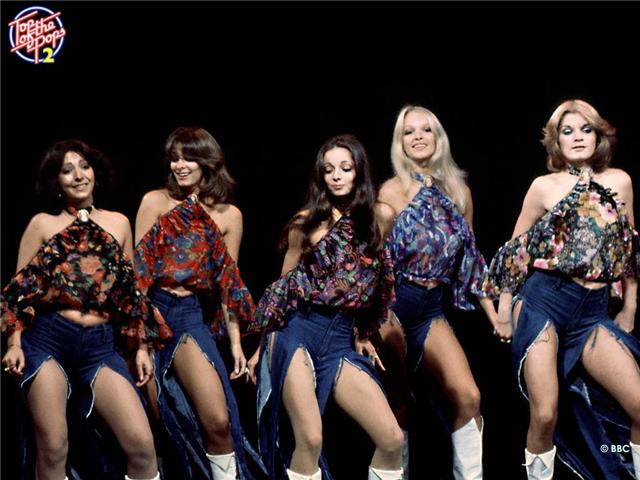
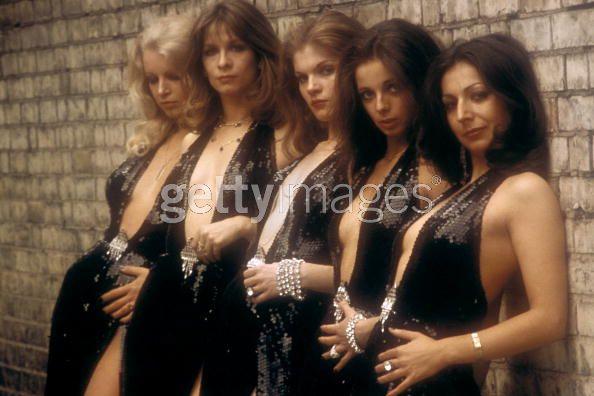
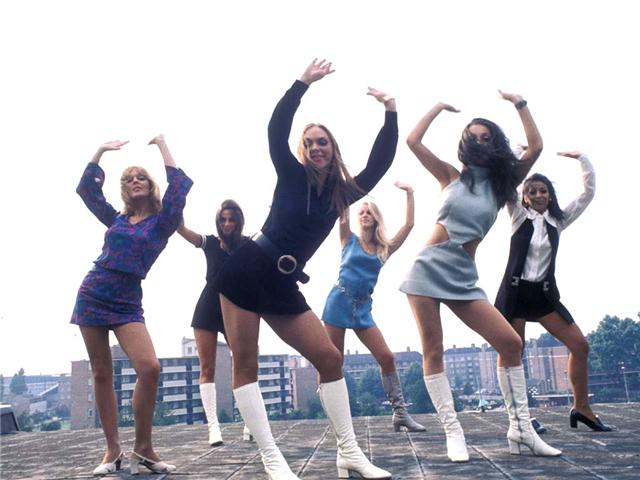
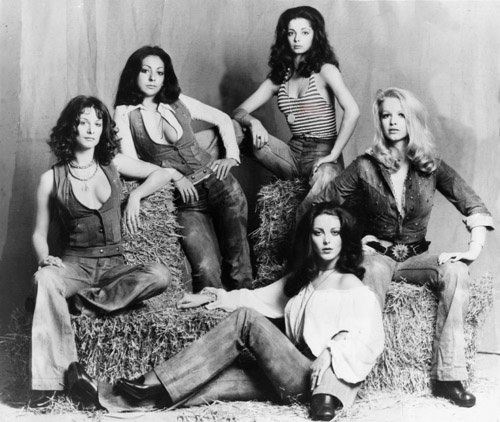
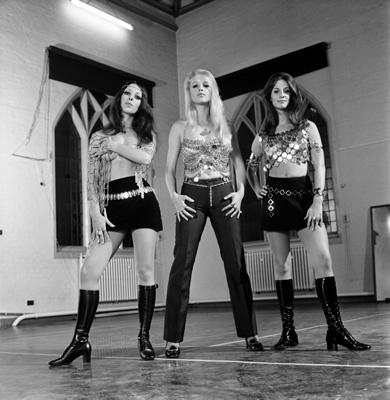
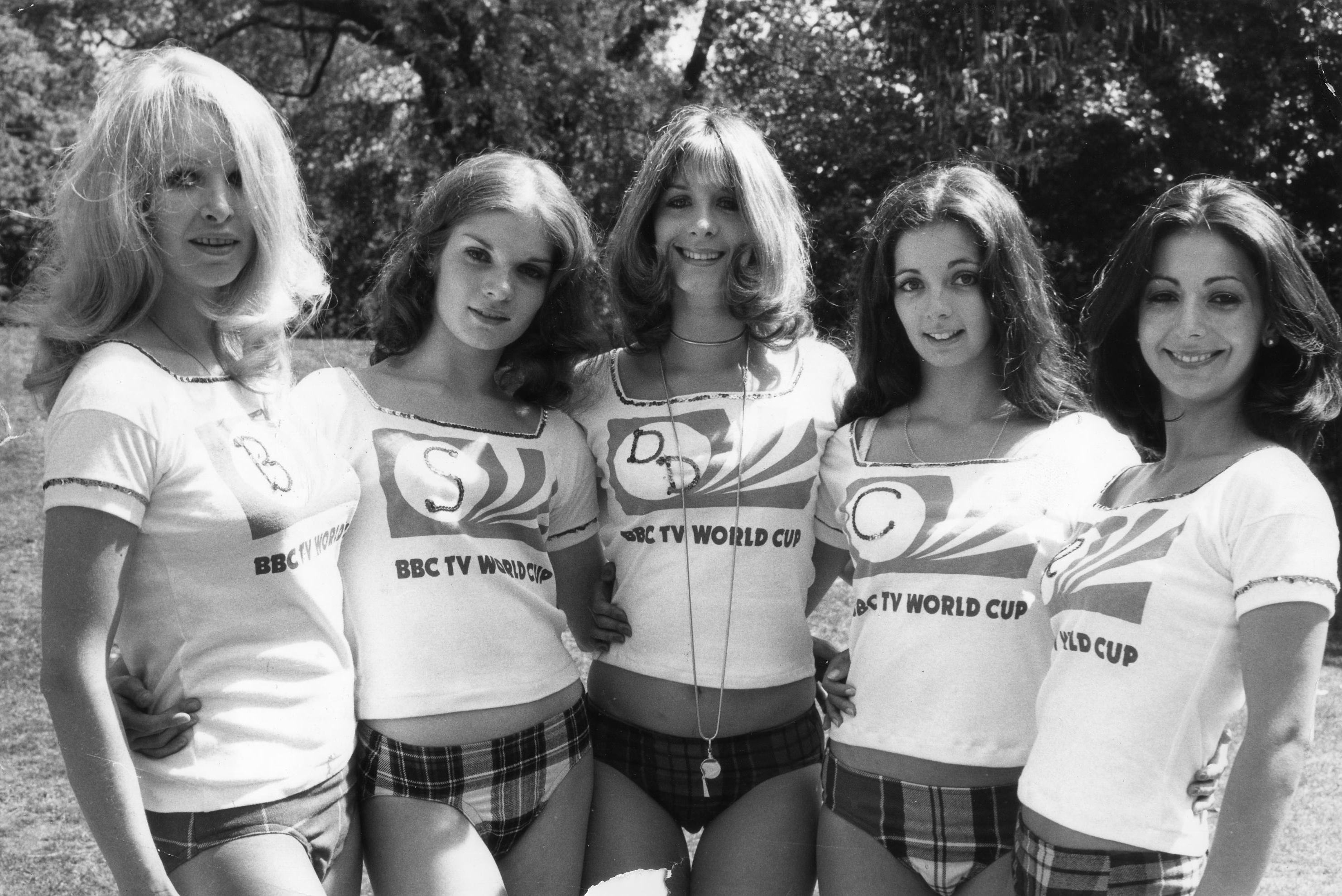
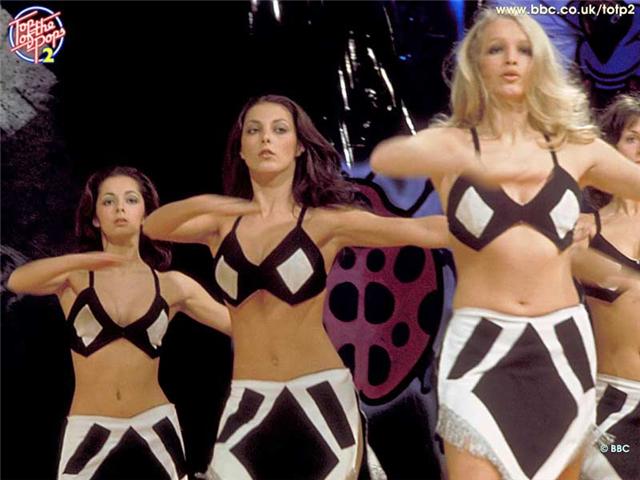
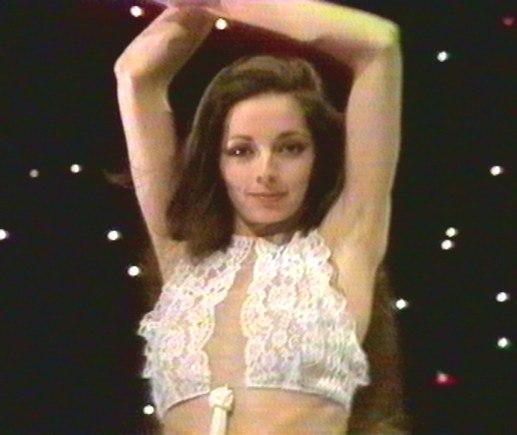
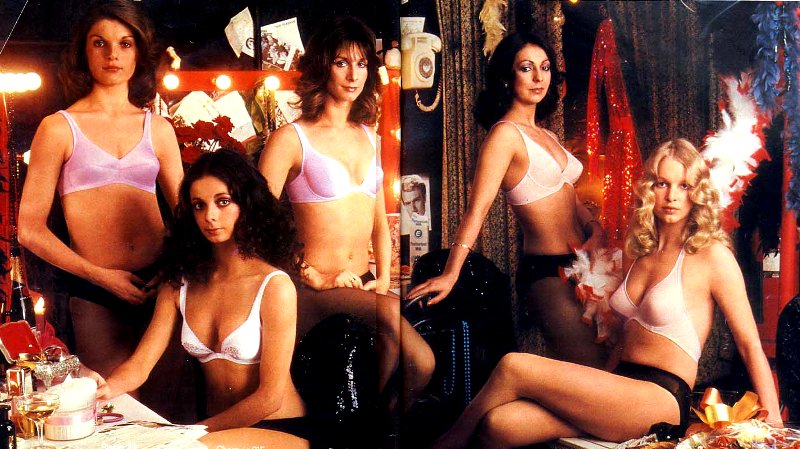
Always Dad’s favourite and often the highlight of Top Of The Pops, they were the madams with the moves, the coquettes in the costumes and the bods for the mod times – they were fun, frolicsome, a bit fancy, but always family-friendly; they were Pan’s People and they were most definitely Talent, five or six doses of it all in one go…
.
Profile
Name: Pan’s People
Members: Louise Clarke (1968-74), Felicity ‘Flick’ Colby (1968-71 dancer/ 1971-76* choreographer); Barbara ‘Babs’ Lord (1968-75); Ruth Pearson (1968-76); Andrea ‘Andi’ Rutherford (1968-72); Patricia ‘Dee Dee’ Wilde (1968-75); Mary Corpe (1975-76*); Cherry Gillespie (1972-76*); Susan ‘Sue’ Menhenick (1974-76*); Lee Ward (1975-76*)
Nationality: British
Profession: Dance troupe
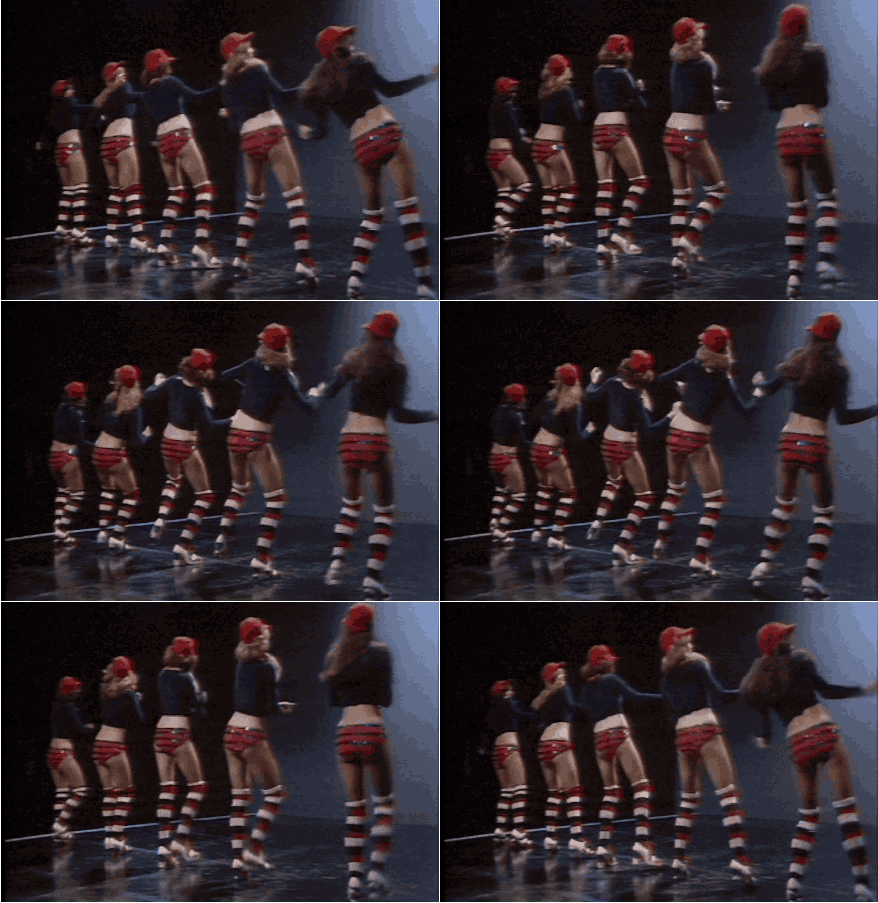
Known for: Performing light-hearted and cheeky dance routines on the BBC’s weekly chart music show Top Of The Pops during the early- to mid-1970s, when live performances of particular songs or video films for them weren’t available; as well as public appearances throughout the decade and performances on the BBC’s 1974 In Concert TV series and, occasionally, The Two Ronnies sketch show.
Strange but true: Pan’s Person Babs Lord went on to marry actor Robert Powell and became an amateur yachtswoman and explorer – travelling to the Himalayas, the Sahara and the Guyanan jungle, and is the oldest housewife to have visited both the North and South Poles. Also, Cherry Gillespie went into acting and appeared in the James Bond film Octopussy and episodes of Bergerac and Minder.
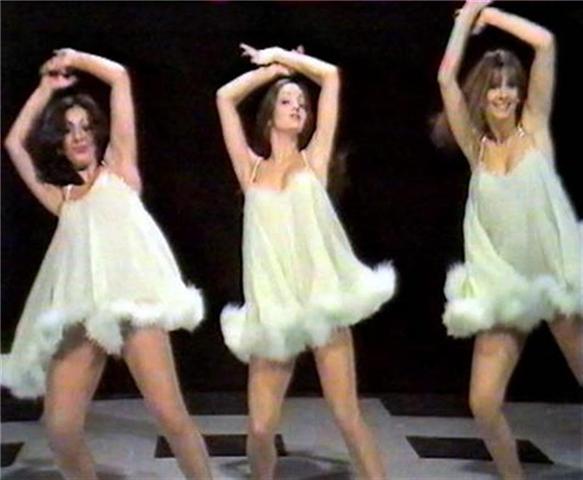
Peak of fitness: Dancing along to Van McCoy And The Soul City Symphony’s The Hustle on Top Of The Pops, while all wearing terribly short white, frilly, feathery dresses
* Pan’s People continued as a group of dancers beyond 1976, but their final Top Of The Pops performance was broadcast in April 1976
.
CLICK on images for full-size
.

.

.

.
.
.

.
.

.
.
.
.

.
.

.
.
.
.

.
.

.
.
.

.
Hope opera: World Cup 1990 – West Germany v England
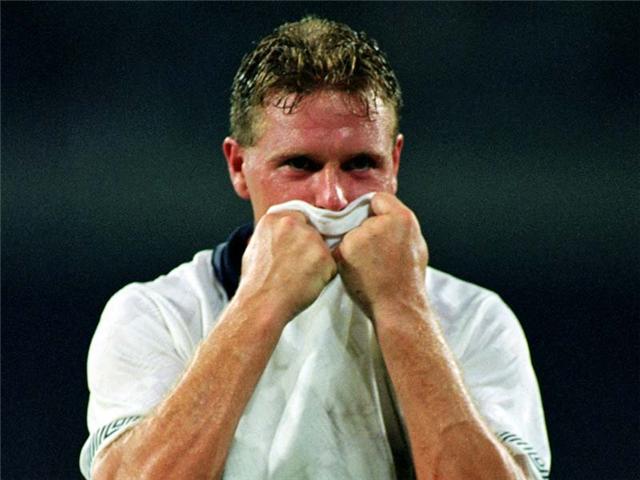
Tears of a clown: starved of success for so long, England fans didn’t know what to expect this World Cup – what they got was Gazza, a boy wonder and first superstar of a new football age
So, as the curtain has fallen on the 19th global football extravaganza in South Africa, here it is then… George’s Journal’s own final World Cup special. And its focus is – and, let’s be honest, could only be – the world’s 14th soccer spectacular, which took place in Italy in 1990. Yes, Italia ’90. A particularly memorable World Cup for footy followers of not Spain or Holland, but Argentina, Italy, (West) Germany, Cameroon and, yes, England.
And, you know, England in 1990 was rather the bright, colourful, happy place. Or, at least, it was recalling it through the eyes of a ten year-old, as I was that year. But with Teenage Mutant Hero/ Ninja Turtles on sale in every toy shop in the land, Bart Simpson ‘doing the Bartman’, Kylie and Jason singing especially for us all and seemingly every moment of the day being ‘Hammer Time’, how could it not have been a good year?
Well, from a wider, more grown-up perspective, it actually wasn’t that bad a twelve months. Following the life-affirming moment the previous October when the Berlin Wall was broken down and friends and family from either side were reunited and strangers became compatriots in all but name, East and West Germany took momentous steps to reunify their country – finally doing so in the autumn. And this development looked like it might genuinely prove the rod to break the camel’s back, or at least the Soviet Union’s (and, with hindsight, of course, we know it was). Plus, lest we forget, in April of this year, Nelson Mandela, the man who had been incarcerated in Robben Island off the coast of South Africa’s Cape Town for 24 years, finally walked out of jail a free man – and into the world’s consciousness for all time. Even Thatcher was finally given her marching orders at the end of the year – all right, yes, she was replaced by John Major, but still.
Yes, the ’80s were over and now a hopeful, fresh, new decade free of Thatcherism, Communism and apartheid seemed to yawn ahead of us – the oh-so modern-sounding 1990s. Yet, at the same time, all was not entirely happy within the UK. Thatcher’s parting shot before she left, the hideously unfair Poll Tax, threatened to poleaxe Middle England as well as the most financially vulnerable – and it resulted in a violent protest in London’s Trafalgar Square. Moreover, those in the know could see a recession looming that would come to the fore over the next two years, which would be partly generated by the 1987 stock market crash and partly by the growing tensions in the Middle Eastern Gulf thanks to Saddam Hussein’s Iraq invading the free state of Kuwait late in 1990. That incident itself would also lead to a war in which Britain would become unavoidably drawn. Even the youthful, drug-fuelled abandon of the rave scene, which had been kicked into the mainstream the previous summer, seemed much more cynical and aggressive than its supposedly comparable hippy movement of around 20 years earlier, as it was more a decadent avoidance of – rather than a naive answer to – the darkness of modern times.
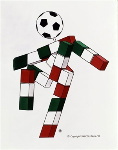
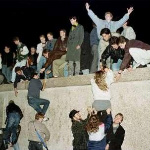
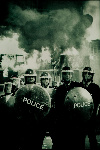
Hello, goodbye: Italia ’90’s logo (left) and mascot, Ciao (centre left); the Berlin Wall is felled (centre right); and the Poll Tax riot rages in Traflagar Square as Thatcher finally goes (right)
And, if all that wasn’t enough, football itself was looking universally gloomy on these shores. After a dreadful showing in the European Championships of 1988 (England lost all three group games), negating an inspiring, decent turn in the ’86 World Cup, there wasn’t exactly universal belief in the national team. Indeed, Bobby Robson – still the manager – was receiving the sort of verbal volleys from the tabloid press usually reserved for a deeply unpopular PM at the helm of a useless government (he was only the England manager after all, not Gordon Brown). In fact, the English public didn’t have much belief in its national sport in general either. The bane of the sport in the late-’70s and throughout the ’80s, hooliganism, was far from eradicated, and it ensured what was once a father-and-son sport was now very much the preserve of the adult male. Kids, let alone women, hardly seemed welcome on the terraces in what too often were heated and far from savoury environments. Throw in the hooligan-driven disaster at the Heysel Stadium in ’85 and the completely non-hooligan-related tragedy at Hillsborough Stadium in Sheffield the previous year, and football was genuinely becoming something of a tarnished past-time in the national psyche.
This then was the picture when in June the England squad touched down on the Italian island of Sardinia to begin their group games, along with their fans – seemingly segregated from those of other nations who were happily ensconsed in mainland Italy (yet, given our hooligan problem, you could hardly blame the tournament organisers making that decision really). And, as if to underline English football’s woe at this time, Robson’s men hardly made a brilliant start to the tournament – in fact, in a word, they were crap.
They kicked off proceedings against the Republic of Ireland, who had qualified for their first ever World Cup and, managed as they were, by English 1966 Cup winner Jack Charlton, featured a fair number of men in their ranks who were representing the Emerald Isle owing to ancestry rather than actually being born Irish, given they hailed from the likes of Liverpool, Yorkshire and London. Therefore, the players on both sides were greatly familiar to each other, as, even the genuine Irish among them, played week-in, week-out in the English First Division. As such, the game proved something of a derby grudge match and the quality practically non-existent. England took the lead as early as the eighth minute, however, when their hero of the previous World Cup, midas-touched marksman Gary Lineker, bungled in a goal, but after 72 minutes Kevin Sheedy equalised for the Irish and the game finished all-square.
Next up for the men in white were the heroes in orange – and Holland’s team were indeed heroes. Packing Ruud Gullit, Marco Van Basten and Frank Rijkaard, the Dutch were formidable foes, having demolished England just two years before on the way to winning the European Championships that year. Well, formidable foes they were in prospect, at least. For the game that ensued ended in a greatly disappointing 0-0 stalemate and, surprisingly, England dominated most of the play. Still the draw wasn’t much use to either side, given Holland had also drawn their opening match – against Egypt – 1-1. And it was against Egypt then that England played their final group game. To say everything was riding on it would not be an exaggeration; the group, unlike others in this – and many – World Cups was incredibly tight, ludicrously so, in fact, thanks to so many draws and so few goals.
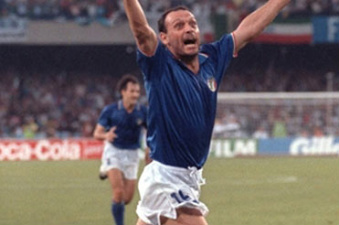
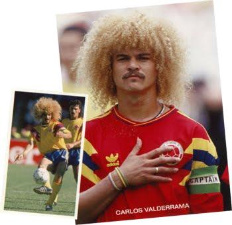
The hero and the hairdo: Italy’s Toto Schillaci had good days in front of goal (left); Colombia’s Carlos Valderrama clearly had a bad day at the barber’s – but could play a bit, mind (right)
Yet, in keeping with their depressing performances so far, England scored an unremarkable goal from a set-piece – a header from defender Mark Wright – and held on to the 1-0 lead. And this ensured that, in spite of their poor form, they had some how conspired to top the table – and as group winners they would have the presumably ‘easier’ draw in the second round. Ireland and Holland followed them through; the Irish in second place and Holland in a disappointing third (but with one of the best records for a team finishing in that place in a group, thus their qualification), but only after both teams had drawn lots for their places, given they had exactly the same records. This was the first and – so far – only time lots have had to be drawn to decide group finishes in World Cup history.
Still, if the English and Dutch hadn’t instilled hope in their respective nations with their group form, it was a different story for the hosts. As ever, the Italian team looked classy, made up as it was with players from the likes of AC Milan, Juventus and Inter, such as defender and captain Giuseppe Bergomi, centre-back Franco Baresi, forward Roberto Baggio, midfielder Roberto Donadoni, striker Gianluca Vialli and young left-back Paulo Maldini. And the Azzurri were impressive from the off too, securing three victories out of three in their group (unusual tournament form even for a good Italian side), as they defeated Austria, Czechoslvakia and the United States and reached the next stage with ease. More unusual was the fact that two of Italy’s four goals came from a player only once before capped, diminutive but exciting striker Salvatore ‘Toto’ Schillaci.
Indeed, it would be fair to say too that the style, grace and blue cool the hosts displayed on the pitch was reflected by their staging of this tournament. This was a very Italian World Cup, make no mistake. All the stadia seemed to be grand, almost Classical theatres in which the events unfolded before spectators and TV viewers’ eyes – somehow it felt like there was something of the Colisseum about every one of them. Opera seemed to be everywhere too, not least if you tuned into the BBC’s coverage, thanks to their use of Luciano Pavarotti’s unmistakable rendition of Nessun Dorma from Puccini’s Turandot over their broadcasts’ opening titles. Quite frankly, this piece of fine music became so imprinted on the mind during the contest that it effectively became the thing’s unofficial theme tune – surely playing a decisive, early role then in the popularisation of opera and classical music during the decade to come. And it quickly became apparent that – on television, at least – opera and football were far from strange, but perfect bedfellows; the melodramatic, broad-brushstroke action and passion to be seen in the TV visuals a terrific fit with the music of past masters. Even the event’s opening ceremony was too cool for school (bringing Milan catwalk fashion to a football pitch at one stage, as it did), while the home Italian broadcaster’s gracefully moving screen graphics were far more stylish than anything the Beeb or ITV had come up with for mere footy.
Unfortunately, though, there was something else about Italia ’90 that could also be said to be rather Italian, at least in a football sense. This was a World Cup, more than any that had gone before, where defensive tactics seemed to outstrip attacking ones. And that meant that, for all the spectacular and impressive settings and soundtracks, sadly there weren’t a hell of a lot of goals.
For instance, out of the tournament’s six opening groups all the big names went through, but with little pomp. This was perhaps most characterised by Brazil – not looking their most imaginative team ever – who claimed three wins out of three, but with mere 2-1, 1-0 and 1-0 victories. Joining them in the second round from their group, though, was something of a surprise package in the shape of debutants Costa Rica, who got through at the expense of yet another disappointing Scotland team. Mind you, one side that bucked the low-scoring trend was, perhaps surprisingly, West Germany. Decked out in shirts that featured a natty tri-colour horizontal stripe across the breast and featuring stars such as über-midfielder and captain Lothar Matthäus and forwards Jürgen Klinsmann and Rudi Völler, they lived up to their pre-tournament favourites tag by defeating Yugoslavia 4-1 and the United Arab Emirates 5-1. All the same, though, it’s probably fair to say that all the real early drama occurred in title-holders Argentina’s group.
Yes, the campiones in pale blue and white stripes struggled from the beginning. Their – and the entire competition’s – opening match was against total minnows Cameroon, and they lost it, 1-0. Just as the world had been stunned by captain Diego Maradona’s ‘hand of God’ antics in the tournament four years before, yet another match in which he was involved sent shockwaves around the globe. Fair enough, this didn’t look to be a great Argentina side by any stretch of the imagination, but for an African team to beat it in the curtain raiser of football’s greatest show was a sensation. True it was too that the Cameroonians hardly outplayed their opposition, deploying the tactics of bandits rather than cavaliers – at one stage Argentine forward Claudio Caniggia was fouled three times in one run; riding the first two challenges honestly, the third one was so bad his boot came off. Unsurprisingly, Cameroon had two men sent off (one of them the brother of goalscorer Francois Omam Biyik), but held on to claim the win. And they didn’t stop there. The team in the traffic light-like green, red and yellow strip beat Romania 2-1 in their next match, with a brace from 38-year-old veteran striker Roger Milla, before slumping to a 4-0 defeat to the Soviet Union. Still, their two victories were enough to see them top the group – undoubtedly one of the highlights of the compeition thus far. And what of Argentina? Well, wouldn’t you know it, they managed to scramble together a win and a draw and thus reached the second round as one of the first’s third-placed teams with the best records. Jammy so-and-so’s.
There was little jammy about the Argentines’ victory over Brazil in the all-South American Last Sixteen fixture, though, or was there? The winning goal came the former’s way from Caniggia thanks to a Maradona run just ten minutes from time. However, the Albicelestes‘s former captain has since claimed that when, during the match, Brazilian player Branco was sportingly offered water by a member of the Argentine team staff, the water contained a tranquiliser. Not very sporting after all then. Elsewehere in the second round, Schillaci scored again as Italy beat Uruguay 2-0; Yugoslavia advanced past the, as usual, underperforming Spain; Costa Rica were Czech-mated to the tune of 4-2; and, deep into extra-time, Cameroon did the business again by beating Colombia.
It was all thanks to the miraculous Milla weaving his magic once more as, coming on as a substitute after normal-time had been completed, he scored two goals in three minutes. Indeed, the second came from a catastrophic mistake committed by the Colombian keeper – the infamous mistachioed and perm-haired Rene Higuita – as he brought the ball out of the penalty area at his feet only to be disposessed by the cool forward who then slotted home. Colombia reduced their arrears to 2-1 before the end, but it wasn’t enough, Cameroon won and thus became the first African nation ever to make it through to the quarter finals of a World Cup. And terrific stuff it was too.
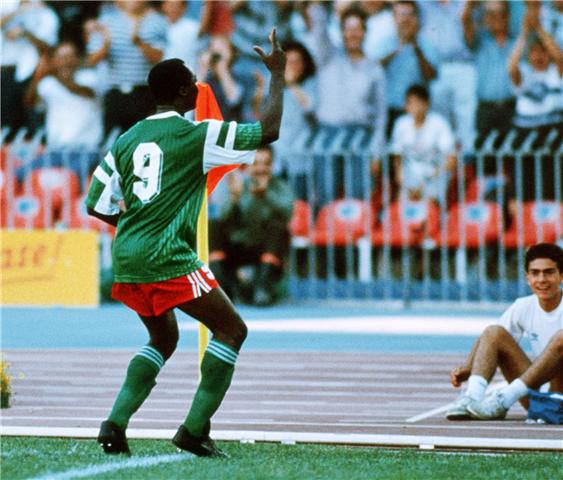
Doing the jig: The groovy goal celebration of Cameroon’s extraordinary Roger Milla
Less terrific, though, unfortunately, was this round’s meeting between West Germany and Holland. Two nations between whom there’s traditionally little love lost, of course, they last met in this compettion way back in the ’74 final when Cruyff’s quality Dutch were surprisingly beaten to the title by Beckenbauer’s efficient Germans. This time around then, the Dutch once more had a quality footballing side, the Germans were once more efficient and, indeed, Franz Beckenbauer was once more leading them – this time as manager, however. But there the similarities ended, because if you’re not aware of this match and thought Sunday’s latest World Cup final was bad-tempered, well, you really ain’t seen nothing yet.
The game was feisty from the start, with unnecessarily strong tackles going in all over the shop, but the real farago began when Rijkaard fouled Völler and a free-kick was awarded the Germans around the midway point of the first-half. The former player followed this up, bizarrely, by spitting in the latter’s hair; Völler made a big show of complaining about it to the referee and, for his troubles, got booked along with Rijkaard. Then, as the free-kick was taken, Völler dived theatrically in the hope of winning a penalty; it wasn’t given, but an unimpressed Rijkaard proceeded to twist the German’s ear and stamp on his ankle and, perhaps understandably, Völler squared up to him. The referee was having no more and gave them each another yellow card – they were both sent off. However, that wasn’t the end of it. As they walked off, the German slightly ahead of the Dutchman, Rijkaard demonstrated what he thought of Völler once more – by spitting in his hair again. Having suffered this indignity a second time (and it was an indignity too, as the home broadcaster needlessly showed a slowed-down replay of the unsavoury moment, saliva in Völler’s horrible blond perm and everything), Völler looked appealingly to the ref, but to no avail given he’d already been dismissed from the pitch.
The Germans reacted far better following this incident and actually started to play football. Then, in the 51st minute, Völler’s partner in attack, Klinsmann (who, now playing up front on his own and improving by the second, pulling the Dutch defenders here, there and everywhere), completed a fine move with a terrific striker’s finish to put his team 1-0 up. Then, eight minutes from time, defender Andreas ‘Andy’ Brehme curled in a superb shot from distance, sealing the win for Germany. And with that, the great Dutch class of ’88 went crashing out – and the Germans rumbled on.
Holland’s fellow group qualifiers, England and Ireland, had just as eventful ties this round. Drawn against the unfancied Belgium, as their side was, optimistic England fans probably felt this one was going to be a push-over. It proved to be anything but. Containing the remnants of the more than useful side that finished fourth in Mexico ’86, Belgium made for stubborn opposition throughout. Having said that, England seemed rather devoid of ideas and invention in trying to make the break-through anyway. The game drifted into extra-time and the very real possibility of a dreaded penalty-shootout (a huge rarity in English football back then – how innocent that seems now) to decide the winners, let alone who’d progress, loomed ominously. And then, with just a minute remaining, an England free-kick was lofted to the Belgian goal’s back post, and a player swivelled, connected and scored the most exquisite volley possible. The player was David Platt, a regular with Aston Villa, who prior to the tournament had only played five times for his country, and had come into the side in the second match, replacing yet again injured captain Bryan Robson. An unlikely hero to say the least. But none of that mattered – it was a truly magical World Cup moment for England; a miraculous one too that ensured they had made it into the quarter finals by the skin of their teeth.
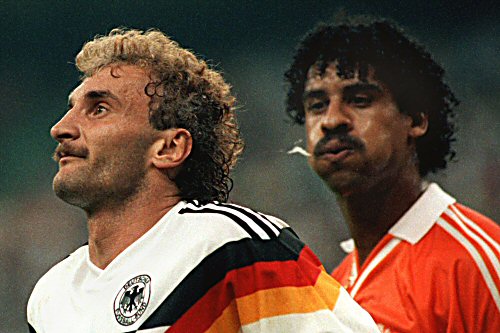
Splitting hairs?: More like spitting in his hair – Frank Rijkaard lands one on Rudi Völler’s perm
And, against odds even a Dublin bookie wouldn’t have liked, Ireland confounded all expectations by reaching the least eight as well – and they only did it on penalties. In fact, they made it look easy. Finishing their match against Romania 0-0, they managed to convert all five of their spot-kicks to Romania’s four, with centre-back David O’Leary unfeasibly putting away the winning one (he’d never taken a peanalty before in his football career). Memorably, the Irish players, substitutes on the bench and team staff sprinted towards O’Leary and buried him in one giant, triumphant pile-on. Manager Jack Charlton hung back, though, perhaps musing on the promise he’d made his players that if they managed to win the match and make the quarter finals, he’d ensure they got an audience with the Pope at Vatican City. And, yes, amazingly, ‘Big’ Jack somehow pulled some strings and, inconceivably, this event happened – the moment when John Paul II met Jack Charlton (two most incongrous individuals) really was unforgettable. What did His Holiness say as they shook hands? Yes, that’s right: “I know who you, are Mr Charlton – you’re the boss!”. It’s nice to know that in this world, with all its unsavouriness, occasionally things like that are just meant to happen.
Anyway, on to the quarters, and, for the most part, this round proved to be less memorable than its preceding one. Yugoslavia managed to match Argentina until penalties decided their contest in the latter’s favour (despite Maradona missing in the shootout); West Germany defeated Czechoslovakia thanks to penalties as well – only one this time, though, from the boot of Matthäus in the 25th minute; and Italy eventually – and rather unromantically – put an end to Ireland’s magical mystery tour thanks to a 38th minute goal from that man – again – Schillaci. Still, as they departed this World Cup, Irish eyes were definitely smiling – they’d managed to finish among the last eight, plus they’d done it without winning a match outright. And, of course, their team had met the Pope. Worth mentioning a second time that, methinks.
As for England, well, hopes were high. Yes, because unlike four years before at this stage, when they’d been drawn against eventual winners Argentina, this time they would face the johnny-come-latelies Cameroon. An entertaining side, sure, but an ill-disciplined rabble who Lineker and co. would easily stuff. Right? Wrong. As the two teams lined up in the tunnel, the England players at first looked loose and easy, but then as they turned to see the Cameroonians next to them, they noticed that, in the words since of central-defender-cum-brick-s***-house Terry Butcher, ‘they were enormous’. Their opponents were also singing a traditional song in French. England player Chris Waddle has since claimed that his manager Bobby Robson told his team not to worry as the Cameroonians were singing because they were scared of facing England, only for one of the opponent’s players to tell him politely in English that his team were singing because they always sung before matches and that they certainly weren’t scared of England.
This, perhaps, should have been a bad omen, but England started well. So much so that on 25 minutes, Platt popped up in the penalty area again and headed in a cross to put them in front. His goal against Belgium then did seem to have been the brilliant spark England had needed to get their campaign well and truly underway. By half-time, England were comfortably on top and, it’s probably fair to say, a nation glued to its TV sets was feeling a little smug. But then came and a change in the Cameroon camp – Roger Milla was substituted on. So effective in extra-time against Colombia, the (in football terms) geriatric striker’s introduction to proceedings proved devastating again. Slowly but surely, his presence caused the English defence more and more problems and, eventually, in the 61st minute his side won a penalty, which was duly despached by Emmanuel Kundé. Then, five minutes later, panic stations – Eugène Ekéké smartly scored to put them 2-1 ahead.
However, unlike their disbelieving fans, England didn’t lose their heads. They kept playing good, attacking football – due, in no small part, to the midfield of Platt, Waddle and withdrawn-striker Peter Beardsley, and, due, probably in large part, to Paul Gascoigne.
Yes, Gazza. It’s very difficult to imagine a time when the clown prince of football from up there in Geordieland wasn’t a part of the English (and wider British) consciousness, but before this tournament, he was just a useful midfielder who had come down south and played for Tottenham Hotspur. He wasn’t particularly well known at all. Like Platt, he’d made only a handful of appearances in a national shirt before this tournament, but he exploded like a bright, brilliant lightbulb of ebullience as England progressed through it. And yet, that mostly wasn’t because of his footballing prowess. It seemed more so (especially for me) because of his irresistible personality; a tubby, bubbly barrel of fun that was far more the joker in the class – his practical jokes were in evidence seemingly whenever TV sport reporters interviewed anyone in the ‘England camp’ and surely did much for the team’s morale and relaxed spirit – than a football king-in-making. He seemed a bit like the team mascot whom they let play because he was lucky for them – indeed, many misconstrued why he stuck his tongue out at the camera during the national anthem at the start of each match, assuming it was a cheeky greeting to the audience back home; it was actually a good-luck charm he’d adopted.
Yet, great players rise to the occasion (and, at his best, Gazza was assuredly great). Cometh the 83rd minute against Cameroon, cometh the man. The Africans were just seven minutes away from knocking England out, but Gascoigne had other ideas. He squeezed a pass – seemingly through the eye of a needle – to Lineker and, so good was it, that the beaten defender had no choice but to bring the striker down. England’s Number 10 did what was required of him – under untold pressure, admittedly – and blasted the penalty home. The game was drawn. Extra-time. And Gazza was involved in the build-up once more when Lineker was felled in the penalty area again in the 105th minute. The result was another spot-kick converted by Lineker – under untold pressure once more (he would later say he had been practicing ‘that penalty for years‘) – and from the jaws of disaster England had done it, they’d clinched a dramatic and rather heroic victory and, get this, they were now through to the last four. Their biggest football, nay entire sporting, achievement since 1966 itself. It was heady stuff. But Bobby Robson, who was seeming more like the country’s avuncular uncle each moment than public enemy number one, was keeping his feet on the ground, as he pleasingly pointed out something everyone knew already, that Gazza was ‘daft as a brush’. Ah, Bobby Robson, what a lovely chap he was.
Now, must admit, by this time in the tournament, and despite their knocking out the tournament’s ultimate underdogs Ireland, I’d developed a soft spot for the Italians. They were the hosts after all. When on the attack, they were playing exciting football (soon to be superstar midfielder Roberto Baggio scored a stunner in a group stage match) and Schillaci seemed to celebrate as wildly as his nation’s fans when he scored a goal. And now they were close – really close – to the World Cup final once more as they lined up for the first semi-final against Argentina. Sadly, though, the game was a let-down, there’s no of getting around it. The totemic Toto put them one up after just 17 minutes, but Caniggia equalised for the Argentines midway through the second-half. And that’s how it remained – until the end of extra-time. And wouldn’t you know it? Yes, for the second World Cup match running, the Argentines got through by penalties – the Azzurri, so attractive in their home tournament, had fallen at the penultimate hurdle; they hadn’t even made the final, Maradona’s mob had instead. As an English child who’d gone through the last four years with the ‘Hand of God’ always fresh in the memory, it seemed cruely destined somehow that ‘dirty little’ Diego would drag his team through to football’s showpiece match once again. Like the general negative style of play, that surely was one of Italia ’90’s disappointments.
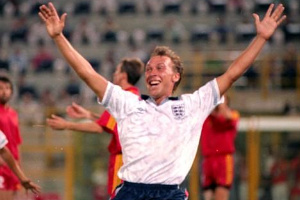

Miracle workers: David Platt heroically scores against Belgium (left) and ‘Big Jack’ gets the Irish in to meet the Pope (right)
However, of course, another, bigger disappointment was to befall me and the rest of the English nation thanks to the second semi-final. Even followers of football who weren’t even born when it took place know not just the story, but the events therein – nowadays they’re arguably better remembered than the ’66 final. And, yes, like that final, this one featured the same two protagonists. England and West Germany. And, like that final, this match was an utter belter. England maybe started just the better, but neither side created a genuine chance in the first-half. Then in the second, the breakthrough came, but unlike against Cameroon, it didn’t come England’s way. The goal was the Germans’, and it was damned fortuitous too. On the hour-mark, Brehme struck a free-kick from just outside the England penalty area and, deflecting off the backside of the unrushing and turning full-back Paul Parker, it crazily looped high up into the air and dropped between keeper Peter Shilton’s outstretched glove and the bar – and into the goal. The man who had been flummoxed by Maradona’s cheating four years before had been flummoxed by a great slice of bad luck here. And England were behind, with just half-an-hour to turn it around.
They did it though, admittedly with just ten minutes remaining. Parker, nicely atoning for his ‘mistake’ of before, hoisted a long ball from the left-wing forwards, and Gary Lineker controlled the ball beautifully, his touch managing to drag it away from the two German defenders on him and across to his left foot, with which he belted it past keeper Bodo Ilgner and into the bottom corner. 1-1. England’s striker supremo had done it again, and his celebration (arms aloft, fists in the air and head rocking back with pure relief and exultation crossing his face) said everything. And so extra-time came. The most memorable moment of which, and the entire match’s third most memorable, being when Gazza went heavily into a mis-timed tackle against midfielder Thomas Berthold and was booked – his second in the tournament after being shown a yellow card in the match against Belgium. In this World Cup, two bookings accrued in separate games – even if they were in separate rounds – ensured a player would miss the next match, meaning that Gascoigne would automatically miss the final, should England get there. And then it happened, Gazza’s waterworks; the image for which he’s most remembered, one of modern football’s most recalled images. His bottom lip trembling and the tears falling, the player was inconsolable and the TV cameras brilliantly captured Gary Lineker observing his teammate and gesturing to the bench that someone needed to ‘have a word with him’. Yes, Gazza was out of the final, but less than 20 minutes later, so were England themselves.
Before the utterly unforgettable penalty shootout, though, there were more highlights in extra-time that, owing to the match’s climax, are nowadays easily forgotten. Both the Germans and the English – namely Chris Waddle – managed to hit the post and, by now England’s lucky charm, David Platt even put the ball in the net, but his effort was ruled offside. Yet, it’s for the penalties and their result that this match – and, in fact, England’s entire campaign at Italia ’90 – has gone down in the annals of legend. The Germans took four penalties and put them all away (Brehme, Matthäus, Karl-Heinz Riedle and the terribly mistachioed Olaf Thon); the English, taking first, took five and put away three (Lineker, Beardsley and – only just – Platt). Their last two, of course, they didn’t convert. Stuart Pearce, penalty-taker for his club Nottingham Forest, inexplicably struck his into the keeper’s body, and Chris Waddle, dead-ball specialist par excellence, fired his over the bar. After Pearce’s saved effort, Waddle apparently changed his planned penalty, reverting to Plan B – ‘leathering it’. Clearly it didn’t work and, clearly, he should never have had that haircut right before such an infamous match – such a move always ends in tears in football. England, having arguably had just the better of the match, had lost it, and in a manner that, at the time, seemed the most theatrical, unfair and painful possible, but West Germany were through and Bobby Robson’s brave boys, after a campaign that had seen them get better and better and by the end play good, solid and exciting football, were out.
They did have one more match to play, however, the seemingly meaningless play-off for third place against Italy – Gazza missed it, of course. The Italians deservedly won it 2-1, with goals from Baggio and Schillaci (his sixth of the tournament, bagging him both the Golden Boot and Golden Ball awards) and from Platt (impressively his third of the contest). So, Italy at least salvaged something following their penalty heartache against the Argentines; England had to console themselves with the Fair Play award. It was something, I suppose. As for the final… well, talk about an anti-climax. To my mind, it probably still remains the worst World Cup final in history; even worse than the latest one – I mean, at least that had Iniesta’s goal. Italia ’90 then culminated in 90 minutes of fouling (mostly from a dire Argentina), play-acting, two players sent off – both Argentines – Pedro Monzon and Gustavo Dezotti, and was decided by a penalty five minutes from time, which was tucked away by Brehme. The better of the two teams on the day won it, but not the best team in the competition. Still, to the victor go the spoils, of course, and winning their third crown, West Germany had now become the most successful nation in world football – that is, until Brazil won their fourth title four years later in the USA. Oh, and come the final whistle, Maradona, who’d bizarrely expected the Italian dominated crowd to support his team (and swore at them in Spanish as they unsportingly booed the Argentine national anthem before kick-off), was reduced to tears. Again, that’s something, I suppose.
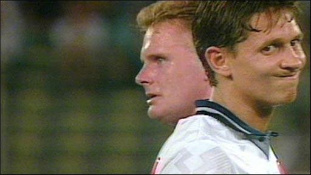
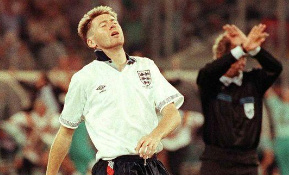
Losing it: emotions get the better of Gazza in the semi-final – and Lineker knows it (left); Chrissy Waddle fires his penalty over and it’s sadly all over for England (right)
So, in the final analysis, what should one make of this World Cup and, in particular, England’s performance and disappointing defeat? Well, as noted, overall it wasn’t a great competition; however, the ultimate winner may well have been football – English football, that is. The first sign of this were the scenes at Luton Airport as the England squad landed back home. Quite frankly, they were welcomed as heroes, as a group of players who had really achieved something and by doing so had made the nation proud. In truth, of course, they’d only gone one match further than they had in the ’86 World Cup; but that and playing really well against the Germans seemed to mean a hell of a lot to the punters, and, suddenly, seemingly overnight, football was back in the country’s good books. Indeed, leading its charge was hero of the hour and new national treasure Gazza – a young man not just idolised by kids in the playground like me, but loved by housewives everywhere thanks to his blubbing up in a Turin stadium. Gascoigne was an instant star, like Gary Lineker before him then, but somehow more so – perhaps because he was so human, and thus gave football such a human face once more. In what remained of 1990 alone, he would release both a Number One 1 hit single, Fog On The Tyne, and win the BBC’s Sports Personality of the Year award.
And yet the boost that England at the 1990 World Cup gave football seemed to go further; the feelgood factor didn’t seem to fade. All right, the England team itself went into decline for the next few years (Robson departed as manager, Lineker retired, Gazza wasn’t fit enough and the team slumped at the ’92 European Championships and didn’t even make the ’94 World Cup), but English football itself flourished with the arrival of the Premier League. The new top division for the country’s national sport was swish, colourful, exciting, media-savvy, advertised to the hilt and importantly much more safe, hooligan-free and family-friendly. It also proved a money-making machine – the secret to its success, naturally – as the style and quality of football it presented improved, new stars became household names with bells on and the big clubs became bigger than ever and more and more popular. Slowly but surely, as the ’90s progressed, England seemed to gain a football identity that reflected the would-be-triumph that Italia ’90 suggested it deserved. In time, too, the national side itself improved. At the 1996 European Championships – handily held on home soil – England had another stonker of a tournament, in which Gazza dazzled again and Stuart Pearce got to atone for his penalty miss… well, it all was brilliant until they crashed out to the Germans on penalties again in an eerily almost exact same semi-final as the one six years before.
So that’s the last word then? Well, it would be nice, nay seductive, to finish this final of my World Cup blogs on such a positive note, but I’m not sure it would really be honest. For, I’m afraid to say, I can’t help but think things aren’t that rosy – and, following England’s woeful showing at this year’s World Cup – I suspect many would agree with me on that too. Frankly, to my mind, it rather feels like we’ve come full-circle since 1990. Before that tournament, English football was beset by hooliganism and tragedy off the pitch and a lack of imagination and invention on it. Now, in spite of footy’s hugely successful past two decades in this country, the national game now is undeniably very top-heavy – the big clubs behave like small countries and, while lesser clubs struggle to pay the bills, even they aren’t properly financially sound either. Plus, the English national team and, more importantly, its own association seem stuck at a cross-roads, not knowing which way to turn. The bloated, money-driven psyche of the Premier League seems to stunt our best players when they put on the national jersey in tournaments and, tactically, we once again are found wanting.
What’s the answer? Where to next? Just what will football’s future be? I’m damned if I know. Since 1990, World Cups – and England’s involvement in them – may not have been as legendary as the past ones I’ve covered on here, yet they still have definitely been World Cups with highs, lows, moments to cheer, moments to boo, and – most of all – incident. Hindsight and nostalgia are wonderful things and, at their best, both honest and delightful to indulge in, but football and its World Cups will continue in some way or form long into the future, I heavily predict, surely ensuring the sport itself will always be the winner.
Well, at any rate, we’ve all got to hope that, right…? 
Don’t pass this by: Happy 70th birthday, Ringo Starr
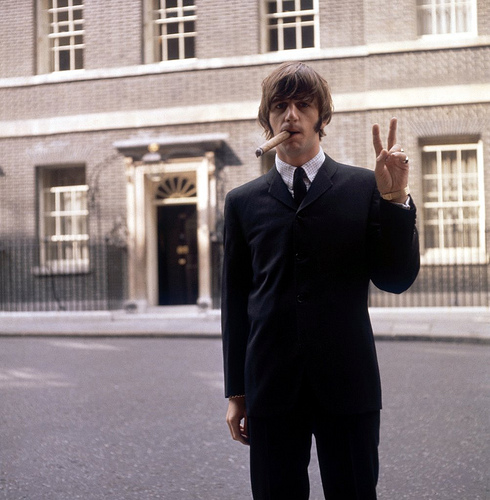
Close and some cigar: Ringo shows who’s boss as he poses in front of 10 Downing Street with a big fat stogy at the height of his Beatles fame
Yes, that’s right, one of rock ‘n’ roll’s most famous sons has reached his three scores and ten years today. Ringo Starr. Richard Starkey. That one who got a huge ring stuck on his finger in the movie Help. While some cruelly suggest he wasn’t even the best drummer in that rather famous band he played with, it’s undeniable he’s an utter legend in his own lifetime – and for all the right reasons.
He was always the most loveable, carefree and- maybe – most accessible of The Beatles (a bit like a big Liverpudlian teddy bear); married a gorgeous fan in the shape of Maureen Cox and then married a Bond Girl, the drop-dead beautiful former model Barbara Bach (Major Anya Amasova or XXX in 1977’s The Spy Who Loved Me), gave arguably the best performances of all four Fabs in their two iconic films A Hard Day’s Night and Help; and sired another top drummer in son Zak Starkey, who has played with The Who in recent years.
“Ringo was a star in his own right in Liverpool before we even met. He was a professional drummer who sang and performed and had Ringo Starr-time and he was in one of the top groups in Britain but especially in Liverpool before we even had a drummer. So Ringo’s talent would have come out one way or the other as something or other. I don’t know what he would have ended up as, but whatever that spark is in Ringo that we all know but can’t put our finger on — whether it is acting, drumming or singing I don’t know — there is something in him that is projectable and he would have surfaced with or without the Beatles. Ringo is a damn good drummer.” ~ John Lennon, speaking in September 1980
Starr’s post Beatles career hasn’t received anything like the critical acclaim his work with John, Paul and George did – which included vocals on With A Little Help From My Friends, Yellow Submarine, Act Naturally and the three tunes he was involved in writing or penned himself, Don’t Pass Me By, What Goes On and the seemingly universally loved Octopus’s Garden. However, over the decades his own music has developed a strong – and often cult – following, and Ringo himself has ever remained a hugely popular figure the world over. In 2006, following a campaign staged by a British tabloid, he claimed he didn’t want a potential knighthood, but instead wouldn’t mind being made a duke or a prince.
So, here’s to Duke Ringo of Starrdom, 70-not out and still a force for good, old fashioned peace and love. Go on, give the old ‘V’ sign a go right now now and do the man proud – it is his birthday after all… 

Cheat it: Diego Maradonna’s moves were even better than Michael Jackson’s, but when talent failed, cheating sufficed – no surprise as what was really on Argentina’s mind was revenge
Ah, 1986. The year when ill-starred Royal couple Andrew and Fergie married, when Crocodile Dundee showed New York lowlifes what a real knife was, when the space shuttle Challenger exploded in mid-air, and when the 13th World Cup took place in Mexico. The 13th? Yes, that’s right, this tournament – and especially its most memorable match (around which this sixth World Cup special here at George’s Journal will pivot) – certainly proved to be lucky for some, unlucky for others.
However, the all-important need-to-know background to this competition and, in particular, this match dates back another five years, to 1981. And, in part, it involves a figure familiar to followers of a past World Cup blog from yours truly. Yes, our old ‘friend’, General Jorge Videla, self appointed tyrant of Argentina; but don’t worry, it genuinely only involves him in part. That’s because it was in 1981 that the Argentine power at the top switched from Videla to another general, Roberto Viola, and, in turn, later in the year, the military junta that ruled the country was replaced with another, resulting in its third army dictator in succession, General Leopoldi Galtieri. Unfortunately, though, Galtieri was quick to become as infamous on the world stage as Videla. And it was all because he turned his attention to a small group of islands in the South Atlantic.
Economically depressed and suffering from civic unrest, Argentina was under the kosh in the early ’80s and this latest ruling junta was feeling the pressure. So, well aware of its country’s longstanding claim of sovereignty over the nearby Falklands Islands, South Georgia and Sandwich Islands, in spring ’82 the Galtieri government took the decision to invade the islands – first with civilians, then with soldiers – and raise the Argentine flag on South Georgia. This it decided, although potentially leading to war with the the UK (not only owner of the islands, but internationally recognised as such), would stoke up patriotism among the Argentine population, turning its head away from the nation’s domestic problems and lend legitimacy and room for manoeuvre to the new junta. It was an interesting and, ultimately, doomed gamble. For what Galtieri and his cohorts had not counted on was the fortitude and resilience of Britain’s leader, PM Margaret Thatcher.
Relatively new to power herself, Maggie was not yet the immoveable object, let alone the ‘Iron Lady’, political legend has since cast her as. With her deeply unpopular and drastic economic policies beginning to take effect on the UK (tackling inflation, but raising already high unemployment levels), the majority of Britons’ verdict on Thatcher was out; she was far from assured a second term as leader when she would go to the polls – in either ’83 or ’84. However, the Falklands War changed all that.
In love and war: the Mexico ’86 logo (left); Pique, the funky World Cup mascot I adored when I was six years-old (centre); and the Falklands War – serious business back in ’82 (right)
Seizing her opportunity, as the great opportunist she was, she threw all the British armed forces had at the Argentines (army, navy, air force and the SAS) and won the thing within 74 days. Despite 257 losses, Britain’s victory was comprehensive (there were 649 Argentine losses – including 321 on the sunken Belgrano ship alone) and her status as perma-strong, patriot leader was established and her re-election the following year assured – she received a landslide vote. Galtieri and co. were less lucky. Fallout from the Falklands defeat in Argentina saw his junta toppled and, mercifully, democracy swept in to fill the void. Yet, this was still a nation that had lost a war; its national pride had taken a fall. At the hands of the British then, a new wound had been opened in Argentina and the country was hurting…
Four years later in June ’86, though, and it was all smiles. Following South America’s Colombia having to pull out as host, the latest World Cup had instead kicked off up in sunny Mexico, which had been the stage for the classic 1970 tournament – surely a good omen. The world, then, awaited yet another fun-filled festival of football. Well, not just the world, but me too. Yes, at the tender age of six, as I was, this was the first World Cup of which I was aware. Now, I’ll admit, at this blissfully innocent and wonderful point in life I was more interested in catching The Flintstones each evening after the children’s telly had finished on BBC1 (Neighbours wouldn’t fill this slot until later that summer), than I was in keeping abreast of what was going on in the greatest sport on earth’s greatest and latest competition. However, when one day I happened to turn over to ITV instead of watching The Flintstones, I was faced by those two former cornerstones of TV football, Liverpool legend Ian St. John and Spurs supremo Jimmy Greaves, otherwise known as Saint and Greavsie, as they presented their early-evening report on that day’s World Cup goings-on – and thus my introduction to televisual football took place.
Not to say footy on telly and me were a perfect fit immediately, though. This sport seemed a very grown-up and rather rough and tough entity, quite the intoxicating thing to my young mind – a bit like pubs. Not surprising perhaps, considering this was the era of hooliganism; football was some way from the family-fiendly status it’s enjoyed in modern times. In short, I couldn’t quite fathom it. Yet, at the same time I totally grasped the inherent appeal of it – as do many when they first encounter football at the time of a World Cup. Unquestionably then, footy had lit some sort of flame in me; and, no doubt, that had something to do with the fact that, once again, England were taking part.
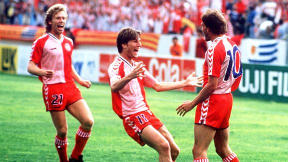

Setting the pace: the Danes (left) and the Soviets (right) show exciting, surprising early form
Unlike in the previous tournament, but like so many before and since, the English got off to a far from auspicious start. Their first group game against Portugal resulted in a 1-0 loss, their second against Morocco was arguably just as bad, ending 0-0 – yes, they may have gained a draw from it and therefore a point, but through it they lost to a dislocated shoulder their now captain, the utterly rambunctious Bryan Robson, and to a silly red card their vice-captain Ray Wilkins. Looking a busted flush already, former Ipswich manager Bobby Robson’s side required a re-shape… and a miracle.
“We were getting pilloried back home, which is the norm when England don’t start particularly well. But we weren’t really aware of it at the time. We were cocooned in our hotel without any TV that was watchable or even a landline back to the UK, so we were able to focus on our final match. We knew what we had to do – beat Poland to go through,” remembered an England squad member, one Gary Lineker. Aged 26 and top scorer in the First Division the previous season with a brilliant 40 goals for Everton, Lineker had developed a reputation as a great poacher and, leading up to this tournament, England’s most dependable striker. Could he be the one to deliver a miracle in the final group match against old on-the-pitch sparring partner Poland? The answer was emphatic.
Wearing a plaster-cast owing to a broken wrist, as well as the esteemed number 10 shirt, and thanks to his intuitive positional awareness and some decisive attacking football from his team, Lineker struck in the ninth minute, then the 14th, and then the 34th. A first-hat-trick. And an absolutely electric one at that. From being no-hopers that hadn’t mustered a single goal, England – with Lineker lethally leading the line – suddenly looked a dangerous foe for anyone in the second round.
Gratiously, this was the first World Cup in four in which the second round wasn’t a second group stage, but the beginning of the knock-out tournament proper – as it sensibly and entertainingly has been ever since. And joining England there were all the usual suspects. Holders Italy and the impressive looking Argentina qualified from the same group – Italy drawing two matches and winning one; Argentina winning one 2-0 (against Bulgaria) and another 3-1 (against South Korea, in which Italy-based star turn and captain Diego Maradonna grabbed a brace). Brazil made it through with three group victories (and packing stars from four years before Sócrates, Zico and Falcão), dismissing among others a Northern Ireland side sadly unable to match their achievements of ’82. France, who had been a fine side in the last World Cup and were scintillating winners of 1984’s European Championships, were surprisingly outshone in their group by a very attacking Soviet Union (who beat Hungary 6-0), yet they qualified for the next round in a comfortable second place. The two drew 1-1 against each other in a match memorable for a 40-yard screamer scored by the Soviet Vasyl Rats past the French keeper Joel Bats. Rats versus Bats? Yes, you couldn’t make it up.
This tournament – as so many seem to – also featured a ‘group of death’. Who did it contain? Why, West Germany, Denmark, Uruguay and Scotland, of course. Yes, I kid you not, in 1986 this was considered a groupe de mort. Mind you, it proved to be a stonker, not least because Denmark, not West Germany, progressed from it with a 100 percent record. The dynamic Danes beat Scotland 1-0, the Germans 2-0 and routed Uruguay 6-1. Impressive stuff and no mistake. For their part, the Scots gave it a go, what with spunky little midfielder Gordon Strachan opening the scoring against West Germany (the latter eventually winning 2-1), but not managing to win a game, it was they who went home early and the Germans who happily went through in second place behind Denmark.
What the football gods had given the Danes in their first three matches, they took away in their fourth, however. Yup, they crashed out – and, believe it or not, to those perennial World Cup under-performers Spain, with Real Madrid star Emilio Butragueño grabbing four goals in a 5-1 win. Elsewhere, in an absolute cracker, Belgium shocked everyone by defeating the Soviet Union 4-3 after extra-time – Soviet striker Ihor Belanov scored a hat-trick, but conspired to end up on the losing side – while Brazil beat Poland 4-0; France knocked out Italy 2-0; Argentina defeated Uruguay 1-0; and the Three Lions roared again, marching past Paraguay 3-0, with Lineker getting another two goals and his front-line partner, Liverpool’s skillful Peter Beardsley, the other. For many, though, the highlight of the round was host Mexico’s 2-0 victory over Bulgaria, thanks to an unforgettable goal scored via a scissor-kick from Manuel Negrete Arias.
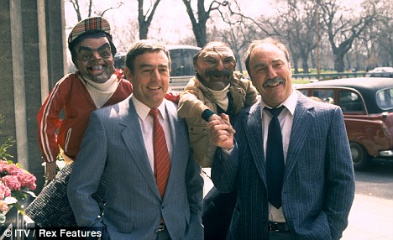
Spitting image: ITV’s fun football pundits Saint and Greavsie were in their prime during Mexico ’86 (left), just as was France ace – and present UEFA chief – Michel Platini (right)
For the most part, the next round, the quarter finals, weren’t the most exciting – certainly in terms of goals. Three of the four matches ended in draws and had to be settled by penalties. Germany versus Mexico finished scoreless, with the former winning the shoot-out; Spain equalized against Belgium on 85 minutes, but lost 5-4 on spot-kicks; while, in an admittedly entertaining match, the brilliant Zico missed an easy chance and had a penalty in normal-time saved, as his side drew 1-1 against France. The latter’s goal came from their talismanic captain Michel Platini, on his birthday, and he too missed a penalty, this time in the shoot-out. Yet, with another miss during the old 18-yard box lottery from Brazilian Sócrates, it was the French who finally did the business, by four penalties to three.
The fourth quarter final, however, was a match unlike the others. In fact, it was unlike any match in this World Cup – and unlike many matches in any World Cup. Indeed, it was the game that, come the end, this entire tournament seemed to revolve around. At the tender age I was then, I guess it was the first football match I ever actually watched – and, given it was England against Argentina, The Flintstones it was not.
Thanks to the notoriously ill-tempered match between the two in the ’66 World Cup, sporting bad-blood already existed between England and Argentina. However, the hostilities, casualties and result of the Falklands War lent this fixture another dynamite dimension. It was four years since the war and, of course, the English public had far from forgotten it, but as a country beginning to be bouyed by a resurgent economy driven by the City of London and as the victors of the aforementioned conflict, this footballing clash was more about extra spice than some sort of a re-match. For the Argentine public, however, anticipation for the game was different – it was more like awaiting an Olympic meeting contested by the USA or the USSR at the height of the Cold War. Indeed, following the match, Diego Maradonna commented: “Although we had said before the game that football had nothing to do with the Malvinas [Falklands] War, we knew they had killed a lot of Argentine boys there, killed them like little birds. And this was [about] revenge”.

Magic moment: Maradonna on his way to scoring his sensational second against England
The two teams went off at half-time even-steven – Argentina had had the better of it, but hadn’t managed to breach England’s defence. All was to change in the second-half, though. And on 51 minutes, the first of two utterly unforgettable moments occurred. Having started a move, Maradonna ran on deep into the England half, expecting a one-two from striker Jorge Valdano. The ball, however, came back to him from a skewed clearance from England midfielder Steve Hodge, looping up ahead of the diminutive player. England’s 6′ 1″ goalkeeper – and captain for the match – Peter Shilton rose to punch the ball clear, while the 5′ 5″ Maradonna jumped towards it too. Surely the latter’s jump was in vain? Apparently not. The ball bounced away from the two of them and into the England net. The referee, Tunisian Ali Bin Nasser, blew his whistle and awarded the goal. 1-0 to Argentina. But, suddenly, Shilton raced towards him, tapping his arm, flagrently indicating that his opponent had, in fact, handled the ball and that the goal shouldn’t stand. Quickly catching wind of what Shilton was saying, other England players began to crowd around the referee and claim the same. Yet, the referee – and his relevant linesman – hadn’t seen the infringement and so would hear nothing of it: the goal stood. Instant TV replays from a reverse angle backed up England’s cause – with bells on. Maradonna had deliberately – and cutely – fisted the ball a split-second before Shilton could reach it.
Four minutes later, though, the Argentina number 10 created another incredible moment – this time one of utter magic. Picking up the ball in his own half, he went on a 10-second, 60-metre run, beating four England players as he did, and finished it off by placing it past Shilton and putting his side two goals clear. In the years since, many observers have claimed this to be the ‘goal of the century’ or, plainly, the best ever scored. It may be. Such a thing is very difficult to quantify to my mind. What is undeniable, though, is that it was a piece of otherworldly skill – and, ironically and bittersweetly, in direct contrast to the moment that directly preceded it.
After two such extraordinary moments, one would be forgiven for thinking that Argentina were now out of sight, that England were dead and buried. Were they ever, though. Showing the smart and tactically-aware manager he was, Bobby Robson made a double substitution and brought on two exciting players in the shape of Chris Waddle and Liverpool superstar John Barnes. Sparked into life by this change, England gave it a real go and started to press and attack themselves – midfielder Glenn Hoddle soon went close with a free-kick. Then, in the 80th minute, John Barnes rampaged down the left and delivered an acute cross into the penalty area that Lineker deftly headed in – it was his sixth goal of the tournament. Another Barnes cross seven minutes later caused further panic for the Argentines when Lineker nearly reached it again, but this time it was not to be. And, in the end, so proved the match for England. They lost 2-1 – that late goal, though they were beaten, ensuring Maradonna’s moment of blatant cheating had proved critical; his brilliant goal would not alone have been enough to defeat them.
“Un poco con la cabeza de Maradona y otro poco con la mano de Dios” (“A little with the head of Maradona and a little with the hand of God”) ~ Diego Maradonna shares with the world how his cheating goal against England was scored, and so the ‘Hand of God’ reference is born
Immediately following the game, England defender Terry Butcher was required to give a urine example for routine drug-testing, along with Maradonna. Meeting the man during the process, he asked him whether he’d used his head or hand to score the first goal; the reply being the head. Butcher, an ardently competitive and patriotic sportsman, has since claimed that if Maradonna had admitted to him he’d cheated, he’s not sure what he would have done to him. And, somewhat less courageously, that’s exactly what the Argentine admitted to the world’s media minutes later – suggesting the ‘hand of God’ had been involved in the scoring of the goal. Bobby Robson knew his mind all right, though, claiming instead it was the ‘hand of a rascal’ what had scored it. Maradonna has also since admitted that immeditaly following the hand-ball he urged his teammates to hug him, otherwise the referee may not have allowed it.
All the same, there was no getting away from it, a decent England team – the first since the defending champions of 1970 – were out; the Argentines were through to the semi-finals. Less controversially, they beat Belgium 2-0 there (Maradonna scoring another outstanding goal in that match) and West Germany, the efficient, well-oiled machine of this era they were, beat the star-studded French 2-0 as well. And so to the final, and quite the exciting match it was too. Argentina took the lead after just nine minutes through defender José Brown, and Valdano added another in the 55th. However, the Germans had other ideas, what with veteran midfield powerhouse Karl-Heinz Rummenige scoring in the 74th minute and striker Rudi Völler grabbing an equalizer on 80 minutes. Yet just three minutes later, and thanks to a pass from the ubiquitous Maradonna, Jorge Burruchaga sealed the deal and got the winner. For the second time in their history then – in fact, the second time in three World Cups – Argentina were champions.
It’s little surprise that in the years since, this World Cup has generated much debate – all of it, seemingly, pivoting around that England-Argentina match and those two moments from Maradonna. To my mind, his performance in Mexico ’86 and, especially, his second goal in that game has ensured he must be considered one of the greatest footballers ever to have played the game (perhaps he’s even second only to Pelé himself). Yet, that’s only one side of the coin and can only ever be viewed as such. Maradonna had dark moments in his career both at international and club level following this World Cup, but just on its own his first goal in that match in question tempers all else he achieved in that tournament. All these years later, I’ve never been able to get away from the conclusion I came to as a six year-old at the time – for all his God-given talent, Diego the little devil was a plain and simple cheat.

Golden boy: England’s six-goal hero and new national treasure, the one and only Gary Lineker lifts a paper – if not World – cup following his hat-trick against Poland
Overall though, this World Cup probably wasn’t a bad ‘un, it’s only fair to say – not the classic of 1970 that Mexico also staged, but it was never going to match that one, surely? And it did offer a couple of silver linings too. Not only did Belgium pull off the incredible coup of finishing fourth (when are they next going to repeat that feat, honestly?), but England’s Lineker proved himself Gary the Great and the nation’s favourite son by finishing the tournament’s top scorer and thereby winning its Golden Boot – the first, and so far, only Englishman to have done so in a World Cup.
But after all my thoughts and words, what is the take on this World Cup by its winners? Well, you may be a little surprised, because according to former player Roberto Perfumo (whose international career ended in 1974): “In 1986, winning that game against England was enough. Winning the World Cup was secondary for us. Beating England was our real aim”. Things that occur in World Cups often make you think, but surely that opinion offers a huge chop of Argentine-beef food for thought… 
Listen, my friends! ~ July
In the words of Moby Grape… listen, my friends! Yes, it’s the (hopefully) monthly playlist presented by George’s Journal just for you good people.
There may be one or two classics to be found here dotted in among different tunes you’re unfamiliar with or never heard before – or, of course, you may’ve heard them all before. All the same, why not sit back, listen away and enjoy…
Click on the song titles to hear them
~~~
The Youngbloods ~ Get Together
Donovan ~ Barabajagal (Love Is Hot)
The Band ~ I Shall Be Released
Julie London ~ Light My Fire
Burt Bacharach ~ South American Getaway
Paul McCartney ~ Maybe I’m Amazed
The Rolling Stones* ~ Happy/ Let It Loose
Edgar Wright Group ~ Free Ride
War ~ Low Rider
Justin Hayward ~ Forever Autumn
Madonna ~ Borderline
David Bowie ~ Underground
~~~
* Yes, that’s right, a Stones double bill here from the legendary Exile On Main St. album – in honour of the recent documentary film on its making, Stones In Exile, no less. I know, I know, I spoil you, but you’re most welcome…
Blue steal: World Cup 1982 ~ Italy v Brazil

Assured azzurro?: Italy’s Paolo Rossi pursued by Brazil’s Sócrates in one of the all-time classic World Cup matches that would prove a critical turning point in 82’s terrific tournament
So, if you’re of an English persuasion like me, you’ll no doubt still be down in the mouth and in need of a tonic to get over the so-called Three Lions’ ignominious exit from South Africa at the weekend. And what better tonic could there be than to look back on this exceptional tournament and, in detail, its greatest match, in this, my fifth World Cup special? Well, short of throwing oneself into the smuggery of Wimbledon, I can’t think of a better one anyway.
Now, for some odd reason, the 1982 World Cup seems rather ignored or even forgotten when compared to its fellow illustrious football tournaments of times past. And that’s a shame, seems to me, because this one was an out-and-out crackerjack. Perhaps, over here in the UK at least, that has something to do with it taking place in the early ’80s. Before the rise of the yuppie, the invention of the brick-like mobile phone and Stock, Aitken and Waterman’s culpability for almost every song that found its way into the charts, the ’80s weren’t exactly a very colourful, optimistic or even an ‘us and them’ divisive time. Indeed, the early years of that decade were – perhaps predictably – far more like a continuation of the previous one and, thus, not too fondly recalled nowadays.
The fact was the policies – for better and worse – of new Prime Minister Margaret Thatcher hadn’t really bitten Britain yet and no single demographic of the population was clearly feeling the effect of 1979’s Tory election victory. In which case, money was tight for pretty much everyone as the economy was still far from bouyant, unemployment was high (although it would only rise in the next few years, of course), and civil unrest had reared its ugly head once more.
Famously, in April 1981, a day-and night-long violent riot had taken place in Brixton, a very multicultural borough of South London, thanks to the the area’s crime rate having grown rapidly owing to a recent rise in unemployment. The rioters, who were white as well as black, were initially angered by the sudden surge in police presence and its heavy-handed stop-and-search policy. Time Magazine referred to the event as ‘Bloody Saturday’, an allusion to the so-called ‘Bloody Sunday’ in Belfast at the height of ‘The Troubles’ in the early ’70s. Less well remembered is that in the same year similar riots had also broken out in Birmingham, Liverpool, Bristol, Leeds, Leicester, Coventry and Edinburgh, among other cities. Culturally, the feel of urban decay and despair seemed to be reflected through song with the ska-flavoured Ghost Town by The Specials and the driving punk-pop London Calling by The Clash, both of which were big chart hits of the era. The ’70s were over, but the country still seemed to lack direction then; it still felt like a sleeping giant that couldn’t quite pull itself up and forwards – and it desperately needed to.
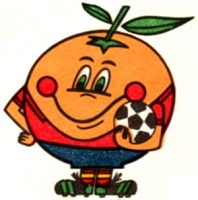
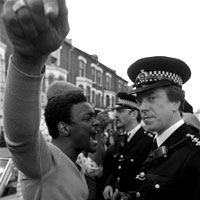
Picasso and fiasco: World Cup ’82’s poster, inspired by the work of Spain’s greatest artist; tournament mascot Naranjito; and violence on the streets of London’s Brixton in 1981
In many ways, the same could be said for the England team that qualified for the World Cup of Summer ’82, held in Spain – although they were the first to do so in eight years. Indeed, the team even wore skin-tight shirts with bad patterns on them and very short shorts (or strangely iconic ’80s sportwear, if you prefer), just like every man on the street of Britain seemed to wear in early ’80s summers. And manager Ron Greenwood’s men hardly seemed like glamorous world-beaters either. Instead of 1966’s Charlton, Hurst, Moore and Banks, the class of ’82 boasted the likes of Francis, Wilkins, Brooking and an injury-carrying Kevin Keegan. Oh, and a promising young lad named Bryan Robson.
Ah, Bryan Robson. In actuality, it wasn’t the perma-permed Keegan, but this midfielder with energy and endeavour comparable to that of a Duracell bunny who turned out to be England’s talisman this tournament. And he hit the front as soon as 27 seconds into the side’s campaign, putting them 1-0 up against the much fancied France (packing the terrific Michel Platini and others) in their opening game. Impressively, this goal was to rank the fastest in World Cup history for the next 20 years. And come the 67th minute, Robson grabbed another – undeniably, a new star was born on the international stage – and thanks to a late strike from Paul Mariner, England won 3-1 and were off to a great start.
Indeed, with a further 2-0 win over Czechoslovakia and 1-0 win over Kuwait, in both of which striker Trevor Francis scored, England cruised through to the second group stage with a rare 100 percent record. Unlikely it may have seemed, but they were doing all right, better than all right, actually. Could they, as promised in their official tournament song, really ‘get it right this time’? Of seemingly less interest at this stage, France also made it through the group in second place.
Actually, as if to kick some juice into the ’80s, right from the off and all over the shop this was an exciting World Cup. The tournament had, in fact, opened with an Argentina-Belgium fixture – surely a bog-standard victory for the former, the reigning champions? Erm, well, no as it turned out. Having underestimated their rivals, the Argentines fell to an embarassing 1-0 defeat. Still, along with the Belgians they did manage to progress to the next round. Almost as impressively, the other highlight of this group was the match between its two minnows, Hungary and El Salvador, which was won to the tune of 10-1 by the former, surely reminding their nation of the fine side it possessed back in the ’50s. This crazy scoreline is still the joint second highest ever achieved in the competition’s history.

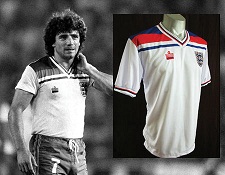
Burly start, curly non-stalwart: Bryan Robson scores his first goal against France; Kevin Keegan struggles and, inset, the fashion statement that was the World Cup ’82 England shirt
Elsewhere, the mighty West Germany’s opener produced another unexpected result, beaten, as they were, 2-1 by Algeria – the first ever African victory in a World Cup. Erstwhile and efficient as ever, mind, the Germans did make it through to the next stage, but not without controversy. In their final game of the round, they faced Austria (with whom they’d shared an infamous match in the ’74 contest) and the two teams, knowing they’d both go through if West Germany won 1-0, completely shut up shop and kicked the ball around in a strange unspoken agreement as soon as the former scored a goal early in the first half. The Spanish-majority crowd, TV audiences around the world and even the fans of the two countries were appalled by this behaviour – disgusted, a German fan in the stadium even burned his nation’s flag. How could this have happened?
Well, just as in the immediately previous World Cup when Argentina had managed to get through to the final with a dubious defeat of Peru, this match had taken place after all the others in the group had been played so both teams knew exactly what they needed to do in the game. This sort of thing needed stamping out once and for all, and finally in the next tournament FIFA ensured such an unfair advantage wouldn’t take place again, but clearly the desire to act had come not one, but two, World Cups too late.
There were three more groups in the first round this year (yes, that’s six in all) and, in spite of the three mentioned so far, none of them generated more surprise than the one in which Italy found itself. At the beginning of this tournament, it wasn’t so much Forza Italia as For goodness sake, Italia. In an occurence that, incredibly, would be repeated 24 years later in 2006, going into the contest the Italian domestic game had been rocked to its very roots by a huge match-fixing scandal across its top league Serie A. So bad had the debacle been that the clubs AC Milan and Lazio had been relegated to Serie B in punishment, while major players had served suspensions, including star striker Paolo Rossi who had been dished out with a two-season ban (even though evidence that’s since come to light suggests he may have been innocent).
All the same, to all intents and purposes the 1980 Totonero had surely provided the Azzurri with the worst possible preparation for this World Cup, and that appeared to be proved so in their opening group when, shamefully as far as their compatriots were concerned, they scraped through to the second round by the skin of their teeth, drawing 0-0 with Poland, 1-1 with Peru and 1-1 with Cameroon. In fact, the Africans were only denied the place that went to the Italians because they had scored one goal less, tied on points as they were. This was despite the fact the former had had a perfectly good goal from striker Roger Milla disallowed against Peru. In great contrast to Italy, Poland put five past Peru and qualified for the next round by topping the table. Indeed, the Poles were bolstered by the now legendary striker-from-midfield Grzegorz Lato appearing in his third consecutive World Cup – unsurprisingly, he was one of those who’d got on the scoresheet against the Peruvians. Rossi, meanwhile, hadn’t come close to a sniff in his three matches and, famously, the Italian media is supposed to have referred to him as a ghost wandering aimlessly over the field.
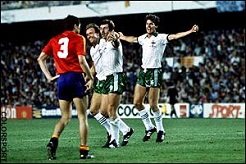
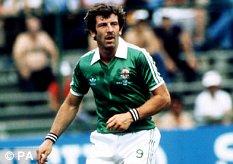
The pluck of the Irish: Northern Ireland defeat Spain (left) thanks to a strike from hero Gerry Armstrong (right)
Wandering aimlessly through the first group stage had been the preserve of the home nations in recent World Cups, but, like England, another UK representative had a cracking time of it – frankly, to the utter shock of the footballing world and, in particular, the hosts. Northern Ireland had qualified for the ’82 tournament – their first in 32 years – and following plucky draws against Yugoslavia (0-0) and Honduras (1-1), they did the unthinkable, yes, thanks to a single goal they beat Spain… in Spain… in Spain’s World Cup. An amazing feat that saw them through to the next round by incredibly topping the group. The Spanish, a disappointing team in their home World Cup, joined them there with a record of one win, one draw and that one loss against the Northern Irish.
If luck was going the home nations’ way elsewhere, then, perhaps predictably, it didn’t rub off on the Scots. Through to their third Cup in a row, they – like everybody else in their group – demolished New Zealand and claimed a fighting draw against the Soviet Union, but that result wasn’t good enough and saw them cruelly go out – yet again – on goal difference. However, in truth, this group was only really about one team. Indeed, the entire early stages of the tournament were only really about one team… Brazil. Yes, that’s right, Esquadrão de Ouro were back, and, indeed, they did appear to be a golden squad once more.
For they had captain, midfield maestro and eventual cult figure Sócrates, who was as much loved for his terrific beard as for his silky skills (and for sharing his name with Ancient Greece’s pre-eminent philosopher, of course); they had the goalscoring machine that was Zico (also, in fact, a midfielder rather than a striker – well, he was Brazilian, after all); they had another outstanding midfielder in the shape of the marvellous Falcão; they had the left-winger with a beautiful touch Éder; and, finally, they had the very useful striker Serginho. Just like back in 1970 when they’d last won the thing, the Brazilians looked the real deal, displaying footballing ability and clinical finishing unlike any other side thus far. They defeated the decent Soviets 2-1, beat up Scotland 4-1 and put another four past New Zealand without reply; Zico scoring three, Serginho two, Éder another two and Falcão yet another two in the process. To say by the end of the opening group stage they were favourites for the tournament would be like saying cameramen traditionally like lingering on on bikini-clad Brazilian female fans dancing in the stands. World Cup ’82 was well and truly rocking already, and to an undeniable samba beat.
Puzzlingly, unlike in the last two World Cups where the second group stage had comprised two groups of four teams, this one’s second round of groups comprised four of three teams. Three may be a magic number, but it’s an odd number for a group in a football contest, surely. However, this change did ensure that the winners of each of the new groups – four of them, of course – would go through to a pair of semi-finals, which had been blessedly reinstated after going AWOL in the ’74 and ’78 tournaments, so perhaps there was some actual method to the madness. Talking of methods, having applied a successful one to their first group, the Poles did exactly the same to their new one (the first of the second round), beating Belgium 3-0 as they did, thanks to a hat-trick from hot-to-trot striker Zbigniew Boniek, and drawing against the Soviet Union. After their previous heroics, Belgium, a little sadly, weren’t to go any further; conversely, Poland were the first side through to the semis.
And joining them there – you guessed it – were West Germany. The nation who, by now, was really making a habit of being there or thereabouts in every football contest in which it participated, got the better of both the pretty woeful Spain and, yes, England. The Germans beat Spain 2-1 and drew 0-0 with England (hardly a match that latter one, then, to rival the clashes of ’66 and ’70). For their part, England also picked up another 0-0 draw with the hosts. In the end, injuries – in particular to the man who perhaps could have delivered the goods for them, the Superstars superstar himself Kevin Keegan – had caught up with the English this campaign, but they did have the (in)glorious honour of returning home having not lost a game.
In contrast, the side who England had so impressively beaten in their first match, France, cruised through their second group, beating Austria 1-0 and Northern Ireland 4-1. This second stage was clearly a step too far for the otherwise terrific Northern Irish, but they’d had a legendary tournament and could boast one of its top scorers in three-goal hero Gerry Armstrong, who – given his team had defeated the hosts – would somewhat ironically switch Watford for Real Mallorca the following year. As Jimmy Greaves had a wont to say once upon a time, football really is a funny old game.
The final group of this World Cup was unquestionably what the media would nowadays dub ‘the group of death’, containing, as it did, Brazil, Italy and Argentina. The latter of those three were, of course, the World Cup holders, but losing as they already had to Belgium, they weren’t the team of four years before (not least because they didn’t possess the huge home support they had enjoyed in their home country then). They fell first to a 2-1 defeat to Italy – the latter’s goals coming from decent-looking midfielder Marco Tardelli and left-back Antonio Cabrini – and then to a 3-1 defeat to Brazil – for whom Zico and Serginho again scored. Those results ensured that the Argentines were out of it and it now all came down to the Brazil-Italy clash to decide the final semi-finalist. And what a clash it turned out to be. In a word, it was incredible.

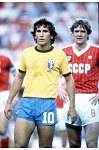
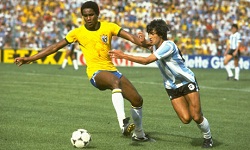
Dream team: Brazil’s Falcão, Zico and Serginho in action – but could they win the World Cup?
Not that, before kick-off, it looked like it was going to be that much of a contest, of course – Brazil were the undoubted pre-match favourites. Yet, lest we forget, in addition to its importance as a decider of a semi-final place, this match also saw these two great footballing nations clash for the first time in a meaningful World Cup tie since the classic 1970 final. And, just as then, it was those in green and gold who held all the artistic aces, beginning the game, as they did, with the sort of skill, style and flambouyance they’d shown throughout this tournament. In answer to this, the Italians looked set to rely on an old favourite of theirs, catenaccio – the smart, if not arty, tactic of playing defensively (indeed, catenaccio translates from the Italian as ‘door-bolt’) – a method of play dreamt up and used very effectively by Inter Milan in the ’60s to scoop up Scudetto after Scudetto. In actual fact though, the system Italy used in this World Cup was a slightly modernised, more flexible version that has become known as zona mista (‘mixed zone’) – and, make no mistake, the boys in blue used it in this match with bells on.
The first indication that the game wasn’t going to go to the script – or even go to the form of either side so far – was unmistakeable: Paolo Rossi scored a goal. The event took place just five minutes into play too, when the much-maligned marksman nodded in a cross from Cabrini, showing the true poaching instincts that had made him such a star in his homeland years before and which had so far eluded him so clearly this competition. True to their instincts as a good Brazilian side though, the samba boys didn’t panic and played their natural easy-on-the-eye and, when necessary, powerful and decisive football – and got what they deserved in the 17th minute when a marvellous move culminated in Sócrates brilliantly striking home at the Italian keeper’s near post. 1-1. This was shaping up to be a good contest. And it got better.
Just three minutes later, stepping past a defender and intercepting a loose pass across the other penalty area, an utterly reinvigorated Rossi lashed home a shot into the Brazilian net, putting his side back into the lead. 2-1. If the Brazilians were stunned by going behind again – and to Rossi again – they didn’t show it. Instead, they bombarded their opponents’ half of the pitch and bore down on the opposing penalty area for much of the remainder of the match. However, owing to the Italians’ drilled organisation and, in particular, the exceptional work of central defenders Claudio Gentile and Gaetino Scirea, the South Americans just couldn’t get through. The passes, interplay, shots, strikes, volleys and venom from the Brazilians were no good, the Azzurri were standing firm – and conducting an admirable masterclass in how perfectly to counteract such great forward play. Indeed, Gentile had been charged the unenviable task of man-marking Zico and so good did he do it he picked up a yellow card for his efforts, but Brazil’s irresistible Number 10 neither scored a goal nor set up another the entire match.
Finally, however, the fabulous Falcão did find a way through the Italian resistance when he scored from a full 20 yards out in the 68th minute, the delight and relief etched on his face as he celebrated with his teammates – at 2-2, Brazil would now be through to the last four on goal difference; the Italians out. But someone had other ideas. And who was it? That’s right, you guessed it. Popping up in the Brazilian box just six minutes later and connecting as quick as lightning to a poor clearance from his side’s corner, that man Rossi sealed an amazing hat-trick, sending his team 3-2 in front and, yes, into the semi-finals.


Keeper’s KO: Harald Schumacher crashes into Patrick Battiston in the second semi-final
Over the years, many have decried this match owing to it sending such a brilliant Brazilian side out of the World Cup. Indeed, the BBC’s John Motson has claimed his co-commentator for the game Bobby Charlton cried at the end of it for that very reason. Yet, there’s always two sides in a football match, and there’s often two ways of playing one – and this match showed up both in their equally fascinating extremes. While Brazil played near-fantasy football in this World Cup, the style the Italians played was (arguably) just as impressive, more effective and ultimately smarter. Their defensive counter-moves to Brazil’s forward-efforts were brilliant in their own way and their break-away counter-attacking (now such a recognisable and welcome part of modern football the world over) was thrilling, decisive and winning. There’s a reason why it took Brazil 24 years to win their next World Cup after the beautiful triumph of 1970; until 1994 they didn’t play defensively – or, if you like, smartly – enough to do so. It was perhaps this very match that taught them the lesson that free-flowing, fluid, forward-dominated football wasn’t enough to conquer the world anymore; you needed to be smart like the Italians too.
And lucky as well, it should be said. For in their semi-final the latter met the Poles, who, having had a great tournament thus far, really didn’t perform and against an Italy that had just found its form – fortuitously? – at the right time went down 2-0. Both goals came from Rossi. Italy too were perhaps lucky they didn’t face either side that contested the other semi-final, two true European powerhouses in the sport at this time, France and West Germany. And, make no mistake, this particular meeting made for another stonker of a match.
The drama began as early as the 17th minute when German midfielder Pierre Littbarski opened the scoring, only for his goal to be negated by a Michel Platini penalty in the 26th. Platini was involved again in the second half’s – and probably the entire match’s – most memorable moment when his fine pass put defender Patrick Battiston through on goal, only for German keeper Harald Schumacher to come racing out and… not clear the ball, but miss it completely as he delibarately floored the unrushing Frenchman. Play was halted for several minutes while the unconscious Battiston was stretchered off the pitch, the result of which being that neither a penalty was awarded nor was Schumacher sent off, the referee deeming the assault not even to have been a foul. For his sins, the coolly gum-chewing, shockingly permed German keeper took the goal-kick and the game resumed. At least after the match he offered to pay Battiston’s dental bill when it was revealed he’d knocked two of the poor feller’s teeth out, although one may say that was adding insult to literal injury.
Into extra-time the match went then and on 92 minutes, French sweeper Marius Trésor volleyed home to make it 2-1 and six minutes later his teammate Alain Giresse finished a swift counter-attack to put their side two goals clear. But you can never count out the Germans, oh but you can’t. On 102 minutes they themselves scored following a counter-attack through Bayern Munich’s European Footballer of the Year, German squad captain and very recent substitute Karl-Heinz Rumenigge, while in the 108th a terrific move was topped off by a volley into the net in the form of a bicycle kick from Klaus Fischer (since voted German football’s greatest ever goal). The scores were level once more then at 3-3, and that meant… penalties. Of course, penalty shoot-outs to decide knock-out matches in international football are ten-a-penny nowadays, but back in 1982 they were a great rarity. Thus, this fatalistic, sado-masochistic manner to decide a winner merely seemed to lend this epic match a fittingly über-dramatic climax. And, predictably, it was the Germans who proved the über penalty-takers, winning the shootout as they did – as they always seem to.

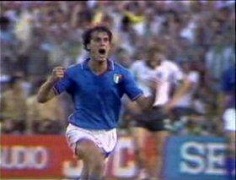
Abiding memories: Paolo Rossi scores – again – in the final (left); Marco Tardelli’s explosive and utterly unforgettable goal celebration (right)
So, Italy versus West Germany in the final. It had a nice ring to it and, as if this World Cup hadn’t had enough already, it proved to be yet another memorable, quality match. Save a missed penalty from Italian Cabrini, the game was goalless and honours even going into the second half – and that’s when it really sparked into life. And who was it who provided the spark? Who else could it be now but Paolo Rossi, as in the 57th minute he headed in a low cross at very close range. Having mastered their zona mistra system against the Brazilians, the Azzurri now struck gold with it against the Germans. The latter were clearly knackered from their huge semi-final exploits against the French, while their far sprightlier opponents wre defending superbly (especially Gentile and Scirea again), which ensured they could counter-attack and apply the sucker-punch – not once, but twice. First, on 69 minutes Tardelli scored from range to put Italy two clear, then substitute striker Alessandro Altobelli sealed the win twelve minutes later following a great solo run from Conti down the wing. Paul Breitner managed to pull one back in the 83rd minute for the Germans (impressively, his second goal in two World Cup finals, as he’d already scored a penalty in the ’74 final), but it was scant consolation. The boys in blue had done it – they’d won the World Cup for the third time in their history.
And, following the terrible match-fixing scandal that had preceded their tournament and the frankly terrible start they’d made to it, it was rather a remarkable win for them too (indeed, as hinted at earlier, the whole thing seemed to repeat itself for Italy as they went into, competed in and eventually won the 2006 World Cup – bizarre really). Not just that, though. Having been a laughing stock right up until his side’s third match from the end, Rossi finished the contest as top scorer with six goals, ensuring he picked up not just the Golden Boot, but also the newly introduced Golden Ball award for the tournament’s best overall player. Not bad going for an aimless ghost.
Perhaps this terrific tournament’s most enduring memory, though, is the celebration of Marco Tardelli as he scored Italy’s second – and decisive – goal in the final. Raising his hands in clenched fists, his mouth opening into a square and his eyes widening, he sprinted away along the pitch and towards his team’s bench, completely lost in the ectasy and majesty of the moment. And, you’ve got to say, it’s an image that fits this tournament like a glove, one of the most entertaining, exciting, colourful, controversial, crazy and unpredictable sporting contests there’s ever been. Yes, it was 1982 and it may have been drab in Britain, but this World Cup and all its components had surely afforded the country – and the world – something of a taster of the extraodinary decade that was to come… 
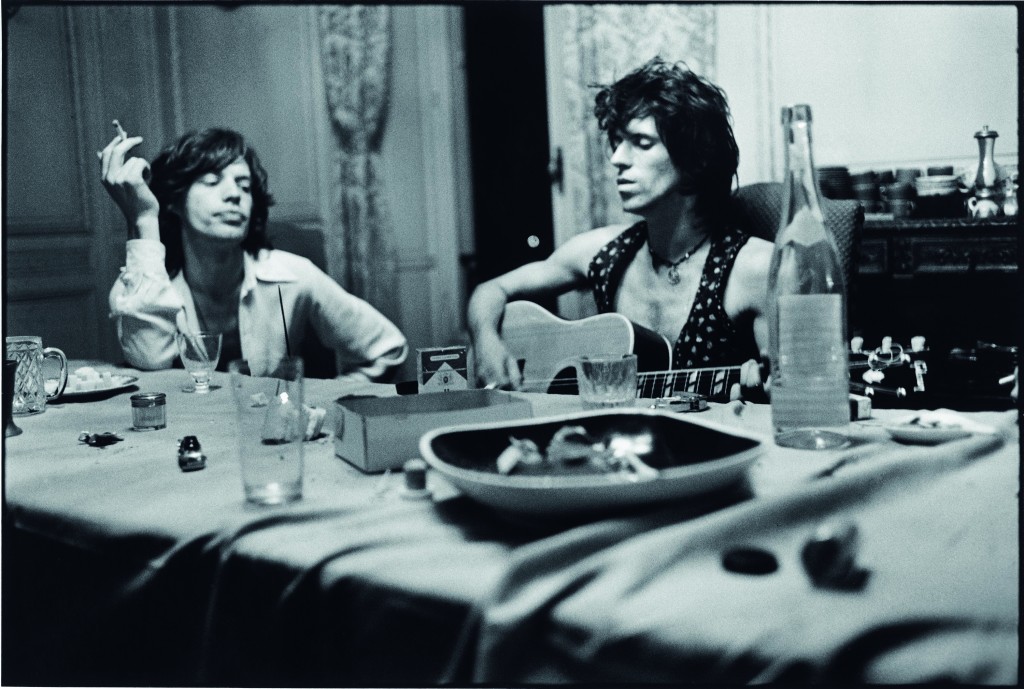
Soul survivors: Mick and Keith during the making of Exile On Main St. – for once the two seem without booze, maybe that’s why Mick’s face suggests Keith’s playing a bum note
Whichever way you wrap it, 1972’s Exile On Main St. has always been the oddest of their great gifts The Rolling Stones have bestowed on us over the decades. A double album that was crafted during the period the band should surely have slowed down following their spiritual leader Brian Jones’ death in 1969, it’s also stripped back, bluesy and hopelessly loose – just when you’d have thought they’d have retreated into the safe embrace of studio technology and trickery, instead of taking the seemingly harder and more dangerous route of going back-to-basics. Plus, for all its (rightfully) accumulated acclaim over the years, the album only contains one tune that turned out to be a genuine hit single.
Yes, it’s always been a bit of a curate’s egg – if one of which exquisite trinket maker Carl Fabergé would have been proud. So, good news it is then that the brand spanking new 61-minute documentary that looks at the album’s making, Stones In Exile, goes a damned good way to explaining why.
As if in keeping with the undiluted, rather shambolic genesis and ethos behind the album in question, this docu film, directed by Stephen Kijak, was both premiered at the Cannes Film Festival and shown on BBC1 in the UK last month, at almost exactly the same time. A bit weird to my mind that, I must say. Still, it did mean I didn’t have to worry about having to rub shoulders with the movers and shakers on the Promenade in the vain hope I may get hold of a ticket from a tout – no, instead I could watch the whole thing at home in the comfort of my favourite armchair and with a nice cup of coffee. Who could ask for more? Well, going to Cannes would have been cool, I guess.
Exile On Main St.‘s origins were not promising; in fact, they were downright ominous. Owing to businessman Allen Klein (who was famously involved in screwing up The Beatles’ finances, which helped bring about their demise) sticking his finger into The Stones’ money matters towards the end of the ’60s, following the legendary Andrew Loog Oldham’s departure as their manager, the band were facing financial – as well as legal – problems. And problems that for a rock ‘n’ roll band, which at the time was undisputedly living the archetypal rock ‘n’ roll lifestyle, were seemingly too complex and difficult to get their heads around.
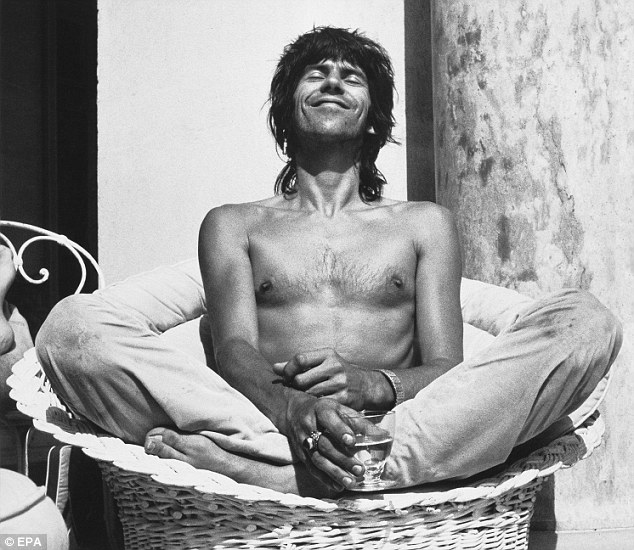
Let It Loose: As he says in the film, Keith proves he was more ‘roll’ and Mick more ‘rock’ during the recording of Exile On Main St. – but a hell of a smack was about to hit him
Basically, it boiled down to the fact that the four main members of The Stones hadn’t paid tax for several years and were required to clear their debts with the Inland Revenue as quickly as possible. However, there was another problem. Britain’s finances too were in a mess at this time and UK residents at the highest end of the wage earning scale, as The Stones were now, were required to pay as much as 97 percent in the pound (£) to the taxman. In short, living and working in Blighty, the band actually couldn’t make enough money quickly enough to pay the state back what they owed. There was one solution, therefore – leave the country and set up home elsewhere. As it happened, guitarist Keith Richards and his German actress wife Anita Pallenberg, fresh with a toddler daughter, had just started renting out a sixteen-room mansion called Nellcôte on the seafront of Villefranche-sur-Mer, not from Nice on the French Riviera. France it was for The Stones then.
However, perhaps surprisingly for peeps who had become well accustomed to jet-setting here, there and everywhere by now, leaving Britain behind was a bind for the band. And covered nicely in the film is this point, for while drummer Charlie Watts mentions that moving country naturally meant there was a language barrier to tackle, guitarist Bill Wyman recalls he had to have all his favourite British food sent over – you could get hold of PG Tips that way, all right, but you still had to contend with French milk. The band quickly decided their next money-making venture would be an album and, without any studios to meet their requirements in the south of France, they opted for the next best thing. Oddly, this turned out to be attempting to record the thing at Richards’ villa. It was probably one of those ideas that sounded brilliant at the time. Over a bottle of Jack Daniels. The trouble was they quickly discovered that it would be completely impractical to play and record in the house’s large ballroom, as they had planned. This ensured that recording would have to take place throughout the dank and dirty cubby hole-like rooms that made up the mansion’s basement. To say this arrangement wasn’t ideal would be a gross understatement.
Using a mixture of anecdotes from those involved, archive filmed footage, music from the album and photography captured by a snapper who had turned up at the villa before everyone else merely to get a few shots of Richards and Pallenberg, but instead stayed the entire summer, the documentary does a fine job of getting across the totally disorganised, haphazard and frankly nuts recording work that went on at Nellcôte. In truth, it was like one long jam-session that went on alongside a months-long party. As frontman Mick Jagger admits, they could get away with doing it because they were young – surely no music artist over the age of 30 and in their right mind would consider recording an album that way. Indeed, it’s unlikely any music artist would be able to get away with recording an album that way nowadays at all. Still, somehow – and despite all the distractions – The Stones magically pulled it off. And, boy, were there distractions too.
Booze, drugs, wives, kids and numerous hangers-on (besides saxophonist Billy Keys and manager Jimmy Miller) were everywhere. The film effectively suggests the album was almost secondary to the party. Yet – and for me this is sadly where Stones In Exile pulls its punches somewhat – it doesn’t really get into the nitty-gritty of what really went on. Yes, we learn that only some musicians were around some of the time, and when there they’d jam and play day or night (whenever they were awake, often); and that the music from the basement was so loud that it could be heard from the beach, but curiously none of the neighbours complained; and that everyone would eat together for lunch prepared by cook ‘Fat Jacques’; but the more juicy, controversial stuff, which clearly went on, is rather glossed over. The closest we really get to it is being told that the band members’ kids pretty much fulfilled the roles of joint-rollers and that everybody was on ‘Keith’s time’ – an allusion to his and Pallenberg’s descent into heroin addiction during this summer.
“‘Happy’ was something I did because I was for one time early for a session. There was Bobby Keys and Jimmy Miller. We had nothing to do and had suddenly picked up the guitar and played this riff. So we cut it and it’s the record, it’s the same. We cut the original track with a baritone sax, a guitar and Jimmy Miller on drums. And the rest of it is built up over that track. It was just an afternoon jam that everybody said, ‘Wow, yeah, work on it'”. ~ Keith Richards on the recording of the Stones standard Happy, which to this day he himself sings on stage while on tour
One could certainly argue that had the film aimed to be more revelatory then it would have unlikely had the full involvement it does from The Stones – why would verteran rockers like them want to reveal what really went on back then? It’s certainly water on the bridge between them all now. Yet, knowing – if you’ve read around the album’s making – as you would, that Richards may well have moved on to heroin in reaction to Jagger sleeping with his wife while the two of them made the 1971 film Performance together, you may feel a little short-changed not to get more on the obvious antagonism and genuine strains the relationship between the band’s two leaders must have been under at this time. Not to mention the strains that must’ve been showing between the other members too.
Despite this, the documentary certainly continues to deliver nuggets. For instance, Jagger wrote the album’s hit Tumbling Dice after a conversation with a maid about how to throw dice when gambling. And, when the album’s second half of recording had upped and shifted to LA’s Sunset Sound Recordings studio (as was the norm for Stones albums of this period), following the time at Nellcôte exhausting itself in more ways than one, Mick remarks that he and Keith came up with the lyrics for Casino Boogie by writing phrases on pieces of paper, mixing them all up and pulling them out at random. By then, with difficult tracks as well as easier ones, it was just a matter of getthing them finished and recorded.
Stones In Exile, then, while providing a window – if not a microscope – on to what was going on in the fascinating lives of The Rolling Stones as they made this seminal album, finds its focus in examining exactly how the album itself was made. It was conjured up out of nothing, as good art often is, of course, but with the odds truly stacked against it; and yet, in their characteristic shipshod manner (and then some, in this particular case), Mick, Keith and co. somehow managed to unearth a diamond that to this day may just glimmer brighter than all their other albums.
Funny really then, that – as the film backs up – Mick still seems somewhat non-plussed with it, as if he wonders what all the fuss is about. Mind you, the most driven of The Stones (and its eventual leader), he was always about jumping into the next thing as soon as the last was over. Perhaps that’s why he is such a Soul Survivor – as usual, answers on a postcard as to how exactly Keith is, of course. 
You can buy Stones In Exile on DVD here; or if you’re in the UK – and, no doubt, for a short time only – you can watch it on the BBC iPlayer here

Super Mario bother: Argentina main man Mario Kempes scores in the ’78 final against Holland, memorably played on a ticker-tape littered pitch – but darkness lurks elsewhere in Buenos Aires
All right, a word of warning before this, my fourth World Cup special, properly kicks-off. If you’ve been enjoying these ramblings from me about fantastic football tournaments past – I know someone out there must have been, surely? – then you may feel short-changed by this one. Yes, the fourth in this series of articles isn’t as celebratory in tone as the others so far. Why? Well, because the 1978 tournament wasn’t exactly one you’d call a classic. In fact, you might even say it was the nadir, the dark moment, certainly the black sheep among the modern-age Cups (and not only because it was the first to feature Coca-Cola as a sponsor). Still, as a culmination to the tale of ‘Total Football’ and being, as it was, the third and final episode in the trilogy of 1970s World Cups, it plays a role that, like it or not, can’t be ignored.
However, at the time, many English people may have preferred to have ignored it. For all the trials and tribulations going on in the UK at the time (strikes by dustmen and gravediggers; PM Jim Callaghan going to the IMF for a loan to bolster the ecomony; and the so-called ‘Winter of Discontent’ that would follow at the end of the year), there was a damn good reason why few looked forward to this World Cup. Yup, for the second time in a row, England had failed to reach the finals themselves – quite some disappointment, especially given both Liverpool and Brian Clough’s Nottingham Forest were dominant in the European Cup around this time. Unlike four years before though, what with a poor qualifying campaign and the falling at the final hurdle thanks to the Wembley draw against Poland, this time the English could probably count themselves unlucky. They had played six games in their qualifying campaign, won five of them and lost only one against Italy. They had won the return home match against the Italians, but the latter had the exact same record and boasted a better goal difference – they were through; England weren’t.


Dot matrix and street wastage: the fun World Cup ’78 poster, logo and mascot, Gauchito; the ‘Winter of Disconent’, with rubbish seen everywhere – a bit like watching England then
Still, those of a more tartan persuasion had reason to be positive. Just like in ’74, Scotland had succeeded where England could not and were there in Argentina to represent the home nations (actually, thanks to a very controversial penalty awarded against Wales that saw them qualify instead of the latter). And, on paper, they had quite a decent looking team too, featuring the likes of Kenny Dalglish and Graeme Souness of Liverpool, Joe Jordan of Leeds United and Archie Gemmill of Nottingham Forest. Their manager Ally MacLeod wasn’t shy of talking up his side’s chances either, declaring before they flew out that they were so good they would return ‘at least with a medal’. His optimism proved mis-placed, though; in fact, Scotland’s overall performance made his pre-tournament confidence and bluster look rather ridiculous.
They opened their ’78 account by scoring first against Peru, but by the end had conspired to lose 3-1, and they then could only manage a 1-1 draw against Iran (their own goal being an, er, own-goal). Then one of their players, Willie Johnston, was embarassingly sent home for taking a banned stimulant. The third match seemed to promise little then, given it was against the ’74 runners-up Holland. Surely it would be an exercise of damage limitation? However, the Dutch – without the talismanic Cruyff, but otherwise blessed with sheer quality – had started the tournament sluggishly this time and, pulling themselves together, the Scots managed to neutralise striker Rob Resenbrink’s 34th minute penalty when Dalglish grabbed an equaliser ten minutes later. What happened next – just two minutes later, in fact – has gone down not just in the folklore of Scottish football, but also in the folkore of the entire country itself.
As Scotland pressed forward again, Gemmill latched on to a free-ball on the right and jinking past two Dutch players and playing a one-two with Dalglish, then deftly dinked the Dutch keeper Jan Jongbloed to put his side 2-1 up with a sensational goal. To this day, it remains one of the greatest goals scored in a World Cup and arguably one of the competition’s all-time golden moments (and plays a pivotal role in the iconic 1996 Britflick Trainspotting). Gemmill then tucked away a penalty to stretch the lead, but his next major moment wasn’t so clever – on 71 minutes Johnny Rep struck in the Scottish penalty area and, thanks to it deflecting off Germmill’s outstretched leg, the ball flew past goalkeeper Alan Rough. What the football gods gaveth Gemmill then, they tooketh away – as so often sadly seems to have been the case with Scotland down through the decades. This, the match’s final goal, pretty much ensured that this rare Scottish victory over the Dutch would be a pyrrhic win – on goal difference, again, they failed to make it through to the second group stage.
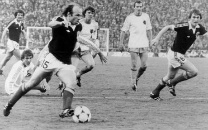
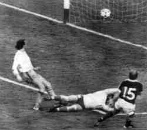
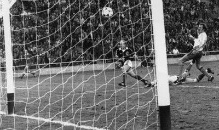
“I haven’t felt that good since Archie Gemmill scored against Holland in 1978!”: For Renton – and many Scots – Archie’s golden moment is even better than Trainspotting
Unlike the Scots, Peru – who started their tournament so brightly against the former – went through from their group and, impressively, ahead of the Dutch. Elsewhere, Austria shocked everyone by qualifying from their group ahead of Brazil. Poland, so good in ’74 and still packing Grzegorz Lato up front, managed to top their group ahead of holders West Germany, and Italy went through along with hosts Argentina, whom surely owed a real debt to their fanatical fans’ electric support in every match they played.
On to the second round groups then and, amazingly, Austria went one better than they already had – yes, they somehow defeated their big-time neighbours West Germany 3-2, the hero being forward Hans Krankl whose efforts and those of his teammates are still today lauded as Austrian football’s greatest ever achievement. Indeed, this match, in some ways an echo of the West Germans’ group stage defeat to East Germany in the previous World Cup, dented the Germans’ hopes of making the final, and draws against Italy and Holland (the latter an entertaining, if haphazard, replay of the previous tournament’s final) saw to it their title defence was over.
Conversely, it was in this same group that the Dutch discovered their form and, thanks to a 5-1 demolition of Austria and a 2-1 defeat of Italy, they topped the group. Indeed, although they weren’t exactly playing the brilliantly fluid ‘Total Football’ system they did in ’74 – and were missing Cruyff owing to kidnap threats against him and his family (his absence only being honestly explained in recent years) – they looked the real deal once again, playing fine football and scoring memorable goals. And now, once again, they were through to the World Cup final. What an opportunity, indeed.
The other second round group was, ultimately, struck by controversy; proper controversy. And in a very South American World Cup it involved the group’s three South American sides. Two of them, Brazil and Argentina, dominated proceedings, having both despatched Poland and rather disappointingly drawn 0-0 against each other. The table topper, of course, would go through to the final, so it came down to who could beat Peru by the most number of goals. Where was the controversy here then? Well, if one of the two sides kicked-off their final match – against the Peruvians – after the other’s final match, then they’d know how many goals they’d need to score to go through on goal difference, wouldn’t they? And that’s exactly what happened. And, suspiciously, it happened in favour of the hosts, Argentina – Brazil beat Peru 3-0; their rivals put six past them without reply. The Argentines were therefore through. That wasn’t all that was dodgy, though, given that it emerged the six-time-beaten Peruvian goalkeeper in that match, Ramón Quiroga, had in fact been born in Argentina. Both teams denied collusion in this regard and the tournament’s organisers couldn’t exactly be held culpable for ‘rigging’ Argentina’s progress to the final thanks to their matches’ scheduling, but the coincidences were, nonetheless, undeniable.
And that fact was disappointing because Argentina had a very good side. Coached by the chain-smoking César Luis Menotti (known as El Flaco – ‘The Slim One’) and driven by the centre-back who loved to attack, captain Daniel Passarella (who would go on to manage his nation in the 1998 World Cup), it also featured cultured, diminutive midfielder Osvaldo Ardilles and lanky play-maker Ricky Villa (who would both join English club Tottenham Hotspur the following season) and was spearheaded by moustachioed frontman Leopoldo Luque and major goal threat Mario Kempes. Yes, they were stylish, exciting and easy on the eye – even if, inexplicably, their squad was numbered alphabetically. Yet, as if willed on by the unfair advantage they’d received in match scheduling thanks to their compatriots who organised the whole shebang, they also didn’t mind playing dirty. And, frankly, that mired what should been a fine final.
It all started with the hosts keeping the Dutch waiting ready to start proceedings in Buenos Aires’ Estadio Monumental for five minutes, until they finally emerged from the tunnel to a gigantic tumult from the home fans packing the rafters. And that wasn’t all. In a concerted – and surely pre-arranged – effort, the Argentine players then complained to the referee about Dutch midfielder René van de Kerkhof wearing a plaster cast, even though he’d worn the cast on his wrist without previous complaint since his side’s opening match. Further minutes were wasted over the issue; indeed, the Dutch were so cheesed off they looked like they were about to walk off at one point. Eventually, the game kicked-off and in spite of the unsporting behaviour designed to rattle and unsettle the Dutch, the Argentines appeared to have gained no advantage as a balanced first-half proceeded, complete with a great deal of fouling and rule-breaking – mostly from Argentina – which scandalously, perhaps owing to the overpowering presence of fans with blue and white striped flags, went unpunished.

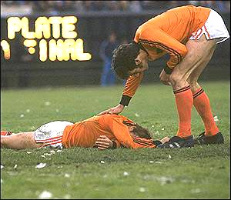
Winning ugly, losing fair: General Jorge Videla hands winning captain Daniel Passarella the World Cup; Dick Nanninga consoles a teammate after Holland come so close – again
Then, in the 37th minute, the deadlock was broken, as the long-haired Kempes expertly struck, putting his side in front. Unsurprisingly, the crowd went beserk, yet the men in orange didn’t wilt and – the second-half following much the same the pattern as the first – just eight minutes from time, conjured up a nice move topped off with Dick Nanninga heading in an equaliser. 1-1. Extra-time. Having led for some time and seeing victory snatched out of their hands so near the end, it wouldn’t have been surprising had Argentina deflated and run out of juice. Yet, they didn’t. Come the end of the first period of extra-time, up popped that man Kempes again and he just got enough on the ball in the penalty area to see it home and put his nation back in front. It was his sixth goal, giving him the Golden Boot and surely ensuring he was the player of the tournament too. Exhausted after a hard, physical match, the Dutch had gone for good now and, five minutes from the very end, right-winger Daniel Bertoni scored (despite a very strong suggestion of hand-ball), wrapping up the result and sparking delirious celebrations.
For the second World Cup in a row then, the Dutch had fallen at the final hurdle. Would they have managed to win the thing had Cruyff been in the side? Who knows, one can only speculate. Losing twice in a row in the final is a very painful reality, yet with the commendable magic and wonder of ‘Total Football’ which was so much the story of these two tournaments for Holland, theirs are nowadays looked upon as two truly glorious failures – and, because of that, the two sides are probably more fondly remembered than if either one of them had actually triumphed. And there’s something nice but also sort of enigmatically cool about that. After all, ‘Total Football’ was a wonderful dream – and don’t all the best dreams fail in the end?
In contrast, Argentina had won their first World Cup – the congatulations were theirs. Yet, aforementioned controversies aside, there’s more to why I’m not fond of this particular tournament; much more. And it concerns the man who handed Daniel Passerella the trophy after the final whistle: General Jorge Rafael Videla. The country’s leader thanks to his position as head of a miliary junta that had seized control just one year before, Videla was a tyrant of the worst sort. In truth, Argentina’s leadership had been unstable ever since the legendary Juan Perón was deposed by a coup in 1955, in which case one has to question FIFA’s decision to give this country hosting duties in the first place. Especially as, leading up to the tournament, there had been great doubts raised as to the viability and ethics behind it and offers had come from other countries, such as Holland, to host instead. FIFA’s reluctance to step in and do anything would come back to bite it royally on the arse, though, as the chairman of the organising committee General Omar Actis was bumped off – apparently because he spoke out about escalating costs.

Don’t cry for those Argentinians? Buenos Aires’ Naval Mechanics School today – the artwork on the railings speaks a thousand words
The reality was that Videla’s junta was sponsoring forced disappearances and assassinations within Argentina, ostensibly against left-wing figures, yet to to this day nobody knows how many people were affected or killed – the number is thought to be in the thousands, however. This campaign – effectively a campaign of terror – became known as the ‘Dirty War’ and was the backdrop then to the ’78 World Cup. To placate participating nations who were concerned about their teams’ safety if they went to the World Cup, Videla said that there would be no bloodshed during the tournament – apparently, this was good enough for FIFA. Perhaps rightly so, Holland had called for a boycott before they, obviously, relented. Meanwhile, German Paul Breitner (who had scored a penalty in the ’74 final) wouldn’t take part and for many years it was assumed this too was the reason for Cruyff’s absence.
In perhaps the most stark summation of the situation, it has been said that inmates in Buenos Aires’ infamous Naval Mechanics School, which was used as a concentation camp at this time and is located only about a mile away from the Estadio Monumental, could hear the roars of the crowd during the final. While the football was generally good and the tournament entertaining, the off-field reality of this World Cup was simply monstrous, to my mind.
Indeed, years later ’78 World Cup winner Leopoldo Luque admitted: “With what I know now, I can’t say I’m proud of my victory. But I didn’t realise; most of us didn’t. We just played football.” He has also said: “In hindsight, we should never have played that World Cup. I strongly believe that.”
Not since Mussolini’s grandstanding of fascism when Italy hosted the competition in 1934 had the ugliness and evil the real world can create impinged on and blighted a World Cup – let’s hope it never does so again.