Listen, my friends! Playlist: World Cup 2026
.
In the words of Moby Grape… listen, my friends!
Yes, it’s back (again), the occasional playlist presented by George’s Journal just for you good people – this time to mark the frenzied festival of football that’s the North American-hosted 2026 World Cup.
There may be one or two classics to be found here dotted in among different tunes you’re unfamiliar with or have never heard before – or, of course, you may’ve heard them all before. All the same, why not sit back, listen away and enjoy…
.
CLICK on the song titles to hear them
.
Original Motion Picture Cast ~ America (1961)¹
Lonnie Donegan ~ World Cup Willie (1966)²
England World Cup Squad ’70 ~ Back Home (1970)³
San Jose (Rod Argent) ~ Argentine Melody (Canción de Argentina) (1978)¹
Andy Cameron ~ Ally’s Tartan Army (1978)4
Royal Philharmonic Orchestra ~ The Jellicle Ball (1981)¹
Jeff Wayne ~ Matador (1982)¹
Opus ~ Live Is Life (1984)5
Heads ~ Aztec Lightning (1986)¹
Silsoe (Rod Argent and Pete van Hooke) ~ Aztec Gold (1986)¹
Englandneworder ~ World In Motion (1990)6
Rod Argent and Peter van Hooke ~ Tutti al Mondo (1990)¹
Luciano Pavarotti ~ Nessun Dorma (1990)¹
Tamba Trio ~ Mas Que Nada (1998)7
The Wimbledon Choral Society ~ Pavane (1998)¹
Fat Les ~ Vindaloo (1998)8
The Beatles ~ Come Together (1969)9
.
¹ The tunes used, unforgettably so in most cases, over the opening titles of the BBC and ITV coverage of World Cups past – in chronological order: America from Leonard Bernstein and Stephen Sondheim’s West Side Story (World Cup 1994, BBC); Rod ’The Animals’ Argent’s take on Argentine Melody from Andrew Lloyd Webber’s Evita (World Cup 1978, BBC); The Jellicle Ball from Lloyd Webber’s Cats (World Cup 1982, BBC); Jeff ‘The War Of The Worlds’ Wayne’s Matador (World Cup 1978, ITV); Aztec Lightning (World Cup 1986, BBC); Argent and Peter van Hooke’s Aztec Gold (World Cup 1986, ITV, and subsequently used for ITV’s late ’80s/ early ’90s Saint and Greavsie Saturday lunchtime football show); Argent and van Hooke’s Tutti al Mundo (World Cup 1990, ITV); Pavarotti’s unmistakeable take on Verdi’s Nessun Dorma (World Cup 1990, BBC) and Gabriel Fauré’s Pavane (World Cup, 1998)
² The official anthem performed by the early ’60s skiffle king for the 1966 tournament, hosted and won by England
³ The legendary official song for England’s defence at World Cup 1970, performed by the squad itself, and later constantly celebrated/ mocked by David Baddiel and Frank Skinner on their soccer comedy show Fantasy Football League (1994-96)
4 Comedian Cameron’s memorably jolly but ultimately hopelessly hopeful tune to promote Scotland’s ill-starred World Cup 1978 campaign, which hit #6 on the UK Singles charts
5 Austrian rockers Opus’s hit song, which became synonymous with the boyishly exuberant on-pitch genius of World Cup 1986 Golden Ball awardee Diego Maradona, owing to it soundtracking (thanks to its use over stadium speakers) footage of him warming up with Napoli teammates and practicing keepy-uppy skills ahead of an April 1989 UEFA Cup semi-final against Bayern Munich, which eventually went globally viral in a pre-Internet age
6 The cast-iron classic official song (and UK chart-topper) for England’s fondly recalled World Cup 1990 campaign, written and performed by the iconic New Wave outfit and featuring a surprisingly impressive rap courtesy of John Barnes
7 The now legendary Nike TV ad that seemed to be everywhere (at least on TV screens) during the ‘Nike vs. Adidas’ branding war that was also referred to as World Cup 1998 and which featured the then famed Brazilian team performing tricks and flicks while supposedly waiting for a flight at an airport
8 The alternative anthem (UK #2) for England’s World Cup 1998 campaign; created and performed by a one-time musical collective spearheaded by actor Keith Allen (dad of Lily) and Blur bassist Alex James, it was embraced by many at face value as a suitably primal, tribal ’90s ‘lad culture’ chant that was perfect for an England team-tilt at a World Cup, while others readily recognised its mocking faux-nationalism, marking it out as a(n overly?) clever, money-making send-up
9 The official and really rather beautiful video announcing the England squad for their World Cup 2026 campaign, backed by a brilliantly fitting and, of course, fantastic track from The Fabs
.

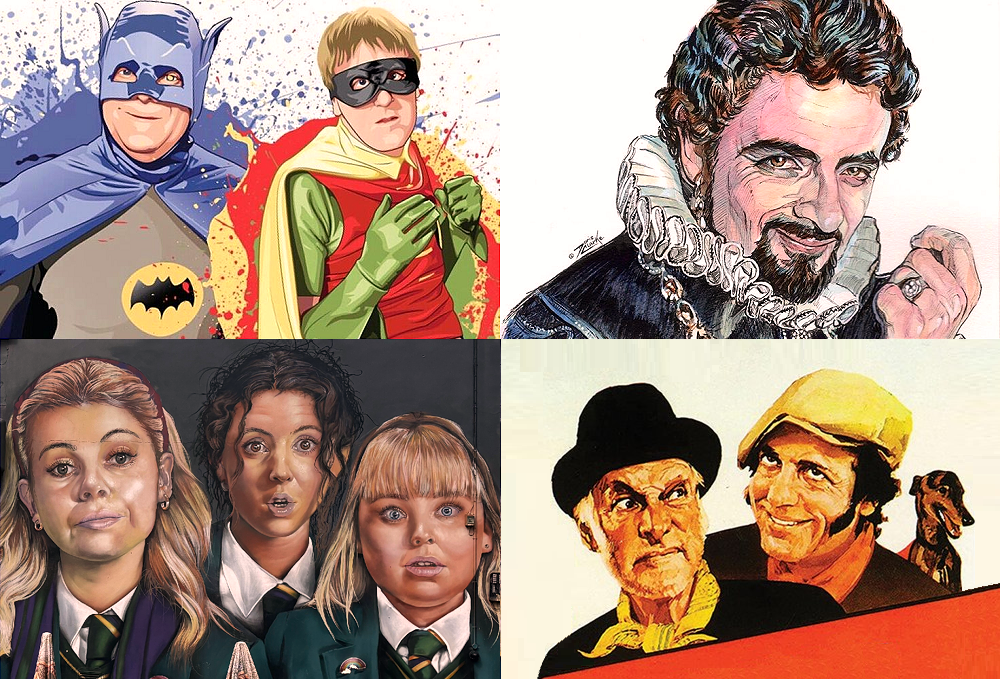
Quality quartet: you may well have laughed at and loved each of these four British sitcoms but where do they come on the all-time countdown and just which classic series is the number one rib-tickler?
Two or three decades ago, you couldn’t go an hour or two watching TV in the UK without a sitcom popping up. Nowadays, because the nature of television, cultural tastes and how we consume both have changed, not so much.
Despite this blog being committed to looking back at things past, though, I’ll never subscribe to the cliché that ‘everything was better back in the day’; it simply isn’t true. Yet, in the case of modern TV versus past telly and the demise of (especially the British) sitcom, surely you’d be a plonker not to recognise we never had so good as we did in the ’70s, ’80s and ’90. Reggie Perrin and Rigsby, and Del Boy and Rodney versus Amandaland and – gah! – Mrs Brown’s Boys? The realisation of a brilliant Baldrick-like cunning plan, this surely isn’t.
So, to put a more positive spin on things and enacting that age-old political ploy of turning a setback into an opportunity (just as Jim Hacker would try to, with or without Sir Humphrey’s help), I’ve decided to come up with a couple of (apologies, marathon-long) posts to celebrate Blighty’s situation comedy tradition at its finest by offering up, to all and sundry, a rundown of the 2o greatest sitcoms this little island has ever produced, in my humble opinion, of course.
Was this a painstaking effort? Did it take forever to put together? Feck me, yes. Will it raise a (likely unintentional) laugh or two and result in a heckle, here and there (sorry, there’s no Dad’s Army, Fawlty Towers or The Office; none have ever truly clicked with me)? Quite possibly. But I… or, er, this blog didn’t get where it did today by always being lovely jublee about everything. Or without mixing its metaphors and its sitcom puns.
Anyway, settle down in that armchair, put down that remote and dunk that custard cream in your cuppa because, yes, here we go! Cue that cosily familiar theme tune…
.
.
.
.
Original channel: Channel 4
Seasons: 3 (1995-98)/ 25 episodes
Christmas specials: 1 (extended episode; 1996)
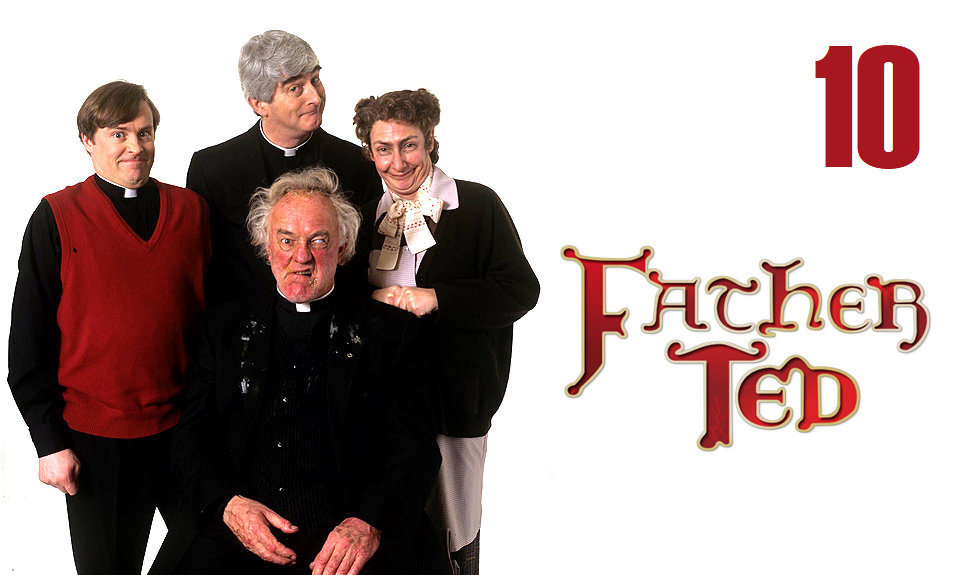
Regular cast: Dermot Morgan (Father Ted Crilly), Ardal O’Hanlon (Father Dougal McGuire), Frank Kelly (Father Jack Hackett) and Pauline McLynn (Mrs Doyle)
Regular crew: Graham Linehan (creator/ writer/ director); Arthur Matthews (creator/ only other writer); Declan Downey (director); Andy de Emmony (director); Geoffrey Perkins (producer)
The situation: Father Ted is a selfish, conniving but largely sensible priest who, for an indiscretion alluded to but never explained, has been banished by the Irish Catholic Church to the desolate Craggy Island with its backward inhabitants. With Ted live the also discarded Father Dougal, whom seems to be a child in a man’s body (and yet somehow at some point qualified as a priest), and Father Jack, a wildly unkempt, monosyllabic, offensive and permanent drunk. Their housekeeper is the ludicrously patient Mrs Doyle (obsessed with serving tea) and their greatest grievance visits from other oddball, corrupt priests or – especially – nuns.
The greatness: Before Graham Linehan lost the plot as a Twitter transphobe, he deservedly made his name as the creator and writer of Channel 4 sitcoms (2000-04’s Black Books and 2006-13’s The IT Crowd), full of desperate characters and lashings of absurdity, surrealism and wonderfully jolting hand-break turns – and the best of of them was undoubtedly the first, Father Ted. So much so, it’s easily one of Britain’s and – as an Anglo-Irish TV effort – probably Ireland’s best sitcom, too.
In truth, Father Ted seemed to come, fully formed and fantastic, out of nowhere. An instant Gen-X sensation, it became beloved by its wide but young-ish audience, which revelled in its ever-so-slightly unnerving and occasionally vulgar laughs, its anti-establishment stance (the Catholic Church comes in for a constant kicking), its unexpected cleverness (the iconic ‘small or far away cows’ joke and the Speed homage on a milk-float) and, well, its wonderful (very Irish) weirdness.
As ever with seriously good sitcomming, the success lay in the writing and the characterisation. Father Ted may have been tonally unlike quite anything on television but the strength and consistency of its irresistible tone was bolted to solid plotting with sometimes unforgettable set-pieces (but which cannily knew its limits) and driven by gloriously good characters.
Morgan’s Ted was the perfect put-upon, common-sense straight-man to the deliriously silly Jack (played by, yes, classical actor Kelly) and break-out character-and-a-half Dougal, whom was so loveable he gave the show its necessary heart (and made O’Hanlon a TV star). Meanwhile, McLynn’s Mrs Doyle and, frankly, every guest character added further layers of absurdity and incredulity, terrifically stirring the (tea) pot as much as possible.
Greatest episode: A Song For Europe (Season 2)
Title theme: Theme by Neil Hannon
Spin-offs: 0 (tragically, Morgan died in 1998 aged just 45, ruling out any more Father Ted or, it seems, further visits to its universe)
Did you know? Neil Hannon, writer of the show’s theme, is the driving force behind The Divine Comedy, and the tune appears as Songs Of Love (with added lyrics) on the band’s sophomore and seminal 1996 album Casanova.
In 2014, Hannon’s ditty My Lovely Horse (Ted and Dougal’s effort for Ireland’s entry in a very obvious take-off of the Eurovision Song Contest; see video below) was the subject of a petition-to-government looking to elevate it as Ireland’s actual entry for the following year’s Eurovision; sadly, the tongue-in-cheek move was turned down.
.
.
.
.
.
.
.
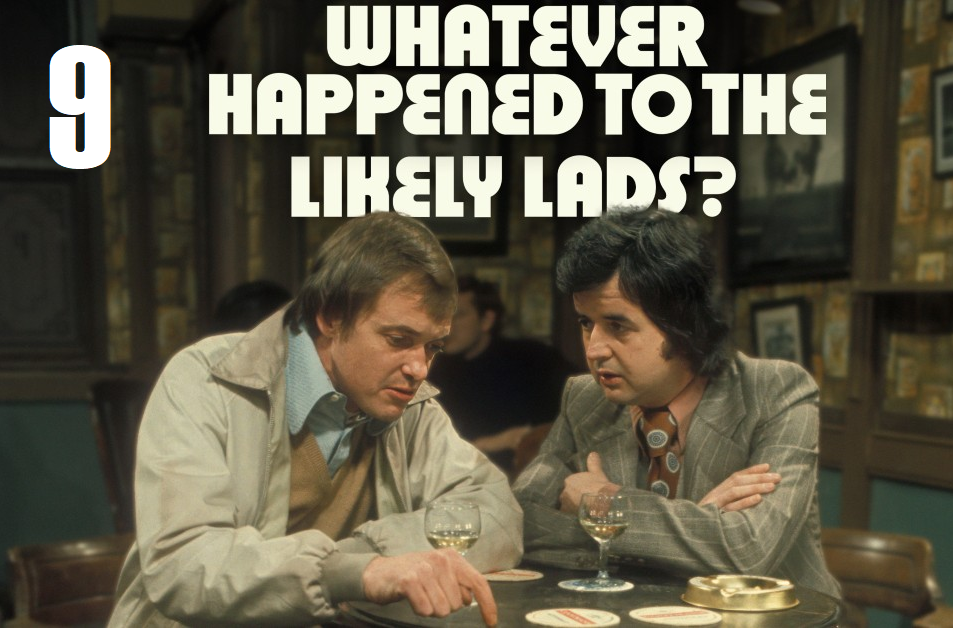
Original channel: BBC1
Seasons: 2 (1973-74)/ 27 episodes
Christmas specials: 1 (extended final episode)
Regular cast: James Bolam (Terry Collier), Rodney Bewes (Bob Ferris), Bridgit Forsyth (Thelma Chambers/ Ferris) and Sheila Fearn (Audrey)
Regular crew: Dick Clement and Ian La Frenais (creators/ only writers); James Gilbert (producer)
The situation: Terry, having served in the British Army in the Middle East for a few years and recently divorced from a young German wife, returns home to his native Newcastle-upon-Tyne but discovers much has changed in the traditionally working-class city he once knew so well.
Not only have landmarks from his youth gone and tenement houses been replaced by ghastly high-rise flats but, worst of all, his best friend Bob is now engaged to the no-nonsense and sharp-as-a-tack Thelma, works as a manager in her father’s construction firm and wants to join the middle class, having bought a house on a new suburban housing estate.
Yet, has Bob actually changed that much? Can he still get up to no good and into Thelma-disapproving scrapes with the left-behind, now fish-out-of-water-esque Terry…?
The greatness: The one entry on this list that instead of spawning a spin-off or two was itself a spin-off, Whatever Happened To The Likely Lads? exceeded the popularity and acclaim of its predecessor sitcom (1964-66’s The Likely Lads) by picking up the lives of the latter’s protagonists as thirtysomethings in the early ’70s and running with that concept to dizzying heights.
Indeed, its exploration of the themes thrown up by its set-up (see above) and its setting (the evolving North-East) was top-notch. Every episode found a way to look at the passage of time, nostalgia, social-class blurring, working-class patriarchal demise, urban redevelopment, sexism and (to an extent) feminism. And, never overplaying its hand, it did so with a cannily light touch; social truths were always conveyed in good humour via knowing wit.
Its success lay in the fact TV writers extraordinaire Clement and La Frenais’ outstanding scripts were perfectly complemented by the brilliant, believable characters that were Terry and Bob. As a bit of an odd-couple double-act, Bolam and Bewes were second-to-none; fully fleshing-out rather than reviving their ’60s ‘likely lads’ and relishing every word of every line the delightful dialogue gave them.
In which case, everything about Whatever Happened To The Likely Lads? felt authentic, while it also admirably delivered a far more upbeat version of the North-East than many a news report or, say, Get Carter (1971) ever did. It’s grim up north? Howay, man! With Terry and Bob, it was anything but.
Greatest episode: Boys Night In (Season 1)
Title theme: Whatever Happened To You? (Highly Likely)
Spin-offs: The Likely Lads (1976; cinematic feature film)
Did you know? In 2002, nearly three decades after its original broadcast, No Hiding Place (the classic episode from the first season in which the lads spend a whole day trying to avoid finding out a football result) was reshot in its entirety with ITV’s self-appointed Geordie ambassadors Ant and Dec as Bob and Terry, respectively; reaction to this one-off tribute was mixed but, in a decidedly nice touch, it did feature Bewes in a blink-and-you’ll-miss-it cameo as a newspaper seller.
.
.
.
.
.
.
.
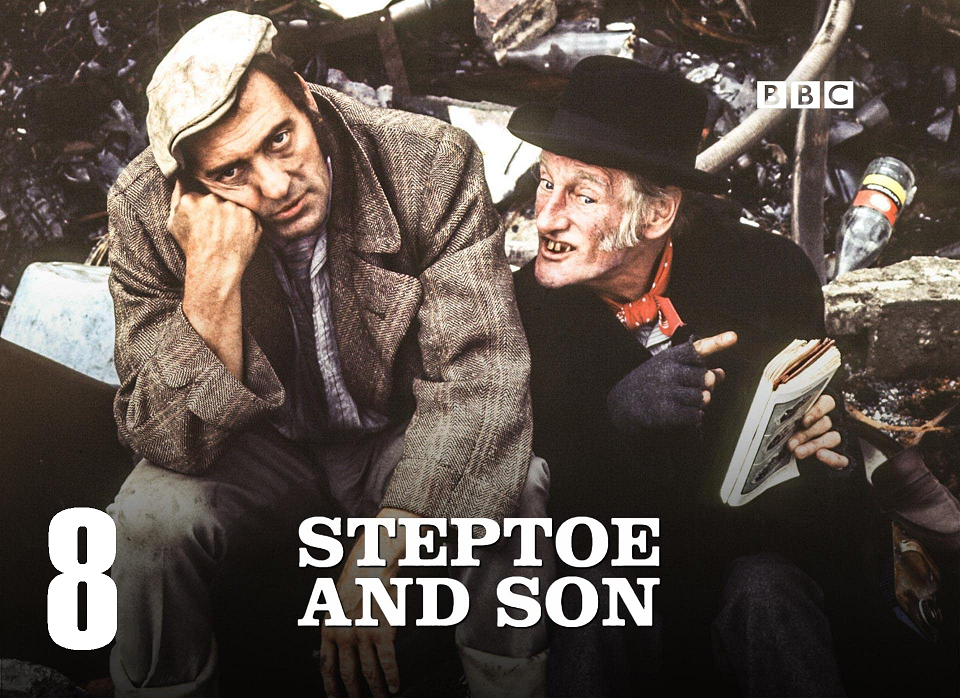
Original channel: BBC/ BBC1
Seasons: 8 (1962-74)/ 57 episodes
Christmas specials: 2 (extended episodes, including final episode; two short specials also featured, respectively, in the 1962 and ’67 editions of the BBC’s Christmas Night With The Stars)
Regular cast: Harry H. Corbett (Harold Steptoe) and Wilfred Brambell (Albert Steptoe)
Regular crew: Ray Galton and Alan Simpson (creators/ only writers); Duncan Wood (producer/ director); John Howard Davies (producer/ director); Douglas Argent (producer/ director)
The situation: Harold is a bedraggled rag-and-bone-man in West London’s Shepherd Bush, in whose ‘Oil Drum Lane’ he lives in a run-down property with his elderly father Albert, from whom he effectively inherited their junkmen business.
Harold and Albert are polar opposites and endure a deeply dysfunctional, volatile relationship. The former is a dreamer; he longs to escape his father, tries to better himself and, although of limited education, is relatively well-read.
The latter is lazy, wily, dresses poorly and maintains even poorer hygiene, yet is content with his lot and worldlier than his son, and so manages to outdo him at any and every opportunity and activity.
The greatness: The OG giant British sitcom, Steptoe And Son enjoys a mythic status. It’s the one that, now in the 2020s, many modern Britons may not have actually seen but, thanks to cultural osmosis, know its set-up, its music and its characters. Indeed, once it was as big and resonant as Only Fools And Horses; in terms of TV (and definitely sitcom) history, it’s just as important and often as good.
Conceived by iconic writers Galton and Simpson (their first major project after the equally seminal sitcom that was 1956-61’s Hancock’s Half Hour), Steptoe and Son’s set-up was sublimely simple and, therefore, the situations, complications and action of each episode blithely straight-forward. So much so, there was a wonderful purity to it all.
Almost entirely a two-hander, the show lacked witty dialogue and bore as much resemblance to a Tom and Jerry or Looney Tunes cartoon as it did to the sophisticated near-TV drama of, say, Ever Decreasing Circles (although not physically violent, it overflowed with verbal and psychological violence and, for its era, was also stridently gritty and edgy). Yet, where it delivered in absolute spades was its unbridled, almost painful tragicomedy. In that regard, few British sitcoms have got close to its magic.
Each episode wouldn’t just wind up to 11 Harold and Albert’s sparring but would wring as much as possible out of the desperation and pathetic nature of Harold’s situation (only enhanced, of course, but how pathetic a character he was). Obviously, this owed much to the the perfection of Corbett’s performance and, in turn, to the corking comic creation that was Brambell’s Albert.
The pathos Steptoe And Son managed to generate, then, was off the charts; the human pain softened by the laughs something true and universal. Just like the show itself, it was twisted but beautiful.
Greatest episode: Divided We Stand (Season 7)
Title theme: Old Ned by Ron Grainer
Spin-offs: 1972’s Steptoe And Son and 1973’s Steptoe And Son Ride Again (cinematic feature films)
Did you know? As, a young actor, Corbett added the middle ‘H’ initial to his name (which he would later joke stood for ‘hennyfink’; Cockney for ‘anything’) to avoid confusion with puppeteer Harry Corbett, whom was then enjoying enormous success on TV as the creator and original performer of iconic kids’ favourites Sooty, Sweep and Soo; rather quirkily, both Harry Corbetts featured in 1976’s New Year Honours list.
An Irishman who settled in the UK as a middle-aged actor, Wilfred Brambell was actually only 13 years older than his Steptoe co-star and is fondly recalled, too, for playing Paul McCartney’s ‘grandfather’ in A Hard Day’s Night (1964).
.
.
.
.
.
.
.
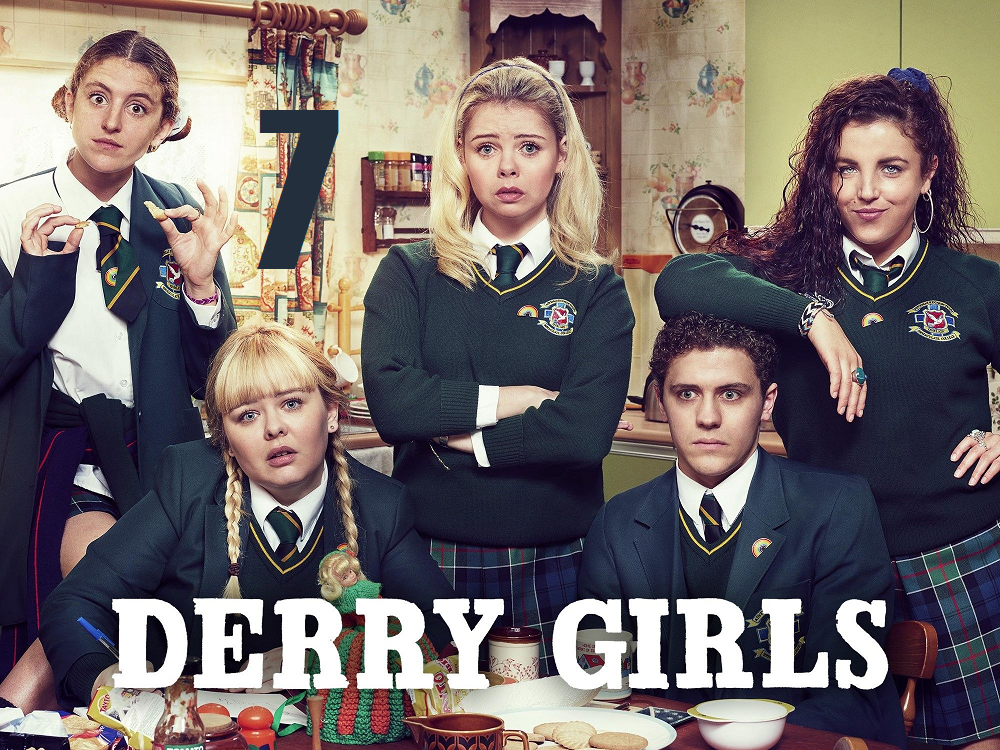
Original channel: Channel 4
Seasons: 3 (2018-22)/ 19 episodes
Christmas specials: 0
Regular cast: Saoirse-Monica Jackson (Erin Quinn); Nicola McCoughlan (Clare Devlin); Jamie-Lee O’Donnell (Michelle Mallon); Dylan Llewelyn (James Maguire); Louisa Harland (Orla McCool); Tara Lynne O’Neill (Mary Quinn); Tommy Tiernan (Gerry Quinn); Kathy Kiera Clarke (Sarah McCool); Ian McElhinney (Joe McCool); Leah O’Rourke (Jenny Joyce) and Siobhán McSweeney (Sister George Michael)
Regular crew: Lisa McGee (creator/ only writer); Michael Lennox (director)
The situation: Erin is an aspirational teenager, growing up in the Catholic suburbs of ’90s Derry, towards the end of Northern Ireland’s ‘Troubles’. She lives with her ‘Ma’ Mary (the de facto leader of the household), her dad Gerry (Ireland-born and easy-going), her maternal grandfather Joe (sarcastic and always picking on Gerry), her aunt Sarah (hopelessly dreamy) and her cousin Orla (whom seems to live in her own universe).
Together with Orla, Erin knocks about with two schoolfriends she’s known all her life: the academic but anxiety-plagued Clare and the boy-obsessed tearaway Michelle, the latter of whose English cousin (the fish-out-of-water James) has been dumped in her household and, therefore, forced to attend the quartet’s girls-only school. Hopelessly maladroit and even less mature, the gang try to negotiate the vagaries of adolescent life in their intricate, sectarian hometown, usually with disastrous results.
The greatness: In the everything-up-for-grabs era of modern TV, in which network channels battle for any market share in a vain fight against world-conquering streaming giants, British sitcoms now struggle to get made, let alone strive, so Channel 4’s glorious Derry Girls (and the phenomenon it became) was a glorious surprise nobody saw coming in the late 2010s – least of all sceptical old me – and so, methinks, should be celebrated to the skies.
Like Extras (see last post), in that its set-pieces (the girls’ side-splitting hijinks and disasters) were actually only its headline act, the show’s secret sauce was the detail-rich, fully three-dimensional character-driven world it absorbed viewers into each episode. Its sense of time, place and delightfully quirky and earthy people was wonderfully immersive. There wasn’t just a constant hilarity to Derry Girls but a cosiness, a warm-heartedness and a knowingness; it was this unbeatable combination that made it such a binge-worthy little-show-that-could-and-did in an age of binge-seeking TV behemoths.
Terrifically well-written and cast (it made breakout stars of the now-ubiquitous Nicola Coughlan and Siobhán McSweeney), Derry Girls offered, too, something unique that narrative TV has rarely tried, let alone pulled off – a setting in an era of instability and violence but with a subtle, light touch. That’s to say, ‘The Troubles’ may have been the show’s backdrop but because its action was nostalgic, light-hearted adolescence and tightly-knit family life, that backdrop was mostly kept at arm’s length.
As far as the teenagers were concerned, then, the province’s problems weren’t their problem and so barely ever concerned their daily lives. As such, reference to ‘The Troubles’ was often left to the likes of the girls walking past an armed barricade as if it were the most normal thing in the world – a nuanced, refreshing comment of defiance that spoke a thousand words. In short, like everything in Derry Girls, it was treated, more often than not, with a breezily smart insouciance that was impossible to resist.
Greatest episode: ‘Episode 1’ (Season 1)
Title theme: Dreams (The Cranberries)
Spin-offs: 0 (but the five main cast members sort of resurrected their characters for a pandemic-era ‘zoom call’ sketch for the BBC’s 2020 Comic Relief appeal)
Did you know? While there’s a sense that, like Peaky Blinders did for Birmingham, Derry Girls helped put modern Northern Ireland on the map, the show is also adored in the province itself; statistically speaking, it’s the most watched TV programme there in 20-odd years (since reliable records began in 2002), its average 519,000 viewers a – fittingly – titanic 64 per cent audience share.
.
.
.
.
.
.
.
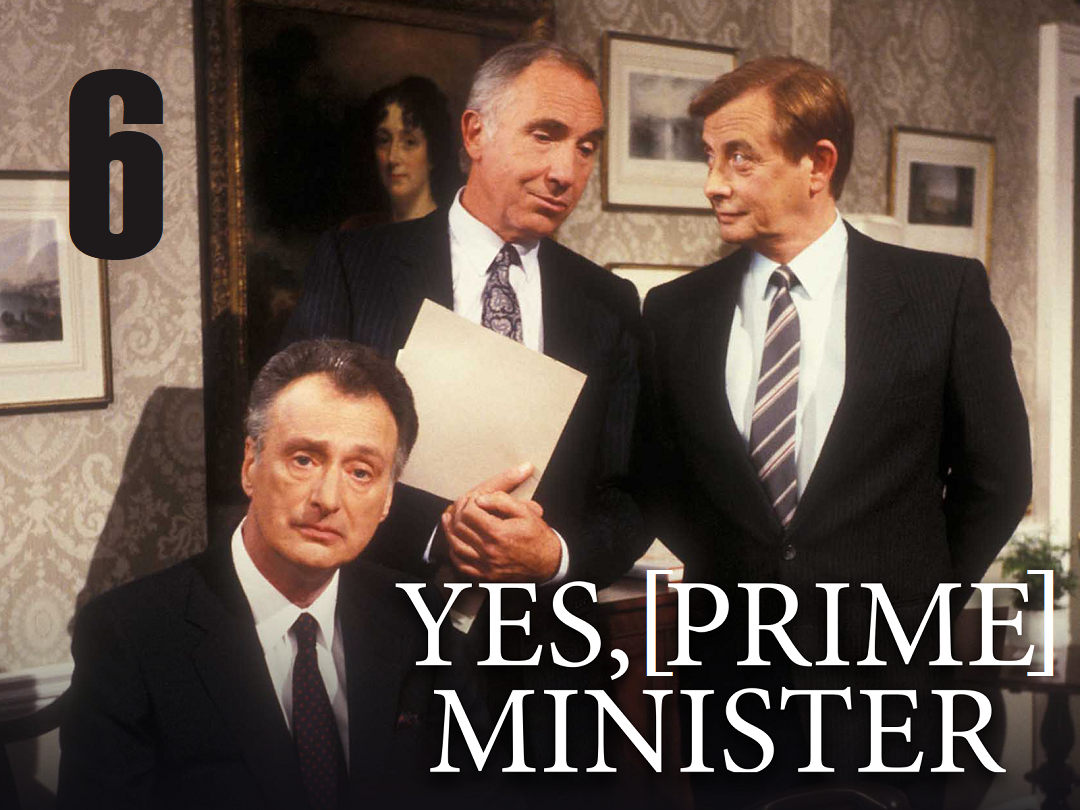
Original channel: BBC2
Seasons: 5 (1980-88)/ 38 episodes
Christmas specials: 1 (plus, a short festive special featured in The Funny Side Of Christmas, broadcast on BBC1 in 1982)
Regular cast: Paul Eddington (Jim Hacker), Nigel Hawthorne (Sir Humphrey Appleby), Derek Fowlds (Bernard Woolley) and Diana Hoddinot (Annie Hacker)
Regular crew: Anthony Jay and Jonathan Lynn (creators/ only writers); Sydney Lotterby (producer)
The situation: Jim Hacker is a Cabinet Secretary in a soft-right (presumably) Conservative Government. He’s mostly well-intentioned and likeable but just as ambitious as the next MP and, therefore, malleable in the eyes of the more intelligent and better informed playing the Westminster political game alongside him.
One of whom is the artful, smooth and loquacious Sir Humphrey, the Permanent Secretary – senior civil servant – in the department Hacker leads (Administrative Affairs), whom spends most of his time trying to guide and/ or manipulate Hacker to thwart the latter’s more progressive, radical or reforming policy proposals. Sir Humphrey is aided and abetted in these efforts by another, albeit less experienced civil servant, Hacker’s Permanent Private Secretary (PPS), the slightly slow-on-the-uptake Bernard.
About halfway through his time in Government, Hacker is – against all odds – elevated to Prime Minister, which sees Sir Humphrey become the most powerful civil servant in the land and Bernard remain as PPS, but now to the PM. (At this point, accordingly, the show’s name changed from Yes, Minister to Yes, Prime Minister.)
The greatness: It may have been Margaret Thatcher’s favourite thing on the box while she was PM (she even performed a sketch with Eddington and Hawthorne, written by its scribes, when giving the show an award) but don’t let that put you off – Yes, Minister/ Yes, Prime Minister, in its day, was also easily one of the best things on the box.
Many would say that was down to how brilliantly reflective of its real-life setting it was; then Labour Shadow Cabinet Secretary Gerald Kaufman described the show as “The Rt. Hon. Faust MP, constantly beset by the wiles of Sir Mephistopheles”. Indeed, many of its scripts were based on actual Westminster/ Whitehall incidents. However, that’s only partly why it worked so well (after all, any satire worth its salt satisfyingly reflects the reality of its target).
The real secret of Yes, Minister/ Yes, Prime Minister’s success, then, was its accessibility; its ability to take stolid yet intricate political issues and necessarily complex plots and interweave them, every episode, into a standard, characterful sitcom format, with all its audience-friendly, familiar beats and laughter-lines. This was its makers’ and performers’ collective stroke of genius. It may have been as smart and sly as Milton Friedman’s economics but it was as populist as Mrs T’s policies (with which it otherwise shared little, I might add).
For, just like Steptoe And Son and Whatever Happened To The Likely Lads?, at the core of Yes, Minister/ Yes, Prime Minister was that tried-and-tested comedy trope: a struggle of wills between the main characters – the dim but well-meaning Hacker and the all-knowing but smugly complacent Sir Humphrey. Perfectly drawn, indulged with delightful dialogue and expertly realised (nobody could do dumfounded like Eddington; nobody could do overly-verbose monologues like Hawthorne), they were simply an all-time great double-act; the lynchpin of an all-time great sitcom.
Greatest episode: Party Games (Christmas special, 1984)
Title theme: Theme by Ronny Hazlehurst
Spin-offs: 0 (but eventually there followed How To Beat Sir Humphrey: Every Citizen’s Guide To Fighting Officialdom, a radio play broadcast on BBC Radio 4 in 1997, and two stage plays: 2010’s Yes, Prime Minister and 2023’s I’m Sorry, Prime Minister, I Can’t Quite Remember)
Did you know? The actors’ deliriously exaggerated caricatures in the show’s opening titles were, fittingly, the work of Gerard Scarfe, legendary political cartoonist and conceptual artist for Pink Floyd – The Wall (1982) and Disney’s Hercules (1997); Scarfe’s wife is the star of Alfie (1966) and one or two sitcoms herself (as well as one-time Paul McCartney squeeze), Jane Asher.
.
.
.
.
.
.
.
Original channel: BBC1
Seasons: 4 (1975-78)/ 30 episodes
Christmas specials: 1 (plus, the final episode was a Royal Command Performance attended by The Queen and Prince Philip in celebration of the former’s 1977 Silver Jubilee, although it was filmed and broadcast the following year)
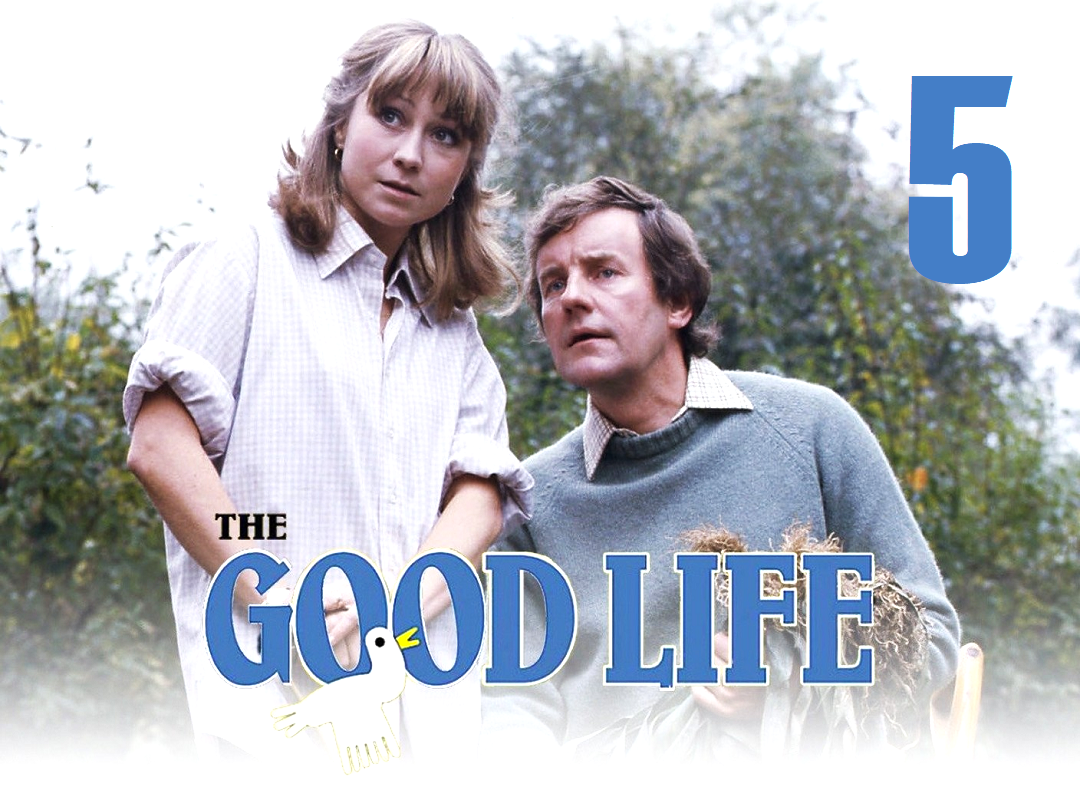
Regular cast: Richard Briers (Tom Good), Felicity Kendal (Barbara Good), Penelope Keith (Margo Leadbetter) and Paul Eddington (Jerry Leadbetter)
Regular crew: John Esmonde and Bob Larbey (creators/ only writers); John Howard Davies (producer)
The situation: Tom is a resolute but optimistic and affable 40-year-old draughtsman who designs ephemeral toys included as freebies in cereal packets. Fed up with his job and life, he persuades his oft heart-over-head but witty, good-humoured wife Barbara to abandon their comfortable middle-class existence in South London’s pleasant Surbiton and become self-sufficient. This sees them turn their front and back gardens into allotments (complete with chickens, pigs and a goat), live off their own produce and get by on an shoestring.
The couple’s transformation bewilders their next-door neighbours and close friends, Jerry and Margo. The former is a high-achiever in the company Tom has left but bemoans his stressful life; the latter an irrepressible cornerstone of polite Surbiton society, domineering yet loving, a stickler for standards and (socially at least) a prude. In spite of their misgivings, though, Jerry and Margo care deeply for Tom and Barbara (and them likewise) and try to support their new lifestyle.
The greatness: Easily the most popular of the many shows turned out by sitcom kings Esmonde and Larbey and the most popular thing any of its stars appeared in (whom all became giants of the small screen because of it), The Good Life was so damned good it was surely the best thing its writers and stars ever did, too. Yet, half a century on from its heyday, the reason why it’s so enduringly watchable and remains so well regarded isn’t quite so easy to put your, er, green finger(s) on.
For, while this so-easy-to-fall-for show appears to be the ultimate cosy sitcom populated by decent characters caught-up in light-as-air plots with low-stakes complications, that’s something of a smokescreen. In actuality, The Good Life was a tad smarter (and sharper) than its many millions of fans realised; under the surface, what it was up to was more intriguing and arguably more satisfying than it’s deceptively pleasing veneer suggested.
In pitting the new-agey Goods up to their necks in ’70s-trendy self-sufficiency in staid Surbiton ‘against’ the Leadbetters, their wealthy, decidedly materialistic neighbours, its makers certainly delivered a never-bettered-on-the-box ‘comedy of manners’ but they also offered up a slyly subtle satire of middle-class mores, conventions and expectations.
The easy assumption to make here is that it was Margo and Jerry, with their ‘acceptable’ conservative prejudices, who were the weekly targets of gentle ridicule and, largely, that would be right. Yet, consider too the fact that Tom and Barbara stubbornly – or maybe comfortably? – chose to opt-out while living in their nice house and keeping their closer-than-kin best friends in leafy suburbia. Were we, then, always supposed to look more fondly on and ‘side’ with the latter couple over the former?
Whatever the answer (as if it matters), The Good Life was a triumph. And, let’s face it, nuanced undercurrents or not, that was because every episode was an utter delight. Indeed, it’s hard to think of a cast that achieved quite such perfect chemistry in British comedy than its four leads: the ever-brilliant Briers, the bright and breezy, impossible to resist Kendal, the always one-step-behind Eddington (again) and, of course, the indefatigable, flawless Keith in the breakout role of all breakout roles.
Thanks to them, the superb scripts with all their delicious dialogue, and a crew who knew how to turn, yes, cosy comedy into TV gold, the wit and wisdom of The Good Life will wonderfully live forever.
Greatest episode: Silly But It’s Fun (Christmas special, 1977)
Title theme: Theme by Burt Rhodes (by the way, check out this incredible cover by What We Do In The Shadows’ Matt Berry)
Spin-offs: Life Beyond the Box: Margo Leadbetter (2003; BBC2 mockumentary)
Did you know? A relative unknown prior to The Good Life (who had quirkily grown up in her parents’ theatre troupe as it travelled around India), Felicity Kendal quickly earned household name status and, in part thanks to her constant appearance on the show in tightish jeans and other boyish clothes, became a sex symbol for many years thereafter; indeed, she ‘won’ the UK’s Rear of the Year award in 1981.
In spite of this, when her young son, right before the live recording of the final episode’s Royal Command Performance, was presented to and handed flowers to The Queen, the latter (on being told whose son the boy was and apparently claiming the sitcom was her favourite BBC programme, hence the performance in her honour) reputedly asked the attendant BBC bods “Who is Felicity Kendal?”.
.
.
.
.
.
.
.
Original channel: BBC2
Seasons: 2 (1997-2002)/ 12 episodes
Christmas specials: 0 (but there was something of a special during the BBC’s 1999 Comic Relief night, which included Alan performing a live Kate Bush medley)
Regular cast: Steve Coogan (Alan Partridge), Felicity Montagu (Lynn Benfield), Simon Greenall (Michael), Amelia Bullmore (Sonja), Barbara Durkin (Susan), Sally Phillips (Sophie), James Lance (Ben) and Phil Cornwell (Dave Clifton)
Regular crew: Armando Iannucci (creator/ writer/ director); Peter Baynham and Steve Coogan (creators/ only other writers); Dominic Brigstocke (director)
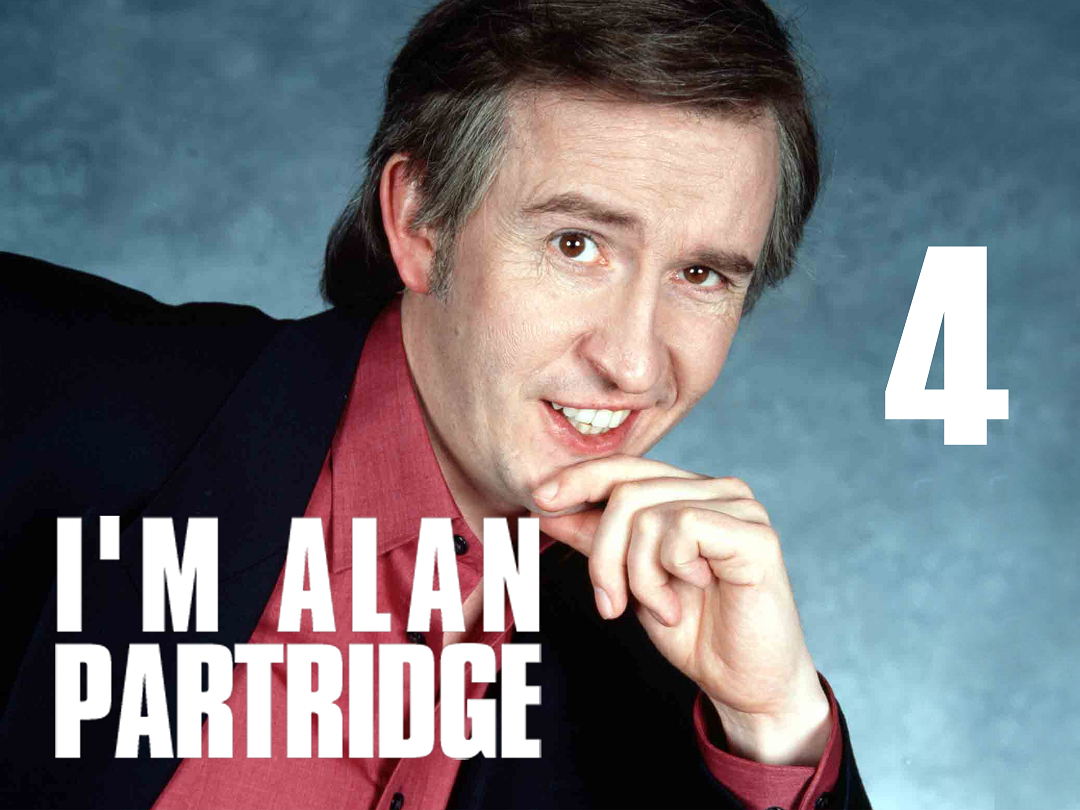
The situation: Alan is a TV presenter trying to survive without a TV show to present (the final episode of his recent BBC chat show Knowing Me, Knowing You With Alan Partridge descended into on-air chaos, dooming it to the dreaded axe). Middle-aged, deeply unfashionable, socially unaware and prone to clumsy, inappropriate expressions, Alan is out of place in the late ’90s (and beyond), blithely carrying on with 1970s/ ’80s values and attitudes. Moreover, having lost his job and respected household name status, he’s also lost his wife and house; he now presents the middle-of-the-night slot on Radio North Norfolk and is a long-term guest at the Linton Travel Tavern. Despite all this, he’s determined to ‘bounce back’ and is constantly flanked by Lynn, his prudishly prim, unfeasibly loyal PA of many years.
When we catch up with him five years later (Season 2), Alan’s no longer stuck in his purgatory-like rot. Still ensconced at Radio North Norfolk, he’s bought a new house and lives in an on-site static caravan owing to extensive building work, enjoys a healthy-ish, unconventional relationship with Ukrainian girlfriend Sonja and socialises with a former Linton Travel Tavern employee, the strong Geordie-accented Michael, whom works nights at a local petrol station. Yet, being Alan, of course, our hero still manages to get himself into just as many ridiculous misadventures as before.
The greatness: Starting out as the sports reporter on Armando Iannucci’s news show satire The Day Today (1994) before graduating to the aforementioned actual chat show parody Knowing Me, Knowing You With Alan Partridge (1994-95), the Steve Coogan-performed, deeply flawed media personality that’s Alan Partridge has, over the past three decades, become modern UK comedy’s most enduring character and, frankly, a national institution but, of all his TV shows, podcasts and live appearances, this fully-fledged, Millennium-era sitcom has always been his best – and funniest – showcase.
With Coogan and Iannucci’s incredibly well-drawn creation at its centre, then, I’m Alan Partridge was a sometimes edgy, teensy bit unnerving but always easy-to-consume examination of a tragic hero’s foundering attempts to remain relevant in a world that’s moved on, no longer needs him and doesn’t care what happens to him. As such, the level of desperation in every episode (nay, in basically everything Alan did) was near constant, while the level of pathos was inevitably high, too.
Yet, unlike in a more wholesome sitcom, the empathy was tempered and exquisitely so because of how regressive and selfish Alan was. Indeed, in a stroke of genius on the part of its creators, the character was (and has always remained) the embodiment of British ‘boomer ick’. A sort of more acceptable Alf Garnett equivalent for the less class-oriented, more media-obsessed 21st Century. And it’s this that makes him uniquely irresistible for Gen-X and Gen-Y Brits and beyond.
However, it wasn’t Alan alone that ensured the greatness of I’m Alan Partridge and why viewers always came back for more. For supporting him was a coterie of pretty much just as well-observed characters; from the put-upon but quietly condemning Lynn to the everyday yet slightly unsettling Michael and the confused, transactional Sonja to the bemused, grin-and-bare-it Linton Travel Tavern employees.
Populating brilliantly written, terrifically delivered plots that saw Alan navigate scrapes with TV executives, crazed fans, a swinger couple, an overly erotic fellow divorceé, a new acquaintance to whom he was hopelessly devoted and, of course, his own ‘friends’ – to whom he unforgettably acted out the opening of The Spy Who Loved Me (1977) – these characters, whirling around the man himself, helped I’m Alan Partridge pull off a timely, albeit exaggerated portrait of the modern British man, complete with all his foibles, insecurities, hypocrasies and uncomfortable home truths.
Greatest episode: A Room With An Alan (Season 1)
Title theme: Theme by Jonathan Whitehead
Spin-offs: Mid Morning Matters With Alan Partridge (2010-16; Sky Atlantic), Alan Partridge: Welcome To The Places Of My Life (2012; Sky Atlantic), Alan Partridge: Alpha Papa (2013; cinematic feature film), This Time With Alan Partridge (2019-21; BBC1), From The Oasthouse (2020-25; podcast), Stratagem (2022; UK stage tour featuring Coogan only) and How Are You? It’s Alan (Partridge) (2025; BBC1)
Did you know? In the guise of Partridge, Coogan attended the 1996 Labour Party Conference, at which he interviewed Tony Blair (just months away from the latter becoming Prime Minister); apparently, Blair wasn’t aware Partridge was a fictional creation and not a real interviewer, despite Number 10 Communications Director-to-be Alastair Campbell subsequently spinning the incident as proof of Blair’s “great sense of humour”.
.
.
.
.
.
.
.
Original channel: BBC1
Seasons: 4 (1983-89)/ 25 episodes
Christmas specials: 1 (1988; plus, a short special was broadcast on the BBC’s 1988 Comic Relief night)
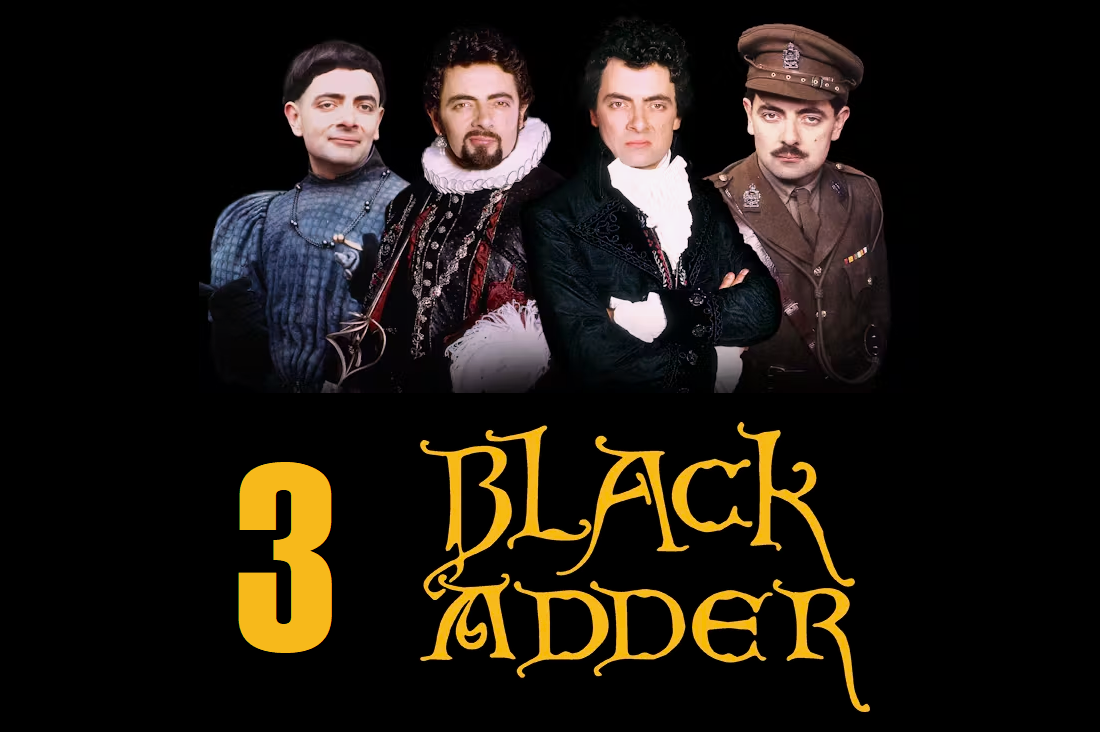
Regular cast: Rowan Atkinson (Edmund Blackadder), Tony Robinson (Baldrick), Hugh Laurie (Simon Partridge/ Prince Ludwig the Indestructible/ George, Prince Regent/ Lieutenant George The Honourable Colthurst St. Barleigh), Stephen Fry (Lord Chamberlain Lord Melchett/ General Melchett), Tim McInnerny (Lord Percy Percy/ The Scarlet Pimpernel/ Captain Kevin Darling), Miranda Richardson (Queen Elizabeth I/ ‘The Shadow’/ Mary Fletcher-Brown), Patsy Byrne (Nursie), Rik Mayall (Mad Gerald/ Lord Flasheart), Gabrielle Glaister (‘Bob’/ Kate) and Brian Blessed (King Richard IV)
Regular crew: Richard Curtis and Rowan Atkinson (creators/ writers); Ben Elton (only other writer); John Lloyd (producer); Martin Shardlow (director); Mandie Fletcher (director); Richard Boden (director)
The situation: Edmund Blackadder is an occasionally influential, usually insignificant figure who keeps popping up in different eras of English/ British history. First, there’s Edmund ‘The Black Adder’ (Season 1; second son of the fictitious medieval King Richard IV), then Lord Blackadder (Season 2; a member of the Tudor court and favourite of Queen Elizabeth I), next Edmund Blackadder Esq. (Season 3; a Georgian gentleman and butler to the Prince of Wales during the latter’s Regency) and, finally, Captain Blackadder (a middle-class army officer stuck in the trenches of the First World War).
Although starting out as something of a snivelling idiot in his medieval guise, the most prominent Blackadder (or, to be precise, this first one’s descendants in subsequent centuries) is sly, witty, charming and rakishly handsome. All versions, however, are selfish, conniving and unquestionable cowards. All of them, too, are aided and unintentionally thwarted by their servant/ underling Baldrick; an utterly gormless, largely unchanging figure also descended from a medieval original.
Together, then, Blackadder and his sidekick bounce from one harebrained scheme to another as they try to survive in the brutal, dangerous-at-every-turn world around them, which always tends to be populated by just as greedy but luckier, more successful chancers and fools.
The greatness: Let’s face it, historical sitcoms tend be more miss than hit (Plebs or Chelmsford 123, anyone?) and that trend wasn’t exactly bucked in the early ’80s when then relative newcomers Richard Curtis and Rowan Atkinson combined on the fictional, costly romp that was the first season of Blackadder. Although it was a moderately success, the BBC had understandable reservations over a second season, so changes were made. And, taken together, they proved a masterstroke.
First, Ben Elton joined Curtis on writing duties; second, Atkinson focused primarily on playing the lead (whose off-putting idiot persona was switched with the more charismatic, smart-alec Baldrick) and, third, production costs were slashed, removing any location shooting but delivering more bang for the Beeb’s buck via a tighter focus on the writing, directing and acting (better plotting, better characters, wittier dialogue, funnier jokes and a cleverer, keener send-up of actual history).
What emerged, then, in the second – and the subsequent third and fourth – season of Blackadder was one of the smartest, most satisfying and most streamlined sitcoms ever made. The restraints applied to its production ensured it was honed to perfection; its creative team poring over every scene, every character, every historical detail and every joke to make sure everything worked. And did it ever.
For Blackadder didn’t just use various English/ British eras as its setting, it chose them to explore and deliberately satirise them and, arguably, to challenge the well-worn notion that great men make and decide history. Instead, according to Blackadder, usually foolish, greedy know-nothings find themselves in charge (mostly through the fortune of birth) and cause a balls-up that all and sundry have to make the best of. Like it or not, there’s a lot of truth in that more cynical, even nihilistic view.
Moreover, this reading of history was complemented by the show’s comedic language and attitude; a punkishly sparse, witty yet anarchic approach to humour with OTT characters that owed a clear debt to the ’80s ‘alternative comedy’ crowd led by the likes of Elton, Robbie Coltrane, Fry and Laurie, and Rik Mayall and Adrian Edmondson (all of whom contributed to the show; most to a significant extent).
Granted, come the WWI-focused, final season, the devastating reality behind its setting was treated with maybe a tiny bit more respect, meaning slightly tempered clownish set-pieces, more loaded irony and a touch more humanity; yet, the Blackadder brand was otherwise entirely intact. Indeed, whatever its season, like the pong of a rotten turnip mislaid by Baldrick, Blackadder’s joyous wit, wisdom and brilliance was all too clear at every twist, turn and finger-insult of its riotous rifle through history.
Greatest episode: Goodbyeee (Season 4)
Title themes: Themes (Season 1, Season 2, Season 3, Christmas special and Season 4) by Howard Goodall
Spin-offs: Blackadder: Back And Forth (originally shown at London’s Millennium Dome exhibit throughout 2000; broadcast on Sky One in autumn that year and on BBC1 in 2002)
Did you know? SPOILER ALERT (in the unlikely event you’re yet to see the ending of Blackadder’s final episode, do not highlight the following): In a jolting tonal shift from everything that’s preceded it, the show’s final episode concludes, of course, with most of the main characters being forced to leave the safety of their WWI trench and finally ‘go over the top’ to their viscerally implied demise.
Yet, this legendarily poignant ending only achieved the pathos-dripping perfection it did because, initially, it all went wrong. With its limited budget, the studio-set filming of the set-piece apparently fell flat when watched back, even looked amateurish and funny, so it had to be salvaged in post-production (it was slowed down, a bare, sombre version of the theme added and the final fade from the battlefield to a poppy field with serene birdsong applied). Not everything has to be a cunning plan, eh?
.
.
.
.
.
.
.
Original channel: BBC1
Seasons: 7 (1981-91)/ 64 episodes
Christmas specials: 19 (1981-83, 1985-90, 1991 x 2, 1992-93, 1996 x 3, 2001-03; plus, a short festive special featured in the BBC’s 1982 sketch compendium The Funny Side Of Christmas, while two short specials were broadcast, respectively, on the BBC’s 1997 Comic Relief and 2014 Sport Relief nights)
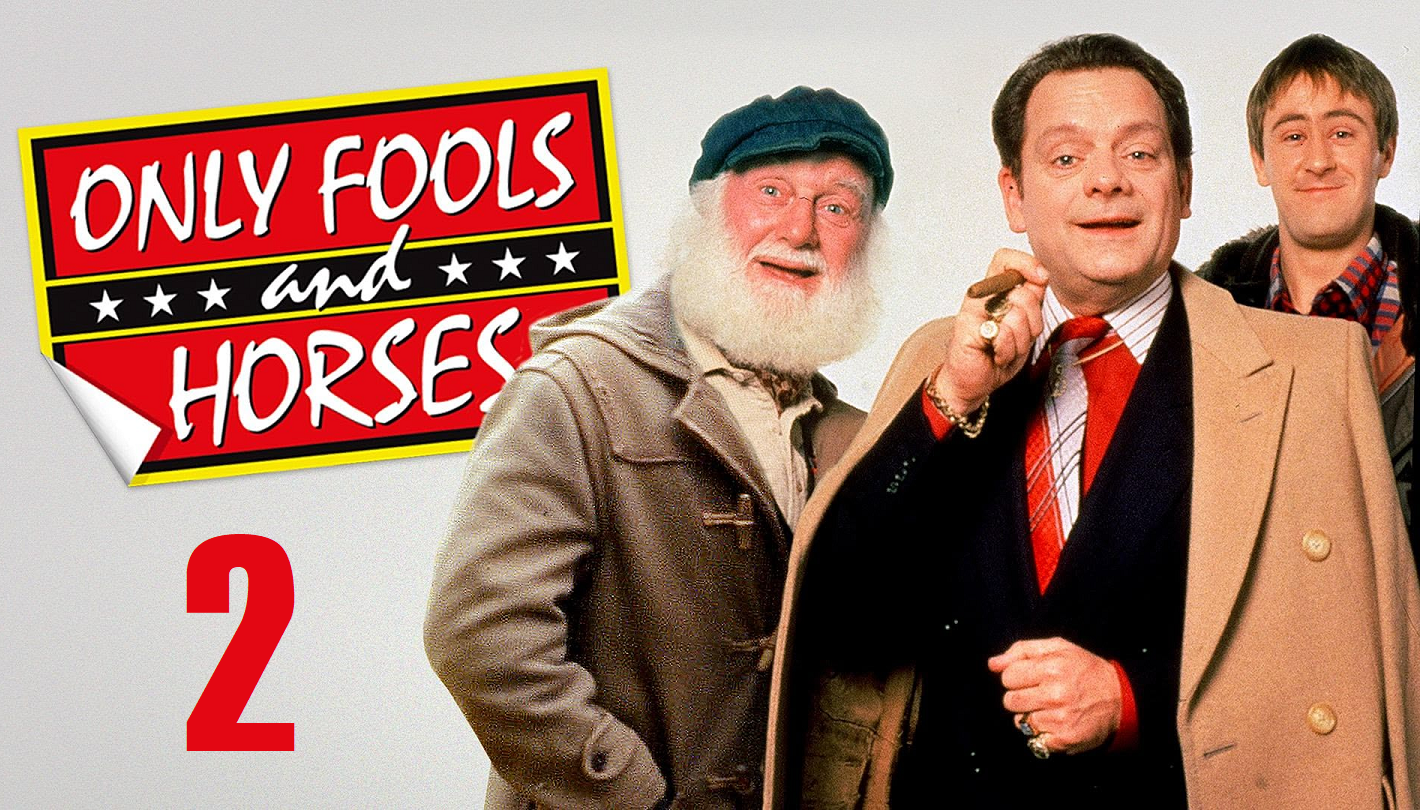
Regular cast: David Jason (Derek ‘Del Boy’ Trotter), Nicholas Lyndhurst (Rodney Trotter), Buster Merryfield (‘Uncle’ Albert Trotter), Lennard Pearce (‘Grandad’ Trotter), Tessa Peake-Jones (Raquel Turner), Gwyneth Strong (Cassandra Parry/ Trotter), Roger Lloyd-Pack (‘Trigger’), John Challis (‘Boycie’), Paul Barber (Denzil Tulser), Patrick Murray (Mickey Pearce), Sue Holderness (Marlene Boyce), Kenneth MacDonald (Mike Fisher), Roy Heather (Sid), Dennis Lill (Alan Parry), Wanda Ventham (Pam Parry) and Jim Broadbent (DCI Roy Slater)
Regular crew: John Sullivan (creator/ only writer/ executive producer); Ray Butt (producer/ director); Gareth Gwenlan (producer); Martin Shardlow (director); Susan Belbin (director); Mandie Fletcher (director); Tony Dow (director)
The situation: Del Boy is a wheeler-dealer in South London’s vibrantly multicultural, working-class Peckham. He’s irrepressible, quick-witted, a bit of a ‘wideboy’, operates at the fringes of the law and prone to malapropisms but has a heart of gold. The latter is especially true when it comes to Del’s unfeasibly lanky, somewhat idealistic and naïve kid-brother Rodney (whom he was forced to effectively raise) and their dozy Grandad, all of whom share a council flat in the high-rise Nelson Mandela House.
Often lurching from one doomed money-making deal to the next, Del has aspirations of leaving his market stall behind and hitting the big time, which he never really seems to get close to despite his best/ worst efforts. Sometimes he ropes an old friend or two into his schemes; the likes of the incredibly dim ‘Trigger’, the upwardly mobile used-car salesman ‘Boycie’ or the Liverpool-born Denzil.
Over the years, Del gets older (but no wiser), Rodney matures and Grandad passes on (he’s ‘replaced’ in the flat by the equally slow-on-the-uptake Uncle Albert). Del and Rodney settle down, too, with Raquel and Cassandra, respectively; both well-adjusted and long-suffering. All along, though, the question remains: will the Trotters make it and, against the odds, realise their dream of becoming millionaires?
The greatness: As any Brit knows, Only Fools And Horses isn’t a mere TV show; it isn’t even a critical cultural touchstone; it’s an unqualified national institution. Once upon a time, it was just another perky yet slightly edgy ’80s sitcom with lots of promise; for the past 30 years, it’s enjoyed unparalleled status in Blighty as surely the most popular British TV show ever broadcast – even though no new episodes of it have been broadcast in the last 20 years.
Popularity, though, is a strange beast. So many things are unfathomably popular (the execrable Mrs Brown’s Boys being a moot point for this post). Yet, it would surely take a heartless and tasteless TV viewer to suggest Only Fools… didn’t deserve practically every bit of its unique success.
Season after season, Christmas special after Christmas special, it got better and better, proving irresistible to millions with its loveable, everyday characters, delightful dialogue, superior scenes and sequences, and unexpected tonal shifts from true hilarity to compelling human drama and back again.
Of course, at mention of its greatness, many would point to Only Fools…’ unforgettable moments – from Del falling through the bar (see video below) to the chandelier incident; from Batman and Robin saving the day to the blow-up dolls; and from Damien’s birth to the rocking Reliant Regal.
Yet, maybe more significant is the fact that sitcom scribe supremo John Sullivan always placed his protagonists’ relationship at the heart of things. Indeed, if there was any sort of secret sauce, it was this; ultimately, beneath its double-decade character-saga appeal, the show was a timeless two-hander with the utterly perfectly-cast Jason and Lyndhurst playing polar-opposite, bickering brothers whom, in spite of all their ups, downs, embarrassments and misadventures, stuck together until the very end.
Indeed, come that end in the early ’00s, perhaps we could have done without the final trio of specials; lacking, as they did, the pace, verve, authenticity and adversity, and universal humour of the earlier episodes and specials. Yet, that does feel like nit-picking. Because, while average, good, very good and even great UK sitcoms have come and gone, none have quite resonated like Only Fools… did with quite so many Brits; black or white, rich or poor. And that’s no laughing matter.
Greatest episode: Yuppy Love (Season 6)
Title theme: Themes by Ronnie Hazlehurst and John Sullivan
Spin-offs: The Green Green Grass (2005-09; BBC1), Rock & Chips (2010-11; BBC1 prequel specials) and Only Fools And Horses The Musical (2019; West End stage musical)
Did you know? Amazingly, David Jason wasn’t first choice to play Del Boy; other actors who were considered included Oscar-winner-to-be Jim Broadbent, whom would go on to be cast as Del and co.’s schoolmate-turned-corrupt copper Roy Slater.
Time On Our Hands, the third of 1996’s three specials and the end-point of the show’s original run when the Trotters, yes, became millionaires, drew 24.3 million viewers – one of the most-watched broadcasts on UK television and, to date, the nation’s third most-watched scripted TV programme.
.
.
.
.
.
.
.
Original channel: BBC1
Seasons: 3 (1973-77)/ 21 episodes
Christmas specials: 2 (1975 and ’76)
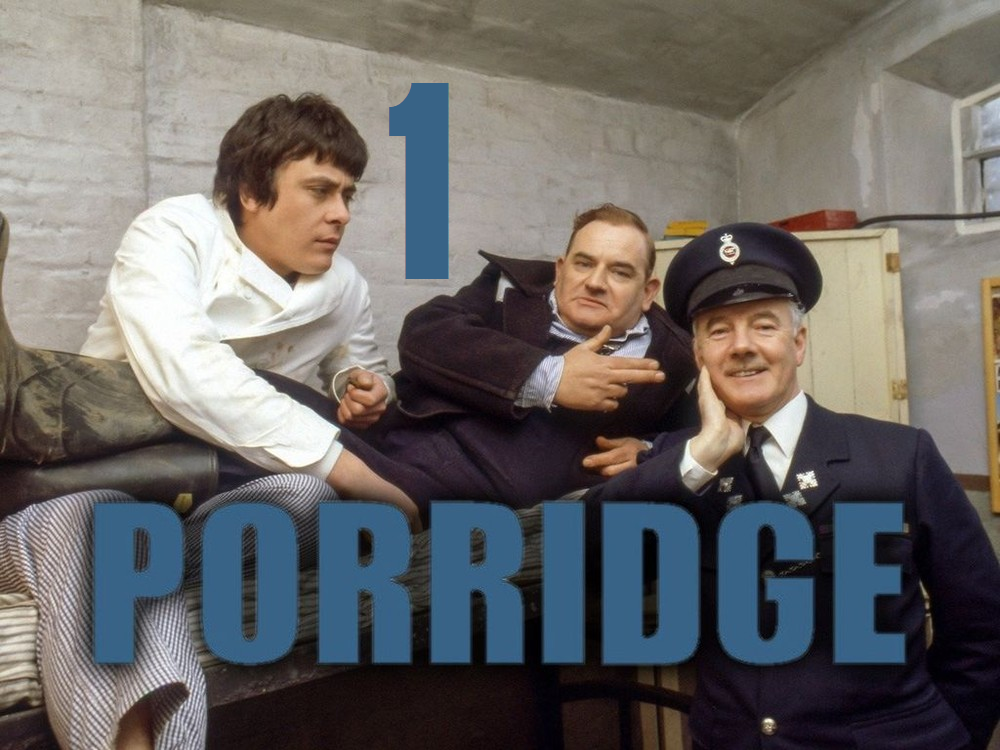
Regular cast: Ronnie Barker (Norman Stanley Fletcher), Richard Beckinsale (Lennie Godber), Fulton Mackay (Mr Mackay), Brian Wilde (Mr Barraclough), Peter Vaughan (Harry ‘Grouty’ Grout), Sam Kelly (‘Bunny’ Warren), Tony Osoba (‘Jock’ McLaren), Christopher Biggins (‘Lukewarm’), David Jason (Blanco Webb), Ken Jones (‘’Orrible’ Ives), Brian Glover (Cyril Heslop), Ronald Lacey (Harris), Maurice Denham (Mr Justice Stephen Rawley) and Patricia Brake (Ingrid Fletcher)
Regular crew: Dick Clement and Ian La Frenais (creators/ only writers); Sydney Lotterby (producer/ director of all episodes apart from pilot)
The situation: An affable, charming but wily, middle-aged Londoner, Fletch is an habitual thief who’s spent more of his adult life in prison than not. His latest stint ‘inside’ sees him banged up at HMP Slade, located somewhere in the wilds of North-East England.
There, Fletch is forced to share a cell with Godber, a likeable, callow Brummie with a strong sense of morality but who fell in with a wrong crowd, got caught and is paying the penalty. In which case, the similarly ethical (in his own way) Fletch takes Godber under his wing and tries to guide him through the vagaries of prison life and show him how to get by while ‘doing porridge’.
Outside their cell, Fletch and Godber are surrounded by a coterie of colourful inmate characters (including the shifty ‘Bunny’ Warren, the hard Scot ‘Jock’ McLaren, the gay ‘Lukewarm’ and the near-elderly but sly Blanco Webb), whom they join in reluctantly facilitating banged-up, menacing crime-kingpin Harry Grout and, more often than not, defying the authority of the prison’s guards. These comprise the gentle, rehabilitation-favouring soft-touch Mr Barraclough, whose marriage woes ensure he prefers being in prison than at home, and the ex-army sergeant-major disciplinarian Mr Mackay, with whom Fletch is locked in an endless battle of wills.
The greatness: What?! It’s not Del Boy who sits atop my sitcom pile? No, that’s right, it’s Norman Stanley Fletcher. Why, you might ask? Well, for me, when it comes down to it, simply so many episodes of Porridge are practically perfect – indeed, I think many are probably flawless – that surely, then, Fletch, Godber and Mr Mackay rightly deserve to break out (er, from the pack) and take the top spot.
I’m not exaggerating when I use the word flawless, either. Porridge was so darn good that I struggle to think of a moment when it put a foot wrong; right the way through from the glorious pilot that saw Mr Barraclough transport Fletch to Slade Prison (despite the latter’s fruitless attempt to escape) to the last episode when, having seen Godber right and the latter’s released, we were deceived yet ultimately reassured the experience hadn’t broken our anti-hero’s anti-authority spirit (see video below).
Now, all that’s very well but just what was it that made Porridge such an unrivalled UK comedy showcase? Frankly, the question should be what wasn’t it? Take, for instance, the fact comedy-writing kings Clement and La Frenais (see above) set it in a prison. Was that a stroke of genius? Given Porridge was written and realised as well as it was, it certainly looks like one.
For, while the maxim ‘Don’t sweat the small stuff’ is a fine saying to live by on the outside; if you’re incarcerated that’s surely impossible. Thanks to the suspended liberty, exaggerated enforcement of social hierarchies and lack of privacy in a prison, one’s focus on and irritation by small details and grievances surely become oversized. The trivial becomes vitally important. So, if handled right (as it was in Porridge), this overblown significance of the small and petty, on tiny victories and one-upmanship, is hopelessly funny. How couldn’t it be?
Yet, while the emotional truths of confinement informed so much of the comedy currency of Porridge, they didn’t underpin it; nor did they take the show into dramatically satisfying territory, which like the very finest sitcoms, this show – the jewel in Clement and La Frenais, Barker and Beckinsale’s collective telly crown – liked to do every episode. Instead, it was the quality of its characterisations – and, thus, the wonderful plots they could be thrown into and sparkling dialogue they could deliver – that enabled it to rise to the dizzy, very funny and dramatic heights it did each week.
No question, Fulton Mackay’s oh-so marvellously observed, starched namesake guard was one of TV’s greatest love-to-hate-him comic villains, while Richard Beckinsale’s young Godber so deserved a second chance in life it was impossible not to root for him. Yet, it was, of course, Ronnie Barker’s Fletch who was at the heart of everything and always dominated proceedings.
As flawed as a prison stretch is long he may have been, Fletch was also smarter, worldlier, more accessible and (importantly) more empathetic than any other character in the show – and, frankly, more than the vast majority of characters in any other sitcom, too. So fully-fledged and convincing a creation was he in the hands of Barker, he wouldn’t have been out of place in a rehearsed-to-the-hilt Mike Leigh dramedy or a stage play by, say, Pinter or Plater. To spend half-an-hour in his company was joyous; to watch Barker perform him in scene after scene special, indeed.
Moreover, consider that Barker gave us Fletch at pretty much the same time he and Ronnie Corbett gave us many of The Two Ronnies’ best sketches (a good number of which he also wrote) and you might be excused if you suddenly feel like a ‘nerk’ because your brain’s starting to hurt!
To my mind, then, Porridge is so priceless that, when all’s said and done, it’s the jailbird that soars above the rest of the British sitcom firmament. But that’s only my opinion, of course. How about yours? Go on, leave a comment below and let me know what you think of this rundown and which sitcoms tickle your ribs no matter how many repeat viewings you’ve given them over the years…
Greatest episode: Take your pick from Prisoner And Escort (pilot), A Day Out, Men Without Women, A Night In, (all Season 1), Happy Release, Heartbreak Hotel, Just Desserts (all Season 2), No Way Out (Christmas special, 1975) or The Desperate Hours (Christmas special, 1976)
Title theme: Opening title theme (voice: Ronnie Barker) and end title theme by Max Harris
Spin-offs: Going Straight (1978-79; BBC1), Porridge (1979; cinematic feature film) and Life Beyond the Box: Norman Stanley Fletcher (2003; BBC2 mockumentary)
Did you know? Having made his name in The Lovers (1970-71), then solidifying his comedy thesping credentials in Porridge, its spin-off Going Straight and Rising Damp (1974-78; see directly previous post), Richard Beckinsale enjoyed a unique status as a sort prince of sitcoms come the end of the ’70s; it was shocking then when, in 1979, he died from a heart attack at the age of just 31.
A father to two daughters, Richard sadly didn’t get to see them grow up to both become actresses of note. The elder, Samantha Beckinsale, was a familiar face on British TV in the ’90s, while her younger step-sister is, yes, Hollywood star Kate Beckinsale, whom has said that, given Richard died when she was a young child, the fact that, like us all, she sometimes catches TV repeats of his shows in which he’s a young, handsome actor full of energy and talent, helps her remember and memorialise him in a unique, special way. Which, I must say, I think is really a rather a wonderful, heart-warming thing.
.
.


Quality quartet: you may well have laughed at and loved each of these four British sitcoms but where do they come on the all-time countdown and just which classic series is the number one rib-tickler?
Two or three decades ago, you couldn’t go an hour or two watching TV in the UK without a sitcom popping up. Nowadays, because the nature of television, cultural tastes and how we consume both have changed, not so much.
Despite this blog being committed to looking back at things past, though, I’ll never subscribe to the cliché that ‘everything was better back in the day’; it simply isn’t true. Yet, in the case of modern TV versus past telly and especially the demise of the British sitcom, surely you’d be a plonker not to recognise we never had it so good as we did in the ’70s, ’80s and ’90s. Reggie Perrin and Rigsby, and Del Boy and Rodney versus Amandaland and – gah! – Mrs Brown’s Boys? The realisation of a brilliant Baldrick-like cunning plan, this surely isn’t.
So, to put a more positive spin on things and enacting that age-old political ploy of turning a setback into an opportunity (just as Jim Hacker would try to, with or without Sir Humphrey’s help), I’ve decided to come up with a couple of (apologies, marathon-long) posts to celebrate Blighty’s situation comedy tradition at its finest by offering up, to all and sundry, a rundown of the 2o greatest sitcoms this little island has ever produced, in my humble opinion, of course.
Was this a painstaking effort? Did it take forever to put together? Feck me, yes. Will it raise a (likely unintentional) laugh or two and result in a heckle, here and there (sorry, there’s no Dad’s Army, Fawlty Towers or The Office; none have ever truly clicked with me)? Quite possibly. But I… or, er, this blog didn’t get where it did today by always being lovely jublee about everything. Or without mixing its metaphors and its sitcom puns.
Anyway, settle down in that armchair, put down that remote and dunk that custard cream in your cuppa because, yes, here we go! Cue that cosily familiar theme tune…
.
.
.
.
Original channel: ITV
Seasons: 6 (1973-76)/ 39 episodes
Christmas specials: 0 (however, a short festive special featured in All-Star Comedy Carnival, broadcast on ITV at Christmas 1973)
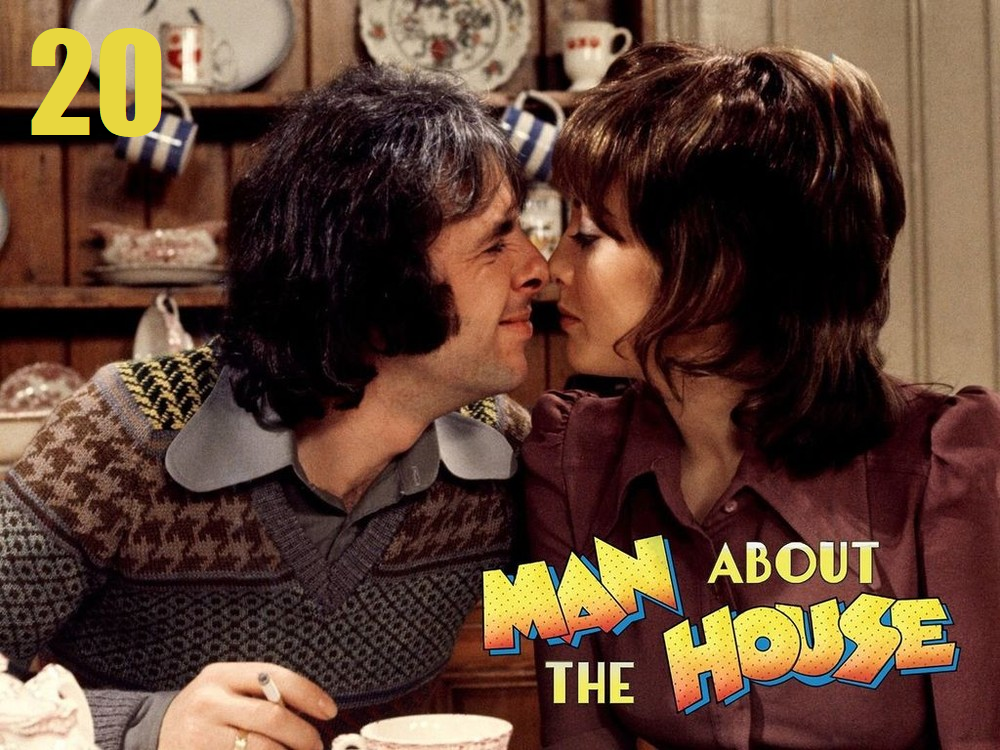
Regular cast: Richard O’Sullivan (Robin Tripp), Paula Wilcox (Chrissy Plummer), Sally Thomsett (Jo), Yootha Joyce (Mildred Roper), Brian Murphy (George Roper) and Doug Fisher (Larry Simmonds)
Regular crew: Johnnie Mortimer and Brian Cooke (creators/ only writers); Peter Frazer-Jones (only producer/ director)
The situation: Chrissy and Jo, two young secretary-types in ’70s London Town, require a new flatmate; their choice is eligible if a wee-bit-hapless cookery student Robin. At first, the downstairs-dwelling, stingy and weedy landlord Roper isn’t keen on the arrangement, while his liberated, undersexed wife Mildred is, being attracted to Robin. The latter’s friend, the cocky and womanising chancer Larry, is also on the scene; he eventually moves into the attic at the top of the house.
The greatness: Owing to its unashamedly populist approach and knockabout, mostly family-friendly tone, it’s easy to overlook Man About The House. In fact, in its day, it was radical. Making a pre-watershed TV comedy about a handsome man and two attractive women sharing a flat, all unattached, complete with overt sexual tension and scripts that never shied away from fairly frank references to the act, was something unimaginable in Britain before the early ’70s, let alone something ever tried before.
Very much a product of the permissive society, then (although admittedly soft on challenging chauvinism and, to a small extent, homophobia), Man About The House was skilfully done. Solidly scripted with an always high gag count, it was perfectly played by a cracking cast; Joyce and Murphy’s sidekicks becoming so beloved they got their own hit spin-off. Indeed, it was so good it was remade over the pond (with, at first, the same scripts) as the just-as-successful Three’s Company.
Greatest episode: One For The Road (Season 4)
Title theme: Up To Date by Johnny Hawksworth
Spin-offs: George And Mildred (1976-79; ITV), Robin’s Nest (1977-81; ITV) and Man About The House (1974; cinematic feature film)
Did you know? When cast as one of the titular Railway Children in the classic 1970 British film, Sally Thomsett was a 20-year-old woman tasked with playing a pre-pubescent girl; as such, she was asked to hide her true age during filming lest there be any controversial publicity, which meant no smoking, drinking or socialising down the pub with cast and crew.
Having quietly struggled with the enormous fame afforded her by Man About The House and George And Mildred, Yootha Joyce tragically took her life in 1980; Brian Murphy was especially bereft for, as work dried up, he discovered he’d lost not only one of his best friends but his acting partner, too.
.
.
.
.
.
.
.
Original channel: Channel 4
Seasons: 6 (1989-94)/ 71 episodes
Christmas specials: 1 (1994; final extended episode)
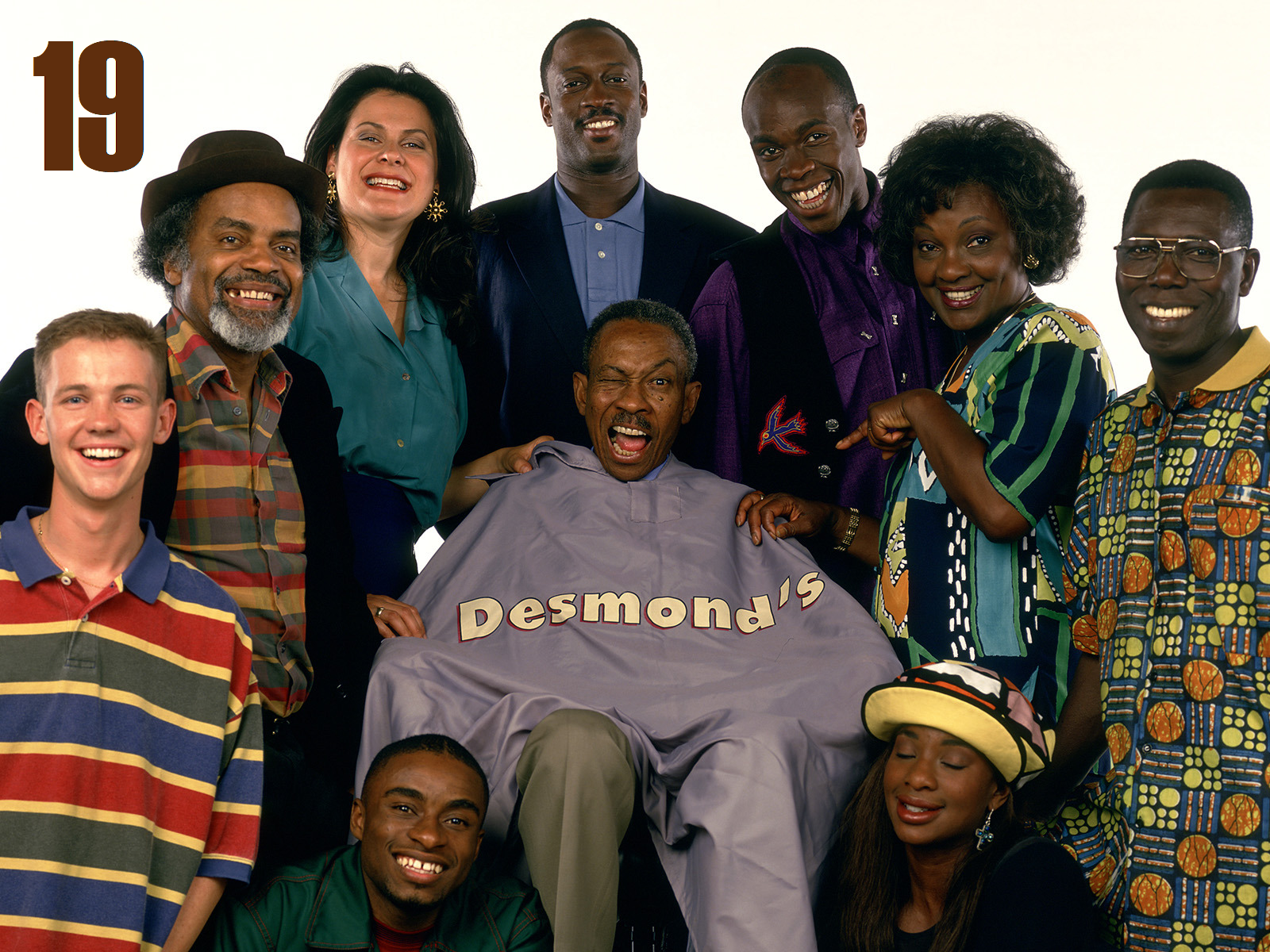
Regular cast: Norman Beaton (Desmond Ambrose), Carmen Munroe (Shirley Ambrose), Ram John Holder (‘Porkpie’), Gyearbuor Asante (Matthew Joffor), Geff Francis (Michael Ambrose), Kimberly Walker (Gloria Ambrose), Justin Pickett (Sean Ambrose), Robbie Gee (Lee Stanley), Matilda Thorpe (Mandy) and Mona Hammond (Auntie Susu)
Regular crew: Trix Worrall (creator/ regular writer); Humphrey Barclay and Charlie Hanson (producers)
The situation: Desmond is an ageing former calypso singer from Guyana, who co-owns and runs a barbershop bearing his name in London’s Peckham. He shares the flat above the barbershop with his wise, emotionally mature wife Shirley, and their adolescent children, Gloria and Sean. Their eldest son Michael, an upwardly mobile assistant bank manager, is the business’s other co-owner. That said, the barbershop itself seems to operate as less a going concern than a community meeting place; its daily clientele including Matthew, a perpetual student from The Gambia; Lee, the local wideboy; and ‘Porkpie’, the group’s crumpled fall-guy and former guitarist in Desmond’s one-time calypso band.
The greatness: One of the first, easily the best and the longest running of British sitcoms focused on a minority community (its crew, too, was filled by black professionals), Desmond’s was an immediate hit and proved ever-popular with its faithful, young Gen-X audience, ensuring it played an important role in the rise and evolution of multiculturalism on the box.
Yet, as a sitcom, it owed that non-niche success not just to its winning cast and populist writing but also its specific, deliberate foundations – a very definite ethnic set-up (a British Guyanese family in an urban setting; a close-knit Caribbean-meets-West-African-meets-White community) but with universally recognisable character types (the put-upon father; the wise mother; the challenging kids; the ambitious yuppie; the righteous intellectual and, of course, the comedy sidekick).
So, whether it rewrote the sitcom book or not, Desmond’s never felt like it did; its appeal was always too broad and its effect too light-hearted and fun for that. Yet, that was the point. In proving so successful and so enduring, it quietly changed what was possible in British TV comedy (i.e. it could be less white *and* popular) without many people noticing, which was its aim right from the off.
Greatest episode: Calypso (Season 4)
Title theme: Don’t Scratch My Soca (Norman Beaton)
Spin-offs: Porkpie (1995-96; Channel 4)
Did you know? A native of Guyana, Norman Beaton came to Britain as part of the ‘Windrush Generation’ and ended up working as the first black teacher in Liverpool; while there, he became a calypso musician and, on occasion, played guitar for the city’s famed group of beat poets at the Cavern Club, the venue made iconic thanks to its legendary early Beatles gigs.
.
.
.
.
.
.
.
Original channel: BBC1
Seasons: 3 (1976-79)/ 21 episodes
Christmas specials: 0 (however, a short festive special featured in The Funny Side Of Christmas, broadcast on BBC1 in 1982)
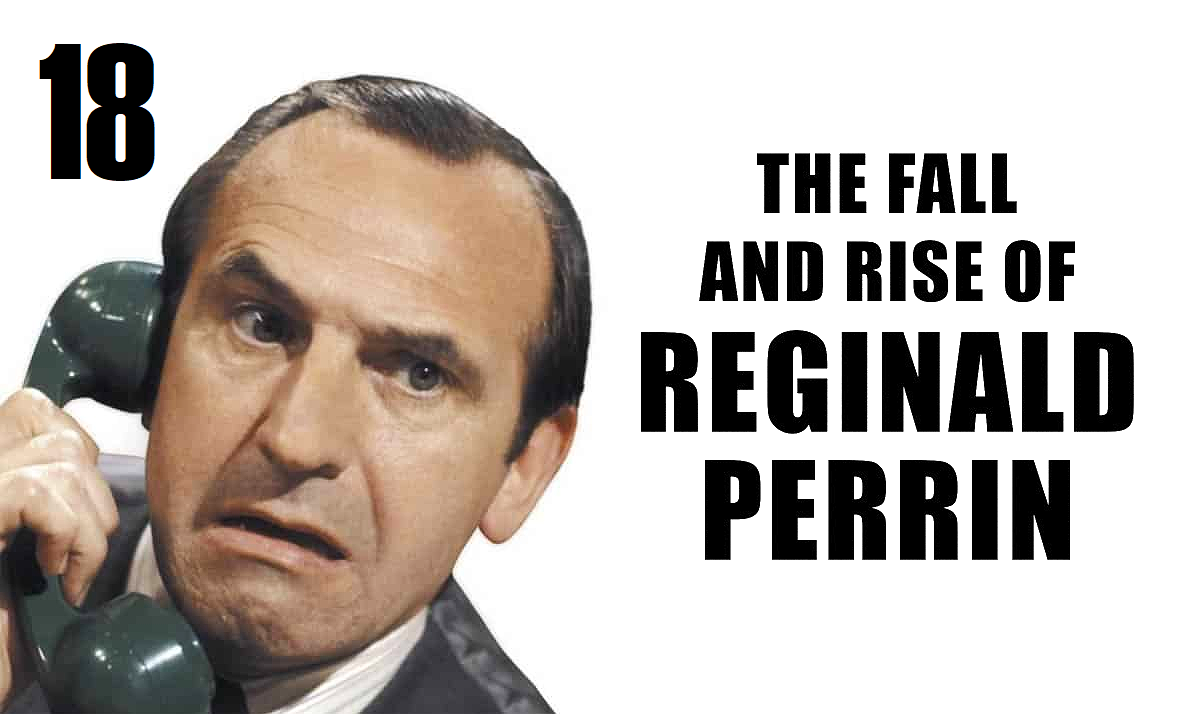
Regular cast: Leonard Rossiter (Reggie Perrin), Pauline Yates (Elizabeth Perrin), Geoffrey Palmer (Jimmy Anderson), John Barron (C.J./ F.J.), Sally-Jane Spencer (Linda Patterson), Tim Preece/ Leslie Schofield (Tom Patterson), Sue Nicholls (Joan Greengross), Trevor Adams (Tony Webster), Bruce Bould (David Harris-Jones) and John Horsley (Doc Morrisey)
Regular crew: David Nobbs (creator/ only writer); Gareth Gwenlan (only producer/ director)
The situation: Suffering from a mid-life crisis, Sunshine Desserts marketing manager Reggie Perrin decides to fake his death, leaving behind his comfortable but suffocating suburban existence and lovely, loving wife Elizabeth. Returning as a thinly-veiled ‘Reggie replacement’, he ends up resuming his life and job as before (complete with wife, daughter Linda, brother-in-law Jimmy, eccentric boss C. J., irritating colleagues and lust-worthy secretary Joan), before jacking it all in again to become an itinerant land worker, and then roping in everyone he knows to launch retail venture Grot – shops that sell utterly useless tat, but which defy Reggie’s plan for glorious failure to become a huge high-street success story.
The greatness: Reginald Perrin was a bit of curio in its more mannered TV era, being a prime-time BBC1 sitcom that revelled in satirical inanity and daydream-derived surrealism. Despite an over-reliance on repetitive gags, it worked because it married the ‘alternative’ absurdity of Monty Python and The Goodies with the mild mocking of the cosy middle-class sitcom, never straying too far into the territory of either and so never overplaying its hand for a mainstream 1970s audience.
The effect was a comedy whose style and tone would seamlessly shift now and again, leaving a lightly unsettling effect; it wasn’t truly comfortable viewing yet neither was it threatening. Smartly written and directed, it was anchored by a pitch-perfect Leonard Rossiter – was he merely struggling with existential angst or going dotty due to all the dotty normies around him? It was never really clear.
Greatest episode: The Unusual Shop (Season 2)
Title theme: Theme by Ronnie Hazlehurst
Spin-offs: The Legacy Of Reginald Perrin (1996; BBC1) and Fairly Secret Army (1984-86; Channel 4); although the latter wasn’t, strictly speaking, a Perrin spin-off, it was written by Nobbs and featured Palmer as a character that was Jimmy in all but name attempting to stage a paramilitary coup of the UK, an idea that Jimmy once posited in a Perrin episode.
Did you know? A stickler for high standards, as well as a wine connoisseur and right-winger (rare for a Liverpudlian successful in the arts), Leonard Rossiter didn’t suffer fools gladly; apparently, on the set of a well-recalled 1983 Cinzano advert, he referred to glamorous co-star Joan Collins as ‘the prop’.
.
.
.
.
.
.
.
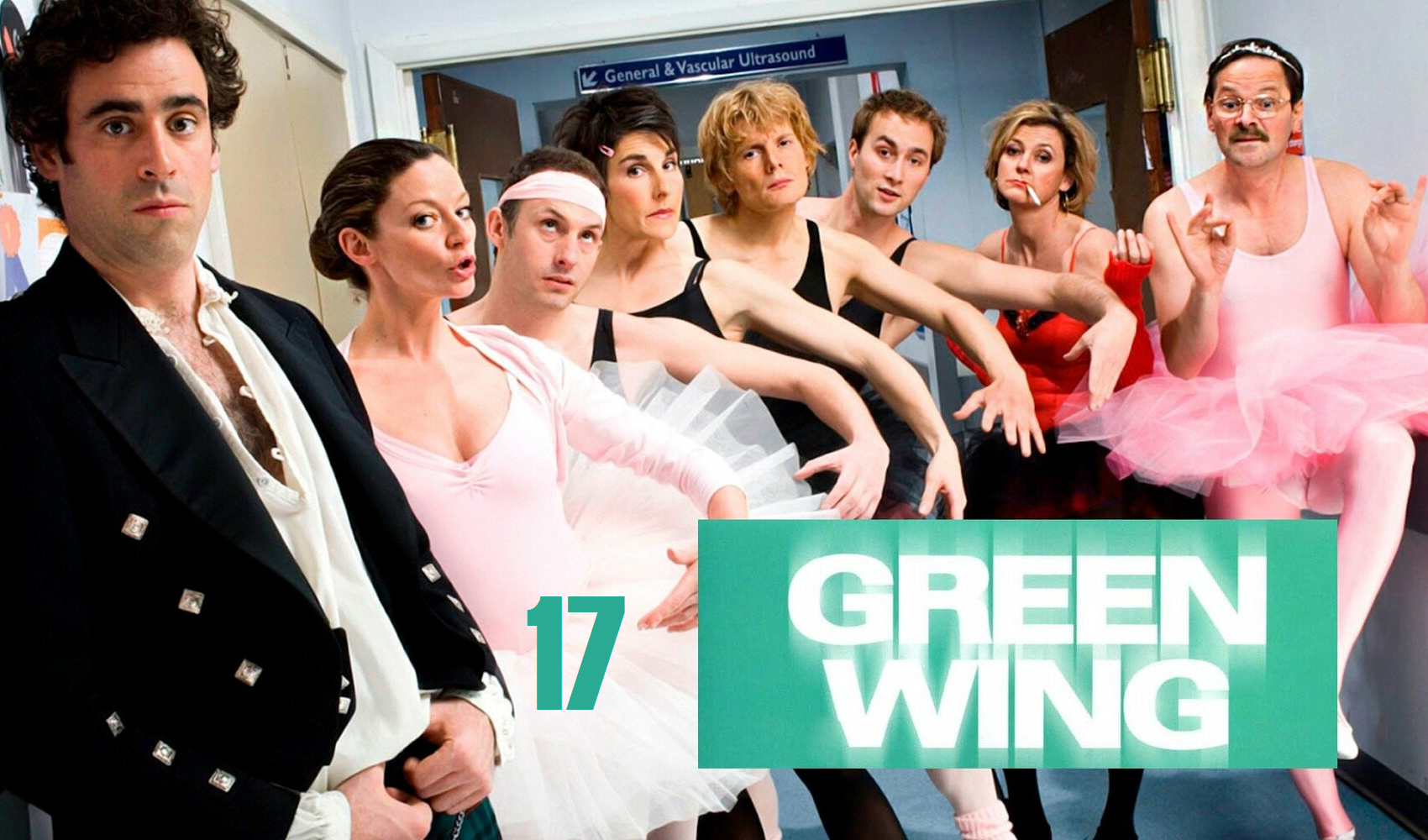
Original channel: Channel 4
Seasons: 2 (2004-07)/ 18 episodes
Christmas specials: 0 (however, two short specials were produced, the first broadcast on BBC1’s Comic Relief night in March 2005 and the second performed live as part of the Amnesty International-benefiting Secret Policeman’s Ball in October 2006)
Regular cast: Tamsin Greig (Dr Caroline Todd), Stephen Mangan (Dr Guy Secretan), Julian Rhind-Tutt (Dr ‘Mac’ Macartney), Michelle Gomez (Sue White), Mark Heap (Dr Alan Statham), Pippa Haywood (Joanna Clore), Karl Theobald (Dr Martin Dear), Oliver Chris (Dr Boyce), Sarah Alexander (Dr Angela Hunter), Olivia Coleman (Harriet Schulenburg), Sally Bretton (Kim Alabaster), Katie Lyons (Naughty Rachel), Lucinda Raikes (Karen Ball) and Paterson Joseph (Lyndon Jones)
Regular crew: Victoria Pile (creator/ writer/ director/ producer/ editor); Tristram Shapeero (director/ editor); Dominic Brigstocke (director/ editor); Peter Fincham (executive producer)
The situation: Capable and level-headed surgeon Caroline starts work at an unnamed hospital’s ‘Green Wing’, sharing accommodation with the attractive, effortlessly popular Angela and working alongside handsome, easy-going lothario Mac (a fellow surgeon) and the mendacious, inferior-complex-plagued Guy (an anaesthetist), whom she lusts after and rebuffs, respectively.
Also on the scene is Martin, a hopelessly naïve and incapable junior doctor; Alan Statham, an increasingly deranged consultant; and Boyce, another junior doctor who can’t function without winding-up Statham. Meanwhile, overly sexually-aggressive admin chief Joanna makes hell the lives of her underlings (Harriet, Kim, Rachel and Karen) and HR officer Sue White exists in a performative fantasy world as she torments everyone but Mac, whom she delusionally pursues.
The greatness: While Reginald Perrin delivered a balanced blend of absurdity and traditional sitcomming, Green Wing was for none of that; it went the whole hog and served up absurdity at every opportunity. Granted, for those who like their TV comedy less experimental, this may’ve been a step too far; using hospital/ work scenarios and doctor/ admin character types as a basis to mine comic opportunities that took logic to the ‘nth’ degree and sometimes tested the bounds of taste. Even so, millions of Noughties viewers found it to their taste and devoured its never-ending surreal scenarios.
For Green Wing, devised and delivered by the same team behind Channel 4’s equally iconic feminist sketch comedy Smack The Pony (1999-2003), seemed a sitcom in only a loose sense. Its sequences often came off as comedy bits rather than scripted scenes. As such, it felt like a sketch comedy in a sitcom’s clothing, pulling on the impeccable improvisation of its ensemble (a clutch of then up-and-comers, now established names; including a top-of-the-class, madcap Michelle Gomez and a marvellously callous Stephen Mangan, as well as Tasmin Greig, Sally Bretton and Oscar-winner-to-be Olivia Colman).
Engaging in non-stop passive-aggressive encounters, infantile misbehaviour and liberated physical comedy (regularly sped up and slowed down for exaggeration), the characters were akin to kids in a playground and their predicaments unashamedly cartoonish.
Yet, for all that, Green Wing *was* a sitcom, thereby delivering enough story continuity and character-driven pathos – especially by the time of its terrific first season finale – that you weren’t just entertained by all the buffoonery but invested. In spite of yourself, you were rooting for these lunatics, too.
Greatest episode: Emergency (Season 1)
Title theme: Last Week by Jonathan Whitehead
Spin-offs: Green Wing: Resurrected (2024; podcast)
Did you know? Using Middlesex’s Northwick Park Hospital and Basingstoke’s North Hampshire Hospital for its interiors and exteriors, Green Wing’s filming took place during actual operational hours when doctors, nurses and patients were mere yards away; at one point, while he was messing about in character, Mangan nearly hit a real-life patient with a tennis ball.
.
.
.
.
.
.
.
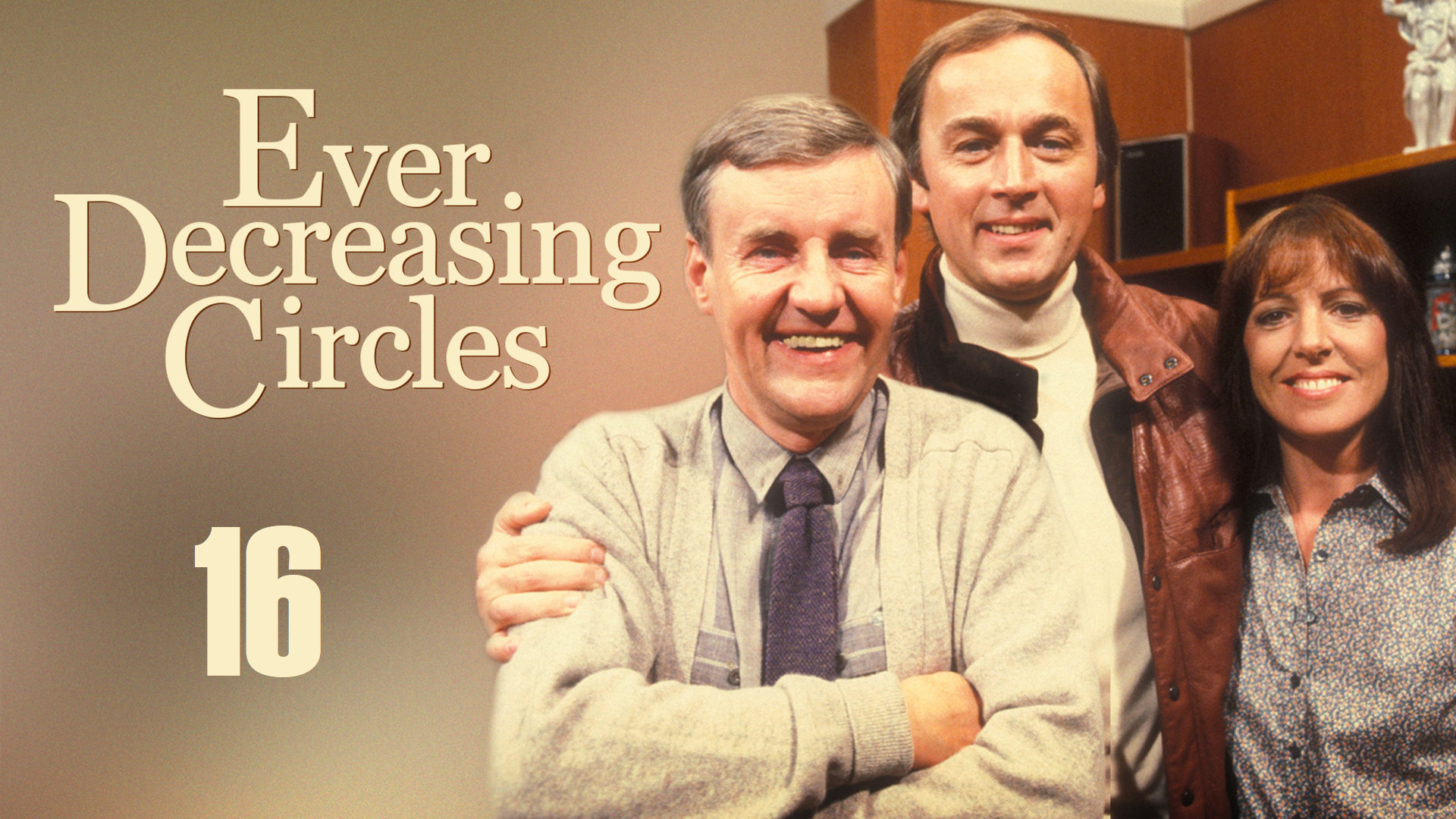
Original channel: BBC1
Seasons: 4 (1984-89)/ 27 episodes
Christmas specials: 2 (including extended final episode)
Regular cast: Richard Briers (Martin Bryce), Penelope Wilton (Ann Bryce), Peter Egan (Paul Ryman), Stanley Lebor (Howard Hughes) and Geraldine Newman (Hilda Hughes)
Regular crew: John Esmonde and Bob Larbey (creators/ only writers); Sydney Lotterby (director); Harold Snoad (director)
The situation: Martin is a dysfunctional chap; he only functions if he’s able to organise not just his and loving but long-suffering wife Ann’s extra-curricular activities but those, too, of everyone who lives in their immediate community – a suburban cul-de-sac (referred to as ‘The Close’) in Surrey’s Mole Valley. Included in Martin’s flock are his and Ann’s best friends, the overly pleasant, dreamy couple Howard and Hilda, whose placid natures placate his need to control. Everything is fine, neat and ordered in Martin’s world; until, that is, handsome, charming and fashionable singleton Paul moves in next door. Suddenly, everybody loves easy-going Paul (not least Ann) and, to make matters worse, he seems somehow to be good at everything, too.
The greatness: On the surface, Ever Decreasing Circles was the epitome of the elegant, inoffensive middle-class sitcom (of which the BBC seemed to churn out endless iterations in the ’70s and ’80s) but, dig a little deeper, and you discovered something interesting was going on. For, under the standard laughter lines, recognisable beats and pleasant misunderstandings, a darkness lurked – this was a show using the respectable sitcom as cover to explore a character who seemed far from well and in constant danger of going over the edge and taking everyone with him.
To rewatch Ever Decreasing Circles today, it strikes you Martin probably isn’t suffering from mental illness but that he’s neurodivergent; his blinkered need for order and control suggestive of autism. Were this show made today, the character would doubtless be handled differently (most of all by those around him) – but would he be fundamentally written or played differently? Probably not. And therein lies the greatness of Ever Decreasing Circles.
While the situations Martin gets himself into are funny, it’s not his ‘differentness’ that is; nor does that cause his downfall – his envy, selfishness or vanity does. And when he comes up trumps, it’s because of his innate goodness or love for Ann. Much of this works, of course, because of the late, oh-so great Richard Briers’ perfect performance (always empathetic; never unlikeable) and the rest of the tip-top cast. Yet, it’s also down to the subtlety of the direction and – especially – of the writing, for which nuance is king.
It’s all rather like a sophisticated Pinter/ Ayckbourn stage play with respectable characters in respectable situations but, beneath that finely polished veneer, everything’s all too flawed and potently true.
Greatest episode: The Cricket Match (Season 2)
Title theme: Prelude No. 15 from Twenty-Four Preludes, Op. 34 by Dimitri Shostakovich
Spin-offs: 0 (but Briers and Wilton appeared together in a string of 1990-broadcast Nescafé coffee adverts as alter egos reminiscent of their Ever Decreasing Circles characters)
Did you know? Having evolved into a TV sitcom from Esmonde and Larbey’s early ’80s stage play Hiccups, the show gained its eventual title from a brainstorming session when, in desperation at getting nowhere near finding a suitable title, someone inevitably uttered “We’re going round in ever decreasing circles”.
.
.
.
.
.
.
.
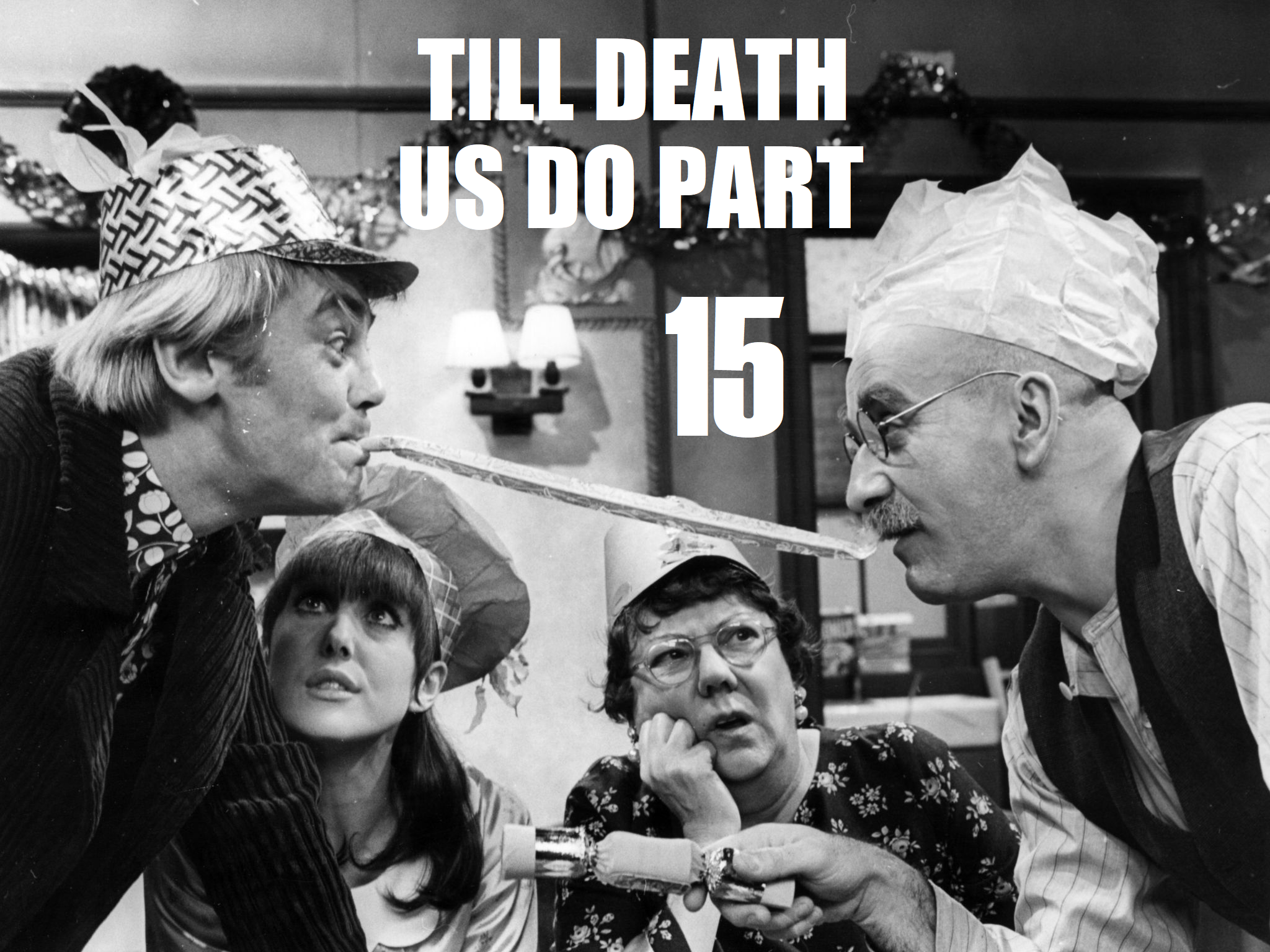
Original channel: BBC/ BBC1
Seasons: 7 (1965-75)/ 54 episodes
Christmas specials: 2 (two short specials also featured, respectively, in the 1967 and ’71 Christmas Day editions of the BBC’s Christmas Night With The Stars)
Regular cast: Warren Mitchell (Alf Garnett), Dandy Nichols (Else Garnett), Anthony Booth (Mike Rawlins) and Una Stubbs (Rita Rawlins)
Regular crew: Johnny Speight (creator/ only writer)
The situation: Alf Garnett is a middle-aged, post-war East Londoner; he’s a reactionary right-winger, patriotic bordering on nationalist, ill-informed and cowardly, and supports West Ham. With him in his pre-war tenement flat lives his belittled, dreamy but slyly wise wife Else (‘silly moo’), his fashionable, liberated daughter Rita and the latter’s easy-going, left-wing Liverpudlian husband Mike (‘lazy Scouse git’), with whom Alf never sees eye-to-eye and argues on every topic under the sun.
The greatness: One of the first British sitcoms to lodge itself in the public mindset up and down the land, Till Death Us Do Part enjoyed wild popularity as up to 20 million people viewed in each week to watch Alf Garnett spar with his son-in-law and throw around insults; remarks that were often racist, sexist or offensive in some other way. But was it boldly transformative TV or just the ’60s equivalent of an exploitative reality show with ordinary people in the headlights for our amusement?
Well, certainly in its early seasons, it was the former. Although by the 1980s and beyond, repeats of it had become awkward viewing as society had become more tolerant and tastes had shifted, whenever you may have watched a superior episode of Till Death Us Do Part, it was impossible to deny its uncompromising rawness and its fly-on-the-wall-esque reflection of reality.
This wasn’t a show that held a mirror up to real lives, relationships, opinions and the generation gap through clever-clever fictional distance, it went for the jugular and tackled them head-on via sound writing and pinpoint characterisation (especially from the brilliant Mitchell and Nichols). Indeed, some scenes were so relevant they featured references to extremely recent political/ topical events. This, then, was it’s secret sauce and, for better or worse, why it became so popular.
Now of course, there was always a proportion of Till Death Us Do Part’s audience that didn’t get the uncomfortable satire and would blithely laugh along with Alf and his bigotry instead of at him when he received his deserved downfall at every episode’s end. Yet, maybe that’s the deal with radical, challenging art? You can’t control reaction to it; some will be forced to confront their prejudices, while others’ prejudices will only be confirmed.
Greatest episode: N/A (too few episodes from the series’ 1960s heyday exist, their tapes having been wiped soon after broadcast, to come to a fair conclusion)
Title theme: Theme by Dennis Wilson
Spin-offs: Till Death… (1981; ITV); In Sickness And In Health (1985-92; BBC1), 1969’s Till Death Us Do Part and 1972’s The Saga Of Alf Garnett (cinematic feature films)
Did you know? Anthony Booth was the father of Cherie Blair; barrister, judge and wife of Millennium-era and (fittingly) Labour Prime Minister Tony Blair
.
.
.
.
.
.
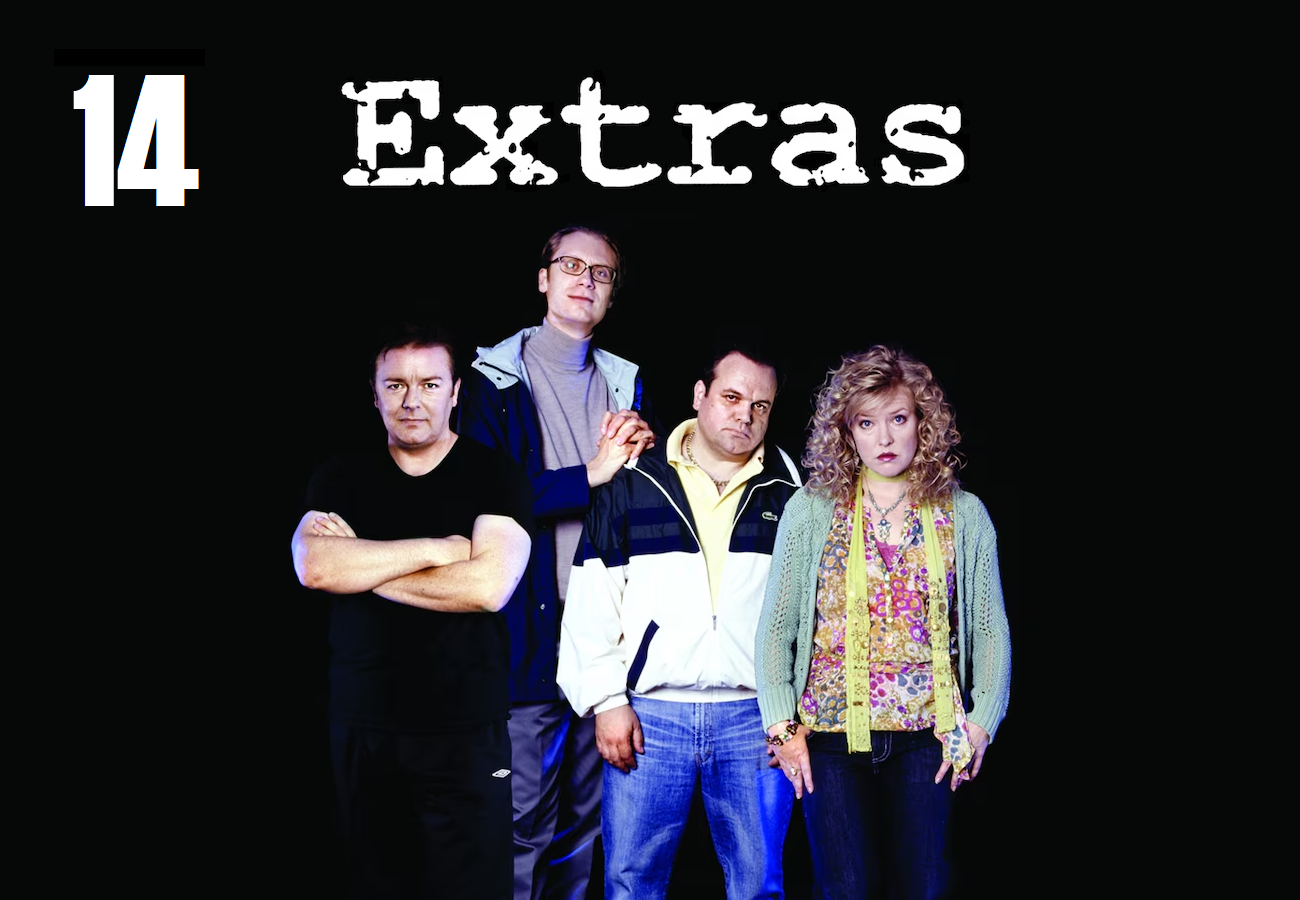
.
Original channel: BBC2
Seasons: 2 (2005-07)/ 13 episodes
Christmas specials: 1 (extended final episode, broadcast on BBC1)
Regular cast: Ricky Gervais (Andy Millman), Ashley Jensen (Maggie Jacobs), Stephen Merchant (Darren Lamb) and Shaun Williamson (himself aka ‘Barry’)
Regular crew: Ricky Gervais and Stephen Merchant (creators/ only writers/ only directors)
The situation: Andy is a thirty-something feller looking to make it in showbiz, vainly hoping that filling his days working as an extra on TV and film sets, thereby rubbing shoulders with Brit thesp royalty and Hollywood heavyweights, might garner him the contacts he needs to get a sitcom he’s written off the ground. Along for the ride is Andy’s best friend and fellow extra Maggie, a vacant and naïve innocent; his agent Darren, a useless, happy-go-lucky sociopath; and the latter’s sidekick Shaun, a fictionalised version of the real-life actor who played Barry on EastEnders (and so always referred to by that name), who’s ostensibly Darren’s only other client but, in reality, his office dogsbody.
The greatness: As Gervais and Merchant’s follow-up to their iconic original UK version of The Office (2001-03), it’s no surprise Extras mined the same knowing, squirm-inducing situational comedy; mostly via ironic complications and/ or vulgar predicaments involving its big-name guest stars, such as Patrick Stewart’s awkward voyeurism fantasy, Daniel Radcliffe’s errant condom, Les Dennis’s existential crisis or David Bowie’s devastating impromptu song (see video clip below).
However, it’s only after you properly sit down and watch Extras you realise its true focus isn’t these clever-clever meta guest-thesp set-pieces; very funny though they are. They’re the headline act. Instead, its the loser lives of its quartet of likeable regulars that’s smartly at its heart and what gives it heart. Being so well drawn and played, it’s these characters that pull us in and, more often than not, keep us watching.
In other words, underneath its playfully meta exterior, Extras offers the stuff of the superior sitcom with bells on – pathos as well as hilarity. We want Andy to achieve success with integrity and for Maggie to get more from life, and we’re strangely pulling for hapless Darren and hopeless ‘Barry’, too. While The Office made our skin crawl, Extras gets under it.
Greatest episode: ‘David Bowie’ (Season 2)
Title theme: Tea For The Tillerman (Cat Stevens/ Yusuf Islam)
Spin-offs: 0 [Life’s Too Short (2011-13)]
Did you know? For a brief moment in the early ’80s, Ricky Gervais was a pop star; sort of. As the vocalist of New Wave duo Seona Dancing, his talents featured on two singles, neither of which troubled the charts in Blighty but one of them (More To Lose) received extensive airplay in the Philippines in 1985, becoming hugely popular there with New Wave-turned-on teens.
.
.
.
.
.
.
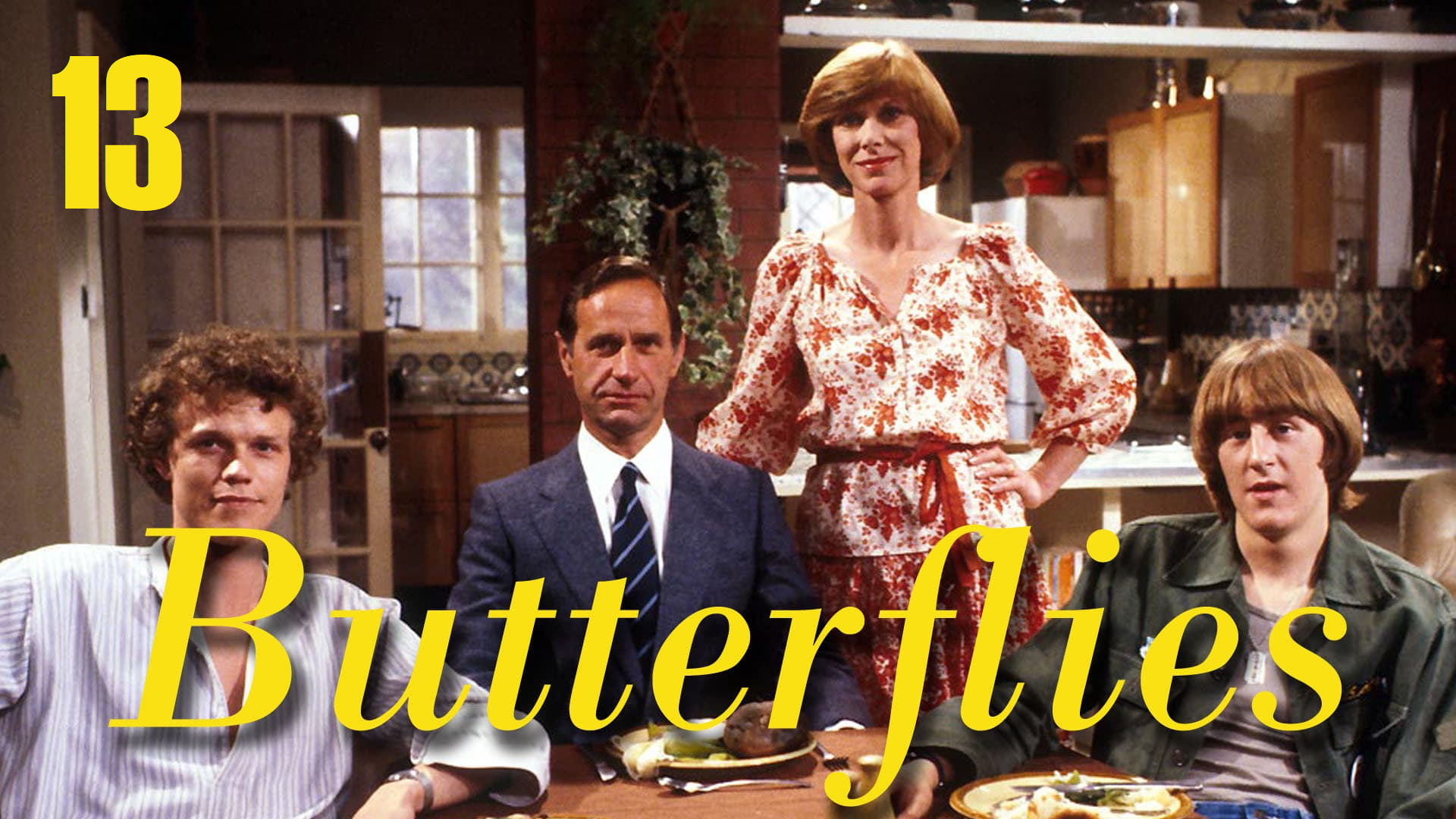
.
Original channel: BBC2
Seasons: 4 (1978-83)/ 28 episodes
Christmas specials: 1 (a short festive special also featured in The Funny Side Of Christmas, broadcast on BBC1 in 1982)
Regular cast: Wendy Craig (Ria Parkinson), Geoffrey Palmer (Ben Parkinson), Nicholas Lyndhurst (Adam Parkinson), Adam Hall (Russell Parkinson), Bruce Montague (Leonard Dunn), Michael Ripper (Thomas) and Joyce Windsor (Ruby)
Regular crew: Carla Lane (creator/ only writer); Gareth Gwenlan (producer/ director); Sydney Lotterby (producer/ director); John B Hobbs (director); Mandie Fletcher (director)
The situation: Middle-aged Ria lives in comfortable suburbia as housewife to misanthropic dentist Ben and sensitive yet tearaway teenage-verging-on-adult sons Adam and Russell. She loves her husband but realises they’ve drifted apart; wanting and needing different things from life. For her part, Ria is deeply unfulfilled but doesn’t know what the answer is – it certainly isn’t spending her days trying to improve her atrocious cooking and popping out for aimless walks in the local park. Then, one day, she meets handsome, charming and willing Leonard – but is she willing…?
The greatness: Famed TV writer Carla Lane had already scored success with a female-perspective sitcom (1969-79’s iconic The Liver Birds) but Butterflies was something new and different.
By making a complex, three-dimensional woman its protagonist, who’s discovered the sexual revolution, the permissive society and second-wave feminism have passed her by, it enabled Lane to explore the specific disillusion of millions of adult women in 1970s Britain. As such, Butterflies wasn’t just a feminist sitcom but a properly feminine one – and arguably Britain’s truly first and, frankly, its finest of that ilk.
Many may point to Wendy Craig’s performance as its lynchpin and they’d be right. She inhabited Ria; lending her not just an aching angst but also passion, tenderness, maturity and, now and again, sparks of youthful joy. Yet, what defined and differentiated Butterflies was, with Ria at its heart, a prevailing a mood: a wispily delicate melancholia.
There was a feeling of wasted opportunity and being trapped that haunted not just Ria but everyone in Butterflies. Ben’s only escape from patriarchal mundanity was watching/ pursuing beautiful butterflies, Leonard was successful but lacked any fulfilment and even Adam and Russell seemed trapped in their infantile adolescent-cum-young adult lives, unsure whether to and how they should grow up.
Of course what lightened things was the humour, the wit, the funny situations and everyone’s innate goodness. Nobody in Butterflies meant to hurt anyone else; they just couldn’t make sense of what they felt and so struggled to connect. All of which made not just for a superior sitcom but a rare existential, sophisticated and, yes, refreshingly feminine one.
Greatest episode: When Ria Met Leonard (Season 1)
Title theme: Love Is Like A Buterfly (Clare Torry)
Spin-offs: 0 (but Butterflies returned for a short special in 2000, broadcast during that year’s BBC Children In Need charity appeal, catching up with the show’s characters two decades on)
Did you know? Title theme Love Is Like A Butterfly was written by Dolly Parton, while its performer Clare Torry is famed for her iconic wailing vocals on Pink Floyd’s legendary The Great Gig In The Sky, from their seminal Dark Side Of The Moon album (1973).
Originally paid a backing singer’s flat-rate £30 for her work on the Floyd track, Torry reached an out-of-court settlement with the band and publisher EMI in 2005, with the agreement her enormous, improvised contribution to it entitled her to official recognition as one of its songwriters and, therefore, royalties.
.
.
.
.
.
.
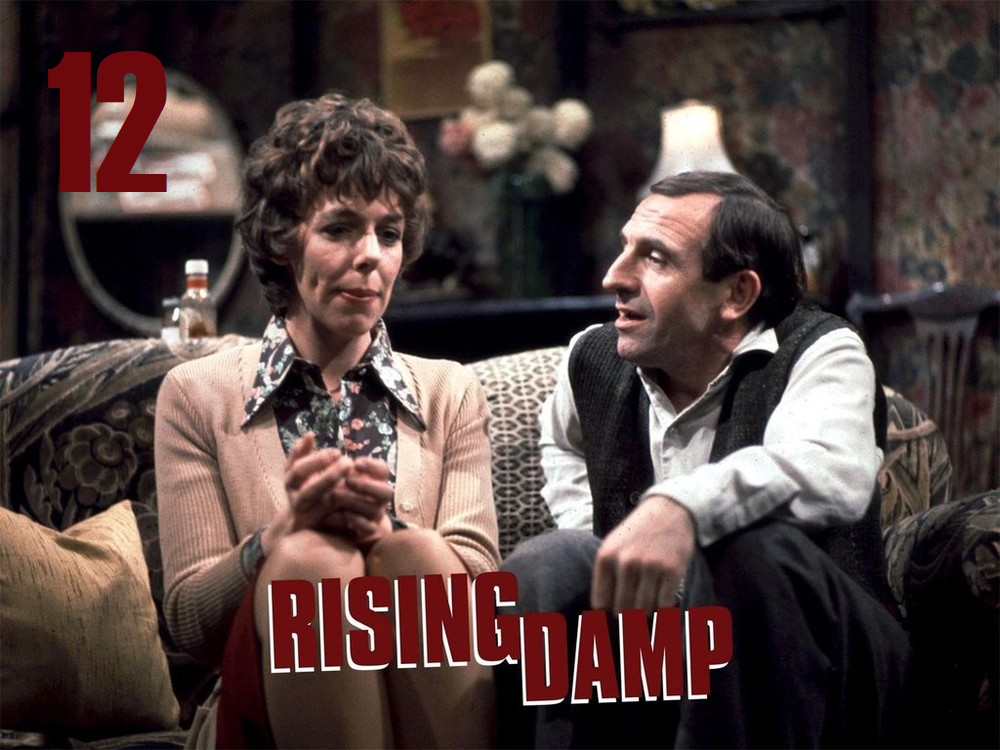
.
Original channel: ITV
Seasons: 4 (1974-78)/ 28 episodes
Christmas specials: 1 (Season 2)
Regular cast: Leonard Rossiter (Rigsby), Frances de la Tour (Miss Jones), Don Warrington (Philip Smith) and Richard Beckinsale (Alan Moore)
Regular crew: Eric Chappell (creator/ only writer)
The situation: Rigsby is the landlord of a rickety Victorian townhouse with several tenants; he’s devious, thrifty, bigoted, hypocritical and easy-to-deceive, with aspirations of social-climbing despite having few substantial interactions beyond his own financially-constrained tenants. They number Miss Jones, a middle-aged, unattached romantic who also has aims of social-improvement and is occasionally acquiescent to Rigsby’s constant amorous interest; Alan, a naïve, inexperienced and not-very-good medical student, and Philip, a confident, well-educated, black sophisticate student who has Rigsby believing he’s an affluent African tribal prince – which may well be a wheeze at his landlord’s expense.
The greatness: Long-admired, forever repeated and universally known, Rising Damp isn’t just ITV’s most enduring sitcom but also, as an absolute cast-iron classic, undoubtedly its best. It may not have offered audiences and its genre anything new, trendsetting or transformative but, like all the other remaining entries in this rundown, it did everything it did brilliantly.
The fine writing (perfect plotting and sparkling dialogue; especially from the loquacious Rigsby) and the magnificent cast (with their crackling chemistry) was Rising Damp’s hallmark. To throw yourself into any half-hour of it is joyous; an escape from whatever you’ve got going on. And that’s in spite of its rather depressed, impoverished, very 1970s-Britain setting with its loser characters, especially its barely redeemable protagonist (a racist braggard made maybe oddly adorable by Rossiter’s comic virtuosity).
Perhaps it should but nothing fundamentally bad or tragic happens in Rising Damp’s world, although it maybe has done or yet will to one or more of its characters. Yet, we’re definitely not burdened with considering or worrying about that; the deal is we’re just here for the wind-ups, misunderstandings, one-upmanship, characterisations and laughs – and they make us feel like we’re renting an exclusive penthouse apartment, smoking a cigar and, yes, a loaded African tribal prince.
Greatest episode: Great Expectations (Season 4)
Title theme: Theme by Dennis Wilson
Spin-offs: Rising Damp (1980; cinematic feature film)
Did you know? In hindsight, perhaps the show’s greatness and success weren’t surprising; it started out as writer Eric Chappell’s 1973 stage play The Banana Box, in which – aside from Beckinsale, apparently because of unavailability – all its principals were cast as the play’s corresponding characters.
.
.
.
.
.
.
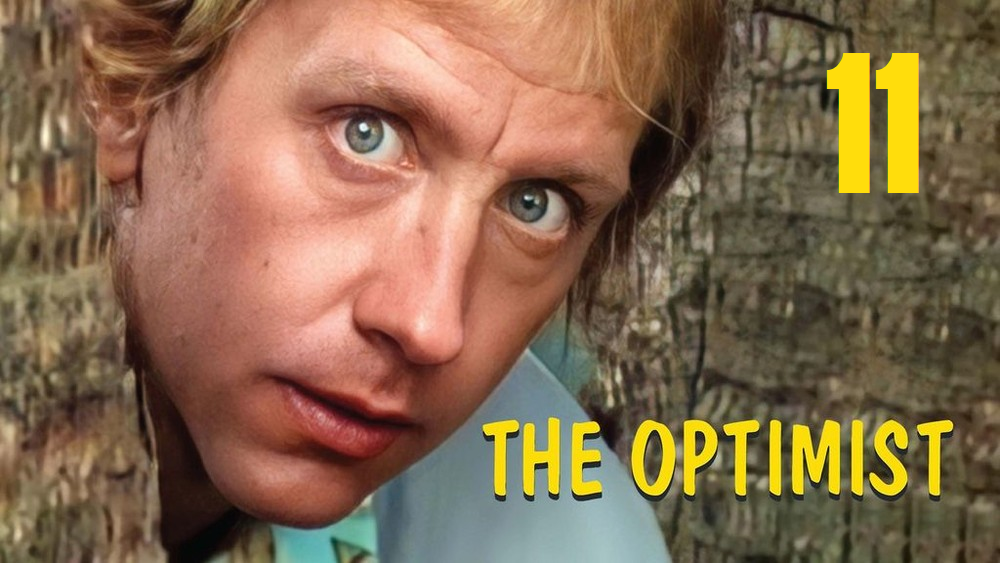
.
Original channel: Channel 4
Seasons: 2 (1983-85)/ 13 episodes
Christmas specials: 0
Regular cast: Enn Reital (‘The Optimist’)
Regular crew: Robert Sparks (creator/ writer); Robert Sidaway (producer/ writer); Enn Reital (writer/ producer); Peter Ellis (director/ writer); Robert Fuest (director/ writer)
The situation: ‘The Optimist’ is an ordinary chap who somehow constantly finds himself in extraordinary situations. Whether he starts out as a humble odd-job man, babysitter, decorator, cobbler or recreational roller-skater, he quickly winds up becoming a circus acrobat, cowboy, ballet dancer, Cold War spy, racing driver or acclaimed abstract artist – albeit sometimes with a little help from his own Walter Mitty-esque daydreams; but only a little. And, naturally, just as quickly as he goes from zero to hero with the lovely girl on his arm, he goes back to zero again. Such is life, eh?
The greatness: Years before Mr Bean there was The Optimist – doing the same non-verbal everyman-in-comic-scrapes thing but with a glossy, stylish veneer in sunny, glamorous Californian locations and with funky, unlikely guest stars (Dynasty’s Tracy Scoggins, Olympic swimmer Sharron Davies, ’70s Miss Great Britain Dinah May and cult-ish thesps Robert Davi, Ferdy Mayne, Jenny Runacre and Bill Irwin).
With a much more cinematic sensibility than the former show, then, the key inspiration behind The Optimist wasn’t anything as homegrown or humdrum as the UK sitcom tradition; it was Hollywood and, in particular, its golden age of silent comedy and the most legendary icons thereof. To say Eital’s misadventures, his attractive ‘love interests’, his vaguely menacing foes and, most of all, his slapstick antics recalled those of Chaplin and Keaton is to put it mildly.
Much of what made up The Optimist and made it so special was Hollywood homage (and, sure, a touch of Jacques Tati, too); no wonder the showrunners splashed the lion’s share of their budget on actual L.A. locales. As such, it had as much in common with the wit, variety and verve of the similarly cinematic-informed Wallace and Gromit (whose pitch-perfect filming and derring-do constantly reference old school Hollywood) than with Bean or Michael Crawford’s repetitive pratfalls in Some Mothers Do ’Ave Them (1973-78).
However, commissioned and broadcast as one of Channel 4’s earliest trailblazing offerings to British TV, The Optimist fell victim to that channel’s terribly tiny early ’80s audience, ensuring barely anyone’s aware of it, let alone seen it, to this day – save a select few, that is, due to a recent Kickstarter campaign that secured it a DVD release and, at last, a more than deserved slither of publicity.
And yet, thanks to, yes, this very blog post, you can put that right – for yourself, at least – by giving a watch one of its episodes (the Golden Rose of Montreux-nominated The Fool Of The House Of Esher) – see below. Go on, I’m sure it’ll raise more than a (silent) laugh or two!
Title theme: Theme by David Spear
Greatest episode: Burning Rubber (Season 1)
Spin-offs: 0
Did you know? Enn Reital is most noted for the opposite to non-verbal physical comedy, namely providing the voices of the grotesque puppet impersonations of the likes of Neil Kinnock, Prince Philip, Paddy Ashdown and, er, Satan on Spitting Image (1984-96); director of several Optimist episodes, Robert Fuest originally carved out an eclectic big-screen helming career, directing cult classics like
The Abominable Dr Phibes (1971), Dr Phibes Rides Again (1972) and The Final Programme (1973).
.
.
Listen, my friends! Playlist: Winter 2026

.
In the words of Moby Grape… listen, my friends!
Yes, it’s back (again) – the occasional playlist presented by George’s Journal just for you good people.
There may be one or two classics to be found here dotted in among different tunes you’re unfamiliar with or have never heard before – or, of course, you may’ve heard them all before. All the same, why not sit back, listen away and enjoy…
.
CLICK on the song titles to hear them
.
The Beatles ~ Rain (1966)¹
The Association ~ Windy (1967)¹
Bob Sleigh and the Downhill Racers ~ Pop Looks Bach (1970)²
The Byrds ~ Chestnut Mare (1970)³
Bernard Herrmann ~ I Still Can’t Sleep/ They Cannot Touch Her (1976)4
Barbara Dickson ~ January, February (1980)
Kate Bush ~ Under Ice (1985)
Denis King ~ Theme from Lovejoy (1986)5
The Bangles ~ Hazy Shade of Winter (1987)6
Carly Simon ~ My Funny Valentine (1990)
Underworld ~ Born Slippy (Nuxx) (1996)7
Eva Cassidy ~ Over the Rainbow (1996)8
Fleet Foxes ~ White Winter Hymnal (2009)
.
¹ Like it or not, the new normal for the British winter, weather-wise at least, is higher temperatures, and wind and rain. Lots of it. The first two months of 2026 have delivered an unprecedented near-constant deluge of rain and consistent high winds, up and down the country. The fact that the Scottish city of Aberdeen experienced no sunshine at all for 21 days straight made national headlines. Today’s lesson: climate change deniers are idiots.
² The unmistakeable, utterly irresistible stock music track that, from 1978 right up to the present, has served as the title theme to BBC2’s winter sports magazine show Ski Sunday – and opened each day’s BBC coverage of many a Winter Olympics, too. Composed for the Boosey & Hawkes music library by Sam Fonteyn and recorded in 1970 by the Cavendish Orchestra (Bob Sleigh and the Downhill Racers being their playful moniker for a 1988 single release), Pop Looks Bach is so named because of the influence of Bach’s Fugue in D Minor on its awesome melody.
³ Originally intended as a tune for a Roger McGuinn-orchestrated stage musical adaptation of Peer Gynt (which would have been nattily titled ‘Gene Trypp’), this whimsically idiosyncratic tune instead ended up on The Byrds’ 1970 ‘Untitled’ album and hit a high of #19 on the UK Singles charts; the 2026 Chinese Lunar Year – the Year of the Horse – begins today, February 17th.
4 From the soundtrack of Taxi Driver, the definitive cinematic meditation on the post-conflict Vietnam vet experience from Martin Scorsese, which opened in US cinemas exactly 50 years ago on February 8th 1976
5 The opening (and closing) theme of the Beeb’s Ian McShane-headlined, quirky Sunday-night antiques-themed comedy-drama Lovejoy; although enjoying huge popularity in its early 1990s heyday, the show’s first episode was originally broadcast 40 years ago, on January 10th 1986
6 A classic Simon & Garfunkel tune, of course, originally released in 1966, this rollicking Bangles version from 1987 (#2 in the US; #11 in the UK) is notable on two fronts. It was recorded for and features in the forgettable Robert Downey Jr.-James Spader drug addict movie Less Than Zero (footage of which features in this, the single’s video) and is a rare instance of a Bangles tune without the sensational Susanna Hoffs on lead vocals; instead, the vocals are harmonised by all four Bangles throughout, in fitting Simon & Garfunkel-style.
7 The unforgettable and iconic UK #2 dance anthem that helped, musically at least, to define mid-’90s British youth culture along with the feature film phenomenon in which it featured, Trainspotting; hard to believe it may be, but the latter exploded on to British cinema screens all of 30 years ago on February 23rd 1996
8 This winter marks the 25th anniversary of the peak of the Eva Cassidy phenomenon; in particular, the popularity of her timeless take on this most timeless of tunes and her album Songbird, which eventually scaled the summit of the UK album charts.
A Washington D.C. native, Cassidy died in 1996, aged 33, from melanoma, her touchingly beautiful singing talent unknown to any wider public until, from 1998 onwards, her recordings were championed in the UK by several presenters on the BBC’s Radio 2, including the one-and-only Terry Wogan.
Alex Petridis nailed it on the head when, in 2002, he wrote of Eva Cassidy: “There’s an undeniable emotional appeal in hearing an artist who you know died in obscurity singing a song about hope and a mystical world beyond everyday life”.
.
Listen, my friends! Playlist: Autumn 2025
.
In the words of Moby Grape… listen, my friends!
Yes, it’s back (again) – the occasional playlist presented by George’s Journal just for you good people.
There may be one or two classics to be found here dotted in among different tunes you’re unfamiliar with or have never heard before – or, of course, you may’ve heard them all before. All the same, why not sit back, listen away and enjoy…
.
CLICK on the song titles to hear them
.
Marty McFly with The Starlighters ~ Johnny B. Goode (1955?)¹
Edith Piaf ~ Les Feuilles Mortes/ Autumn Leaves (Live) (1957)
John Coltrane and Johnny Hartman ~ Autumn Serenade (1963)
The Kinks ~ Autumn Almanac (1967)
Keith Mansfield ~ Grandstand (1975)²
Justin Hayward and Richard Burton ~ Forever Autumn (1978)³
Earth, Wind & Fire ~ September (1978)
Frances Ruffelle ~ On My Own (1985)4
The Dream Academy ~ Power To Believe (1987)5
Guns N’ Roses ~ November Rain (Live) (1992)
Tina Turner ~ GoldenEye (1995)6
The Beatles ~ Free As A Bird (1995)7
Alan Silvestri and the Outatime Orchestra ~ Overture from Back To The Future (1985)¹
.
¹ Back To The Future may have celebrated its 40th anniversary this summer (it was originally released in US cinemas on July 3rd 1985) but its fantabulous time-travel trilogy is a decidedly autumnal affair; Marty McFly first traveled to/ arrived in 1955 on October 26th, arrived in 2015 on October 21st and arrived in 1885 on September 2nd
² This absolutely stonking track by library music supremo Keith Mansfield debuted as the iconic title theme of BBC1’s equally iconic Saturday afternoon sports magazine show Grandstand (1958-2007) 50 years ago on October 11th
³ From Jeff Wayne’s incomparable, classic concept album adaptation of H. G. Wells’ sci-fi novel par excellence The War Of The Worlds (1898)
4 As featured on the first English-language cast album of revolutionary France-set mega musical Les Misèrables, which opened at London’s Barbican Centre 40 years ago on October 8th and in the West End on December 4th 1985 at the Palace Theatre, its London home for the next 19 years
5 From the soundtrack of the pre-eminent Thanksgiving-themed film, John Hughes’ Steve Martin-John Candy comedy starrer Planes, Trains And Automobiles (1987)
6 The beginning of the Pierce Brosnan era of Eon’s James Bond celebrates its 30th anniversary on November 17th, the date in 1995 when the glorious GoldenEye opened in US cinemas
7 Conceived as a part of the awesome Anthology project, which ensured Beatlemania swept Britain all over again in autumn 1995 and so is currently celebrating its 30th anniversary, this really rather wonderful effort was the Fabs’ first reunion single, hitting a high of #2/ #6 on the UK/ US charts (indeed, it’s also received a swish, new, just-released 2025 mix)
.
George’s Journal’s pick of the flicks and top of the pops ~ 1990-94

.
Like me, does it feel to you that, in a blink of an eye, the 1990s have gone from being a heartbeat away to more than two or three eras ago? If so, that’s because it’s now – unbelievably – 30 years since the middle of that very decade.
Yes, 30 years since the emergence of ‘New Europe’ and the Internet, the rise of the home PC and the Premier League, and boomer Bill Clinton in the White House and ‘Call me Tony’ Blair in Number 10.
But not so fast! Just how much of all that took place in the first half of the ’90s, the time period this blog post is all about? Well, more than you might think; for as they raced their way to the Millennium (as they always had a wont to), the ’90s actually hit their stride pretty quickly.
Indeed, in this penultimate post in a very long (and, er, very interrupted) series of posts, my little nook of the ’Net is tasking itself with re-examining the culture of the early to mid-’90s.
A time when the Anglo-American greed of the ’80s gave way to the, well, slightly reduced greed of the 20th Century’s last decade. When high street fashion may have calmed down in the wake of ’80s excess, yet modern art bamboozled everyone, music charts and cinema releases became an utter free-for-all, and The Simpsons and (somehow) Mr Blobby evolved into inescapable small-screen icons.
So, following on from my cinematic and musical picks for 1950-54, 1955-59, 1960-64, 1965-69, 1970-74, 1975-79, 1980-84 and 1985-89, just what are my pick of the flicks and my ‘top of the pops’ for each year of the half-decade that was 1990-94?
Well, let’s find out, shall we, as we ditch those leggings and pick up that bucket hat, call off that D&D night to tackle that latest Gameboy, er, game, and throw out that worn VHS of Working Girl and throw on that shiny, new LaserDisc of Last Of The Mohicans… for the 1990s have arrived and they’re here to stay – well, for the length of this blog post, at least…
.
.
CLICK
on the film and song titles for video clips…
.
.
.
1990
.
Maggie out of No. 10, Major in; Germany reunified; Nelson Mandela walks to freedom;
Gazza’s tears at Italia 90; Saddam seizes Kuwait’s oil; Teenage Mutant Ninja Turtles;
Hubble Telescope take-off; Hammertime; Vanilla Ice; McDonald’s opens in Moscow
.
Film:
.
.
Directed by: Martin Scorsese/ Starring: Ray Liotta, Robert De Niro,
Joe Pesci, Lorraine Bracco and Paul Sorvino/ Country: USA/
Running time: 145 minutes (Crime-period drama)
What George says: While many say Scorsese’s Raging Bull (1980) is the ’80s’ best film, others claim the same of GoodFellas for the ’90s. Charting the rise and fall of Liotta’s mobster, it updated the Mafia epic for the MTV generation and became a true gamechanger; marrying pinpoint characterisation and violence with inventive plotting, punkish visual verve, profanity, humour, and tip-top rock and pop – everything from And Then He Kissed Me to Layla soundtrack the antics of Liotta and his cronies (De Niro’s gangster ‘gent’ and Pesci’s wild ‘wise guy’), as they navigate New York’s postwar underworld.
What the critics say: “No finer film has ever been made about organized crime – not even The Godfather.” ~ Roger Ebert
Oscar count: 1 (also won the BAFTA awards for Best Film and Best Director)
Oscar’s Best Picture pick this year: Dances With Wolves
The public’s pick this year: Ghost (global box-office #1)
.
George’s runners-up: 2. Cyrano de Bergerac;
3. An Angel At My Table; 4. Edward Scissorhands; 5. Longtime Companion


.
And the rest: ¡Átame! (Tie Me Up! Tie Me Down!); Back To The Future Part III;
Dances With Wolves; Dick Tracy; Die Hard 2; Ghost; The Grifters; The Hunt For Red October;
The Krays; Miller’s Crossing; Pretty Woman; Reversal Of Fortune; Tremors; Wild At Heart;
The Witches
.
.
.
Song:
There She Goes ~ The La’s
.

.
Writer: Lee Mavers/ Released: October 1990 (re-issue)
What George says: If The Stone Roses wanting to be adored in ’89 was Britpop’s harbinger, then this incredible one-hit wonder courtesy of a Liverpool quartet that split up before grunge had even left Seattle was its (early) opening salvo. Indeed, so utter are this tune’s retro bona fides that, first hearing it in the mid-’90s, I genuinely assumed it came out of the ’60s. What fooled me wasn’t its quality but the nature of its quality; its just-right jangly guitars, how clean its close harmonies were and, most of all, the purity of its melodic simplicity. There She Goes is just a perfect song – whichever decade it hails from.
What the critics say: “[It] defines the perfectly written pop song: an instantaneously recognisable melody and lyric set to simple, economic musical structure. It is such a simple song that it boggles the mind that someone hadn’t already written it.” ~ Ben Gibbard
Chart record: UK #13/ US #49
Recognition: Ranked #2 for 1990, #16 for the 1990s and #188 for ‘all-time’ on acclaimedmusic.net’s cumulatively ranked ‘top songs’ lists
.
George’s runners-up:
2. Enjoy The Silence (Depeche Mode)/ 3. A Little Time (The Beautiful South)/
4. The Only One I Know (The Charlatans)/ 5. (We Want) The Same Thing (Belinda Carlisle)


.
And the rest: Advice For The Young At Heart (Tears For Fears)/ All I Wanna Do Is Make Love To You (Heart)/ All Together Now; Groovy Train (The Farm)/ And So It Goes (Billy Joel)/ Bad Love; No Alibis (Eric Clapton)/ Better Than A Dream (Mike Batt)/ Better The Devil You Know; Step Back In Time (Kylie Minogue)/ Black Velvet (Alannah Myles)/ Can I Kick It? (A Tribe Called Quest)/ Crying In The Rain (a-ha)/ Cuts Both Ways (Gloria Estefan)/ Doubleback (ZZ Top)/ Downtown Train (Rod Stewart)/ Groove Is In The Heart (Deee-Light)/ Hanky Panky; Justify My Love; More; Sooner Or Later; Vogue (Madonna)/ Heal The Pain (George Michael)/ Here’s Where The Story Ends (The Sundays)/ Hold On (Wilson Phillips)/ How Can We Be Lovers? (Michael Bolton)/ I Wish It Would Rain Down; Something Happened On The Way To Heaven (Phil Collins)/ I’m Free (The Soup Dragons)/ Ice Ice Baby (Vanilla Ice)/ It Must Have Been Love (Roxette)/ John Dunbar Theme (John Barry and London Philharmonic Orchestra)/ Killer (Adamski and Seal)/ King Of Wishful Thinking (Go West)/ Kinky Afro; Step On (Happy Mondays)/ Let Love Speak Up Itself; My Book (The Beautiful South)/ Lily Was Here (David A. Stewart featuring Candy Dulfer)/ Little Fluffy Clouds (The Orb)/ Loaded (Primal Scream)/ Love Theme From Twin Peaks (Angelo Badalamenti)/ Nessun Dorma (Luciano Pavarotti)/ Nothing Compares 2 U (Sinéad O’Connor)/ Nothing Ever Happens (Del Amitri)/ Opposites Attract (Paula Abdul)/ Pictures Of You (The Cure)/ The Power (Snap!)/ Preacher Man (Bananarama)/ Put The Message In The Box (World Party)/ Real Real Real (Jesus Jones)/ Sacrifice (Elton John)/ Sadeness (Part 1) (Enigma)/ Serious (Duran Duran)/ Show Me Heaven (Maria McKee)/ Suicide Blonde (INXS)/ This Is How It Feels (Inspiral Carpets)/ Thunderstruck (AC/DC)/ Tom’s Diner (DNA featuring Suzanne Vega)/ U Can’t Touch This (MC Hammer)/ Unbelieveable (EMF)/ What Can You Lose (Madonna and Mandy Patinkin)/ World In Motion (Englandneworder)
.
.
.
.
1991
.
USSR collapses, Yeltsin gives Gorbachev a way out; war in the Gulf;
Japan’s economy goes pop; Yugoslavia disintegrates; AIDS claims Freddie;
Arnie in Terminator 2; (Everything I Do) I Do It For You is UK #1 for 16 weeks
.
Film:
(Raise The Red Lantern)
.

.
Directed by: Zhang Yimou/ Starring: Gong Li,
He Saifei, Cao Cuifen, Kong Lin, Jin Shuyuan and Ma Jingwu/ Country: China/
British Hong Kong/ Running time: 125 minutes (Period-psychological drama)
What George says: Surely the most beautiful meditation you’ll see on the psychological power that fuels sex slavery (and the horrendous harm it causes), this elegiacal, immersive, lustrously colour-coded costume drama of sparse dialogue plays out as a sort of Chinese take on Cries And Whispers. Indeed, both Bergman and Kurosawa may well have been big influences on helmer Yimou, as he filmed his tragic yet feminist tale that pivots around the naïvete and mental state of its protagonist, a never more luminous, never better Gong Li. Come the end, you’ll be left devastated – but in the best way possible.
What the critics say: “Yimou shot the film so that its rich colours and claustrophobic atmosphere matched the story perfectly, and it can also be viewed as a parable about the patriarchal, semi-feudal society of late 20th-century China … It is perhaps [his] most lavish and stately film … [and] his most resonant. You have only to watch Gong Li being prepared for the marital bed to see how well the film captures the scent of sex, jealousy and impending disaster.” ~ Derek Malcolm
Oscar count: 0 (but won the 1991/ 92 BAFTA, David di Donatello and National Board of Review awards for Best Foreign Language Film)
Oscar’s Best Picture pick this year: The Silence Of The Lambs
The public’s pick this year: Terminator 2: Judgment Day (global box-office #1)
.
George’s runners-up: 2. The Silence Of The Lambs;
3. La Double Vie de Véronique (The Double Life Of Veronique);
4. Beauty And The Beast; 5. Hitlerjunge Salomon (Europa Europa)


.
And the rest: Barton Fink; La Belle Noiseuse (The Beautiful Troublemaker);
Boyz N The Hood; Cape Fear; Close My Eyes; Delicatessen; Doc Hollywood;
The Fisher King; JFK; Life Is Sweet; Point Break; Robin Hood: Prince Of Thieves;
Terminator 2: Judgment Day; Thelma & Louise; Truly, Madly, Deeply
.
.
.
Song:
The Whole Of The Moon ~ The Waterboys
.

.
Writer: Mike Scott/ Released: March 1991 (re-issue)
What George says: First released in 1985, this barnstorming anthem of delicious musical dexterity, building one piano-pounding verse and one soaring chorus after another, defies easy interpretation. My take on what the masterly Mike Scott, beguiled by Romanticism as a literature-loving teen, delivers here is a mesmerising, trumpet-blaring, synth-soaked paean to the glory of the creative spirit in the face of the mundane (“I saw the rain-dirty valley, you saw Brigadoon / I saw the crescent, you saw the whole of the moon”). Honestly, how could any daydreamer who’s ever dared to dream a little deeper resist it?
What the artist says: “It’s about how amazing it is to live in a world where so much is available, where a human being can grow and learn like that. It’s a dramatic, celebratory song with a real big climax. And that’s because it’s describing something wonderful.” ~
Mike Scott (interviewed in 2024)
Chart record: UK #3
Recognition: Ranked #25 for 1985, #276 for the 1980s and #1,884 for ‘all-time’ on acclaimedmusic.net’s cumulatively ranked ‘top songs’ lists/
won the Ivor Novello Award for ‘Best Song Musically and Lyrically’ (1991)
.
George’s runners-up: 2. One (U2)/ 3. Stars (Simply Red)/
4. Fall At Your Feet (Crowded House)/ 5. I Touch Myself (Divinyls)

.
And the rest: All This Time (Sting)/ All Woman (Lisa Stansfield)/ Apparently Nothin’ (Young Disciples)/ Auberge; Looking For The Summer (Chris Rea)/ Baby Baby (Amy Grant)/ Back To The Interstate, Ben Stone (Carter Burwell)/ Be Our Guest (Jerry Orbach and Angela Lansbury)/ Beauty And The Beast (Angela Lansbury)/ Black Or White (Michael Jackson)/ Calling Elvis; Heavy Fuel (Dire Straits)/ Can You Dig It? (The Mock Turtles)/ Can’t Stop This Thing We Started; (Everything I Do) I Do It For You (Bryan Adams)/ Come Home; Sit Down; Sound (James)/ Coming Out Of The Dark (Gloria Estefan)/ Countdown; My Legendary Girlfriend (Pulp)/ Crazy (Seal)/ Cream; Diamonds And Pearls (Prince)/ Dizzy (Vic Reeves and The Wonder Stuff)/ Everybody’s Free (To Feel Good) (Rozalla)/ Fields Of Joy; It Ain’t Over ’Til It’s Over (Lenny Kravitz)/ The Fly; Mysterious Ways (U2)/ From A Distance (Bette Midler)/ Get Here (Oleta Adams)/ Get The Message (Electronic)/ Go (Moby)/ Gonna Make You Sweat (Everybody Dance Now); Things That Make You Go Hmmm… (C+C Music Factory)/ Holding On; Promise Me; Woman To Woman (Beverley Craven)/ I Believe (EMF)/ (I Wanna Give You) Devotion (Nomad featuring MC Mikee Freedom)/ International Bright Young Thing; Right Here, Right Now (Jesus Jones)/ Joyride (Roxette)/ Justified And Ancient; Last Train To Trancentral; 3 a.m. Eternal (The KLF)/ Learning To Fly (Tom Petty and the Heartbreakers)/ Let’s Talk About Sex (Salt-N-Pepa)/ Live Your Life Be Free (Belinda Carlisle)/ Long Train Running (Bananarama)/ Losing My Religion; Shiny Happy People (R.E.M.)/ Love And Understanding; The Shoop Shoop Song (It’s In His Kiss) (Cher)/ Love… Thy Will Be Done; Martika’s Kitchen (Martika)/ More Than Words (Extreme)/ Move Any Mountain (The Shamen)/ No Son Of Mine (Genesis)/ The One And Only (Chesney Hawkes)/ Overture from Robin Hood: Prince Of Thieves (Michael Kamen)/ Radio Wall Of Sound (Slade)/ Rescue Me (Madonna)/ Rocket Man (Kate Bush)/ Sailing On The Seven Seas (Orchestral Manoeuvres in the Dark)/ Saltwater (Julian Lennon)/ Sheriff Fatman (Carter the Unstoppable Sex Machine)/ The Show Must Go On; These Are The Days Of Our Lives (Queen)/ The Size Of A Cow (The Wonder Stuff)/ Smells Like Teen Spirit (Nirvana)/ Something Got Me Started; Wonderland (Simply Red)/ Sunshine On A Rainy Day (Zoë)/ There’s No Other Way (Blur)/ Too Many Walls; Touch Me (All Night Long) (Cathy Dennis)/ Unfinished Sympathy (Massive Attack)/ Walking Down Madison (Kirsty MacColl)/ Walking In Memphis (Marc Cohn)/ Wicked Game (Chris Isaak)/ Wind Of Change (Scorpions)/ World In Union (Kiri Te Kanawa)/ You Got The Love (The Source featuring Candi Staton)
.
.
.
.
1992
.
‘Baby Boomer’ Bill Clinton elected US President; Tories re-elected in UK;
Queen’s ‘annus horribilis’; Black Wednesday; L.A. riots; Damien Hirst’s shark;
Nirvana; Basic Instinct; ‘The Dream Team’ at the Olympics; Denmark win Euro 92
.
Film:
.
.
Directed by: John Musker and Ron Clements/ Starring: (the voices of) Robin Williams,
Scott Weinger, Linda Larkin, Jonathan Freeman and Gilbert Gottfried/
Country: USA/ Running time: 87 minutes
(Animated musical-adventure)
What George says: This, Disney’s stylish, swaggering Arabian Nights adaptation, has to be the high watermark of its second ‘Golden Age’ of animation. It soars like a magic carpet ride because, like Beauty and the Beast and The Lion King, its script and irresistible tunes seem smartly written as if for a hit Broadway musical (much unlike comparable ’90s cartoon fare), while the freewheeling improv of Robin Williams’ ebullient Genie inspires and reinforces a feisty, flip, postmodern tone, with jokes fit for any superior sitcom of the era; perfectly paving the way for all those Pixar classics just around the corner.
What the critics say: “Pixar’s sparkling output may not have come along as soon had Aladdin not primed an adult audience to look at animation as a genre as exciting as any other, and shown that Simpsonian sophistication could work when stretched to feature length.” ~ Olly Richards
Oscar count: 2
Oscar’s Best Picture pick this year: Unforgiven
The public’s pick this year: Aladdin (global box-office #1)
.
George’s runners-up: 2. Reservoir Dogs; 3. Glengarry Glen Ross;
4. Malcolm X; 5. Como Agua Para Chocolate (Like Water For Chocolate)


.
And the rest: Alien³; A Few Good Men; Bram Stoker’s Dracula;
Chaplin; The Crying Game; Howard’s End; The Last Of The Mohicans;
Memoirs Of An Invisible Man; The Muppet Christmas Carol; The Player;
Scent Of A Woman; Sneakers; Strictly Ballroom; Unforgiven; Wayne’s World
.
.
.
Song:
Constant Craving ~ k.d. lang
.
.
Writers: k.d. lang and Ben Mink/ Released: March 1992
What George says: The genius move k.d. lang pulled to ensure a big, fat slice of gay longing went wonderfully mainstream back in the early ’90s was to deploy the oldest trick in the book: produce a fine work of art of mass appeal. With a country-tinged sound, lyrics delivered in perfect plaintive tone and a mild-rock radio-friendly smoothness, this instant classic’s instant-replay appeal lies in those driving, melodious hooks, heightened by the Canuck songstress supreme’s studio-honed, yearning harmonies. For a time, you heard Constant Craving everywhere – and its greatness always left you craving more.
What the critics say: “There is no denying the rootsy, down-home quality of this wonderfully produced tune. Lang’s distinctive voice is woven into spiraling multitracked harmonies, wafting over a base of acoustic guitar strumming and subtle accordion and xylophone interludes.” ~ Larry Flick
Chart record: US #38/ UK #15 (1993)
Recognition: Ranked #33 for 1992, #312 for the 1990s and #2,487 for ‘all-time’ on acclaimedmusic.net’s cumulatively ranked ‘top songs’ lists/
won the Grammy Award for Best Female Pop Vocal Performance (1993)
.
George’s runners-up: 2. Motorcycle Emptiness (Manic Street Preachers)/
3. Bell Bottomed Tear (The Beautiful South)/ 4. Why (Annie Lennox)/
5. Sense (The Lightning Seeds)


.
And the rest: Ain’t No Doubt (Jimmy Nail)/ Am I The Same Girl (Swing Out Sister)/ Arabian Nights (Bruce Adler)/ Barcelona (Freddie Mercury and Montserrat Caballe)/ Book Of Days (Enya)/ Born Of Frustration (James)/ Come As You Are; Lithium (Nirvana)/ Connected; Step It Up (Stereo MCs)/ Damn I Wish I Was Your Lover (Sophie B. Hawkins)/ Deeply Dippy (Right Said Fred)/ Ebeneezer Goode (The Shamen)/ End Of The Road (Boyz II Men)/ Even Better Than The Real Thing; Who’s Gonna Ride Your Wild Horses (U2)/ Finally (CeCe Peniston)/ For Your Babies; Thrill Me; Your Mirror (Simply Red)/ Four Seasons In One Day; It’s Only Natural; Weather With You (Crowded House)/ Friday I’m In Love (The Cure)/ Friend Like Me (Robin Williams)/ Goodnight Girl (Wet Wet Wet)/ Hazard (Richard Marx)/ Hit (The Sugarcubes)/ Human Touch (Bruce Springsteen)/ I Can’t Dance; Jesus He Knows Me (Genesis)/ I Drove All Night (Roy Orbison)/ I Love Your Smile (Shanice)/ I Will Always Love You (Whitney Houston)/ I Wonder Why; You’re All That Matters To Me (Curtis Stigers)/ If You Don’t Love Me; The Sound Of Crying (Prefab Sprout)/ I’m Stronger Now (Ben Chapman and Steve DuBerry)/ It Feels Like Christmas (Jerry Nelson)/ It’s My Life (Dr. Alban)/ Just Another Day (Jon Secada)/ Keep The Faith (Bon Jovi)/ Laid So Low (Tears Roll Down) (Tears For Fears)/ The Life Of Riley (The Lightning Seeds)/ Man On The Moon (R.E.M.)/ Metal Mickey; The Drowners (Suede)/ No Ordinary Love (Sade)/ November Rain (Guns ’N Roses)/ Old Red Eyes Is Back; 36D; We Are Each Other (The Beautiful South)/ The One (Elton John)/ Save The Best For Last (Vanessa Williams)/ Sentinel (Mike Oldfield)/ Sexy MF (Prince and The New Power Generation)/ Sleeping Satellite (Tasmin Archer)/ Stay (Shakespeare’s Sister)/ Tears In Heaven (Eric Clapton)/ This Used To Be My Playground (Madonna)/ Walking On Broken Glass (Annie Lennox)/ Welcome To The Cheap Seats (The Wonder Stuff)/ A Whole New World (Brad Kane and Lea Salonga)/ Would I Lie To You? (Charles and Eddie)/ You Love Us (Manic Street Preachers)
.
.
.
.
1993
.
EU launched via Maastricht Treaty; Stephen Lawrence and Jamie Bulger murders;
Waco siege; UKIP forms; CGI dinosaurs in Jurassic Park; Grand National no go;
Man Utd win inaugural Premier League; The X-Files; Mr Blobby vs. Take That
.
Film:
Trois Couleurs Bleu (Three Colours Blue)
.

.
Directed by: Krzysztof Kieślowski/ Starring: Juliette Binoche, Benoît Régent,
Florence Pernal, Charlotte Véry, Yann Trégouët and Emmanuelle Riva/
Country: France/ Poland/ Switzerland/ Running time: 94 minutes
(Human-psychological drama)
What George says: If what defines a film as great is that it terrifically tells its story as much through moving images as traditional narrative, then Bleu (the opening act in Kieślowski’s ‘New Europe’-themed Three Colours trilogy) is undoubtedly a great film. Ostensibly a character study of a grieving woman (a never-better Binoche), it’s really a precociously smart meditation on the virtue of personal freedom. It’s utterly compelling from its brutally raw opening right through to its emotionally satisfying climax and, yes, the everyday-beautiful imagery it uses to propel you through its rich tale will stay with you forever.
What the critics say: “Kieślowski is the master of the telling detail … what his imitators’ work often seems to lack is the lyrical intensity we see in Blue’s mise-en-scène, and the adroit use of images suggestive of inner life … The film … seems to examine the feminist rallying cry ‘the personal is political’ with greater scope and sensitivity than any other. And its rich ambiguities leave enough room for us to see that the price of freedom depends on what kind of freedom you want.” ~ Nick James
Oscar count: 0 (but did win the Golden Lion, the Volpi Cup – for Juliette Binoche – and the
Golden Osella – for cinematographer Sławomir Idziak – at the 1993 Venice Film Festival)
Oscar’s Best Picture pick this year: Schindler’s List
The public’s pick this year: Jurassic Park (global box-office #1)
.
George’s runners-up: 2. Schindler’s List; 3. Dazed And Confused;
4. Groundhog Day; 5. The Remains Of The Day


.
And the rest: The Age Of Innocence; 霸王别姬 (Farewell My Concubine); The Firm;
The Fugitive; In The Name Of The Father; Jurassic Park; Much Ado About Nothing;
Naked; The Nightmare Before Christmas; Philadelphia; The Piano; Short Cuts;
Sleepless In Seattle; 喜宴 (The Wedding Banquet); What’s Eating Gilbert Grape
.
.
.
Song:
Ordinary World ~ Duran Duran
.

.
Writers: Simon Le Bon, John Taylor, Nick Rhodes and Warren Cuccurullo/ Released: January 1993
What George says: Almost 10 years on from their peak, Brum’s Best Ever Band were back with this belter of a ballad. Sure, its lyrics alternate between bombastic and indecipherable but who cares when Le Bon’s voice soars in that chorus and – especially – when we crash into that guitar solo? Yet, what’s truly irresistible here is the air of cool melancholia; one that feels more sophisticated than in Duran Duran’s best ’80s ballads. This is a song us ’90s teens may well have fantasised soundtracking our in-and-out-of-love adult lives. It’s the sound of aspiration and heartbreak, then – a combo far too seductive to resist.
What the critics say: “[This] excellently crafted [song demonstrates Duran Duran are] capable of delivering the goods. And as an added irony for a band that was introduced [to the US] by MTV when radio wouldn’t touch it, this particular song exploded across radio’s many formats before a video was even made.” ~ Tony Fletcher
Chart record: US #3/ UK #6
Recognition: Ranked #36 for 1993, #438 for the 1990s and #3,283 for ‘all-time’ on acclaimedmusic.net’s cumulatively ranked ‘top songs’ lists
.
George’s runners-up: 2. Creep (Radiohead)/ 3. Regret (New Order)/
4. Fields Of Gold (Sting)/ 5. Harvest Moon (Neil Young)


.
And the rest: Ain’t No Love (Ain’t No Use) (Sub Sub)/ All That She Wants (Ace Of Base)/ Animal Nitrate; So Young (Suede)/ Are You Gonna Go My Way; Believe; Heaven Help (Lenny Kravitz)/ As If We Never Said Goodbye; With One Look (Patti LuPone)/ The Bell (Mike Oldfield featuring Alan Rickman)/ Boom Shak-A-Lak (Apache Indian)/ Boom! Shake The Room (DJ Jazzy Jeff & The Fresh Prince)/ Breathe Again (Toni Braxton)/ Break It Down Again (Tears For Fears)/ Come Undone (Duran Duran)/ Distant Sun (Crowded House)/ Don’t Be A Stranger; The Perfect Year (Dina Carroll)/ Dreamlover; Hero (Mariah Carey)/ Eat The Music; Moments Of Pleasure; The Red Shoes; Rubberband Girl (Kate Bush)/ Eat The Rich (Aerosmith)/ Everybody Hurts; Nightswimming; The Sidewinder Sleeps Tonite (R.E.M.)/ For Tomorrow (Blur)/ From Despair To Where (Manic Street Preachers)/ The Heart Asks Pleasure First/ The Promise (Michael Nyman)/ Hey Jealousy (Gin Blossoms)/ I Can See Clearly Now (Jimmy Cliff)/ I Don’t Wanna Fight (Tina Turner)/ I Wouldn’t Normally Do This Kind Of Thing (Pet Shop Boys)/ If I Ever Lose My Faith In You; Seven Days (Sting)/ In All The Right Places; Someday (I’m Coming Back) (Lisa Stansfield)/ Insane In The Brain (Cypress Hill)/ Laid; Sometimes (James)/ Linger (The Cranberries)/ Little Bird (Annie Lennox)/ Love Scenes; Mollie’s Song (Beverly Craven)/ Lullabye (Goodnight, My Angel); The River Of Dreams (Billy Joel)/ Main Theme from Jurassic Park; Main Theme from Schindler’s List (John Williams)/ Moving On Up; One Night In Heaven; Renaissance (M People)/ Open Up (Leftfield)/ Play Dead (Björk featuring David Arnold)/ The Return Of Pan (The Waterboys)/ Return to Innocence (Enigma)/ Run To You (Whitney Houston)/ Slide Away (The Verve)/ Somewhere Over The Rainbow/What A Wonderful World (Israel Kamakawiwoʻole)/ Steam (Peter Gabriel)/ Sunflower (Paul Weller)/ Two Princes (Spin Doctors)/ What Is Love? (Haddaway)/ What’s This? (Danny Elfman)/ What’s Up? (4 Non Blondes)/ When I Fall In Love (Celine Dion and Clive Griffin)/ Where I Find My Heaven (Gigolo Aunts)/ You’re In A Bad Way (Saint Etienne)
.
.
.
.
1994
.
Nelson Mandela elected President of South Africa; genocide in Rwanda; O.J. on the run;
Tony Blair ‘New Labour’ leader; Channel Tunnel opens; Tonya Harding vs. Nancy Kerrigan;
Brazil wins fourth World Cup; Brookside’s lesbian kiss; Liz Hurley’s dress; Tarantino-mania
.
Film:
.

.
Directed by: Quentin Tarantino/ Starring: John Travolta, Samuel L. Jackson,
Uma Thurman, Bruce Willis, Ving Rhames and Harvey Keitel/ Country: USA/
Running time: 154 minutes (Crime drama-black comedy)
What George says: Arriving to cinemas on a wave of unprecedented hype and controversy, this film was a rare beast of a Royale with cheese – it met or perhaps even exceeded its insane expectations. Just the second effort Tarantino helmed, it’s a hugely confident affair; blending ‘f-bombs’ and unapologetic splatters of violence with an old-new ‘B-movie’-nostalgia, a dynamic narrative structure, killer dialogue and off-kilter characters that will live forever. Like A New Hope, Pulp Fiction was a one-off cinematic experience that seemed to define and spearhead a cultural era; one in which retro-cool reigned supreme.
What the critics say: “It towers over the year’s other movies as majestically and menacingly as a gang lord at a preschool. It dares Hollywood films to be this smart about going this far. If good directors accept Tarantino’s implicit challenge, the movie theater could again be a great place to live in.” ~ Richard Corliss
Oscar count: 1 (also won the Palme d’Or at the 1994 Cannes Film Festival)
Oscar’s Best Picture pick this year: Forrest Gump
The public’s pick this year: The Lion King (global box-office #1)
.
George’s runners-up:
2. Four Weddings And A Funeral; 3. Trois Couleurs Rouge (Three Colours Red);
4. The Madness Of King George; 5 Trois Couleurs Blanc (Three Colours White)


.
And the rest: The Adventures Of Priscilla, Queen Of The Desert; Backbeat;
饮食男女 (Eat Drink Man Woman); Ed Wood; Forrest Gump; Heavenly Creatures;
Hoop Dreams; The Hudsucker Proxy; The Last Seduction; The Lion King; Maverick;
Quiz Show; The Shawshank Redemption; Speed; 活着 (To Live) .
.
.
.
Song:
Live Forever ~ Oasis
.

.
Writer: Noel Gallagher/ Released: August 1994
What George says: Despite Britpop’s reputation for repackaging ’60s sounds for the ’90s, Oasis weren’t the ’90s’ Beatles; after all, the two decades were very different. So, while this absolute stonker of an indie anthem eulogises ’60s-ish rebellious freedom with a hooky melody built on fabulous Fabs-eque chord shifts, it’s driven along by a pulverising bassline, which combines with Liam Gallagher’s Manc lout-angel vocals to deliver a tune of unmistakeable masculinity. It’s in-yer-face laddishness bolted to deceptively nuanced musicianship – and, back in ’94, it was nothing short of a musical manifesto.
What the critics say: “This ain’t a song, Mr Gallagher, it’s a meditation, a moan, a mantra – with a grinding, tarmac-digging, mind-cutter of a melody.” ~ Dominic King
Chart record: UK #10
Recognition: Ranked #1 for 1994, #13 for the 1990s and #152 for ‘all-time’ on acclaimedmusic.net’s cumulatively ranked ‘top songs’ lists
.
George’s runners-up: 2. To The End (Blur)/ 3. Babies (Pulp)/
4. Stay Together (Suede)/ 5. Lucky You (The Lightning Seeds)


.
And the rest: Afternoons & Coffeespoons; The Ballad Of Peter Pumpkinhead; God Shuffled His Feet; Mmm Mmm Mmm Mmm; Superman’s Song (Crash Test Dummies)/ All I Wanna Do; I Shall Believe; Leaving Las Vegas; Run Baby Run; Strong Enough (Sheryl Crow)/ All I Want For Christmas Is You; Any Time You Need A Friend (Mariah Carey)/ Black Hole Sun (Soundgarden)/ But Not For Me; Can You Feel The Love Tonight; Chapel Of Love; Circle Of Life (Elton John)/ Change; Marvellous; My Best Day; Open Goals; Perfect; Why Why Why (The Lightning Seeds)/ Cigarettes & Alcohol; Half The World Away; Rock ‘n’ Roll Star; Shakermaker; Slide Away; Supersonic; Whatever (Oasis)/ Come In Out Of The Rain (Wendy Moten)/ Common As Muck (The Other Two)/ Confide In Me (Kylie Minogue)/ Connection (Elastica)/ Cornflake Girl (Tori Amos)/ Crash! Boom! Bang! (Roxette)/ David’s Last Summer; Do You Remember The First Time?; Lipgloss (Pulp)/ Dreams; Zombie (The Cranberries)/ Due South Theme (Jay Semko)/ End Of A Century; Girls & Boys; Parklife; This Is A Low; Tracy Jacks (Blur)/ ER (Main Theme) (James Newton Howard)/ Everybody’s Talkin’; Good as Gold; Prettiest Eyes (The Beautiful South)/ Fade Into You (Mazzy Star)/ Hallelujah (Jeff Buckley)/ Hold Me, Thrill Me, Kiss Me (Gloria Estefan)/ I Don’t Wanna Talk About It (Indigo Girls)/ If I Could (Seal and Joni Mitchell)/ I’ll Remember; Take A Bow (Madonna)/ I’ll Stand By You (The Pretenders)/ I’ll Take You There (General Public)/ Kiss From A Rose (Seal)/ La La La (Means I Love You) (Swing Out Sister)/ Love Is All Around (Wet Wet Wet)/ Love Spreads (The Stone Roses)/ The Most Beautiful Girl In The World (Prince)/ Patience Of Angels (Eddi Reader)/ Pineapple Head; Private Universe (Crowded House)/ Right Beside You (Sophie B. Hawkins)/ Rocks (Primal Scream)/ Sabotage (Beastie Boys)/ Saturday Night (Whigfield)/ 7 Seconds (Youssou N’Dour featuring Neneh Cherry)/ Space Cowboy (Jamiroquai)/ Stay Another Day (East 17)/ Stay (I Missed You) (Lisa Loeb and Nine Stories)/ Streets Of Philadelphia (Bruce Springsteen)/ Suite from Forrest Gump (Alan Silvestri)/ Sweetness (Michelle Gayle)/ Things Can Only Get Better (D:Ream)/ When We Dance (Sting)/ The Wild Ones (Suede)/ What’s The Frequency, Kenneth? (R.E.M.)/ You And Me Song (The Wannadies)
.
.
.
And coming up…
George’s pick of the flicks
and top of the pops ~ 1995-99
.

Raising the stakes: casting Daniel Craig as a lugubrious 007 and Eva Green as an ambiguous leading lady in the Fleming-faithful Casino Royale made for a risky yet triumphant Noughties reset for Bond
Once upon a time in the year 2010 and for a good few years after, this blog spewed out posts like there was no tomorrow. And yet, there was always a tomorrow – because that was then, this is now, time marches on, life’s got in the way with yours truly and the blog posts have, like it or not, dried up. But they haven’t dried up completely. Oh no, because George’s Journal is back!
Now, dear reader, before you get too excited (I know, I know, but do try to contain your excitement), this brand-spanking new post is, I think it’s fair to say, highly unlikely to precipitate a glut of more of its ilk from this very nook of the Internet. So why, after so long and out of the blue, this new post now?
Well, as mentioned, this blog started out in 2010 – a full 15 years ago – and given its predilection for celebrating anniversaries (not least in exactly this sort of way), methought it fitting to mark this particular milestone with just what you’re perusing right now. As Aleksandr the Meercat would say (and has done for at least the last 15 years), simples.
But why the ‘Legends’ and ‘Talent’ of the Noughties hook? Well, this blog has been elevating ‘legendary‘ and ‘talented’ figures of past cultural significance (into sort of halls of fame) since the very beginning – especially in such anniversary posts.
Nay, it’s even done so for ‘legendary’ fellers and ‘talented’ fillies for each year from 1950 right through to 1999 (in fact, it’s very nearly done it twice; God knows why, but still).
So, what better way, then, to bring the blog roaring back from the dead with a pictorial post celebrating its existence since 2010 with one celebrating the ‘legends’ and ‘talents’ it’s yet to celebrate – that is, those from the 10 years up to 2010? See, what I did there?
Now, since when has this blog concerned itself with the Noughties, you may ask? Well, not often, but time does march on and has (even for a blog concerning itself with things past), so maybe it’s, er, time to loosen our temporal constraints a little?
You’ll notice, too, the gender of the following ‘legends’ isn’t as limited as it once was – times change, progress happens and, indeed, the idea that only men can be legendary was always tosh. In short, if this blog’s gone woke, then it’s about, yes, time.
So, here we go then… let’s – each and every one of us – wend our way back to the Millennium Dome, crack open an alcopop or two, throw on that Moby CD and party like it’s 2000, as together we celebrate 15 fantastic(?) years of George’s Journal…
.
.
.
CLICK
on the images for full-size
.
.
.
2000
.
Legend:
Steve Redgrave
.
Making this year his by: at the age of 38 and with type 2 diabetes, winning
his fifth successive rowing gold medal at his fifth successive Olympic Games –
a feat still to be matched by any other male in an Olympics endurance event
.

.
.
.
.
.Talent:
Kylie Minogue
.
Making waves this year by: confirming her status as the all-time Pop Pixie
with a masterful Millennium comeback, as she releases the unforgettable
UK #1 single Spinning Around (and stars in its unforgettable video)
.

.
.
.
.
2001
.
Legend:
Peter Jackson
.
Making this year his by: gifting the world the exceptional cinematic adaptation of
The Fellowship Of The Ring, ahead of the equally exceptional other two films in the Lord Of
The Rings trilogy – still the thinking person’s answer to both Star Wars *and* Game Of Thrones
.

.
.
.
.
.Talent:
Sophie Ellis-Bextor
Making waves this year by: after doing everyone a favour the year before by killing off Victoria Beckham’s solo singing career before it started (via the chart battle-winning UK #1 Groovejet), releasing her first album, featuring, of course, the impossible-to-resist Murder On The Dancefloor
.

.
.
.
.
2002
.
Legend:
Denzel Washington
.
Making this year his by: becoming the first black man to win a Best Actor Oscar in 38 years
for his can’t-take-your-eyes-off-it villainous turn in Training Day (2001) – the least of all
he, one of the best and best-loved Hollywood actor-stars of his generation, deserves
.
.
.
.
.
Talent:
Rosamund Pike
.
Making waves this year by: ruffling Brozzer-Bond’s feathers as ice-cold fencer-cum
double agent extrarodinaire Miranda Frost in her big-screen debut Die Another Day (2002)
.
.
.
.
.
2003
.
Legend:
Bill Nighy
.
Making this year his by: honing his loveable, awkwardly mannered, middle-aged mockney gent persona, while going fully mainstream via star-making turns in the escapable Love, Actually and TV’s superior The Lost Prince and State Of Play – the latter will garner him a BAFTA award next year
.

.
.
.
.
Talent:
Beyoncé
.
Making waves this year by: leaving her girl group past behind and taking a big step towards
world domination with the release of her debut album, for which everybody falls Crazy In Love
.

.
.
.
.
2004
.
Legend:
Kelly Holmes
.
Making this year hers by: rocking the athletics world, delightedly shocking her homeland and becoming a British national institution when she wins the Women’s 800m and 1,500m at the Athens Olympics – eventually, she’ll use her public platform as an LGBTQ+ and mental health advocate
.
.
.
.
.
Talent:
Alicia Keys
.
Making waves this year by: continuing to fuse NYC-flavoured R&B with tumbling piano melody-driven pop on her sophomore album and going global with the ’70s soul-throwback, monster hit single You Don’t Know My Name
.

.
.
.
.
2005
.
Legend:
David Tennant
.
Making this year his by: following up eye-catching turns in Harry Potter And The Goblet Of
Fire and TV’s Casanova with a corking Christmas Day debut as The Tenth Doctor – he’ll go on to
become a global pop culture icon thanks to his hugely successful stint in the TARDIS (2005-10)
.
.
.
.
.
Talent:
Billie Piper
.
Making waves this year by: bridging the Eccleston-led first series and Tennant-headlined second of ‘NuWho’ (and so playing a critical role in Doctor Who’s hugely successful relaunch) by killing it as Rose Tyler, one of the best drawn and most important of the Gallifreyan’s companions
.

.
.
.
.
2006
.
Legend:
Daniel Craig
.
Making this year his by: redefining 007 for the 21st Century (while delightfully silencing obtuse naysayers) with his rough-and-ready, psychologically satisfying portrayal of Bond in the box-office boffing Casino Royale – which instantly transformed him into a Hollywood heavyweight
.
.
.
.
.
Talent:
Eva Green
.
Making waves this year by: after an, ahem, very revealing debut in The Dreamers (2003), catapulting herself into the silver screen’s ‘white hot’ category with her scintillating yet subtle take
on Bond’s original tragic love, Vesper Lynd – a linchpin of Casino Royale’s popular and critical success
.

.
.
.
.
2007
.
Legend:
Helen Mirren
.
Making this year hers by: receiving the Best Actress Oscar for portraying an empathetic yet flawed
and thoroughly believable version of an ageing Queen Elizabeth II in the The Queen (2006) –
the, yes, crowing glory of a singularly bold, diverse and superior thesping career
.

.
.
.
.
Talent:
Keira Knightley
.
Making waves this year by: following an Oscar-nommed turn in 2005’s Pride And Prejudice
with lead duties in awards-friendly epic WWII romance Atonement, thereby completing her
evolution from sexy Brit ingénue to top period-piece-actress-of-note of the Noughties
.

.
.
.
.
2008
.
Legend:
Usain Bolt
.
Making this year his by: running faster than anyone else before or since at 100 and 200 metres
and, in so doing, wowing the world by winning both Beijing Olympics finals by an unreal country mile
.
.
.
.
.
Talent:
Amy Adams
.
Making waves this year by: while basking in the popular glow of becoming a live-action Disney Princess in Enchanted (2007), delivering a (second) Oscar-nominated supporting turn in Doubt,
which will fast-track her on to Hollywood’s ‘A List’ of high-calibre, audience-friendly talent
.

.
.
.
.
2009
.
Legend:
Kathryn Bigelow
.
Making this year hers by: helming immersive, watch-through-your-fingers Iraq War drama The Hurt Locker, whose through-the-year transformation from indie outsider to Oscars favourite will eventually see her become the first woman to win the Academy Award for Best Director
.
.
.
.
.
Talent:
Adele
.
Making waves this year by: releasing her sophomore and, eventually, world-conquering
album 21, brimming, as it is, with marvellously mature Brit-soul ballads and the huge singles
Someone Like You, Rumour Has It, Set Fire To The Rain and Rolling In The Deep
.

.
.
.
.
.

.
Listen, my friends! Playlist: Summer 2025

.
In the words of Moby Grape… listen, my friends!
Yes, it’s back! It’s the occasional playlist presented by George’s Journal just for you good people.
There may be one or two classics to be found here dotted in among different tunes you’re unfamiliar with or have never heard before – or, of course, you may’ve heard them all before. All the same, why not sit back, listen away and enjoy…
.
CLICK on the song titles to hear them
.
Tony Bennett ~ Stranger In Paradise (1953)¹
Julie London ~ Theme From A Summer Place (1965)
The Sandpipers ~ Guantanamera (1966)
Love ~ Bummer in the Summer (1967)
Michel Legrand ~ Thème de La Piscine (1969)²
Quincy Jones ~ Summer In The City (1973)
John Williams ~ Main Theme from Jaws (1975)³
Donna Summer ~ I Feel Love (1977)4
Kiri Te Kanawa ~ Chants d’Auvergne: Baïlèro (1983)
Queen ~ Radio Ga Ga (1985)5
Soul II Soul ~ Back To Life (1989)
Oasis ~ Cum On Feel The Noize (1996)6
Dr. Teeth and the Electric Mayhem ~ Mr Blue Sky (2021)
.
¹ This irresistible Tony Bennett version may have ensured Robert Wright and George Forrest’s tune became an American standard, but it originated as a love duet from the 1953 Arabian folk tale-themed musical Kismet, the music and songs of which were themselves lifted from the works of Russian classical composer Alexander Borodin – in Stranger In Paradise’s case, the Gliding Dance Of The Maidens melody from the 1890 opera Prince Igor
² The main theme from the score of Jacques Deray’s scintillating Côte d’Azur-set psychological drama La Piscine (1969), forever recalled for the iconoclasm of its scantily-clad stars Alain Delon, Romy Schneider and Jane Birkin
³ The utterly iconic main theme from Steven Spielberg’s Jaws, courtesy of movie musical maestro extraordinaire John Williams (at first, when the latter pitched a minimalist arrangement of such few notes as the theme, the former thought he was joking; in fact, the theme is heavily influenced by the opening to the finale of Dvořák’s New World Symphony); Jaws, which for two short years until the release of Star Wars (1977) was the global box-office champ, single-handedly introduced the concept of the Hollywood summer blockbuster following its US opening 50 years ago on June 20th
4 Featuring a performance of dance troupe Legs & Co. from an end-of-year review episode of Top Of The Pops, broadcast on Boxing Day 1977; the proto-dance music mega-hit that’s I Feel Love had taken the UK charts by storm the previous summer
5 Queen’s performance of this 1984 hit, an ode to radio in the face of the onslaught of TV, was, of course, the opening salvo of their Live Aid set, considered by many to be the greatest live performance in the history of popular music (you only need watch it to understand why); Live Aid celebrated its 40th anniversary on July 13th
6 The B-side to Oasis’s glorious 1996 hit Don’t Look Back In Anger, this track sees them pay rightful tribute to Wolverhampton and glam rock’s finest, the one and only Slade; this summer not only sees Oasis reunite for the first time since they split-up in the Noughties but also marks 30 years since their zenith and that of the mid-’90s UK music phenomenon that was Britpop.
.
Happy times are here again? Caught in an economic maelstrom, the US turned to amiable patrician Franklin D. Roosevelt to lead it through one of its most turbulent eras – was he up to the titanic task?
Unless you’ve been hiding under a rock these past few months – and who could blame you, given the state of the world, right now – it won’t have escaped your notice this summer and autumn look set to deliver potentially era-defining elections in the UK and the United States.
In which case, this blog, albeit much neglected of late, is marking the fact with a series of politically-themed posts (hey, why not, given it has a wee bit of form in this area), focusing, as they will, on the good, the bad and, yes, the ugly of post-war Anglo-American leaders, right up to the end of the 20th Century.
Well, that’s the theory anyway. But, hopefully, we will indeed make it all the way to the millennium via these US President/ UK Prime Minister profiles – each of them packed full of facts and pics and a tinsy bit of expert and personal opinion.
Because, down through the decades in question, from FDR to Slick Willy and Churchill to Teflon Tony, we’ve been offered up a coterie of curious, nay fascinating Cabinet chiefs.
Variously, they’ve been driven by ambition, fuelled by good, flawed or plain bad intentions, and defined by their reactions to events. And, of course, they were defined, too, by the simple fact they were the right/ wrong person to scale the greasy pole at the right/ wrong time.
So, let’s kick things off, then, with the oh-so charismatic chap who was in the Oval Office as the US successfully emerged from the Great Depression and World War Two – yes, the triple-initial trend-setter himself, Franklin D. ‘FDR’ Roosevelt…
.
.
The details
.
Born: Franklin Delano Roosevelt (January 18th 1882)
Birthplace: Hyde Park, New York, United States
Died: April 12th 1945; Warm Springs, Georgia, United States (Resting place: Hyde Park, New York)
Political party: Democrat
Presidential terms: 3 full 4-year terms (March 4th 1933-April 12th 1945; died in office)
Education: Groton School, Massachusetts; Harvard University; Columbia Law School
Occupation prior to politics: Lawyer
Political roles prior to Presidency: Representative in New York State Senate (26th District; 1911-13); Assistant Secretary of the Navy (Wilson administration; 1913-20); Democrat nominee for Vice President of the United States (1920 Presidential election); Governor of New York (1929-32)
Spouse: Eleanor Roosevelt (married: March 17th 1905; First Lady)
Notable nicknames: ‘FDR’; ‘Sphinx’; ‘That Man in the White House’; ‘Feather Duster’ (childhood nickname)
Strange but true: Belonging to the elite Roosevelt family of New York, FDR and wife Eleanor were first cousins, while her uncle, Theodore ‘Teddy’ Roosevelt, had served as both Governor of New York and as the hugely successful, liberalising 26th President of the United States (1901-09).
FDR suffered from poliomyelitis to such an extent that during the 1920s he lost the ability to walk. Having withdrawn from public life, he eventually returned with renewed zeal and was elected and served as Governor of New York and US President despite considerable physical challenges (including occasional facial paralysis, fevers, and bowel and bladder dysfunction) and by hiding his condition from the public, in part thanks to a complicit media.
.

United front: the union of Franklin and Eleanor Roosevelt (together here with pet dog Meggy) may have evolved into a marriage of convenience but it was a partnership that suited both of them; the latter used it to become the most crusading and acclaimed of all First Ladies – a great humanitarian in her own right, Eleanor Roosevelt is simply one of the greatest Americans to have ever lived
.
The pros
.
♦ In his first term, FDR forced through fundamental ‘New Deal’ legislation that delivered economic aid to America’s unemployed citizens, struggling farmers and impoverished elderly in the wake of the Great Depression; the deep, unrelenting recession that swept through the world following the 1929 US stock market crash.
♦ To be exact, there were two New Deal Acts (1933-34 and 1935-36), which included programs that reformed the US banking system, delivered economic relief, introduced protections for labor organizing (trade unions) and pushed through employment-boosting make-work projects. The latter helped deliver more than 39,000 new schools, 2,500 new hospitals, 8,000 national parks, 300 airports and notable construction projects like the Hoover Dam, the Lincoln Tunnel and the Tennessee Valley Authority.
♦ Roosevelt recognised that ambivalence to the ever-growing threat of fascism and eventual war in Europe and South East Asia was incompatible to ongoing US economic and social (and arguably democratic) recovery. Realistically, then, there was no alternative than for the US to enter the conflict. Following Japan’s attack on Pearl Harbor in December 1941, the issue was forced; Roosevelt faced down opponents to entering the fray and mobilised US forces, providing the Allies with a critical boost in military numbers, weapons and hardware, and tactical options and leadership (not least his own as US Commander-in-Chief). This eventually paved the way to victory shortly after his death in spring/ summer 1945.
.
.
♦ Via the supercharging of US industry to produce all the weaponry and hardware required for the war effort, securing victory also indirectly pulled around the nation’s economy, ending the Great Depression and ensuring America’s status as the world’s only remaining democratic superpower, leading to its socio-economic, military and cultural dominance in the decades to come.
♦ Elected on less a wave than a tremble of optimism in the face of the onerous Great Depression, Roosevelt’s unbridled charisma and optimism was, nonetheless, a direct contrast to the seemingly uncaring businessman persona of his doomed predecessor, Herbert Hoover. It was, indeed, FDR’s reaching out to the public via his (albeit relatively infrequent) radio broadcasts – quickly referred to as ‘fireside chats’ – which helped endear him to them as an avuncular first among equals, and build and keep their trust during the dark, challenging days of the 1930s and ’40s. It revolutionised the personality of the Presidency, too – none of his successors could afford to come off as standoffish and stiff lest they lose support or not get elected in the first place.
♦ FDR won four consecutive, greatly lopsided Presidential election victories, ensuring he not only served 12 straight years in the top job (far longer than anyone before or since) but bestrode US politics throughout the 1930s and the first half of the 1940s. This established an era of American liberalism, which was sustained by his ‘New Deal coalition’ of voters – not just labor union members, urbanites, liberal intellectuals and blacks and other minority voters, but also Southern (usually conservative-minded) Democrats. As a result of which the so-called ‘Fifth Party System’ began, running until at least the early 1950s or, depending on your viewpoint, longer.
.
Pitch perfect? FDR throws out the ceremonial first pitch of Major League Baseball’s 1933 World Series (contested by New York Giants and Washington Senators) at Griffith Park, Washington, D.C.
.
The cons
.
♦ Perhaps inevitably, FDR endured a sticky second term, thanks to a backlash to his eye-wateringly high public spending and unprecedented expansion of the federal government. Not just from small-government, low-spending Republicans either; his relationship with the relatively conservative Vice President John Nance Garner had soured; so the latter was ditched for deeply liberal Henry Wallace. All this ensured resurgent Republicans were able to stymie some New Deal objectives, while the US entered recession again in 1937. As noted above, it’s widely believed the necessary transfer to a war-economy ultimately reversed the country’s financial fortunes, as opposed to Roosevelt’s domestic policies.
♦ Although being good at leading, Roosevelt wasn’t good at sharing. With VP Wallace proving just too liberal for the then very ‘big tent’ Democratic party, it was little-known Harry Truman who was forced on FDR as a compromise running mate for the final fourth election in 1944. No problem, right, given Roosevelt was all over everything like a rash? Wrong. When time caught up with him and he died in April 1945, the war was yet to be won and the untested Truman was thrust into power, facing the ultimate test. FDR hadn’t even told him an atomic bomb was being built.
♦ Every President has a genuine black spot on their record, Roosevelt’s must be the decision, during the war years, to intern 110,000 Japanese-Americans (and, to a greatly lesser extent, some of German or Italian ancestry). In general, his was an administration largely on the side of minorities, what with its generous economic relief programs for the desperately poor and frail, and increased government employment for black and Native Americans. Yet, certainly by today’s standards, the internment policy seems unnecessary and cruel.
♦ Despite being re-elected three times by the people, FDR’s holding on to the Presidency for 12 years was, at the time, likened by some to the dominance of a dictator, albeit a benevolent one. Indeed, in the wake of these three terms, the nation’s politicos eventually concluded anyone holding that much power for that long again probably wasn’t the best idea and introduced a two-term limit for the Presidency via 1951’s Twenty-Second Amendment.
.
.
The elections
.
1932 US Presidential Election
(November 8th 1932)
Electoral College vote ~ Roosevelt: 472 votes/ Hoover (Republican; incumbent): 59 votes
States won ~ Roosevelt: 42/ Hoover: 6
Popular vote ~ Roosevelt: 22.8 million votes/ Hoover: 15.7 million votes
Popular vote percentage ~ Roosevelt: 57.4%/ Hoover: 39.6%
Result: Roosevelt elected by landslide
.
1936 US Presidential Election
(November 3rd 1936)
Electoral College vote ~ Roosevelt: 523 votes/ Landon (Republican): 8 votes
States won ~ Roosevelt: 46/ Landon: 2
Popular vote ~ Roosevelt: 27.7 million votes/ Landon: 16.7 million votes
Popular vote percentage ~ Roosevelt: 60.8%/ Landon: 36.5%
Result: Roosevelt re-elected by landslide
.
Two into three won’t go: FDR and his long-standing, two-term Vice President Henry Wallace (right) are joined by the man who replaced the latter on the Democrats’ 1944 election ticket, Vice-President Elect Harry Truman (centre), for maybe not the most carefree car journey in November 1944
.
1940 US Presidential Election
(November 5th 1940)
Electoral College vote ~ Roosevelt: 449 votes/ Wilkie (Republican): 82 votes
States won ~ Roosevelt: 38/ Wilkie: 10
Popular vote ~ Roosevelt: 27.3 million votes/ Wilkie: 22.3 million votes
Popular vote percentage ~ Roosevelt: 54.7%/ Wilkie: 44.8%
Result: Roosevelt re-elected by landslide
.
1944 US Presidential Election
(November 7th 1944)
Electoral College vote ~ Roosevelt: 432 votes/ Dewey (Republican): 99 votes
States won ~ Roosevelt: 36/ Dewey: 12
Popular vote ~ Roosevelt: 25.6 million votes/ Dewey: 22.0 million votes
Popular vote percentage ~ Roosevelt: 53.4%/ Dewey: 45.9%
Result: Roosevelt re-elected by landslide
.
.
The experts’ view
.
“FDR’s legacy, his ‘shadow’, established the bulk of today’s US domestic institutions and largely defined the structure of postwar international relations we have lived with since his death … Right or wrong, good or bad, successful or unsuccessful – we are still in Franklin Delano Roosevelt’s world.” ~ Warren F. Kimball¹
“FDR was only one man, surrounded by able and ambitious advisers (many with different agendas). He usually hedged his bets because he did not have a master plan, only assumptions and guiding principles. The man whom Frances Perkins [US Secretary of Labor, 1933-45] called the worst administrator she ever knew had to rely on others to carry out his hopeful schemes. Although determined to make final decisions himself, he often waited for outside events, as in the case of Pearl Harbor, to assert his leadership.” ~ John Garry Clifford¹
“What is remembered [of him best] is the image FDR cultivated of jaunty optimism, complete with smile and cigarette holder. His effervescent leadership style may have special appeal when counterposed to contemporary events that can deprive Americans of a cherished self-image as a virtuous nation. We can remember FDR as representing the best in ourselves, when we rose to our ideals of ‘liberty and justice for all’ in a crisis.
This confidence in our principles and aspirations, and in FDR’s contribution to an American capacity to overcome crises, surely has an element of nostalgia, but it helps explain why politicians of all stripes have continued to invoke FDR.” ~ Mark Leff¹
.
The big three: UK Prime Minister Winston Churchill (l), FDR and Soviet premier Joseph Stalin (r) pose for pictures in iconic pose during February 1945’s legendary Yalta Conference of the WWII allies
.
George’s view
.
The idea of blithely stating so-and-so is your favourite leader of a country strikes me, I must admit, a tad twee, even infantile, and doing so here isn’t a precedent I’m exactly comfortable setting for this (intended) series of posts. But, dang it, FDR *is* my favourite American President. To my mind, he stands head and shoulders above others of the 20th and 21st Centuries and he’s surely up there with the all-time greatest, alongside Washington, Lincoln and his cousin Teddy.
At the point in history he took on the role, around the middle of the 20th Century, he was basically the identikit ideal American President. Patrician and (despite the illness he was concealing) well-groomed, he was also possessed of genuine confidence in thought and deed, and resolute in speech – and in wit.
Yet, perhaps in contrast to his easygoing, good-living and twinkle-eyed public persona (and, indeed, his old-fashioned ‘acceptable’ philandering), the illness he endured and its cruelty had, it seems, burnished a kindness in him, which undoubtedly guided his progressive principles and that simple desire to do what’s right.
And, naturally, what he managed to do can’t be understated. The stakes for his country were immeasurably high when he was in office, yet he took the bull by the horns and guided the United States through and out of both the Great Depression and the Second World War. So much so that, by VJ Day in August ’45, the US had emerged from economic bedlam and total war not just less bedraggled than others of the world’s powers, but as the Free World’s richest and its undisputed leader.
Now, of course, Roosevelt didn’t do all this alone. He wasn’t WWII’s sum-total US military contribution nor did he turn the US into the West’s sole superpower – it was the men and women of America who did that.
However, he was the man who called the shots, made the ultimate decisions, appointed (and fired) the experts and military commanders, cajoled, arm-twisted, pivoted and stood firm, and inspired and reassured the US public through it all, more intimately than any other President had before. And he did all of that for 12 years. With polio, without being able to walk and in a body that was giving up on him.
So, to sum up Franklin D. Roosevelt’s Presidential pre-eminence, consider this. On April 12th 1945, Harry Truman might well have paused in the Oval Office, for a second or two, and reflected he’d just become the most powerful man on Planet Earth. No man who’d preceded FDR as US President could have ever thought, let alone, said the same.
.
Etched in stone: the memorials of Eleanor Roosevelt (right) and FDR (along with faithful friend Fala, left) located in Washington, D.C. and featuring some of the wisest words either of them ever uttered
.
The quotes
.
♦ “The only thing we have to fear is fear itself.” (March 4th 1933)
♦ “Among American citizens, there should be no forgotten men and no forgotten races.” (October 26th 1936)
♦ “In these days of difficultly, Americans everywhere must and shall choose the path of social justice … the path of faith, the path of hope, and the path of love toward our fellow man.” (October 2nd 1932)
♦ “The test of our progress is not whether we add more to the abundance of those who have most; it is whether we provide enough for those who have too little.” (January 20th 1937)
♦ “No country, however rich, can afford the waste of its human resources. Demoralization caused by vast unemployment is our greatest extravagance. Morally, it is the greatest menace to our social order.” (September 30th 1934)
♦ “They [who] seek to establish systems of government based on the regimentation of human beings by a handful of individual rulers … call this a new order. It is not new and it is not order.” (March 15th 1941)
♦ “We have faith that future generations will know that here, in the middle of the 20th Century, there came a time when men of good will found a way to unite, and produce, and to fight the forces of ignorance, and intolerance, and slavery, and war.” (February 12th 1943)
♦ “More than an end to war, we want an end to the beginnings of all wars.” (from a speech intended to be delivered on April 12th 1945)
.
.
Reference:
¹ Koch, C. M. (2006). ‘A New FDR Emerges: Historians, Teachers, Authors Take a Fresh, Sometimes Critical, Look at Roosevelt’. National Archives. https://www.archives.gov/publications/prologue/2006/winter/fdr-emerges.html (Accessed 27 May 2024).
.
Retro Crimbo 2023: George’s gigantic festive photo archive

So this is Christmas, and what have you done? Plastering NYC – and other global metropolises – with billboards carrying an unfettered pro-peace message was what John and Yoko did in December ’69
Christmas may come but once a year, yet it’s rather a regular occurrence on this blog – must get back to some less itinerant blogging in 2024 (you might even call it a New Year’s resolution!).
Anyhoo, what better way to see out this year than with a truly bumper-bumper pictorial celebration of seasonal goodwill, featuring the great and the glamorous, the funny and the dramatic, the melodic and the pugilistic, the beautiful and the brilliant, and the cute and the cuddly of yesteryear?
All the very best of what remains of the season and a very happy and peaceful new year to all of you out there in Internetland…!
.
RIGHT-CLICK on images and open them in a new tab to enlarge them (on Desktop)
.


Gimme some peace: as with the posters and billboards erected in other global cities (including Berlin, Tokyo and Toronto), those in NYC went up on December 15th 1969, as part of John Lennon and Yoko Ono’s ‘Peace Movement’ response to the ongoing Vietnam War, which would also include that year’s infamous ‘bed in’ and the 1971 single (Happy Christmas) War Is Over, and would rope in the support of famous friends like George Harrison, Eric Clapton and Keith Moon (tl), and Mary Hopkin (br)
.
.


Snow angels: Audrey Hepburn and Marilyn Monroe enjoy lots of winter fun in the white stuff (middle), while Anna Karina beams with pride as she proudly shows off her skies (top and bottom)
.
.


Toys for girls and boys: the now both too-soon-departed Kirsty MacColl and Shane MacGowan promote the original release of The Pogues’ greatly loved Christmas hit Fairytale of New York in 1987
.
.


Bows, wreaths and trimmed trees: Much-loved Hollywood starlets of yesteryear – original ‘It Girl’ Clara Bow (top left), King Kong’s Fay Wray (top right), Mildred Pierce’s Ann Blyth (bottom left) and triple threat-and-a-half Ann-Margret (bottom right) – pose in some seasonal cheesecake shots
.
.


Laughs and scarfs: legends of British festive TV – Morecambe and Wise in a portrait from a Radio Times article, Ann and Vicki Michelle delighting Ronnie Barker in a promotional shot for a Porridge Christmas special and David Bowie in an on-set snap while filming his intro for The Snowman
.
.

Melody makers: The Beach Boys (l) and Blondie’s Chris Stein and Debbie Harry (r) pose with pines
.
.

Back to the Christmas future: before they were famous, Lea Thompson, Elisabeth Shue and a pint-sized Sarah Michelle Gellar feature in an ad for Burger King, which screened on US TV in 1982
.
.


Winter warmer: Claudia Cardinale puts on a brave face (and a glorious smile) in three snowy snaps
.
.


Hosts of Christmas presents: Terry Wogan bearing gifts (left) and Ted Rogers, Dusty Bin and Caroline Munro promoting a Christmas special of unfathomable game show 3-2-1 in TV Times magazine (right)
.
.


Mills and balloons: Hayley Mills promoting the 1966 film Sky West And Crooked (top), a 1969 stage production of Peter Pan (middle) and volunteering in a charity Christmas card shop in 1967 (bottom)
.
.


Delightful duos: a Santa-suited pairing of Danny Kaye and Nat King Cole, Kermit and Miss Piggy in The Muppet Christmas Carol and a very merry then-husband-and-wife Tony Curtis and Janet Leigh
.
.


Tree-mendous: a 1970s Dick Van Dyke posing for a TV special in front of a Christmas tree on then permanent display at Harold Lloyd’s Beverly Hills mansion (left), Lloyd himself touching up the tree, which featured thousands of ornaments sourced from across globe (middle), and Cynthia Myers literally lit-up like a Christmas tree on the cover of the Playboy December 1968 issue (right)
.
.


Fur-ly well wrapped-up: Mick Jagger, Pattie Boyd and Boney M. opt for furry outerwear to stave off the winter cold, the latter while promoting their single Rasputin in Moscow’s Red Square in 1978
.
.


Santa’s leggy helpers: film noir’s Jane Greer pens a letter to St. Nick, Joan Collins greets the gift-giver, Elizabeth Montgomery does a spot of Santa Claus-ing and Debbie Reynolds flirts with a snowman
.
.


Simply having a wonderful Christmastime: Paul McCartney films the video for his 1979 festive hit
.
.


Especially for yule: Kylie Minogue proves nobody holds a candle to her in the Crimbo cuteness stakes
.
.


Who’s behind you! Frank Bruno, Stephanie Lawrence and Sooty promote their early ’90s pantomime in Woking (top left), as do Britt Ekland and Gladiators’ Wolf for 1993’s Aladdin at the Birmingham Hippodrome (top right), while in the mid-’80s, then-husband-and-wife Peter Davison and Sandra Dickinson publicise their production of Cinderella (middle), and Colin Baker, Nicola Bryant and Mary Tamm do likewise for their John Nathan-Turner-produced pantomime in Southampton (bottom)
.
.


North Pole stars: Roger Moore is snapped as he dresses up as Santa (rosy cheeks and all), while Colonel Tom Parker dons the coat, boots and beard for Elvis Presley’s 1965 Christmas card to fans
.
.


New year cheerleaders: Buster Keaton and Debbie Reynolds (top ), Judy Garland and Olivia de Havilland (middle), and model Karen Jensen (bottom) ring out the old and ring in the new
.
.

.
.
.