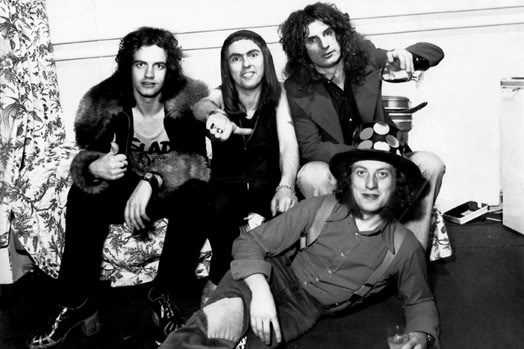
Glam champions: the legendary Slade, regulars from the golden era of Top Of The Pops, in an image on show at the V&A exhibition
If you go down to the V&A today, you’ll be sure of something of a surprise. For the world famous London museum, known for its huge collection of decorative art objects from times past, is currently playing host to a free exhibition of photos taken especially for the Beeb’s classic midweek chart music-themed magaine show Top Of The Pops.
Specifically displaying the work of Harry Goodwin, the programme’s resident photographer from its very first show broadcast on New Year’s Day 1964 right through to 1973, the exhibition features images of the major figures from the Merseybeat, ‘British invasion’, psychedelic rock, Motown and glam rock eras; among them The Fabs, The Stones, The Kinks, Ike and Tina Turner, Pink Floyd, Elton John and Marc Bolan.
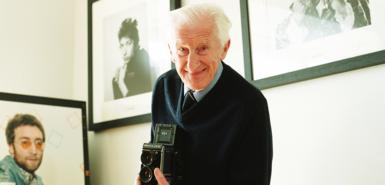
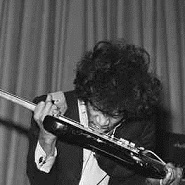
Snap happy: Harry Goodwin (left), TOTP’s resident photographer for the first nine years of the show’s existence; and his image of Jimi Hendrix from 1967 (right), simulating the star playing his guitar with his teeth, as he would go on to do on that night’s show
Admittedly, this isn’t a huge exhibit, covering three walls of just one room of the enormous museum’s Theatre and Performance collection, and the majorty of the images are familiar, face-on portrait-style snaps. Yet, accompanied by top ’60s and ’70s pop/ rock tunes as it is, the display makes for a cosy and diverting way to spend half-an-hour or 45 minutes, as well as throwing up one or two interesting tid-bits (TOTP effectively invented glam rock thanks to early ’70s guests wearing increasingly outrageous costumes to stand out from each other).
It’ll surely bringing a smile to almost any visitor’s face too. This is British TV history in front of you – very accessible TV that had no agenda aside from providing universal entertainment and dads with the occasional eye-candy that was delectable dance troupe Pan’s People (they too get a look-in here with a satisfyingly big image).
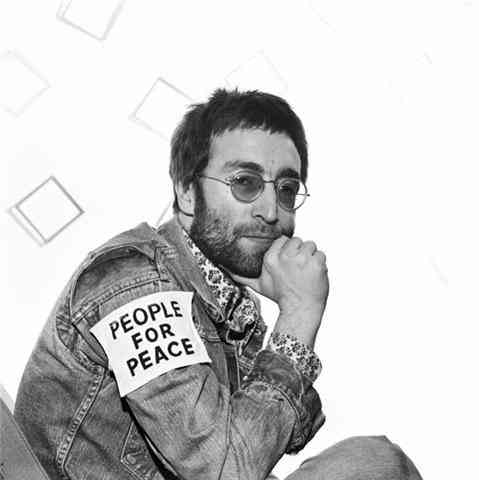
One man arm-band: a post-Beatles John Lennon snapped on his own from the 1970s
For his part, Manchester-born Goodwin started out as a photographer following the Second World War and, thanks to his success as Top Of The Pops‘ in-house snapper, became a freelance shooter for major bands as well as football and boxing stars. Now 85, more of his images can be poured over in the coffee table book My Generation: The Glory Years of British Rock – Photographs by Harry Goodwin, on sale both in the V&A shop and here.
All in all then, I certainly recommend this exhibition; it’s ideal if you happen to find yourself in the Smoke and are in a whimsical, nostalgic mood. Plus, on the way out you can examine the remains of a guitar owned by The Who‘s Pete Townshend, broken on stage during a performance as he had a wont to do – talk about my generation; well, the generation before mine, if you’re being precise. 
‘Harry Goodwin: The Glory Years of British Rock 1964-73’ runs free of charge at the V&A Museum until August 30 and will then transfer to the Grundy Art Gallery, Blackpool, from November 20 – January 8 2011
Listen, my friends! ~ May/ June



In the words of Moby Grape… listen, my friends! Yes, it’s the (hopefully) monthly playlist presented by George’s Journal just for you good people.
There may be one or two classics to be found here dotted in among different tunes you’re unfamiliar with or never heard before – or, of course, you may’ve heard them all before. All the same, why not sit back, listen away and enjoy…
Click on the song titles to hear them
~~~
Barry McGuire ~ Eve Of Destruction
P P Arnold ~ Angel Of The Morning
David McWilliams ~ Days Of Pearly Spencer
The Zombies ~ Time Of The Season
Jethro Tull ~ Livin’ In The Past
Joe Cocker ~ Delta Lady
Derek And The Dominos ~ Why Does Love Got To Be So Bad
Roxy Music ~ If There Is Something
Aerosmith ~ Sweet Emotion
Electric Light Orchestra ~ Evil Woman
Yvonne Elliman ~ If I Can’t Have You
Harold Faltermeyer ~ Axel F
Carly Simon ~ Let The River Run

Red-letter day: Not Roger, but Bobby Moore and his men become saints, winning England’s – so far – only World Cup in the year when their country was envied as the hippest place on earth
The Bobbies Moore and Chalton; Hurst’s hat-trick; Kenneth Wolstenholme; Nobby’s dancing; the dodgy third goal; the Russian linesman; Pickles the dog… is there anything to say about the 1966 World Cup final that hasn’t been said already? Maybe not. But then again, maybe it depends how you look at it.
With us now officially less than a month away from the 19th World Cup in South Africa, here at George’s Journal we’re kicking off a series of seven looks-back at previous World Cups – and, specifically, at the most memorable and iconic match from each of them. But more than that. Over the next 25 days, each of these footie friendly pieces’ll focus on not just the matches in question and the tournaments to which they belong, but also the culture and events that surrounded them. So then, indeed, much has been said, read and heard about the ’66 final, but most often out of context – that’s not what we’re going to do here.
It was Saturday July 30, and at London’s Wembley Stadium England’s football team were about to go out to battle to become world champions of the biggest sport on the planet. Yet, lest we forget, that’s far from all that was going on. The Big Smoke – especially its West End – was on top of the world already. Nowadays, in the UK as much as in Italy or Spain, football stars are the new rock ‘n’ roll/ movie stars; back then the rock ‘n’ roll/ movie stars were the rock ‘n’ roll/ movie stars. The Beatles, The Stones, Michael Caine, Marianne Faithful, Twiggy, Terence Stamp, Julie Christie, David Hemmings, Vanessa Redgrave, Cathy McGowan, Sandy Shaw… the list goes on and on, and on and on and on. It was the Swinging Sixties and in this summer in this city, it was in absolute full-swing.


Mascot and hero: World Cup Willie, the little lion in a Union Jack outfit (left); Pickles the dog, the canny canine who found the stolen Jules Rimet trophy dumped in a garden (right)
In the charts were The Kinks’ exceptional elegy on the downside of pop stardom Sunny Afternoon; The Stones’ wilfully lugubrious, sitar-featuring Paint It Black; and The Fabs’ precursor single to the magnificent Revolver album, Paperback Writer. At the cinema Audrey Hepburn ditched Givenchy chic for mini-skirts as she and fellow icon-of-the-age Peter O’ Toole taught audiences How To Steal A Million. Down on the King’s Road in Chelsea, the trendiest boutique going, Granny Takes A Trip, was doing booming business; Cockney snappers Bailey, Donovan and Duffy were capturing models Jean Shrimpton, Penelope Tree and Verushka in Mary Quant (the Bailey-inspired flick Blowup was just around the corner); and on TV the Edwardian adventurer hero in the one week-old series Adam Adamant Lives! woke up from suspended animation to be told: “this is London, 1966 – the swinging city”.
Now, let’s not kid ourselves, it wasn’t like this all over the country, of course not. It was only in London; only in a few venues across the centre, in fact, and, even then, it was like a rarefied bubble accessible only to a select few. However, its tentacles were forever stretching out throughout 1966 and touching teenagers, hipsters and the average joe and jodie throughout Britain – and further afield. And it was into this marvellous maelstrom of classless celebration, artistic diversity and exciting, colourful, vibrant joie de vivre that eleven relatively ordinary men in red jersies with three lions on their chests were about to leap as at 3pm they stepped on to Wembley’s green turf this Saturday afternoon. They weren’t to know that, though; they were here to win a football match and capture the ultimate prize in their sport. And they did that with bells on.


Dirty tricks and top pick: An incensed Alf Ramsey won’t let Bobby Charlton fratenise with the Argentines (left); Portugal’s nine-goal player of the tournament, Eusébio (right)
Their route to the final hadn’t been the stuff of dreams, however. The ’66 World Cup featured 16 teams, divided up into four groups of four in the first round, in which each team played the other in each group. In their group, England faced Uruguay (twice previous World Cup winners), Mexico and France. They drew 0-0 with Uruguay in their first match, the tournament’s opening game and far from a statement of intent from the host nation, but then beat Mexico 2-0 and France 2-0. Finishing top of the group, having scored four goals and conceding none, they qualified for the quarter finals. There they faced Argentina in what would become a very memorable match, but sadly not for the best of reasons.
Yes, the English got through it, and that’s maybe the best way of putting it; the football on show was of negligible quality thanks to the Argeninians’ hard-tackling and spoiling tactics. Eventually, the referee had had enough and sent off their captain Antonio Rattín for dissent. The player was so disgusted, however, he refused to leave and had to be escorted off the field by two policeman, wrinkling a British pendant as he left. To this day the Argentines, believing they were unfairly treated, refer to the match as el robo del siglo (the robbery of the century) and thus began the football feud between the two nations that arguaby still exists today. Striker Geoff Hurst scored the match’s only goal in the 78th minute and, at the final whistle, England’s manager Alf Ramsey stopped his players from shaking hands with their opponents and engaging in the customary swapping of shirts, indeed grabbing swapped shirts from their hands in some instances. In the following days he would refer to the Argentine side as ‘animals’. Rather an exaggeration, perhaps.
If legendary Manchester United midfielder Bobby Charlton was a mercurial figure for this side, then Alf Ramsey was its Zeus-like figure. He had been appointed in 1963 and immediately set about planning to win the World Cup in three years’ time. He was a firm, abrupt man who didn’t get on with the press enormously well, but he was fair and loyal with his players. His breakthrough decision was, radically, to transform the team’s formation by removing wing-based midfielders, which England and many other sides had played with for decades, giving rise to the side later being referred to as Ramsey’s ‘wingless wonders’. There’s no question the move served them well in the tournament, as with advanced-minded midfielders who could drop back and defend if necessary, England attacked through the middle as opposed to on the flanks.
Now through to the semi-finals, England faced Portugal – one of the true form teams of the tournament. The skillful Iberians were riding the crest of a wave in the ’66 tournament. They’d never qualified before and wouldn’t get anywhere near these dizzy heights again until 2006 with Cristiano Ronaldo. Their star this time around – arguably the star player of the entire competition – was the frighteningly useful Eusébio (who, upon completing his football career, had managed to score an amazing 727 goals in 715 games). When this tournament was completed, Eusébio finished top scorer with a highly impressive total of nine goals, four of which, in fact, had come in Portugal’s quarter final clash against North Korea. Yes, you read that right, North Korea.
The fact this particular team, another debut qualifier, had got this far was a true wonder and, perhaps even more remarkably they led this match 3-0 at one stage, before an incredible comeback from Eusébio and co. saw them eventually turned over 5-3. The main man scored again in the semi-final against England, an 82nd-minute penalty awarded against Bobby Charlton’s younger brother, centre-back Jack, but by that time it was too late – Charlton the elder had unleashed two trademark long-range, slide-rule strikes, giving England a 2-1 victory. They were through to the final.

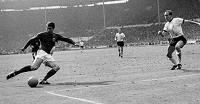
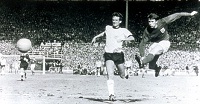
1… 2… 3: Geoff Hurst’s World Cup final hat-trick – an achievement still yet to be equalled
And there, of course, they faced West Germany. England lost the coin toss deciding which of the two teams would play in their home kit (the West Germans also wore white shirts and dark shorts), which ensured the host nation would wear their away strip. And the superstitious may have seen this minor defeat as an omen for what was to come as, in the 12th minute, the Germans took the lead through striker Helmut Haller, following a mistake in England’s defence. English fears were availed just six minutes later, however, when assured, young captain Booby Moore launched a free-kick into the penalty area and England’s Number 10 Geoff Hurst headed the ball into the back of the net. 1-1. Famously, of course, Hurst was selected for the final ahead of the public’s first choice, Jimmy Greaves, who had been a high-profile high-scoring striker for fashionable London clubs for some years. Yet, in another savvy move, Ramsey had decided to give Hurst the nod after he had replaced the injured Greaves earlier in the tournament.
There are probably few better known football matches than this World Cup final – not just in the UK but around the world – and yet much of the conventional knowledge concerns only what happened in extra-time. There were two more goals in ordinary time and both were dramatic. England thought they had won the match and the whole thing in the 77th minute when midfielder Martin Peters put away an Alan Ball cross – how different history and nostalgia could have been if the score had remained like this; Peters would have been iconic hero for all-time, surely? But it’s funny how things go – England only had to hang on for 13 minutes, but couldn’t. In the final minute – yes, the final minute – Wolfgang Weber scored for West Germany, sending the match into extra-time. Indeed, it’s little recalled now, but the ball appeared to strike a German hand before it went in, making this the match’s most controversial moment. So far.
And then extra-time. Hurst’s pivot in the Germany penalty area, the ball hitting the crossbar and bouncing off the ground and out. The Russian linesman (actually from Azerbaijan) declaring it a goal – on his deathbed he claimed he was sure it crossed the line because of ‘Stalingrad’. The Germans pushing up-field for an equaliser. Moore finding Hurst in acres of space, Hurst running towards goal and hoofing it – cue Kenneth Wolstenholme: “Some people are on the pitch, they think it’s all over – it is now”. And Moore wiping his muddy hands on his shorts before receiving the World Cup itself, the Jules Rimet trophy, from The Queen in the royal box.
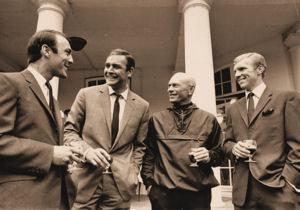
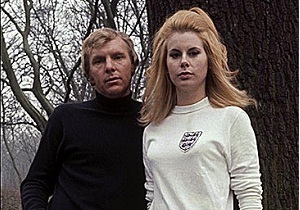
Living it up: Jimmy Greaves and Bobby Moore meet Sean Connery and Yul Brynner during an England team visit to Pinewood studios (left); Moore and wife Tina – the originial WAG (right)
England winning the World Cup, and the manner in which they did so in extra-time, was the perfect cultural high of 1966 – out of many British cultural highs that year. It was the ideal topper-off for Swinging Sixties Britain or, England, if you’re being picky. For instance, as a symbol of the country’s cultural relevance in this period and its ease and pride with this, the Union Jack flag was constantly popping up among the exciting new fashions emerging from London. Following England’s football success, though, national pride positively pushed the Union Jack into becoming the Swinging Sixties’ foremost trademark.
The England players themselves, if neither being regarded as utterly normal working class men before the triumph or on a par with Lennon or Jagger after it, did find themselves somewhat pulled into the fashionable glitterati for a brief period. And none more so than the boyishly handsome, 25 year-old Bobby Moore – the proto David Beckham. Soon his image was everywhere, as was that of his trendy and attractive wife Tina. If he’d have run for PM he’d have probably won. A public vote he definitely did win was the BBC’s Sports Personality of the Year award that December, with Geoff Hurst coming third.
And for as long as London remained an arts, fashion and counter-culture capital, the England team retained its cool kudos. Take a gander at the classic 1969 Michael Caine-starring comedy The Italian Job. The caper at the centre of the plot relies on a minibus supposedly full of football fans being driven through the city of Turin on the eve of an England-Italy match. Thus, the oh-so recognisable names of the England team are graffittied all over the vehicle, pitching them alongside the other hip British icons of the period to appear in the film: the Union Jack, Mini Coopers, the Aston Martin DB5, TV host-cum-actor Simon Dee and, yes, Michael Caine.

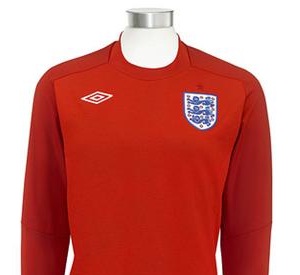
Spot the difference: England’s away jerseys for the 1966 (left) and 2010 (right) World Cups
And let’s not forget that jersey in which the team won the World Cup. To say it became iconic is almost to do it a disservice. Nowadays, it feels like its strikingly stark bright red with the three lions badge on the left chest, hoop collar and long sleeves almost sums up the cool yet often so simple fashion of the Swinging Sixties. It’s become acceptable male dress in general – especially at England football matches where not only does it seem appealingly retro, but also elegantly sartorial. As if to underline this point, its influence is utterly clear behind the latest England away shirt, heralded – along with the simple new home shirt – as perhaps the trendiest England togs ever.
In the end though, what was the most important thing about this match? Well, that it ensured England had won the World Cup, stupid. Forget cultural significance and its place in the Swinging Sixties story. For folks up and down England then this trumped – and continues to trump now – everything else about the ’66 World Cup. And following their triumph, the most important thing for the team was to try and repeat the feat four years later. Could they do it? Well, you won’t have to wait four years to find out – more like three or four days – as all will be revealed right here, folks, in the second offering of my World Cup specials series… 
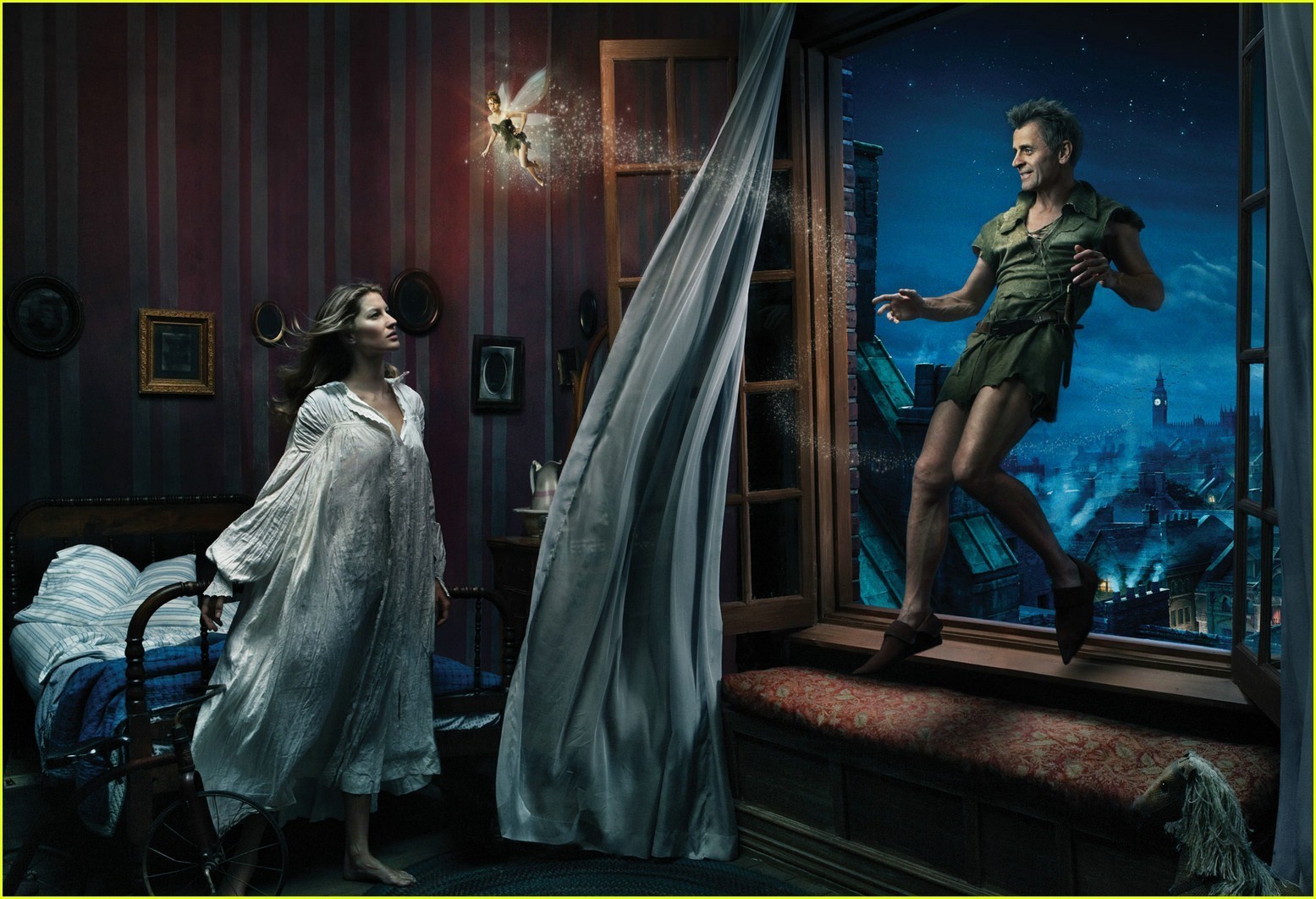
Where you never have to grow up: Annie Leibowitz’s 2008 shoot of ballet star Mikhail Baryshnikov as Peter Pan, supermodel Gisele Budchen as Wendy and comedian Tina Fey as Tinkerbell for Disney Parks’ ‘Year Of A Million Dreams’ promotion
~~~
If you were browsing on google yesterday, you may well have noticed this very image in place of the old trusty search engine’s usual logo…
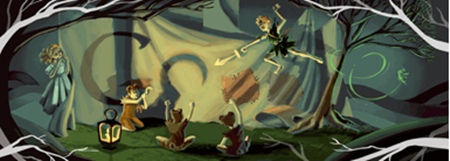
What is it? And what was it doing there? Well, if you’d have passed your mouse over it – or if you’re particularly keen of mind – you’d have discovered/ realised it’s a neat, fun little picture inspired by Peter Pan, and had pride of place on google’s homepage owing to yesterday being the 150th anniversary of the birth of his creator, J M Barrie.
If you’re at all like me, you may well have a fond place in your heart for Peter Pan – and, in turn, J M Barrie. When I was a child, like many children, I suppose, I found the character, the Neverland fantasy world he inhabits and the truly marvellous idea he can transport ordinary children from our reality to his dream-like island paradise seductive to say the least. And, in many ways, my admiration for Barrie’s hero and the primary conceit behind it hasn’t diminished over the years; if anything, it’s grown. I find the whole Peter Pan thing fascinating, in its way.
Perhaps I should put this all into context, in addition to blogging about retro stuff from the ’60s, ’70s and ’80s, I’m also a budding (would be) childen’s author and, around the time I started writing my novel, I decided it might be a good idea to re-read a handful of children’s classics – The Wind In The Willows, The Lion, The Witch And The Wardrobe, Charlie And The Chocolate Factory, The BFG and… Peter Pan. And upon picking up the latter classic as an adult, it struck me just how smart, acerbic and humorous Barrie’s prose was and just how genuinely the legendary tale on the page drips with pathos and sadness. This is the boy who never grows up – for all his childish abandon and liberation, remaining a child is a gig he’s stuck with for life. It’s a genius concept.
Anyway, to mark the great writer’s 150th, I felt it might be somewhat fitting to record a double-digit list of things you may not know about him and his creation…
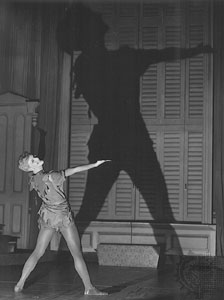
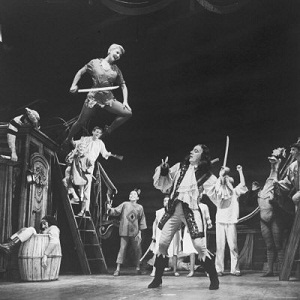
Principal boy: Mary Martin as Neverland’s most famous son in the 1950s musical version of Barrie’s tale
~ Born in Kirriemuir, Scotland, Barrie went on to become a relatively unsuccessful author and dramatist in London, until one day he met the Llewelyn Davies boys (John, Michael, Peter and Nicholas) with their nanny in Kensington Gardens, while out walking his St Bernard dog Porthos. He later met their mother Sylvia and father Arthur. This encounter and his subsequent relationship with the family inspired him to write the hugely successful stage play Peter Pan, Or The Boy Who Wouldn’t Grow Up.
~ This real-life story is told in the Oscar-nominated 2004 film Finding Neverland, starring Jonny Depp as Barrie and Kate Winslet as Sylvia. Liberties are taken with factual accuracy, however, such as Arthur dying before Barrie became acquainted with the family and the youngest boy Nicholas not included (presumably to neaten up the ‘casting’ of the three remaining boys as the three main boy protagonists in Barrie’s story – Sylvia then fits as Wendy and Porthos as ‘Nanny’ the dog).
~ The Peter Pan character was debuted by Barrie in his fairytale fantasy novel The Little White Bird, published in the UK in 1901. The section of the novel featuring Peter, dealing with his origins, was later published in 1906 as Peter Pan In Kensington Gardens. The stage play Peter Pan, Or The Boy Who Wouldn’t Grow Up was first performed on 27 December 1904, and was developed by its author into the 1911 novel Peter And Wendy.
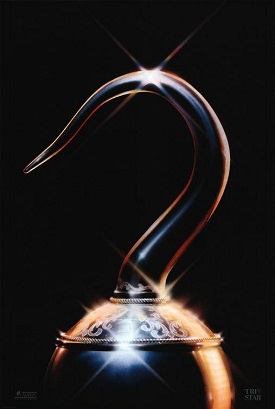
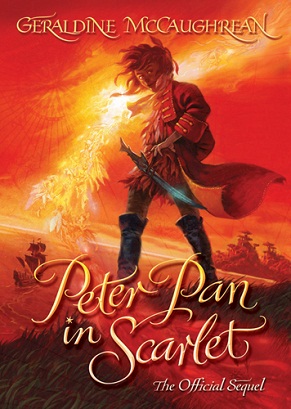
By hook or by crook: the hip poster for Spielberg’s 1991 sequel film Hook (left) and the ‘official’ 2006 sequel novel, in which Peter – erk! – takes on Hook’s mantle (right)
~ Barrie was friends and/ or acquaintances with many of the literary elite of his day, such as Robert Louis Stevenson, George Bernard Shaw, H G Wells, Thomas Hardy, P G Wodehouse, G K Chesterton, Jerome K Jerome and A A Milne – some of whom even played on a cricket team he set up. He also knew Robert Falcon Scott (‘Scott of the Antarctic’).
~ Another good friend was American theatre producer Charles Frohman, who, having got the Peter Pan play on to the stage, is supposed to have paraphrased a line from the work when turning down a lifeboat seat as RMS Lusitania was sunk by a German U-Boat: “To die will be an awfully big adventure/ Why fear death? It is the most beautiful adventure in life”. He did indeed die in the incident.
~ The Peter Pan stage play, novels and films (including, of course, Disney’s much loved 1953 animated effort) popularised the name ‘Wendy’, which before their creation was merely a rare 19th Century name in the United States.
~ Before his death in 1937, Barrie gave the rights to his Peter Pan works and characters to the Great Ormond Street Hospital in London.

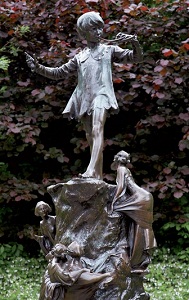
Garden feature: Peter playing his pipes in London’s Kensington Gardens
~ The iconic Peter Pan statue that stands in Kensington Gardens was produced by sculptor Sir George Frampton, who was also responsible for the lion figures outside The British Museum in London. Six further casts of the original Peter Pan statue can be found in Liverpool; Brussels; Toronto; Perth, Australia; Camden, New Jersey, USA; and St John’s, Newfoundland, Canada.
~ In the early 1960s, Cuban children were sent to Miami to escape – for better or worse – the Castro regime in an initiative called ‘Operation Peter Pan’ and, in the 1980s, the term ‘Peter Pan syndrome’ began to become popular in describing male underdeveloped maturity
~ And finally, a real retro fact… in 1954 a hugely successful musical version of Peter Pan was staged on Broadway. Running for 152 performances, its two stars Mary Martin (as Peter) and Cyril Ritchard (as Captain Hook/ Mr Darling) both won Tony awards. NBC broadcast the production as telecasts in 1955, 1956 and 1960. The musical was revived in 1979 and 1990 and won Tonys for Best Musical Revival on both occasions. Another revival was rumoured to be in the offing in 2007, but so far hasn’t appeared – however, like he does through Wendy’s bedroom window, you can be assured Peter Pan will always come back… 
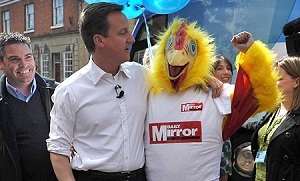

Avian: David Cameron with his feathered nemesis from The Daily Mirror (left); available: Nick Clegg (right) open for business – but with whom?
My name’s George, and I’m a political junkie. There, I’ve admitted it. Truth be told, though, I tend to oscillate between finding the whole Westminster farago fascinating and finding it a pathetic nonsense that’s merely all about power-play. And, let’s face the facts, the seeming failure of Gordon Brown’s tenure as Chancellor under Blair and his time as PM at the head of a knackered government, the little difference, when you boil down to it, there seems to be between Labour and David Cameron’s Tories, and the expenses crisis that seems to have eroded trust among the electorate in politicians all combined and pointed to a fairly unwelcome, rather dull and uneventful election campaign. And now, with just hours to go until the big vote, is that what we’ve had?
Is it eccers like. This general election campaign has been the most interesting and unpredictable since 1997 when smiley Tony’s New Labour made mincemeat of Major’s Tories on a daily basis and swept to a sensational victory. Since then we’ve had two non-event elections that saw Blair easily returned and now we’re left where we are in 2010. It’s a choice between Big Gord and his reddish troops, Cameron the toff and his blue charlies or Nick Clegg’s yellow Lib Dems. Wait a tick, Nick Clegg, who he?
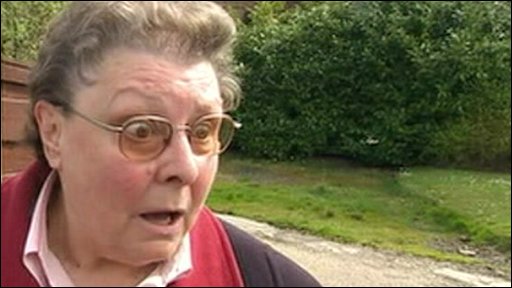
Shock horror: the moment Gillian Duffy discovered Gordon Brown’s slip of the tongue really has been this campaign’s second biggest talking point
Yes, that would have been a reasonable question for many folks a month ago, but now The Cleggster is more instantly recognisable to students than the cast members of Glee and a more discussed figure in Middle-England than either Jonathan Ross or Russell Brand. It was, of course, the first leadership debate what done it (which was branded in capitals by broadcaster ITV as The First Leadership Debate, just in case you weren’t sure whether Alistair Stewart and co. had got there first). Standing on a set that oddly but rather comfortingly looked like it belonged to a 1980s sports show, Clegg appeared less nervous than his two foes and spoke clearly, politely and emitted doses of charm and charisma. And, literally overnight, he was a national superstar (frankly, the fact he wasn’t already, given he’s the leader of the ‘third party’, must say something about this country). His approval ratings following his hour-and-a-half in the primetime telly limelight soared – some say it proved he was the most popular leader since Churchill (impressive considering he’s not even Prime Minister) – and the Lib Dems spread their wings and set flight like liberated liberal free-birds.
It’s a good question, though, whether ‘Cleggmania’ has actually been real or whether he’ll be remembered, reminsicent of winter 1988, as an Eddie ‘The Eagle’ Edwards-style comfortable curiosity but ultimately glorious loser. Yup, he’s likeable, sort of handsome, a bit like a cuddly bank manager, so he’s clearly not Barack Obama – he’s as British as a cup of tea. However, for us over here at least, he’s stolen Cameron’s thunder by seeming to represent genuine political change. At least, among some. Or many. The truth is that with this election nobody really knows.
The Lib Dems’ surge in the polls has been so surprising, it’s incredibly difficult to predict what will happen on Friday – or perhaps even in the days following that. Now, 12 days after the first debate – a long, long time in politics; an eternity in an election campaign – the third party’s position in the polls is standing pretty firm. Are we heading for a hung parliament then? Or a minority government? Or a Lab-Lib coalition? Or even a Con-Lib coalition? I have my own thoughts, but considering I could be completely wrong don’t want to set myself up for a fall – or tempt fate – by predicting anything. Talk about excitement, this is genuinely the power of democracy at work here – or at least it’s potential power. Because what actually matters, of course, is what happens at the polling stations up and down the country today.

Has the balloon gone up?: Big Gord looks down in the mouth, but after the last three years amazingly he may not yet be down and out
Mind you, as is always the case when it comes to politics, this campaign hasn’t been without its distasteful moments. Nobody will forget – the right-wing press certainly won’t allow you to – Brown’s blunder in branding a lifelong Labour voter from Rochdale a ‘bigot’. Frankly, methinks he was really searching for an appropriate word with which to describe her and found the worst possible one instead. I mean, let’s be grown up about it, politicians make the same unseemly mistakes we all make; the real big mistake he made was forgetting he was still wearing a radio mic. Talking of being grown up, or rather being the opposite, there’s also the scrap going on down in Barking between Labour, the Lib Dems and those genuine bigots the BNP. Indeed, the scrap became real today as the London campaign manager of the country’s most xenophobic, nay most racist, party was caught on film in fisticuffs with a group of Asian youths. The BNP’s popularity in that particular constituency makes me genuinely uneasy and whoever gets in – or back in – to Downing Street surely, with the rest of society, has to address the worrying flirtation with right-wing extreme politics some of us seem happy dabbling with.
And, on a lighter yet unquestionably unseemly note, this election has also made us endure the sight of Peter Mandelson ballroom dancing with a pensioner. Didn’t see it? Trust me, you lucked out there. All the same though, for me, it’s been a campaign that’s felt, for a change, like it’s flown by, rather than gone on week after week. And it’s strange that, given that unlike the last US Presidential election, the ‘Net hasn’t played a very big role in events, and probably thanks to the domination of the three debates it’s felt far more telly-dependent, retro and a bit end-of-the-pier-like tacky than modern and swish.
Yup, I’ve enjoyed it, but I appreciate few of you out there may be with me on that one. In which case, maybe the best sign-off I can give here is to reaffirm the point that, despite whatever you think of ’em, in the end it’s all about strolling down to the polling station today and putting an ‘x’ next to one of the politicians’ names. After all, having to endure/ enjoy the campaign as we all have for the last month or so, if we don’t do that, what’s been the point of any of it…? 
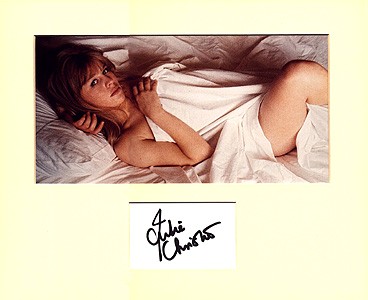
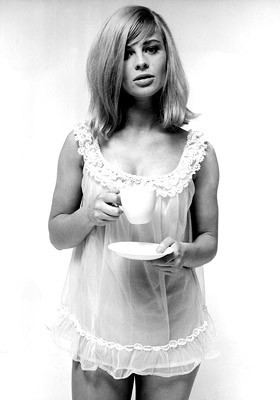
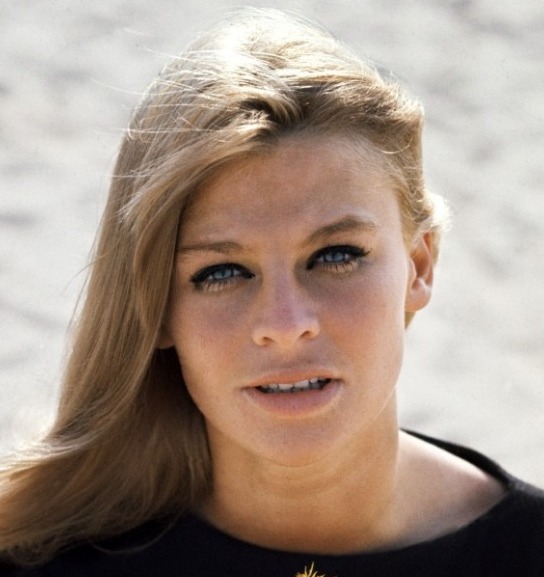
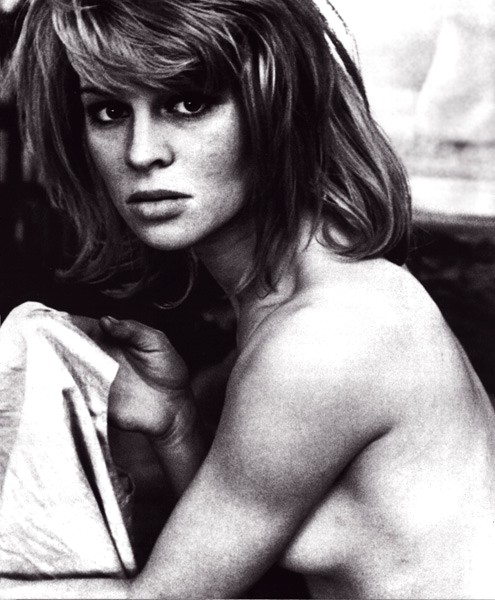
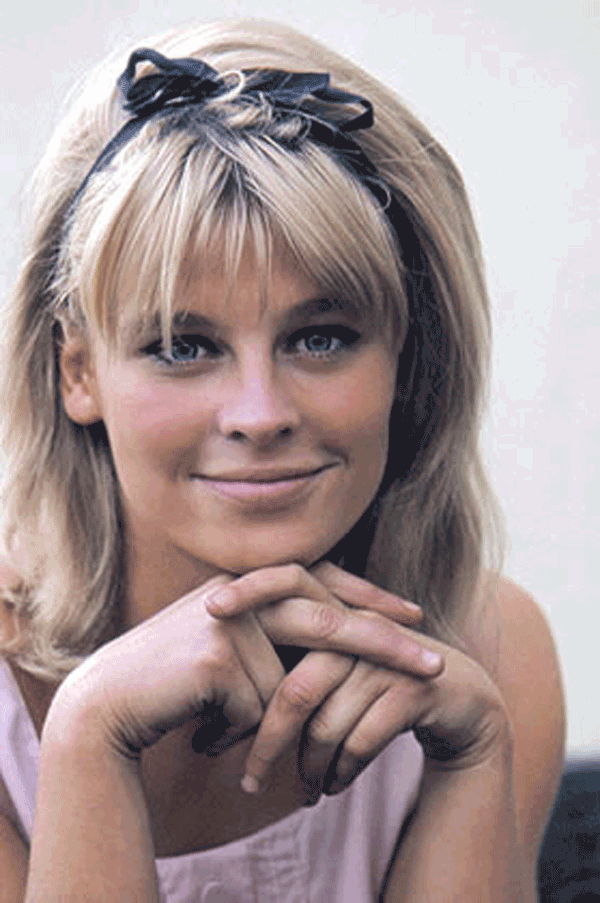
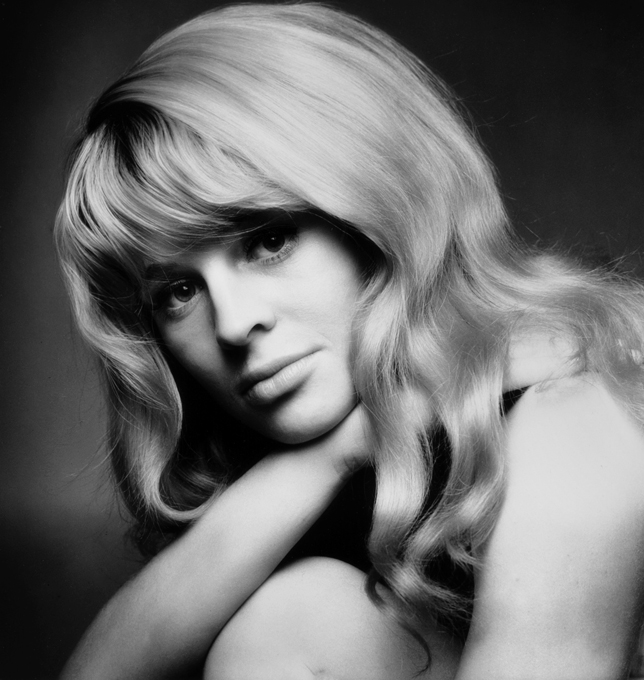
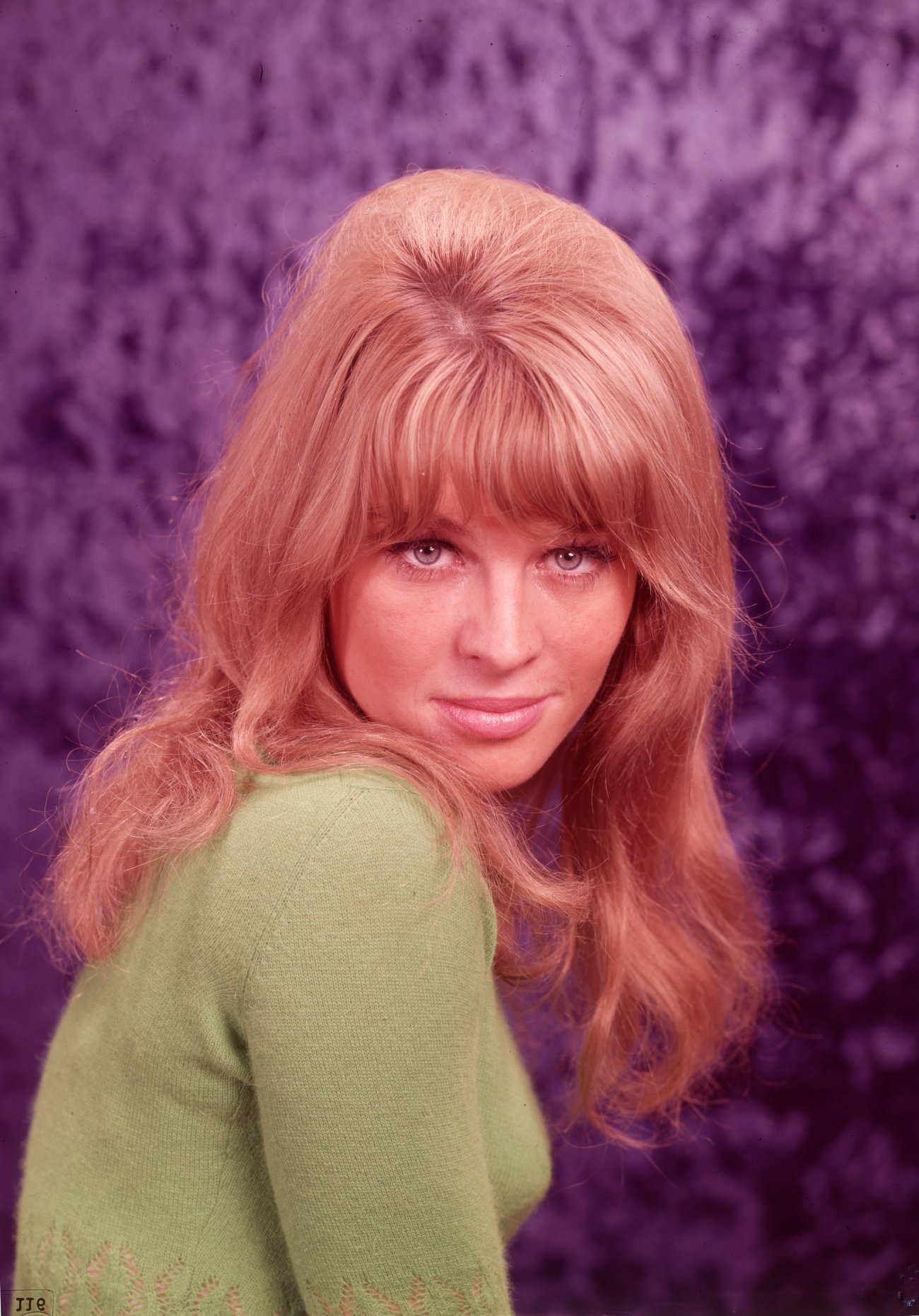
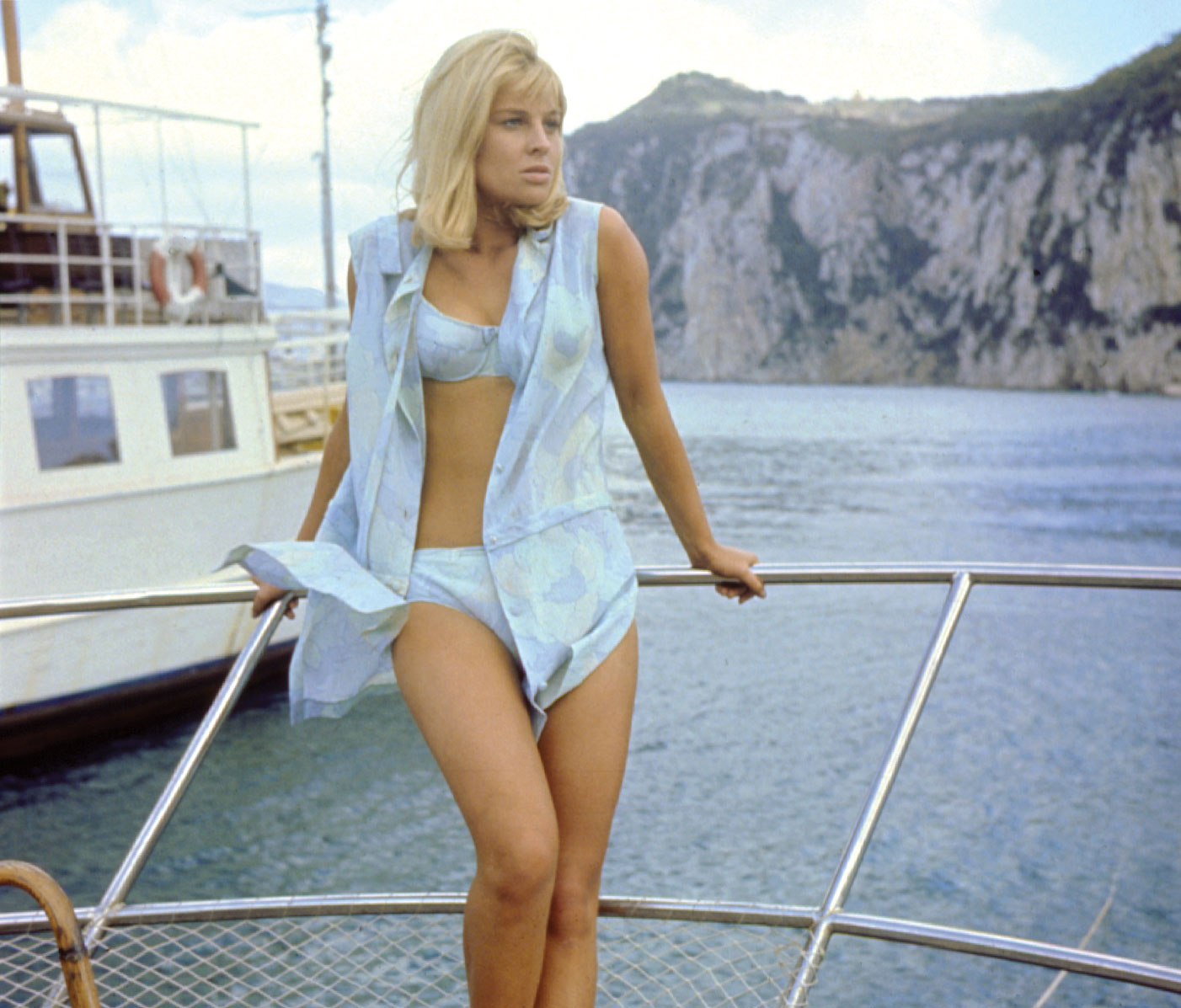
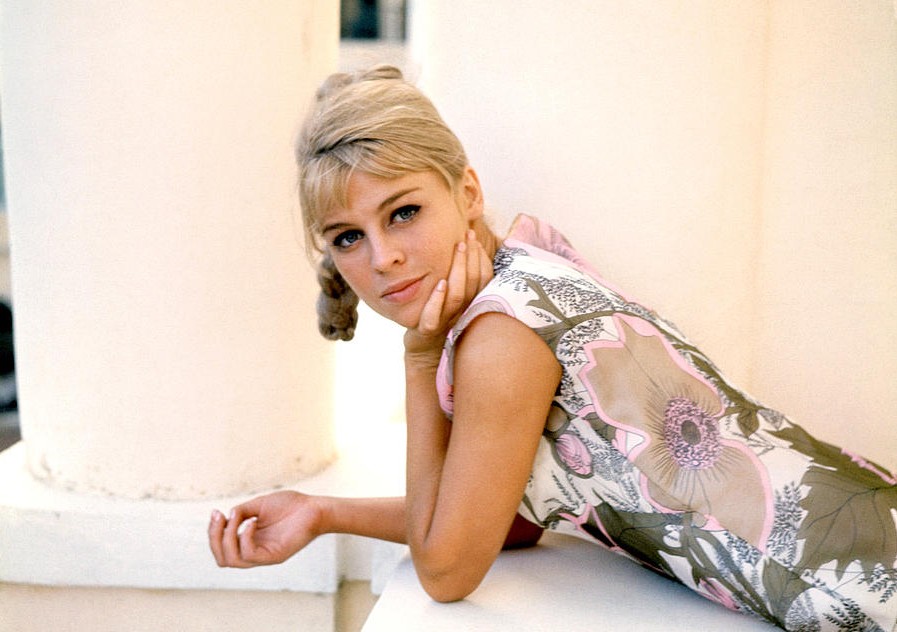
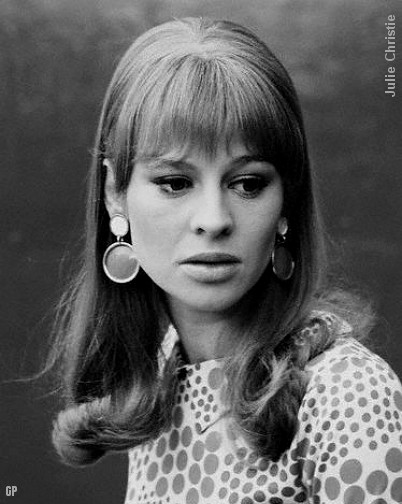
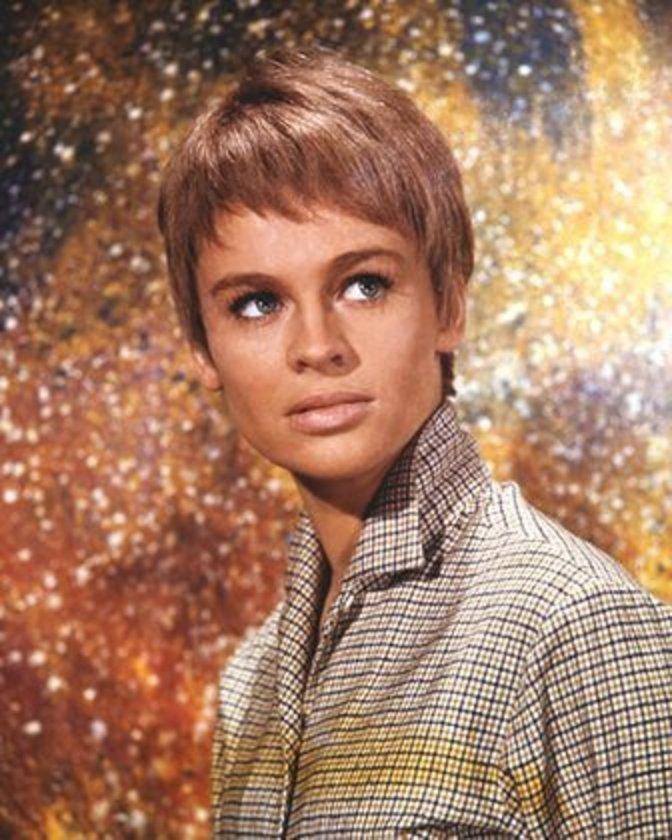
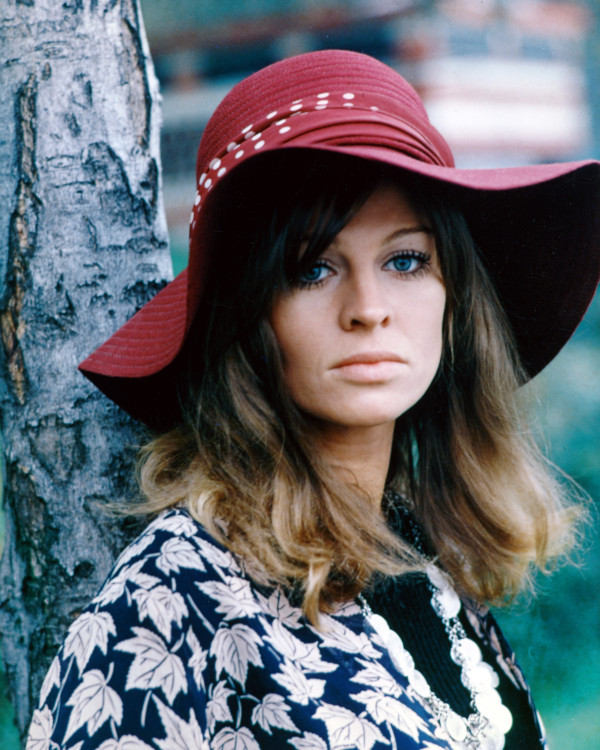
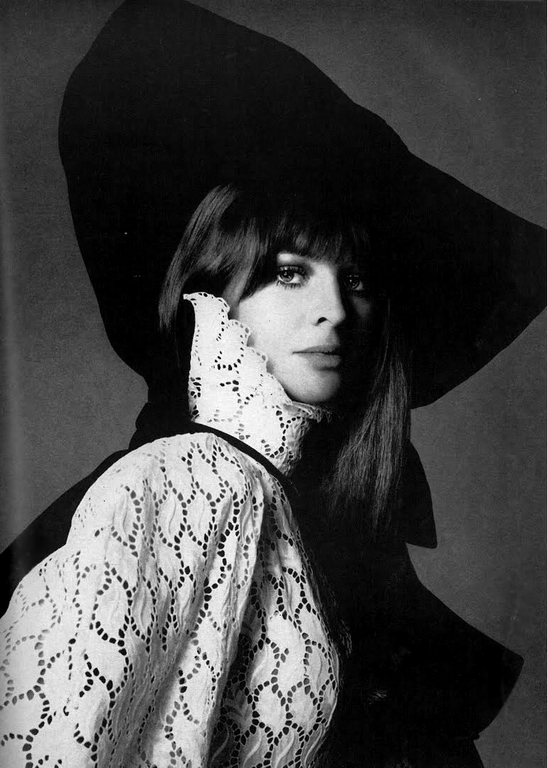
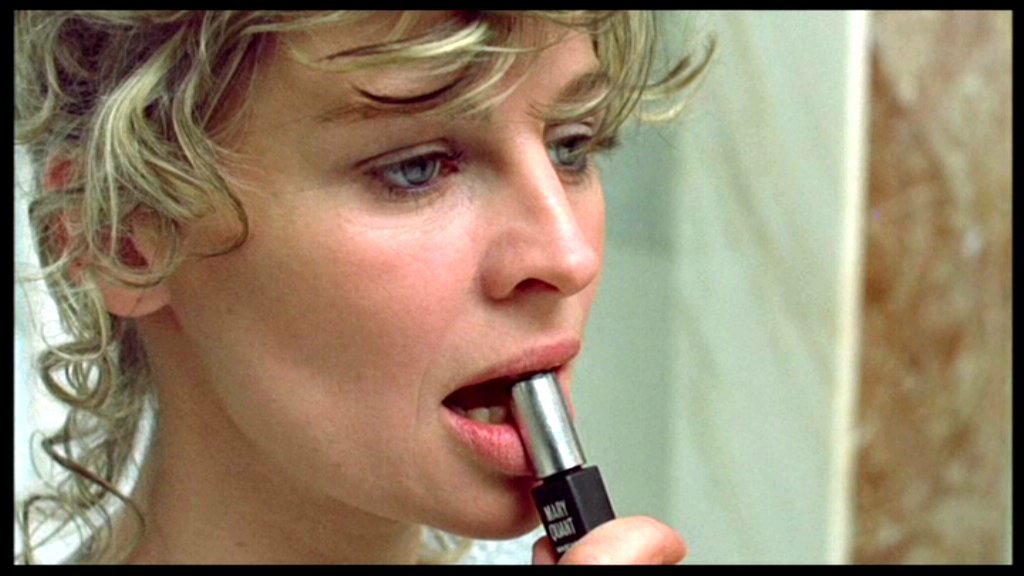
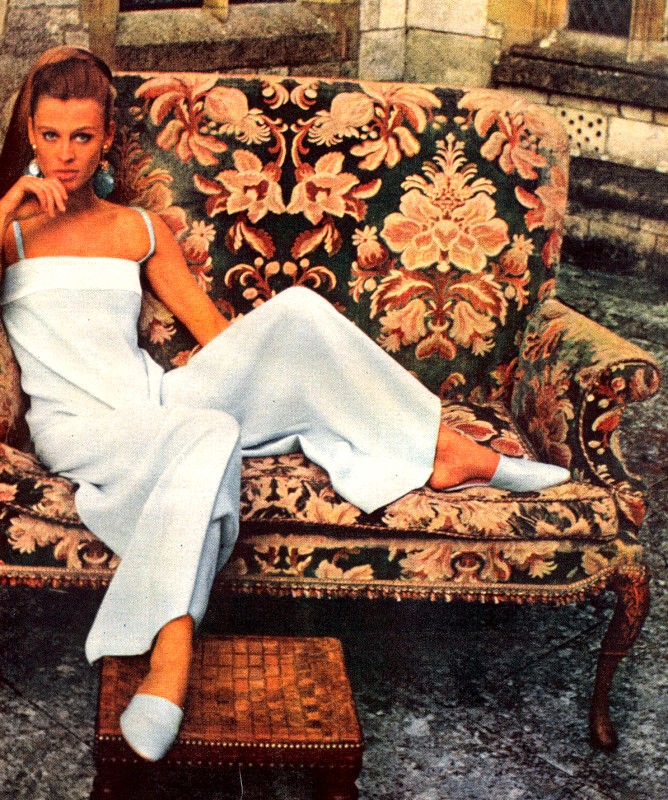
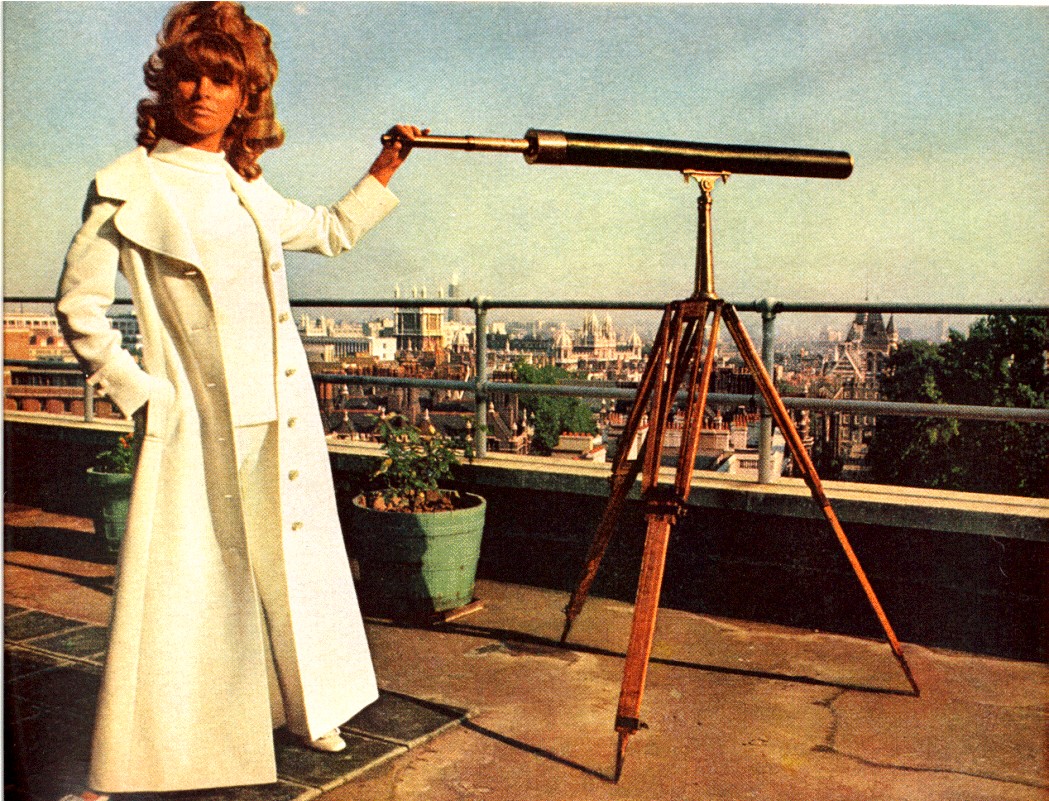
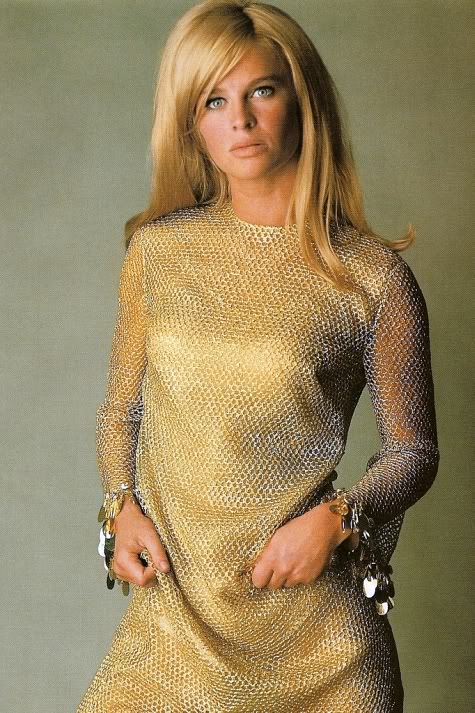
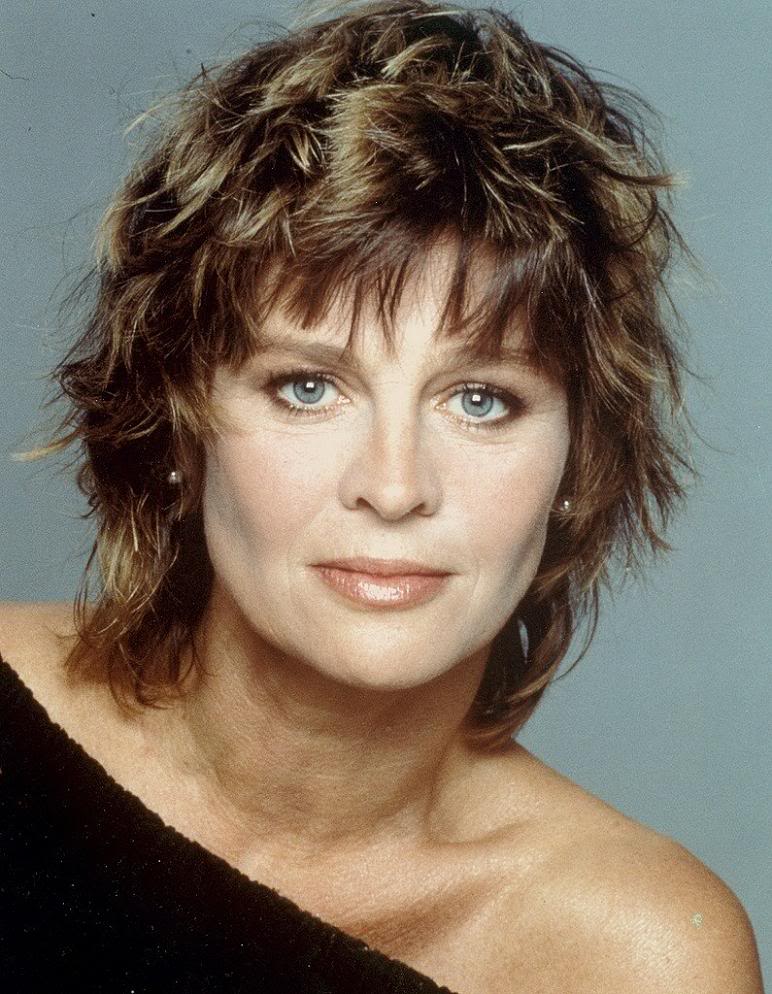
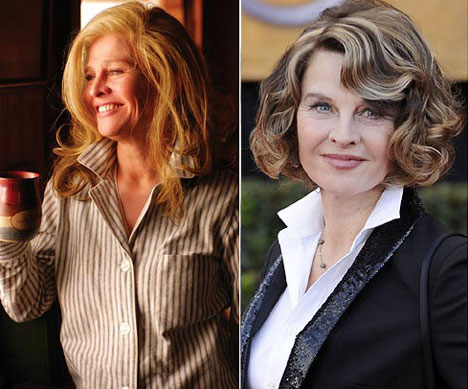
Julie Christie: Swingin’ Out Sister
.
Talent…
.
… These are the lovely ladies and gorgeous girls of eras gone by whose beauty, ability, electricity and all-round x-appeal deserve celebration and – ahem – salivation here at George’s Journal…
~~~
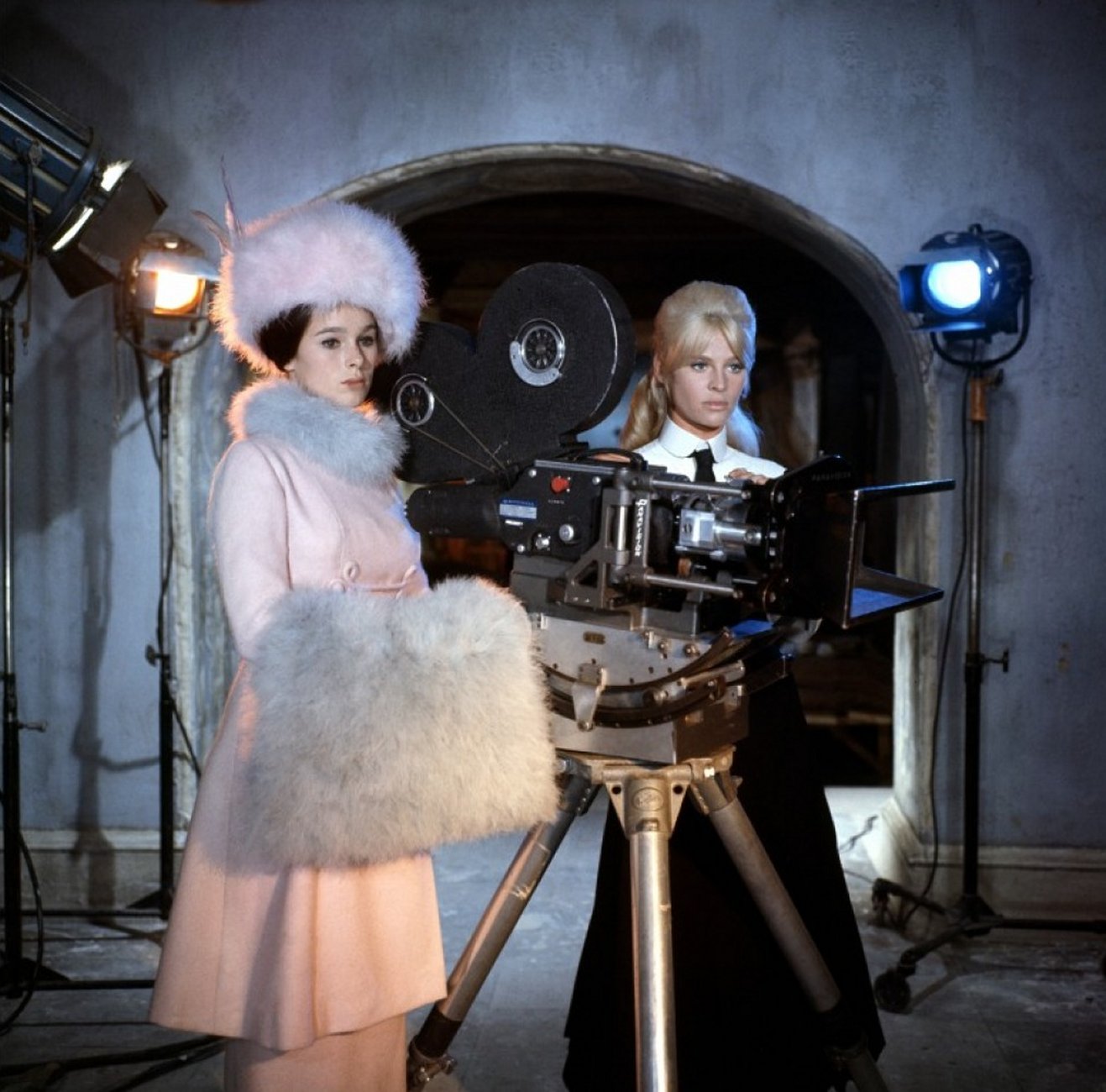
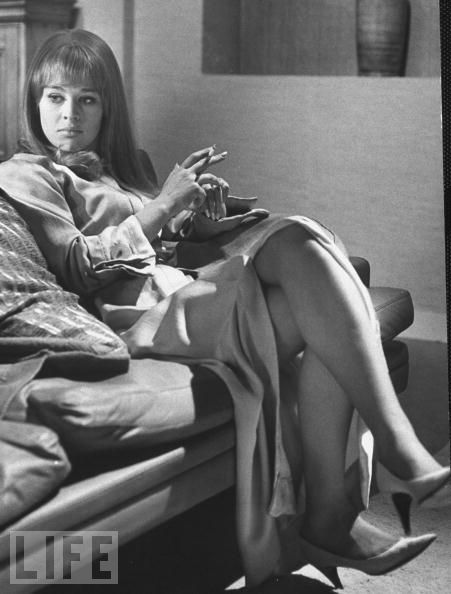
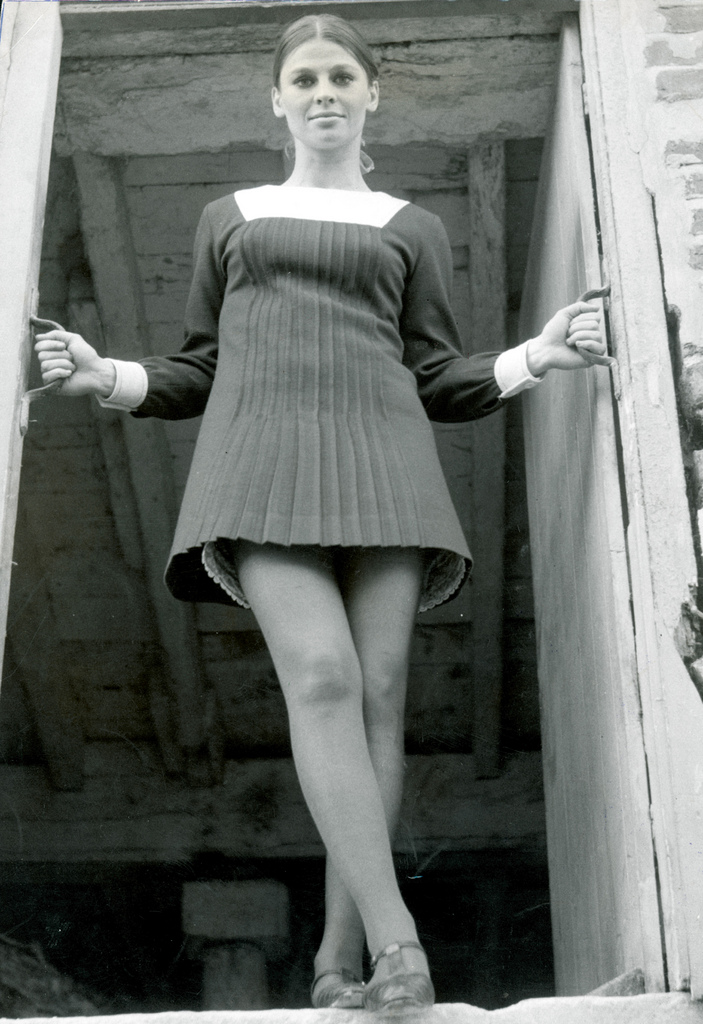
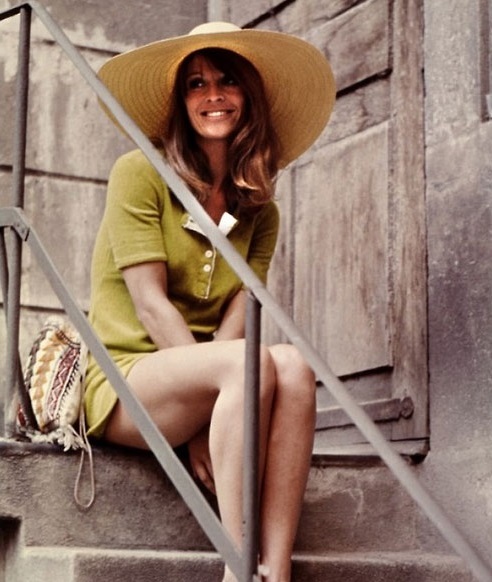
Free-spirited. Electric. Iconic. Enigmatic. Utterly irresistible. Julie Christie is probably the ultimate – and original – ‘it girl’ (she will be forever associated with the liberated Swinging ’60s London scene), but she’s also one of the greatest cinematic actresses this little island has ever produced. She’s Zhivago’s muse, Donald Sutherland’s on-screen wife, Tel and Warren’s former squeeze – in short, a completely delicious Darling. And she’s my deserved, third Talent offering…
~~~
Profile
Name: Julie Frances Christie
Nationality: English
Profession: Actress
Born: 14 April 1941, Chukua, Assam, India
Height: 5ft 2in
Known for: Roles in the films Billy Liar (1963); Darling (1965) – Oscar win; Doctor Zhivago (1965); Farenheit 451 (1966); Far From The Madding Crowd (1967); Petulia (1968); The Go-Between (1970); McCabe And Mrs Miller (1971) – Oscar nomination; Don’t Look Now (1973); Shampoo (1975); Heaven Can Wait (1978); Hamlet (1996); Afterglow (1997) – Oscar nomination; Finding Neverland (2004) and Away From Her (2007) – Oscar nomination.
Strange but true: Following two infamous affairs to fellow cinematic and ’60s icons Terence Stamp and Warren Beatty, she announced she would never marry – only to go back on this vow when she quietly married her long-time partner of the past 30 years in January 2008.
Peak of fitness: It has to be in psychological thriller-cum-horror Don’t Look Now – yes, the one with that scene. Rarely has marriage been presented onscreen as tenderly, carnally or passionately.
~~~
CLICK on images for full-size
.
.
.
.
.
.
.
.

.
.
.
.
.
.
.

.
.
.
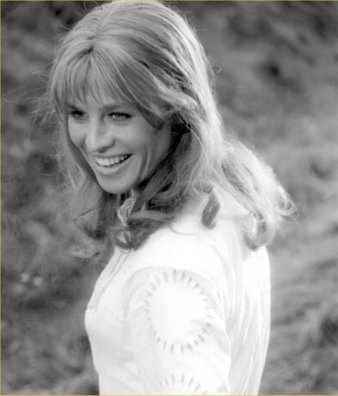
.
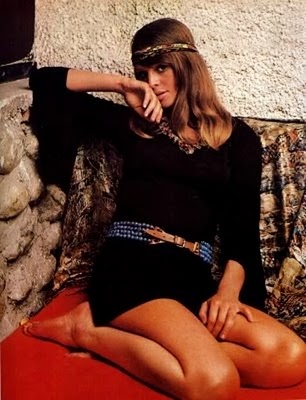
.
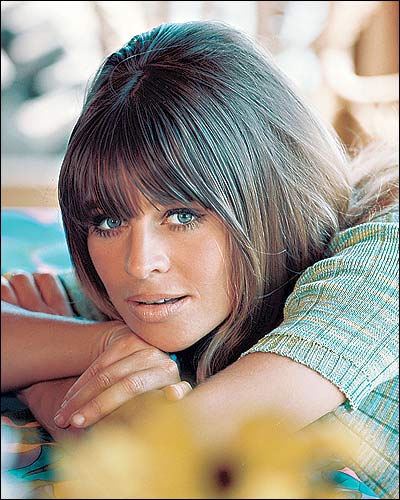
.
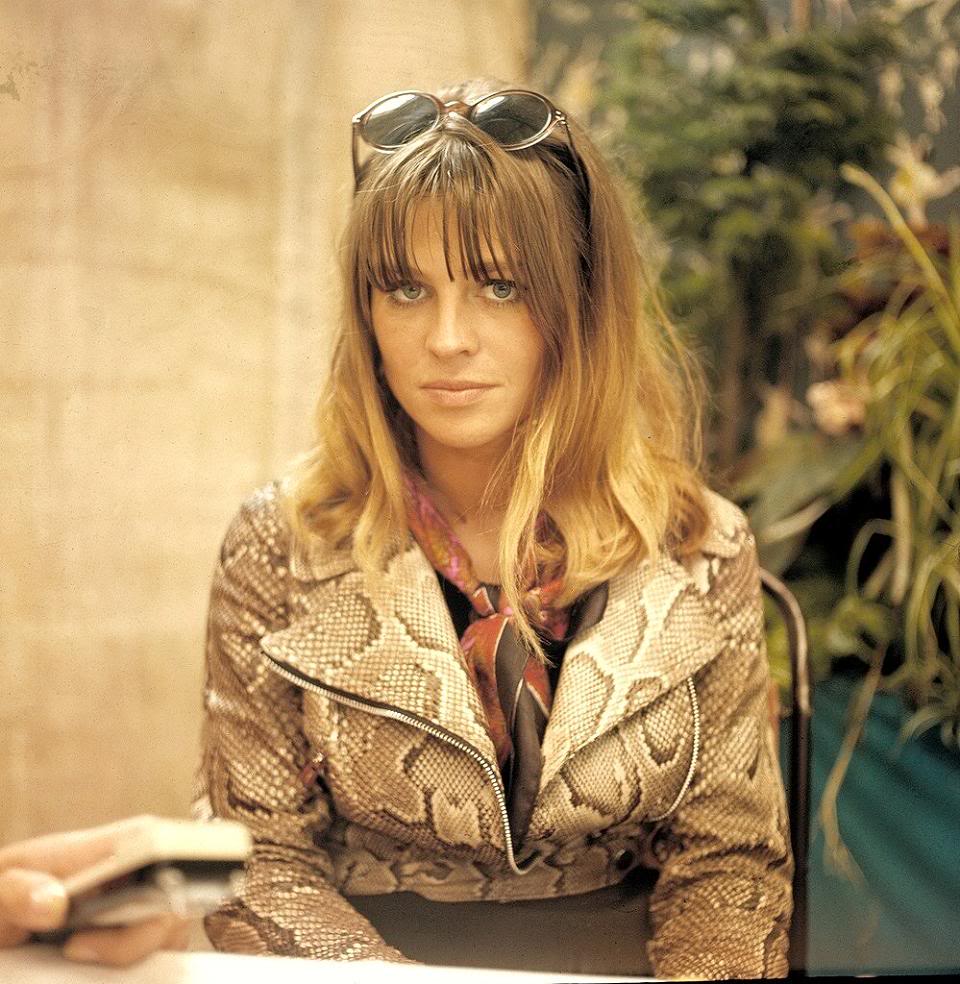
.
,

.
.
.
.
.
.

.

Snooker loopy: Taylor versus Davis ~ April 28 1985
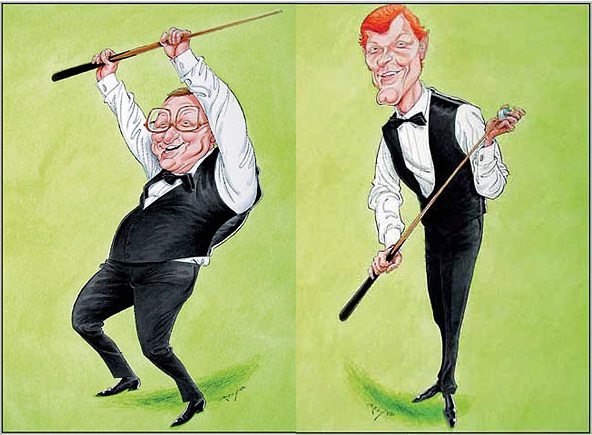
Frame, set and match: everyday heroes Dennis Taylor and Steve Davis – 1985’s gladiators of the green beize
There are several things you could have enjoyed immensely after midnight in 1985. Aside from the bedroom-based obvious, you could have been at a late-night showing of Back To The Future, you could have dipped into Gabriel Garcia Marquez’s or Margaret Atwood’s respective new novels Love In The Time Of Cholera or The Handmaiden’s Tale, or you could even have been listening to Kate Bush’s Hounds Of Love album (through big, chunky earphones, of course – you wouldn’t want to wake up the neighbours, surely). But could you have enjoyed any of them as much as the black-ball decider of the 1985 World Snooker Championsip Final on April 28th?
Doubtful, I’d suggest. Was this glorious moment of green beize action really better than those – or actually better than sex? Maybe. Just maybe.
What can’t be denied was that it was momentous. As we come around to this year’s World Snooker final that will conclude on Monday (I’m rooting for Robertson), this extraordinary event at Sheffield’s famous Crucible Theatre – celebrating its 25th anniversary this week – still holds the record for the highest UK television audience after midnight: 18 million. 18 million! That’s a bigger telly audience than most shows over here achieve all year nowadays. Yup, Snooker ruled the absolute roost that year, if for one night only.

Interesting moment: he may’ve been known for being boring, but Steve was also a winner – was he in ’85, though?
Having said that, good old Snooker was very much in the midst of its Golden Age in the ’80s. While, at present, it struggles to engage the public (last year’s World Championships final only achieved a TV audience of 2 million) and is looking to rejuvenate itself through crowd-pleasing modernisation, back in the day the grandmaster of all billiards games was so popular that it seemed nearly every boy had a miniature snooker table in the garage, Chas & Dave’s so-bad-it’s-good Snooker Loopy hit was permanently lodged in people’s minds and the sport’s masters were even more recognisable than Hollywood stars.
Indeed, Snooker’s popularity in the ’80s may have owed more than anything else to its top players. In the age of the seemingly ordinary, likeable Frank Bruno, Ian ‘Beefy’ Botham and Gary Lineker, all the Snooker stars too were chaps you not only loved to watch on the box, but who you’d happily have in your living room watching it with you. There was the cool, moustachioed Canadian Cliff Thorburn; the bald-headed mate of the aforementioned Lineker, the pretty useless Willy Thorne; the Canuck whose weight was more famous than his cue prowess ‘Big’ Bill Werbenuik; the South London whirlwind Jimmy White; the wily Welsh wizard Terry Griffiths; the potter from Penny Lane John Parrot; and the flawed Northern Irish genius that was Alex Higgins (yes, Ronnie O’ Sullivan, someone else got there first). And, of course, there was Steve Davis and Dennis Taylor too.
Davis and Taylor. You couldn’t get two more different personalities. Davis, ‘The Nugget’, a very lean, mean, ginger potting machine from Essex who, up to this point, had won three World titles in four years (and would go on to win another three), and Taylor, an extremely affable, bizarrely upside-down glasses-wearing, roly poly Northern Irishman who had never won one. And it was these two that contested the ’85 final. As ever, it looked like it would be Davis’s title, racing as he did into a 8-0 frames lead (out of a ‘best of 35 frames’ total). But, gradually, Taylor got back into it. The player who had lost to Davis in the previous year’s contest at the semi-final stage was not going down without a fight. At the end of the match’s second session he trailed 9-7 and, then, at the end of the third, 17-15. Then, in the fourth and last session, he managed to level the match – 17-17. A wonderful comeback. And then it really began.
Deep into this final frame, Davis had the lead. All the red balls and the yellow and the green had been potted; Taylor needed all the remaining colours. And he got them (brown, blue and pink); all of them, except one, that is – the black. For the first time in its decades-long history, the World Championships final had amazingly come down to its last ball. Frankly, both players’ attempts to pot it – or put it safe – were, well, awful; they’d both pretty much lost their nerve and ability to play by now, the stakes were so high and the atmosphere so electrified. Then Taylor made a mistake and Davis had a relatively easy cut into the bottom left pocket to win the frame, match and title. The one thing, he claimed afterwards, he had to make sure he didn’t do was hit the black ball too thickly. What he did, though, was strangely hit it too thin. An unforgettable exclamation of ‘No-ooo‘ came from legendary (and sadly now departed) commentator ‘Whispering’ Ted Lowe, and Taylor was back in. And, this time, Dennis made no mistake – he sunk the black and realised eternal glory.

Specs-tacular: older, greyer and wiser now, perhaps, (right), but sadly Dennis’s trademark glasses have gone
The frame, the penultimate shot, the final shot and Taylor’s celebrations (raising his cue above his head like a weightlifter’s weights, shaking his head in disbelief and wagging his finger at the head of ITV Sport who had, apparently, told him he’d never be World Champion) have truly gone down in television history and are now iconic. These two sportsmen and the sport itself (especially back then, and maybe still now, which may account for its supposed lack of popularity nowadays) are of a different era. They were both hopelessly accessible sporting heroes, for whom glory, fair play and the sport itself seemed to matter much more than the money. After all, the winner only received £60,000, the runner-up £35,000, when BBC host David Vine gathered them together afterwards for ‘wages’ time’ as he forever referred to it.
The truth, though, is that this event somewhat paradoxically comes from a decade dominated by money, social climbing and greed. But then, like the sport to which it belongs, that maybe explains why it was so popular with and fixated the nation in that decade – like a caravan holiday in New York, it was comfortable and thrilling at the same time. Who really knows? One thing is for sure, though, it was magical, magnetic, unforgettable and very special.
After it was all over (and referring to the black-ball finish, in particular), Davis said the match had all been there ‘in black and white’. No, Steve, you were wrong – it was in colour, on TV and finished at 12:25am… I know, because at the age of five, it was the first time, and one of the very best times, I stayed up after midnight. 
Elizabeth (1998)/ Elizabeth: The Golden Age (2007) ~ Review
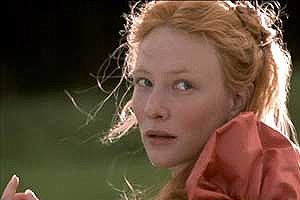

Director: Shekhar Kapur
Starring: Cate Blanchett, Geoffrey Rush, Christopher Ecclestone, Richard Attenborough, Joseph Fiennes, Kathy Burke (Elizabeth)/ Cate Blanchett, Clive Owen, Abbie Cornish, Geoffrey Rush, Samantha Morton, Jordi Molla (Elizabeth: The Golden Age)
Screenplay: Michael Hirst (Elizabeth)/ William Nicholson, Michael Hirst (Elizabeth: The Golden Age)
UK/ US; 124 minutes; Colour; Certificate: 15 (Elizabeth)/ UK/ US; 114 minutes; Colour; Certificate: 15 (Elizabeth: The Golden Age)
~~~
So, if you’ve read the ‘About’ page of this blog, you’ll notice that I warn there may be some ‘smart art’ or historical stuff on here from time to time. Well, to ease you in gently to that likely occurence, I thought I’d first offer up this – a review of two acclaimed yet mainstream movies about one of the most fascinating and, arguably, most glorious eras of British history. Honestly, who doesn’t love Good Queen Bess (well, unless you’re her cousin Mary from north of the border, that is)?
So, up first we have Elizabeth. Yes, that’s right, the multi-Oscar nominated one starring Cate Blanchett from 1998. Upon its release, I recall there being a lot of hooplah about how visceral, relevant and modern a take on the early life of England’s greatest queen this was supposed to be and, I must say, the hype wasn’t exaggerating things. Nowadays, such attempts at dramatising history in a ‘modern way’ are ten-a-penny, especially on the box (Rome, The Tudors and the Beeb’s Charles: The Power and the Passion spring to mind), but back in the late-’90s, such an idea was a bit different, take such faithfully old-fashioned historical romps as Titanic and The English Patient from that decade.
And, I must say, well done to director Shekhar Kapur, for with some real confidence and class he successfully sets interesting visuals, no lack of grit and violence and well-pitched ‘modern’ performances from his cast against the somehow complimentary faithful locations and excellent costumes. His real success, however, is ensuring the film has such a strong storytelling sense throughout – about two-thirds of the way through you find yourself pretty much gripped to see how all the plot’s loose ends’ll tie up, whether you know from history how they should or not.
I’m sure I read somewhere that Kapur wanted to direct this flick as a thriller, for he claimed that’s what Elizabeth’s early life was (she could have been put to death by her sister before becoming queen herself) and the wickedly fast-moving plot is certainly testament to that, and no bad thing.
However, what one may recall most readily is the performances. This is a film with a very groovy cast, but all are on fine form, make no mistake. Geofrrey Rush, Richard Attenbrough, Kathy Burke, Christopher Ecclestone, Vincent Cassel, John Gielgud and Eric Cantona (yes, Eric Cantona!) all offer very strong support – especially Ecclestone as the cut-throat, shaven-headed Duke of Norfolk – but the standout is certainly Cate Blanchett’s titular role.
Must confess, I have a soft spot for Gwynie, but I can’t deny Blanchett was robbed at the ’98 Oscars, the Best Actress gong should certainly have gone to the Antipodean powerhouse ahead of Paltrow’s charming turn in Shakespeare In Love. Elizabeth’s transformation from innocent, religious, loyal princess to hard, ruthless and stoic monarch is damned impressive – not much less regal, in fact, than that of Helen Mirren’s performance as the next Queen Elizabeth to take her place on the throne of England, to be seen, of course, in that other more recent, but just as must-see Brit flick The Queen.
On to Elizabeth: The Golden Age then. So, would this unquestionable follow-up film, coming nine years after the ‘original’, hit the innovative heights of the first? Would it achieve that same mix of grit, ‘realism’, historical accuracy and damn good historical yarn? In short, would it be as good? Well, no. It’s just not as cerebral, balanced, polished and overall satisfying an experience as Kapur and Blanchett’s first foray into Tudor high-society and political depravity. But it’s still an entertaining two-hour diversion, don’t get me wrong.
Undeniably, the script isn’t as smart and perceptive as the first film’s. Events revolve around Clive Owen’s Walter Raleigh and his time at court and the subsequent naval war against the Spanish Armada, which is all very well, but was Raleigh quite as omnipresent in the queen’s company as presented here, lurking in corridors and behind staircases? And did he truly have the monarch’s ear as much as he does here? And isn’t it surely too easy to present Spain’s king Philip II using the execution of Samantha Morton’s Mary Queen of Scots as an excuse for launching a religious war against Protestant England? I’m no expert, but surely the politics of the time was a little more complicated than that? And surely the king himself was a bit more complex a character than the Catholic zealot he’s presented as here?
Still, if you can overlook such points, then there’s much to enjoy in this effort. The visuals, costumes, sets and music are all impressively bold, faithful and stirring and the overall tone – if way too often – entertainingly bombastic, especially during the wartime last third. And, naturally, Blanchett delivers a fine performance as an older, wiser and more weary queen, looking to – and then resenting – a female favourite’s exploits for her own vicarious amorous experiences.
In the end, though, this flick will always strike me as a missed opportunity – it tells the story of the age of Raleigh, Drake and the Armada, but comes off as a bit of a cop-out. And that’s well summed up by Clive Owen as the rakish Raleigh. Yes, he looks perfect, but his acting simply isn’t; in fact, it just isn’t up to scratch. He’s too wooden here to generate any sort of charisma at all. There’s no way Blanchett’s sharp-as-a-razor Elizabeth would have made him the golden boy of her golden age, I’m afraid.
So, to sum up, it’s top marks for Elizabeth then, a film that’s a feast for the mind as much as the eyes; but a bit of a ‘meh’ for The Golden Age – Blanchett and the visuals are undeniably winning, the rest though, unlike the English ships in the Channel, not so much. 
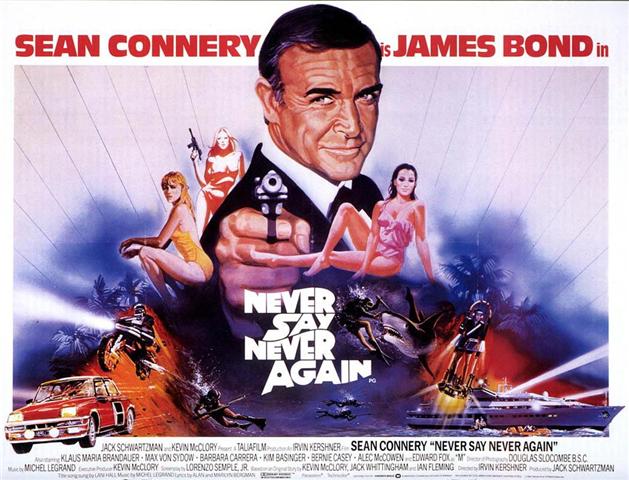
His word was his Bond?: Turns out turning his back on Bond was more like Never Say Never Again for Sean Connery
It’s a Bank Holiday Monday. It’s raining cats and dogs outside. And you’re at a loose end. Anything on the box? Well, as is often the case there’s a Bond film, but it’s that one from the early ’80s with Connery in it. You know, the one he came back for long after his ’60s heyday; the one that isn’t supposed to be ‘official’. So do you give it a try or a berth as wide as Connery’s middle-aged belly?
For me, a big Bond fan, it’s an interesting question. Because this flick is a curiosity, an anomaly, a real black sheep among its Bond contemporaries. But does it deserve the low opinion it seems to have cultivated for itself? Is it really as bad a Bond film as all that? And how on earth did it come to be made in the first place? Well, settle back into your favourite chair with a dry Martini, because – like Val Doonican – I want to tell you a story, a bloody good one…
It starts way back in 1961, a year before the first ‘official’ Bond film Dr No, made by Albert R ‘Cubby’ Broccoli and Harry Saltzman’s Eon Productions, was even made – and Bond creator Ian Fleming is in trouble. Eager to get his literary sensation on to the big screen, Fleming had worked on a screenplay along with friend Ivar Bryce, fellow scribe and screenwriter Jack Whittingham and Irish film producer Kevin McClory. However, having proceeded to turn the ideas into a novel entitled Thunderball – the ninth in his long line of 007 books – Fleming now found himself being taken to court by McClory and Whittingham, their claim being it was unfair the former should get sole financial reward from a story they had originally authored just as much as he had.
Taking place at London’s High Court in November 1963, the trial resulted in future printings of the novel being credited to McClory and Whittingam as well as Fleming, and McClory receiving damages and court cost payments amounting to £52,000. McClory had done well, for sure, but his relationship with Whittingham (who recieved no help from him in paying his hefty court costs) and Fleming was no more – indeed, 007’s creator wouldn’t be the only member of the ‘Bond family’ McClory made an enemy of.

Water-sport: Kevin McClory and family out for a drive in a car Q would be proud of
Kevin McClory was a colourful figure; it’s been claimed he loved the idea of becoming a celebrity, seduced by the glamorous world of Hollywood, and would climb over anyone to get what his burning ambition wanted. Born in Dublin in 1926, at 16 he entered the British Merchant Navy’s Nowegian Marines and, while serving as a radio officer during the Second World War, his ship was torpedoed and he drifted for 14 days in the North Atlantic on a lifeboat. Perhaps it was this incident that instilled in him the uncompromising fighting spirit he would show in future years? Following the war, he found himself in Hollywood and established himself as a jack-of-all-trades on the John Huston films The African Queen (1951), Moulin Rouge (1952) and Moby Dick (1956), and the multi-Oscar winning Around The World In 80 Days (1956). In 1957, he wrote, produced and directed The Boy And The Bridge, thanks to financial backing from Ivar Bryce’s heiress wife. It wasn’t a success, and hampered attempts to get his, Fleming, Bryce and Whittingham’s original Bond script made into a movie.
In the meantime, of course, Bond had made it to the big screen via the Broccoli and Saltzman route and had proved a resounding success, first with Dr No, then From Russia With Love (1963) and then with the enormously popular Goldfinger (1964), all three of which were based on previous Fleming Bond novels. Come 1965, though, and Broccoli and Saltzman decided to turn their attention to Thunderball. They had considered turning it into their first 007 big screen adventure, but owing to its disputed authorship, had to pass on it. With the trial now over, however, it could be made – and its glossy, sunny Bahamas-setting and big-stakes nuclear warhead crisis-driven plot must have been seductive to the two producers who were now riding the tsunami-like wave that was Bondmania following Goldfinger‘s box-office gold rush. The one problem was that, in order to bring it to the screen, they had to make a deal with McClory. Eventually, it was legally agreed he would receive a sole ‘producer’ credit, while they would get mere ‘presenting’ credits, plus he won the rights to re-make the film again after 12 years of its release, if he so desired.
In the event, Thunderball turned out to be a monster success – the tenth biggest grossing film of the ’60s, in fact, and only helped solidify Bond and Connery’s iconic positions in that decade’s popular culture. But behind the scenes, all was not well. Not only did Broccoli and Saltzman, perhaps predictably, not get on with McClory, but Connery himself was not a happy bunny. He’d become tired of the character, who seemed to him more Superman than super-spy these days, and couldn’t stand the press intrusion into his life. He claimed that the public seemed incapable of separating him as an actor from the character – once during this period a woman asked him for an autograph and complained he hadn’t signed as ‘James Bond’.
“Kevin had a project in life and that project was Kevin McClory” – Jeremy Vaughn, friend of Kevin McClory
Following one more outing in the role, the Japanese-set You Only Live Twice (1967) – during the filming of which a reporter even followed him into a toilet; now that’s real intrusion into one’s private life – Connery hung up the shoulder holster. Only not for long. Four years later, in the wake of the supposed lack of box-office success for the George Lazenby-starring and rather wonderful On Her Majesty’s Secret Service (1969), he was back for Diamonds Are Forever. Although he claimed this one had the best script of any Bond film he’d worked on, he wasn’t doing it for the art; in fact, he was doing it for a then incredible $1 million fee, and a deal with distributor United Artists he’d star in two further films for them, as well as a big donation to a charity he’d just set up for Scottish children’s education. This time then, following Diamonds, Connery was done with Bond for good, right?
Wrong.
Enter the ’70s and Connery’s pal Roger Moore was comfortably entrenched in the role, making his debut in Live And Let Die (1973), and following this up with The Man With The Golden Gun (1974). But now, suddenly, disaster seemed to strike oo7’s cinematic existence – as it so often seems to have done over the decades. Broccoli and Saltzman’s own relationship had reached breaking point owing to the latter’s dodgy financial dealings forcing him into bankruptcy. Saltzman sold his rights in Bond to Cubby, who continued to plough forward as sole producer of the film series. However, the legal wrangles this fall-out necessitated had delayed production on the next espionage epic, so once again in stepped McClory – and Connery.
It was now 1976, very nearly 12 years after Thunderball, so McClory was free to remake said film if he wanted to, and he did. The same year, Broccoli was finally ready to plough on with Bond too and the Fleming novel he was going to adapt for the tenth in Eon’s Bond series was The Spy Who Loved Me. In the deal Fleming made with Eon way back in the ’60s to turn his books into movies, an odd stipulation was included regarding this novel, as Fleming was unhappy with how it turned out (written as it was from the heroine’s viewpoint rather than 007’s), he said the title could be used, but none of the characters apart from Bond and those of MI6, and none of the plot. Cubby then was free to come up with an entirely original story to hang the title on, which – using several different writers including Anthony Burgess and John Landis – he duly did. The story he seemed to settle on involved an international terrorist group stealing submarines for the nuclear missiles, which, of course, in essence sounded an awful lot like the basic premise for… Thunderball.
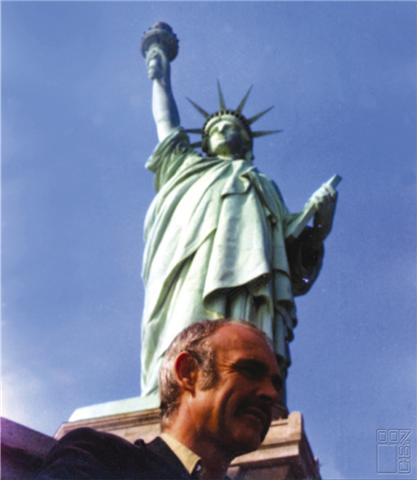
Statuesque figure: Connery visits the Statue Of Liberty in the 1970s, a proposed location for an action set-piece, during location scouting for McClory’s James Bond Of The Secret Service/ Warhead
McClory, having now roped Connery into the mix for his proposed new Bond flick, saw his chance and was gathering momentum in getting it made – possible titles included Warhead, Warhead 8 and the highly imaginative James Bond Of The Secret Service. It’s unclear whether McClory and Connery knew of the similarities between the The Spy Who Loved Me and Thunderball plots, but it’s surely very likely they caught wind of what Broccoli was planning. Even so, given this likelihood, surprisingly this time it wasn’t McClory who sued, it was United Artists, still distributors of Eon’s series. The upshot was that in the face of the big film studio’s lawyers, McClory’s remake, which Connery had dabbled in scripting and planned on directing as well as starring in, was as dead in the water as a dud warhead. Conversely, The Spy Who Loved Me was released and became the most successful Bond flick at the box-office since Thunderball itself, and was followed by the Star Wars-inspired hokum that was Moonraker (1979), which made more money than either of them.
The ’70s became the ’80s and, no doubt in spite of his best efforts, McClory’s folly seemed doomed to failure. But now on the scene appeared American film producer Jack Schwartzman (husband of Rocky and Godfather actress Talia Shire, and by extension step-brother of Francis Ford Coppola) and, in one of the best ironic twists in this saga, his Hollywood muscle pulled off what all of McClory’s single-minded ambition never could – the rival Bond film was being made, helped out by the clout of movie studio Warner Bros. And it featured Sean Connery as 007 once again. Not just that, though, Never Say Never Again (which owed its title to a jokey suggestion from Connery’s wife in reference to his second return to the role) would be released in 1983, the same year as Eon’s latest Bond opus, the India-set Octopussy, and no doubt in the same summer season.
And now, in stepped the media. The press fell over themselves to create a contest out of the two films, pitting them as rival productions and dubbing the development as the ‘Battle Of The Bonds’. As it turned out, though, the movies weren’t released relatively near each other; Octopussy opened in the summer, Never Say Never Again in the autumn. The former, with its summer release, perhaps predictably made more money, and nowadays it seems that the latter, as the ‘unofficial’ upstart that made less money is remembered as something of a failure, an interesting one, but a failure nonetheless.
But is this fair? What is Never Say Never Again actually like? Was it worth all the effort, time and acrimony it took to bring it to the screen?
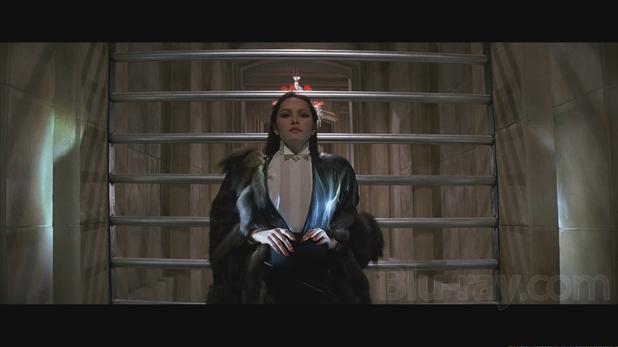
Femme fatale: Barbara Carrera’s Fatima Blush making her entrance in Never Say Never Again – an explosive exit awaits
Well, for most fans of the Eon series, the answer is probably no. But for the curious filmfan, Never Say Never Again offers a great deal. True, it is practically a re-run of Thunderball, one of the most popular Bond flicks ever made. But it’s Thunderball updated for the ’80s – instead of Bond using a jetpack, there’s Bond in his first motorbike chase; instead of a jet being stolen from clipped-voiced RAF chaps, a jet’s stolen using a nifty, electronic eye-recognition kit; and instead of a card game showdown between Bond and the villain; there’s a surprisingly cool and satisfying computer game showdown between Bond and his foe (which, in fact, is the film’s best scene).
The movie, directed by The Empire Strikes Back‘s Irvin Kershner, has a screenplay credited to Hollywood legend Lorenzo Semple Jr, but, in actual fact, Brit writing duo Dick Clement and Ian Le Frenais worked on it as script doctors, their CV also including TV classics Whatever Happened To The Likely Lads?, Porridge and Auf Weidersehen, Pet. No surprise then that it has it’s fair share of witty one-liners and amusing set-ups (among them is Bond’s hotel room blowing up while we expect him to be in it, only unbeknown to us he’s seeing a girl in another one from whose balcony we see the explosion, and a henchman seemingly dying from Bond throwing a glass of liquid into his face, which turns out to be a sample of the MI6 star’s urine).
The casting too is, well, frankly too groovy to pass up checking out. In addition to a finely sardonic Sean Connery as Bond (Girl on a waterski: ‘Oh, but I’ve made you all wet’/ Bond: ‘At least my Martini’s still dry’), there’s ’80s blonde bombshell Kim Basinger as the heroine; quality German actor Klaus-Maria Brandeur as an eerily unhinged yet nerdy villain; legendary Swedish star Max Von Sydow as Blofeld; Bernie Casey as the first black Felix Leiter (pre-dating Jeffrey Wright’s in Casino Royale by 23 years); Rowan Atkinson in his first cinematic debut as a bumbling Bahamas contact; and Nicaraguan knockout Barbara Carrera as sexy assassin Fatima Blush. Not only does her character possess a terrific name, but her performance – including one of the most ludicrous and most entertaining Bond baddie deaths – is delightful cartoon villainy to the max; she received a Golden Globe Award nomination for it.

Virtual reality: Bond and villain Largo face-off over the ‘Domination’ computer game – Never Say Never Again’s answer to Thunderball’s casino showdown
And for its worth, even though Octopussy outgrossed it, the ‘unofficial’ flick was actually a surefire hit. Made for $36 million, it grossed $160 million and set the record for the biggest ever box-office opening for a film released in the autumn. Audiences then lapped it up – and so did Roger Ebert. Upon its release, the legendary US film critic wrote: “Sean Connery says he’ll never make another James Bond movie, and maybe I believe him. But the fact that he made this one, so many years later, is one of those small show-business miracles that never happen. There was never a Beatles reunion. Bob Dylan and Joan Baez don’t appear on the same stage anymore. But here, by God, is Sean Connery as Sir James Bond. Good work, 007”.
But what of Never Say Never Again‘s real cast of characters – what did it do for them? Well, Connery went on to re-find his mojo later in the ’80s, with the likes of The Name Of The Rose (1986), The Untouchables (1987), for which he won an Oscar, Indiana Jones And The Last Crusade (1989) and The Hunt For Red October (1990). Cubby Broccoli continued to produce hugely popular Bond films until his death in 1996. And Kevin McClory? Well, he tried again to re-make Thunderball, with a turn-of-the-millenium effort to be entitled Warhead 2000 (this time reputedly with former Bond Timothy Dalton returning as 007), but once again the big studio lawyers stopped him in his tracks. And his dream of producing a Bond film ended for good in 2006 when he died – four days after the release of the latest massively popular Eon-produced reinvention of Agent 007, Casino Royale with Daniel Craig in the role.
Hindsight’s a wonderful thing, of course, but it does seem McClory backed the wrong spectre all along; Bond was – and, who knows, probably always will be – Broccoli and Eon’s ‘Domination’ game. 
~~~
For more on Never Say Never Again and its history, read Robert Sellers’ book The Battle For Bond: The Genesis Of Cinema’s Greatest Hero, available from Tomahawk Press.
~~~
Listen, my friends!
In the words of Moby Grape… listen, my friends! Yes, it’s the (hopefully) monthly playlist presented by George’s Journal just for you good people.
There may be one or two classics to be found here dotted in among different tunes you’re unfamiliar with or never heard before – or, of course, you may’ve heard them all before. All the same, why not sit back, listen away and enjoy…
Click on the song titles to hear them
~~~
Marianne Faithfull ~ As Tears Go By
The Kinks ~ Dead End Street
John Barry ~ The Girl With The Sun In Her Hair
Love ~ Maybe The People Would Be The Times Or Between Clark And Hilldale
Herb Alpert ~ This Guy’s In Love With You
Stevie Wonder ~ My Cherie Amour
George Harrison ~ What Is Life
John Kongos ~ Tokoloshe Man
Foghat ~ Slow Ride
Wreckless Eric ~ (I’d Go The) Whole Wide World
Joy Division ~ Atmosphere
Billy Idol ~ Eyes Without A Face
Phil Oakley and Giorgio Moroder ~ Together In Electric Dreams











 George's Journal