Hill Valley’s high noon: Back To The Future Part III (1990) ~ Review
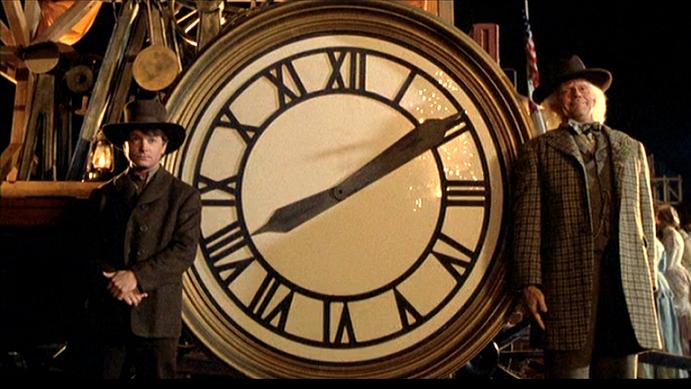
Directed by: Robert Zemeckis
Starring: Michael J Fox, Christopher Lloyd, Mary Steenburgen, Thomas F Wilson, Lea Thompson
Screenplay by: Bob Gale/ Story by: Robert Zemeckis and Bob Gale
US; 118 minutes; Colour; Certificate: PG
~~~
Butch and Sundance; Earp and Holliday; Jesse and Frank James; Buffalo Bill and Annie Oakley. For sure, there were many great double acts of the Old West, and come 1990 – or should that be 1885 – taking their deserved place on that list too were Marty and The Doc. Wait a tick, Marty and The Doc? As in Marty McFly and ‘Doc’ Emmet Brown of Back To The Future fame? Am I being serious? Damn right I’m being serious; I’m being straight as an arrow unleashed from a Sioux brave’s bow.
In the summer of 1990, the Back To The Future trilogy of films came to a close with its second sequel, Part III. The first flick (absolutely one of the biggest comedies of all-time at the box-office) transported its protagonist, Californian teenager Marty McFly, back to the bobby-soxer-filled 1950s from the skateboarding-furnished 1980s; the second saw Marty jump forward to a fantasy 2015 before travelling back again to the ’50s of the original. Whichever way you sliced it then, this time Marty and his genius pal The Doc had to go further than before, but which way?
Well, given the near future of Part II was maybe handled a little too outlandishly, perhaps best not to go further forward. Easier to recreate believably would be, say, 100 years in the past, wouldn’t it? Not to mention that travelling back 100 years from 1985 California would put filmgoers slap-bang in the middle of the Old West. What a conceit for the trilogy’s finale! No suprise at all then that the filmmakers, the Bobs Zemeckis and Gale, went for it. But could they, did they do it justice? Did BTTFIII turn out to be a calamity jane or a bonanza?
It may be fair to say that the success of many movie trilogies is judged by their first and final flicks – a strong opening and end can overcome an iffy middle (it’s arguably the case for The Lord Of The Rings; certainly not so for the Pirates Of The Caribbean or Scream trilogies, both of which are let down by their third films). And surely, 20 years on, it can’t be a coincidence that the Back To The Future trio of flicks is seen as such a triumph when its final film is such an enduringly watchable and wholly enjoyable exercise in entertainment.
There are many reasons why BTTFIII is so good. Chief among them is probably its script – as so often in movies, and always when it comes to this particular trilogy. Transplanting Marty and the already-there Doc to the Wild West, and setting that up as the film’s selling point, is a genius move. It ensures, instead of the moving back and forth in time of the series’ second flick, that like with the mostly ’50s-set original, the characters have an entire timeframe to discover, move about in and, ultimately, try to escape from – after all, if you’re going back to the Old West, surely you’d short-change the audience if you only spent half-an-hour there?
This also ensures that, in another refreshing break from the frenetic Part II, this flick’s plot and narrative more closely align with Part I‘s. For instance, like in the original, here the DeLorean is again incapacitated, stranding the protagonists in the past and necessitating a clever solution to get them home. Also as in Part I, the mere existence of one of the protagonists is put in doubt; The Doc produces a ludicrously good model-based-experiment of the time-travel climax to come; and a complication arises that may mean that climax doesn’t take place at all. Once more, this complication is romance – but this time, in a nice BTTF trademark twist, the romantic entanglements don’t concern Marty, the teenager with all the charm and looks (one of the reasons why the BTTF films are so popular has to be that they pleasantly surprised filmgoers by never quite giving them what they expected). Plus, if you want to look at all deeply into the script, there’s something of an exploration into the power of embracing free will over surrendering to fate. A nice touch there amid all the fun.
But what of Part III‘s aforementioned selling-point ‘Back To The Future goes Wild West’? How does that play out? Truly, wonderfully well. The sets, costumes, dialogue and locations (in particular, classic film locale Monument Valley is captured beautifully by cinematographer Dean Cundey) are all spot on, while the western genre parodies come thick and fast and roundly satisfy. Indeed, contrary to the ‘futurised’ gags in BTTFII, this time around the filmmakers and actors all appear to be having as much, not more, fun than the audience. Moreover, in addition to regular leads Fox and Lloyd (the latter enjoying perhaps more focus and depth this time), supporting players drafted in for the 1885 setting deliver the goods – Steenburgen’s Clara Clayton is a lovely, ditzy delight and Wilson’s final Tannen creation, the gunslinger ‘Mad Dog’, makes for a tip-top pantomime villain. Oh, and the steam train-based climax is a genuine tour de force – a fine finale for the film series.
Indeed, in tying up the trilogy then, BTTFIII as a whole encompasses all that’s best about the three flicks – it’s funny, thrilling, surprising, silly, romantic, rompish, charming, cheerful, detailed and tightly-delivered. Yes, all right, it may be just one or two notches down from giving viewers another dose of the original’s utter brilliance, but it perfectly recaptures that movie’s spirit and fun, as well as – via going cowboy – concluding the story started in the second one with (ahem) cowbells on.
And so, folks, finishes the Back To The Future season here at George’s Journal. I hope you’ve learnt a little, enjoyed it and feel it’s been a fair tribute to the seminal original movie turning 25. Speaking of which, let me leave you with this one, final treat – yup, it’s a pic of the major BTTF actors with Robert Zemeckis and Huey Lewis, all looking pleasingly sprightly, at a reunion in New York just two days ago (October 26). See in you in the future… or the past! 

.
.
.
Twice upon a time?: Back To The Future Part II (1989) ~ Review
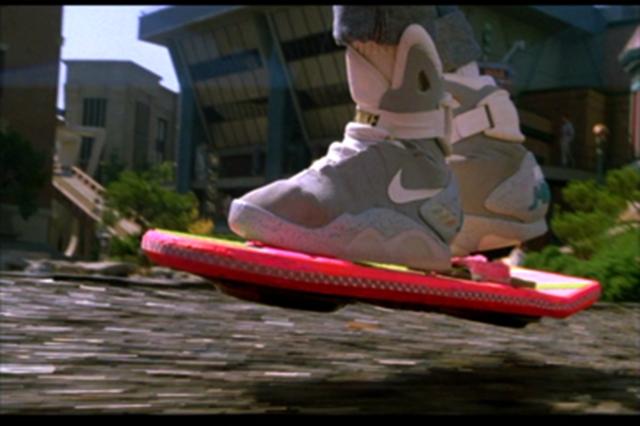
Directed by: Robert Zemeckis
Starring: Michael J Fox, Christopher Lloyd, Lea Thompson, Thomas F Wilson, Elisabeth Shue
Screenplay by: Bob Gale/ Story by: Bob Gale and Robert Zemeckis
US; 108 minutes; Colour; Certificate: PG
~~~
It’s a tricky thing predicting the future. In 1948, George Orwell suggested that Britain 40 years on would be under the thumb of a fascist overlord and overseen by ‘Big Brother’, while in 1968, Stanley Kubrick and Arthur C Clarke foresaw that 30 years on from then mankind would be walking about in mega-space stations while searching the recesses of space and creating computers that seem to have souls. All right, admittedly the depictions of what was to come in both the novel 1984 and the film 2001: A Space Odyssey (1968) may have been created to make clever points rather than straight-out future predictions, but they were still very wide of the mark. And, unfortunately, the depiction of the year 2015 in Back To The Future Part II doesn’t exactly stand up to the limits of semi-believability either.
But what’s wrong with that, you may ask? And it’s a decent question; after all, this first sequel to the eponymous mid-’80s time-travel comedy adventure is clearly not supposed to be taken anywhere near wholly seriously, just like its predecessor. Yet, surely any form of fiction depends on not stretching the realms of believability too far in case it loses its audience (unless its deploying surrealism, absurdity or the such like, I guess) and for me, BTTFII has really always had this problem.
Picking up where the first film left off, this unquestionably successful sequel sees a just-returned-to-the-present-1985 Marty McFly (Fox) jet off – quite literally – with his girlfriend Jennifer (Shue) and inventor friend ‘Doc’ Emmet Brown (Lloyd) in the latter’s DeLorean-motor-car-converted-into-a-time-machine-converted-into-a-flying-vehicle and forward to the year 2015. There, Marty must pose as his own son to put right an event that will have catastrophic circumstances for his future family, while he also takes in the sights and sounds of his home town 30 years into the future.
Fair enough, there’s no question a lot of thought, planning, imagination and wit went into the creation of Hill Valley c.2015. And, while essentially silly, the notion of vehicles converted and manufactured to fly as well as be road-worthy is charming, fun and well executed, the ‘futurising’ of other aspects of daily life are, for me, just too silly. Screenwriter Bob Gale was apparently definite that the future reality shown in BTTFII should be lightweight and knockabout, and clearly the other creatives behind the film (Zemeckis certainly and the likes of executive producer Steven Spielberg) were sold on the idea too. After all, they got it so right with the original film, why wouldn’t they trust their instincts this time around too?
However, the choices to re-do or – because they’re re-done with such tongue in cheek – to pastiche crowd pleasing sequences from Back To The Future in, er, the future here, come off, well, a little naff. And that’s not to mention the inclusion of hydrating pizzas, utterly wacky fashions including men’s suits replete with two ties hanging from the collar, robotic dog-walkers and hovering back supports for the elderly that see the wearer hung upside down. Perhaps worst of all, though, is the casting of Fox as both his character’s future son and daughter. Fox is clearly more than eager and hams it up like a good ‘un, but then maybe that’s the point – and the wider point with BTFFII‘s entire future world – it feels as if the makers had more fun making the movie than you are watching it. Hey, it’s no cinematic crime and all that, but it is a shame.
And that’s because the flick’s next two acts are fine stuff. Following the (as it was at the time of the movie’s release) much hyped trip to the future, we have a return to a messed-up, dystopian 1985 present and another return to 1955. The 1985 section, like the 2015 one, is admittedly silly, but throws less caution to the wind and – as the plot starts to crank up and the film’s villain is unveiled – proves more engaging.
Yet, BTFFII‘s genuine success is, perhaps surprisingly, its return to ground well trodden in the original film – the 1955 setting. And well trodden is the term, for half of this setting revisits story and literal scenes that were created for the first film. Undeniably then, this is the section of the film one would most expect the filmmakers to mess up, but it’s testament to their plotting, attention to detail, technical brilliance and sheer love of their material, story and characters that they don’t. More like they pull off a thrilling, tense last third that entirely recaptures the sense of wonder and magic of the original flick – by doing something almost entirely different. All that, and there’s a sort-of-twist ending that’s so clever-clever it never fails to impress however many times you see it – it’s simply outstanding stuff.
Outstanding too are the sets and special effects – of which, what with so much time-travel, there are substantially more than in the first film – while Alan Silvestri’s score carries the action along nicely, with its oh-so recognisable main theme sweeping you up at choice moments (important considering, unlike the original, this flick features no publicity-generating chart hit). Of deserved mention too are the main players. Fox – when not playing Marty’s kids – and Lloyd make for strong, effortlessly likeable leads once more, while both Thompson and Wilson, with arguably more to do this time around (Thompson plays three different versions of the same character; Wilson two different characters), really impress.
So, overall then, Back To The Future Part II is something of a mixed bag. While the first half-hour or so is far from future-perfect, the rest – like Marty McFly on a hoverboard – manages to glide above it, more than redeeming the film and turning the piece, as it does so, into a memorable slice of entertainment – and, naturally, a nice set-up for the trilogy’s third and final flourish.
The time traveller’s strife: Back To The Future (1985) ~ Review

Directed by: Robert Zemeckis
Starring: Michael J Fox, Christopher Lloyd, Lea Thompson, Crispin Glover, Thomas F Wilson
Screenplay by: Robert Zemeckis and Bob Gale
US; 116 minutes; Colour; Certificate: PG
~~~
So, following hot on the fire-trails of my article on the story behind the Back To The Future flicks, that very time-travel movie trilogy’s season continues right here at George’s Journal with a review of the original film by, yes, yours truly.
First things first though, because a few nights ago I was lucky enough to see Back To The Future on the big screen (in a brand spanking new digitally remastered print) thanks to its cinematic re-release for its 25th anniversary – and indeed I’m aware that admitting that fact in an Internet-published article is essentially gloating about it on a large scale. Yet, that fact is a moot one for this very review, for watching a film classic at a flickatorium is quite a different experience to slipping its disc into the DVD player, settling down in an armchair and hitting ‘play’. Not only because the cinema screen is so much bigger and you catch more detail than you would on a TV-sized one, but also – and most importantly – because you’re not the only one watching it.
About 10 years ago I saw classic cross-dressing caper Some Like It Hot (1959) in a cinema, and the experience was very similar to the other night with Back To The Future. I was surrounded by an audience of viewers who, like me, had predominently seen the flick before and were fans; it was an audience therefore on the movie’s side throughout and, more than that, knew the points at which most of the big laughs came. And that was what made following Marty and the Doc’s first adventure this time really unique – the goodwill of all those there and the laughter exercise had by them.
Back To The Future is a comedy, of course, but I’ve perhaps never realised quite how much of a comedy before the other night. Personally, I’ve always thought of it as a sci-fi-romantic-comedy-adventure – a film that genuinely has something for everyone, but the other night my company were laughing at every one of the Doc’s idiosyncratic expressions, guffawing at each of Marty’s ’85-in-’55-slips-of-the-tongue and rolling about at all of George McFly’s stuttering machine-gun-like laughs. In short, this was an audience that was genuinely, completely entertained by what they saw – and it’s not hard to work out why.
The movie, of course, tells the story of 1980s highschool ‘slacker’ Marty McFly (Fox), whose friendship with the father figure that is white, wirey haired Doc Emmet Brown (Lloyd) – itself presumably existing owing to his own lacklustre parents (Thompson and Glover) – leads him accidentally to be transported 30 years into the past by a time machine built into a DeLorean car by his ingenious old pal. Once there, Marty enlists a younger version of the Doc to get him back to the future, while making sure his parents get together to ensure he continues to exist at all, having inadvertently ballsed-up the moment when they’re supposed to have fallen in love.
An undeniable blockbuster on release (it was the biggest money-spinner of its year), Back To The Future is nowadays hard to disassociate from its blockbuster tag and look at purely as a film on its own. However, watching it on the silver screen, I can assure you it measures up differently and very favourably to today’s too-often-too-mindless blockbusters. And that’s because this film was made in an era when a flick genuinely had to earn the reddies to become a blockbuster. How did it do that? By simply being a damn good, solid flick in the first place.
Zemeckis and Gale’s script is water-tight; not one line is wasted in forwarding the plot (indeed, Zemeckis even considered removing the oh-so memorable Johnny B Goode scene in the film’s last third because he felt it contained no pl0t development). However, despite the tightness, the flick’s also entertaining as hell. As explained, it’s funny, but also thrilling (the time-travel sequences are terrific), perfectly paced (the action sequences breeze along, while the dialogue-heavy and more emotive scenes are given room to breathe – overall then, it’s finely balanced) and there’s genuine substance and heart to engage the noggin and the emotions as well.
Indeed, the players must take their fair share of credit for the latter. Fox, in his true star-making role, is an entirely engaging, sympathetic hero and very accessibly cool along with it; Lloyd’s mad scientist routine as the Doc is wonderfully judged – subtle at times and fully flourishing thanks to broad brushstrokes the next; and Thompson’s predatory lust-struck mother-to-be nicely played, while Glover’s awkward middle-aged loser in the present becoming a proto-geek in the past is a fine performance.
Worthy of mention too is an instantly recognisable orchestral score from Alan Silvestri; two top hit pop tunes from Huey Lewis And The News; excellent mid-50s period detail and sets to transform the film’s time period; and, of course, ace special effects (for their time) from the legendary Industrial Light & Magic.
And yet, at the end of the day, Back To The Future is probably really the film it is because of the keen vision and technical ability of Zemeckis and Gale. As mentioned in my previous post, it took them three flops and then five years’ writing and development to get their eventual hit off the ground – but when their time came they hit it out of the ball-park at a full 88mph.
Back in the ’80s, I remember them saying they don’t make films like they used to, but giving Back To The Future the proper re-watch it deserves, I can confirm they really don’t make films like they used to in that decade either.

The face that launched millions of ticket sales: detail of Michael J Fox as Marty McFly from the 1985 theatrical poster for the original, unforgettable Back The The Future film adventure
According to the first words we hear in perhaps the most popular time-travel flick ever (thanks to an ad on Doc Brown’s radio), October is inventory-time. Well, here at George’s Journal, October is most certainly Back To The Future-time, as we celebrate the 25th anniversary of the release of this mind blowingly successful, terrifically entertaining and wonderfully endearing trilogy’s first movie.
But where to start? Where to begin? Where does the story of this corner of much lauded and oh-so much wallowed-in ’80s screen nostalgia kick-off? That night in 1985 when the DeLorean first hit 88mph? Or, earlier, at The Doc’s house that fateful day in 1955 when he first realised time travel was possible? Or, even earlier, way back in 1885, that is, when farmer Seamus McFly discovered a strangely dressed chap on his land claiming to be Clint Eastwood? Well, while they may all be fitting starting points, in actual fact the story began in the summer of 1980 when filmmaker Bob Gale visited his parents’ house in St. Louis, Missouri.
Along with his friend and collaborator, Robert Zemeckis, Gale had just made and seen released their third film together Used Cars, a satirical, knockabout comedy set in the world of used car salesmen (Gale had co-produced, Zemeckis had directed, and together they had written it). Like their previous two films – I Wanna Hold Your Hand (1978) and 1941 (1979), the latter directed by cinema’s biggest thing since, well, Cecil B DeMille, Steven Spielberg – Used Cars turned out to be an unmitigated flop. As a duo then, the pressure was on Gale and Zemeckis – in the dollar-driven environment of the Hollywood movie machine they needed to produce a hit, or their careers would surely be dust. However, it just so happened that, while rooting around in his parents’ dust-laden basement, Gale found something that set in motion the formation of their next film’s story.
It was his father’s highschool yearbook. Granted it wasn’t exactly Gray’s Sports Almanac, but it was quite the find. Why? Because, through it, Gale discovered his father had been president of his graduation class. Thinking back, Gale hadn’t particularly known his own graduation class’s president and this made him wonder, if he’d have known his dad back in the day, would the two of them have been friends? Perhaps there was something in that, the germ of the idea for a film? Gale told Zemeckis about it and the latter came up with the notion of a woman who claimed never to have dallied with boys but had, in reality, been promiscuous at school. They took the project they had worked up out of the two ideas to Columbia Pictures and struck a deal with the studio to develop a script.
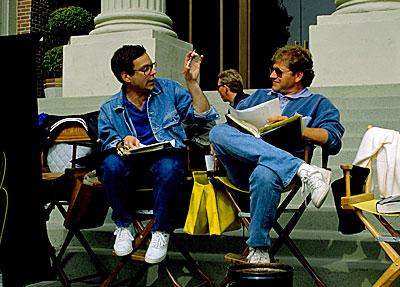
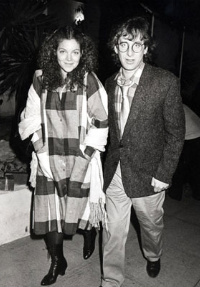
Three of a kind: The two Bobs – Bob Gale and Robert Zemeckis in discussion on the Back To The Future set (left); and Uncle Steven – Spielberg stepping out with wife Amy Irving in 1985 (right)
Unfortunately, however, teen comedies of the period tended to be far more adult in tone – National Lampoon’s Animal House (1978), Fast Times At Ridgemont High and Porky’s (both 1982) – than the script Zemeckis and Gale had on the table, ensuring their potential movie found itself in development hell. One option, though, was to approach the family-friendly Disney, but when they did so that studio ironically said their script was too adult, owing to it featuring a mother getting the hots for her son. Finally, their last option appeared to be approaching Spielberg again, asking him to produce and thus provide the muscle to get their picture made.
They were reluctant, however, as their previous efforts I Wanna Hold Your Hand, 1941 and Used Cars had all involved the fast-becoming King of Hollywood and all had flopped – they didn’t want to become known for only getting films made because they knew Uncle Steve. All that changed, though, following Zemeckis directing a bona fide hit, the Indiana Jones-inspired and eminently entertaining Romancing The Stone (1984). Suddenly, the goalposts had moved; he and, by association, Gale would be taken seriously. They went to Spielberg and their lastest flick together was set up at Universal Pictures.
Although the film had now been greenlit, its title needed deciding on. Head of Universal at the time Sidney Sheinberg suggested Spaceman From Pluto, his notion being that the name of a comic a boy reads in one scene could be changed in the script from Space Zombies From Pluto to Spaceman From Pluto. Spielberg got on the case and embarrassed Sheinberg into reneging on the idea, insisting that Gale and Zemeckis had thought his suggestion was a joke. The film thus retained the title the filmmakers had given it, Back To The Future.
Back To The Future, of course, tells the tale of 17-year-old Marty McFly who, through association with older, eccentric scientist friend Dr Emmett ‘Doc’ Brown and his newly invented time machine (built into a Delorean DMC-12 car), manages to accidentally and sensationally travel 30 years back in time, finding himself in the 1955 version of his home town, California’s fictitious Hill Valley. Once there, Marty’s obvious aim is to return to the present, so he enlists the help of the 30-years-younger Doc, but also comes across both his parents (who are his own age and in highschool) and manages to disrupt their falling in love – indeed, his mother falls for him instead of his father. So Marty must somehow ensure his parents do get together (otherwise he won’t exist) and with the Doc work out how he can, well, get back to the future.
“[Back To The Future] is a quintessential 1980s flick that combines science fiction, action, comedy, and romance all into a perfect little package that kids and adults will both devour.” ~ Christopher Null, editor-in-chief, Filmcritic.com
Like many of the best film plots, it offered something that hadn’t quite been done before, but was also brilliantly simple. Even so, such a good story as it was had required the ironing out of a few wrinkles – originally, Marty had needlessly been a video pirate, the time machine not a DeLorean but a fridge and the hero was to be sent back to the future via an atomic explosion at the Nevada nuclear test site. The latter idea was, naturally, replaced by a lightning bolt, but it just goes to show, lightning bolts didn’t always strike the two Bobs as they wrote Back To The Future – you have to work at perfection.
Initially, the role of Marty was offered to ’80s Canadian popstar Corey Hart, but he turned it down. Zemeckis and Gale’s next choice was another Canadian, actor Michael J Fox who had proved he was a dab-hand at light comedy – and was fast becoming something of a heart-throb – on top-rating NBC sitcom Family Ties. Although Fox was more than keen, his contract on that show precluded him from the film. Next on the list then were ‘Brat Packer’ C Thomas Howell – who had starred in E.T.: The Extra-Terrestrial (1982) and The Outsiders (1983) – and Eric Stoltz. The latter had particularly impressed the filmmakers in his portrayal of a heavily disfigured teenager in the biopic Mask (1985), so Stoltz it was who won the role. Supporting him were Christopher Lloyd as Doc Brown – following first choice John Lithgow becoming unavailable; Lea Thompson as Marty’s mother Lorraine – on the strength of her starring opposite Stoltz in The Wild Life (1984), in fact, the two would appear together again in John Hughes’ Some Kind Of Wonderful (1985); arty actor Crispin Glover as Marty’s father George; and Thomas F Wilson as George’s lifetime bully ‘Biff’ Tannen.
Filming got underway in December 1984, but just a few weeks into the shoot a major problem surfaced. In the second week, Stoltz phoned director of Mask Peter Bogdanovic and confessed to him he was uneasy about the direction Zemeckis and Gale wanted and wondered whether he was right for the film. Two weeks later, Zemeckis himself came to the same conclusion and – even though recasting the role of Marty and, thus, shooting again from scratch would add $3million to the the flick’s $14million budget – he and Spielberg agreed to let Stoltz go and find another lead. The decision was because Stoltz was simply too dramatic and not light enough. Clearly, with the aid of hindsight, it’s obvious a non-comedic Marty McFly would never have worked.
So, it was back to Family Ties producer Gary David Goldberg to see whether he’d agree to release Fox in any way. This time a deal was struck – Fox would continue to work on the show throughout the week, but be free to work on the movie at night and at weekends. For sure, it was a crazy schedule for the actor, ensuring he averaged only five hours’ sleep a night and that exterior scenes – those that required natural daylight – were shot on Saturdays and Sundays. Robert Zemeckis has since referred to the movie as ‘the film that would not wrap’ and its necessary night-time shooting meant he was half-asleep and out-of-shape throughout. Still, on April 20 1985, after a full 100 days, it did wrap. Back To The Future was in the can.
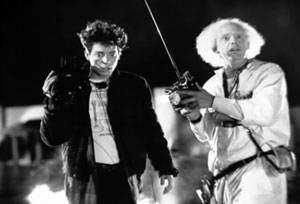

Spot the difference: Eric Stoltz and Christopher Lloyd in the Twin Pines Mall scene (left) and Michael J Fox and Lloyd in the same scene after Fox replaced Stoltz weeks into filming (right)
But when would it be in cinemas? Originally, the release date was set for August that year, but Sheinberg quickly moved it forward to the coveted Independence Day weekend sensing he had a hit on his hands. Why? Because at a preview test screening, in the words of Speiberg’s fellow executive producer Frank Marshall, ‘the audience went up to the ceiling’. In spite of Zemeckis and Gale only giving Industrial Light & Magic’s 32 effect shots the nod a week before the final completion date and the editors removing eight minutes of footage (including Marty witnessing Lorraine cheating on a test, George getting stuck in a phone booth before ‘saving’ her and Marty posing as ‘Darth Vader’) – or perhaps that helped – the movie wasn’t just a hit, it was an absolute monster.
In total, it spent an amazing 11 weeks at the top of the North American box-office charts. Its opening weekend was the fourth biggest of 1985, and yet its second weekend was even bigger – suggesting excellent word-of-mouth. During its outstanding theatrical run, the bawdy, slapstick comedy National Lampoon’s European Vacation knocked it off Number 1, but it happily bounced back up to the top the following week. Indeed, audiences lapped up Marty McFly’s time-travelling adventures so much that the flick ended up becoming North America’s biggest film of the year (total gross: $211million) and the biggest film of the year worldwide too (total gross: $381million). In fact, as of June this year, the film stands at 59th on the list of highest grossers in North America (adjusted for inflation), with a total gross of $469million.
But so much for the statistics, we all know it became a licence to print money for the two Bobs, Steven and co. – what about the effect it had on the public at large, its cultural impact? Well, that was just as large as the figures at the box-office. Nowadays, it’s genuinely difficult to imagine the 1980s without Back To The Future being a part of it. It is, simply, a seminal ’80s movie – among those unforgettable decade-definers like E.T., Ghostbusters and Beverly Hills Cop (both 1984), Top Gun (1986) and Wall Street (1987).
On both sides of the Atlantic and probably further afield, I’d argue, it cemented tenets of ’80s Americana in the collective consciousness. Take, for instance, Marty McFly skateboarding as he holds on to the back of cars and, indeed, actually ‘inventing’ the skateboard (legendary skaters Per Welinder and Tony Hawk doubled for Fox); unquestionably this made kids outside the States realise just how cool skateboards really were, and soon, in the UK as well as across the pond, they were vying with the BMX as every child’s favourite garage-based toy. Also, the camcorder and the Sony Walkman cassette player (both used by Marty) were yet to cross over to these shores, but after this flick, by ‘eck were we looking forward to them coming! The movie acted as a brilliant advert for US youth culture of the ’80s that Britain fell for hook, line and sinker.
Plus, lest we forget, featured oh-so coolly less than a quarter of a way through the movie was the perfect pop tune that is The Power Of Love. While the theme from Ghostbusters and The Heat Is On (from Beverly Hills Cop) failed to make their respective singers Ray Parker Jr and ex-Eagle Glenn Frey big solo artists, this Billboard Hot 100 topping-ditty helped make old fashioned rockers Huey Lewis And The News global superstars – following their flirtation with Hollywood, their records sold and sold (actually, amazingly there were two other hit singles named The Power Of Love in ’85, one by Frankie Goes To Hollywood, the other by Jennifer Rush). Moreover, Marty McFly’s wonderful performance of Johnny B. Goode – although, in reality not played or sung on the film’s soundtrack by Fox himself – contributed to the conspicuous renaissance of 50’s and ’60s soul, blues and rock ‘n’ roll hits in the ’80s; other previous hits from these genres often became ’80s hits thanks to them featuring prominently in Levi Jeans commercials.
However, perhaps the most obvious side-effect of the mid-’80s Back To The Future phenomenon was its effect on the career of its star, Michael J Fox himself. While the standings of Lloyd, Thompson and Glover certainly rose thanks to the flick’s enormous success, it was Fox – the man who, as mentioned, was on the verge of major stardom anyway owing to his popularity in Family Ties – who hit the stratosphere. In 1985 he starred in the Number 1-rated TV show of the year and the Number 1-rated film of the year – surely a feat that’s never been repeated by an actor?
Not only did he manage to make Marty McFly the coolest teenager since James Dean in Rebel Without A Cause (1955), but he also offered something new and unique among Hollywood stars; he was young and very fresh, yes, but also funny, energetic, sympathetic and loveable – you got the feeling he would be the cool kid who’d befriend the geeks and the one that a mother would trust her daughter with. On the strength of this blockbuster hit, he had further hits that made use of him in very similar roles – Teen Wolf (1985), The Secret Of My Success (1987) and Doc Hollywood (1991). None of them were as good as Back To The Future admittedly, but thanks to that film and Fox’s appeal they all inevitably made box-office tills ring with glee.
Talking of boffo-ing the box-office, three years later Zemeckis and Gale finally gave in to the clamour of fans and/ or fulfilled their inevitable ambition of bringing Marty, the Doc and the DeLorean back, but not for one sequel… for two. When it came to Back To The Future – and compared to other Hollywood adventure films – everything seemed to go that extra yard. And in the first of the two new films, Back To The Future Part II, the extra yard certainly was gone; a full 30 years into the future, in fact.
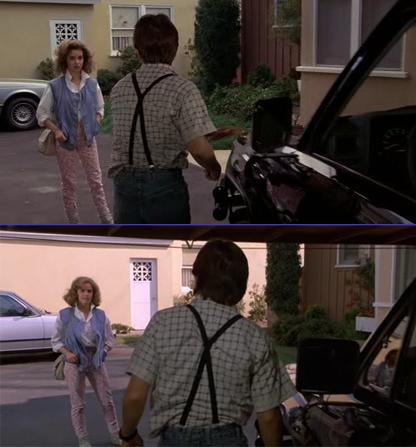
Spot the difference #2: Elisabeth Shue (bottom) replaces Claudia Wells (top) in the reshoot of the first film’s final scene for the second film’s first scene (do re-read that sentence if required)
At the end of the original film, as a cheeky epilogue, Doc Brown had arrived at Marty’s house back from the future – the year 2015 – all gaudily dressed and with the DeLorean running on refuse (thanks to its ‘Mr Fusion’ fuel system) and insisted that both Marty and his girlfriend Jennifer, who’s with him, must accompany him to 2015. Once in the car, Marty informed his driver he wouldn’t have enough road in the street to get the DeLorean up to 88mph and thus travel in time, to which the Doc memorably replied ‘Roads? Where we’re going, we don’t need roads’, and, in immediate answer to this, the car rose into the air, tucked its wheels under itself and flew towards the camera and into the future.
It was a fine, witty and fun way to top off the film, but inevitably left filmgoers salivating – what would Marty and the Doc do in 2015? What would 2015 look like? And wouldn’t it be oh-so cool to see more of the DeLoren flying? For the two Bobs, however, none of these questions had occurred to them; they’d never intended a sequel. When they finally decided to make one though, they found themselves having to come up with answers – and good ones too. BTFFII, therefore, gave its makers a titanic technical challenge. They had to make the DeLorean fly once more – and for more than one scene this time – and they had to realise an impressive Hill Valley c.2015 that didn’t shortchange the audience.
Again, Lucasfilm’s Industrial Light & Magic was deployed for the special effects, of which, necessarily, there were far more in this film than the first. And it shows – and ILM’s brilliant work does too. Perhaps the DeLorean flying, and so looking even cooler than it did the original, is the abiding memory of this film. However, the effects technicians’ work didn’t stop there. They also had to come up with other vehicles that could fly – after all, if just one car could fly in the future, surely all the others would have to as well? And they did, in addition to a highway floating in the clouds complete with flying taxis and trucks. But vehicles weren’t the only thing to get off the ground in BTTFII… enter the hoverboard.
BTTFII aimed humorously to update – or, rather, ‘futurify’ – much of Marty McFly’s world , and this went so far that it included introducing a skateboard that mirrored the flying DeLorean – yes, the skateboard hovered; it was a hoverboard. Jokily and smartly bearing the logo of real-life toy manufacturer Mattel, the hoverboard proved such a hit that requests went out to its ‘manufacturer’ asking when they would be putting it on the market for the general public. Seriously. Mind, this occurrence was perhaps somewhat influenced by Zemeckis joking in an interview that the hoverboard was a real gadget built for the movie and not merely the invention of set designers and those clever beardy blokes at ILM. Featured in the film too were clever trainers that fitted the size and shape of any foot. Perhaps as these too bore the logo of a real manufacturer (Nike), people also wanted to know when they could get their mits on them. In the end, Nike gave in and made a BTTFII-style trainer available – alas, it wasn’t a one-size-fits-all model. Clearly the public would have to wait until 2015 – or maybe longer – for that technology to reach the shoe industry.

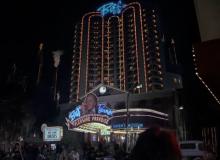


Changing face of a clocktower: the centrepiece of Hill Valley in 1955 (top left), the nightmarish alternative 1985 (top right), 2015 (bottom left) and 1885 (bottom right)
As far as fulfilling – or exceeding – filmgoers’ expectations in terms of the sets, production designer Rick Carter and his team took a full two years to design and and bring to life the Hill Valley of 2015. Instead of taking the chrome and spires approach of Blade Runner (synomymous with futuristic set design), they instead opted for colour, glass and light – in line with Bob Gale’s sentiment that Back To The Future‘s world of the future would be shot through with a thorough sense of fun.
Elsewhere, technical wizardry was required for the realisation of Marty McFly’s future family – to be specific, the filming of the 47-year-old Marty, his son Marty Jr and daughter Marlene in one scene. The issue here was they were all played by Michael J Fox. The trick of featuring two characters played by the same actor in one scene had been in existence since cinema began, but never had such a scenario involved a camera moving about in that scene – to achieve that the special effects would indeed need to be smart. Thus ILM were called upon again to come up with a solution, which they duly did in the shape of ‘VistaGlide’. This technique was also used in the scenes in which an older Biff interacted with a younger version of himself.
Meanwhile, Zemeckis was forced to produce a shot-for-shot re-filming of the original movie’s ending that could be used at the start of this film. But why go to all that trouble? Why not just use the original scene? Two reasons – first, the aforementioned scene in question (the Doc whisking Marty and Jennifer off in the flying DeLorean) had to be redone in order to change one or two little details relevant to this flick’s plot; and, second, actress Claudia Wells, who had originally played Jennifer, was unwell and couldn’t reprise the role in the sequels. So a new actress Elisabeth Shue – who would really make her name in the ’90s in Leaving Las Vegas (1995) – was cast and the scene reshot. If you like, this reshoot with another actor was like a small repeat of the refilming done for the original when Fox replaced Stoltz – talk about déjà vu for the crew.
All the same, while BTTFII bulges with showy technical skill, it isn’t the film’s only – or even primary – concern. One might argue that, if you read between the lines, it’s the plotting that takes centre stage (indeed, perhaps the true strength of this entire trilogy is its commitment to story). For following the 2015 episode, the flick moves back to an alternate, nightmarish 1985 that has been created thanks to events that have taken place – with a bit of clandestine time-travel – in 2015. In creating this dystopian version of Hill Valley ’85, Zemeckis and Gale were clearly influenced by It’s A Wonderful Life (1946) – yes, it’s pretty obvious when you compare both films, but if you’re going to be an utter magpie and ‘steal’ from a movie, then you might as well pinch from one of the greats, as the latter is. Yet, that’s not the end to the jumping about in time, it’s then back to ’55 and nattily revisiting some of the same territory – nay, the same scenes – as the ’55-set ones from the original. Now that’s real déjà vu.
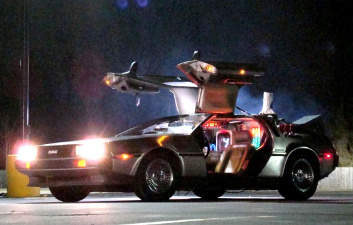
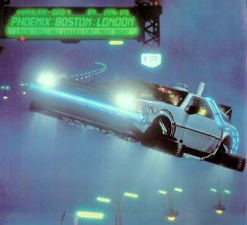
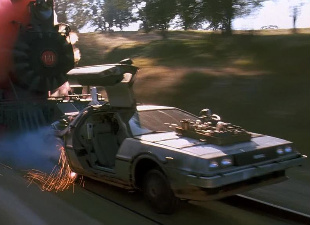
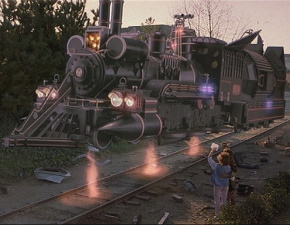
Planes, trains and automobiles?: Doc Brown’s time machines – the DeLorean (top left), and modified to fly (top right), then on rails (bottom left) and the final flying train (bottom right)
Would the complicated plot (with its – count ’em – four time-travel trips in the DeLorean) prove too much for the audience’s poor bonces? Some cinemagoers did admit to being confused when coming out of BTTFII, and it’s certainly a movie that benefits from a second or third viewing, but it was still an unquestioned hit, earning $118million at the North American box-office and $332million worldwide – the third biggest grosser in the world in 1989. That’s not to be sniffed at by Einstein or anyone else at all.
And neither is the series’ second sequel and concluding entry, Back To The Future Part III. In stark and smart contrast to its immediate predecessor, this one spends the majority of its length in one timeframe – 1885, a full 100 years before Marty McFly’s own reality. Why go this far back, though? Well, when, on the set of the first film, Gale and Zemeckis asked Fox which period he’d most want to visit in the role, he said he’d like to go back to the old West and meet cowboys. Perhaps, after playing such a huge role in the success of the first two flicks, they decided to indulge him?
Yet, while BTTFIII clearly showcases both cast and crew having a whale of a time putting together a Back To The Future western – playing about with the genre’s conventions as they do so (a train hold-up à la Butch and Sundance, the ironically unhelpful arrival of ‘the cavalry’ and a high noon showdown all feature), the filmmakers certainly intended there to be more to this ‘un than merely that. Through BTTFIII, they carefully reveal the very beginnings of both the McFly family and of the town of Hill Valley itself, bringing the series nicely full-circle – in a suitably time-twisty way, naturally.
Sections of the movie were filmed in the notorious Monument Valley in the Colorado Plateau, a very familiar film location, especially in westerns – Stagecoach (1939), Fort Apache (1948) and The Searchers (1956) were all filmed there. Plus, for the train sequences that are some of the film’s very best, California’s Sierra Railway heritage line was used. This location too harks back to Hollywood western history, having been used over the decades for the filming of flicks such as High Noon (1952) and for several old West-themed TV series.
As a whole, BTTFIII was actually filmed back-to-back with BTTFII and was released just six months later in cinemas – the makers clearly confident that with its story so strongly following on from the latter, this one would be just as much a hit with audiences despite the relative lack of respite between the two films. And they were proved right – BTTFIII made $88million in North America and $245million worldwide – finishing sixth on 1990’s top 10 global grossers’ list. Although these numbers were slightly down on BTTFII’s, if anything over time the third film’s popularity has proved greater than the second’s – filmfans seem to prefer its simpler plot, its narrative more closely aligned to the first film’s and, who knows, maybe just the fact that it’s the series concluder and ties up loose ends?
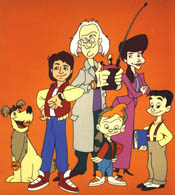
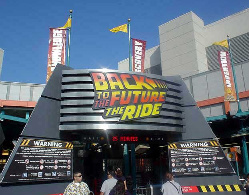
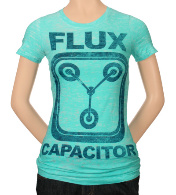
Forwards to the future: the Doc and Marty go cartoon in BTTF: The Animated Series (left), Universal Studios’ simulator ride (middle) and a Flux Capacitor t-shirt – real geek chic (right)
What is unquestionable, however, is the enduring appeal of the trilogy as a whole. Put together, the box-office grosses of the three films falls just $1million shy of an incredible $1billion – God knows how many rentals and video and DVD units they’ve shifted over the last 20 years too. And the story didn’t finish with the films either. One year after BTTFIII hit cinemas, Marty, the Doc and Einstein’s adventures continued on the small screen, in the shape of Back To The Future: The Animated Series. Joining them on scrapes through time (and space) were the Doc’s wife Clara and children Jules and Verne (all characters appearing in the third film). Albeit this cartoon series ran for only two seasons, clocking up a total of 26 episodes, it had a fanbase that turned kids too young to have seen the flicks in cinemas on to the movies themselves.
Also in 1991 a simulator ride, entitled Back To The Future: The Ride, arrived at the Universal Studios Florida amusement park, in which the Doc led ‘volunteers’ through time in pursuit of Biff. Two years later the ride opened at Universal Studios Hollywood. Indeed, both rides proved so successful that they only closed in 2007 – another opened at Universal Studios Japan in 2001 and is still going strong. And, of course, all this is not even to mention the huge ‘geek’ and Internet following the Back To The Future phenomenon has garnered for itself over the years. Although of neither the numbers nor perhaps the crazy commitment of Star Trek or Star Wars followers, Back To The Future fans are spread far and wide throughout the world and are loyal to the ends of the earth. Admittedly, perhaps not to the point of demanding Michael J Fox climb into the DeLorean one more time for Back To The Future Part IV, but after such a near perfect, wonderfully self-contained trilogy, who’d really want to see that anyway?
Indeed, proof – if any were really needed – of the series’ enduring popularity can be found in the pudding that is, to celebrate its 25th anniversary, the re-release of the original Back To The Future film in cinemas on both sides of the Atlantic this month. I’ll certainly be indulging in a bit of time-travel back to 1985 (and, er, 1955) on the big screen, and I’ll be re-watching the other two flicks as well in order to give the whole trilogy, film-by-film, a good reviewing right here, just as they deserve – so look out for that.
After all, who wouldn’t want to relive Marty McFly’s ‘sea fatigue’ jacket, that Jaws 19 promo, the DeLorean getting struck by lightning – twice – or ZZ Top’s cowboy band cameo? Who indeed. But enough of my ramblings… Great Scott! Is that the time? It’s time I was out of here…
Further reading:
Playlist: Listen, my friends! ~ October



In the words of Moby Grape… listen, my friends! Yes, it’s the (hopefully) monthly playlist presented by George’s Journal just for you good people.
There may be one or two classics to be found here dotted in among different tunes you’re unfamiliar with or never heard before – or, of course, you may’ve heard them all before. All the same, why not sit back, listen away and enjoy…
CLICK on the song titles to hear them
~~~
Petula Clark ~ Downtown
The Kinks ~ Autumn Almanac
Tomorrow ~ Colonel Brown
The Nice ~ America (Second Amendment)
The Moody Blues ~ Question
Yes ~ I’ve Seen All Good People (Your Move)
Elton John ~ Mona Lisas And Mad Hatters
Bad Company ~ Feel Like Makin’ Love
Peter Gabriel ~ Solsbury Hill
Ron Grainer ~ Tales Of The Unexpected
Wah! ~ The Story Of The Blues
Midge Ure ~ If I Was
Phil Collins ~ Two Hearts
American prince: Tony Curtis (1925-2010)

The prince and the showgirl: Tony Curtis and Marilyn Monroe on the set of Some Like It Hot in 1959 – despite the difficulty of the shoot, this classic comedy would define both their careers
He romanced Marilyn Monroe on and off the screen, led that crowd of slaves in delivering the immortal line ‘I’m Spartacus!’ and, it could be said, defined Hollywood living for six decades, but two days ago his dramatic story came to an end. Tony Curtis, perhaps the longest, last survivor of Hollywood’s Golden Age, has died at home in Nevada. He was 85 years old.
Born on June 3 1925 as Bernard Schwartz to Hungarian Jewish imigrants in The Bronx, New York (explaining the trademark accent he’d never really be able to hide), he suffered a troubled childhood owing primarily to his schizophrenic mother’s physical abuse. Her mental illness would lead to his older brother Robert being institutionalised, while he and his younger brother Julius were placed in an orphanage for a month – Julius was killed when hit by a truck just a month later.
However, Curtis put his upbringing behind him when, as World War Two raged, he joined the US Navy. Stationed aboard a submarine tender, his service included witnessing from a mile away Japan’s surrender to the United States in Tokyo Bay on September 2 1945. Upon discharge, he attended college in New York and studied acting, his fellow students numbering Rod Steiger and Walter Matthau. Then, on arrival in Hollywood in 1948, he secured a contract as a player with Universal Studios, even though he later admitted that at this stage he was only interested in acting for the girls and money.
“The age gap doesn’t bother us. We laugh a lot. My body is functioning and everything is good. She’s the sexiest woman I’ve ever known. We don’t think about time. I don’t use Viagra either. There are 50 ways to please your lover.” ~ Tony Curtis on his final wife, Jill Vandenburg Curtis, who was 42 years his junior
Over the next few years he appeared in roles for many and various pictures, building up a young female fanbase owing to his undeniable good looks. By the mid-’50s he was something of a heart-throb, and he perhaps made his first real big splash in circus-based high-wire flick Trapeze (1956) opposite Burt Lancaster and Gina Lollobrigida. A year later he made his genuine, unmistakeable breakthrough, starring with Lancaster again but against type as a corrupted press agent in the scathing drama The Sweet Smell Of Success. Having now proved to audiences he could definitely act, his work became yet more high-profile and better, among it a leading – and Oscar-nominated – role alongside Sidney Poitier in the chain-gang escape-themed The Defiant Ones (1958) and co-starring with Jack Lemmon and Marilyn Monroe as Joe/ Josephine in the classic cross-dressing comedy Some Like It Hot (1959).
As the ’50s slid into the ’60s, Curtis featured most prominently in more comedy roles, no doubt owing to his success in Some Like It Hot (of the two man-dressed-as-a-woman acts, his is the more subtle and arguably more accomplished, while his additional Cary Grant impersonation is flawlessly brilliant). There were the big box-office hits Operation Petticoat (1959), Sex And The Single Girl (1964), and the car-based capers The Great Race (1965) and Monte Carlo Or Bust (1969). All the same, he was able to mix it up in the ’60s as well, starring as he did as learned slave Antoninus in Spartacus (1960) – in which he shared a controversially sexually ambivalent bath scene with Laurence Olivier – and as the title character in the dark, hard-hitting The Boston Strangler (1968).
As culture, mores and tastes changed at the end of the ’60s though, Curtis found the roles were beginning to dry up. So, turning his back on Hollywood, he looked to television and agreed to star opposite Roger Moore in light-hearted adventure series The Persuaders! (1971). It’s fair to say that his sometimes eccentric, other times erratic, but always entertaining performance as New York banker-turned-globetrotting-vigilante Danny Wilde is this blog’s favourite of his repertoire (after all, you may recall that George’s Journal featured an image of Sir Rog and Tone from this very series as its original page banner). Sadly though, despite popularity of The Persuaders! in its native UK and – more unexpected – in France and Germany, the series didn’t transfer successfully to the US and only one series was ever made.
Undaunted, Curtis continued to act, even if the quality was middling to non-existent – admittedly, by now he had also suffered drink and drug problems. Yet, in the early ’80s he discovered and established a second career for himself as an Impressionist painter; nowadays his works often reach up to $250,000 at auction. He also went on to make a name for himself as a popular raconteur, but his loose tongue belied a cruel streak when remembering past colleagues and acquaintances – he once said that kissing Marilyn Monroe (with whom he had enjoyed an affair in 1949) while making Some Like It Hot was ‘like kissing Hitler’.
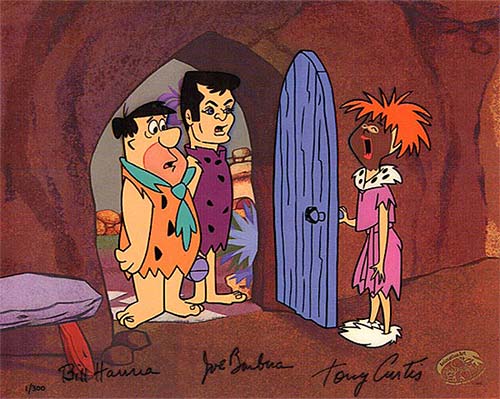
Cartoon immortalisation: Fred, Wilma and ‘Stony Curtis’ in a 1965 episode of The Flintsones – the latter character’s appearance and voice bore an uncanny resemblance to Curtis’s own
Famously, he was married to Psycho star Janet Leigh, with whom he had two actress daughters Kelly and Jamie Lee – the latter, of course, went on to become a Hollywood star in her own right. The break-up of this marriage hurt him deeply, but didn’t prevent him from marrying again… and again and again and again and again. Aside from a four-year gap in the ’90s, he was married for the entire rest of his life – admittedly to five separate wives, pretty much one directly after the other.
Curtis never won an Oscar, but rightfully has a star on the Hollywood Walk of Fame and received an Empire magazine Lifetime Achievement Award in 2006. Around this time, it became apparent that his health wasn’t what it once was and it would probably be fair to say it deteriorated up until the end. All the same, around this time too, he took the surprising decision no longer to wear wigs, but instead boldly show off the fact that he was now a proudly bald, elderly man.
Undoubtedly then, star of over a hundred films, utterly loveable and something of an outspoken, non-conformist American legend that always eluded easy categorisation, the late, great Tony Curtis was a defiant one to the last.
Further reading:
American Prince: A Memoir ~ Tony Curtis, with Peter Golenbock
Transatlantic ambition: The Special Relationship (2010) ~ Review
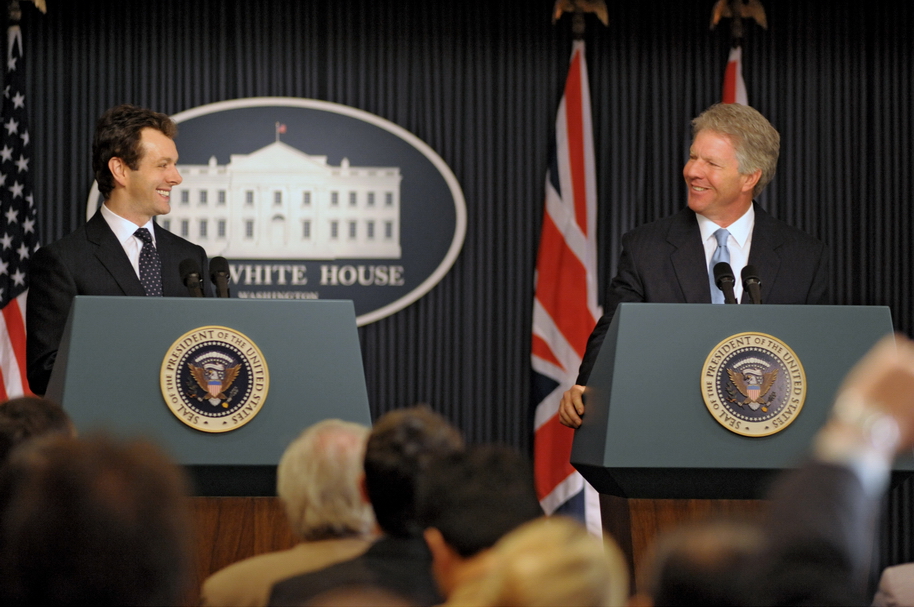
Directed by: Richard Loncraine
Starring: Michael Sheen, Dennis Quaid, Hope Davis, Helen McCrory, Mark Bazeley, Adam Godley
Screenplay by: Peter Morgan
UK/ US; 93 minutes; Colour; Certificate: n/a
~~~
Ah, the special relationship… Two fellers so damned close politically, socially and in personality they could be brothers. What will they do together? Will they actually come together do anything? And who will genuinely hold the reigns? No, I’m not talking about the Milibands, Ed and David, silly – I’m talking about Blair and Clinton, Tony and Bill.
Ever since the ancient Greek tragedies, dramatists have always been fond of trilogies and, like so many before them, the makers of The Deal (2003) and The Queen (2006) clearly felt that three is the magic number. Indeed, like its two preceding dramas, The Special Relationship was written by Frost/Nixon (2008) and the next Bond film scribe Peter Morgan and stars Michael Sheen as former British PM Tony Blair. Unlike those two dramas, however, both of which were helmed by Stephen Frears, the shots on this one were called by Richard Loncraine, director of Richard III (1995), Wimbledon (2004) and Firewall (2006) – actually, Morgan himself had considered directing, but backed out at the last minute. And like The Deal, The Special Relationship went straight to TV (made as it was by the BBC and HBO), but unlike The Queen, which made it into cinemas first, and from so doing successfully reaped the benefits (including an Oscar for Helen Mirren’s portrayal as Queen Elizabeth II).
So what to make of that? More of the same quality Blair impersonation from Sheen? More clever scenes and incisive, witty dialogue from Morgan? And could the fact that this effort went directly to TV instead of the flicks say anything about its real quality? Well, the answer to all three questions is, frankly, yes.
The Deal dealt with Tony Blair and Gordon Brown’s supposed agreement over the leadership of the Labour Party made at Islington’s Granita restaurant in the early ’90s; The Queen dealt with Blair’s ‘handling’ of The Queen and the Royals following Princess Diana’s death in 1997; and The Special Relationship deals with, nattily, not the relationship between Blair and Dubya, but the earlier one between Blair and Bush Jr.’s Presidential predecessor, Bill Clinton.
This nicely ensures that, like the finale to all good trilogies, The Special Relationship brings a satisfying chronological closure to its protagonist’s story (in The Deal, Blair the leader was in genesis; in The Queen he was taking the reigns and finding his feet domestically; and here he’s consolidating and setting up the seeds of his legacy – his foreign policy). Unquestionably, that’s one of the good things about this film; it’s smartly and well thought-out – although Blair and Bill’s work together focused most memorably on forcing Serbia out of Kosovo, the forming of Tone’s self-defining ideology of removing rogue dictators in unstable states (think Sadam Hussein) is clearly on the agenda. And, to this end, the thing’s well, tightly plotted too (Morgan’s a good screenwriter for sure, and Loncraine an able storyteller) – indeed, it’s not giving away too much to say that all that goes on leads up to the final scene’s message that ‘Iraq inevitably will be next’. All good, all enjoyable and all satisfying then.
Or is it? Well, for me, must admit, all of it’s laid on a little thickly. Unlike in the finely judged The Queen, in which fantasised scenes between Blair, The Queen and their people were for the most part intelligently, subtly underplayed (so the feeling that the filmmakers may be overplaying their hand when it came to fantasy-versus-reality never arose), here one or two too many of the situations, spins on real events and scenes themselves seem a little too over-cooked, and some of the brushstrokes creating them feel a little too broad. While it may be fair to say that Loncraine isn’t as talented a filmmaker as Frears (the latter being surely being one of Britain’s very best), methinks it’s also only fair to say that Morgan’s script tries to blur fantasy and reality a tad too much – again not to give too much away as an example here, but the British PM not knowing that ‘POTUS’ is an acronym for ‘President of the United States’ until he gets to the White House on his first visit comes across as naff indeed. I know what it’s an acronym for and I’m not even Prime Minister. And would Blair, as golden-touched as even he was back then, have ever got away with walking out of PMQs while his opposite number, William Hague, was speaking? Would he eccers like.
To that end, Sheen’s performance too feels less effective than in the earlier two films – especially compared to the middle one. Here, a little too often it feels like he’s playing Blair as a wide-eyed kid in a sweetshop, whereas in The Queen the character was impish and eager, sure, but also felt a more calculated and canny politico. In the latter you could imagine he’d just won a landslide election victory; in the former you’re almost left to wonder how he’d managed it. Still, for all that, Sheen is still unquestionably good value, while the other major player, Quaid as the eponymous Clinton, is spot on the money. His is a measured, perfectly poised interpretation of a wisely veteran heavyweight fighting to stay off the canvas (the drama nicely involves the Monica Lewinsky debacle) – quite simply, I have never seen Quaid this good, let alone better.
The supporting players too are up to scratch. Hope Davis’ Hillary is a very effective recreation and Helen McCrory’s Cherie is less impersonation, more interpretation (as it was in The Queen), and well done. However, there is an undisputed letdown among the players, as spin doctor-cum-adviser extraordinaire Alastair Campbell, Mark Bazely may get some great one-liners, but his performance is so broad it’s straight out of a Rory Bremner sketch (having said that, the Prince Charles in The Queen was just as unconvincing, if memory serves correctly).
So overall then, The Special Relationship is intelligently, wittily and entertainingly done – maybe not as intelligently, wittily and entertainingly done as exactly this sort of thing’s been done before, but there you go, it is a second sequel after all. My advice then is, like with Braveheart, don’t go thinking that this drama necessarily gives you the genuine article – just as it’s highly unlikely William Wallace sired England’s King Edward III, it’s pretty unlikely Blair sired his foreign policy in exactly the manner it’s shown here.
The Special Relationship is not available on Region 2 DVD at present, but is available to buy on Region 1 DVD here.
The sardonic Don: Happy 60th birthday, Bill Murray

Raising a glass to a rascal: Bill Murray has delighted public and critics alike for years with both comic and arty brilliance – often awesomely off-kilter but never lost in translation
Brimming with talent, dripping with sarcasm, often hipping it up and always seeming a little weird, Bill Murray has been officially Bill-Murraying for 60 years – well, as of yesterday, to be precise – so happy birth-and-one-day, Bill.
A reluctant film star following his huge success as the wonderfully wry Dr Peter Venkman in über-hit Ghostbusters (1984), Murray had always had aspirations of making it as a serious film actor rather than as one of Hollywood’s golden comedy crowd of the ’80s. Yet, his humour chops were well used and received throughout that decade. He played an obssessive golf course groundsman in Caddyshack (1980), a wisecracking army recruit in Stripes (1981), a pretentious actor roommate in Tootsie (1982), was perfectly cast as a modern-day Scrooge in, er, Scrooged (1988), reprised Venkman in Ghostbusters II (1989) and found genuine public and critical acclaim as a weatherman repeating the same day over and over in the eponymous Groundhog Day (1993).
The fifth of nine children in a poor family, Murray grew up in a suburb of Chicago and attended a Jesuit university in Colorado – before leaving after being arrested on marijuana charges. Following this, he drifted into Chicago’s Second City improvisational comedy troupe (he’d previously played in a rock band), which led him to The National Lampoon Radio Hour, itself in turn leading him to being offered a contract on the legendary Saturday Night Live TV show in 1976, following the departure of Chevy Chase. Eventually, of course, he and early SNL alumni Dan Aykroyd and John Belushi (for whom the Venkman role was originally written) would follow Chase to Hollywood.
“Movie acting suits me because I only need to be good for ninety seconds at a time” ~ Bill Murray
After an attempt at serious film fare in The Razor’s Edge (1984) – it absolutely bombed – Murray didn’t try (or, perhaps more likely, wasn’t hired for the such) again for several years. However, artistic success finally came his way in the ’90s, first with roles in indie gangster comedy Mad Dog And Glory (1983), then Tim Burton effort Ed Wood (1994) and sexy mock-thriller Wild Things (1998). In recent years he’s carved out an enviable niche as one of the actors that weird and sometimes wonderful director Wes Anderson falls back on for his flicks, with appearances in Rushmore (1998), The Royal Tenenbaums (2001), The Life Aquatic With Steve Zissou (2004) and The Darjeeling Limited (2007) – for which he’s received hefty critical praise.
Sadly, he missed out on the biggest prize of all – an Oscar – having won every other award in sight for his outstandingly well observed performance as a washed-up Hollywood star who re-discovers his soul in the Japan-set Lost In Translation (2003). He lost out to fellow ’80s icon Sean Penn, but was clearly the popular choice, as referenced on the night when, straight after his loss, the ceremony’s host Billy Crystal announced ‘We still love you, Bill’.
As if to underline his immense popularity, he’s even managed to get away with literally playing himself in major movies – first alongside Bugs Bunny and co. in Space Jam (1996) and then in last year’s Zombieland, in one scene of which he sat down with the film’s protagonists to watch himself in Ghostbusters.
So here’s to surely the driest dude ever to have glittered among Hollywood’s glitterati; he’s made us cheer, laugh and maybe sometimes almost cry on numerous occasions – I may be a day late, and so it’s a bit off-kilter, I know, but happy birthday, Bill. Actually, knowing him, that well-wishing might well be right up his street.
Looking good: a roster of rare movie posters

Posters. At their best, they can serve as both a canny advertising tool and a satisfying work of art. And this collection, a score of, methinks, some of the very best lesser known film posters from the ’60s, ’70s and ’80s, is no exception. Among them are unusual but more than worthwhile efforts for big-name flicks, and some outstanding ones for less well recalled movies. Either way, for me, they all deserve posting here at George’s Journal.
Don’t forget to CLICK on the images for full size – and on the links for more information.
~~~
You Only Live Twice (1967)/ for USA market
(Above)
First up, a poster from a Bond film. And why not? It’s hard to think of any 007 escapade that hasn’t been promoted by a good one. The above one’s very similar in style, tag-line and use of font to its far more famous sister poster that features Connery in the autogyro Little Nellie amid an air battle with pesky SPECTRE helicopters. However, this ‘un’s surely just as good, its alternative design featuring Bond inside the villain’s volcanic lair; the hero bedecked in a dinner suit and at that ridculous angle, with the deep red colour behind him, all lending the thing a somewhat bizarre and sinister feel. The result? An exciting poster that can’t fail to entice one to see its film.
~~~
It’s A Mad, Mad, Mad World (1963)/ for USA market
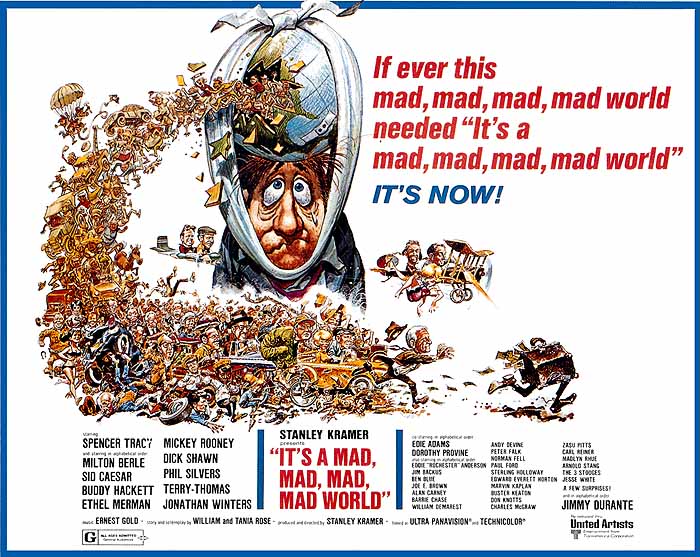
Perfectly capturing the spirit of its madcap caper of a movie, this effort is a classic – and all too rare – cartoon-based film poster. Truth be told, I’ve never been a huge fan of the flick, I’m sure I’ve only seen it in snatches, but I’ve always greatly admired this artwork. Seemingly featuring every one of its cacophany of a cast (check out all those guest stars!) as figures rushing after a suitcase of money – as in the movie – notice that every one of them, including Spencer Tracy at the front there, have cartoonishly slightly over-sized heads. In fact, the whole effect isn’t dissimilar to trying to find film stars in a Where’s Wally? landscape. Clever, indeed.
~~~
Blow Up (1966)/ for Italian market
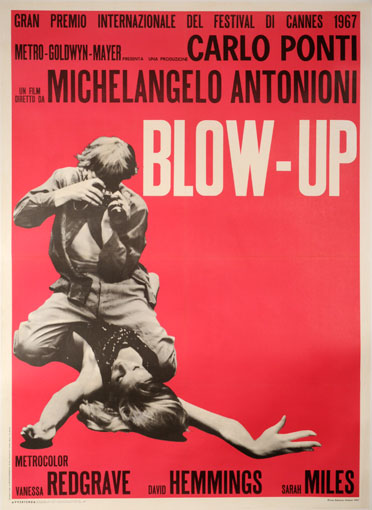
An unforgettable, iconic image on a bold, bright red background. This poster’s simplicity is its genius – and it’s so genius it almost aches. Blow Up, the legendary Antonioni’s only foray into UK filmmaking, is an undeservedly still under-seen classic capsule of the Swinging Sixties and, most specifically, the London fashion scene of that era. And this poster perfectly encapsulates – and therefore sells – all that the film is. The design also came out on a yellow and green background, but the red is, probably for obvious reasons, the best.
Further reading:
http://doubleonothing.wordpress.com/2010/05/09/blowup-antonionis-seminal-60s-film-is-no-let-down/
~~~
Fantastic Voyage (1966)/ for USA market
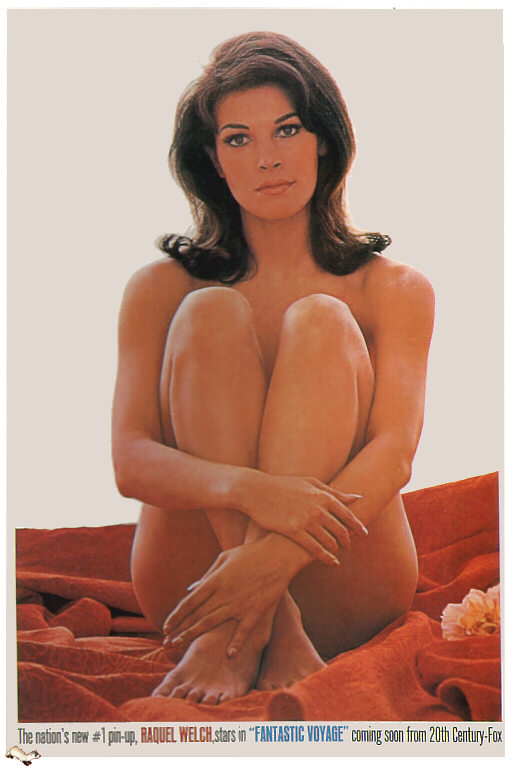
And here we have what may be, to my mind, the greatest ever ‘teaser’ poster. Fantastic Voyage is a rather stodgy sci-fi flick featuring a Jules Verne-like voyage inside the human body (the ’80s adventure Innerspace was its remake). And, in their infinite wisdom, how did 20th Century Fox announce to – let’s be honest – male moviegoers that this film was ‘coming soon’? That’s right, they slapped up a picture of an ‘implied’ nude Raquel Welch (one of the film’s stars, at least) and called it a film poster. A pin-up teasing on a teaser poster? Genius. If that wouldn’t get the punters in, surely nothing would. One interesting sidenote, though, is that that this poster clearly displays how the social mores of the States – and, indeed, elsewhere – were definitely relaxing by the mid-’60s. And then some…
~~~
Un Homme Et Une Femme (A Man And A Woman) (1966)/ for French market
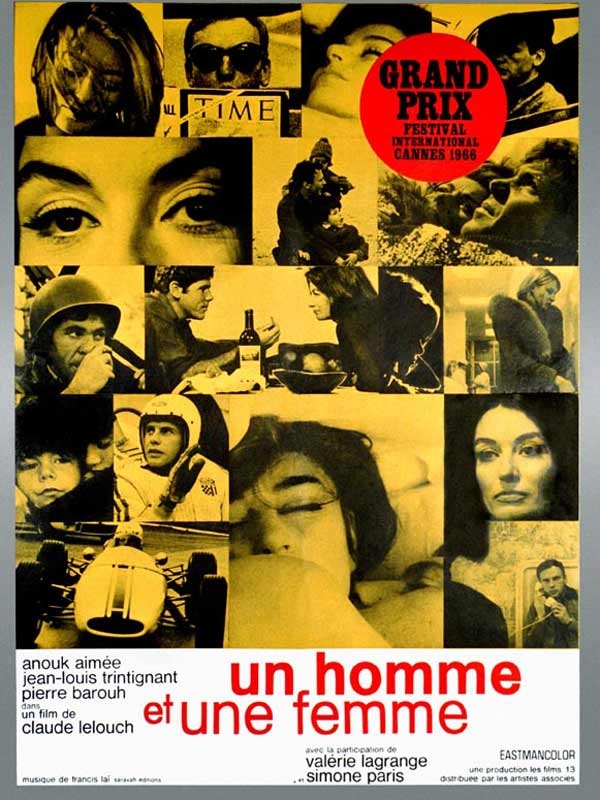
A lesson in ’60s European cool here. This features the exact same idea of filling a canvas with on-set stills of different sizes and shapes that was used for a major poster of the great, similarly French/ New Wave-made À Bout de Souffle (Breathless), released six years earlier. However, despite the same design and the latter flick’s status as an unadulterated classic, I must admit I prefer this poster. There’s something so unquestionably cool about it. Two trendy film stars cast as beautiful lovers – one of whom’s a racing driver – caught in sepia moments in time. It’s very French, it’s very nouvelle vague, and it’s very cool.
~~~
Camelot (1967)/ for USA market
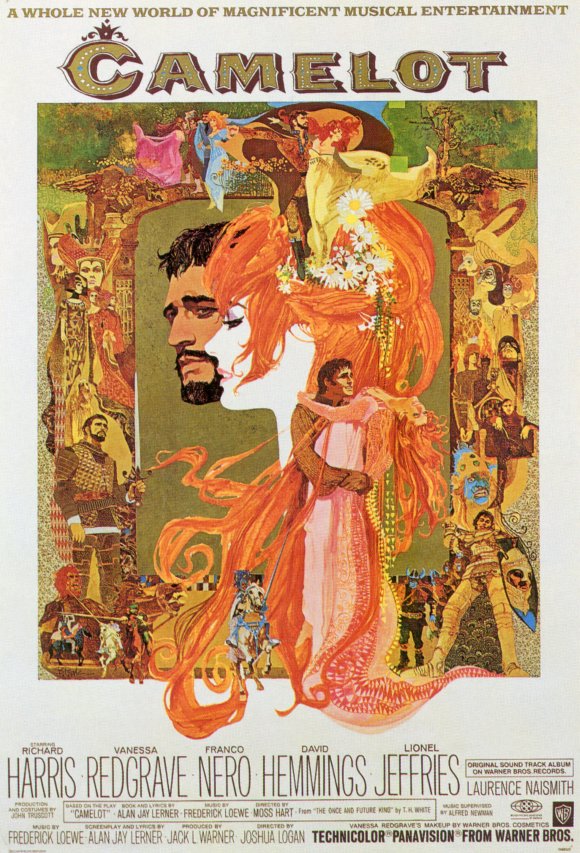
For me, Warners’ cinematic adaptation of Camelot is a highly underrated movie musical – it’s right up there with the likes of Oliver! and Mary Poppins – but many seem to disagree with me. What surely isn’t up for question, though, is that its poster is a stonker. Released, as it was, right slap-bang in the middle of the ‘free love’ age, the film’s stylings, tones and costumes take influence from the times, and, reflecting this, the poster does too. In fact, you could say it goes further. It’s not quite psychedelic, but its a whirlygig of colour and movement and, at its focal point, Vanessa Redgrave’s Guinevere is represented as a hippie angel with free-flowing, wild red hair – both in the main image and the smaller one in the foreground. Indeed, if a ’60s makeover of King Arthur’s court – featuring David Hemmings as a suitably impish but cool Mordred – appeals to you, then I heartily recommend this flick.
~~~
Cool Hand Luke (1967)/ for USA market

By way of contrast with Camelot‘s poster, this one’s artwork is positively gaudy – indeed, there’s something almost ’70s about the repeated cut-out silhouette shape in red and cream it deploys. More funky than hippie, certainly. But it’s confident, assertive, brassy and cool as hell, very much in keeping with Paul Newman’s Luke himself, a one-man machine of defiance on a chain-gang in America’s Deep South. As the tag-line reads, it simply screams exhilarating non-conformity.
~~~
The Fox (1967)/ for USA market
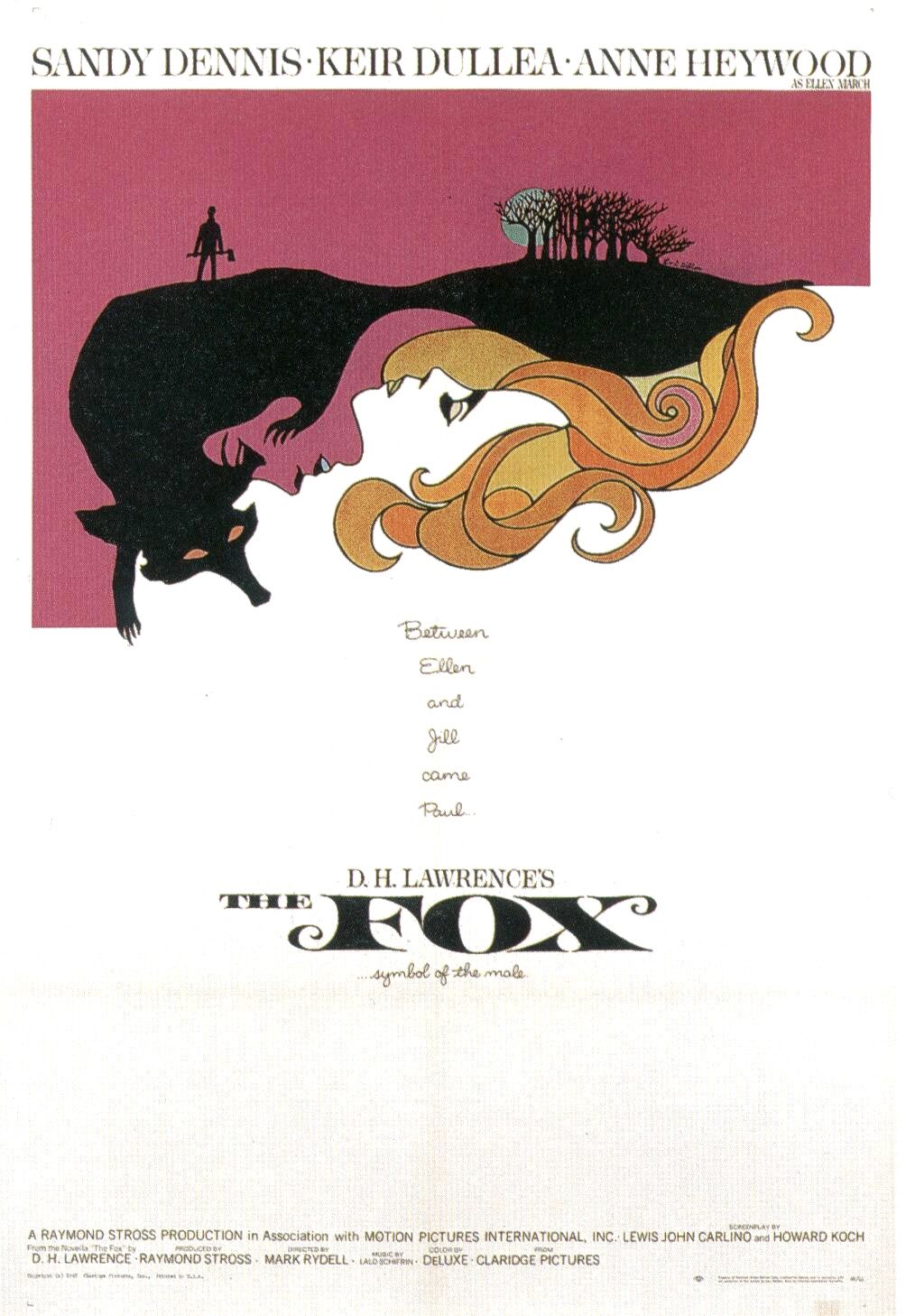
A curate’s egg, this one. The film is a generally forgotten adaptation of a D H Lawrence novella written in 1923, but you’ll surely remember the poster from the second you clap eyes on it. Such a simple idea too – reflect the movie’s plot with its sapphic overtones by interlocking two women’s heads, and suggest the man involved with them both – and the dangerous ménage à trois that creates – by the axe he holds. Produced as this poster was in 1967, note the hint of psychedelic design in the right-hand head’s flowing locks.
~~~
If…. (1968)/ for UK market
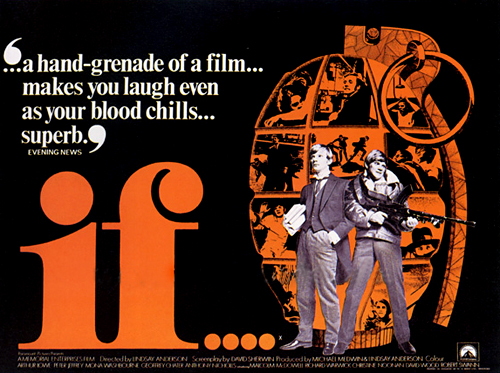
A terrific example of an image and tag-line working in perfect harmony on a poster, this one is an all-time classic of UK cinema – and the film certainly ain’t no slouch either. Also, a closer look at the grenade will reveal its individual sections are cleverly made up stills from the film (a la Un Homme Et Une Femme above), while the classy, yet big, bold two-worded title is a terrific use of typeface. This poster is deliberately but subtly disturbing – rebellion was in the air in the late ’60s and that’s exactly what the intelligent If…. was all about.
~~~
The Thomas Crown Affair (1968)/ for USA market

Surely you’d have to be rather an ignorant retro enthusiast not to be aware of the original Thomas Crown Affair? Steve McQueen; Faye Dunaway’s super-long eyelashes; The Windmills Of My Mind etc. But have you seen this poster of said flick before? Perhaps you have, but perhaps you haven’t. By perfectly mirroring what it’s supposed to promote, it too is a visual tour de force. Effortlessly cool and hugely sexy (look at how Dunaway is almost biting McQueen’s lip there), it terrifically reflects the film’s memorable split-screen technique and, in doing so, like the film again, in each smaller box it makes use of close-ups of the main image and focuses almost indiscriminately but appealingly on anatomical details. It even coolly rocks that shocking pink.
~~~
Where Eagles Dare (1968)/ for USA market

So what’s so great about this poster then, I hear you all cry? Well, because just like the flick from which it comes, its greatness lies in its utter ridiculousness. The design of the image is very Bond film poster- like, and not a million miles away from the style adopted for posters for the likes of The Guns Of Navarone (1960), but none of those such posters would claim that two men and one woman were capable of ‘winning World War II’, especially because they’d just decided to! It’s silly, grandiose and a load of nonsense, but it’s nicely designed, very engaging and a whole lot of fun.
~~~
Downhill Racer (1969)/ for USA market

An example, if ever there were one, of a poster that’s better than the movie (trust me, Robert Redford looks neither cool or sexy in skiing garb), this effort’s also a great example of how cutting edge, manipulated images to be found in magazine ads in the ’60s, by the end of the decade, began to be employed by Hollywood for their big flicks. There’s little pretence here about trying to fool the viewer into thinking this is a ‘natural’ image crafted by its designer; anyone who takes a glance at it ‘can see the joins’, as it were, where the scissors have been got out and individual images moved around and put in place. Yet the effect is damn cool – even if , when you break it down, it’s all a bit hokey (the tagline reads: ‘How fast must a man go to get from where he’s at?’), and yet that hokeyness just adds to its charm for me. Think the movie bombed, mind.
~~~
Hello, Dolly! (1969)/ for USA market
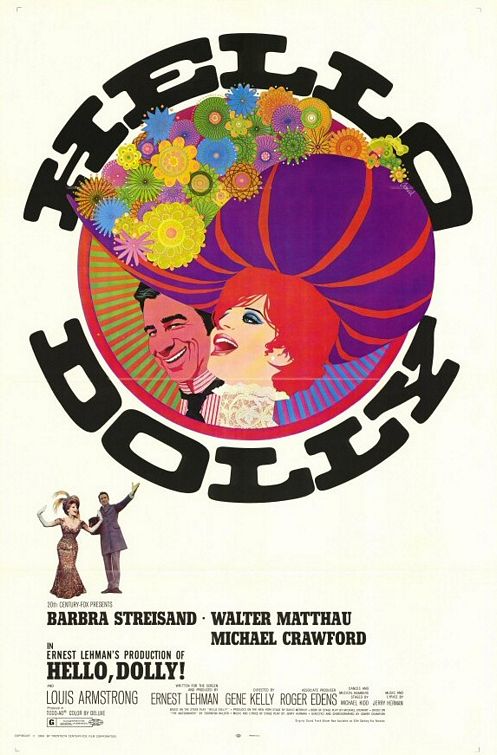
As the poster reveals, Michael Crawford of Some Mothers Do ‘Ave ‘Em fame was in Hello, Dolly!, but there’s nothing Frank Spencer-esque about its poster. While I’m unlikely to send flowers anymore – or, to be precise, ever – to Ms Streisand for her musicals, this one’s artwork is indeed top stuff. Again, there’s more than a hint of psychedelia – in fact, the copious foliage of Barb’s bonnet is blooming with it – and the bright colours are immediately appealing. But it’s greatness surely lies in the fact the oval-shaped centre, containing all the colour and surrounded by the lively title in bold typeface, is set on a completely white background. There’s something very modernist to it all, seems to me, and something very effective too.
~~~
The Italian Job (1969)/ for USA market
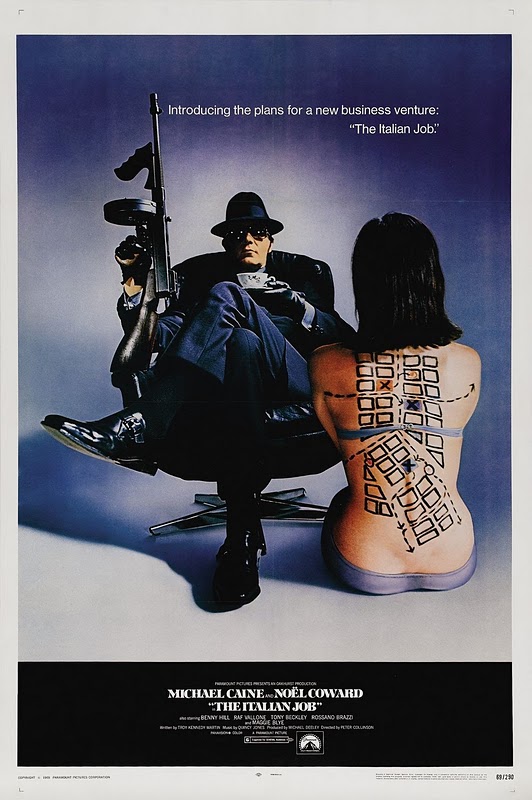
In all fairness, if a film poster is supposed to sell its product by smartly and – ideally – subconsciously sowing the seeds in someone’s mind of what it’ll be like, then this poster pretty much fails. Instead of suggesting to US moviegoers that The Italian Job was a hip, sunny, very British crime caper, it surely put in their minds a stylish, heavy mafia-related heist thriller. All right, the movie’s a bit like that latter description, but that’s not how anyone would choose to describe it, is it? So the big question is why have I included this poster in this list then? Because it’s cool as hell, that’s why. It’s one of those products that makes you wonder whether any decade managed to produce anything remotely as cool as anything that came out of the ’60s. Sharp, sleek, witty and stylish, it really shouldn’t be a film poster – hell, it should be a ’60s Pan paperback cover. It’s art and that’s that.
~~~
Carry On Henry (1971)/ for UK market
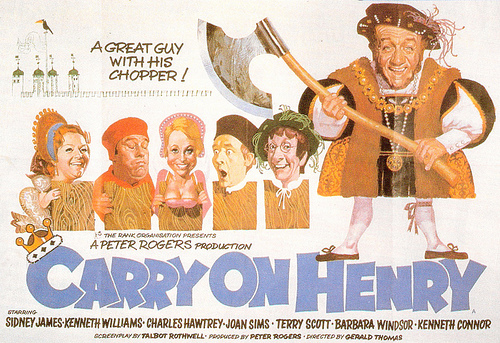
All right, yes, while this one doesn’t exactly deserve to be in this company for its artistic merit, it surely makes up for it with its fun and ebullience. And for that outstanding tag-line. Plus, there’s something appealing – and fittingly childishly comic – about the characters with their over-sized heads again (a staple with Carry On posters, in fact). If anything, they’re reminiscent of toby jugs – like the Carry On films themselves, another great British institution.
~~~
The Candidate (1972)/ for USA market
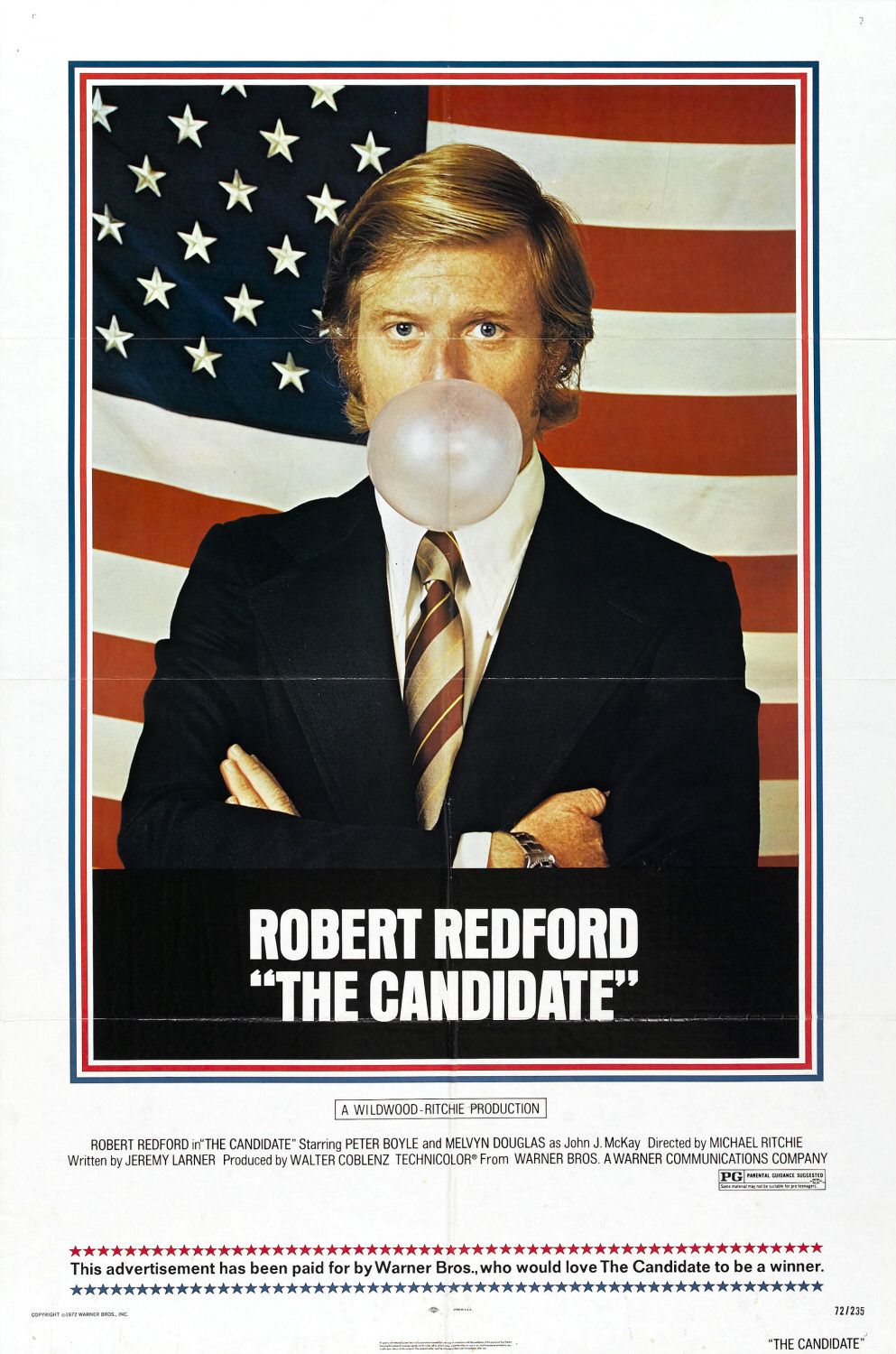
The product of an era of intense politicial cynicism, nay disillusionment (what with McGovern’s flattening by Nixon and the subsequent Watergate scandal), The Candidate featured Robert Redford (again) as a no-hoper running for office merely to espouse on a platform, but becoming corrupted once he had a shot at winning. It’s a flick lighter than, say, All The President’s Men, but has bite nonetheless. But what about the poster? Well, all this is wonderfully suggested by Redford blowing a bubble in front of the Stars and Stripes – creating both a devil-may-care attitude and a tone totally at odds with the earnestness and augustness with which politics is supposed to be infused. A very ’70s film poster and an unforgettable image. The line at the bottom tops it off nicely, indeed.
~~~
Saturday Night Fever (1977)/ for USA market

While hinting at none of the grit, edge and darkness that makes The ‘Fever the decent film it is under all the disco, this is nonetheless, to my mind, a poster that’s an absolutely doozie. Why? Because with the iconic shining, metallic title typeface, the sharp as hell tagline and the mirror-like half-repeat of the unforgettable main image, it sizzles with energy and electricity. In short, back in ’77 it would have jumped out at you and grabbed you by the balls. Nowadays, yes, it may well seemd damned tasteless, but surely its effectiveness as simply a poster advertising a film is unquestionable.
~~~
The Empire Strikes Back (1980)/ for USA market

There are, of course, many, many great posters produced for the original Star Wars trilogy, but staying true to the ethos of this list, I’ve picked here a lesser known – perhaps the least known – one. What I love about it is it’s simplicity. For me, it’s a perfect teaser poster. Even three years on from the original Star Wars, you’d surely be forgiven for wondering how they’d be able to equal – let alone top – that, but of course they did with Empire – and this poster may just have given you an inkling they were going to. The message is plain, the Rebels’ cause is not over; the Empire is striking back. Not only are we told that, but we’re presented with the forbidding helmet of Darth Vader set against a pitch black background of space (albeit with some stars). The stark message hits you like a sledgehammer – just as well then that loveable, brilliant old Yoda the Muppet popped up in the flick to soothe adults’ fears and delight the kiddies.
~~~
Excalibur (1981)/ for USA market

Make no mistake, Excalibur is an ambitious film, and its poster ably hints at that. Suggested in this beautiful artwork , with its light beams created by swords and glittering armour, dramatic poses and expressions and magical-looking creatures is all the luxurious, melodramatic and shimmering beauty on show in the movie itself. Moreover, the glossy texture of the image even seems to reference the enigmatic nature of the film’s tone – never quite attainable, much like myths (and especially those of King Arthur and Camelot) themselves.
~~~
The Goonies (1985)/ for USA market

A light, fun poster to finish on then – and one that could only have come out of the ’80s. Unashamedly inspired by the fantasy heroism-themed artwork of the Indiana Jones posters (and indeed created by the artist behind many of those classics, Drew Struzan), this effort for The Goonies struck a big chord with me back in the day and I’m surprised you don’t see it more – I would have though the fun, campy image would have proved endurably memorable (after all, everyone remembers the Crocodile Dundee poster in which Paul Hogan bends back the skyscrapers of New York – and that’s a very similar ‘visual gag’ in tone and style to this one’s). Anyway, this poster for me is tops, referring perfectly as it does to the adventure, action, fantasy and mild peril throughout a flick that’s proved inescapable entertainment for kids of the ’80s – at all ages.
So, folks, thanks for looking – and reading my reporting on posters of years past for posterity. 
Manhattan transfer: Mad Men’s UK return (September 8)

Big fish in the Big Apple: Don Draper and the rest of the new Sterling Cooper Draper Pryce team reveal how – and how not – to get ahead in advertising in the fourth season of Mad Men
You know, in recent years, if I’m being honest, there’s been few dramas out there in Tellyland that have been up my street from the start and kept me loyally watching to the finish. Studio 60 On The Sunset Strip for sure (based on the strength of The West Wing – the same guy created both). Ashes To Ashes definitely (conceived by the same peeps behind Life On Mars). And that’s about it. Oh… but of course, how could I forget? Then there’s Mad Men.
Created by Matt Weiner, one of the chaps behind the hugely successful The Sopranos, US cable channel AMC’s Mad Men – for the uninitiated – is focused around the work and people of the fictitious Madison Avenue ad agency Sterling Cooper. Set in early to mid-’60s, it’s shamelessly stylish, refreshingly intelligent and unfalteringly captivating. It’s also unrepentantly un-PC – or, at least, the world it presents us is – what with characters smoking like chimneys and drinking like fish, executives slapping secretaries’ backsides, husbands cheating on wives without a thought of remorse and a homosexual character compromised because he’s gay. It shows the era in which it’s set fairly honestly then.
But, for me, best of all, it’s genuinely grown-up drama. The writing, acting and directing is consistently excellent, offering up three-dimensional characters, crisp, acerbic dialogue and constant food for thought – while passing through the 1960 Presidential election, the Cuban Missile Crisis and Kennedy’s assassination, it examines the beatnik ethos versus corporate capitalism, the hobo versus the ‘American Dream’-style family man laying down his roots, and a chauvinistic society discovering early feminism. Indeed, moments experienced by ad man extraordinaire Don Draper and would-be highflyer account handler Pete Campbell showcase the best existential angst you’ll see this side of a Stephen Poliakoff drama.

Meeting the Beats: Ad man Don mingles with beatniks Midge and Roy in the first season
The retro and artistic appeal isn’t just limited to the creators and actors, though. For any lover of mid-century modern design, Mad Men is interior decor and clothing porn. The Madison Avenue office interiors are beautifully and starkly seductive (much like the dark behaviour of the characters), and the suits and dresses on show as sharp and eye-catching as Errol Flynn in a sword fight. Moreover, the opening credits clearly nod to the credits and poster design created by the legendary Saul Bass for Hitchcock’s North By Northwest (1959) and Vertigo (1958), respectively.
And, if a would-be viewer required any further reason to give this series’ fourth season a whirl, then be assured it’s never been in a more promising and exciting position. In the real world, just last week it won the Best TV Drama Golden Globe award for its third season, its third in a row – it’s also won the corresponding Emmy award three times. And, in its own world, at the end of the third season (warning: here be spoilers) its eponymous ad agency had folded, a new one created from its ashes and the main character started life as a single man. Make no mistake, the fourth season is awaited with greatly baited breath by fans.
Plus, if you’re still not convinced, consider the fact Mad Men features two of America’s latest sex symbols, James Bond lookalike Jon Hamm (ladies’ man-and-a-half Don Draper) and the irresistibly lovely Christina Hendricks (voluptuous office vixen Joan Holloway). If that advert won’t draw you to the Sterling Cooper Draper Pryce agency, then you’re a bull-headed, stuck-in-the-mud client indeed.
The fourth season of Mad Men begins in the UK tonight on BBC4 at 10pm.
~~~
Further reading:
http://www.amctv.com/originals/madmen
http://doubleonothing.wordpress.com/2010/09/08/mad-world-the-production-design-of-mad-men
~~~











 George's Journal