~~~~~~~~
.
Author: Andrew Marr
Year: 2007
Publisher: Macmillan
ISBN: 978-1405005388
.
Make no mistake, Andrew Marr’s A History Of Modern Britain is a doorstep of a book. Boasting more than 600 pages, it’s an uncompromisingly ambitious, densely fact-filled and very long telling of the UK’s postwar story. But what a story – all the way from the welfare state-establishing Labour government of the ’40s to the Iraq War-mongering New Labour government of the ’90s and ’00s. And what a way to tell to it too.
For Marr kicks off his tome as he means to go on – highlighting the unexpected truth at the heart of the decision made in May 1940 (just after Winston Churchill had succeeded the failed Neville Chamberlain as Britain’s PM) over whether an arguably half-crippled Blighty should fight on against the German war machine or surrender to Hitler and seek clemency. The reality – a very little known one – is that of the five men of the war cabinet that had to make that decision that day, it wasn’t the usually ‘war friendy’ right-wingers who had traditionally ruled Britain (the Tories Chamberlain and the Foreign Secretary Lord Halifax) who voted to carry on, but the left-wingers (Labour’s Clement Attlee and Arthur Greenwood) who, with Churchill’s decisive vote, did so. The two Tories voted to cut a deal; had they had their way, they would have seen the Nazis march into the country and probably finish off Britain, ensuring no modern story could even take place.
It’s exactly this unearthing of the unusual, surprising, delightful and even ironic throughout its tale of Britain’s last 50-plus years that is behind this book’s success. Attlee’s 1945 Labour government (despite its socialist agenda) can be thanked/ praised for turning Britain into a nuclear power; the ’60s’ telling legacy isn’t the peace movement or free love, but actually the triumph of modern consumerism; Thatcher at first wasn’t really that crazy about privatisation – they’re all here; this book’s full of ’em.
Indeed, anyone who watched BBC News about ten years ago will know that Marr (originally a Fleet Street hack with the likes of The Daily Express and The Observer) is a showman. His delivery of each night’s Westminster round-up as the Beeb’s political editor was full of theatrical flourishes; all lyrical turns of phrase and animated similes. He was a very populist sort of television newscaster and, rightly, became very popular because of it. And that impressively accessible style is to be found right here in this book. Brilliantly researched, unerringly focused, but an easy read – it’s both smart and light. Like many books of this sort, it’s best read by dipping in and out – and whenever you do so, it leaves you feeling more knowledgeable and more curious and often with a wry smile on your face.
Admittedly, you may not agree with all the conclusions Marr draws (the suggestion that ’60s/ ’70s troublemaker Enoch Powell was a more impacting politician than that era’s PMs – Labour’s Harold Wilson and the Tory Ted Heath – doesn’t really convince) and when he tries to summarise the complex, ever changing, youth-oriented culture of the ’60s in just six pages, he perhaps overreaches himself – more successfully he tries the same for merely the punk movement of the ’70s and doesn’t try at all for the popular cultures of the ’80s and ’90s. Yet one can allow him such oversights.
For, given the audacious aim of his book, he unquestionably brings to life the major events, ideologies, machinations and – most impressive and probably most important of all – the players behind Britain’s modern story. Yes, he manages to make many politicians appear interesting, intelligent, principled and full of personality. We have a dim, very cynical view of politicos right now (for good reason), so this genuinely is refreshing. For instance, his colouring of Harold Wilson as a sometimes paranoid, but often very clever ‘little spherical thing’ of kind of working class roots who presided over his cabinets by playing entrenched opponents off each other is one that will live with me forever.
If you’re at all interested in what this book’s all about, the political, economic, social and cultural history of postwar Britain, then you’ll no doubt have watched Marr’s BBC TV series that shared its name with this book. Fair dues, this very long read covers exactly the same territory as that terrific programme – and will probably take longer to read than that did to watch. But, in actual fact, this book was not the commercial companion to that series; in reality, Marr wrote the book first and, thus, wrote the series from the book.
Therefore, if you want the whole story, the real treatment not just the telly-friendly abridged version, then you have to give this book a read. If you thought the show was TV gold, then there’s many more nuggets mined here, just ready and waiting to be discovered and enjoyed by eager readers. 
.
A History Of Modern Britain is available to buy here.
.
Playlist: Listen, my friends! ~ July 2011



In the words of Moby Grape… listen, my friends! Yes, it’s the (hopefully) monthly playlist presented by George’s Journal just for you good people.
There may be one or two classics to be found here dotted in among different tunes you’re unfamiliar with or never heard before – or, of course, you may’ve heard them all before. All the same, why not sit back, listen away and enjoy…
CLICK on the song titles to hear them
.
Peter, Paul And Mary ~ Puff The Magic Dragon
Les Atomes ~ Michelle
Lindisfarne ~ Lady Eleanor
Frank and Nancy Sinatra ~ Life’s A Trippy Thing
Badfinger ~ No Matter What
Hawkwind ~ Master Of The Universe
The Raspberries ~ Go All The Way
Yvonne Elliman ~ Everything’s Alright
ABBA ~ Intermezzo No.1 (Instrumental)
Mike Post ~ Theme from Magnum P.I.
Mandy Patinkin ~ Younger Than Springtime
Jane Wiedlin ~ Rush Hour
Madonna ~ More


Some time in New York City: John and Yoko salute the Statue of Liberty in a moment from the video to the 1971 single Power To The People, filmed shortly after the couple’s arrival in NYC
About a year ago, the BBC screened – and I viewed and reviewed – Lennon Naked, a Christopher Eccleston-starring biopic of John Lennon’s life in London at the end of the ’60s, as he became reacquainted with his estranged father, endured heroin addiction and The Beatles broke up. And just last week, the BBC also screened and I also viewed what one may describe as, if you’ll so indulge me, something of a sequel to that made-for-TV-movie in the shape of the documentary Lennon: The New York Years, shown as part of Alan Yentob‘s Imagine art show strand. And, yes, peeps, I’ve also reviewed it – right here.
Lennon Naked concluded with John and his relatively new wife Yoko Ono leaving behind Britain and, with it, controversy, vilification and trauma, as they boarded a plane bound for a new life in the Big Apple, all blue skies and marshmallow-like happy clouds around them. However, as is made clear in this affectionate but fairly warts-and-all two-hour docu from filmmaker Michael Epstein (presumably no relation to the late Beatles’ manager Brian), that’s rather a rose-tinted view of the Lennons’ lives-to-come.
The decade that followed, in which they made New York almost exclusively their home, was far more troubled, tortured and turbulent than many may have assumed. In fact, it was a period that saw the couple fight against America’s establishment as they continued the youthful idealists’ call for universal peace, fought with its authorities in order simply to stay in the country and at times even fought each other.
The trouble started almost immediately. As the couple moved into the wilfully arty and unconventional Greenwich Village, welcomed by its musical crowd with whom they began collaborating in the studio and playing at militant and anti-war concerts, the Richard Nixon-led Republican government got decidedly twitchy – or, to be exact, paranoid. Hopelessly embroiled in the Vietnam War and no doubt worried about youth discontent – vocal like never before – what with re-election looming in late ’72, Nixon’s administration employed the FBI to monitor Lennon. This, to many who have even a passing interest in the former Beatle, is not particularly news. What may be, though, is that in an era when the political establishment was disconnected from the politicised – and mainly left-wing – young like never before and thus became overly anxious, is that it’s actually sort of understandable why the US establishment took such steps against Lennon.

Gimme Some Peace: Yoko and John emerge from an immigration hearing in New York City on April 18 1972 – John’s fight to stay in the United States would continue for the next three years
For, as this documentary makes clear, the anti-war leaders in America at that time explicitly engaged Lennon to become a mouth-piece for their movement through concerts and appearances in the wider media with the long-term aim of toppling Nixon at the next election and getting the troops out of Vietnam. And, given the success of the Lennons-led John Sinclair Freedom Rally at Ann Arbor in December 1971 (which led to the release of the counter-culture poet just three days later; Sinclair had been imprisoned for a total of 10 years simply for possession of marijuana), early on it may have looked like the Lennon factor could have some genuine impact.
As we now know, however, it was Nixon’s anxiety that the Democrats themselves would beat him at the polls and the attempts to undermine them, leading to the break-in at Washington’s Watergate hotel, that did him in. In fact, as the decade progressed, John had less and less to do with the anti-war movement, mostly because it lost traction itself, no doubt. Perhaps the pivotal moment here was Nixon’s re-election in November ’72, which was indirectly responsible for a pivotal moment in the Lennon story of the ’70s. So devastated by the election result (an extraordinary landslide for Nixon) was Lennon that he turned to drink. Indeed, disconsolate and drunk as a skunk when he arrived from the recording studio at a post-election party, he apparently picked up the nearest girl and noisily got down to it with her – in the full knowledge that Yoko and all his New York friends were in the next room, very much within earshot. Apparently, for Yoko’s benefit somebody had put on a Dylan record to muffle the noise, but to little avail.
By all accounts, John was literally prostrate with apology the next day (as is revealed in the film in a location photo taken that day for publicity of his new album Mind Games, in which he playfully and semi-seriously begs at Yoko’s feet). But real damage was done. In his words, his wife ‘threw him out’ – in reality, it appeared they agreed to spend some time apart; they’d spent the last two or three years around each other 24 hours a day, after all. So, John now jetted from one of America’s most iconic cities to another – Los Angeles.
In his first few days there, he seemed to relish both his newly discovered freedom and his new surroundings (sun, sea and the coital company of assistant May Pang – whose accompaniment had actually, rather bizarrely, been engineered by Yoko – agreed with him). He met up with former Beatles and – despite whatever anyone says – forever friends Paul McCartney and Ringo Starr, as well as with Fabs favourite Harry Nilsson (singer of both Everybody’s Talkin’ and Without You) and enjoyed many a drunken evening.
Yet, after so many years of marriage – with both his first and second wives – it soon became clear that the bachelor life didn’t suit Lennon; in fact, it suited him as well as alcoholic stupors. And it was exactly one of the latter, one that lasted throughout the ill-begotten recording of his misguided rock ‘n’ roll covers album, er, Rock ‘n’ Roll (which took place at Hollywood’s A&M Studios in autumn ’73) that things came to a head. As recording footage included in the documentary makes clear, Lennon was drunk out of his skull during these sessions; surrounded by masses of musicians and verbally abusing legendary producer Phil Spector on the other side of the glass. The chaos and carnage (aided and abetted by the free-wheeling Nilsson) had to come to an end. Quite simply, Lennon had to return to New York.
This he did then, at the end of the year, and seemingly found himself immediately thrown into the recording of yet another album – the self-produced and more-than-decent Walls And Bridges. Actually, as he was still in the mood to make music, he pretty much had to do this, given Spector had oddly disappeared with Rock ‘n’ Roll‘s master tapes. Still, he got on with it, alcohol-free along with the rest of the performers as they recorded the album. A lovely moment in Epstein’s film regarding this period comes in New York-based DJ Dennis Elsas’s recollection of a September 1974 interview with Lennon in promotion of Walls And Bridges. Part of it can be heard here and, from it, one can can only agree with Elsas that the Lennon he met on this occasion was an amusing, laconic, lucid, relaxed and very amiable chap.
Indeed, although he would later recall the ’73-’75 period of his life as his ‘Lost Weekend’ (owing to him being separated from Yoko throughout these years), for much of ’74 it appears he was getting on with getting his music back on top. Proof of this can be seen in his grudging agreement with Elton John that he’d appear at the latter’s 1974 Thanksgiving concert at Madison Square Gardens and perform with him the Walls And Bridges single Whatever Gets You Thru The Night, so long as that single reached #1 in the charts. Of course, it did and, of course, Lennon kept his promise.
As Elton John recollects, a near petrified Lennon, who hadn’t performed on-stage for years, threw up in the toilet before going on, but went down a storm (see video above). Plus, lest we forget, it was at the end of this concert that he met up with and eventually reconciled with Yoko. Does Elton feel responsible for this reconciliation then? A rather humble Elton in the film – despite wearing glasses with ‘EJ’ emblazoned in a corner of one lens – says he certainly doesn’t, but touchingly seems pleased to have (in)directly played a part in it. Bless him.

Silver dream pacer: John and Yoko taking a stroll in Central Park in a publicity shot for the Double Fantasy album, taken on November 26 1980 – less than a fortnight before his death
As Lennon’s ’70s story slides into mid-decade, it becomes less congested. Mostly owing to the birth of his and Yoko’s son, Sean, on October 9 1975. However, that very date proved a momentous one in this story, given that not only was it John’s 35th birthday and the day of his second son’s birth, but also coincided with the dropping of the case to boot him out of the country. Hounded by American immigration ever since he first landed in the USA (owing to Nixon and co.’s original vendetta against him and continued after the latter’s fall due to the authorities’ thoroughness), Lennon had amazingly been living on a visa that only lasted for 60 days at a time. Indeed, on one occasion in the early ’70s he heard he supposedly had to leave the country on the radio while sitting in a taxi cab – allegedly wisecracking to the driver: ‘Take me to the airport, Sam’.
In the end, then, he won his case and, according to his former lawyer, did so partly because the judge dealing with the issue was a fan of his – and believed that the singer’s struggle to stay in the USA was reflective of America’s own founding principle of freedom. Lofty philosophy perhaps, but as the lawyer reflects, rather heart-warming in its way.
Moving towards middle-age and with less hunger to make music and top the charts (he’d been at it for nearly 20 years, after all), Lennon now withdrew from professional and public life and effectively became a house-husband. Of the two parents it was he who spent the majority of the time with his new son rather than his wife, it was he who did the majority of the cooking and it was certainly he during this period who wanted to spend quality time with his second son given he hadn’t with his first. As one may guess – and as the documentary suggests (with help from archival footage of Lennon speaking) – there’s little doubt an older, perhaps wiser Lennon found more balance and happiness in his life during this slowed-down, toned-down period. Actually, check out the wonderful Watching The Wheels from 1980’s Double Fantasy album; it pretty much spells this out.
Sadly, the film naturally has to finish on the sour, moving note of its subject’s death at the end of this self-imposed retirement, just as the artist had returned to making music and was on the verge of releasing it to the public again in the shape of Double Fantasy. Yet, in reality, it feels like more of a bittersweet note, for by this stage in his life, Lennon was surely a man at peace (both with Yoko and without); delighted at merely being able to walk into a shop and buy a nice (er, silver) jacket like a non-celebrity and happy that his music had become ‘MOR’ instead of trend-setting (he was now middle-aged just like his likely audience: ‘how’re you doing? how did your relationships turn out?’ he proffered as a question his new album may pose them).
So, yes, it’s tragic he was taken from the world at a point when he was – perhaps for the very first time – genuinely happy, but at least when he went he was content after all the difficult and dramatic, troubled and trauma-filled years with both the Beatles and those that followed in New York. Just listen to (Just Like) Starting Over (below), go on, and say that ain’t so. 
.
John Lennon: The New York Years isn’t available to watch again on BBC iPlayer, but check the programme’s official page to see if and when it is, as well as when it’s next screened in the UK and Northern Ireland.
Still looking good: another roster of rare movie posters
Not to big up this blog of yours truly too much, but one of its most popular posts has been an effort I put together last September featuring 20 of my favourite rare film posters. Well, in that great (and, admittedly, sometimes not so great) Hollywood tradition of the sequel, I’ve decided with this very post to repeat the trick.
So, here follows, mes amis, a score more of – to my mind – terrific but too little talked about, pored over and purchased movie posters of lore. Unlike last time out, most of the examples of this collection are grouped together by genre, theme or poster artist – not because I’m trying to go too arty on you all, you understand, but merely to try and better highlight why methinks they’re such damn good posters. Anyhoo, enough with the waffle; on with the perusal…
.
CLICK on the images for full size and on the film titles for more information
~~~
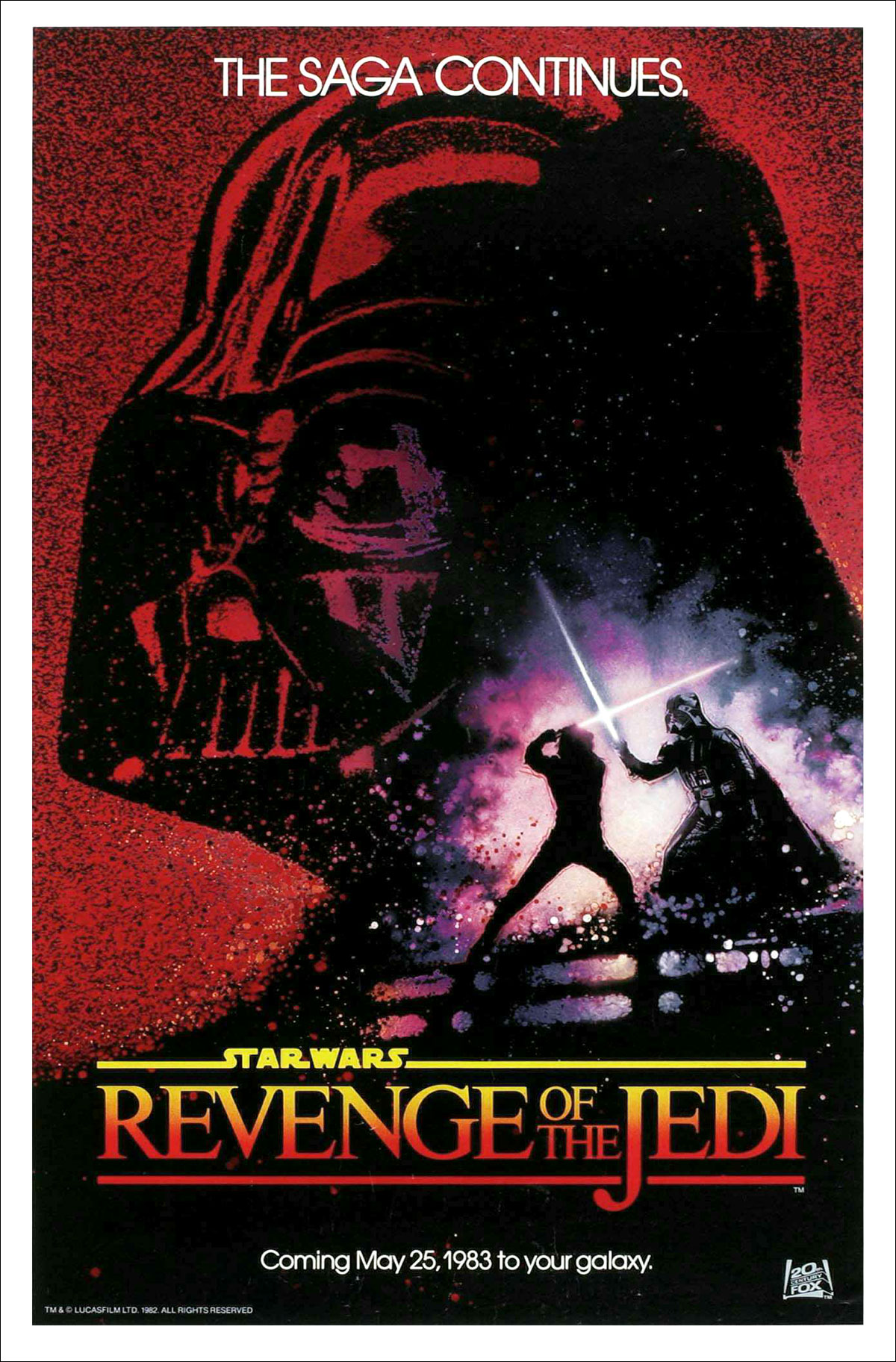
Return Of The Jedi (1983) ~ for USA market (unused artwork)
(Above)
Wait a tick, there wasn’t ever a Star Wars movie called Revenge Of The Jedi, was there? Yes, peeps, our opener this time is a real teaser of a would-be teaser poster. You see, Revenge Of The Jedi was the ‘working title’ for (as the poster suggests, if you look at the line of type at its bottom) 1983’s Return Of The Jedi. Quite the rare piece of film publicity this then – but a real goodie too. This ‘un, methinks, is a great exponent of the use of watercolour on a movie poster (when do you ever see that nowadays?). Only a watercolour could produce that wonderful splash, or even explosion, of light in the bottom right-hand corner – ostensibly created by the duelling lightsabers – suggesting the epic, nay operatic, clash between good and evil (or, to be specific, Luke Skywalker and Darth Vader) that would await us in this final instalment of Star Wars‘ original trilogy. Classic stuff, indeed.
~~~
Judgment At Nuremberg (1961) ~ for USA market/
A Bridge Too Far (1977) ~ for UK market
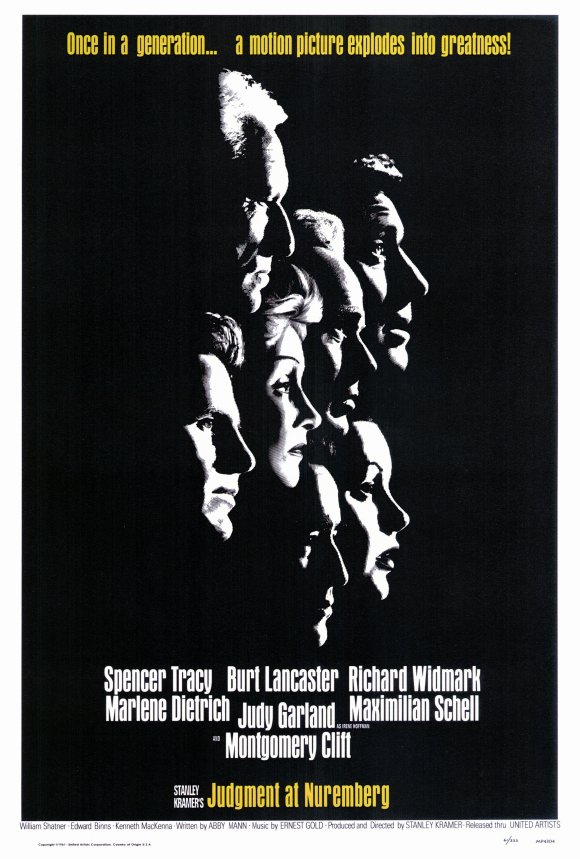

Often there’s no better way to sell a product than by using a famous face – and these two posters do that with bells on. Frankly, given the fact their respective flicks feature casts absolutely bulging with Hollywood heavyweights, why the hell not? The better of the two surely must be Judgment At Nuremberg‘s; the starkly white but very familiar faces in profile on a simple black background not just creating a striking image, but also nicely reflecting the dark sombre subject matter of the movie (the post-WWII Nazi war crime trials). A Bridge Too Far‘s poster then isn’t a classic and is pretty blatant in selling its film on the strength of its stars by featuring mugshots of them in character (indeed, its alternative parachutes-landing-on-a-pink-backgound version is probably more satisfying), but for me there truly is something charming about its shameless selling – I mean, back in ’77, how could you have not wanted to see an epic war film with all the guys this image purports are in it?
~~~
Dr. Who And The Daleks (1966) ~ for UK market/
Thunderbird 6 (1968) ~ for UK market
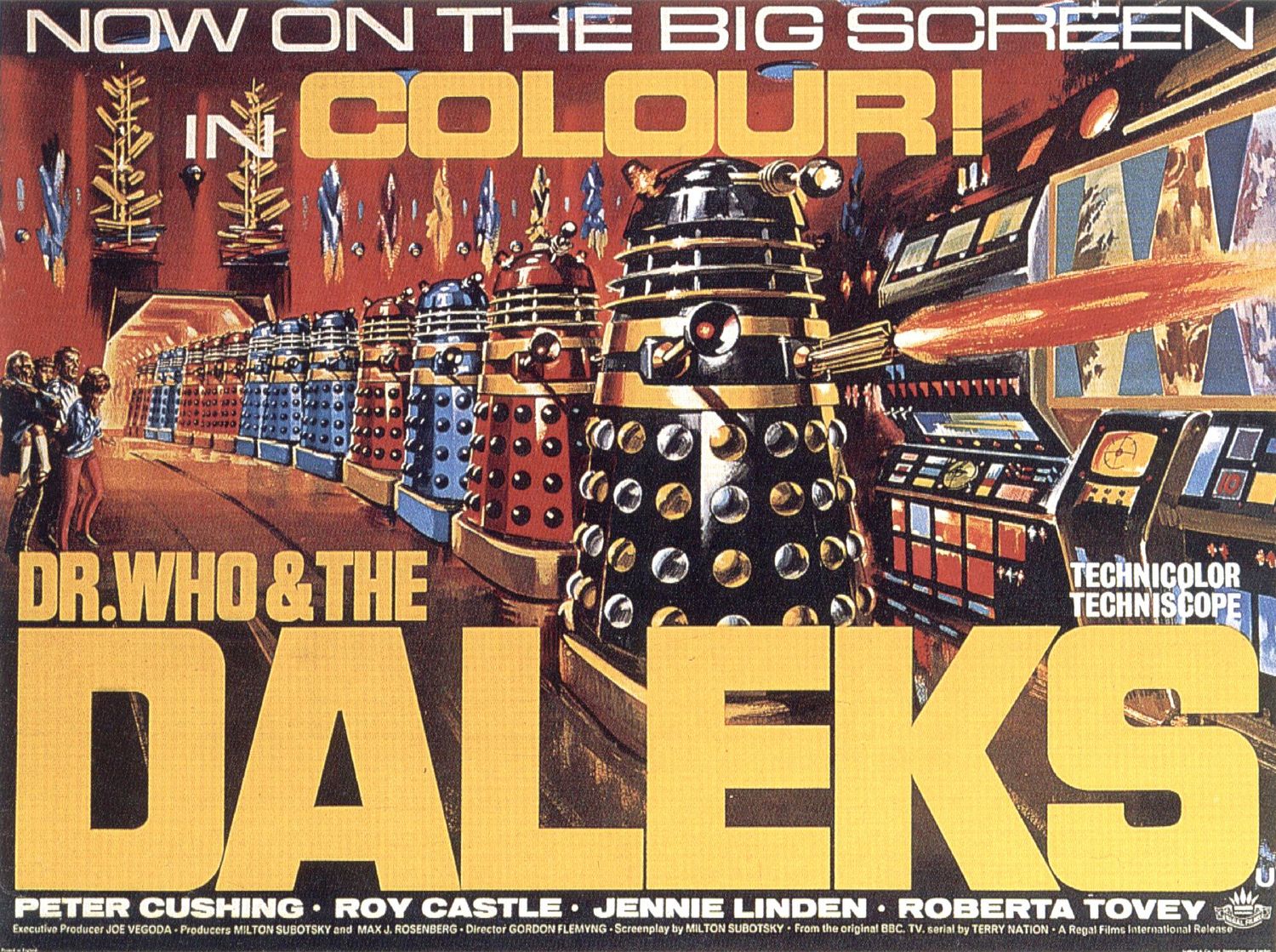
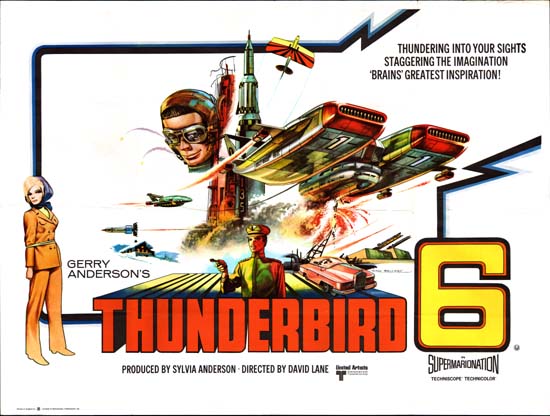
Two hugely popular ’60s British kids’ telly shows transferred to the big screen here and done so with the aid of a pair of stonking posters. The first is simple as you like, but effective as hell. What I love about it is that it leaves you in little doubt as to who the main draw is – and it’s not Who (as he was here, not ‘The Doctor’ as in the Beeb’s classic still-running series); yup, it’s unquestionably those pesky tin-pot scallywags from Skaro, the Daleks. If you were at all unsure from the main image – how could you be, they’re enormous compared to the human characters on the extreme left? – then the size of the font that the word ‘Daleks’ in the title is given absolutely rams home the message. The Thunderbird 6 poster is (perhaps sad to report) air-miles and air-miles better than the actual film it promotes. Honestly, the flick itself possesses none of the style, dynamism and downright cool of this image. Mind you, like its poster, it does have both Lady Penelope and Parker in it, which is something at least, I guess.
~~~
Thunderball (1965) ~ unused artwork/
The Great Escape (1963) ~ detail from artwork/
Danger Diabolik (1968) ~ detail from artwork
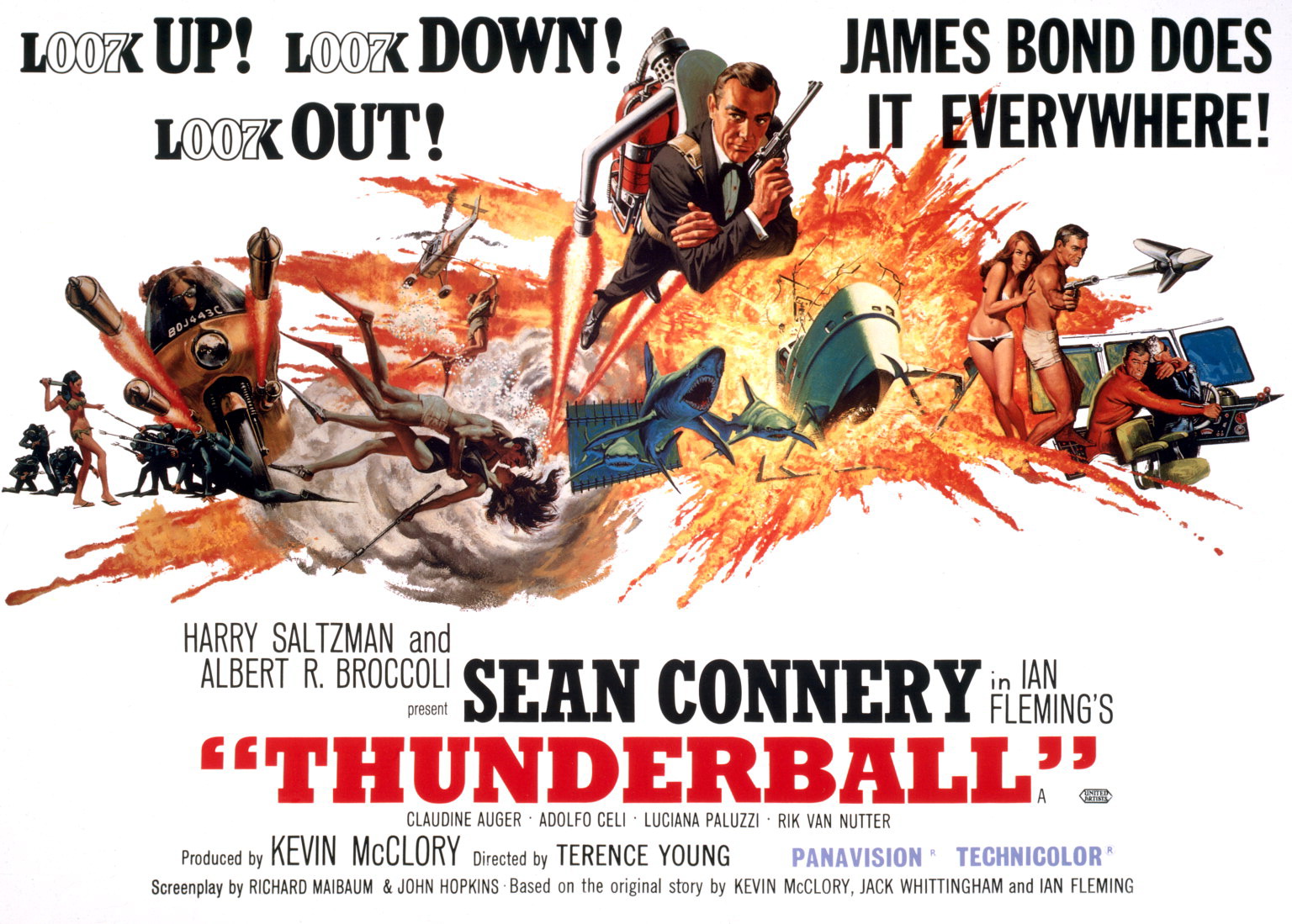
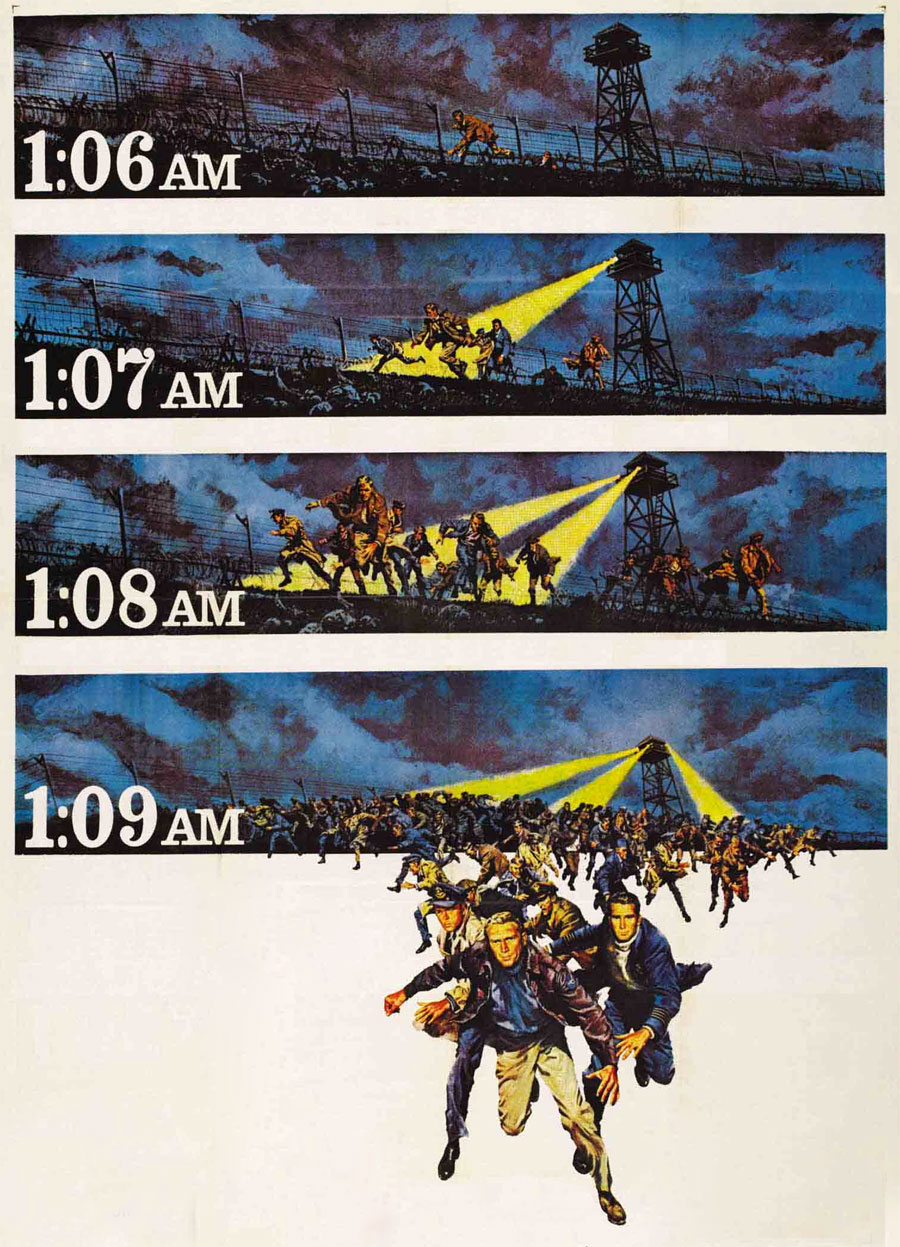
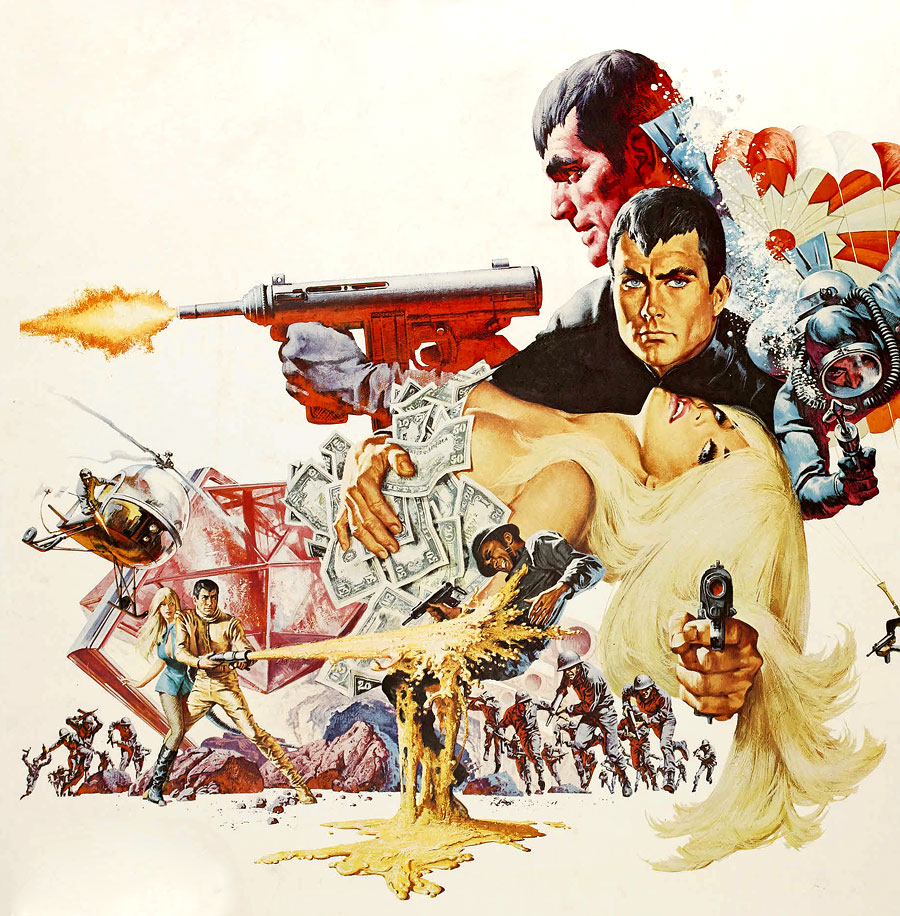
Three posters here (I spoil you, I know, I really do) and all by the same artist, Frank McCarthy. In addition to being a producer of fantastic film posters, the late, great McCarthy also expertly doodled paperback covers, advertisements and magazine artwork, until in 1968 he gave up all that commercial stuff to focus on what he’d always held most dear, paintings of the American West. His cinema work, though, included posters for The Ten Commandments (1956), The Dirty Dozen (1967) and Once Upon A Time In The West (1968), but here are – to my mind, at least – perhaps his three best efforts in the name of film advertising. Macho, exciting and naturalistic but with a flair for the fantastic (like much of his poster art), all three display McCarthy at the peak of his movie publicity powers. The first is an unused artwork for the Bond film that came at the height of ’60s ‘Bondmania’ Thunderball, which for me is better than the actual posters used for the film – McCarthy created it in conjunction with felllow artist Robert McGinnis, with whom he also produced posters for the 007 epics You Only Live Twice (1967) and On Her Majesty’s Secret Service (1969). The second effort is for The Great Escape and is a genius example of using time-lapse to build anticipation from the top to the bottom of the artwork (why the technique wasn’t used in the movie’s main poster, I’ll never know). The final effort comes from the little-seen spy hokum Danger Diabolik and simply demonstrates an awesome composition – no doubt far better than that of the flick itself.
~~~
Modesty Blaise (1966) ~ for USA market/
Billion Dollar Brain (1967) ~ for USA market
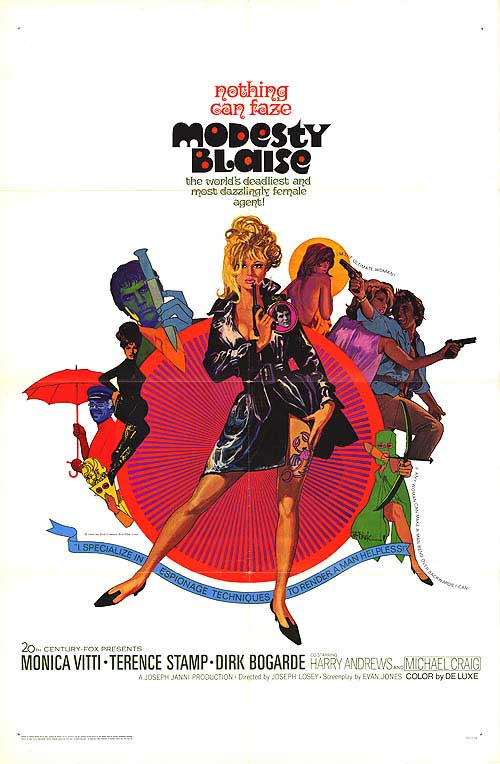
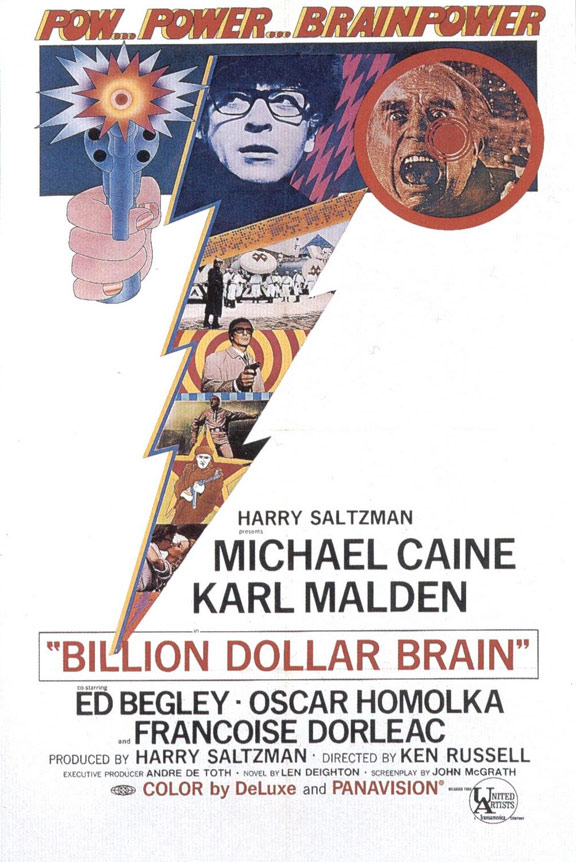
Continuing the theme of ’60s spy cinema started with the immediately preceding images, here’s artwork for two unquestionably cult espionage flicks from the decade of ‘spy mania’. Modesty Blaise is an adaptation of the classic Peter O’Donnell comic strip featuring his sexy, feline anti-hero and, tipping its hat to – by that time – ’60s design’s growing predilection for psychedelia, its poster is a florid combination of McCarthy-like action-oriented characters and bright and bold colour (all pinks, reds, yellows and greens) smoothly circling about a becoming Monica Vitti blowing on the end of her phallic pistol. Nice. By contrast, the poster for Billion Dollar Brain (the second sequel to 1965’s utterly iconic The Ipcress File) is a lightning bolt of psychedelia – quite literally. Along the top it boasts Michael Caine in those oh-so cool specs, a pop-art firing pistol and Ed Begley’s face in the middle of a scream, then one’s eyes are inevitably drawn down that image-packed jagged slash to the credits at the poster’s bottom. And just check out that tagline; cool, rather clever and definitely crazy – very much like the movie it promotes.
~~~
Bob & Carol & Ted & Alice (1969) ~ for USA market/
About Last Night (1986) ~ for USA market

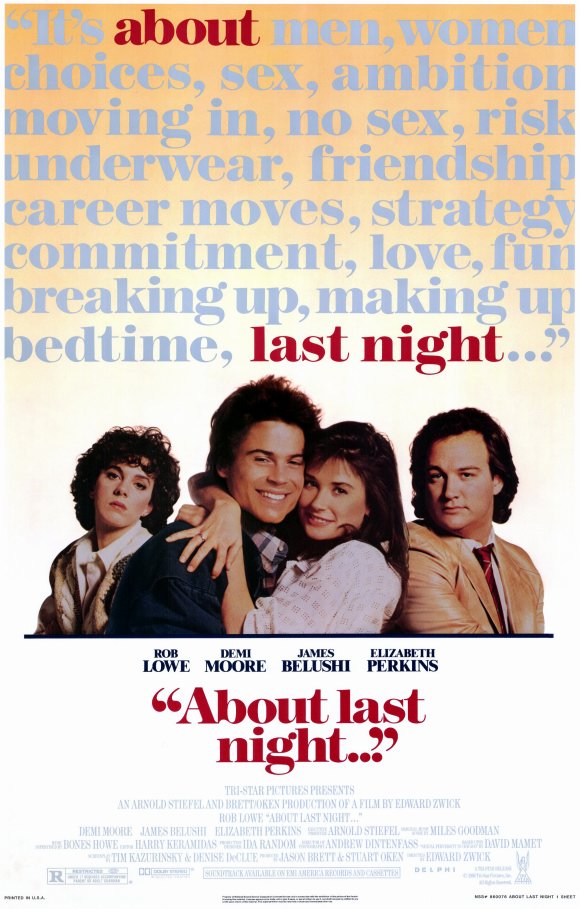
Of all the players in poster design’s clever production company, not often does type – or, if you prefer, simple writing – take centre-stage. After all, posters are usually, understandably all about the image, right? Here, though, are two fine examples to the contrary, which let the writing, er, do the talking. Coincidentally too, both the movies to which they belong concern themselves with sexual relationships. The first is the landmark Bob & Carol & Ted & Alice, if not Hollywood’s first frank foray into the exploration of sexual mores in a – by the late ’60s – increasingly liberated and experimental society, then surely its first flick to focus on swinging. Its poster is a classic. By repeating the film title over and again and cramming together the words – and thus the protagonists’ names – and following that up with the wonderful tagline below (‘Consider the possibilities’), the viewer is inevitably left to conjure up all the pairings, threesomes and foursomes as they might involving that quartet in question. Putting the words on a horizontal slant too and in varied bright colours adds a fitting hint of pop art-iness and psychedelia. About Last Night’s poster is less bold and therefore arguably less impressive than its predecessor’s (especially given the presence of the mugs of the movie’s stars at the bottom), but in making typography the major thing – and nattily highlighting the words of the title in a long, descriptive sentence – it’s a similar and very effective effort.
~~~
Woodstock (1970) ~ for USA market/ M*A*S*H (1970) ~ for USA market

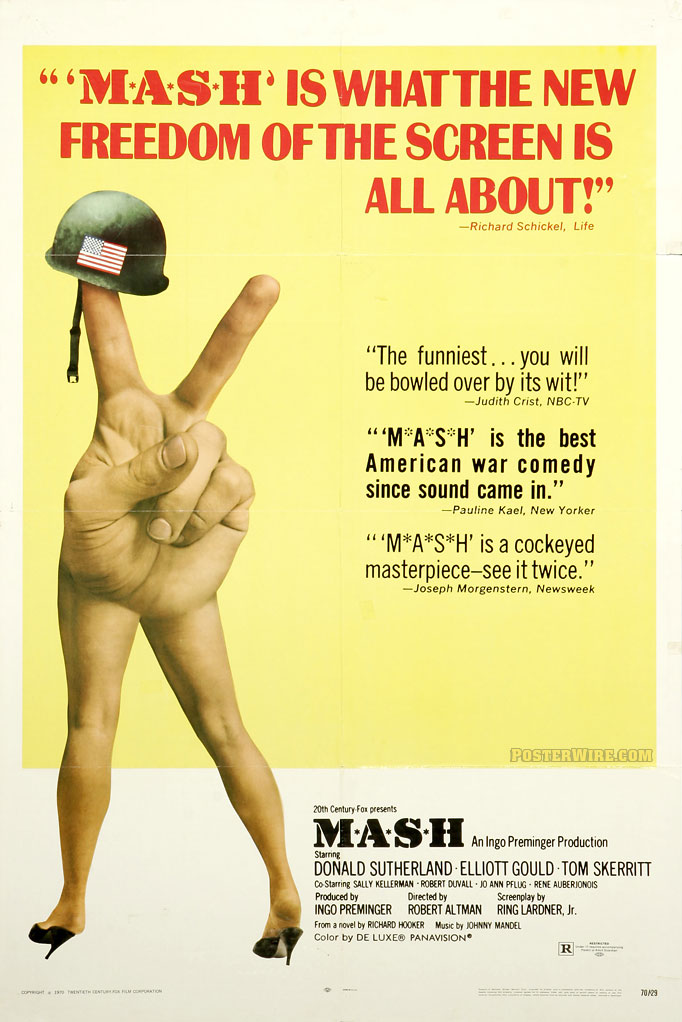
The ‘V-‘ or ‘peace sign’. First popularised by Winston Churchill upon the Allied victory at the end of World War Two and then adopted 20 years later by idealists of a much younger generation in defiance of the Vietnam War and other conflicts. It will, rightly then, always be associated with hippies and, while captured in thousands of photographs of the time, it was also captured on the posters of two prominent movie of the period – and here they are. The more famous of the two artworks (although you may not be familiar with it) was created for Robert Altman’s breakthrough film, the superb anti-war satire M*A*S*H. Once seen, this poster really is never forgotten. The use of the ‘V-sign’, with a soldier’s helmet (which sports a Stars And Stripes flag) resting on the index finger and the bottom of the hand transforming into a pair of comely, slender woman’s legs is genius, indeed. The image perfectly reflects the film’s themes and unquestionably hints at its gauche, knowing and anarchic tone. By contrast, the poster for the Woodstock documentary is a very rare one. Its better known relations are those that include photos from the legendary 1969 concert, but this one’s different – its image is painted and is properly provocative. Like on M*A*S*H‘s poster, the ‘V-sign’ is prominent, but being delivered by a young woman seemingly bewitched (by the music at Woodstock or substances sampled there, or perhaps both?), whose body is artily ‘painted’ in the blue, red stripes and white stars of America’s flag, the fusion – and therefore juxtaposition – of anti-war sentiment and (anti-?) US patriotism is arguably even more obvious than on the other poster. Less brash then, but just as pointed.
~~~
Gold (1974) ~ for UK market/ InnerSpace (1987) ~ for USA market
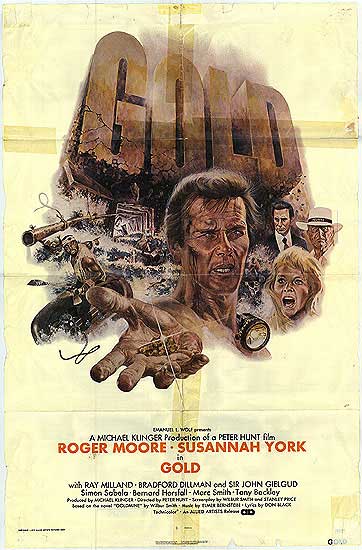
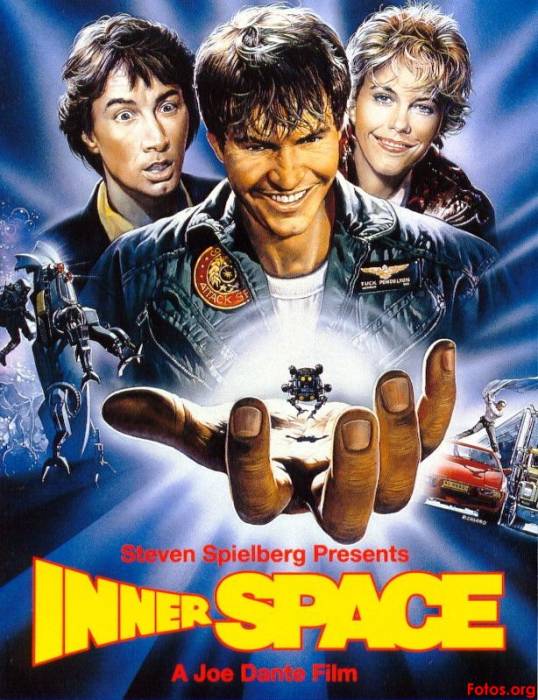
A hand gesture is what ties these two posters together too, but this time the gesture is an opened hand in the extreme foreground. The first is offering us something – gold, no less. Yes, the 1974 Roger Moore and Susannah York-starring Gold may not be the best adventure drama about South African precious-metal mining you’ll ever come across (mind, no others actually spring to mind right now), but its poster is a doozie. Not only do we have the lovely Susannah pictured mid-shout/ scream, Moore looking macho with his cheek bleeding and frantic images of drilling-gone-wrong all over the shop, we also have the film’s title rising in the background in a huge, daft Ben Hur-like stone font and, of course, Sir Rog over dramatically offering us a handful of glinting gold. Barmy but brilliant. InnerSpace‘s poster is, admittedly, less ridiculous, but no less impressive. In fact, it’s arguably more so. Unlike with Gold‘s artwork, our eyes are immediately drawn to the protagonist’s (hero Dennis Quaid) outstretched hand, which isn’t offering us anything but holding the macguffin of the film – the ‘innerspace’ capsule in which he ‘miniaturises’ and enters another character’s body. There are images of action dotted on either side of the poster too, but we’re reassured this movie is definitely a comedy (if very much a sci-fi comedy) by the shocked-silly look on Martin Short’s face, the smiling directly at us by Meg Ryan and that sly, slick grin of Quaid’s. It’s a great poster, indeed, and although a remake (of 1966’s Fantastic Voyage), the flick’s an , ahem, little gem too.
~~~
The Spy Who Loved Me (1977) ~ for Hungarian market/
Tootsie (1982) ~ for Polish market

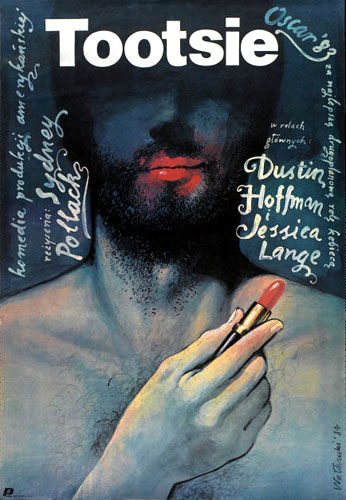
If film posters straight out of left-field are your bag, then these two have got to be for you. They’re European, for sure, but not produced for European flicks – one for a very Hollywood movie, the other for a Bond flick (which is probably best described as Anglo-American, or, er, Anglo-Hollywood). The latter is a Hungarian effort for that ultimate ’70s 007 blockbuster The Spy Who Loved Me – not that you’d guess that unless you spoke Hungarian. However, aside from all its adventure, explosions, comedy, comic-book violence and mild sex, you perhaps could describe Spy as a tale of two espionage agents from either side of the Cold War having to come together for the world’s greater good, despite the ideological, sexual and emotional tensions between them. And, you know, I’d argue all that’s rather well referenced in this poster. In a wack-job of a way, of course. The stamping of the male foot (Britain’s James Bond) and the female foot (Soviet Russia’s, ahem, Agent XXX) on that shotgun sort of suggests all that. Sort of. In any case, there’s surely no question that it’s a striking, unforgettable image – and that has to be the priority for a good movie poster. Mind you, if Spy‘s Hungarian offering is rather odd, then Tootsie‘s Polish effort at publicity is downright bizarre. Yes, it gets across the the film’s cross-dressing theme what with a bearded figure applying lipstick to his rather feminine-looking mouth, but why on earth is the whole thing such a dark image? It almost seems to suggest the film’s a violent slasher featuring the exploits of a transvestite killer rather than a finely executed comedy-drama about a desperate thespian who pretends to be a woman in order to land an acting gig. Moreover, the grafitti-like freehand type (included vertically, no less) also suggests the movie’s far artier than it really is. Still, despite all that (in fact, exactly because of it), I think it’s a work of art-oddity magnificence. Er, probably.
~~~
The Great Muppet Caper (1981) ~ for USA market/
Back To The Future (1985) ~ unused artwork
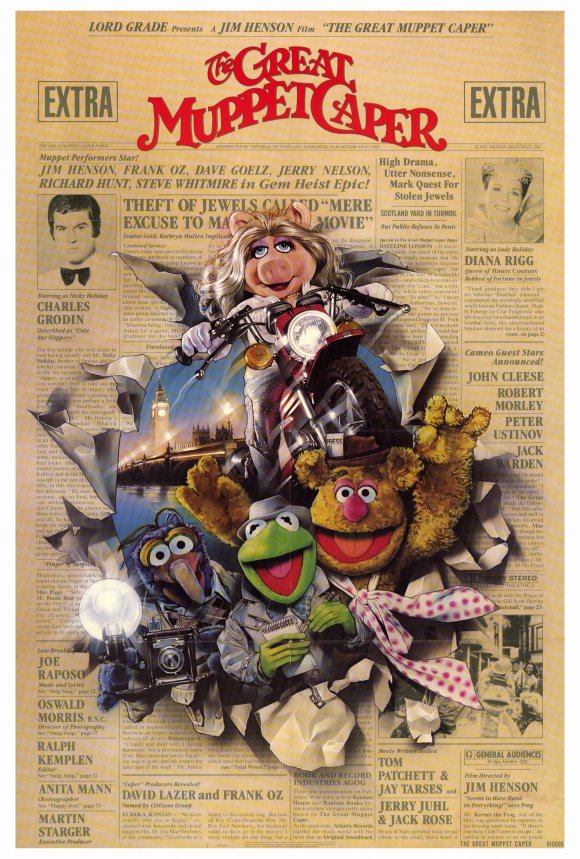

And, finally, peeps, two (or more) posters that could only be from the ’80s. Why? Because they were all created by the king of Hollywood poster art in the ’80s, the one, the only Drew Struzan. The artist made his name thanks – as, seemingly, for so many involved in ’80s Hollywood – to his connections with George Lucas and Steven Spielberg, having created posters for every one of the Star Wars, Indiana Jones and Back To The Future films. In recent years too, you’ll recognise his work on the poster for Harry Potter And The Philosopher’s Stone. It’s for the classic, original Back To The Future adventure, however, that the four artworks on the right were produced. What I find particularly interesting about them, must say, is that none of them were ultimately used (the Struzan image that made the grade in the end, of course, was the one that featured Michael J Fox emerging from the DeLorean time-machine car). None of the quartet above are as impressive and, thus, as potentially iconic as that one perhaps, but then none of them are bad either – at least three of them ably give the viewer a good impression of the movie they would have been selling (the one with the hand and watch is a little weird, mind). And, to my mind, had Struzan’s other, rightly chosen image not been selected, the one with Fox’s character pulling the minute hand of the clock-face (bottom right) could certainly have been used as the film’s main poster. Our final artwork is a true Struzan classic and, oddly, is little seen. It’s for a Muppet movie, oh, yes; indeed, the one that features Kermit & co. working as newspaper hacks (not for The News Of The World, though, don’t worry). Thus, quite brilliantly, not only are our furry friends excitedly breaking through newspaper, but the ‘paper itself features the film’s credits as if they’re news stories. No, really – take a closer look. It is, unquestionably, a work of poster art genius. Indeed, best to agree with me on that or you may have to face a Miss Piggy judo chop…

The face that launched thousands of trips: leader of The Doors, the indubitable Jim Morrison
Yes, 40 years ago on Sunday, the formidable front-man of psychedelic rock powerhouse band The Doors, the self-styled Lizard King, Mr Mojo Risin’ himself or (if you prefer) plain-old Jim Morrison broke on through to the other side in oh-so suspicious circumstances. Laconically cool, effortlessly irresistible to either sex and instantly and eternally iconic, Morrison was arguably both the real deal (a foremost figure of the late ’60s counter-culture with electric talent) and a seductive charlatan (a handsome poet who captivated kids with ideas and moves nicked from Nietzsche, the Beat Poets, Van Morrison and Native American mysticism).
Truth be told, his legend surely would not have endured in the way it has had he not died in Paris aged just 27 (ensuring his membership in the ’27 Club’ – a group of rock musicians who all died at that age, including Jimi Hendrix, Janis Joplin, Brian Jones and Kurt Cobain). He left us young, sure, but, boy, did he cram a lot into his life – fame (nay, notoriety), devotion, drug addiction and, apparently, a plethora of sexual partners, supposedly numbering fellow rock stars of his era Grace Slick, Nico and Joplin herself.
Anyhoo, if any time is the right time to celebrate the strange days of Jim Morrison then this surely is it, so here follows, peeps, a collection of quotes about and attributed to, rare images of, and (my own favourite) musical performances by that man Morrison – yup, long live the legend of the Lizard King, indeed…
.

We could be so good together: Jim Morrison showing off with his girlfriend and/ or common-law wife Pamela Courson, with whom he shared his life before and during his years of fame
.
“Jim read as much and probably more than any student in class, but everything he read was so offbeat I had another teacher, who was going to the Library of Congress, check to see if the books Jim was reporting on actually existed. I suspected he was making them up, as they were English books on sixteenth- and seventeenth-century demonology. I’d never heard of them, but they existed, and I’m convinced from the paper he wrote that he read them, and the Library of Congress would’ve been the only source.” ~ Jim Morrison’s senior-year English teacher
.
.
.

Land Ho!: Jim Morrison steps off an aeroplane with the other members of The Doors (left to right: John Densmore, Robby Krieger and Ray Manzarek) at the height of their late ’60s success
.
“Hey, man, we just did the Sullivan Show” ~ Jim Morrison’s supposed response to the producer of The Ed Sullivan Show in 1967, after the latter told him The Doors would never play the show again because Morrison had not altered drug trip-referencing lyrics when singing the song Break On Through (To The Other Side)
.
.
.
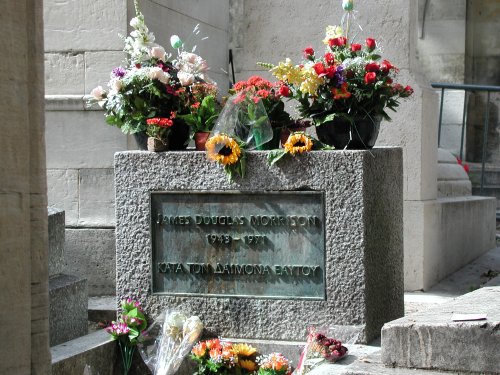
The end, beautiful friend: the resting place of Jim Morrison in Cimetière du Père-Lachaise, Paris
.
‘”ΚΑΤΑ ΤΟΝ ΔΑΙΜΟΝΑ ΕΑΥΤΟΥ (translation: ‘according to his own daemon’, or less literally: ‘true to his own spirit’)” ~ the Greek inscription on Jim Morrison’s gravestone, erected by his father
.
.
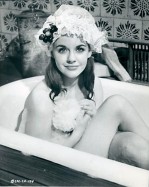
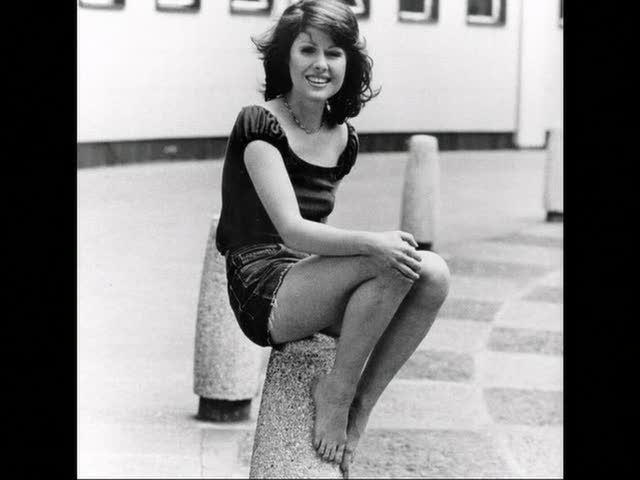
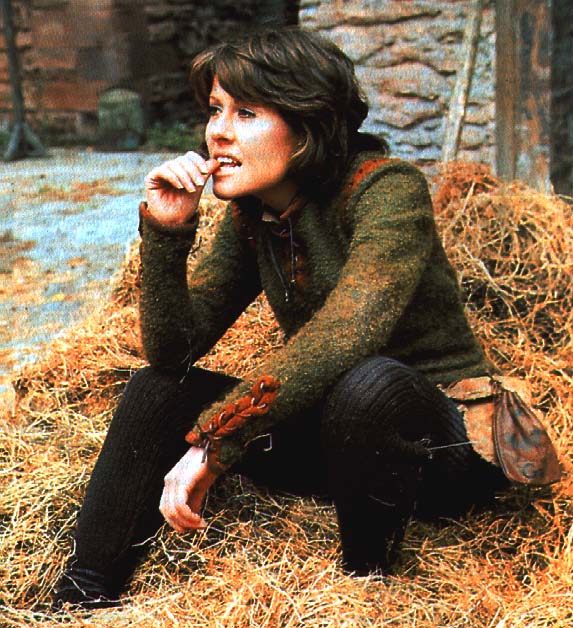
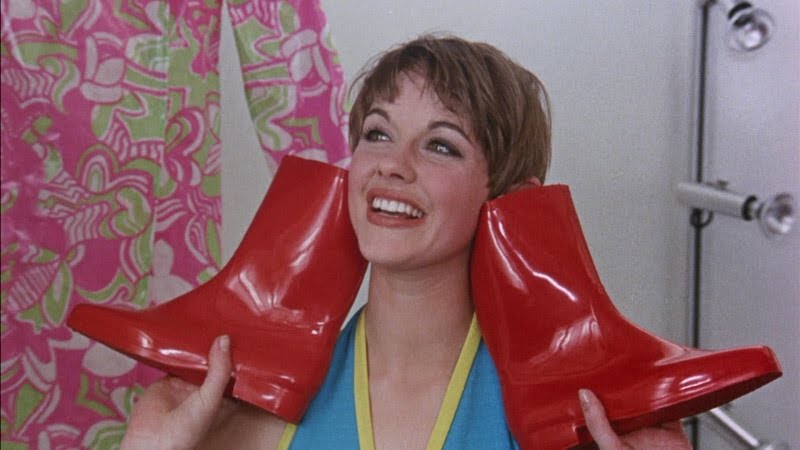
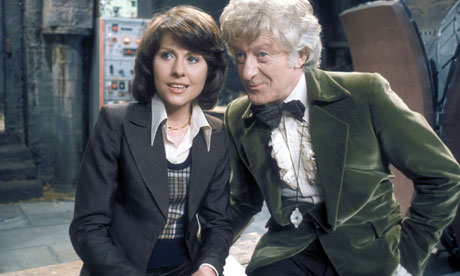
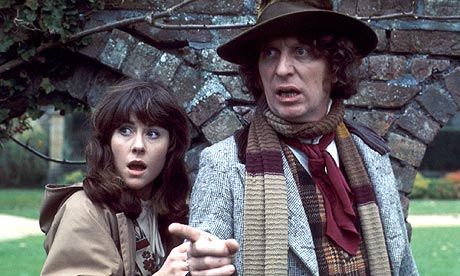
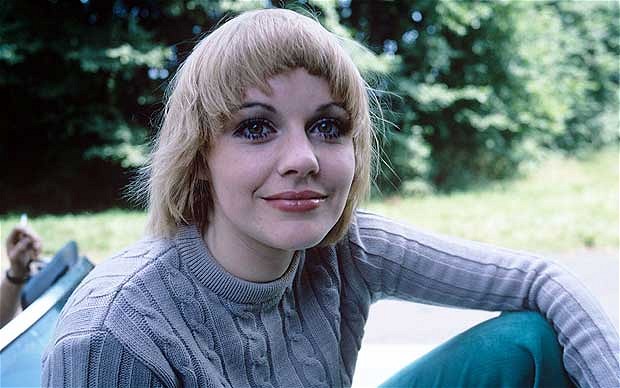
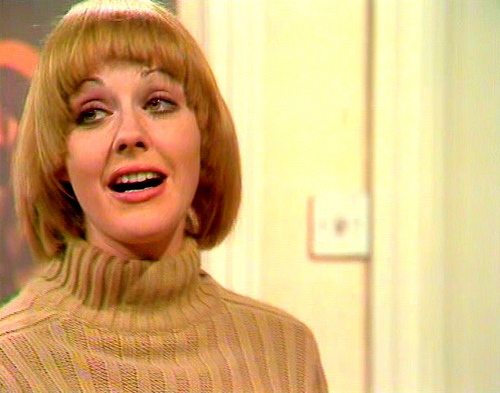
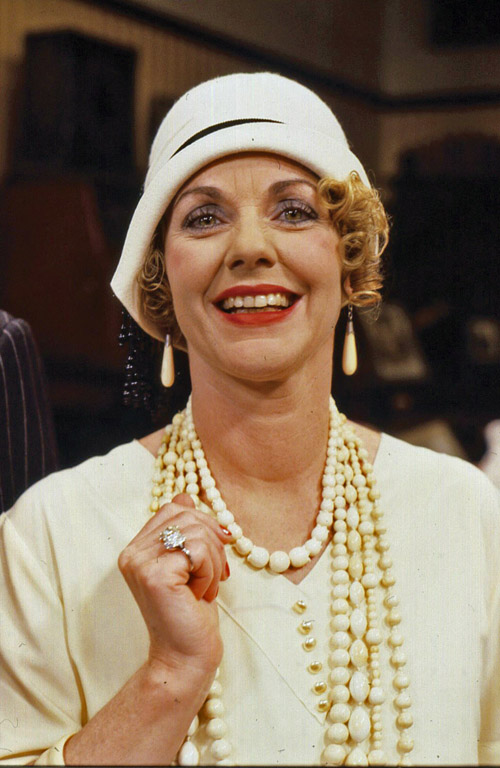
Angela Scoular/ Elisabeth Sladen: Lost Companions

Talent…
.
… These are the lovely ladies and gorgeous girls of eras gone by whose beauty, ability, electricity and all-round x-appeal deserve celebration and – ahem – salivation here at George’s Journal…
~~~
One made a name for herself as a flighty bit-of-all-right in 1960s and ’70s movie comedies, as well as securing a place for herself in that oh-so rare sorority of actresses who have played two separate Bond Girls; the other became the darling of Doctor Who fans forever for portraying the heroic Timelord’s most loveable, nay, most recognisable, companion – in three separate series. Yes, they’re Angela Scoular and Elisabeth Sladen and, yes, so sadly both of them passed on long before their time earlier this year. Here then, folks, is my wee little tribute to them both, indubitably delightful lovelies from back in the day…
~~~
Profiles
Names: Angela Margaret Scoular/ Elisabeth Claira Heath Sladen
Nationalities: English
Professions: Actresses
Born: Angela – 8 November 1945, London/ Elisabeth – 1 February 1946, Liverpool
Died: Angela – 11 April 2011, London/ Elisabeth – 19 April 2011, London
Known for: Angela – Playing Swinging ’60s free spirits in two separate Bond films, 1967’s ‘unofficial’ spoof Casino Royale (Buttercup) and 1969’s On Her Majesty’s Secret Service (Ruby Bartlett) and comedies Here We Go Round The Mulberry Bush (1968), A Countess From Hong Kong (1967) and Doctor In Trouble (1970), as well as appearing in the bawdy Adventures Of A Taxi Driver (1976) and Adventures Of A Private Eye (1977), plus TV series The Avengers (1968), Penmarric (1979), You Rang M’Lord (1988-93) and as Cathy in the BBC’s 1967 version of Wuthering Heights/
Elisabeth – Appearing in Doctor Who (from 1973’s The Time Warrior through to 1976’s The Hand Of Fear) as perhaps The Doctor’s most popular companion Sarah Jane Smith,, opposite both Jon Pertwee and Tom Baker in the title role, as well as returning in the ‘new series’ opposite David Tennant’s Doctor (2006) and reviving the character in the spin-off dramas K-9 And Company (1981) and The Sarah Jane Adventures (2007-11).
Strange but true: Pregnant by another man, Angela moved in with household name Leslie Phillips in 1977 and together they raised the child as their own, marrying in 1982. Elisabeth attended Grammar School with Edwina Currie, future cabinet secretary in Margaret Thatcher’s government; they appeared alongside each other in at least one school drama.
Peak of fitness: Angela – always flirty and comely, but most of all in the nuddy under a sheet, as she’s willingly seduced by James Bond in On Her Majesty’s Secret Service/ Elisabeth – lovely throughout Sarah Jane’s original run, but perhaps most of all when dressed in her blue, one-piece swimsuit in the 1974 Doctor Who story Death To The Daleks.

~~~
CLICK on images for full-size

.

.

.
.

.
.

.
.
.

.

.

.
.

.
.


.
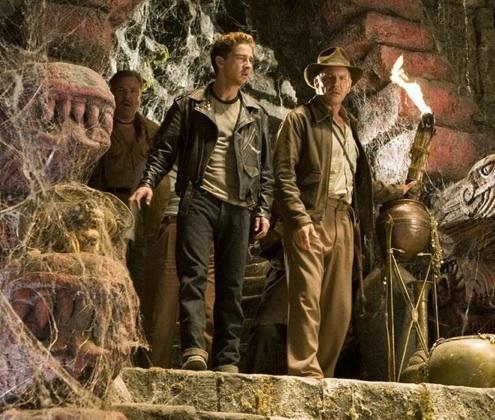
Right then, peeps, here it is, this blog’s final foray in keeping up with the Joneses in celebration of Indy’s big 30. Yup, having gone behind-the-scenes of Raiders Of The Lost Ark (1981) and reviewing that very flick and its immediate sequel Indiana Jones And The Temple Of Doom (1984), it’s now time to close the Ark by sharing with you my thoughts on the saga’s (so far) last two entries, Indiana Jones And The Last Crusade (1989) and Indiana Jones And The Kingdom Of The Crystal Skull (2008). Yup, dust off the fedora, folks, because here we go again…
.
(Last Crusade) Directed by: Steven Spielberg; Starring: Harrison Ford, Sean Connery, Alison Doody, Denholm Elliott, John Rhys-Davies, Julian Glover, River Phoenix; Screenplay by: Jeffrey Boam; US; 127 minutes; Colour; Certificate: PG
~~~
So, five years on from the release of Temple Of Doom and adventure cinema’s duo supremo Steven Spielberg and George Lucas cracked the whip once more and served up a highly expectant public with another dose of Indy. In that half-decade, Lucas had (for now) left Star Wars behind and Spielberg had moved on to more ostensibly critic- and award-friendly fare as The Color Purple (1985) and Empire Of The Sun (1987); in short, both seemed to be growing up. Perhaps because of this then, it’s fair to say Last Crusade lacks some of the youthful vigour, unbridled pace and childlike wonder of its two predecessors, but it also possesses something they arguably lack, a real commitment to character-driven storytelling.
Now, don’t get me wrong, being an Indy flick, this ‘un certainly delivers those trademark genius (or, if you prefer, showing-off) touches of the early Spielberg. For instance, we have a tied back-to-back Indy and companion in a revolving fireplace moving from a fiery room to, maybe even worse, another room laden with villains, as well as a moment when the camera focuses on a chap replacing a car-wheel’s hubcap just as the vehicle itself speeds off. Yet, the real focus this time is on delving deeper into our hero’s back-story and his relationships with those close to him, arguably ensuring this movie is more grown-up than the previous two. Arguably.
First off, we’re offered an episode that tackles our protagonist’s ‘origins’ (so popular with adventure and comic book hero flicks nowadays) as the ill-fated River Phoenix essays an adolescent Indy in a circus-train chase, which neatly and wittily explains away the hero-to-come’s fondness for that lion-tamer’s whip, his aversion to snakes and where he got his fedora and leather jacket look – from a low-grade Indy-style adventurer, as it happens.
And from one ‘father figure’ of his past we move on to another – the real thing, Professor Henry Jones Sr, Indy’s dad, no less. For now the flick shows its true colours as the adult Indiana (Harrison Ford) sets out on an escapade that takes him from his Californian college, via Venice and an Austrian castle full of hidden corridors, to the deserts of Hayat in a bid both to rescue his pop from Raiders-esque nasty Nazis and find and lay claim to the legendary Holy Grail.
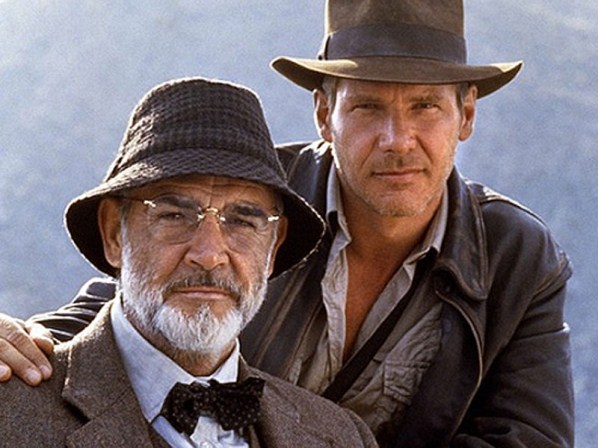
His dad turns out, of course, to be none other than Sean Connery (seriously, who could be more fitting as Indy’s pop than James Bond? Apparently, that thinking genuinely was behind Spielberg and Lucas’s casting of Connery). And this surely has to be Last Crusade‘s master-stroke. As Indy’s academic, priggish and formerly absent father, with whom the son has some serious unresolved issues, the Scottish thunderball delivers an outstanding against-type comic turn. His frequent rebuking of (‘Junior!’) and bickering with Ford (‘I should have mailed it to the Marx Brothers!’) is golden stuff; quite frankly, the film only hits top gear with his entrance a third of the way through. Indeed, second to 007 himself, this is probably the most enduringly popular role of Connery’s long, varied career – and rightly so.
It’s not all The Ford And Connery Show, though (despite how much fun they’re clearly having and, by extension, Spielberg’s having directing them). Indiana Jones wouldn’t be Indiana Jones without chases – and Last Crusade doesn’t disappoint. There’s a chase on motorbikes, one in speedboats, a lengthy tank-versus-horse set-piece in the desert and, best of all, the two Joneses in a byplane and then a car being pursued by Messerschmitts. The movie’s macguffin too (the biblical Holy Grail) is a classic – leading to an eerie, spooky and mystical finale – and, as mentioned, those Nazi villains (back after the controversial Indian Thuggee cultists of Temple Of Doom) do the business once again.
Although neither as sinister nor as threatening as they were in Raiders perhaps (despite Indy meeting Hitler – who’d have thought he was actually Mr Bronson off Grange Hill?), their presence is bolstered by Alison Doody’s love interest turning out to be a fascist-sympathising and memorable femme fatale – in spite of her being shunted down the supporting cast pecking order due to the film’s father-and-son theme and Connery’s casting. Successful too are the welcome returns of John Rhys Davies’s Sallah and Denholm Elliott’s Marcus Brody; Julian Glover’s ‘champagne villain’, Walter Donovan, proves a little flat, mind.
But, ultimately, it’s the Indy-and-his-dad aspect for which Last Crusade remains most memorable. And this is more than ensured by the flick’s more than satisfying climax, where both Joneses naturally and nattily realise that the real Holy Grail they’ve been hunting for throughout their journey has been something else entirely to the little cup from which Christ once drank; proof indeed that with Spielberg and Lucas at the helm, Indy has always been about going further than merely updating Saturday morning serials, but giving the audience exactly what it wants – and more besides.
.
(Crystal Skull) Directed by: Steven Spielberg; Starring: Harrison Ford, Shia Laboeuf, Karen Allen, Cate Blanchett, Ray Winstone, John Hurt, Jim Broadbent; Screenplay by: David Koepp; US; 122 minutes; Colour; Certificate: 12
~~~
It’s a sign of the controversy that, since its release, Indiana Jones And The Kingdom Of The Crystal Skull has generated among modern film fans that just yesterday emerged the news Harrison Ford has apparently called Shia Laboeuf, his co-star in said film, a ‘f*cking idiot’ for recently claiming he (Laboeuf himself, that is) ‘dropped the ball’ while making the movie.
You see, sincere Shia had informed the world that the notorious – and generally derided – moment in Crystal Skull in which he swings on a grapevine surrounded by monkeys and then attacks an enemy with his new simian pals may have been the filmmakers’ creation, but ultimately it was his responsibility to ‘sell it’, which apparently he did not. According to Ford, you don’t knock a film you’ve starred in, you sell it; but Laboeuf presumably feels fans ‘deserve’ an explanation.
But is an explanation necessary for that particular Crystal Skull moment? (For the record, not for me; it rather tickles yours truly – what can I say, like Sheldon in The Big Bang Theory, I like monkeys) And, by extension, does the film as a whole deserve all the criticism it’s garnered over the last three years? Is it really that bad a flick?
The answer, in my opinion, is a plain and simple no. Granted, after the 19-year wait for a new dose of Jonesian heroics, it wasn’t exactly a new Raiders that greeted filmgoers in the summer of 2008. And now in 2011, with the dust having settled somewhat, Crystal Skull‘s still very much in the original adventure’s shadow (and those of its first two sequels perhaps), but despite this I’ll happily state and maintain it’s not that bad a movie.
Much of the film fan antagonism to the flick, it seems to me, centres on what’s at the centre of the plotting – as it goes, not the movie’s macguffin, the psychic crystal skull of South America’s Akator/ El Dorado that the hero sets out to find (surely a pleasingly freaky, eerie, exotic piece of ancient, if not biblical, bling) – but the fact that, unlike the other three Indy escapades, this one’s quest ends in the discovery of aliens/ trans-dimensional beings, rather than something divine.
To me, though, this criticism is a little nonsensical. What are aliens of superior intellect if they’re not otherworldly, mystical and presumably omnipotent – just like the power of established divinity? Perhaps some filmgoers simply didn’t want Indy to dip his toes into sci-fi? But, for me, it’s much of a muchness. Indiana Jones is superior fantasy adventure born out of US Saturday morning adventure serials and comic book heroism – for both of which science fiction is a mainstay. If any film hero then can do sci-fi well, surely Indy can.
And Crystal Skull does do the sci-fi well. Indeed, in setting the flick in the 1950s (a necessity owing to the ageing, greying Ford), director Spielberg and writer/ executive producer Lucas nattily tie into the piece not just Ruskkie Commies as the baddies (the new Nazis, if you will), but also ’50s B-Movie sci-fi overtones (Nevada Desert’s ‘Area 51’, the ‘Roswell incident’, the ‘Grey Alien’ and the space saucer are all smartly and smoothly worked in). General Cold War touches abound too, what with Feds getting all itchy about the Reds, and, of course, Indy surviving a nuclear test blast inside a lead-lined fridge (again, another controversial scene – I’m on the ‘whatever’ side of that controversy). Plus, another ’50s reference comes in the look of Indy’s latest sidekick, the adolescent Mutt Williams, whose entrance is a shameless but neat homage to Marlon Brando in The Wild One (1953).
Ah, Mutt Williams… Mr Laboeuf himself. Another sore point with many Crystal Skull detractors. Does this latest George Lucas creation deserve the criticism he’s received for being added to the Indy universe? Again, for me, no. Probably like many others, I was expecting the worst when it came to this character, but was pleasantly surprised. Mutt’s a spunky, smart greaser that Laboeuf brings to life with just the right balance of bluster, subtlety and charm. Hardly the new Jar Jar Binks at all. Just don’t do the daft thing and give off us a spin-off Mutt film series though, will you, George? Actually, I like to think Indy taking his picked-up-from-the-floor hat from Mutt in the flick’s closing scene is a sign this won’t be the case – and, if anything, another outing for Indy himself’s more likely.
After Crystal Skull, though, should Indy crack his whip one more time? Well, there’s no doubt the moneymen would probably like him to (the movie made nearly $790 million at the global box-office), but even if Lucas is eager, Spielberg may see the light and nix it – at least, one would like to think that. As I’ve said, Crystal Skull is far from a jeep crash in the Amazon, but more of the same probably isn’t necessary. The film’s big set-piece (actually that jeep chase – and several crashes – in the Amazon) isn’t bad, but unlike similar action sequences from the first three adventures, it isn’t quite as exciting or enthralling; it rather lacks their immediacy, as if you can see the joins.
And at times in Crystal Skull, you feel like you can see the joins – there’s around 450 CGI shots in the film, while 30 percent of its scenes feature CGI matte backgrounds. All very well for a fantasy movie, you may say, but past Indy didn’t have to rely on that level of effects work (having said that, past Indy was never set in a hard-to-film undeforested jungle for a third of its running time either).
However, what does undeniably work throughout is the cast and their playing. Perhaps because they all look like they are at play – and having a high-old-time at that. Like Jones, she has more mileage on the clock, but Karen Allen’s Marion Ravenwood is delightful once again (she is, unquestionably, the same character she was in Raiders); her by-play and bickering with Indy – apparently co-written by the latter flick’s scribe Lawrence Kasdan – is sparkling stuff. Just as satisfying, Cate Blanchett’s Soviet villainess Spalko is a deliciously dastardly creation (one can appreciate why she’s Spielberg’s favourite Indy foe), while esteemed British thesps Ray Winstone, John Hurt and Jim Broadbent all offer dependable support, very much in the tradition of Indy UK alumni John Rhys-Davies, Denholm Elliott and, yes, Sean Connery.
Speaking of Connery, you may not know that he was offered the chance to return as Indy’s father (the role he played in Last Crusade), but owing to enjoying his retirement too much, turned it down. It may have been just as well; one may conclude that there’s enough grey hair onscreen already, what with Indy’s own veteran presence (but it’s only fair to mention that, absolutely to his credit, Ford in his sixties most definitely still has it as the physical, sardonic action hero, even if he’s the father figure this time around). For what it’s worth, mind, Connery has taken the effort to see Crystal Skull. His verdict? ‘Rather good and rather long’, apparently. Not so sure about the second bit, but I’m certainly with him on the first bit. If this is to be how Indy bows out, then it ain’t bad at all… and he still didn’t lose his hat doing it.
Playlist: Listen, my friends! ~ June 2011
In the words of Moby Grape… listen, my friends! Yes, it’s the (hopefully) monthly playlist presented by George’s Journal just for you good people.
There may be one or two classics to be found here dotted in among different tunes you’re unfamiliar with or never heard before – or, of course, you may’ve heard them all before. All the same, why not sit back, listen away and enjoy…
CLICK on the song titles to hear them
~~~
The Strangeloves ~ I Want Candy
Henry Mancini ~ If I Fell*
Donovan ~ Atlantis
Sammy Davis Jr. ~ Rhythm Of Life
Eric Clapton ~ Let It Grow
John Miles ~ Music
Laurie Johnson ~ Theme from The New Avengers
Supertramp ~ Give A Little Bit
Kiki Dee ~ Star
The Psychedelic Furs ~ Pretty In Pink
Talk Talk ~ It’s My Life
The Housemartins ~ Build
Soul II Soul ~ Back To Life (However Do You Want Me)
* Performed on the 1965 TV special The Music Of Lennon & McCartney

Indy at 30: Setting the ball rolling ~ Raiders Of The Lost Ark (1981)/ Indiana Jones And The Temple Of Doom (1984) – Review


(Raiders) Directed by: Steven Spielberg; Starring: Harrison Ford, Karen Allen, Paul Freeman, John Rhys-Davies, Denholm Elliott, Ronald Lacey, Wolf Kahler; Screenplay by: Lawrence Kasdan; US; 115 minutes; Colour; Certificate: PG
~~~
It’s had its rivals, its copycats, even its parodies, and yet, if you were to ask, well, anyone, after a few minutes’ thought, they’d most likely come to the conclusion that Raiders Of The Lost Ark is the best family adventure film of the last 30 years. But is it really? Well, in a word… yes. Truly, nothing’s come close to Raiders since its release in June 1981 (which was recently covered on this blog here) and maybe never will.
The reason is pretty darn simple – after all, filmmaking shouldn’t be that complicated when you’re making adventure movies – this flick simply has it all, mixing all the ingredients together in a fast, florid, magical, irresitible brew like the contents of the Ark of the Covenant (before they turn all horrible, that is). For there’s nothing horrible – or second-rate, ironic perhaps given its 1940s ‘B-Movie’ inspirations and aspirations – in Raiders.
First and foremost, Lawrence Kasdan’s script is tight-as-you-like; somehow marrying the mugging of a fantastically barmy Nazi scheme with the establishing of a would-be-iconic action hero, along with a plethora of memorable characters, some terrific dialogue (‘There’s only so many times I can say sorry’/ ‘Then say it again’; ‘I don’t know, I’m making this up as I go’) and a clutch of in-your-wildest-dream set-pieces.
The realisation of these set-pieces, quite rightly, is what Raiders is best remembered for. Director Steven Spielberg maybe deserves the lion’s share of praise here, his rapid-fire shooting-style no doubt ensured the thing remained clipped and focused, as well as visually imaginative – fantastic and just about the right side of unbelievable. Yet, deserving of mention here too has to be his cinematographer Douglas Slocombe, his second unit (mostly directed by George Lucas, in fact), stunt arrangers, production designer Norman Reynolds and those beardy boffins at Industrial Light And Magic who with this flick, following Star Wars (1977) and The Empire Strikes Back (1980), continued to set an amazing template when it came to visual effects.
Because when it comes to set-pieces here, we’re talking the giant rolling boulder chasing our hero (Harrison Ford) through a cave in a perfect tone- and pace-setting opening sequence; we’re talking Indy the hero and his heroine Marion (Karen Allen) escaping from her fire-ravaged Nepalese bar; we’re talking the hero fighting goons under a circling aeroplane that’s about to explode and then stealing the treasure back from the baddies in a crazy truck and car chase (including in an incredible man-under-a-truck stunt); we’re talking Indy escaping the villains’ clutches on a tanker ship by swimming unseen across to their own submarine to the cheers of his shipmates; and, of course, we’re talking the climactic finale of the Ark’s opening when – ironically – God Himself trumps Indy by pulling off the most impressive trick of all.
And, make no mistake, that ironic, sardonic humour is critical to Raiders‘ balance – and ultimate success. You can have all the thrills and spills and artistically impressive chops in the world, but if your movie adventure ain’t funny, then it’ll come off too dry for both the kids and the parents. Take the improvised moment when Indy can’t be bothered with a long tussle with the Cairo swordsman, so just casually shoots him instead. It’s a moment as golden as the disc atop the Staff of Ra.
Still, for all that, Raiders would only be two-thirds, nay half, the film it is were it not for its outstanding, unforgettable score. Film composer extraordinaire John Williams had previously worked wonders with his contributions to Jaws (1975), Close Encounters Of The Third Kind (1977) and the Star Wars flicks, but in creating Indy’s theme (officially titled The Raiders March) for this movie, he came up with his own signature track. The rest of the score too is, of course, terrific, perfectly accompanying and setting the mood for the on-screen action and helping to elevate it to the eerie, mystical, epic and grandiose levels it strives for.
So to sum up, well, let’s put it this way: imagine (in the incredibly unlikely event) you were about to see Raiders for the first time… just how exciting, riveting, magical and special a prize, like Indiana Jones, would you be about to discover…?
Exactly.
~~~
(Temple Of Doom) Directed by: Steven Spielberg; Starring: Harrison Ford, Kate Capshaw, Ke Huy Quan, Amrish Puri, Roshan Seth, Peter Stone; Screenplay by: Willard Huyck, Gloria Katz; US; 118 minutes; Colour; Certificate: PG
~~~
Apparently, on the Hawaiian beach back in the summer of ’77 where George Lucas and Steven Spielberg had agreed to make Raiders Of The Lost Ark, they’d also shook on making two more sequels. A rather presumptuous assumption perhaps, but nonetheless they did make two (in fact, three) further Indy sequels together, the first of which, of course, was Indiana Jones And The Temple Of Doom.
But, much had come to pass between Raiders’ release in ’81 and the two getting down to it and making Temple Of Doom in ’83, not least the former completing the Star Wars trilogy with Return Of The Jedi (1983) and the latter seeing his latest flick E.T.: The Extra-Terrestrial (1982) become the biggest movie of all-time, but also – and perhaps most importantly – Spielberg’s marriage had hit the rocks forcing him into the throes of divorce. As it happened, Lucas wanted Temple Of Doom not to take the easy buck and pander to the kids, but to be darker than Raiders, and Spielberg, given where he was in his personal life, threw himself in that direction.
The film they turned out then was, indeed, darker than its predecessor, but also – perhaps on account of its director’s initial reluctance to the ‘darker’ idea and Lucas’s admission that he’s a ‘humour’ man – was conversely lighter than the first one in different ways. Given this, is it fair to say that Temple Of Doom‘s a bit of a Jekyll and Hyde movie? Maybe. And, yes, that may go some way to explaining why it’s one or two notches down in quality to Raiders. And yet, it also explains why the flick’s quite a different beast to the original – and still today a hell of an entertaining and intriguing ride.
And a ride it unquestionably is. Right from the start it’s breathless stuff with Indy, nightclub chanteuse Willie Scott (a wonderfully clownish Kate Capshaw) and diminutive dynamo of a sidekick Short Round (Ke Huy Quan of Goonies fame) having to escape from Shaghai villains and their schemes via dropping through shop canvasses, hiding from gunfire behind rolling gongs and jumping out of a pilotless aeroplane in a water-raft (and then sliding off a cliff and riding rapids in said raft, of course). The exposition that follows this, as such it is, is that Indy and co. must find a sacred stone and put right a ‘curse’ that an evil palace-based Thuggee cult holds over an Indian village. But, frankly, this thin plot is secondary to the action – or really, the rollercoaster ride – that follows.
Fistfights, swordfights, fleeing from a gigantic flood, human sacrifice in cult rituals, karate-kicking and the plucky trio’s witty bickering all fly by before a final showdown on a ropebridge (guess what happens there?). Indy, almost symbolically, sees his shirt disentegrate as each outlandish and incredible action set-piece piles up on the next; it’s as if the filmmakers see their hero as a superhuman Hercules and they’re putting him through his very own 12 labours. Indeed, in what must be one of Hollywood’s best in-jokes, they even insert an actual rollercoaster ride into this ultimate rollercoaster ride of a movie, in the shape of the flick’s most exhilarating sequence, the iconic, unforgettable mine-cart chase.
So, if Temple Of Doom‘s effectively made up of all these relentless hijinks, where’s all the darkness? Well, remember I squeezed in mention of cult rituals and human sacrifice in that paragraph above? This (admittedly short) middle segment of the film is indeed arguably scary, fiery, gory and not at all played for laughs – in fact, it’s the stuff of a modern, quality horror film. Indiana Jones movies are famous for containing ‘mild horror’ – it’s one of their trademark components and hugely popular with both adults and kids – but this is a step beyond that. I remember watching Disney’s Pinocchio for the first time as an adult a few years ago and it struck me just how solidly dark a film that actually is; to watch this section of Temple Of Doom as a grown-up is a similar experience. It’s no surprise that, on release, the film received criticism from certain quarters for this experiment on Lucas and Spielberg’s part of how far they could push a family film into adult audience territory.
As mentioned though, the movie’s darkness is tempered by its humour. Sillier in most cases than in Raiders (although rather delightful, the meal at the palace is pretty childish and Indy and Willie’s played-for-laughs attraction, if not their by-play, is less convincing than his and Marion’s in Raiders), it does however certainly have its moments. Most especially the starkly brilliant reminder that this flick is the original’s prequel, when, meeting a couple of swordsman, Indy reaches for his gun only to realise he’s mislaid it (echoing the moment in Raiders when – it turns out , having learnt his lesson – he just shoots the mean dude with the sword instead of engaging in a lengthy fight).
And, make no mistake, it’s Spielberg’s often delighfully inventive, always controlled hand on the tiller that strikes this balance between dark horror themes and frivolous humour, while knitting together all the action into a layer-upon-layer cake that feels like it will surely topple over before the end, but, of course, never does. Temple Of Doom isn’t another Raiders (it’s more an experiment in adventure movie filmmaking than an attempt to make the best possible exponent of it), but in its way it’s a fascinating and – for me, at least – as entertaining a slice of cinema as its predecessor. Admittedly, that may have something to do with the fact it was the first Indy flick I properly saw (you never forget your first, right?).
Plus, after all that, it even turned out nice for Spielberg – he swapped the layered cake of Temple Of Doom for a real layered wedding cake thanks to meeting on-set and then making his wife his leading lady, Kate Capshaw. Now that’s an achievement even Indiana Jones wasn’t capable of… well, not in this film, at least.
~~~
Novel idea: Carte Blanche, MI6 Confidential and the continuation of James Bond in print
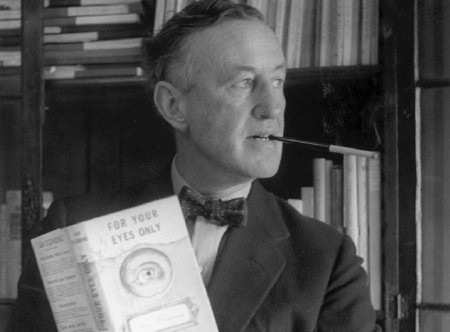

Master and apprentice: James Bond creator and original author Ian Fleming (left); crime writer and new 007 novelist Jeffery Deaver publicising the spy hero’s latest literary adventure (right)
“The scent and smoke and sweat of a casino are nauseating at three in the morning.” These words ooze glamour, cool and a sense of darkness and danger, do they not? And they’re surely the perfect words to begin, yes, a James Bond novel. But not just any James Bond novel – no, they make up the opening sentence of the very first, Casino Royale. Published in 1953, it was written by former British Intelligence planner and journalist Ian Fleming supposedly as a wedding present for his soon-to-be wife – in actuality, he really produced it as a lighthearted distraction to his impending nuptials. However, the sensation it pretty immediately became and the legacy down through the years it bore were, of course, anything but lighthearted.
Now, all of 58 years since Casino Royale was first published, the book Bond is back through the conduit that is best-selling American thriller author Jeffery Deaver. Yet, far from the first print-based adventure for Bond since Fleming put down his pen, the new novel, Carte Blanche, is in fact the latest in a long line of literary ventures – nay, reinventions – of the world’s least secret secret agent. So, lesser known as it is compared to the cinematic version, just what is the literary Bond’s history and just how did he get to Carte Blanche?
Well, if we go back to the start with Fleming, we’ll discover that, following the first novel’s publication, across the next 11 years the latter produced a further 11 novels and two short story collections featuring his irresistible espionage hero. Then, two years before the author’s untimely death in 1964, under their newly created company, Eon Productions, US film producers Albert R ‘Cubby’ Broccoli and Harry Saltzman delivered the first movie in the ‘official’ series of James Bond cinematic escapades, Dr No. Adapted from Fleming’s sixth novel, it starred the then unknown Sean Connery as 007. The Bond films themselves quickly, of course, took on a life of their own, as they struck an even bigger chord with the public than the novels and surely eclipsed the popularity of their literary forebears.
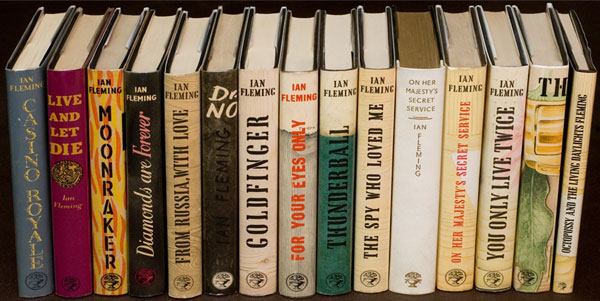
Bond bound: the first editions – lined up in chronological order – of Ian Fleming’s 12 novels and two short story collections featuring the British hero and global entertainment icon that is 007
Nevertheless, in achieving their enormous (continuing) success, the Bond movies have, if anything, made the novels even more popular and critically, as well as, publicly enduring. In which case, upon Fleming’s death back in ’64, the novels’ publisher Gildrose Publications set for itself the unenviable task of finding another author to take the gauntlet and continue 007’s literary missions – and the baton wasn’t just passed on once; down through the years it was passed on several times (mirroring, if you like, the relay race-like continual casting of the Bond film character).
First to take the challenge was a true literary heavyweight, Kingsley Amis. Writing under the pseudonym Robert Markham, his stab at Bond in the shape of Colonel Sun was published in 1968 and was received well. He was followed by dedicated thriller writer John Gardner, whose 16 efforts – including two novelizations – (1981-96) were perhaps a little bland and lacked the style and glamour of Fleming, but found a very dedicated audience. Next up was the first American to write Bond, Raymond Benson, whose six novels, three novelizations and three short stories (1997-2002), although not always popular with the critics and die-hard Fleming fans, proved popular with the book-buying public.
Following Benson’s take on the character, Ian Fleming Publications – as Gildrose now became known – decided to mix it up for Bond once more, as they turned to another literary household name, Sebastian Faulks (author of the universally acclaimed Birdsong), to deliver the next 007 thriller in commeration of the centenary of Fleming’s birth. The year was 2008, the book was Devil May Care… and many did care, a lot. Sold to the public and the minority (and yet vocal) literary Bond fans as ‘writing as Ian Fleming’, Faulks delivered a novel that turned out to be more pastiche than perfect imitation; it was almost the Bond of the Roger Moore-starring, outer-space flick Moonraker (1979) than that of the hard-edged Casino Royale. Predictably, the results were controversial; the fans weren’t impressed, but the public seemed to lap up the print-Bond once again.
And now we find ourselves in 2011 and the new offering is Carte Blanche. This time it seems Ian Fleming Publications haven’t gone with the author with the awesome resputation, but with the proven genre writer, whose hand on the tiller, they surely hope, will be a dependable one. With his back-catalogue of popular Lincoln Rhyme and Kathryn Dance crime mysteries, Jeffery Deaver certainly seems on, ahem, paper far from a risky bet to take on Fleming’s mantle.
Indeed, lucky get that I am, I attended a ‘Meet the Author’ Q&A session with Deaver in London at the end of May for the launch of the new novel. Fleming fans would surely have been assuaged by the reference he made at this event to who the literary Bond is and what’s always made him so: “There is a scene at the end of the novel Moonraker (1955), where he [Bond] discovers the missile that Drax [the villain] has gifted to England, doesn’t point out to sea, but actually points to a place called London, which some of you may have heard of. He is cut off from help and has no way of warning, so he resolves to light a cigarette under the rocket as it is being refueled, destroying it, but killing himself. Obviously being Bond, he doesn’t have to do that in the end, but he was prepared to. Essentially, I’ve tried to make him as much like Fleming’s Bond as I can. He’s the same sort of age as Bond was in Casino Royale; he’s experienced. I kept a picture of Hoagy Carmichael next to my keyboard as inspiration.”
The reference to Hoagy Carmichael may be the clincher – any Fleming fan worth his salt knows the real-life individual on whom the writer most based his character’s appearance was the former, a once famous American singer and pianist. However, Deaver’s Bond – and the world he’ll inhabit – will certainly differ from Fleming’s in some respects. This 007 will be a modern-day character, not one of the post-war period as he originally was (and was, for instance, in Devil May Care). It means Bond’s now a veteran of the present Afghan war rather than World War Two, he no longer smokes (according to Deaver for no real ethical reason, but because smoking would interfere with his ‘tradecraft’ – a modern-day spook who smokes would stand out) and his mode of transportation has altered (out goes the 1933 modified Bentley sportscar; in comes the beast that is the Bentley Continental GT).
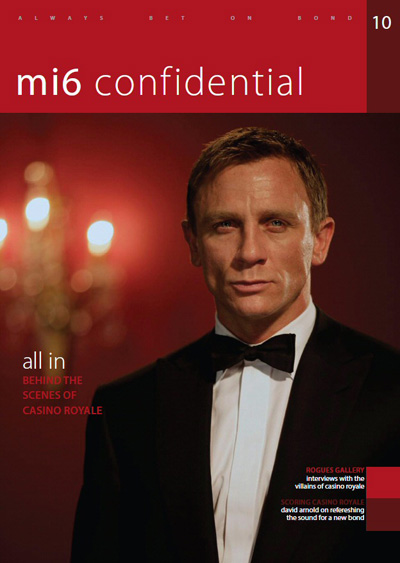

Royale tribute: the cover and villains’ interview spread of the latest issue (#10) of MI6 Confidential – click on the links below for more details and to purchase the magazine
I’m yet to read Carte Blanche (it’s next on my list), but, like I said, the omens look good; Deaver seems to know the scale of the task he’s taken on and, so he said at the London Q&A, is very open to writing more Bond adventures should this one be a success. Good luck to him then, after all, he’s well aware that with writing Bond, an author doesn’t have complete carte blanche: “People don’t read books to get to the middle. A writer’s job is to get you to turn the page and Fleming had that. He kept his stories short and economical, used escalating conflict and kept it lean. Oh, and did I mention the Bond girls? Fleming had his finger on the pulse of what we like. Fine food, drink and beautiful women: these are essential. I think Fleming’s philosophy was, although he never wrote this down, it is evident in his writing, that writing books is all about you guys. And that’s my philosophy, too. In the end you have to write for your audience.”
Speaking of writing for your audience, if you’re a real fan of James Bond, then another relatively new publication may be just up your street. The magazine MI6 Confidential has been going for about a year now and, with its impressive – some never-before-seen – images, as well as exclusive interviews with many folks who’ve played key roles behind-the-scenes on the ‘official’ Eon film series down through the years, it provides a welter of information and entertainment for the reader on the world of 007.
As noted, the very first Bond novel was Casino Royale and 53 years after its first publication, Eon Productions finally got around to releasing their film adaptation. The result was perhaps the most critically acclaimed of their 007 epics and, of course, a huge box-office smash, introducing Daniel Craig to the world as a brand new and yet – to my mind – really quite Flemingian movie Bond. And the latest issue of MI6 Confidential focuses specifically on this most popular of Eon’s epics, featuring, as it does, brand new interviews with the actors behind that film’s villains (Mads Mikkelsen and Jesper Christensen), director Martin Campbell, composer David Arnold, production designer Peter Lamont, costume designer Lindy Hemming, storyboard artist Martin Asbury (as well as his storyboards) and, in a link back to Fleming, an article on the writer’s real-life inspiration for the ‘Casino Royale’ of the novel and film’s title.
After all, it’s inevitable that, whether Sebastian Faulks is doing a pastiche, Jeffery Deaver’s having his protagonist returning from Noughties’ Afghanistan or the marvellous Roger Moore’s winking (and bonking) his way around the Milky Way, in the end James Bond will always find his way back to Fleming.
~~~
Further reading:
http://www.007carteblanche.co.uk