The regeneration game: the story behind the changing faces of Doctor Who
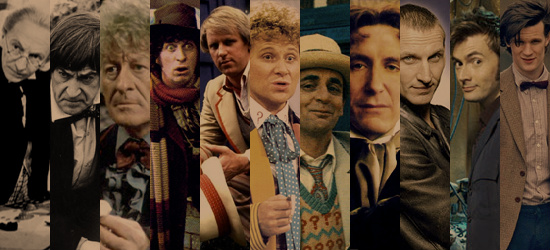
Eleven ages of a man: the undectet of Doctors – in chronological order (and from left to right), William Hartnell, Patrick Troughton, Jon Pertwee, Tom Baker, Peter Davison, Colin Baker, Sylvester McCoy, Paul McGann, Christopher Eccleston, David Tennant and Matt Smith
So then, aside from kicking-off the first proper autumn (or, for all you North Americans out there, fall) month of the year, I take it you know what tomorrow will be bringing us? That’s right, the climactic concluder to the latest season of the indubitably genius Doctor Who. Yes, with all the trailers on the box and the fevered anticipation all over the ‘Net, it’d take a Silurian condemned to the far reaches of the Universe not to know that in one day’s time The Doctor must come up with surely his greatest ever victory – cheating his own death. And his proper death at that, with no chance of a regeneration.
How on earth’s he going to do it? Good question, given we’ve all seen it happen already (at the start of the season – ‘timey-wimey’ and all that). Still, on the bright side, we do know he will manage to cheat death, as it’s been announced that the current actor in the role (Matt Smith) will remain in place for at least another two years yet. Phew, ne-c’est pas? Anyway, talking of The Doctor’s ability to regenerate, in this very post allow me, in celebration of this season’s climax, to guide you through a glimpse at his previous regenerations; that is, in layman’s terms, the on-screen moments when the TARDIS keys have passed from one Doctor actor to the next…
WATCH the video at the end of the post to see, one after another, The Doctor’s regenerations
~~~
The First Doctor (William Hartnell) → The Second Doctor (Patrick Troughton)
The Tenth Planet (1966)/ The Power Of The Daleks (1966)

At the end of the final episode of the serial The Tenth Planet, The Doctor appears to die owing to exhaustion and general old age. Indeed, earlier in this serial he’d commented to his current human companions Ben Jackson and Polly that his body was ‘wearing a bit thin’. In reality, it was actor William Hartnell himself who was wearing a bit thin. Finding it difficult to get on with the show’s new production team (following the moving on of now legendary, but then young and ambitious, producer Verity Lambert) and often unable to remember his lines (owing to an undiagnosed onset of anteriosclerosis), Hartnell’s time had come – the showrunners had decided it was necessary to replace him. But how? Doctor Who was a huge hit in the early-teatime Saturday slot, so there was no question of ending the series with Hartnell’s departure, so just how could they introduce a new actor in the same role? The answer was genius – and it came thanks to then script editor Gerry Davis and then producer Innes Lloyd. Davis reasoned that as The Doctor was now well established as an alien and not human, it would be quite acceptable for him not to die when he appears to do so… indeed, his body would in fact undergo a process of ‘renewal’. And, cannily, Lloyd pointed out that if and when they wanted to replace the lead actor in the series again, they could use this excuse once more. Thus, before the eyes of a transfixed nation, William Hartnell’s Doctor ‘renewed’ himself and became Patrick Troughton’s younger Doctor. Originally, the actual transformation wasn’t intended to be caught on-screen, but vision mixer Shirley Coward realised she could transpose the image of Troughton’s face on top of Hartnell’s – much better than having Hartnell cover his face with his cloak as he ‘died’ then have it pulled back to reveal Troughton, which was the original idea. And, even better, halfway through the transition, the image was overexposed causing the screen to fade almost entirely to white, while the TARDIS time-travel sounds and other eerie noises could be heard; the notion was that this psychedelic ‘renewal’ of the Doctor would be similar to a bad LSD trip, as was discovered last year by the release of archive BBC notes on the subject. Yes, really. Indeed, Billy Hartnell’s Doctor may have been an irascible old traditionalist, but in the end he had far more in common with the hippie-infused culture of the Swinging Sixties than he surely would ever have thought.
~~~
The Second Doctor → The Third Doctor (Jon Pertwee)
The War Games (1969)/ Spearhead From Space (1970)

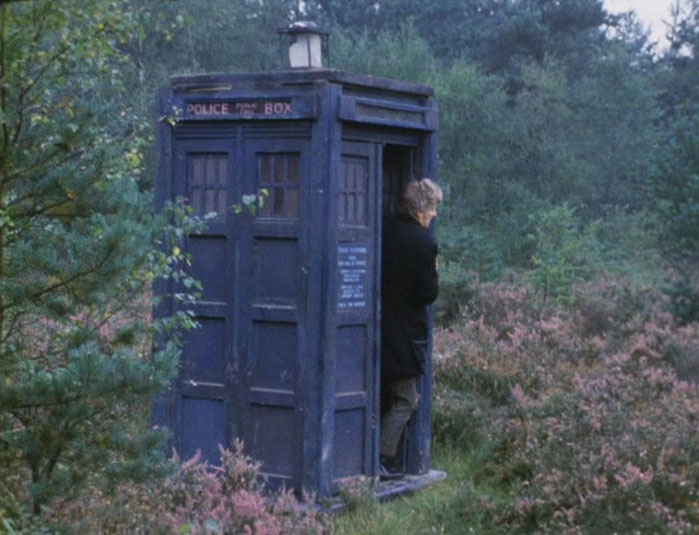
His may be a hugely popular incarnation of The Doctor with today’s fans, but back in the day Patrick Troughton’s take on the character unfortunately coincided with a dip in viewing figures for the show. By the end of the ’60s, it appeared the public simply wasn’t as crazy for Doctor Who as it had been in the middle of the decade. A change needed to be made then, but in actual fact it was Troughton who decided to step down from the role, as opposed to the showrunners asking him to do so. After three years, like Hartnell before him, the actor found the schedule of filming between 40 and 45 episodes a year was too much, plus he was concerned by potential typecasting. Fortuitously, his decision suited the Beeb and the producers as, between them, they came to the conclusion that cost constraints would be imposed on the now seemingly less popular show. What was the effect of this then? Well, at the end of Troughton’s final serial, the excellent The War Games, as punishment for continuously meddling in the lives of other lifeforms, The Doctor would be banished by his own Time Lord race to a single planet – Earth. Yup, no more elaborate, expensive, studio sets for Doctor Who; exterior filming in country villages and interiors in easily mocked-up offices and manor houses would be the order of the day for the next incarnation, the dandy dynamo that was Jon Pertwee. And yet, for all that, one concession, arguably a real improvement, was made – six months after Troughton’s Doc had bowed out, whirling about and gargling away into a monochrome void (presumably at the beginning of his latest ‘renewal’), he reappeared as Pertwee’s Doc falling out of the TARDIS and into a wood… in colour. Yes, with the BBC leaving behind old black-and-white and embracing all the colours of the rainbow at the start of the new decade, The Doctor’s early ’70s adventures may have been completely Earth-bound, but thanks in no small part to their new colourisation, they once more struck an enormous chord with kids of all ages up and down the nation.
~~~
The Third Doctor → The Fourth Doctor (Tom Baker)
Planet Of The Spiders (1974)/ Robot (1974)
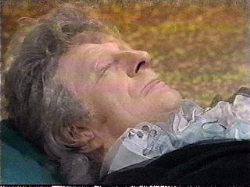


In establishing his Doctor as a heroic, if patrician, dapper man of action, Jon Pertwee’s was surely the most popular incarnation thus far, yet after four years in the role he decided to move on. Just as William Hartnell’s had been before him, his decision was in part influenced by the fact that colleagues with whom he’d been comfortable on the show had left or would soon be leaving the programme, specifically producer Barry Letts and co-stars Katy Manning (who had played his long-time companion Jo Grant) and Roger Delgado (who had originated The Doctor’s Time Lord adversary character The Master and had tragically died in 1973). In looking for a replacement, the outgoing Letts saw the British fantasy film The Golden Voyage Of Sinbad (1974) and was impressed by Tom Baker’s performance as the villain. Although it was intended The Fourth Doctor would be played by an older actor, the 40-year-old Baker won the part and, of course, absolutely made the role his own. His portrayal – all unpredictability, curly hair, boggling eyes and crazily long scarf – took the show to new heights and new viewers, not just in the Britain of the ’70s, but also in the US where Baker’s episodes were the first to be shown in syndication. To this day, for the majority of TV viewers his is surely the most identifiable interpretation of the Gallifreyan gallivanter. The baton was passed from Pertwee to Baker, in the presence of classic companions Sarah Jane Smith (Elisabeth Sladen) and Brigadier Lethbridge-Stewart (Nicholas Courtney), at the end of the episode Planet Of The Spiders, in which The Doctor saves the day but sacrifices himself when he contracts radiation poisoning, and at the start of the next episode Robot, in which the audience witnesses the completion of the actor handover; Baker confusedly spouting lines of previous Doctors and dressing up in different guises (including a Roman soldier) before settling on his Aristide Bruant-inspired togs that’d become his trademark. One further point of interest: it was during this change-over that the transformation of one Doctor into the next was first referred to on-screen as a ‘regeneration’.
~~~
The Fourth Doctor → The Fifth Doctor (Peter Davison)
Logopolis (1981)/ Castrovalva (1981)
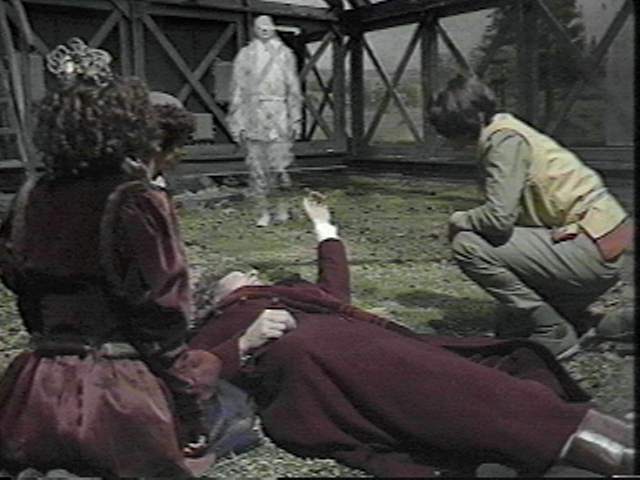


By 1981, Tom Baker had played The Doctor for seven unbroken seasons; he’d been through a full costume change, three producers and four main companions (one of whom he’d married, the second Romana, Lalla Ward). In short, despite little real sign of his popularity dimming, he deemed it was time to bid the TARDIS goodbye. Mind you, his relationship with the show’s latest producer John Nathan-Turner wasn’t what it might have been. New to the job, the latter had wanted to rein in the veteran star’s considerable influence on the show’s direction and had initiated changes when he’d taken over in 1980, including the aforementioned redesign of Baker’s costume, a synth-style updating of the theme tune and a new credits sequence and logo. Sensing that Nathan-Turner really wanted a new actor in the role, Baker bowed out at the end of the ’81 season. Unsurprisingly, the idea behind the casting of the next Doctor was that the role should go to someone who was dissimilar to Tom Baker, both physically and personality-wise. While the portly Richard Griffiths (of Pie In The Sky and Harry Potter fame) was considered, ultimately it was Peter Davison who was chosen, not least because as a fair-haired, 30-year-old he was clearly a departure from Baker, but also as he was already a household name thanks to playing one of the leads in the popular drama All Creatures Great And Small (1978-90), he wasn’t a complete unknown either. As to the actual regeneration itself, during Baker’s final serial Logopolis, a ghost-like, white humanoid figure had kept appearing, which at the point of The Fourth Doctor’s death it became clear was, in fact, a sort of transitional state between him and his next version – referred to as The Watcher, this creature merged with The Doctor as he began to transform. And that’s not the only way in which this regeneration is more elaborate than previous ones. Not only is it witnessed by three companions, but prior to his death-fall from a telescope dish, The Doctor experiences visions of enemies mocking him (including The Master, a Dalek and a Cyberleader) and, during his regeneration, visions of all the companions of the Baker era appear, which include, yes, K-9 the robotic dog – what a loyal canine, eh?
~~~
The Fifth Doctor → The Sixth Doctor (Colin Baker)
The Caves Of Androzani (1984)/ The Twin Dilemma (1984)
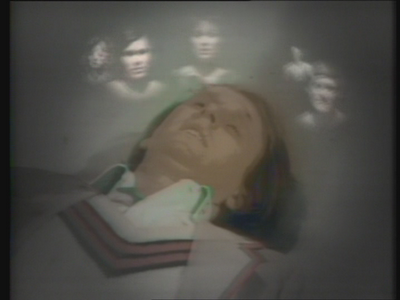
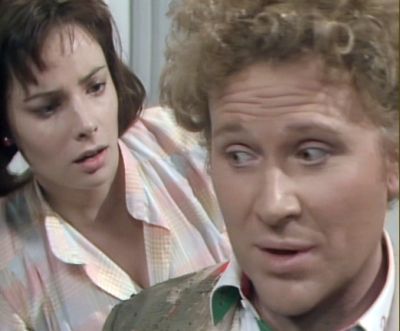
And so to the most controversial regeneration to date. When in 1984 Peter Davison decided to enact what’s become known to fans as ‘The Troughton Rule’ (moving on from playing The Doctor after three seasons, as Patrick Troughton originally did), showrunner John Nathan-Turner took a surprising step. Not only did he cast another Baker – burly, curly blond-haired Colin – as the character’s next incarnation (some sources attest merely because the latter had made him laugh at a party), he also decided to stir things up by making the new Doctor and, thus, this latest regeneration the most challenging so far. Immediately Davison’s always affable version had transformed into the new one (at the end of one of the programme’s best ever serials, the Shakespeare tragedy-like The Caves Of Androzani, thanks to contracting a lethal disease from which, true to form, he saves his latest companion in place of himself), Baker’s Doctor establishes himself as an arrogant, irritable and, frankly, unlikeable character – he attests companion Peri (the bust-dacacious Nicola Bryant) is an ‘egotistical young lady’ because she uses three ‘I’s in her first line to him as she understandably stammers after having witnessed the regeneration. The idea was that the tricksy, crusty exterior to Colin Baker’s Doctor would be slowly peeled away to reveal the warm-hearted, heroic chap underneath the audience had known and loved for more than two decades. But, following his unveiling in the opening episode of his first serial The Twin Dilemma (which is consistently considered the worst in Who‘s entire history), his new persona appears to be more unstable than after any previous regeneration. Not only does he suffer from heavy confusion and amnesia, but in a truly bizarre and disturbing moment he forgets who Peri is and attempts to strangle her. Yes, really. Then he relents, apologises and decides in recompense he must banish himself to a far flung planet for eternity. Yes, really. Colin Baker’s Doctor was off to a bumpy start and, for right or wrong, it wouldn’t get any easier for him…
~~~
The Sixth Doctor → The Seventh Doctor (Sylvester McCoy)
Time And The Rani (1987)

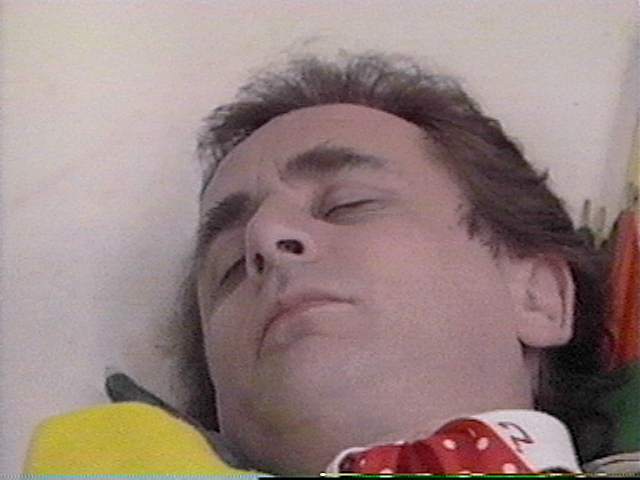
Probably the public’s least popular Doctor, Colin Baker’s was, quite frankly, doomed from the start. After his ill conceived and badly received introduction, he struggled to gain traction with viewers thanks to the slowburn character arc intended for his incarnation in which he’d become likeable and less prickly as his adventures went on. By the time of The Sixth Doctor, the show had long since lost its rightful place at the heart of BBC1’s Saturday tea-time schedule and was now bouncing around weekday early evenings and, at one stage, was even moved back to Saturdays as an afterthought. The effect of all this, combined with the unpopularity of Baker #2’s Doctor, ensured that the programme’s viewing figures were now, relatively speaking, in the toilet. Indeed, it hadn’t helped that BBC1’s new controller of programming Michael Grade felt that Doctor Who had become farcical, violent and past its sell-by date, so much so that he postponed Baker’s second season for a full 18 months (this shortfall was to some extent made up for by Baker and Nicola Bryant as companion Peri, during the gap, appearing in a six-part Who story on a Radio 4 children’s show). In the end, the eventual second season comprised a single 14-episode long story entitled The Trial Of A Timelord, in which The Doctor himself was on trial – a deliberate reference, it’s believed, to the show being ‘on trial’ in the real world. Seemingly fed up then, Colin Baker left at the end of this season and so, for the third time in five years, producer John Nathan-Turner was faced with re-casting the role. The actor he turned to was Sylvester McCoy (the first Scot to land the gig), who’d made a name for himself as a comedy performer on children’s TV shows like Tiswas (1974-82). McCoy made his debut – 10 months after Baker’s final fling – in the first episode of the serial Time And The Rani, when The Sixth Doctor regenerates into the Seventh, presumably (given it’s never specifically explained) owing to injuries from the TARDIS crash-landing on a planet to which its been drawn by an enemy. The regeneration only involved McCoy, as Baker passed on bowing out; the former wore a blonde curly wig while his face was obscured by clever (if very ’80s) special effects, as the transformation into, well, himself took place. Colin Baker, like he is the public’s, is probably my least favourite Doctor, but he surely deserved a better end to his Doctor duties than that.
~~~
The Seventh Doctor → The Eighth Doctor (Paul McGann)
Doctor Who (The TV Movie) (1996)

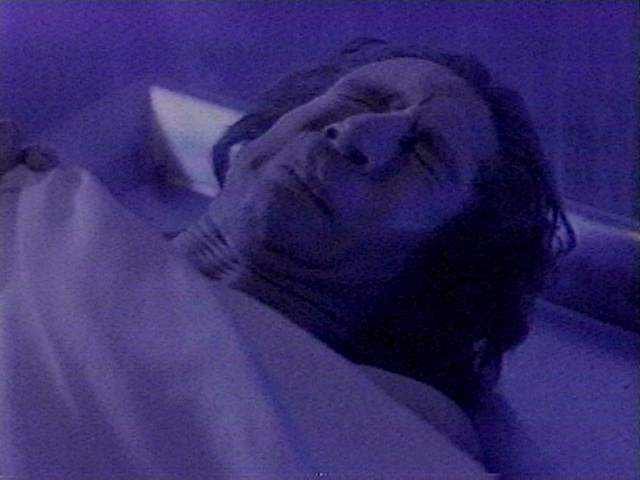
Given it coincided – after 26 unbroken years – with the cancellation of the original (or ‘Classic’) series of Doctor Who, Sylvester McCoy’s departure from the programme might be said to be more ignominious than Colin Baker’s. Only that would be wrong, for after a seven-year hiatus, McCoy had his chance to say adieu when he accepted the invitation for his Doctor to regenerate into the next, the Eighth. But what exactly was he asked back for? Well, it wasn’t the return of the show, but a standalone TV movie merely entitled ‘Doctor Who’; although plans were afoot for a rebooted series had it taken off. In fact, the project – a co-production between the Beeb and the US media giants Universal and Fox – was a resounding success in both Canada (where it first aired) and the UK (where it raked in an impressive nine million viewers), but in capturing just over five million viewers in the US, for whose market it was targeted more than any other, it was deemed a failure and thus became something of a curiosity of the Doctor Who canon. Perhaps because of pressure from its big-money American backers, perhaps not, the decision was made to re-cast the lead character once more, with the gifted and then young-ish Paul McGann brought in. Famed for his co-lead in the classic comedy Withnail And I (1987), McGann offered the audience an intriguingly sensitive, yet mysterious and whimsical version of The Doctor, sporting a shaggy dark mane (although he’d turned up to play the role shaven-headed and thus had to wear a wig). I rather like McGann’s interpretation, so it’s a shame he only got one TARDIS trip – he has made many more in audio adventures and comics and appears at fan conventions, mind. His regeneration is arguably one of the best too, as the trusty old TARDIS materialises in the centre of San Francisco’s Chinatown in 1999, out steps McCoy’s Doctor and, accidentally, is gunned down by gang hoods. A hospital scene ensues which, because his Time Lord body contains two hearts, goes horribly wrong and effectively results in his death and – with Frankenstein overtones (a monochrome movie version of the story even plays on a TV while the regeneration takes place) – The Seventh Doctor comes alive on a slab in a morgue. McGann’s Doctor was born like a monster then, yet proved to be anything but.
~~~
The Ninth Doctor (Christopher Eccleston) → The Tenth Doctor (David Tennant)
The Parting Of The Ways (2005)/ The Christmas Invasion (2005)

Nine years after the Doctor Who TV movie, which was perfectly likeable but at which the public shrugged, the ‘Doc was back in a brand-spanking new 13-part BBC series. This time the public didn’t shrug, it lapped it up like, well, fish-fingers and custard. The brainchild of writer Russell T Davies, the revamped show not only ensured Who was a Saturday night ratings blockbuster for the Beeb once more, but also became a cultural firmament of New Labour Britain. With its multi-ethnic, multi-sexual casts it was a fantastical sci-fi drama that was curiously socially reflective of the urban UK of the Noughties. Being the forgotten Doctor as far as the populace were concerned, Paul McGann enjoyed no curtain-call, instead a very much post-regeneration Ninth Doctor (portrayed by the very Northern, Salford-born and all-round excellent thesp Christopher Eccleston) jumped straight into the new escapades with energy, gusto and passion. And yet, for all that, he decided to quit the show after just one season. Many in the media were surprised, even bemused, assuming he was concerned by the danger of being typecast and kept from heavy, worthy roles if he remained travelling through time and space. Apparently, this wasn’t the case at all; over the years it’s emerged the most likely reason for his departure was he felt that much of the new show’s hard work – and especially the stunt work – was too rushed and thus handled potentially dangerously by its producers who had simply never run a show of this sort before. Whether that’s true or not, well, Rassilon probably only knows, but out went Chris and, of course, in came Dave. The former regenerated into the latter (to spectacularly satisfying effect) after kissing Billie Piper’s companion Rose, in order to prevent her absorbing the fatal time vortex she had consumed in opening the heart of the TARDIS to defeat old enemy the Daleks; don’t worry it all makes sense if you watch his final episode The Parting Of The Ways. So the leather jacketed Eccleston left and sexy Tennant (after Sylvester McCoy, the second Scot to be Doctor, even though he chose ‘Mockney’ as his accent of choice) stepped into the Doctor’s sneakers, making his full debut in the programme’s first Christmas special , er, The Christmas Invasion, in which he saved the world in his pyjamas. Well, we are talking The Doctor, after all.
~~~
The Tenth Doctor → The Eleventh Doctor (Matt Smith)
The End Of Time Part Two (2010)/ The Eleventh Hour (2010)
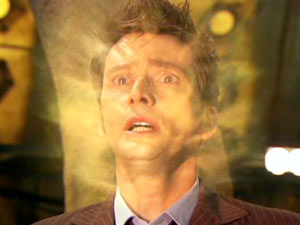


There’s always a lot riding on any Doctor Who regeneration, of course, but because the new series was by now a hugely (and rightly) hyped, unequivocal cash-cow for the Beeb, it felt like everything and the kitchen sink was riding on this regeneration. In a way, it was. On the back of his hugely successful interpretation of The Doctor, David Tennant had surely become the nation’s favourite TV actor – if not its favourite of any medium. His version of the time-hopping hero with two hearts always felt like it was made for the people; up to date with pop culture, falling in love with a nice blonde from a council estate and bantering and bickering with Catherine Tate’s gobby companion Donna, he was the most human Doctor to date. He consistently challenged Tom Baker for top spot in polls of the ‘Docs and still does. In which case, Tennant – as much as midas-touch-like executive producer Russell T Davies – felt like the fulcrum of the show; just what’d happen to it when he left for pastures new? That question, of course, was answered last year when the outsanding Matt Smith was cast as The Eleventh Doctor (then aged just 26, the youngest to date) under the stewardship of new showrunner Steven Moffatt. The new Who has changed under the Moffatt/ Smith direction, for sure, it’s perhaps less accessible and a little more complex, less soapy more sci-fi, if you will (and so, arguably more genuinely Doctor Who), but it very much remains the same show, in which CGI brings alive alien worlds like never before, companions play a bigger role in ensuring an emotional wallop and story arcs across entire seasons enthral fans. And, maybe most important of all, its viewing figures remain as high as they did during the Tennant era. The Tenth Doctor regenerated into The Eleventh on New Year’s Day 2010 at, er, the end of The End Of Time Part Two, when after saving the world from the double threat of The Master and all the other Time Lords, our hero absorbed fatal radiation in order to save Bernard Cribbins (surely a worthy sacrifice in anyone’s book). So powerful was this regeneration, though, that it seemed to semi-destroy the TARDIS, sending the thing crashing to Earth and in need of a regeneration of its own, which took place in Matt Smith’s opening episode, the nattily entitled The Eleventh Hour, in which he also meets new BFF Amy Pond (Karen Gillan). And the rest, as they say, is history. Or the present. Or the future. Or… well, you catch my drift. 
.
Watch the final episode of this season’s Doctor Who, The Wedding Of River Song, tomorrow at 7.05pm on BBC1(HD) in the UK and Northern Ireland, at 8pm (ET) on Space in Canada, at 8/9(pm)c on BBC America in the US, and next Saturday at 7.30pm on ABC1 in Australia
~~~

American grafitti: John Travolta had all the right moves in Saturday Night Fever – a perfect blend of neo-realist cinema with white-hot pop culture glamour and an awesome soundtrack
Few would disagree that, as a whole, the 1970s were all over the shop. And fittingly, perhaps more than in any other decade, so was the Anglo-American (and some of the ‘worldwide’) cinematic output of those 10 years. On the one hand there was economic turmoil and strikes, the demise of the hopes of hippie-culture and ‘free love’, continued conflict in Vietnam and the Middle East, and terrorism seemed to abound eveywhere. Yet, at the same time, music and television was full of colour thanks to glam rock, funk, disco and punk, while British TV’s sitcoms, variety shows, dramas and, oh yes, Doctor Who were all in their prime. Plus, while the England football team was hopeless, the country’s First Division was fascinating and the summer of ’76 felt like it went on forever (correction: it did).
It could be said then that the reality and the culture of the ’70s seemed harder, stranger and more challenging than than those of any previous decade – and seemingly mirroring this, Hollywood and Britain produced more frank and (at the other extreme) more fantastical movies than ever before.
But what are the ‘most ’70s’ films of the ’70s? These then are my specially selected dectet that define cinema of the 20th Century’s eighth decade – in no order but chronological. Yes, have your bell bottoms, platforms and Raleigh Choppers at the ready, folks, because here we go…
.
CLICK on the film titles for video clips
.
The French Connection (1971)

If any film set a standard and even a mould for American cinema of the ’70s, then it has to be The French Connection. Inspired by real events and people, it concerns itself with the world of New York narcotics cops and their attempts to smash a drugs ring originating out of Marseille, France, and aiming to make millions by dumping its product on the mean streets of the Big Apple. Unapologetically uncompromising in its depiction of the world of its protagonist Detective Jimmy ‘Popeye’ Doyle (Gene Hackman in a career-defining role) and his sidekick (Roy Scheider), its director William Friedkin – a leading player among the young talents of the big-studio broken-up ‘New Hollywood’ – embraced neo-realism so well, he made it look like an artform in this flick. Indeed, it would arguably become just that as the decade progressed and similarly hard-edged movies (many from Friedkin’s contemporaries) also made hay going the neo-realist route, among them Martin Scorsese’s Mean Streets (1973) and Taxi Driver (1976), Sidney Lumet’s Serpico (1973) and Dog Day Afternoon (1975), Francis Ford Coppola’s The Conversation (1974) and Milos Forman’s One Flew Over The Cuckoo’s Nest (1975). Like The French Connection, all these films – and more like them – dealt with the themes of urban and moral decay, crime and alienated individuals on society’s fringes. Indeed, as pointed out in my recent post on the previous decade’s cinema, late ’60s flicks like Easy Rider and Midnight Cowboy (both 1969) certainly anticipated (and maybe created) this new direction, but thanks to its action, violence, excitement and huge public and critical success – it won Oscars for Picture, director, actor (Hackman), screenplay and editing – The French Connection was the engine of the gritty, buffed-up freight train that hurtled through ’70s American cinema.
~~~
Carry On At Your Convenience (1971)

In light of the above, surprising it may seem, but in the ’60s the cinematic neo-realism forged by the French Nouvelle Vague (or ‘New Wave’) first reached Britain – with the likes of Tom Jones (1963) and Darling (1965) – before it made it to Hollywood – with the likes of The Graduate (1967) – but as the ’70s progressed, the latter certainly left the former behind in those stakes. In spite of making the odd acclaimed gritty film this decade, such as Get Carter (1971) and Midnight Express (1978), the UK film industry – disadvantaged by a lack of money like, well, seemingly everything else in the country – liked nothing better than to churn out cheap, cheerful, bawdy comedies in a cynical, if not desperate, attempt to pull the punters in. This was unfortunate on two counts. First, artistic merit went out the window and was replaced by T&A, no better exemplified than in the Robin Askwith-headlining Confessions series of flicks (1974-77). Second, the Carry On films – a staple of generally innocent, end-of-the-pier humour; highly successful and sometimes witty and good throughout the ’60s – degenerated too often into contrivance, slapstick and smut in the ’70s. They still had their moments, sure, but unquestionably featured many bum-notes too (fnarr, fnarr). However, one of their highs came with Carry On At Your Convenience. Instead of relying solely on toilet humour (although it certainly featured some), it proved to be one of the wittiest, smartest and funniest of ’em all. With all of the regular cast present (the only absentee being Babs Windsor), director Gerald Thomas and screenwriter Talbot Rothwell shaped a tale about toilet factory shenanigans against the backdrop of class and union politics. Given this fact, for me then there can be no more ’70s a Carry On movie than this ‘un (and, let’s be honest, the Carry Ons themselves are just so ’70s). The only irony being that Convenience was actually made some two or so years before union-led strikes properly hit Britain, ensuring the film wasn’t so of-the-moment as it was prescient. See, told you it was smart.
~~~
Live And Let Die (1973)
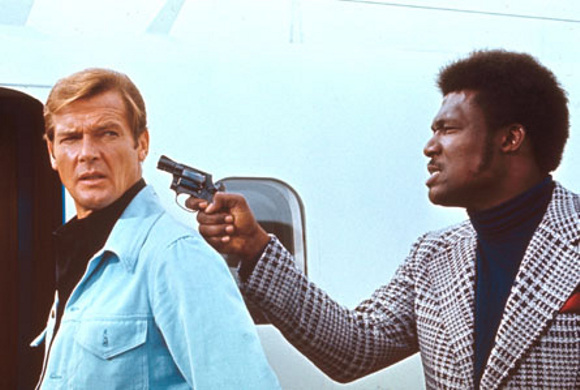
There was, of course, one other cinematic genre in the ’70s that kept the British end up – quite literally. Yes, that man Bond. Following the loss of Sean Connery as everyone’s favourite, highly conspicuous secret agent in 1967, one could have been forgiven for thinking Eon Productions’ oh-so-successful-in-the-’60s Bond film series would have undergone an identity crisis in the next decade (not least as Aussie model George Lazenby enjoyed a mere single fling as 007 in 1969’s On Her Majesty’s Secret Service and Connery only came back for a one-off in 1971’s Diamonds Are Forever), but, in fact, the reality was anything but. This was most of all because of He Of The Errant Eyebrow, the über-smooth Roger Moore, stepping into the role and doing something completely different with it to Connery (but just as confident and appealing), thus guiding the movies with enviable momentum through the next 12 years. But, while Moore’s tenure as the shoulder-holster wearer is maybe best remembered for the boffo box-office of The Spy Who Loved Me (1977) and Moonraker (1979), just as – if not maybe more important – in terms of his Bond was his first outing; the one that truly laid the seeds of his Bond’s success. Live And Let Die is also arguably the most ’70s 007 adventure; in fact, it’s an incredibly ’70s flick. Its success lies not just in the terrifically effective use of exciting speedboat and motorbike-cum-London-bus chases, but also in establishing a brand new actor in the role of Bond by juxtaposing his charming British gent with edgy, urban and dangerous black American villains dressed in bold colours, flares and platforms. This then, in many ways, is Blighty’s finest thrown into the world of Blaxpoitation cinema (the movie is very much of the era of both 1971’s Shaft and ’72’s Superfly) and, by blending into this mix the stunt set-pieces, Caribbean voodoo, a rocking Paul McCartney title song hit and the beauty of Jane Seymour, Sir Rog’s Bond came up smelling of roses – both within the film and without. In short, Bond-goes-funk is far from bunkum.
~~~
Scener Ur Ett Äktenskap (Scenes From A Marriage) (1973)

As stated above, the ’70s were more than a little surprising, in which case it should come as, well, no surprise that Sweden was considered that decade an unquestionably cool, sexy place. Yes, that’s right, good old frigid, oh-so Scandinavian Sweden. In fact, an unashamedly socially liberated nation, thanks in part to decades of rule under its Social Democratic Workers’ Party (defeat in 1976 for this political party would bring an end to 40 unbroken years in power), Sweden was, back in the day, seen as a leader of the ‘sexual revolution’ and seemingly tolerant and easy with both feminism and homosexuality. Not least because of the international sensation caused by the very sexually frank film Jag Är Nyfiken – Gul (I Am Curious – Yellow) (1967) and the amazing rise and worldwide chart domination by pop quartet ABBA, following their victory at the 1974 Eurovision Song Contest. And in 1973 this very liberated, very modern-seeming society was put under the microscope by its greatest filmmaker, the legend that is Ingmar Bergman, in Scener Ur Ett Äktenskap (Scenes From A Marriage). Originally a TV drama that ran almost two hours longer than its cinematically released version, Bergman’s piece is an iconic slice of ’70s culture that details a couple’s (Liv Ullmann and Erlan Josephman) sexual and broader marital difficulties, their separation and later reconciliation. In a post-’60s world in which people were more open to expressing their emotions and investing in more equal relationships, the issues explored in Scenes From A Marriage were very much en vogue, ensuring it went down a storm among arty, fashionable film lovers. The movie was nominated for Best Foreign Language Film at both the BAFTAs and the Golden Globes; both organisations also nominated Ullmann for Best Actress. Indeed, off the back of this film (and her role in it), the lovely Liv – all natural redheaded beauty – became both a premier pin-up as well as a feminist figurehead. One downside to the flick perhaps, though, was that in the year following its release, divorces almost doubled in its native Sweden. Talk about life imitating art.
~~~
Emmanuelle (1974)

While Sweden may have liked to suggest it was a socially liberal paradise in the ’60s and ’70s, for a brief (and, for some, frightening) moment in the ’70s, the United States suggested it too was far more liberal than it thought it was, at least when it came to the naughty stuff. Somehow in 1972 two hardcore porn films, Deep Throat and Behind The Green Door, managed to secure mainstream cinema releases, then the following year another one, The Devil In Miss Jones, achieved the same feat. This, you would have thought was a blip, an anomaly, and it was, but all three became notorious. Why? Because, relatively speaking, people flocked to see them – indeed, before it was removed from cinemas, The Devil In Miss Jones earned nearly $8 million in ticket sales, ensuring it finished seventh at the US box-office in 1973. The short-term effect of all this was what became known as ‘porno chic’. Yes, before the threat of AIDS in the ’80s, among some socially liberal bods porn became, well, fashionable. How could this be possible post-’73 when the stuff no longer found its way into mainstream cinemas? The answer is through softcore films and, most notably, the first and biggest, Emmanuelle. With high production values, a decent score and its legendary soft-focus cinematography, Emmanuelle was effectively a sanitisation of pornography – and because of that it made a mint. The ace up its sleeve may have been the fact its protagonist was a woman, über-sexy Swede Sylvia Kristel as the eponymous Emmanuelle, an ambassador’s wife with time on her hands and oodles of curiosity in kinky old Bangkok. Seemingly taking a vicarious pleasure in her exploits, more women than men saw the film in cinemas, especially those in France, the country of its origin; which gained the movie a strange respectability. Emmanuelle sparked a softcore porn boom, the legacy of which is the risible, nudity-fuelled skin-flicks that fill the late night schedules of today’s TV channels. Make no mistake then, in the ’70s Emmanuelle, in its own way, was as big a phenomenon as Star Wars (1977). But without the lightsabers and black holes (especially as it was softcore). Erm…
~~~
The Towering Inferno (1974)
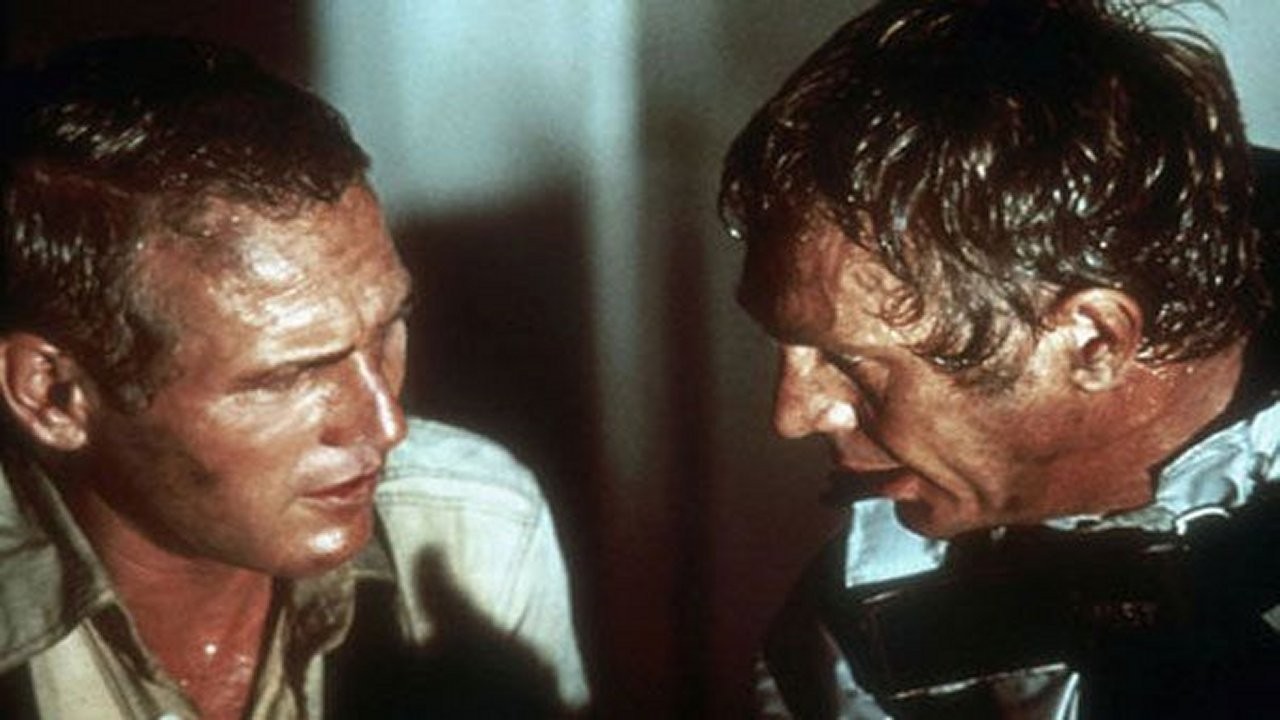
In the wake of television’s increasing popularity, Hollywood saw a worrying drop in audiences in the ’60s; conversely, in the ’70s it saw a growth of revenues thanks to monster hits like Love Story (1970), Jaws (1975) and, of course, Star Wars (1977). As if buoyed by this, Tinseltown this decade came up with one its most give-’em-exactly-what-they-(or-what-we-think-they)-want genres… the disaster movie. The dye was set in 1970 with the $10 million-budgeted, self-describing Airport, which made more than 10 times its budget at the global box-office. Two years later, canny producer Irwin Allen got in on the act with The Poseidon Adventure. This one focused on a Gene Hackman-featuring cruise liner sinking on New Years’ Eve. It too was a huge hit. And, predictably, Allen followed up Poseidon with something even grander. The Towering Inferno was such a big production it had to be financed by two separate studios – not an uncommon occurrence for today’s blockbusters, but unheard of then. Another mark of its largesse was the largeness of its all-star cast – Paul Newman, Steve McQueen, William Holden, Faye Dunaway, Richard Chamberlain, Robert Vaughn and even Fred Astaire all signed on. This was not without its problems, mind, as McQueen threw a wobbly when he learned that Newman had 12 more lines in the script than him. Another potential flare-up was avoided when it came to the two interstellar thesps’ billing; in the credits and on posters McQueen’s name appeared on the left, Newman’s on the right, but higher – so both appeared to enjoy equal status. Frankly, everything about The Towering Inferno was big, yet it was awesome too. And ’70s awesome at that. Hollywood would really succeed in going for shameless hugeness in the ’80s, of course, but with this flick it unashamedly pulled out all the stops (cast, sets, effects et al), yet with creaky, somewhat crappy looking ’70s style. And to my mind these accoutrements – the flares, the wide ties, the big bowties, the bland-cum-naff-looking interiors and the soap opera-esque melodrama – give the thing a huge dollop of so-tasteless-it’s-terrific charm. Oh, and it made more money than Airport – and Newman and McQueen both survived to the end… quel surprise.
~~~
All The President’s Men (1976)

Can you get much more ’70s than ‘Watergate’? It was, of course, the crisis that engulfed US President Richard ‘Tricky Dickie’ Nixon, eventually forcing him to resign from office before he could be indicted for conspiring to jeopardise the Democrats’ attempts to win the ’72 election, along with so many of the leading players of his administration. And for both America and the wider Western world it feels like it sums up the disappointment, dismay and general decay that’s an enduring legacy of that decade. Given all that then, along with the fact it’s one of the finest exponents of the conspiracy thriller (another ’70s film genre par excellence), All The President’s Men is an absolute shoo-in for this list. Adapted from the book of the same name by Bob Woodward and Carl Bernstein, it tells the tale of how these two Washington Post whizz-kid reporters broke the story of Watergate to the world. And it does so supremely well. Scripted by superstar screen scribe William Goldman, with resolute dedication, high detail and refreshing intelligence, this flick is the finest possible advert for old-school investigative journalism. It displays, at times almost excruciatingly, how challenging yet thrilling Woodward and Bernstein’s (a dream-ticket pairing of Robert Redford and Dustin Hoffman) efforts to uncover the truth, step by step, truly were. Nailing Nixon and his cohorts didn’t come about through underhand ‘door-stepping’ or declaring tittle-tattle political gossip as fact, but through securing sources and checking and re-checking the facts. In short, it came down to hard work. And hard work is what this flick’s all about. Goldman deservedly won an Oscar for his spot-on screenplay, while co-star Jason Robards was named Best Supporting Actor for essaying the world-weary, hard but fair editor Ben Bradlee, who was in Woodward and Bernstein’s corner when it came to selling the story to the Post‘s mandarins, but also ensured the hacks got the job done right. Shamefully, while director Alan J Pakula and co. got the job done on this flick so right, the Academy gave the big prize that year to feelgood-athon Rocky. Just like years earlier when a grinning Nixon extravagantly waved goodbye before escaping on the Marine One chopper, there was no justice.
~~~
Saturday Night Fever (1977)

Quite frankly, Saturday Night Fever is probably the quintessential 1970s movie. If you actively tried to seek out a more era-defining film than this caustic coming-of-age tale set amidst New York’s gaudy, multi-coloured disco scene in its pomp, which also, of course, introduced to the world the bobby dazzler dancer himself, John Travolta, you’d probably fail like Barry White attempting a Barry Gibb falsetto note. So synonymous has Saturday Night Fever become with the ’70s and that decade’s infamous Marmite-like love-it-or-hate-it music craze that over the years it’s been the major inspiration behind ’70s-themed nightclub nights, theatrical musicals and even an execrable karaoke-based game show on British TV’s Channel Five. Yes, that John Travolta and those Bee Gees have a lot to answer for – but boy, could he rip up a dancefloor and could they write a disco tune or six. And yet, whether you recall it or not, there’s much more to this flick than just that. The majority of us tend to have quite sanitised memories of Saturday Night Fever, seeing it as a nostalgic trip back to (one of) the decade(s) that taste forgot, but that’s rather ironic given that, in actual fact, it’s a pretty gritty, hard-edged social drama that employs French Connection-style neo-realist techniques to tell protagonist Tony Manero’s story of stunted urban self-improvement. Indeed, near newcomer Travolta (he’d already made a name for himself on the box in sitcom Welcome Back, Kotter) impressed so much in the iconic lead role that, at the age of 24, he became one of the youngest ever nominees for the Best Actor Oscar – and he won the equivalent award dished out by the US film industry’s National Board of Review. Mind you, many can be forgiven for their misty-eyed memories of this picture, as both a proper R-rated version (which actually contains the ‘c’-word) and a retooled PG-rated version were released. Chances are then, if you were a teenager back in the day and originally saw this film at the cinema or on telly, you saw the latter, family friendly version with all the juicy bits – the bits that make it an engaging watch – cut out. Do yourself a favour then and hunt down a DVD of the flick today to get the full R-rated treatment – then you’ll be jive talkin’, all right.
~~~
The Deer Hunter (1978)

Few events have dominated the modern American psyche like the Vietnam War. Straddling three decades (officially taking place between 1955 and ’75) it was an ill-conceived, ill-fought military humiliation for the United States, through which the country not only lost thousands of young servicemen, but also saw thousands more left scarred and disillusioned – as was, to a lesser extent, a generation of idealistic Americans. Inevitably, soon after its sorry close, Hollywood set its sights on using Vietnam as the subject matter for several major flicks. High on its new neo-realist kick, it was ready to bring the thing to life with bells on – and boy, did it ever. It wouldn’t just viscerally dramatise events (real and imagined) set around the war, but also comment, criticise and empathise with unwavering intensity. And surely the most intense and maybe both the most effective and affecting film Hollywood delivered about Vietnam in the ’70s was The Deer Hunter. Directed by Michael Cimino (who would become infamous after the failure of 1980’s Heaven’s Gate contributed to the demise of United Artists), it’s a no-holds-barred examination of the lives of three volunteers from a Pennsylvanian steel mill town before, after and – in a shorter, but unforgettable segment – during the war. Starring the cream of the ‘New Hollywood’ naturalistic players, including Robert De Niro, Meryl Streep and Christopher Walken, it slowly, movingly and, at times, harrowingly expresses how this trio’s lives are inexorably changed by their involvement in Vietnam; all three sacrifice a great deal and only one of them (by far mentally the strongest) gains anything, and then only conditionally. Although epic, sweeping and in many ways beautiful, The Deer Hunter is also a deliberately tough watch. Nevertheless, it rightly stormed the Oscars, winning Best Picture, Best Director for Cimino and Best Supporting Actor for Walken. Since then, criticism has trailed in its wake – it’s been accused of racism as its only Vietnamese characters are drawn as brutal savages and hasn’t benefited from the disaster Cimino’s career became post-Heaven’s Gate – but it remains an (if not the) essential document Hollywood has produced about one of the most regrettable chapters of America’s history.
~~~
Apocalypse Now (1979)
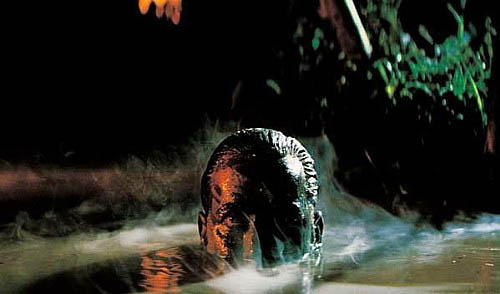
The making of Apocalypse Now is almost as notorious as the movie itself – and effectively spelled the end of auteur-friendly ‘New Hollywood’ and, thus, in more ways than one brought down the curtain on American film of the 1970s. It was made by producer-cum-director-cum-screenwriter Francis Ford Coppola, who had made one hell of a name for himself (and made a mint for Tinseltown) by delivering The Godfather (1972) and The Godfather Part II (1974), for both of which he’d been awarded the Best Picture Oscar and for the latter named Best Director. Essentially an adaptation of Joseph Conrad’s 1902 novella Heart Of Darkness filtered through the Vietnam War, Apocalypse Now is far from a ‘faithful’ cinematic interpretation of that conflict; it’s an hallucinatory and fantasised take on it to examine the war-forced darkness of man. No question, to that end, it’s a triumph. The movie’s arguably the most easily recalled ‘war is hell’ film and, for many, can be thanked/ blamed (delete as appropriate) for forming their mind’s eye view of ‘Nam. However, for all that, it’s actually a wonder Coppola pulled it off. Filmed in the Philippines, the production’s sets were destroyed by a typhoon, star Martin Sheen suffered a near-fatal heart attack and the cameoing Marlon Brando turned up overweight forcing its ending to be improvised. All this ensured filming went on forever and the budget almost spiralled out of control. But the flick went down a storm at Cannes, winning for its director a Palme d’Or, and grossed around $150 million worldwide. Yet, there was a price to pay. The artistic and financial excesses incurred in its making (in addition to those experienced for the likes of, if you will, fellow epic vanity projects like The Deer Hunter) were simply too much for Hollywood to stomach any longer. The big studio control had been broken in the ’60s leading to the ‘movie brats’ (Spielberg, Lucas, Scorsese, Coppola, Cimino etc) to enjoy near free-rein in their ’70s filmmaking escapades, but now the studios bit back and pulled in the purse strings. In response, for his part, Coppola would boldly go it alone and finance his next film himself , but One From The Heart (1982) was an unmitigated disaster that bankrupted him. Hollywood’s flirtation with über -artistry was over; in the ’80s, American cinema, like seemingly everything else that decade, would be all about money – money, money, money…
~~~
Five more to check out…
Get Carter (1971)
Mentioned above, Michael Caine-starrer in which the hardest hard man in Britain returns to his home town to avenge relatives and scare neighbours in his birthday suit with a shotgun
Shaft (1971)
The essential Blaxpoitation flick – Richard Rountree is the bad mother (shut your mouth) sorting out wrong ‘uns while being the coolest private eye since Bogie in The Big Sleep (1946)
Enter The Dragon (1973)
In the best example of that other now ubiquitous ’70s film genre, the kung-fu movie, Bruce Lee immortalises himself as the East’s martial arts answer to Clint Eastwood
The Conversation (1974)
Again, mentioned above, Francis Ford Coppola’s fine conspiracy thriller is among the very best of the genre with a terrific Gene Hackman and lashings of tension and paranoia
Taxi Driver (1976)
Robert De Niro’s first legendary essaying of a Vietnam vet sees a mentally unstable misfit violently lose the plot in the anonymity of New York
~~~
… And five great films about the ’70s
Dazed And Confused (1993)
Excellent ensemble following suburban teenagers on the last day of school in the summer of ’76 – highlights include fine cameos from both Matthew McConaughey and Ben Affleck, no really
In The Name Of The Father (1993)
Thrilling re-telling of the case of the ‘Guildford Four’, imprisoned in 1974 as London pub bombers acting for the IRA, with top performances from both Daniel Day Lewis and Pete Postlethwaite
The Ice Storm (1998)
Kevin Kline and Sigourney Weaver headline this Thanksgiving ’73-set family drama focusing on the shifting social mores of the time
Almost Famous (2000)
Eminently watchable, affectionate tribute to the world of early ’70s rock, with an angelic Kate Hudson and an outstanding soundtrack
Munich (2005)
Spielberg’s take on Mossad’s assumed response to the ’72 Munich Olympics terrorist atrocity, so good an homage to that decade’s conspiracy/ espionage thrillers it actually rivals the quality of the very best

9/11/11: a tribute to The Big Apple

Logo a-gogo: designed by graphic artist Milton Glaser in 1977, this image sold the dream that is New York City throughout the 1980s and beyond (although commissioned for New York State)
This is for the main part, of course, a blog that celebrates retro culture, but this Sunday is the tenth anniversary of a relatively recent date in history – a day on which the world changed, arguably forever: 9/11.
Five years ago this month, I had the pleasure of visiting New York City. Like so many of my generation, perhaps, I’d somewhat idolised the place as the ultimate metropolis, the ultimate destination in many ways. I’m a child of the ’80s and so grew up with New York as it was represented in films like Ghostbusters (1984), Crocodile Dundee (1987) and Coming To America (1988), TV series like Kojak (1973-78) and Cagney And Lacey (1981-88) and was publicised so widely and unavoidably by the ‘I ♥ NY’ logo above. It was the bright, brilliant beacon of Reagan’s America that so colourfully and seductively led the world.
And what did I think of it? Well, it’s a monster of a metropolis that’s very money-driven, for sure, but also a fascinating, soulful and contradictory place, like every other major city you could visit in the world. What it is unquestionably, though, just as it always has been and always will be, is The Big Apple. And through the following images, quotes and, yes, clips featuring moments from flicks, music and song, I’d like to celebrate the one, the only New York City…
~~~
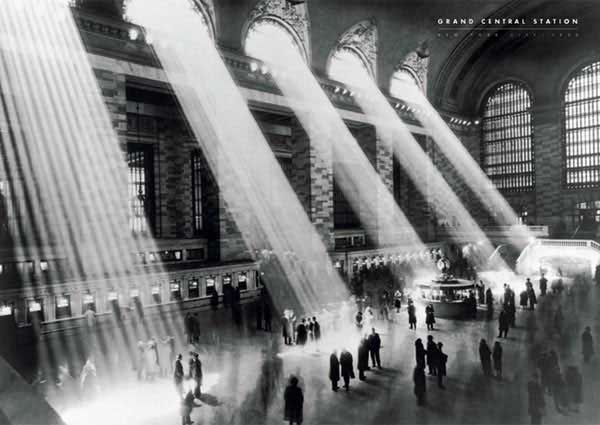
Light fantastic: the magnificent image detailing the shards of sunlight casting through the windows of Manhattan’s Grand Central Station (or, more correctly, Grand Central Terminal) – the station , in fact, owes its continued existence to the preservation efforts of Jackie Onassis
~~~
“On November 1st, 1959, the population of New York City was 8,042,783. If you laid all these people end to end, figuring an average height of five feet six and a half inches, they would reach from Times Square to the outskirts of Karachi, Pakistan.” ~ C.C. Baxter (Jack Lemmon), The Apartment (1960)
~~~
Above: the sensational start to 1961’s 10-time Oscar-winning cinematic adaptation of Leonard Bernstein and Stephen Sondheim’s musical West Side Story, set on Manhattan’s Upper West Side
~~~
“There is something in the New York air that makes sleep useless” ~ Simone De Beauvoir
~~~

Art deco dream: the Chrysler Building at night – erected in 1930 at the intersection of 42nd Street and Lexington Avenue, this soaring testament to extravagant elegance was the city’s tallest building for only 11 years when it was overtaken by the Empire State Building
.
“A hundred times have I thought New York is a catastrophe, and fifty times: it is a beautiful catastrophe” ~ Le Corbusier
.
Above: Billy Joel’s paean to the Big Apple, which appeared on his 1976 album Turnstiles and was written following his return to the city after having lived for three years in Los Angeles
~~~
“If you live in New York, even if you’re Catholic, you’re Jewish” ~ Lenny Bruce
~~~
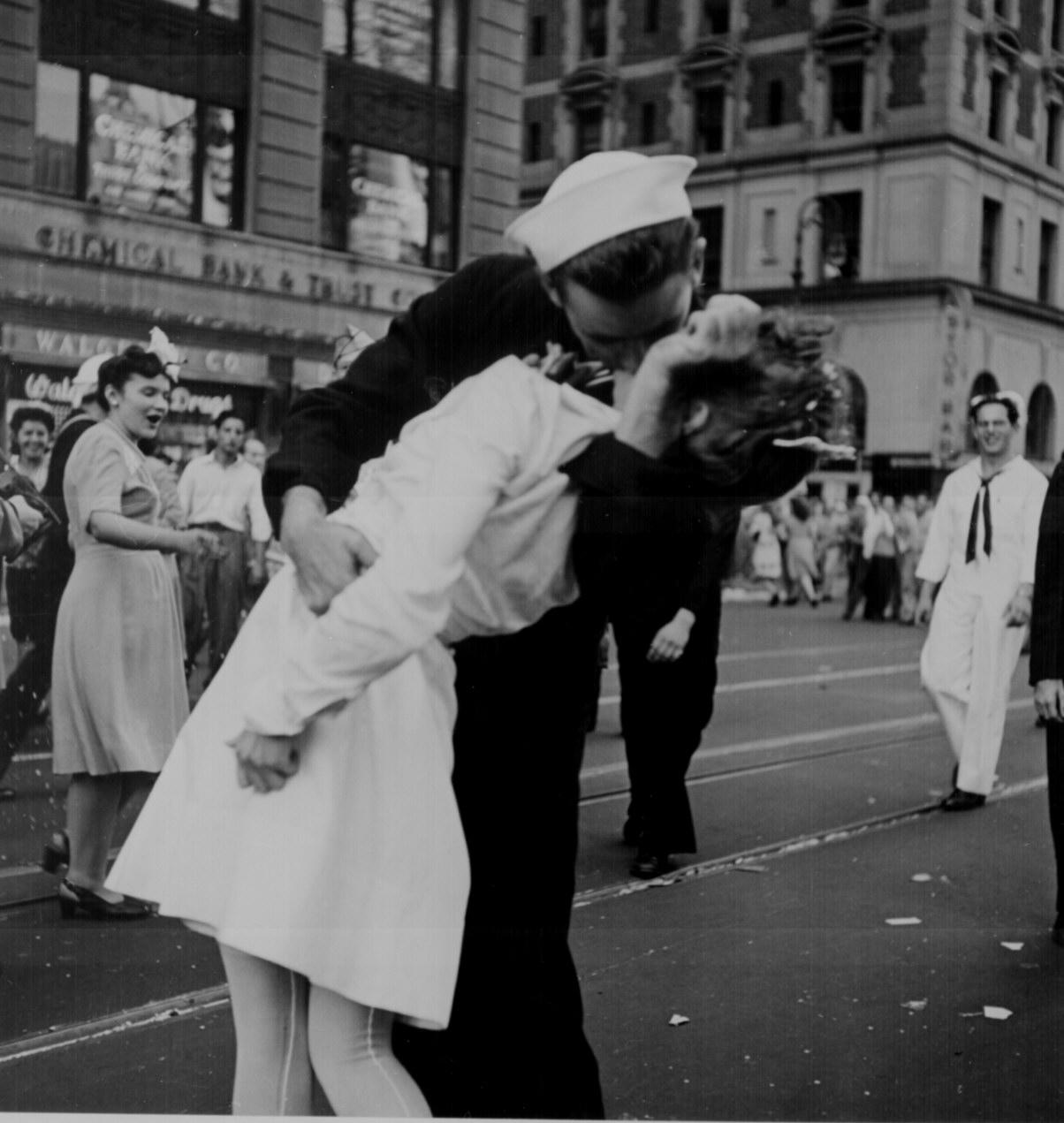
Embracing the moment: US Navy photo journalist Victor Jorgenson’s ‘Kissing The War Goodbye’, which captured the now iconic moment of celebration between a nurse (Edith Shain) and a so far unidentified sailor in Times Square on VJ Day, August 14 1945
~~~
“I don’t want to move to a city where the only cultural advantage is being able to make a right turn on a red light” ~ Alvy Singer (Woody Allen) on the difference between Los Angeles and New York in Annie Hall (1977)
~~~
Above: UK based popster Gerard Kenny’s hit New York New York (So Good They Named It Twice) from 1978, which playfully contrasts the city’s myth against its reality of the time
~~~
“New York remains what it has always been: a city of ebb and flow, a city of constant shifts of population and economics, a city of virtually no rest. It is harsh, dirty, and dangerous, it is whimsical and fanciful, it is beautiful and soaring – it is not one or another of these things but all of them, all at once, and to fail to accept this paradox is to deny the reality of city existence.” ~ Paul Goldberger
~~~

Green giant: to this day, the Empire State Building is New York City’s tallest at 381 metres tall – however, between 1972 and 2001, the World Trade Center’s North Tower eclipsed it at top spot
.
“Vehement silhouettes of Manhattan – that vertical city with unimaginable diamonds” ~ Le Corbusier
.
Above: Audrey Hepburn and George Peppard go walk about in Midtown Manhattan in Breakfast At Tiffany’s (1961) and ponder why anybody would consider leaving the place
~~~
“No matter how many times I visit this great city, I’m always struck by the same thing: a yellow taxi cab” ~ Scott Adams
~~~
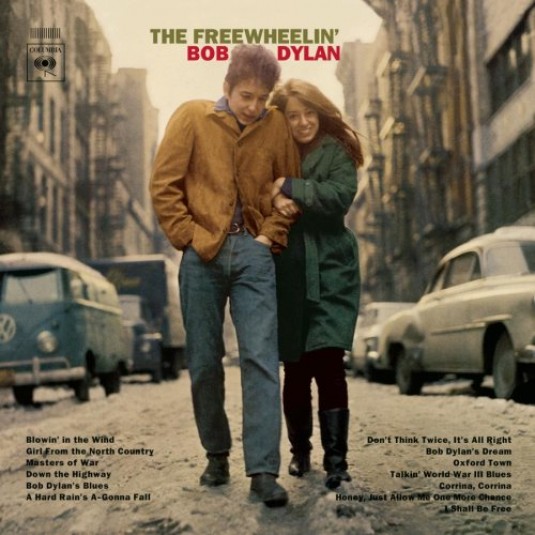
Village voice: the pop culture phenomenon that is the cover to Bob Dylan’s 1963 album The Freewheelin’ Bob Dylan – it shows Dylan and then girlfriend Suze Rotolo taking a winter’s stroll through Greenwich Village, specifically at the corner of Jones Street and West 4th Street
~~~
“When it’s 32 degrees in New York, it’s 78 in Los Angeles. When it’s 102 degrees in New York, it’s 78 in Los Angeles. There are about two million interesting people in New York — and 78 in Los Angeles.” ~ Neil Simon
~~~
Above: a moment from the unforgettable climax to Ghostbusters (1984), ostensibly set atop 55 Central Park West – it’s all a mocked-up set, of course, but comes across damned atmospheric
.
“[New York City is] skyscraper national park” ~ Kurt Vonnegut
.

Far-ch out: Washington Square Park (including Washington Square Arch), looking north towards Midtown Manhattan – the enduring centre of the arty, bohemian Greenwich Village
~~~
“A ‘New York minute’ is the interval between a Manhattan traffic light turning green and the guy behind you honking his horn” ~ Johnny Carson
~~~
Above: Eagles member Don Henley’s timeless New York Minute, from his 1989 album The End Of Innocence – like other iconic songs about the city, it received great airplay following 9/11
~~~

Bibi Andersson/ Liv Ullmann: Bergman’s Beauties
Talent…
.
… These are the lovely ladies and gorgeous girls of eras gone by whose beauty, ability, electricity and all-round x-appeal deserve celebration and – ahem – salivation here at George’s Journal…
~~~
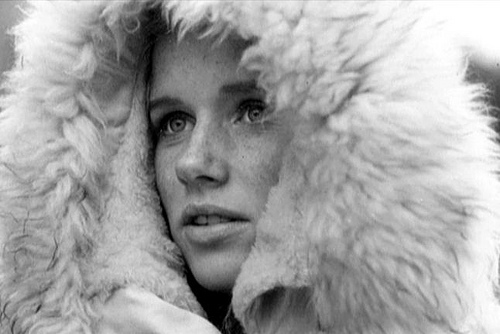
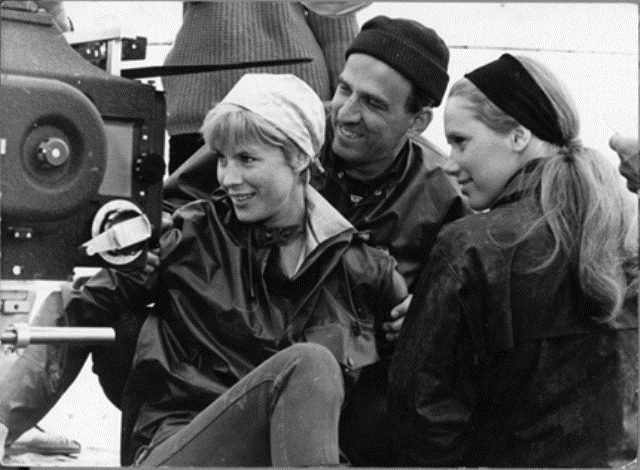
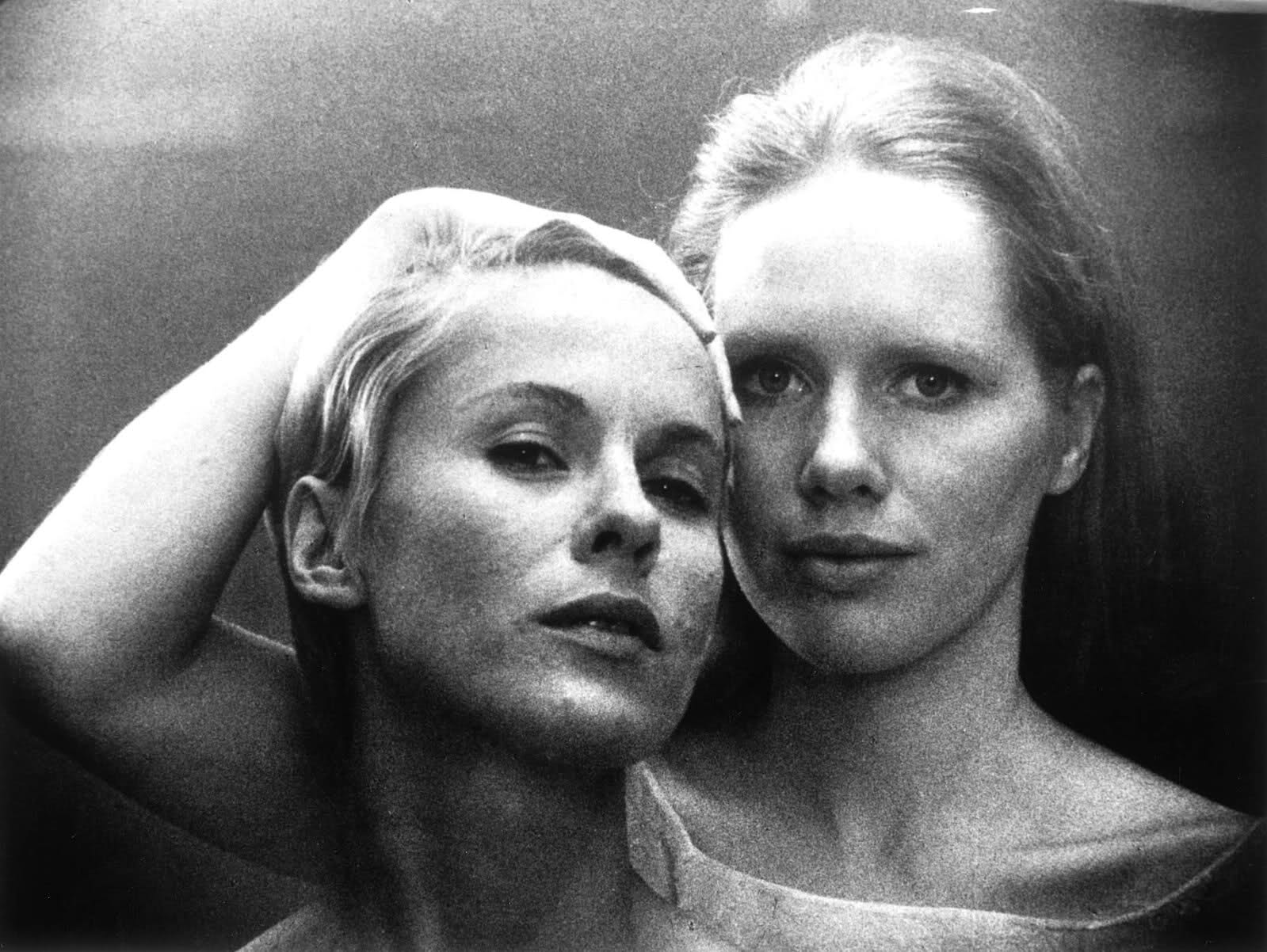
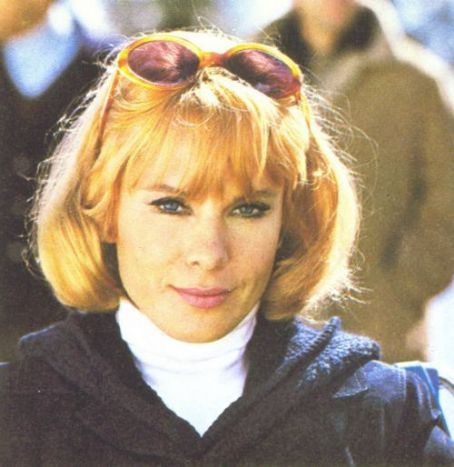
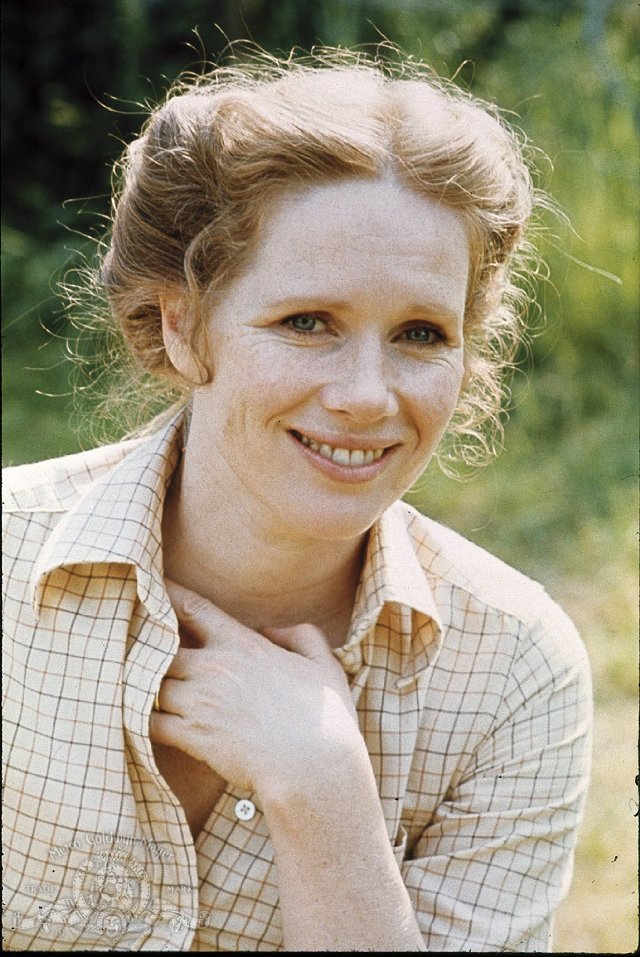
Unforgettable together as an awesome one-two in Ingmar Bergman’s ’60s masterpiece Persona, separately they appeared in many other of his best loved films, inspiring and influencing their female audience and bewitching and tantalising their male admirers. One is a cool, sultry blonde bombshell, the other a flame-haired pin-up of the ’70s. They’re Bibi Andersson and Liv Ullmann – both naturally beautiful and terrifically gifted Scandinavian sex symbols and unquestionably deserving of this blog’s Talent status…
~~~
Profiles
Names: Berit Elisabeth ‘Bibi’ Andersson/ Liv Johanne Ullmann
Nationalities: Bibi – Swedish/ Liv – Norwegian
Professions: Actresses
Born: Bibi – 11 November 1935, Stockholm/ Liv – 16 December 1938, Tokyo, Japan
Heights: Bibi – 5ft 5in/ Liv 5ft 8in
Known for: Bibi – Appearing in 10 movies directed by legendary filmmaker (and fellow countryman) Ingmar Bergman, including Smiles Of A Summer Night (1955), The Seventh Seal (1957), Wild Strawberries (1957), Brink Of Life (1958) and Persona (1966), as well as Hollywood western Duel At Diablo (1966) opposite James Garner and Sidney Poitier, John Huston’s espionage thriller The Kremlin Letter (1970), disaster film sequel The Concorde… Airport ’79 (1979) and Danish Best Foreign Language Film Oscar winner Babette’s Feast (1987)/
Liv – Becoming a cultural, as well as something of a feminist, icon in the ’70s thanks to roles in nine Bergman films (with whom she also had an affair and a daughter, Linn Ullmann), including Persona (1966), Cries And Whispers (1972), Scenes From A Marriage (1973), Face To Face (1976) and Autumn Sonata (1978), as well as appearances in historical drama Pope Joan (1972), Hollywood musical remake Lost Horizon (1974) and WWII epic A Bridge Too Far (1977).
Strange but true: Between 1978 and ’81, Bibi was married to former leader of the Swedish Liberal Party Per Ahlmark; Liv was nominated for the Palme d’Or at the Cannes Film Festival for her work directing Faithless (2000), from a screenplay by Bergman.
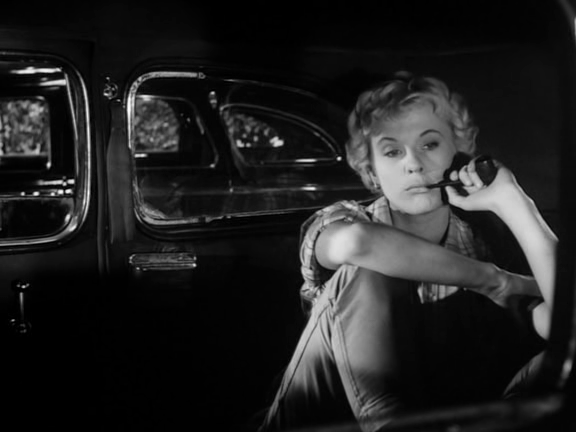
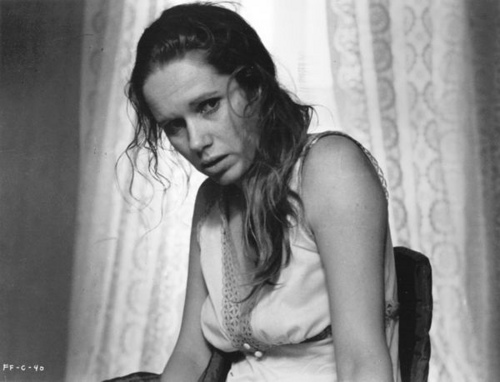
Peak of fitness: Bibi – facing up to her emotional and sexual hang-ups as a young, inexperienced nurse in Persona/ Liv – liberated and lovely in Scenes From A Marriage, using a meeting with her estranged husband ostensibly to sign divorce papers but instead to engage in one last episode of slap and tickle.
.
CLICK on images for full-size
.

.

.

.

.
.
.

.

.

.

.

.

.

.

.
.

.
.

.

.

.

.

.

.


.

Playlist: Listen, my friends! ~ September 2011



In the words of Moby Grape… listen, my friends! Yes, it’s the (hopefully) monthly playlist presented by George’s Journal just for you good people.
There may be one or two classics to be found here dotted in among different tunes you’re unfamiliar with or never heard before – or, of course, you may’ve heard them all before. All the same, why not sit back, listen away and enjoy…
CLICK on the song titles to hear them
.
Herb Alpert And His Tijuana Brass (featuring Mike Redway) ~ Casino Royale
Procul Harum ~ She Wandered Through The Garden Fence
The Bob Crewe Generation ~ An Angel Is Love*
Peggy Lee ~ Is That All There Is?
Edison Lighthouse ~ Love Grows (Where My Rosemary Goes)
Johnnie Taylor ~ It’s September
John Addison ~ A Bridge Too Far**
The Stranglers ~ Walk On By
Yusef Islam/ Cat Stevens (with Elkie Brooks) ~ (Remember The Days Of The) Old School Yard
The Korgis ~ Everybody’s Got To Learn Sometime
Heart ~ These Dreams
Colm Wilkinson ~ Bring Him Home***
Malcolm McClaren ~ Aria On Air
* Plays over the end credits of 1968’s cult classic movie Barbarella
** See more on A Bridge Too Far (1977) – its movie posters, to be precise – here
*** Performed live on a 1987 edition of The Johnny Carson Show

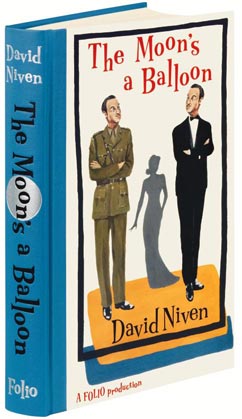
Up, up and away: The Moon’s A Balloon ~ David Niven (Review)
~~~~~~~~
.
Author: David Niven
Year: 1971
Publisher: Hamish Hamilton, London (first edition)
ISBN: 0-340-15817-4
.
From its outrageous teaser of an opening line to its final, tell-all confession, David Niven‘s The Moon’s A Balloon is a wonderfully wry, extremely keenly observed and utterly addictive read. Truth be told, it may just be the best autobiography ever written by a Hollywood celebrity – something it’s been heralded as ever since it was first published 40 years ago.
Compiled by Niven then when the prime of his career had passed (but a couple of years before the notorious incident he observed at, er, first hand while hosting the Oscars), it details the whole of his life – just short of the 12 further years he would live. And, truly, what a life he led; if any film star’s existence warranted a memoir it surely was Niv’s.
Born into an aristocratic family but quickly made fatherless owing to the First World War, Niven’s lissome Anglo-French mother was forever short of money, but made as good a fist of ensuring his and his (marvellously monikered) sister Grizel’s upbringings were as indulged as possible – which in the 1920s/ ’30s meant packing off her offspring to socially respectable boarding schools. This proved double-edged for Niv; arguably both the making and failing of him. While his early years and education at Heatherdown Preparatory School near Ascot and, later, Stowe School in Buckinghamshire instilled in him his unmistakeably polished, mannered, near fey, gentlemanly persona (thanks to which he’d go on to make millions), it also bred his wicked wit and clownish, anti-establishment side.
Indeed, owing to many pranks – for which he experienced a good few lashes – he missed out on a place at Eton (perhaps a blessing in disguise), spent several horrendous weeks at a cruel reform school and, following a stint of army officer training at Sandhurst, didn’t make the cut for his idolised Argyll and Sutherland Highlanders, instead winding up in the far less prestigious Highland Light Infantry, who wore trew trousers rather than kilts. With this regiment he served – in a manner of speaking – for several years of little-to-no-martial-activity in Malta.
Perhaps because they were his formative years, the most entertaining sections of the book are these of his education and early army career. Full of rich detail, insightful observations and funny anecdotes on practically every page, these parts of the Niven story both acknowledge how blessed his upbringing and opportunities were, while pull absolutely no punches in pointing out how flawed a boarding school education can be, how staging hijinks with green beer was the only way to entertain oneself at a military outpost during the dying embers of the British Empire and how exciting, fulfilling and sad a tentative, tender, first affair with a Soho tart-with-a-heart prostitute was. Indeed, as opposed to coming off clichéd, Niven skilfully ensures these teenaged encounters with the aforementioned Nessie come off thoroughly heart-warming – indeed, they’re arguably the most touching moments of the entire book.
On fleeing the army for the States, Niven’s life would take a dramatic turn in the ’30s, featuring several surprising and most impressive entrepreneurial endeavours (among them cleaning rifles for hunters in Mexico and running an indoor rodeo racing venture with, yes, ponies), all of which are wonderfully regaled with both a fine balance of matter-of-fact honesty and a knowing nod to their improbability. As is his fledgling film career and rise from invisible extra, via risible actor, to bona fide Hollywood star. Niven, most certainly, affirms that there was much luck, as well as charming and schmoozing on his part, involved.
From his somewhat hell-raising bachelor days (during which time he shared a house dubbed ‘Cirrhosis-by-the-Sea’ with Robert Newton and socialised greatly with fellow Brit ex-pats like Laurence Olivier and Vivien Leigh), to his post-war highs of headlining the crazily realised yet Oscar-laden Around The World In 80 Days (1956) and unexpectedly winning an Academy Award thanks to his straight role in Separate Tables (1958), his Hollywood years prove a delightfully frank and insightful read – a warm and respectful but honest window then on to Tinseltown’s golden age.
But it’s the section of the autobiography that focuses on the Second World War, during which Niven genuinely earned his military stripes, that leaves you most impressed by the man. For no other reason than a stubborn duty to old Blighty did he give up his lucrative deal with Hollywood bigwig producer Samuel Goldwyn and board a boat back home following the outbreak of hostilities in September 1939.
He confesses that he visited the British Embassy in Washington before embarking, where he was advised to stay in America and not get involved until such a time as he may be called up. Predictably then, there followed a period of months when Niv couldn’t find a regiment that would take him. It’s a mark of the man’s calibre (and maybe that of his generation) that he was frustrated and desperate to get stuck in and sort out Hitler. How many civilians would genuinely seek to go to war today – even against the Nazis?
During his war years he was involved in the formation of the Commandos, took part in the June ’44 Normandy invasion, brushed shoulders with one Ian Fleming (whose first choice to play his later creation James Bond on the big screen was Niven) and dined with Winston Churchill more than once. Indeed, on one such occasion Niv recounts the greatly admired wartime PM telling him: “Young man, you did a fine thing to give up your film career to fight for your country. Mark you, had you not done so − it would have been despicable”.
Niven was lauded in his later years as a great raconteur, both in private and as a TV chat show guest, and this autobiography does feel like the literary equivalent of spending several hours in his company as he relates wonderful anecdote after wonderful anecdote. And yet it’s more besides. It’s the reporting of an interesting, charmed life well lived, with wit, sagacity and pathos springing from almost every paragraph. The first few pages of my edition of the book are taken up with approving quotes from many different reviewers, one of whom is Peter Sellers. Following some words of praise, Sellers asks the question “is there anything he [Niven] can’t do?”. After reading The Moon’s A Balloon, you’ll doubtless find yourself asking that very same thing.
.
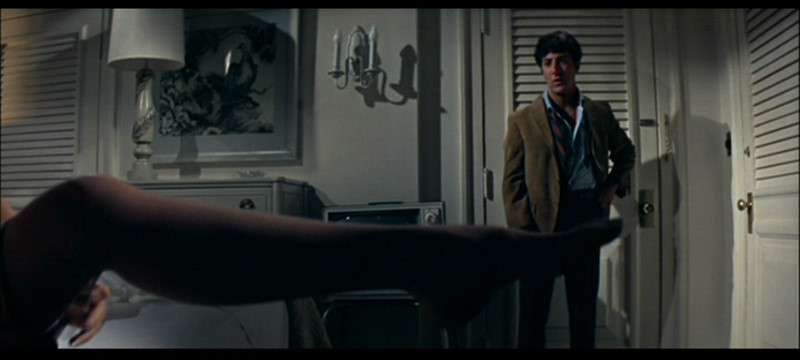
So here’s to you, Mrs Robinson: far from a tight fit, The Graduate, featuring Dustin Hoffman and his seductress Anne Bancroft, is certainly on the list – but which other nine make the grade?
No question, Western society and culture went through dramatic changes in the oh-so notorious decade that was the 1960s. And no more apparent does that become than by looking at the movies it produced. Many of its best flicks reflected the growing sense of self-awareness, hope, disappointment, social and sexual liberation, excitement and conflict throughout Anglo-American culture and beyond. And some arguably went further – by influencing the culture that produced them. So then, as will be the case in posts to come for movies from both the ’70s and the ’80s, this very post details the dectet of cinematic gems that, for me, make up the list of the ultimate exponents of ’60s cinema. Here then, peeps, in no order but chronological, is my 10 films that could only have come from the ’60s – watch out because they ping, they sting and, yes, they most certainly swing…
CLICK on the film titles for video clips
.
À Bout de Souffle (Breathless) (1960)

So, as the opening flick on this list, what’s so special about the curiously named À Bout de Souffle? Well, it’s all about the French Nouvelle Vague or ‘New Wave’ film movement. Born out of the youthful exuberance and turmoil of the time, Nouvelle Vague was an artistic commitment to do the unexpected and different; to excite and stun. Not only did this flick do that with bells on, it also proved to be the one that broke the movement out of the Continent and into the UK and US – it was the film that turned Nouvelle Vague into ‘New Wave’. Filmed on the utter cheap by the now total legend but then debut filmmaker Jean-Luc Godard, the movie was chopped down to its 90-minute running-time thanks to spontaneously created jump-cuts (cutting scenes halfway through). Further revolutionary touches contributed to its bold, highly visual, documentary-like style, ensuring that – to name just three and all of them ’60s classics – Tom Jones (1963’s Best Picture Oscar winner), A Hard Day’s Night (1964) and The Monkees-starring Head (1968) owed much of their look, feel, atmosphere and, well, entire point of being made to its cinematic advances. Moreover, ‘New Wave’ would influence and inspire filmmakers for years to come – well beyond the ’60s – as its techniques became assimilated into the mainstream language of cinema. Admittedly, to watch it, on one level À Bout de Souffle seems merely a French low-budget Hollywood noir take-off, but its title translates as ‘at breath’s end’ – that pretty much says it all.
.
Goldfinger (1964)
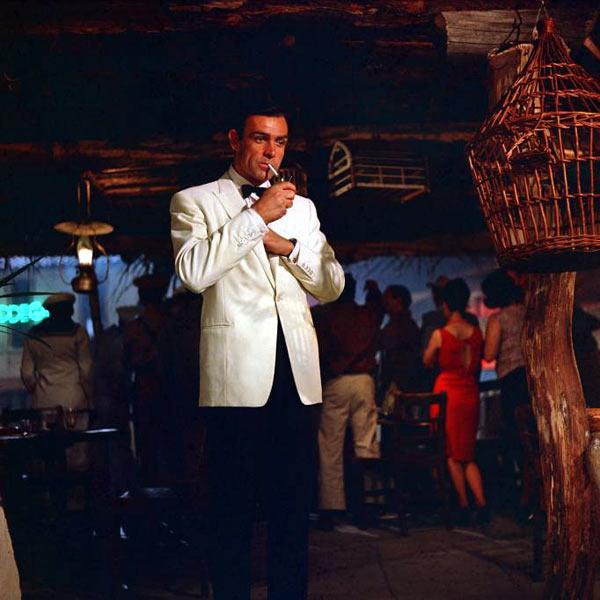
Let’s face it, you can’t get much more ’60s than a Sean Connery Bond film – and Goldfinger has to be the most ’60s of them all. The huge success of the first two 007 film adaptations Dr No (1962) and From Russia With Love (1963) may have paved the way, but it was this flick that established not just Bond, but ‘Bond And Beyond’ in ’60s – and wider – culture. In the wake of its unavoidable impact at the box-office ($125 million worldwide – that’s around $900 million in today’s money), Goldfinger unleashed ‘spy mania’ throughout the ’60s. On the box there were The Avengers (1961-69), The Man From U.N.C.L.E. (1964-68) and The Prisoner (1967-68), while at the flicks there were Our Man Flint (1966), Modesty Blaise (1966) and, in something of a retaliatory move, the oh-so obvious anti-Bond The Ipcress File (1965). And it all comes down to the iconography. Goldfinger simply was the coolest thing since James Dean died in a racing car. Both its look (all sleek, fantastical sets and smooth, sexy Aston Martins) and its sound (Shirley Bassey booming out the bombastic theme and John Barry‘s brassy score) ooze sophistication, sex, danger and aspiration. Both the UK and US consumer booms coincided in the ’60s and Bond – preserving Western capital as he did each escapade – was at their heart, an ice-cube in human form wearing a white tuxedo and flashing a killer smile as he sold an incredible, impossible lifestyle. Every man wanted to be him and every woman wanted to be with him. They still do – thanks most of all to this very film.
.
Darling (1965)

Ah, the Swinging Sixties. That short but irresistible era when the most fashionable of Britain’s youthful movers and shakers ensured that, back-slappingly, London was at the centre of the cultural universe. There were The Beatles, The Rolling Stones, the Mini, the mini-skirt, Jean Shrimpton, Twiggy, the 1966 World Cup win and the Union Jack emblazoned all over the shop and – seemingly – all over every shop. And there were also the movies. For every few breezy, switched-on Brit rom-coms like Georgy Girl (1966) or All Around The Mulberry Bush (1968), there was a real work of art that deconstructed the whole shebang – and the next three entries on the list are all prime examples of the latter. The first, Darling, is remembered as the launchpad for Julie Christie‘s magnificent yet enigmatic career (she won an Oscar for her terrific performance from it, beating herself in the same category for her turn in Doctor Zhivago, in fact), but the actual film itself oddly tends to be overlooked nowadays. Perhaps because it’s so close to the knuckle. Like with his later – and even more critically successful – Midnight Cowboy (1969), US director John Schlesinger concocted a caustic, bleak, cynical and all too honest account of the dark heart at the centre of a seductive dream a major city was selling, as Christie’s opportunistic model-on-the-make achieves all her materialistic dreams but finds little inner emotional satisfaction. Like Henry Cooper, Blighty’s most popular sportsman that decade, Darling pulls absolutely no punches – and is an absolutely essential ’60s movie.
.
Alfie (1966)

If Darling demystified the Swinging Sixties using a female protagonist, Alfie did exactly the same from a male perspective. Adapted from Bill (Cider With Rosie) Naughton’s stage-play, it’s an unapologetic, unfiltered exposé of one man’s exploitation of the sudden social, economic and sexual liberation the ’60s brought to Britain – and, ultimately, the consequences that neither advertising nor pop music of the time would ever admit unchecked carefree, philanderous behaviour wrought. An intelligent and informed part-‘kitchen sink’, part-sardonic sideswipe of a drama then, Alfie connected hugely with both the public and the critics; both groups adored Michael Caine for his triumphant ‘fourth wall’-breaking performance as the Cockney-about-town whose swagger is challenged and then some (following the success of The Ipcress File the year before, it was this flick that cemented Caine as a cast-iron star, as well as bringing him his first Oscar nomination). It also fuelled a storm, adding flames to the fire that was the debate of what an ever increasing liberal society was turning the country into. Away from all the clever stuff, though, a viewing of Alfie offers the viewer not just the sight of one Maurice Micklewhite on top form, but also of ’60s golden girls Jane Asher (then girlfriend of Paul McCartney), Eleanor Bron, Milicent Martin (from TV satire ice-breaker That Was The Week That Was) and Shirley Anne Field. Moreover, its unforgettable title song, composed by the incomparable Burt Bacharach, launched the career of Cilla Black. Short of a cameo from Bobby Moore, there simply ain’t stronger Swinging Sixties credentials than that.
.
Blow-Up (1966)

While both Darling and Alfie are arty takes on fashionable ’60s Britain, neither of them go the whole hog like Blow-Up – for this is Swinging Sixties cinema as art-house. Helmed by idiosyncratic Italian fimmaker Michelangelo Antonioni (who once accepted an Oscar with a single word: ‘Grazie‘), it brazenly shuns the sunny, optimistic feel of many Brit flicks of the period, instead embracing the darkness, confusion and nihilism prevalent of some. It’s a flick that primarily focuses on the notion of perception and reality, specifically with regards to an incident witnessed by its protagonist, a free-wheeling young photographer, which he suspects may have been a murder. So arty is Blow-Up, though, that one’s not entirely sure whether the perception/ reality theme extends to Antonioni wilfully lifting the lid on the Swinging Sixties or not; however, he had intended the main character – blatantly based on David Bailey and brought to life brilliantly by an oh-so cool David Hemmings – to be played by… David Bailey. Had that come off, well, that certainly would have played about with the real and the imagined of the era. The critics loved Blow-Up; it won the Grand Prix at Cannes and Antonioni was nominated for Best Director and Screenplay at the Oscars. Although, predictably, not received by the mass public as well as, say, Alfie, it was an immediate sensation among cineastes and those with their fingers on the cultural pulse – unsurprising given that it also featured early performances by ’60s icons Vanessa Redgrave and Sarah Miles, a nude appearance by fashion model Veruschka and music from jazz great Herbie Hancock and The Yardbirds (which ensured band members Jimmy Page and Jeff Beck made cameos). For all this, and its Soho and Chelsea filming locations, Blow-Up is an eclectic and essential artefact of Swinging Sixties art.
For more on Blow-Up, read my thoughts on its classic poster and this excellent blog post: http://doubleonothing.wordpress.com/2010/05/09/blowup-antonionis-seminal-60s-film-is-no-let-down/
.
The Graduate (1967)

Time to cross the pond now for an indubitable, unforgettable slice of ’60s cinema created by our American cousins. And what a slice – indeed, one may argue that The Graduate is such a great movie of the decade in question, it pretty much takes the entire cake. One of the biggest box-office hits of the ’60s (currently standing 19th on the inflation-adjusted list of all-time grossers in the US alone), it saw – perhaps predictably – students queue around the block to catch its tale of a young man confounded by and dissatisfied with the adult world into which he’s grown and for which his parents’ generation are seemingly responsible, so much so that he embarks on an affair with the wife (the eponymous Mrs Robinson) of his dad’s business partner, only later to fall fortuitously for her daughter. A work of satirical genius, The Graduate‘s sure-footed, caustic and – for the time – frank script and outstanding performances from its lead players (Anne Bancroft in an iconic role, Katharine Ross on charming, winning form and Dustin Hoffman in a star-making turn) is superbly complimented by a sometimes gritty and discombobulating visual style that owes a huge amount to ‘New Wave’ techniques. Jump-cuts, close-ups, zoom-outs, unconventional camera angles and millisecond-long flashes (one of Mrs Robinson’s naked breast – blink and you’ll literally miss it) are all employed by director Mike Nichols to underscore the film’s atmosphere of confusion, angst and agitation. The effect makes for an unusual but outstanding film, whose themes, ideas and, indeed, ending are still being debated to this day. Add into the mix a slew of timeless (and perfectly fitting) Simon & Garfunkel folk rock hits and you’ve got an unquestionably ’60s movie, but one so good and – like Goldfinger – rightly so revered, it transcends the decade of its creation.
.
If…. (1968)

By 1968, the Swinging Sixties were arguably over and hippiedom was being overtaken by youths rioting in the face of slow civil change and war in Vietnam. Plus, lest we forget, this year too saw the assassinations of both Martin Luther King and Bobby Kennedy. The ’60s then were suddenly, almost nightmarishly, giving way to angry confrontation and violence – and boy does If…. deliver that message. Instead of detailing youth revolt in an existential, comic manner like The Graduate, it goes for the jugular; the young ‘uns in If…. go properly rotten and rebel in far more tangible, physical and – ultimately – violent ways. A Palme d’Or winner at Cannes, If…. is a difficult watch. Many moments challenge the viewer’s tastes, ethics and morals; the sight of intelligent teenagers who buck a cruel, despotic private school system being humiliatingly caned for their efforts may disgust one, but the sight of the same teenagers waging guerilla warfare on that system come the film’s end (yes, really) must surely leave one wondering uncomfortably where their sympathies should now lie. Of course, this movie, working up as it does to that extraordinary finish, is an unashamed, unremitting parable of the society of the day – and the dangers its maker (counter-culturalist Lindsay Anderson) maybe feared were being fermented. But its arty – and, to be specific, surrealist – credentials aren’t just to be found in that bombastic finale. Equally surreal and intriguing is a black-and-white sequence in which protagonist Malcolm McDowell (who would go on to play a somewhat similar rebel in Stanley Kubrick’s 1971 classic A Clockwork Orange) indulges in a sort of wildcat foreplay with a girlfriend-to-be, a sequence that foreshadows the animalistic conclusion. However, the thing that’s always pleased me most about If… is the presence of Captain Mainwaring himself, Arthur Lowe, in the cast – who’d predict that? After all, this is about as far away from Dad’s Army‘s cosy back-slapping of old-school British class and social institutions as you can get. The late ’60s, eh? They were strange days, indeed.
Read about If…‘s excellent poster-art here
~~~
Yellow Submarine (1968)

Can you really compile a list of the ultimate ’60s films without a Beatles movie on it? Well, all right, I may be biased as a big Fabs fan, but I don’t think so. However, I’m not going to take the easy option and plump for A Hard Day’s Night (1964) or even for its sequel of sorts Help! (1966); nopes, I’m going for the animated one, the one that was ‘for kids’, the one that doesn’t even feature The Beatles – well not until the very end, at least. Over the years, Yellow Submarine has become regarded as a real curate’s egg, even forgotten or disregarded by many casual film fans, but hey bull-y dog for them. For this flick is a rarefied gem of ’60s psychedelic art. Sure, it’s fair to say that as a ground-breaking pop musical (many of whose sequences prefigured the MTV-era video) and as colourful Swinging Sixties hokum, respectively, A Hard Day’s Night (1964) and Help! (1966) are time capsules of their eras, but neither quite go as far as Yellow Submarine. For, to watch this movie, it seems to sum up, nay define, the drug-influenced, fantastical diversions and affectations of the mid- to late ’60s. The fact it’s animated goes along way to ensuring this. Seemingly taking its look from Peter Blake’s historic album cover for The Fabs’ Sgt. Pepper’s Lonely Hearts Club Band (1967), it’s filled with a cornucopia of colourful characters (the Blue Meanies, Jeremy Hilary Boob PhD/ Nowhere Man and, of course, The Beatles themselves) and a slew of supremely surreal settings and sequences (Pepperland, the Sea of Time, the Sea of Science and the Sea of Monsters – the last of which features a vacuum cleaner monster). A box-office hit on release – especially with, yes, kids, turned-on teenagers and students – and a critical success too, Yellow Submarine not only delighted the mainstream, but also advanced animation techniques (the opening of Monty Python’s Flying Circus TV series owes much to it) and may just have been The Beatles’ favourite flick in which they appeared – now that’s what you call a recommendation.
Read a full review of Yellow Submarine by yours truly here
.
Bob & Carol & Ted & Alice (1969)

Now, I’ll freely admit that Bob & Carol & Ted & Alice isn’t the best film on this list, but, peeps, this is a movie that’s so ’60s it aches. One may argue that Hollywood caught up with and addressed the decade’s snowball-like growing counter-culture rather belatedly – The Graduate only came in 1967 and Barbarella the following year. And in the decade’s final year, Tinseltown finally got around to addressing a small but growing trend among American (often West Coast) married couples eager to experiment in increasingly socially liberal times – namely, swinging or, to give its more chauvinistic but popular moniker back then, wife-swapping. Swinging, of course, would become more widespread in the ’70s (how widespread it genuinely did become then is open to question though, of course), but there’s no doubt that in the late ’60s among couples like Bob and Carol and Ted and Alice it was taking place – and, for once, when it came to the counter-culture Hollywood was on the button here. And like with other filmmakers on this list, director-screenwriter Paul Mazursky wasn’t sure he really like the issue he’d made his film about. His two couples are well-to-do 30-somethings with everything to lose if they sleep with each others’ partner, rather than teenagers exploring and pushing back the boundaries of social and ethical mores and because of that, cannily and pleasingly, hilarity ensues. Bob & Carol & Ted Alice then is a comedy, treating its subject matter as a ‘what if’ scenario rather than as social documentary in the manner of, say, Alfie or Darling, but despite – or perhaps because of – this softer approach it made a big splash with both the public and the critics and made stars of Elliot Gould and Dyan Cannon (both of whom received Oscar nominations for their efforts). Nowadays this film may seem a little tame, a little twee even, but for mainstream audiences of the time this was placing the ’60s under the microscope and examining them minutely – or at as minutely as they were willing to for an entertaining Saturday night out at the flicks.
.
Easy Rider (1969)

Unlike this list’s immediately preceding movie, its final flick has absolutely no interest in holding anything back as it presents an uncompromising view of the counter-culture that had spread across 1960s America. Easy Rider is as legendary as any movie you could name from that decade; indeed, perhaps more so than any other. For many, it will always be the ultimate ’60s film – and for good reason. Director Dennis Hopper and producer Peter – son of Henry and brother of Jane – Fonda (who together are credited as co-writers, despite much of it being ad-libbed on location) conceived the flick as a sort of modern-day western. Two societal drop-outs, one named Wyatt (as in Wyatt Earp), the other Billy (as in Billy The Kid), go looking for America on their hogs only to discover a confused, disconnected, disillusioned and ultimately violent land. What is Easy Rider about? Does it ask what has become of America? Does it ask what has become of the hippie movement? Does it ask where the hell are we all going? Or doesn’t it ask any real questions and is just a counter-culturalist road movie through the great open spaces of the United States? Well, the answers to those questions probably depend on your reading of it. What’s undeniable, though, is that once seen, it’s a movie that’s never forgotten and, thanks to its tone, style, music (Steppenwolf, The Byrds and Hendrix) and public impact, has become unconditionally wrapped up in the whole fabric of the 1960s. Moreover, like The Graduate before it, its wilful adoption of ‘New Wave’ techniques and – more so than the latter – its success as an avant-garde flick connecting with the mainstream, as well as its featuring of Jack Nicholson in his break-through role, ensured Easy Rider helped pave the way for the ‘New Hollywood’ era of the 1970s, when young, hungry filmmakers would take US cinema to new, exciting subjects, destinations and highs. But let’s not get ahead of ourselves, peeps – all that’s for a future blog post…
.
Five more to check out…
The Ipcress File (1965)
As mentioned above, the essential – and entirely intended – anti-Bond, with Michael Caine’s Harry Palmer a bespectacled alternative to 007
What’s New Pussycat? (1965)
Swinging Sixties rom-com romp-and-a-half scripted by Woody Allen and starring, er, Woody Allen, as well as the Peters O’Toole and Sellers, plus a gaggle of gorgeous girls
Barbarella (1968)
Jane Fonda is a sensational sex-kitten in Roger Vadim’s saucy, psychedelic space romp
2001: A Space Odyssey (1968)
Stanley Kubrick’s über-ambitious, sci-fi ‘head film’, featuring a finale that has to be the ultimate trip – indeed, on some posters that very term was the tagline
The Italian Job (1969)
Michael Caine again, alongside Noël Coward, Benny Hill and red, white and blue (i.e. Union Jack-coloured) Mini Coopers, in the most swinging heist comedy imaginable – plus that ultimate cliffhanger ending
.
… And five great flicks about the ’60s
Shampoo (1975)
Warren Beatty tries to juggle affairs with both Julie Christie and Goldie Hawn as Nixon’s ’68 election success looms large in the background
Quadrophenia (1979)
Phil Daniels dons his parka and rides his Vespa to Mod oblivion to the sound of The Who
JFK (1991)
Myth and conspiracy theories collide with reality, as Kevin Costner investigates the assassination of America’s beloved President
Austin Powers: International Man Of Mystery (1997)
The sequel may contain the parody of Blow-Up‘s famous photoshoot sequence (sse above), but Mike Myers’ original ’60s spy movie spoof is the smarter, better and funnier flick
The Dreamers (2003)
Bernardo Bertolucci’s take on the May ’68 Paris riots, with lashings of nudity, sex and an irresistible Eva Green
Legends: Burt Bacharach ~ melody maestro
This girl’s in love with you: Burt Bacharach and film star wife Angie Dickinson lounge about in 1969 as he works on one of his pieces – another cool chart-topper, no doubt (Bettman/Corbis)
He goes by the faintly ridiculous, utterly brilliant moniker of Burt Bacharach, back in the ’60s and ’70s he was handsome, cool and mixed with – and married – Hollywood royalty, and he wrote and produced hit pop record after hit pop record. For those reasons, and those reasons alone, he’d probably deserve his place in the ‘Legends‘ corner here at George’s Journal, but what seals it, what really seals it, is the fact he’s also one of the greatest songwriters/ composers of the last century. In short, Burt Bacharach had it all. And that makes him a bona fide legend.
Yes, penner of more than 120 Top 40 singles in the US and UK combined, a hit Broadway musical, film scores to a handful of cinematic classics and a serious inspiration to everyone from Brian Wilson to Steely Dan and Noel Gallagher to The Last Shadow Puppets, Burt is a pop culture icon whose talent has formed an indelible and important slice of the soundtrack of the last 50 years. Oh, and of course he’s also managed to collect Oscars, Grammys and a trophy wife or two along the way.
He was born on May 12 1928 in Kansas City, Missouri, but was never a Mid-Westener, having been brought up in the affluent, tradtionally Jewish neighbourhood of Forest Hills in Queens, New York City. Unsurprisingly, Bacharach is of German-Jewish descent, the son of Irma (née Freeman) and Bert (yes, that’s right, Bert with an ‘e’) Bacharach, a syndicated newspaper columnist. At the age of 12, at his mother’s instigation, Burt started studying the piano; he also learnt to play the cello and the drums. Perhaps ironically, though, he far from enjoyed his piano lessons and wanted to become a professional American Football player – a dream he was never destined to fulfil given his lack of height and size (he would grow to be only 5′ 8” tall).
Although, in a sign that he’s always had an eye for the ladies, he put his talents to use by starting a band at school, as he realised it would be a good way to meet girls. With Burt on piano, the band achieved relative success, getting booked for local dances and parties. And it wasn’t long before the teenaged Bacharach caught the jazz bug. Thanks to a fake ID, he’d often sneak into 52nd Street’s bebop nightspots to watch and listen to legends like Dizzie Gillespie and Charlie Parker – their unconventional melodies and harmonies would leave a lasting impression on the young, enrapt fan.
Wishin’ and hopin’ (for hits): Burt and Hal David (l) and both with Dionne Warwick (r)
On leaving school, he enrolled at Montreal’s McGill University, where he took a music studies programme and claims he wrote his very first song, The Night Plane To Heaven. He then went on to study music composition at New York University’s Mannes School Of Music; the Berkshire Music Center (now the Tanglewood Music Center) in Lenox, Massachusetts; the New School For Social Research back in New York City (where he studied under the composers Bohuslav Martinu, Henry Cowell and Darius Milhaud); and the Music Center Of The West in Santa Barbara, California, to which he won a scholarship.
The first fruit of all this musical academic labour, though, was playing piano at Governor Island’s officers’ club and at concerts at Fort Dix, as he served in the army between 1950 and ’52. He was billed as a concert pianist at the time, mind, even if he was only playing and improvising pop medleys. Still, his first proper professional gig came thanks to meeting singer Vic Damone while serving as an army dance-band arranger in Germany. Upon his discharge, Burt became Damone’s piano accompanist and, around the same time, accompanied other vocalists in nightclubs and restaurants, one of whom was a young unknown called Paula Stewart. She became the first Mrs Bacharach in 1953, but their marriage was to last only five years.
In 1957, though, Burt got his big break when he was employed by Paramount Pictures’ Famous Music at the veritable pop song sausage-factory that was the Brill Building in New York, for it was here that he first met and first collaborated with, as Juno might put it, the cheese to his macaroni, lyricist Hal David.
Make no mistake, if it weren’t for Hal David, the story of Burt Bacharach would surely be very different. He almost certainly wouldn’t have been as successful; he maybe wouldn’t have made it at all. Why? Simple – Bacharach and David were made for each other. Of all of Burt’s partners, surely Hal was the most important of his life; professionally and artistically he certainly was. And their partnership was successful right from the off.
“There’s always been this need to give music labels, especially in England. If people want to call Walk On By easy listening then fine, call it that. But hold it up to the light and you see it’s not easy at all. I don’t know: maybe those songs have lasted because of that, because it was sophisticated at the time and I took chances.” ~ Burt Bacharach
Within just a year of writing together, Burt and Hal had not one, but two chart hits on their hands. The first, The Story Of My Life, was recorded by Marty Robbins and achieved top spot in the US country music charts; the second, the fondly recalled Magic Moments, sung by Perry Como, reached #4 on the main US chart, the Billboard Hot 100. As if that weren’t enough, both songs (admittedly, in this instance the version of The Story Of My Life was sung by Michael Holliday) became back-to-back #1 hits in the UK – ensuring that Burt and Hal became the first ever songwriters to achieve this feat. They were unquestionably, rather spectacularly on their way.
But almost as soon as they’d got started, Burt was prised away for an enviable assignment – between 1958 and ’61 he served as musical director on screen legend Marlene Dietrich’s stage tours across America and Europe. Even so, he still enjoyed hits in this period, including The Shirelles’ Baby It’s You (whose lyrics, incidentally, were co-written by Hal’s brother Mack).
And as the early ’60s progressed, so did Bacharach and David’s (Hal, again of course) pop compositions. One of which was The Man Who Shot Liberty Valance (1962), which somewhat oddly didn’t feature in the hit western of that year with which it shared its name, but was suggested to them as the title of a tune after the movie came out. That song was recorded by a young Gene Pitney, as was another hugely popular hit in the shape of Twenty Four Hours From Tulsa, released the following year. 1962 also saw the first recording of another standard-to-be, Make It Easy On Yourself sung by Jerry Butler, which reached #20 in the States, but when re-recorded by The Walker Brothers in ’65 hit #16 in the US and the top spot in the UK.
Indeed, Make It Easy On Yourself truly proved the ticket to make Bacharach and David a mint, as it was the song that, albeit indirectly, introduced them to the most prolific and enduring interpreter of their work, Dionne Warwick. Around this time, they were producing a lot of material for soul/ R&B all-male group The Drifters – Burt was also arranging horns and strings on their tunes – and it was at a Drifters session that they met New Jersey-native Dionne (who incidentally is a cousin of the much-later-to-be-famous Whitney Houston).
A backing vocalist back then, Warwick had a terrific ear for and ability to interpret their songs (navigating her way through Bacharach’s often complicated melodies and tempos like nobody they’d yet met) and had cut a demo of Make It Easy On Yourself. This, it seems, led her to believe that Burt and Hal would give her first dibs on the tune, not knowing they’d already promised it to Jerry Butler. Angry with them then, she apparently retorted ‘don’t make me over, man!’. They didn’t; in fact, the first song they did give her was named Don’t Make Me Over. Released later in ’62, it reached #21 in the US and was her first hit.
Having found Warwick, the floodgates now opened for Bacharach and David – if they hadn’t already. Over the next 10 years, they wrote 20 US top 40 hits specifically for or re-recorded by her, seven of which broke the top 10. And practically every one of those seven proved unforgettable: Anyone Who Had a Heart (1963, #8), Walk On By (1964/ US #6, UK #8), Message to Michael (1966, #8), I Say a Little Prayer (1967, #4), Do You Know the Way to San Jose (1968, US #10, UK #8), This Girl’s in Love with You (1969, #7) and I’ll Never Fall in Love Again (1969, #6).
And their successful collaborations with Warwick led to further – often just as – successful collaborations with other music artists at the top of their game. Throughout the ’60s, new and emerging singers made original Bacharach-David songs hits or made existing songs they’d written hits all over again and, with it, made themselves stars. How’s this for a roll-call? Dusty Springfield (I Just Don’t Know What To Do With Myself, 1963/ Wishin’ And Hopin’, 1964); Tom Jones (What’s New Pussycat?, 1965); Aretha Franklin (I Say A Little Prayer, 1968); Sandie Shaw (There’s Always Something There To Remind Me, 1964); Cher (Alfie, 1966); Cilla Black (Anyone Who Had A Heart, 1964/ Alfie, 1966); Herb Alpert (This Guy’s In Love With You, 1968); Adam Faith (A Message To Martha, 1964); Jackie De Shannon (What The World Needs Now Is Love, 1965); Manfred Mann (My Little Red Book, 1966); Bobbie Gentry (I’ll Never Fall In Love Again, 1969); Billy J Kramer and The Dakotas (Trains And Boats And Planes, 1965); The Fifth Dimension (One Less Bell To Answer, 1970); and, of course, The Carpenters with (They Long To Be) Close To You in 1970.
But just why were Burt and Hal’s songs so popular? Why did the public on both sides of the pond buy them up in the ’60s like they were going out of fashion (which they clearly, most assuredly were not)? Well, as a – if you will – sub-genre of the pop song, Bacharach-David compositions have over the decades come to be looked on as the epitome of ‘easy listening’ music. Now, there’s nothing wrong with that, you may say; but the labelling of their work in this manner has been arguably dismissive. Its laid-back, jazz-inflected, aspirational, frankly groovy sound was, back in the day, most definitely where it was at (if you weren’t a rebellious hippie or die-hard blues-rock man, that is). Yet, that type of sound, perhaps really because of its lesser competitors and imitators, soon was out of vogue – even derisively referred to as ‘elevator music’. And was that doing Bacharach and David a disservice? Was it ever.

Baby, it’s you: Burt was also a hit-maker with glamorous girls – with (clockwise from top left) Angie Dickinson at the ’69 Oscars, Marlene Dietrich, Carole Bayer-Sager and Jackie Onassis
The truth of the matter is that, like The Beatles and The Beach Boys at exactly the same time, Burt and Hal were pushing back the boundaries of the pop song. Thanks to the combination of Hal’s pitch-perfect, often full-of-longing lyrics (he sure could turn a phrase) set against Burt’s seductively smooth yet melancholic melodies, their ballads were utterly irresistible. Just listen to Twenty Four Hours From Tulsa, what with Gene Pitney’s outstanding delivery, its a three-minute epic paean to love lost in the face of love found. Now that’s what you call melancholia.
But the true genius of Bacharach-David’s work goes deeper still – thanks to the awesome, experimental talents of Burt the classically trained musician. Like the works of the great composers he studied and admired, Bacharach had total control over his tunes; he arranged, conducted and co-produced many of his hits – and practically all of the best ones. And, like Lennon, McCartney and Wilson, boy, did he experiment.
Unusual chord progressions, syncopated rhythmic patterns, frequent modulation, unpredictably changing meters and irregular phrasing appear throughout his tunes and, from a clever-clever musical point of view, are what make so many of them so damn good. One of many such examples is Anyone Who Had A Heart. In Bacharach’s own words, the melody of this song “changes time signature constantly – 4/4 to 5/4, and a 7/8 bar at the end of the song on the turnaround. It wasn’t intentional, it was all just natural. That’s the way I felt it.” This song also holds the distinction of featuring the first use of polyrhythm (two or more rhythms appearing simultaneously) in popular music.
And perhaps unsurprisingly, given Burt and Hal’s success and the former’s truly outstanding talent, pop songs alone soon weren’t enough for them – at least they weren’t for Burt. Owing to the circles in which he was now moving, Bacharach was hired by friend and Hollywood titan Charles K Feldman to write the score for the latter’s new film, the madcap comedy What’s New Pussycat? (1966), starring Peter Sellers, Peter O’Toole, Woody Allen and a menagerie of ’60s female sex symbols (the movie initially was to star Warren Beatty; deriving its title from the phrase Beatty used to answer the telephone). Not only did his involvement in the flick establish another string to Burt’s bow (film scoring), it also spawned another chart hit for him and David, the unforgettable song that shares the film’s name, sung by Tom Jones, and an Oscar nomination for Best Original Song.
“I feel fine about covers. I don’t feel fine if it’s a new song and the first time they hear it is somebody else’s arrangement. I’ve heard some great versions and some terrible and I’ve heard versions that top what I did. Say A Little Prayer is a prime example. I recorded it with Dionne and, even though it was a big hit, Aretha Franklin made a much better record. It’s not about the vocal, it’s about the way it feels.” ~ Burt Bacharach
As if underlining the fact Bacharach was now gravitating towards Hollywood, around the same time he met the film star Angie Dickinson and they fell for each other. So much so that she agreed to accompany him to London while he composed What’s New Pussycat‘s score. It was a whirlwind romance – ten weeks later they were married in a simple ceremony in Las Vegas, attended by a select few including Feldman (see husband and wife in a wonderfully cheesy Martini ad from the mid-’70s in the video clip above). Although Burt’s first film score had been for the cult ‘B-movie’ horror The Blob (1958), it was now that his association with Hollywood properly got underway.
Following his work on Pussycat, he and David came up with the title song for the Michael Caine-starring Swinging Sixties classic Alfie (1966) and he scored and – with David – provided the title song for less-than-successful comedy After The Fox (1967), featuring Peter Sellers and Britt Ekland. Then he provided the score and – with David again – the smooth-as-silk song The Look Of Love (performed mellifluously by Dusty Springfield) for the chaotic Bond spoof Casino Royale (1967). Produced by old friend Feldman, Casino Royale‘s production turned into a nightmare – it went through half a dozen directors – but turned a moderate profit and Burt’s brassy, playful score (including a marvellous title track performed by Herb Alpert And The Tijuana Brass) and the aforementioned The Look Of Love were all, well, loveable indeed.
So, if you’ve conquered pop music and movies, what next? Musicals. In 1968, Broadway producer David Marrick called on Burt and Hal to work with major playwright Neil Simon on a musical adaptation of the Oscar-winning Billy Wilder comedy The Apartment (1960). The result, Promises, Promises, was yet another hit – running for nearly 1,300 performances on Broadway before it transferred to the West End. It also won two Tonys, a Grammy for Best Cast Album and spawned the classic tune I’ll Never Fall In Love Again. But it was the following year when Bacharach and David were truly to hit the heights.
Butch Cassidy And The Sundance Kid (1969) is a much-loved movie that’s remembered for many things: Paul Newman, Robert Redford, Katharine Ross, that unforgettable freeze-frame finish, the cliff jump, William Goldman’s wonderful, witty dialogue… and, yes, of course, Raindrops Keep Fallin’ On My Head, performed by country-pop-crossover B J Thomas. Surely one of Burt and Hal’s most fondly recalled hits (US #1 for four weeks), Raindrops features in one of the film’s most fondly recalled sequences (Butch and Etta’s bicycle ride, see video clip below). For me, the marrying up of these two aspects – beautiful music and beautiful visuals – sums up the movie. It and Bacharach-David were simply made for each other. And the public (the flick, of course, was a huge box-office hit) and the critics agreed; the following year, Burt and Hal accepted the Academy Award for Best Original Song for Raindrops, while Burt alone also collected the Oscar for his scoring of the film, which although somewhat minimal was simply perfect film score work. No question, Burt was now on top of the world… on the downside, there was only one direction in which he could now head.
The break-up of Bacharach and David came in the wake of their work on the movie Lost Horizon (1973). Seemingly ill-fated all-round, the film was a musical remake of the 1937 Frank Capra classic, but ended up a commercial and critical disaster. The difficulty of the project led to acrimony between Burt and Hal and, following its release, the pair decided after 16 years together to go their separate ways. And the fall-out got worse. Owing to them not just being her writers but also her producers, as well as her being under contract to produce new material for Warner Brothers, Dionne Warwick decided she had no alternative than to sue them both for their split and, thus, effective split from her. This resulted in Hal suing Burt and the latter counter-suing the former. It was all very messy, as was, in fact, Burt’s personal life by now. For, owing to more than one affair he’d had over the years, his marriage to Angie Dickinson had hit the rocks. The second separation in this era of Bacharach’s life then came in 1975; he and Dickinson would formally divorce in 1980.
If the ’70s had been hard on Burt, though, things perked up considerably in the early ’80s. Not only did he remarry, but he also wrote a new chart-topper with his new wife, lyricist Carole Bayer-Sager (who had previously hit it big co-writing the song Nobody Does It Better for 1977’s Bond film The Spy Who Loved Me). Featuring on the soundtrack to the smash-hit Dudley Moore and Liza Minelli comedy Arthur (1980), which he also scored, (Arthur’s Theme) Best That You Can Do, performed by Christopher Cross, not only returned Bacharach to the US #1 spot for the first time in 11 years, but also won him (along with his new wife) another Oscar for Best Original Song.
Things were good again and Burt’s sound was most definitely back in vogue. As the decade progressed, he wrote hits for Neil Diamond (Heartlight, 1982, US #5), Roberta Flack (Making Love, 1982, US #13), Patti LaBelle and Michael McDonald (On My Own, 1986, US #1, UK #2) and Dionne Warwick – as well as Elton John, Gladys Knight and Stevie Wonder – (That’s What Friends Are For, 1985, Us #1 for four weeks). The latter was actually a cover of a tune first recorded by Rod Stewart for the film Night Shift (1982), re-recorded as a charity single that benefited the American Foundation For AIDS Research. It also, obviously, marked a reconciliation between Bacharach and Warwick.
The music industry and the styles and trends of the content it produced, of course, changed dramatically during the ’70s and ’80s, but by the end of the latter decade and into the next, Bacharach’s music – perhaps unexpectedly – began to enjoy what appeared to be a renaissance. Class may age, but will forever remain class. In August 1990, Scottish rock band Deacon Blue released a four-track EP entitled Four Bacharach & David Songs, featuring I’ll Never Fall In Love Again, The Look Of Love, Are You There (With Another Girl) and Message To Michael. The first of the quartet was released as a single and reached #2 in the UK charts.

The look of love: Burt’s face on Oasis’s Definitely, Maybe album cover (l), meeting Kate Moss and Noel Gallagher during Britpop’s mid-’90s high (m) and collaborating with Elvis Costello (r)
This wasn’t a rare blip, more chart-affecting proof that a new mood was calmly and – fittingly – smoothly spreading through the UK music scene, as melody-driven artists brought up on Bacharach-David began to assert themselves; their most successful exponents being the bands Swing Out Sister and, spectacularly, The Beautiful South. But it didn’t stop there, as the ’80s became the ’90s and British music found for itself a winning identity and/ or formula once more in the shape of ‘Britpop‘, Bacharach himself became a recognisable face for punters throughout the land again. Even if they didn’t actually know who he was.
Granted, Britpop was far more about swaggering rock music than melodic pop balladry (although, at its best, it was certainly satisfyingly melodic), but with the appearance of Bacharach’s face on the cover of monster band Oasis’s monster of a debut album Definitely, Maybe (1995), his relevance to the ‘movement’ was clear. For this was a direct reference to Burt’s inspiration on the songwriting of Britpop’s arguable leader, Oasis’s Noel Gallagher. Indeed, that inspiration became crystal clear when Gallagher later performed a live duet with Bacharach of This Guy’s In Love With You (indeed, the former admitted he stole elements of that song for his own song Half The World Way from the aformentioned album). Yet, in a decade so obsessed with retrospective – and in particular with ’60s culture – this labelling of Bacharach as influential (along with the likes of Lennon and McCartney, Jagger and Richards and Ray Davies of The Kinks) on the new music of the time, didn’t just make Burt relevant again, it made him cool again.
Was it any coincidence then that Burt’s music and, yes, he himself popped up in surely the most ’60s-retrospective-friendly movie of the era, the marvellously mocking spy hokum that was Austin Powers: International Man Of Mystery (1997)? Was it eccers like. The protagonist’s, a composite parody of Swinging Sixties icons, mantra may have been the out-moded ‘what the world needs now is love(-making)’, but the presence of Bacharach’s music and the man himself (see video clip below) reinforced that nostalgic, affectionate and – yes, even here – cool connection with the ’60s that the film strove to attain. And, let’s not forget too, that Bacharach-David tunes featured heavily the same year in the well received and watched Julia Roberts romcom My Best Friend’s Wedding, including a cast sing-along of I Say A Little Prayer.
“What really set it apart was its score … Bacharach introduced to Broadway not only the insistently rhythmic, commercial-jingle buoyancy of 1960’s soft-core radio fare, but also a cinematic use of Teflon-smooth, offstage backup vocals.” ~ The New York Times on the Bacharach-David musical Promises, Promises
In an occurrence that was seemingly kismet, it was around this time that I got into Bacharach (I loved Britpop, I loved Austin Powers and I loved Bacharach – they all seemed to fit each other) and it was also around this time that, riding the wave of this career resurrection, Burt decided to release a brand-spanking-new album – a collaboration with versatile musician Elvis Costello. Featuring something very much like the melancholic-melodic sound he produced with Hal David, the resultant album Painted From Memory (1998) was an absolute gem – in fact, for me, one of the best albums of the ’90s; a decade jam-packed full of great albums. Song after song on that record oozes smooth cool, complex melodies, jazzy pianos, flugelhorns and unapologetic romantic longing, all enhanced superbly by Costello’s searingly emotional vocals. If you haven’t heard any of it (you may have heard I Still Have That Other Girl, which won a Grammy), I seriously urge you to do so.
As the ’90s drifted into the ’00s and, indeed, up to the present day, Bacharach has both very much remained in the public firmament and made very firm his position as an iconic deliverer and innovator of pop music – sort of the chart ballad’s Mozart. Basically, he’s looked on and up to as exactly who he is for exactly what he’s done. Although, admittedly, his image now is less playboy songwriter, more avuncular pop godfather. Mind you, in 2005 he released the album At This Time, which came with self-penned lyrics, a collaboration with rapper Dr Dre and controversy thanks to its political message. Clearly, he still likes to mix it then. In his personal life, he’s remarried, had more children and lost a child (his and Angie Dickinson’s tragically troubled but gifted daughter Nikki, for whom he wrote a song in 1969 that became the theme to ABC’s Movie Of The Week on US TV).
But dare one say it, after all those years of success, all those following years in the relative wilderness, all those hits, all those downs both professionally and personally and both those comebacks in the ’80s and ’90s, yes, after all of that, one gets the feeling that Burt is now a man contented, perhaps like never before. He scaled the pop summit once, he did it a second time and now with a family happily around him once more (and friendships with his best collaborators renewed), he can look out on all he surveys with an air of satisfaction. Indeed, if that air were to be put to music, how would it sound? Cool, smooth, easy, yet complex and brilliant, of course. Because class may age, but will forever remain class.
.
Playlist: Ten of Burt’s best
CLICK on the song titles to hear them
Twenty Four Hours From Tulsa ~ Gene Pitney (1963/ US #17, UK #5 )
Walk On By ~ Dionne Warwick (1964/ US #6, UK #8 )
What The World Needs Now Is Love ~ Jackie DeShannon (1965/ US #7)
The Look Of Love ~ Dusty Springfield (1967/ US #22)
I Say A Little Prayer ~ Aretha Franklin (1968/ US #10, UK #4)
This Guy’s In Love With You ~ Herb Alpert (1968/ US #1 for 4 weeks, UK #3)
Do You Know The Way To San Jose? ~ Dionne Warwick (1968/ US #10, UK #8 )
I’ll Never Fall In Love Again ~ Bobbie Gentry (1969/ UK #1 )
(Arthur’s Theme) Best That You Can Do ~ Christopher Cross (1981/ US #1)
I Still Have That Other Girl ~ Elvis Costello (1998/ from the album Painted From Memory)
~~~
Further reading:
An insightful article on Nikki Bacharach and her autism (parentdish.com)
Playlist: Listen, my friends ~ August 2011
In the words of Moby Grape… listen, my friends! Yes, it’s the (hopefully) monthly playlist presented by George’s Journal just for you good people.
There may be one or two classics to be found here dotted in among different tunes you’re unfamiliar with or never heard before – or, of course, you may’ve heard them all before. All the same, why not sit back, listen away and enjoy…
CLICK on the song titles to hear them
~~~
Dusty Springfield ~ Just A Little Lovin’
Henry Mancini ~ Two For The Road
Dick Van Dyke ~ Hushabye Mountain
Janis Joplin ~ Kozmic Blues
Love ~ August
Elvis Presley ~ In The Ghetto
James Brown ~ Something
Elton John ~ Someone Saved My Life Tonight
Cast of Bugsy Malone ~ Finale: Good Guys/ You Give A Little Love
Orchestral Manoeuvres In The Dark ~ Souvenir
David Bowie ~ Modern Love
The Dream Academy ~ Life In A Northern Town
Belinda Carlisle ~ (We Want) The Same Thing
Susanna Hoffs: Bangles Damsel

Talent…
… These are the lovely ladies and gorgeous girls of eras gone by whose beauty, ability, electricity and all-round x-appeal deserve celebration and – ahem – salivation here at George’s Journal…
~~~
Sweet, diminutive, coquette-ish and sexy as hell with those big brown eyes and holding her Rickenbacker guitar, Susanna Hoffs bewitched males the world over as she taught them how to walk like an Egyp-shi-an, then she seduced them when she ordered them to say her name, as the sun shone through the rain on her eternal flame. Or something like that. She’s the one from The Bangles everyone remembers and she still looks cotton-bloomin’ amazing – and, yes, she’s the latest addition to the Talent corner on this very blog…
~~~
Profile
Name: Susanna Lee Hoffs
Nationality: American
Profession: Musician
Born: 17 January 1959, Los Angeles
Height: 5ft 2in
Known for: Writing, playing and performing as vocalist for iconic ’80s all-girl band The Bangles, especially on the hits Manic Monday, If He Knew What She Wants, Walk Like An Egyptian (all 1986), In Your Room and, of course, Eternal Flame (both 1988). She also played the lead role in the film The Allnighter (1987) and appeared in the mock-band Ming Tea in the Austin Powers movies (1997-2002), directed by her husband Jay Roach.
Strange but true: On the ‘interesting’ advice of the producer, Hoffs actually recorded the vocals to Eternal Flame in the nuddy, owing to the former claiming Olivia Newton-John always did so.
Peak of fitness: Topping so many moments, including the cheekily flirtatious look-left-look-right moment in the Walk Like An Egyptian video (apparently the result of Ms Hoffs’ on-stage nerves), must be the scene in the aforementioned The Allnighter in which Susanna oh-so sexily slowly dances in front of a mirror while wearing, well, not very much at all. Hmmm, yes.
~~~
CLICK on images for full-size