Retro Crimbo: Santa Claus is coming to town…

~~~~~~~~~~~~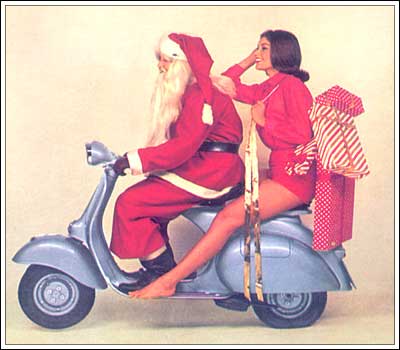
Special delivery: Santa’s on his retro way to George’s Journal this December, peepsters, and there may even be a lovely lady or two – if you’ve been nice (rather than naughty)…!
So then, chaps, it’s finally December 1, the first day of advent and – like it or not – we’re now properly counting down to Crimbo. And, in the spirit of the season, here’s an offer from me to you all… yes, like Tom Cruise was Cuba Gooding Jr.’s ‘ambassador of quorn’, why not let me be your ambassador of, yes, Christmas corn and cheese?
For, my merry mates, I can officially declare that this very blog has now – like it did exactly one year ago today – entered its ‘Christmas Zone’, which means there’s several seasonal highlights to look forward to right here over the next three-and-a-bit weeks.
How’s about a playlist of tinsel-tinged tunes, one or two of which will be very recognisable, most of which will be rare treats? How’s about a vey merry, festive-themed addition to the blog’s Talent corner? How’s about a countdown of yours truly’s ultimate top 10 Christmas presents from back in the day? And, finally and maybe best of all, how’s about a tribute to surely modern Crimbo’s ‘Legend‘ (two clues: it’s neither Bruce Forsyth nor Simon Cowell)? Yes, how’s about all that? How’s about all that, indeed! – as Jimmy Saville may once have said in a 1970s Top Of The Pops Christmas show.
In which case (hopefully), see you all seasonably – and, oh yes, seasonally – soon for the first proper festive post…! 
.

.
“The Beatles saved the world from boredom”~ George Harrison
.

.
“I think we shared a lot of tastes; cars and clothes – and women, obviously” ~ Eric Clapton on George Harrison
.

.
“I remember thinking I just want more. This isn’t it. Fame is not the goal. Money is not the goal. To be able to know how to get peace of mind, how to be happy, is something you don’t just stumble across. You’ve got to search for it.” ~ George Harrison
.
.
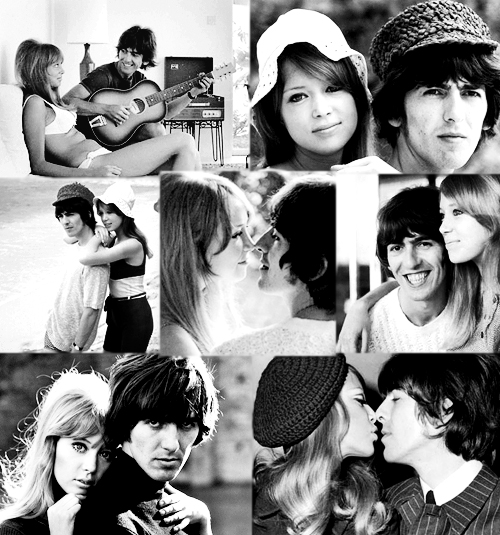
“He’d mortgaged his house to put up the money for this movie because he wanted to see it, which is still the most anyone’s paid for a cinema ticket” ~ Eric Idle on George’s financing Monty Python And The Holy Grail
.

.
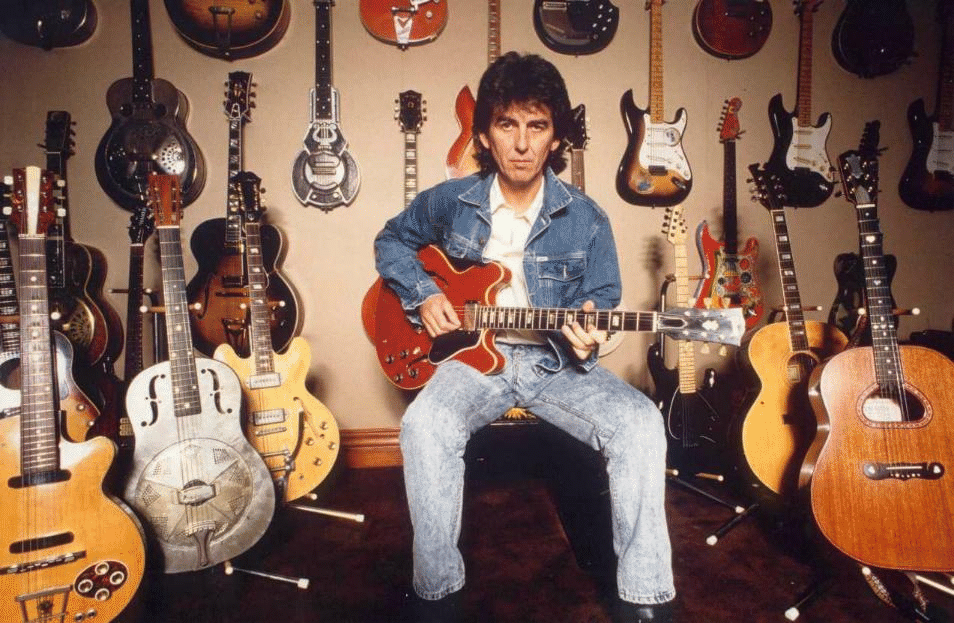
“I think people who truly can live a life in music are telling the world, ‘You can have my love, you can have my smiles. Forget the bad parts, you don’t need them. Just take the music, the goodness, because it’s the very best, and it’s the part I give most willingly” ~ George Harrison
.
.
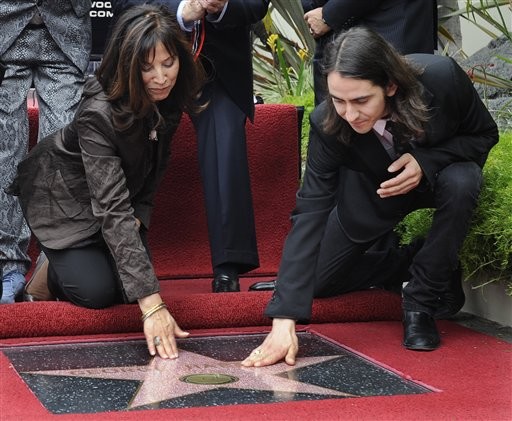
“It’s being here now that’s important. There’s no past and there’s no future. Time is a very misleading thing. All there is ever, is the now. We can gain experience from the past, but we can’t relive it; and we can hope for the future, but we don’t know if there is one.” ~ George Harrison
.
.
Playlist: George’s Golden Dozen
CLICK on the song titles to hear them
Taxman (Album: Revolver, 1966)
Love You To (Album: Revolver, 1966)
While My Guitar Gently Weeps (Album: ‘The White Album’, 1968)
Something (Album: Abbey Road, 1969)
Here Comes The Sun (Album: Abbey Road, 1969)
I Me Mine (Album: Let It Be, 1970)
My Sweet Lord (Album: All Things Must Pass, 1970)
Wah-Wah (Album: All Things Must Pass, 1970)
Isn’t It A Pity (Album: All Things Must Pass, 1970)
What Is Life (Album: All Things Must Pass, 1970)
Got My Mind Set On You (Album: Cloud Nine, 1987)
Handle With Care (Album: The Traveling Wilburys Vol.1, 1988)
.
.

(Le) Carré on spying: Tinker Tailor Soldier Spy (2011) ~ Review
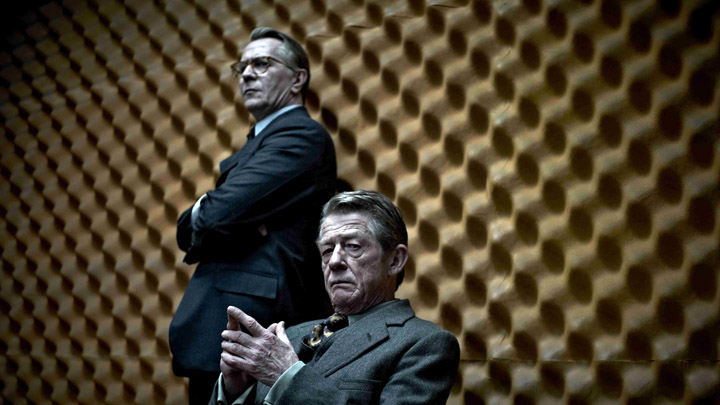
Directed by: Tomas Alfredson
Starring: Gary Oldman, Colin Firth, Toby Jones, Benedict Cumberbatch, John Hurt, Tom Hardy, Ciarán Hinds, Mark Strong, David Dencik, Roger Lloyd Pack, Kathy Burke
Screenplay by: Bridget O’Connor and Peter Straughan
UK/ France; 127 minutes; Colour; Certificate: 15
.
Seeing as Tinker Tailor Soldier Spy‘s been on release for weeks and thus received its wave of hype and publicity, well, weeks ago, in only now catching up and seeing it I’ll admit I’ve been behind the curve. Just like, cynics may suggest, the folks who made this flick have been in making it at all, given the seemingly universally adored 1979 BBC TV version of John Le Carré’s classic espionage novel, published five years before, most certainly got there first. So are the cynics right, was there any point making this movie? Well, peeps, given it’s bloomin’ marvellous, I’d answer a resounding yes.
All right, granted, I’m still to get around to viewing the Alec Guinness-starring telly version and reading the book – I’m a Fleming man, truth be told; I’ve always most enjoyed my fictional espionage as glamorous fantasy. The novel, though, by Le Carré (who receives an executive producer credit on this film and appears in a party scene cameo) is famed for being nothing like Bond. It’s Cold War spy-craft as near reality; dark, wordy, tactical, even depressing. His is the world of spooks that carry on their shoulders the burden of preventing World War Three like Atlas carrying his oh-so heavy globe. They keep a lifetime’s worth of secrets and/ or regrets in their hearts. Many are cold, ruthless, but decent people who thoroughly believe in Britain. Some of them are misled Reds. Others are just plain bastards. And the trick that Tinker Tailor Soldier Spy the movie pulls off so successfully is in bringing this world to the screen. It arguably doesn’t do it vividly or dynamically; it does it subtlely and quietly. And it’s brilliant for it.
Its universe is that of men with bad haircuts in bad suits and bad ties, grey skies and grey concrete, cheap Christmas decorations and cheaper cars, crap caravans and peeling paint on window panes. It’s the sort of world in which George Formby is still played on the radio, causing peeps to tap their feet infectiously. In short, it’s the 1970s and the sense of oppressive decay that pervades everything mirrors the atmosphere inside British Intelligence that the flick’s story is all about.
After a bungled job in Hungary goes badly wrong, British Intelligence – or MI6 – chief ‘Control’ (Hurt) and his fellow ageing and most trusted operative George Smiley (Oldman) are forced out. ‘Control’ (who is endearingly referred to as nothing else throughout the flick) quickly kicks the bucket, but Smiley is brought out of retirement by the politicos to investigate his former boss’s concern that a ‘mole’, who’s been working for the Soviets for decades, is embedded at ‘The Circus’, the affectionate term for MI6’s London HQ. Calling on the aid of a young spook (Cumberbatch with, actually, an ace haircut) and a former Special Branch police officer (Roger Lloyd Pack aka Only Fools And Horses‘ Trigger – yes, really), Smiley focuses his investigation on what seems to be a clue left by ‘Control’, which points to the ‘mole’ either being among the cabal that’s seized control of ‘The Circus’ (Jones, Firth, Hinds and Dencik) or Smiley himself…
At the heart of Tinker Tailor Soldier Spy then is George Smiley. In the hands of Gary Oldman, Smiley is an oustanding character, if a curious cinematic hero; all intellectual rigour but emotional restraint – rather like a former winner on University Challenge who wonders whether his life’s endeavours and sacrifices have all been worth it. Yet he – and the rest of the fine ensemble cast all on tip-top form, especially Cumberbatch, Hardy and Strong who together get considerable screen-time (even if, a little disappointingly, Hinds does not) – are indebted to their screenwriters and director. The latter is the Swede Tomas Alfredson who, having already greatly impressed with the also previously-decade-set, but unusual and moving vampire horror Låt Den Rätte Komma In (Let The Right One In) (2008), takes the formers’ script – which (one assumes) is an excellent exercise in condensing the plot-heavy, detailed text of Le Carré’s novel – and ensures its story unravels if not at a snail’s pace, then at a tortoise’s. And, frankly, there’s absolutely nothing wrong with that.
For this movie, telling an old-school story in an old-school setting, is filmed in an old-school style; it’s a slow-burner. Which means the plot and the characters are given room to breathe, to grow. The drama unfolds gradually, but becomes more and more engaging, ensuring it’s positively, skilfully gripping come its conclusion. Alfredson, as noted, resists using visual gimmicks or flashy editing to help tell his tale (it isn’t a Life On Mars-style ‘look at me!’ ’70s feel, more a dreary ’70s look that aims for a sort of anti-nostalgia). And yet, having said that, both the montages that open and close the movie are ones to cherish, while the sets are delightfully rich in detail: a bureaucratic poster on an MI6 wall warns that using a telephone risks one being overheard as a character is experiencing just that; graffiti on a London brick wall declares the feminist mantra ‘the future is female’ (the present being a totally masculine-led, fading Britain).
This is a film whose themes, characters and appearance are all about things going wrong, falling into disrepute and being past their best, but it leaves the viewer feeling anything but – it reeks of strong storytelling, excellent acting, spot-on observation of time and place; put simply, undeniable quality. This viewer was so drawn into Smiley and co.’s world that, come the end, he found himself spying his fellow cinemagoing strangers leaving their seats and, for a childish second, fantasising whether they might be, could be nefarious double-agents just like those who were up on the screen seconds before. Why? Because the concoction he’d just witnessed, anti-nostalgia it may’ve been, was also an irresistible, heady, old-school brew.
Nicola Bryant: Peri Perfect

.
Talent…
.
… These are the lovely ladies and gorgeous girls of eras gone by whose beauty, ability, electricity and all-round x-appeal deserve celebration and – ahem – salivation here at George’s Journal…
~~~
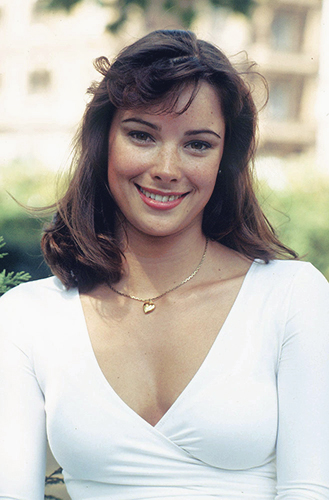
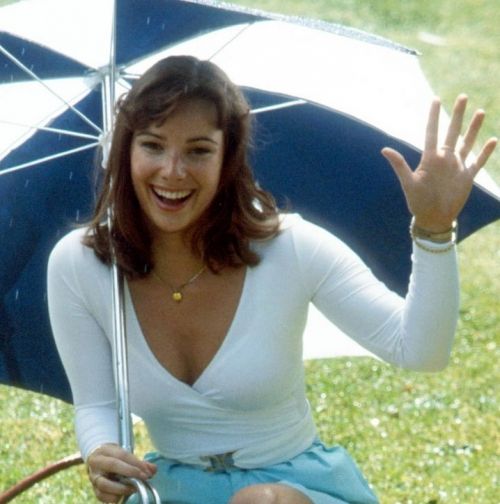
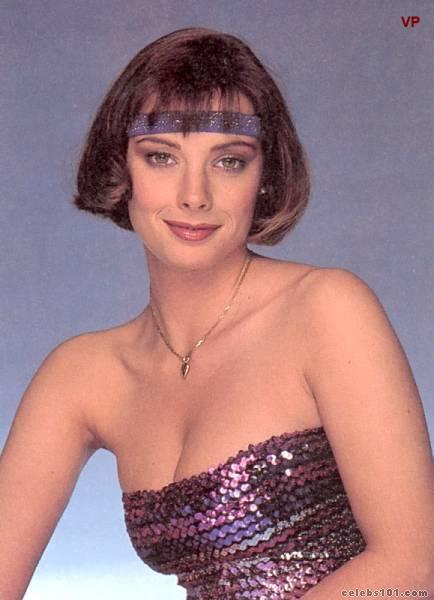
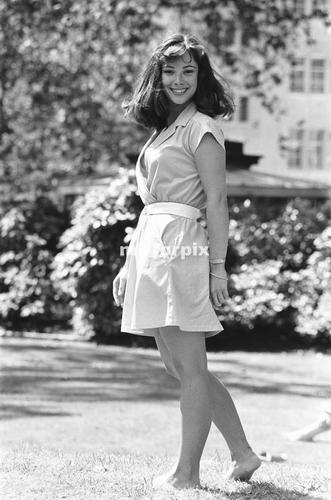
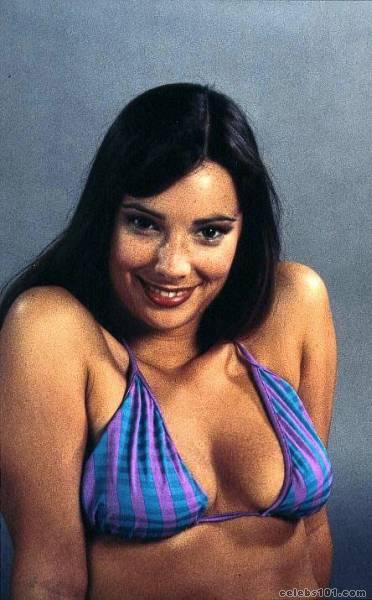
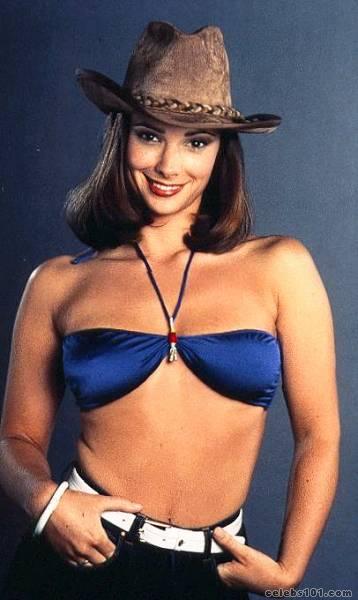
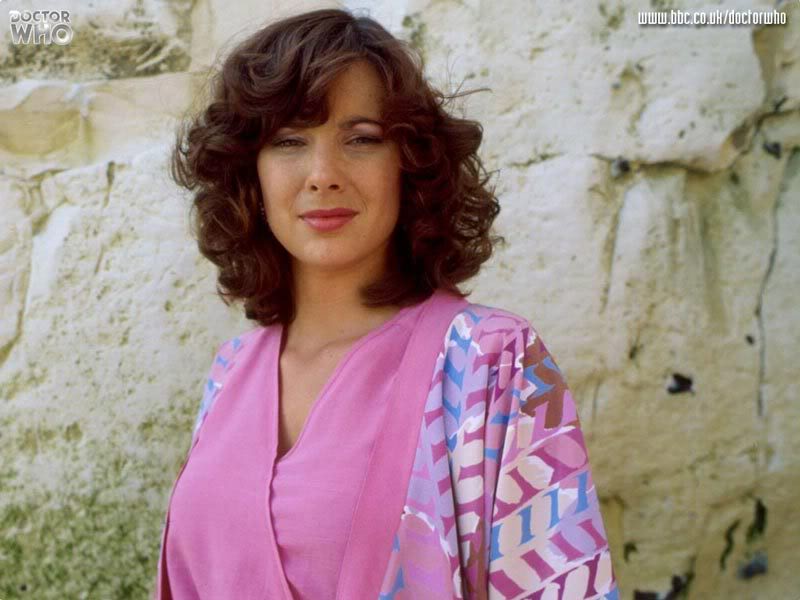
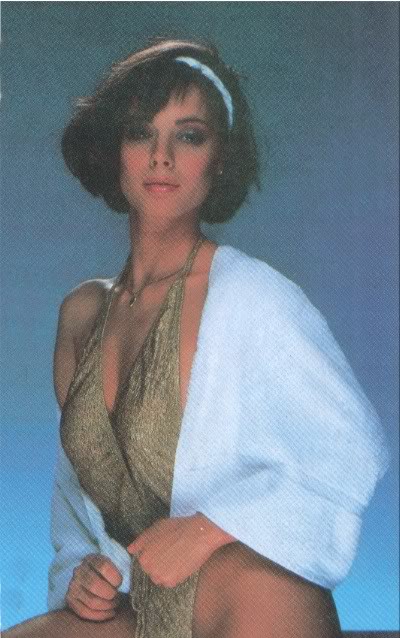
For many, she frequented Blighty’s (and the world’s?) favourite science fiction show Doctor Who in its least popular period, but she easily transcended this, being now so fondly recalled she’s one of the few Doctor’s companions who can boast her own official action figure. Er, yes. She’s pretty as a button – actually, scrap that, sexy as hell – bodaciously busty and (by her own admission) a lover of many a double entendre; she’s Nicola Bryant and she is, yes, verily the latest addition to the Talent corner of this very blog…
~~~
Profile
Name: Nicola Bryant
Nationality: English
Profession: Actress, writer and musician
Born: 11 October 1960, Guildford, Surrey
Height: 5ft 3in
Known for: Playing the American botany student Perpugilliam ‘Peri’ Brown from 1984 to ’86 in Doctor Who (1963-present), opposite Peter Davison’s Fifth and Colin Baker’s Sixth Doctors, a character that was controversial/ popular for making use of her assets in revealing outfits, at least initially. She went on to star alongside Baker again in the made-for-video series The Stranger (1992-95), a partnership than was undeniably, wittingly Who-esque and appeared in the Victorian-set Blackadder’s Christmas Carol (1988). In recent years she has reprised the role of Peri Brown in Doctor Who audio adventures and often appears at fan events devoted to the show.
Strange but true: As an English woman playing an American character, she was encouraged to speak in a US accent in public appearances for Doctor Who and even between takes.
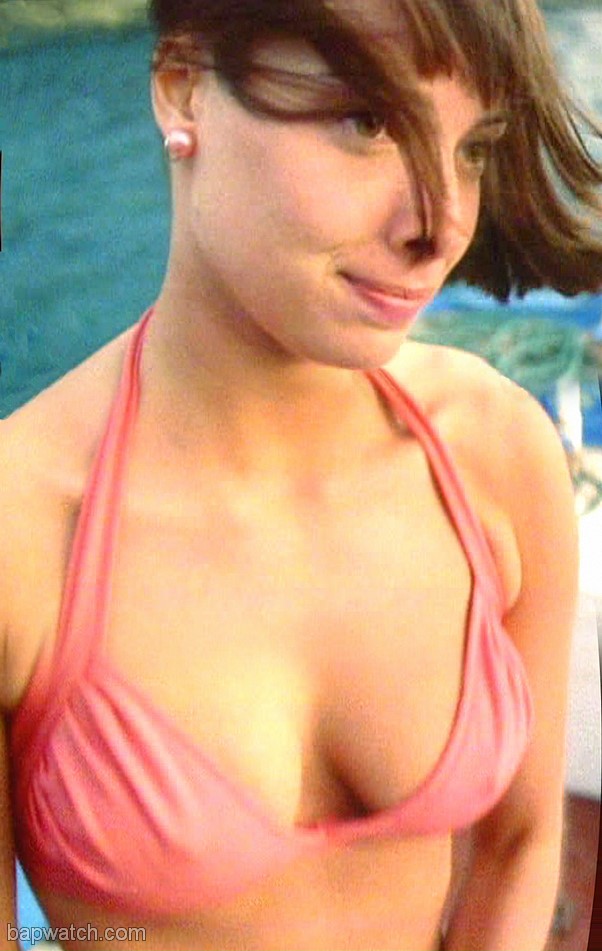
Peak of fitness: Despite her often appearances in only-just-there costumes as Peri, this one’s a doozy – it has to be her Doctor Who debut, the opening episode of the serial Planet Of Fire, specifically the point at which she wears a pink bikini and has to be saved from drowning in the sea by The Doctor’s companion of the time Vislor Turlough (Mark Strickson).
.
nicolabryant.net
twitter.com/thenicolabryant
.
CLICK on images for full-size
.
.

.
.

.

.



.

.

.
.

.


.


.

 .
.
.

.


.

.
Legends: Terry Wogan ~ the blarney marvel
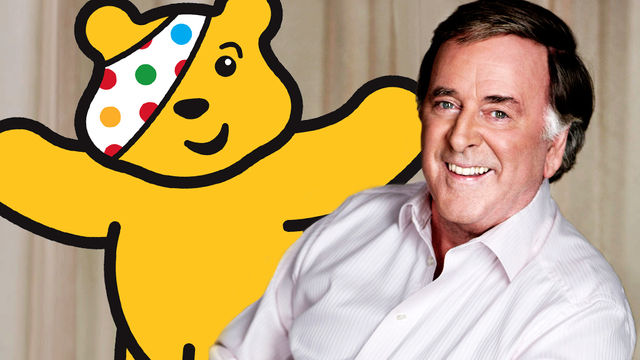
Pudsey’s pal: the bear may have a bandaged eye, but there’s been a twinkle in Terry Wogan’s for more than 40 years – during which he’s become a charity ringmaster and national treasure
Let’s face it, Children In Need is unimaginable without him, he was the voice of Eurovision for an entire generation, he ruled the breakfast airwaves like nobody before or since and he may just have been around for as long as Brucie. He’s Terry Wogan; the Irish broadcaster blessed with über-blarney who seems to have helped make Britain what it is today. And he is, unquestionably, the latest deserved inductee into the Legends corner here at George’s Journal.
Yes, for decades the screens in the corners of the country’s living rooms and the radios on the shelves of its kitchens have been the home of Wogan. Neither audiovisual appliance – indeed, maybe none of them in any British home – has ever been free of the man’s sardonic yet cheery expression and the lilting tones of his soft brogue. There have been many imports from the Emerald Isle that, over the years, have enriched these fair islands – Oscar Wilde, Jonathan Swift, even Dave Allen – but none have fitted quite so seamlessly, so cosily and seemingly so effortlessly into the UK consciousness as the Togmeister himself, Terry Wogan.
He was born Michael Terence Wogan on August 3 1938 in Limerick, the largest city in the Irish county of the same name. His father was a grocery store manager and saw to it that the young Terry had a strong religious upbringing, the latter attending the fee-paying Jesuit secondary school Crescent College from the age of eight. When Wogan senior was made a general manager, he moved his family to the Irish capital Dublin and Terry, now 15, joined Crescent College’s sister school in the city, Belvedere College.
All the Catholic doctrine and culture absorbed by the child and adolescent Wogan was to have a profound effect on him – but surely not the one his father had envisaged: the former turned away from the church. Indeed, in later years (2004 to be exact), he remarked on his upbringing: “There were hundreds of churches, all these missions breathing fire and brimstone, telling you how easy it was to sin, how you’d be in hell. We were brainwashed into believing”.
At Belvedere he developed an artistic bent, participating in school plays, and became interested in early rock ‘n’ roll. Yet, his career that would become synonymous with pop music was not to start until later. For, on leaving school around the age of 18, he was employed at a branch of the Royal Bank of Ireland in Dublin. Fairly soon, however, he realised banking wasn’t for him and applied for a position he saw advertised in a local paper for an announcer with the Irish national broadcaster Raidió Teilifís Éireann (RTÉ). Securing the post, Wogan had now entered the heady world of broadcasting – and wouldn’t look back.


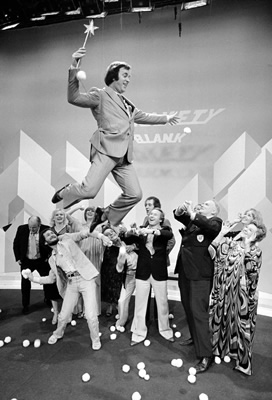
Man and wife and hitting the heights: Terry and wife Helen in 1970 (l), getting chummy with Bond star Roger Moore (m) and flying on a wire during a Christmas edition of Blankety Blank (r)
Unlike, say, Chris Evans, though, he wasn’t exactly an overnight success. It wouldn’t be for the best part of 10 years yet that Terry would make his name and eventually cross the Irish Sea. Over the next decade then, he learnt this trade. In his first couple of years with RTÉ, he found a niche for himself as an interviewer and presenter of documentary features. He then moved on to the entertainment department and – for the first time – worked as a disc jockey, as well as a TV variety show host. One such programme he fronted was a favourite with the viewers, the quiz show Jackpot, which established Terry as an Irish media celebrity. In short, he’d made it.
In reality, his father had always wanted him to be a doctor, but Terry knew he had found his calling – plus, in school at least, he’d never really worked hard enough to stand a chance in the medical profession. “I only ever did enough to pass exams,” he confessed later. “I never had any capacity for preparing for anything. That’s why I’m so lucky to be in a job where I make it up as I go along.”
Indeed, as if making it up as he went along, when RTÉ dropped Jackpot Terry took an unusual step for an Irish broadcaster – he approached the BBC for work. Perhaps to his surprise, perhaps not, the Beeb, recognising his talent, acquiesced and on September 27 1966, he appeared on the British airwaves for the very first time as he presented on The Light Programme (the forerunner to Radio 2) ‘down the line’ from Dublin.
The big change for Wogan and family (by now he was married – he’d tied the knot with Helen Joyce in April ’65 and together they’d have three children across the late ’60s and early ’70s) came with the establishment of Radio 1 at the end of September 1967. Conceived as the Beeb’s alternative to the now illegal offshore ‘pirate’ stations, such as Radio Caroline, that had built a dedicated audience among the turned-on, tuned-in ’60s youth, it quickly proved hugely popular with this demographic – a position it’s cannily never relinquished – maybe thanks to poaching many of the pirate stations’ best loved DJs.
.
Wogan, obviously, wasn’t one of them, but that didn’t stop him from fronting the Tuesday edition of Late Night Extra for two years. And this led to him covering colleague Jimmy Young’s mid-morning show throughout July ’69, which in turn led him to being offered the 3-5pm afternoon slot permanently. He readily accepted it and enjoyed being broadcast simultaneously on Radio 2 as well as Radio 1 owing to budget shortages. During this time he also undertook a regular and unenviable commute from his family in Dublin to his studio in London.
The move to Radio 2 alone came in April 1972 when he took on the mantle of the station’s breakfast show – the broadcast with which he’d become most associated for the rest of his career. With his family now ensconced in Blighty and he himself having found his natural home at the nation’s most cosy-cum-populist media outlet, Wogan became the huge star the twinkle in his eye must have always threatened he’d become.
In the ’70s (as well as, admittedly, every subsequent decade) there was simply no avoiding him. If he wasn’t waxing lyrical on the wireless to Britain’s waking masses, he was on the box presenting the Blackpool-based ballroom-dance-focused show Come Dancing (1949-98) or, yes, commentating on The Eurovision Song Contest for the BBC (he did so first on the radio in ’71, from ’74 to ’77 and again in ’79; he did so on TV in ’73, again in ’78 and forever after from 1980 – see middle video clip).
His first filling of the Radio 2 breakfast show’s chair would last for more then 10 years, during which time he built up a daily audience of nearly eight million listeners. His brand of easy-going, mellow Irish tones blended with knowing, near over-verbose wit proved a fine fit with large numbers of the nation over 25 who preferred not to wake to the likes of Tony Blackburn, Noel Edmonds or Dave Lee ‘The Hairy Cornflake’ Travis and their start-the-day diet of ’70s pop and rock on Radio 1.
Inevitably, Wogan’s ubiquity drew mockery from some quarters, but all of it good-natured. For example, both the comedy trio The Goodies on their madcap BBC2 show (1970-80) and the popular humour-based folk pop group The Barron Knights made him the butt of many jokes. And, being a master of self-deprecation (which has always been among the biggest aspects of his appeal), Terry himself was adept at taking the mickey out of himself. In fact, then – as now – he revelled in it.

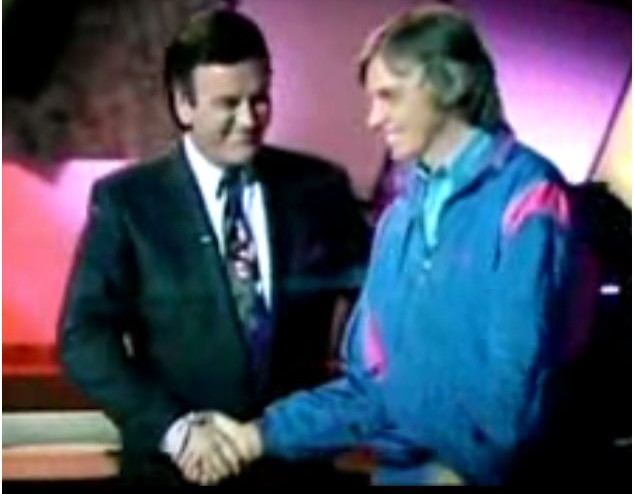
Cartoon characters: with a thrice-weekly chat show, Wogan suffered from overexposure in the ’80s (l), but his 1991 encounter with fantasist David Icke was cracking car-crash television (r)
A case in point was his release in 1978 of The Floral Dance, whose instrumental version by The Brighouse and Rastrick Brass Band had hit #2 in the UK charts at Christmas the year before; Wogan’s take on it reached #21. Surely only hard-hearted souls begrudged Terry this indulgence, though, as he’d played a descisive role in the tune’s first chart success – it had been him who’d brought it to peeps’ attention in the first place by playing it on his show as he, er, sung the lyrics over the top of it. Buoyed by this admittedly dubious musical success, he released both a follow-up single Me And The Elephant and a self-titled album, neither of which (probably rightly rather than wrongly) made it into the charts.
In 1984 Wogan made the decision to focus on his TV career full-time, handing over the reins of the breakfast show to Ken Bruce. Aside from his frequent work on Come Dancing and for Eurovision, he’d already scored a big hit on the box with the so-bad-it-was-brilliant celebrity panel- and double entendre-driven gameshow Blankety Blank (1979-90); the premise of which seemed to be for its hosts and guests to wallow in its cheap and tacky production values as much as possible.
The public loved it, especially on one occasion when Radio 1 DJ guest Kenny Everett grabbed the end of ‘Wogan’s Wand’, his trademark car aerial-style microphone (which, true to the show’s cheapness, actually was an adjusted car aerial), and bent the thing to a ridiculous angle, forcing the former to carry on with the intrument in that condition for the rest of the recording. Whenever Everett guested on the show thereafter, he’d scupper the microphone each time – once doing so by attempting to cut it in two with a giant pair of scissors. Over 20 years later, Wogan himself would destroy his wand – as it were – for comic effect in a one-off Blankety Blank special broadcast as part of a Children In Need night.
Terry quit Blankety Blank the year before he finished on Radio 2, to be replaced as host by comedian Les Dawson. As it was now the ’80s, perhaps inevitably he moved on to the abundant TV variety show of the age: the chatshow. The first he fronted was BBC1’s Saturday evening effort What’s On Wogan? (1980), which although only boasting a single series gave him an important grounding in the format and led to 1981’s one-off Saturday Live, on which he interviewed Larry Hagman aka JR Ewing in Dallas (1979-91).
.
In 1982, BBC1 gave him another crack at a series with the simple-as-pie titled Wogan (1981-92). Unlike his previous chatshow, this one quickly gained traction with viewers. In its first season it was brodcast on Tuesday nights, only to be shunted into the late-night Saturday slot vacated by the legendary Parkinson show (1971-82). Here it remained for its next two series until 1985, when it moved back to weekday evenings – broadcast thrice weekly (Mondays, Wednesdays and Fridays) – for the rest of its run.
Given the show’s profusion, it became something of a cultural firmament of the decade, featuring many a memorable moment. From Chevy Chase remaining silent throughout an interview to Anne Bancroft appearing to be a nervous wreck during hers and Ronnie Barker announcing his retirement in 1988 to George Best’s unfortunate drunken appearance in 1990 when he told Terry what he enjoyed in life was ‘screwing’, Wogan notched up several impromtu gems.
One such unmissable episode was the host’s encounter in April 1991 with former TV sport presenter David Icke, who claimed that he was the son of ‘a godhead’ and that the Earth would imminently be devastated by tidal waves and earthquakes. Wogan and his audience found Icke’s proclamations both absurd and amusing and, predicatably, it was to become Terry’s most recalled interview – for right or wrong. A few weeks later, Des Christy in The Guardian suggested the show had been a ‘media crucifixion’; indeed, it led to Icke retreating from public life as he became a figure of ridicule. When Wogan interviewed him again in 2006, the former admitted that his comments the first time around may have been ‘a bit sharp’.
The Beeb eventually gave Wogan its marching orders in the early ’90s in order to launch Brit-expats-in-Spain soap opera Eldorado; the latter was an unmitigated flop, but in all fairness the former had really had its day too. It almost felt like Terry had reached the stage where the public had had enough of his mug on the telly (one 1992 poll suggested he was somehow both the most and least popular person in Britain) and, perhaps sensing that, in 1993 he took over the reins of the Radio 2 breakfast show once more. It was a canny move, for after all his TV chatshow years, it was his second stint helping get Middle England out of bed in the mornings that seemed to turn him into a genuine national institution.

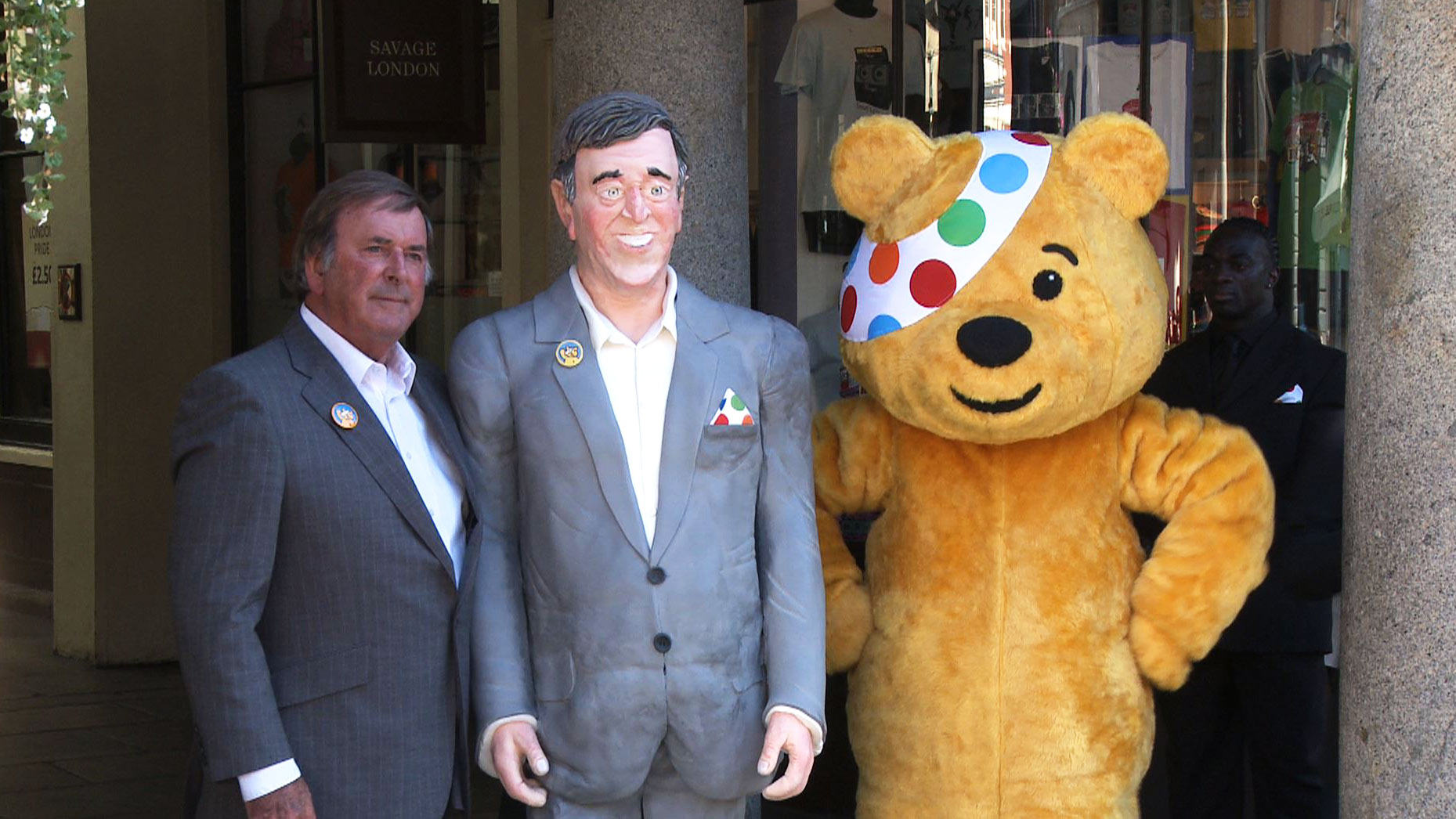
Having his cake and eating it?: Terry hosting Eurovision in the UK in 1998 with Ulrika Jonsson (l) and posing with Pudsey and a life-sized ‘Terry cake’ created for Children In Need in 2009 (r)
Officially named Wake Up To Wogan, the broadcast became less a radio show, more a daily check-in with an avuncular commentator on the country at large, as Terry laced observations on a supposedly increasingly ‘PC gone mad’ Britain with absurdist, nay, childish humour thanks, in no small part, to the innuendo-laden stories listeners would send in ostensibly about Radio 2 newsreader John Marsh that spoofed the Janet and John series of childrens’ reading books from the 1950s and ’60s (see bottom video clip).
Wake Up To Wogan‘s popularity saw it regularly attain around eight million listeners – as well as afford its star an army of fans/ followers who nicknamed themselves TOGs (Terry’s Old Geezers and/ or Gals). Just like their hero, TOGs would – and still do – happily embroil themselves in fundraising efforts every year for the one-Friday-night-in-November charity-a-fon that is Children In Need (1979-present), which was first fronted by Wogan in 1980 and every year thereafter. They also, like millions of others, gobbled up albums by both folk pop artists Katie Melua and Eva Cassidy, whose careers were partly kick-started by Wogan championing them on his show (the latter posthumously, of course).
Throughout both the ’90s and ’00s then, thanks to his cosy but wry emplacement on radio, annual hosting of Children In Need (which seems to raise more and more each year; over £30 million last time out) and, of course, his delightfully unrestrained, acerbic commentary to the Beeb’s broadcasts of Eurovision, Terry not only re-established his popularity, but also pulled off the trick of reaching different demographics at the same time – his appeal was equally embraced by the supposedly PC-hating swathes of middle-aged Middle England as well as the kitsch-loving youth who stage camp Eurovision parties every May.
Fittingly, he was given an OBE in 1997, followed up by a knighthood in 2005 (he’s allowed to call himself ‘Sir’ as he nowadays holds British, as well as Irish, citizenship), was announced Radio 2’s ‘ultimate icon’ in 2007 in honour of its 4oth anniversary and, most important of all, was awarded a Gold Blue Peter badge in 2004. Indeed, he may have commentated on his last Eurovision in 2008 and broadcast his last breakfast show in 2009, but is now arguably more popular than ever. No question then, when this year’s Children In Need kicks-off this Friday, I’ll be tuning in, yes, not just because it’s a fantastic charity event but also, well, because it’ll be fronted as always by lovevable old Terry. And I won’t be the only one; TOGs, Eurovision addicts and general TV viewers in their millions will be doing exactly the same – whether they’ll admit it or not. Because it may never have been cool or fashionable to like or even love Wogan, but so many of us do – and, frankly, why the blarney wouldn’t we?
~~~
Those wonderful Woganisms
Ten of the best from our Tel…
“Who knows what hellish future lies ahead? Actually, I do – I’ve seen the rehearsals” ~ at the beginning of the 2007 Eurovision Song Contest
“That’s the same song the French have been singing since they hung the washing up on the Maginot Line” ~ during the 2006 Eurovision effort
“Thank God we’ve all had a few drinks – if anyone can kill a crowd these two can” ~ during another Eurovision, specifically about the presenters
“She and I have taken up the diet of Monsieur Montignac which revolves around goose fat, red wine, cheese and chocolate – so long as you don’t combine it with bread and potatoes” ~ on going on a diet with his wife
“They’re not laughing with you, they’re laughing at you” ~ during his notorious interview with David Icke
“There can be few things more irritating than returning home, braced and fresh-faced from holiday, to find that everyone who stayed at home has got a better tan than you” ~ waxing lyrical about holidays
“They came out in rehearsals looking like the World of Leather – you could have made a couple of settees out of them” ~ another Eurovision quip about the Dutch entry in 1997
“I speak well of the Cypriot entry as I sit next to the Cypriot commentator – and she’s a fine big woman!” ~ and another from the year 2000
“And to sing for Cyprus, and wearing his mother’s curtains – Konstaninos!” ~ on the 1996 Cypriot Eurovision entry
“Be of good cheer, we’re nearly half way through – it’s about this time I reach for the bottle” ~ during the 2001 Eurovision contest
~~~
Further reading:
http://www.bbc.co.uk/pudsey/grants
To donate to Children In Need:
http://www.bbc.co.uk/pudsey/donate
~~~
Children In Need 2011 begins at 7.30pm on Friday November 18 on BBC1
Playlist: Listen, my friends! ~ November/ December 2011



In the words of Moby Grape… listen, my friends! Yes, it’s the (hopefully) monthly playlist presented by George’s Journal just for you good people.
There may be one or two classics to be found here dotted in among different tunes you’re unfamiliar with or have never heard before – or, of course, you may’ve heard them all before. All the same, why not sit back, listen away and enjoy…
.
CLICK on the song titles to hear them
.
Len Barry ~ 1-2-3
Petula Clark ~ The Other Man’s Grass Is Always Greener
The Marmalade ~ Reflections Of My Life
Stephen Stills ~ Love The One You’re With
Cher ~ Gypsies, Tramps & Thieves¹
The New Seekers ~ Pinball Wizard/ See Me Feel Me
Foghat ~ I Just Want To Make Love To You
The (Detroit) Spinners ~ Could It Be I’m Falling In Love
Wang Chung ~ Dance Hall Days
Owen Paul ~ My Favourite Waste Of Time
Jackie Wilson ~ Reet Petite²
Mike Post ~ Theme from Quantum Leap
Guns N’ Roses ~ November Rain
.
¹ Her first US #1 – performed here on The Sonny And Cher Comedy Hour (1971-74)
² Originally released in 1957, but also a UK #1 hit for four weeks in 1986 thanks, in large part, to the classic claymation video featured here
Yuppies, sequels, geeks and gekkos: the 10 ultimate ’80s movies
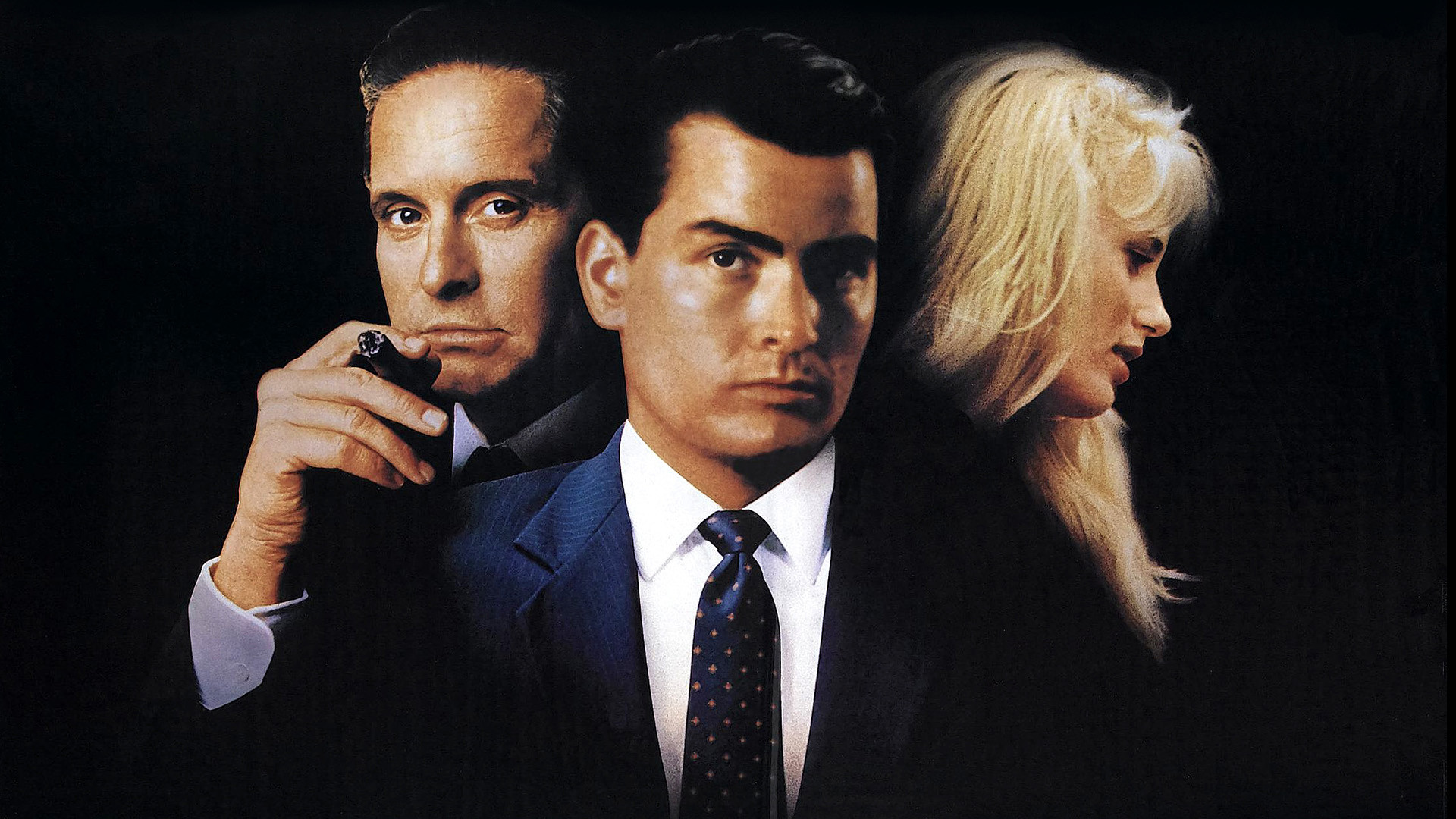
Greed is good?: Michael Douglas created an icon, Charlie Sheen was full of promise and Daryl Hannah looked pretty in Wall Street, a critique of the yuppie that was received as anything but
Ah, the ’80s… we all remember them, don’t we? On the one hand, consumerism hit top gear, the majority on both sides of the Atlantic got wealthier and ‘pooters started to take over the world; on the other hand, society became strongly politically divided, cynical pop elbowed out quality rock and people decided to dress in fashions even sillier than those of the ’60s and ’70s. But is that the whole story? Well, no. The reality was somewhat more complicated. And, despite the rose-tinted view many hold when recalling movies from that decade as easy-on-the-eye-and-brain formulaic fantasy, comedy and violent action, the cinema of the ’80s actually reflected the complicated culture of its times; it was decidedly diverse, unquestionably interesting and assuredly surprising.
Here then, peeps, is the latest post in my series looking back at the most era-defining flicks of, well, their respective eras (see the ’60s and ’70s movie posts here and here) and it offers up the dectet of pictures – in no order but chronological – that sum up cinema of the 1980s. Word-up…
.
CLICK on the film titles for video clips (warning: bottom clip contains strong language)
~~~
Risky Business (1983)
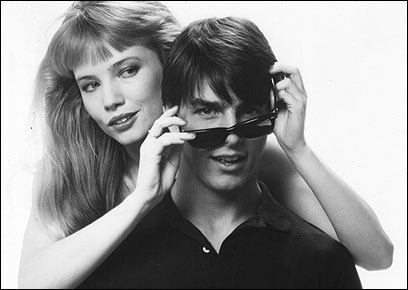
For many, there’s no more ’80s a movie than Risky Business. And rightly so. Not only did it effectively augur how the entrepreneurial-driven, economically liberal culture of Reagan’s America would look onscreen, trailblazing the decade’s ostentatious and extravagant, MTV-friendly visual style (backed up by studio-rich, synthy pop music), but it also properly introduced to filmgoers Thomas Mapother IV, aka Tom Cruise. It tells the tale of a naïve, yet ambitious rich-kid (Cruise) who, while his parents are out of town, has an encounter with a hooker (the equally young and beautiful Rebecca De Mornay), then manages to total his dad’s car and come up with the ingenious/ dubious (delete as appropriate) idea of turning his home into a brothel for his horny schoolmates in order to pay for said motor’s repair. The plot sounds hokey, but thanks to a witty, knowing script and a lot of charm from its winning leads in star-making turns, as well as that aforementioned flashy and sexy, Miami Vice-esque look, the result is far from ropey. Many teen comedies would follow Risky Business in the ’80s, of course – hell, John Hughes built a Hollywood career on them – but none proved to be as significant (not least for unleashing The Cruiser on an unsuspecting world), smart, stylish and prescient as this flick.
~~~
WarGames (1983)
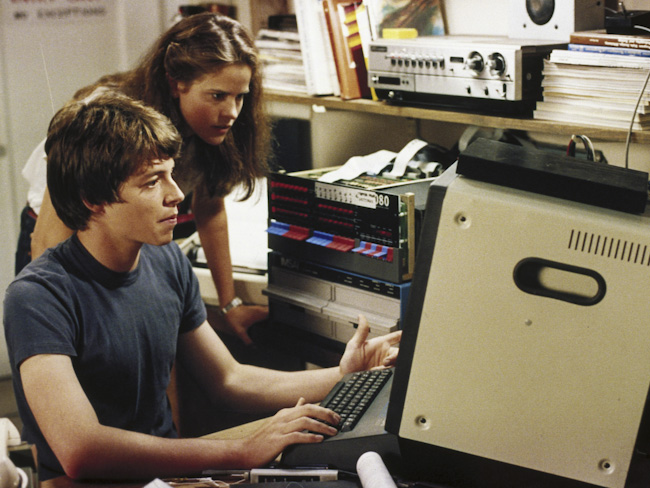
The computer geek. Nowadays they’re ten-a-penny in the movies, but before the early ’80s their celluloid presence was as thin on the ground as a ‘pooter game more advanced than Pong. That all changed with WarGames, though. Directed by the man who’d helmed Saturday Night Fever (1977), the versatile John Badham, it brought into the mainstream the notion of the ‘hacker’, an (often amateur) computer whizz who hacks into stuff they shouldn’t owing to their sheer bonce-bulging intellect and keyboard capabilities, thus potentially bringing about all kinds of unpleasant crap for us all. Given this was, as mentioned above, the era of Reagan (with all his neo-Con foreign policy wonks), the Cold War was once more hotting up and the threat of nuclear catastrophe was again looming large. Therefore, the sh*t-storm stirred up by the pubescent hacker in WarGames (played by Matthew Broderick, shortly to become immortalised as Ferris Bueller) involved accidentally inviting the US Government’s supercomputer to unleash hell on Mother Russia. As with Risky Business, the concept is pure hokum, but its execution is handled competently, ensuring the result is taut and thrilling in all the right places and – like many of Hollywood’s best flicks of the ’80s – satisfies as far-fetched escapist entertainment in all the others. The movie’s legacy, it could be said, is the glut of ‘pooter-based comedies that followed it, including everything from Electric Dreams (1984) and Weird Science (1985) to the Whoopi Goldberg vehicle Jumpin’ Jack Flash (1986). And just 12 short years later, in the shape of Toy Story, we’d get a movie every inch of which was designed by computer – as WarGames taught us, the dull, monolithic ‘pooter really was taking over, whether we liked it or not.
~~~
Ghostbusters (1984)

1984: the year of the ’80s Hollywood blockbuster. The evidence? That year, Beverly Hills Cop, Indiana Jones And The Temple Of Doom, Gremlins, Romancing The Stone, The Karate Kid and Police Academy were all released. Yes, all of ’em. Oh, and Ghostbusters, of course. One may argue that the latter is the ultimate ’80s Hollywood blockbuster; the ultimate, if you will, ’84 Hollywood blockbuster of ’84 Hollywood blockbusters. Why? Well, not only is it one of the decade’s biggest box-office hits (making nearly $300 million; over $600 million in today’s money); is bloody brilliant with so many memorable scenes and moments (Slimer’s take-down in the hotel; the Stay Puft Marshmallow Man climax and, well, every line Bill Murray utters); is fantasy adventure of the highest order like so many of that decade’s cinematic hits; effectively features the trademark 1980s city, the Big Apple, as one its main characters; and nailed its brand maximisation perfectly (Ray Parker Jr.’s infectious theme song and that unmistakeable title card logo), but it also marvellously married the hottest comedy properties of the time with Hollywood commerciality at its most creatively competent. For Murray, his co-stars Dan Aykroyd and Harold Ramis (who together co-wrote the flick) and John Belushi (the intended Peter Venkman, before his untimely death) were all weaned on the late ’70s/ early ’80s TV comedy phenomenon that was Saturday Night Live (1975-present) and/ or the project that would spawn the National Lampoon movie brand, with Ghostbusters proving the hit that sent them and the latter show’s reputation supernova. Hot young TV comedians and Tinseltown largesse, eh? Now that’s you call crossing the streams.
~~~
My Beautiful Laundrette (1985)

So what was going on in British film in the ’80s then? Well, by the middle of the decade, arguably not much. Aside from, perhaps, a handful of flicks financed by George Harrison’s Handmade Films – including Terry Gilliam’s excellent Time Bandits (1981) and Brazil (1985) – and experimental efforts from Peter Greenaway. As in the ’70s, the British film industry was suffering from a lack of finance and commercial success; flicks that caught the imagination of both the critics and the public were very few and far between. All that changed in ’85, though, with My Beautiful Laundrette. No British film of the ’80s managed to generate quite the same combination of freshness, of-the-moment urgency and controversy as this one. In 1982, Britain got a new terrestrial TV station, Channel 4, which admirably poured some of its money into a movie-making wing. Collaborating with a similarly new and progressive film company nattily entitled Working Title, it produced this flick, jam-packed full of polemical issues of the age: racism (Fascist whites versus Pakistani businessmen), homosexuality (the two male protagonists, one a young Daniel Day Lewis, lead a tentative but unashamed affair) and the politics of Thatcher’s Britain (entrepreneurialism versus education, unemployment, class and generational divides). Originally made for TV (admittedly it shows), the keenly observed, often comic piece was instead released cinematically and launched the careers of both its helmer Stephen Frears – who would go on to direct Helen Mirren to an Oscar in The Queen (2006) – and its Oscar- and BAFTA-nominated scribe Hanif Kureishi – who would go on to write the novel The Buddha Of Suburbia (1990) and its 1993 TV adaptation. To say My Beautiful Laundrette was a breakthrough is an understatement; to say it’s one of the most important films of the ’80s is unquestionable.
~~~
St. Elmo’s Fire (1985)

Unlike for the bright young things of a slowly re-energising British film industry, social realism wasn’t exactly the order of the day for Hollywood. Riding the revitalisation of US confidence and self-worth under good King Ronnie, Tinseltown instead banked on fantasy. Fairytale-esque adventures for both kids and adults – i.e. the original Star Wars trilogy (1977-83), the first four Superman flicks (1978-87), the Indiana Jones series (1981-2008) and Conan The Barbarian (1982) – was what the public wanted; not tales that tried to analyse issues of the day. Indeed, when Hollywood did turn to social realism in this era, it tended to produce something like St. Elmo’s Fire. Instead of being an American My Beautiful Laundrette, this coming-of-age drama about recently graduated young ‘uns – delivered by Joel Schumacher, who a decade later would churn out the dubious Batman sequels Batman Forever (1995) and Batman & Robin (1997) – was instead a vehicle for Hollywood’s new golden generation of actors, banded together by the media under the moniker ‘The Brat Pack’. To give it its dues, St. Elmo’s Fire does feature drug-taking, marriage and family break-up, unrequited love, idealism versus vocational pragmatism and a nervous breakdown, but frankly, with its one-dimensional characters and ropey dialogue, it plays more like a cartoon-cum-music video of post-campus life. It’s best remembered for its oh-so iconic cast (Demi Moore, Rob Lowe, Emilio Estevez, Ally Sheedy, Judd Nelson and Andrew McCarthy), its garish hairstyles and fashion, its chart-topping title song, John Parr’s St. Elmo’s Fire (Man In Motion), and one of the characters’ mode of transportation in the urban jungle, er, a jeep. In short, it’s all surface gloss and, thus, so ’80s it aches. The public gobbled it up at the time and it’s still eerily popular. And yet, for all that (or maybe because of it), to paraphrase one of its contemporary youth flicks, it somehow really is some kind of wonderful.
~~~
A View To A Kill (1985)

There was, mind you, one cinematic entity for which the UK and US film industries always converged – the doubling-up effort that was the big screen 007. Unfortunately, though, by now the ‘official’ James Bond film series, produced by movie dynamo Albert R. ‘Cubby’ Broccoli’s Eon Productions, was in a spot of bother. For the first time, Bond actually had competition at the flicks thanks to Hollywood’s latest love affair with action-driven fantasy adventure and, in particular, Indiana Jones. In no uncertain terms, the invention, pace, excitement and all-round quality of Indy’s first two adventures, Raiders Of The Lost Ark (1981) and Temple Of Doom (1984), had stolen Bond’s thunder in the first half of the decade; agent 007, in the guise of the ever suave yet now 50-ish Roger Moore, was starting to look his age, his globe-trotting escapades less thrilling and less till-ringing at the box-office than they’d once been. That’s not to say the early ’80s Bonds For Your Eyes Only (1981) and Octopussy (1983) weren’t any good, but film fans – especially young ‘uns – seemed to be more excited by Harrison Ford being chased by a giant boulder or cutting a rope-bridge in half. In an effort to address this, Broccoli and co. did the only obvious thing they could with their next espionage spectacular (Sir Rog’s last) – embrace the 1980s. So, with A View To A Kill, what we have is an adventure mostly set in an American metropolis (San Francisco) full of flashing neon, fire trucks, Corvettes and police cars with wailing sirens; a plot that sees the villain (a peroxide-blonde Christopher Walken as a demented yuppie) and his sidekick (the crazy ’80s icon that is Grace Jones) wanting to blow up the home of the microchip, Silicon Valley itself, and best of all, the hottest music act of the day, Britain’s Duran Duran, delivering the title song. Did it work? Well, the profits were no higher than for the previous Bond, but the pop-tastic theme hit #2 in the UK charts and, even better, #1 in the States. Moreover, Moore himself got to bow out as 007 in the most ’80s Bond flick imaginable – his old-school smoothie gent colliding and, somehow, complementing the flashy aesthetic-driven world of the decade that taste forgot. Some Bond flicks merge into each other; this one stands out as brashly, colourfully and rather wonderfully as the Golden Gate Bridge in the Californian sunshine.
~~~
Jean de Florette/ Manon des Sources (1986)

Aside from for cineastes, foreign language cinema had never really properly broken through in Anglo-American culture. Yes, thanks to the media, many peeps had heard of Jean-Luc Godard, Ingmar Bergman and Federico Fellini, but how many in the US and the UK had actually seen one of their movies? All that, arguably, changed in the ’80s. In 1981, François Mitterand was elected French President and set about promoting the culture and history of the country by allocating financial support for films of which those were concerns. One such project that benefited was Claude Berri’s duology Jean de Florette and Manon des Sources, based on a novel by Marcel Pagnol. The latter, an established filmmaker, had actually adapted his own book for the screen back in the ’50s, but this production would pull out all the stops and take all the glory. With a combined budget making them the most expensive French film(s) made up to that point, they’re an archetypal example of ‘heritage cinema’ that the French government’s film funding made a trend of, their plot involving the inheritance of a farm in the Provence region around the time of World War One. Together they make for good viewing, but maybe except for a brilliant moment of tragic realisation on one character’s part, they deserve their place on this list for their success and legacy rather than their content. They were a huge hit in their homeland, both publicly and critically; moreover, while he’d been a massive star in France for years, it was this flick that finally made Gérard Depardieu a global name, as well as launching the career of his co-star Emmanuelle Beart. But most important of all was the flicks’ impact on the public abroad. In America Jean de Florette grossed a mightily impressive $5 million and in the UK – thanks too to the Peter Mayle book A Year In Provence (1989), later filmed as the Russell Crowe starrer A Good Year (2006) – the movies encouraged an increasingly moneyed middle class (yuppies very much among them) to holiday and buy property in Provence, eager to experience the beautiful countryside and idyllic culture so stunningly captured in the films. Yes, thanks to Depardieu and co., Francophilia had verily broken out, the symptoms of which (Brits in Provence, Gallic-themed TV ads and European film hits in the UK and US) have been with us ever since.
~~~
Beverly Hills Cop II (1987)

Judge Reinhold espoused in a documentary about Beverly Hills Cop II I saw recently (don’t judge) that, whenever he watches said movie in which he once starred, he’s amused by the size of the sunglasses every character wears. They’re big. But then, everything about Beverly Hills Cop II is big. By this stage in the ’80s, big was in for Hollywood; as it was everywhere else. Big hair, big shoulder pads, stereos so big they were called ‘ghetto blasters’ and big profits in business. Movies are Hollywood’s business, of course, so what was the best way for it to maximise profits? How about doing exactly the thing that made millions first time around all over again? How about making a sequel to every über-hit? The fast emerging suburban multiplexes were, by the end of the decade, awash with sequels to major blockbusters – Ghostbusters II (1989), Back To The Future II (1989), Lethal Weapon II (1989) and a third Indiana Jones (1989). Oh, and Beverly Hills Cop II, of course. The latter’s predecessor was huge at the box-office, featured an obligatory US #1 chart hit and became an instant comedy classic. To direct the sequel, producers Jerry Bruckheimer and the late Don Simpson turned to the helmer of their latest monster hit (the high-concept, high-octane, highly daft Tom Cruise starrer that was 1986’s Top Gun), Tony Scott. Having come to Tinseltown from the UK ad industry, Scott filled the movie with glossy, music video-like visuals and action set-pieces. This ensured the witty comedy that had so characterised the original took a back-seat; almost all of the film’s comic moments relying on star Eddie Murphy’s ad-libbing. It’s still a funny film, but only in places, and the comedy is definitely broader and swearier than the first’s. The plot, pacing and, well, overall quality are all rather ropey too, creaking under the weight of the need for the project to make major moolah. Unquestionably then, Beverly Hills Cop II fulfils that age-old movie sequel maxim: ‘the law of diminishing returns’. Still, given it, very impressively, made just shy of $300 million globally (only around $15 million short of the original’s total) and embraces every nuance of the ’80s’ garish aesthetic, for me it has to be the ultimate exponent of that decade’s addiction to the sequel – an addiction that, let’s be honest, has now grown into an epidemic. Thanks for that, the ’80s.
~~~
Wall Street (1987)
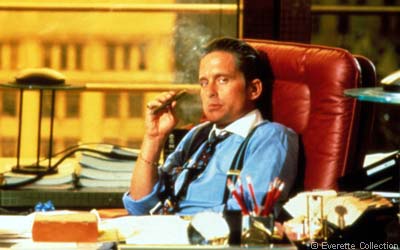
He’s been mentioned more than once in this post already and now it’s finally time to focus on the ’80s’ most enduring icon: the yuppie. In Gordon Gekko, Wall Street not only encapsulated one of the most recognisable stereotypes of its era, but also captured that era’s culture of aspiration, social-climbing, greed and excess brilliantly. In fact, this flick nailed all that so well that many seemed to regard it as an advert for the quick-buck banking crowd, rather than as the critique of Anglo-American economic liberalism hurtling along with nobody on the brake that it actually is. Wall Street, though, is far from a perfect film and maybe that’s why its point didn’t hit home as well as it might. As Bud Fox, a young stockbroker who’s seduced by the allure of easy money and the charismatic Gekko (Michael Douglas) who’s made a career out of making it, Charlie Sheen doesn’t really impress – he only ever seems one eyebrow-raise away from Hot Shots! (1991) – and Daryl Hannah as his trophy girlfriend is mis-cast. Plus, the screenplay, although it whizzes and crackles with impressive stock exchange floor-style dialogue and terminology, doesn’t quite put enough bones on its plot (a fight between two ‘fathers’ for the soul of Fox; the corrupt corporate raider Gekko and his own father, nattily played by Martin Sheen, an aircraft union man) to prevent the whole feeling a little twee. However, as noted, Wall Street was and always will be about Michael Douglas’s Gordon Gekko. An amalgamation of several real power brokers at the top of US business in the ’80s, the character is essayed expertly by Douglas, despite director Oliver Stone’s original reservations about casting him. The former rightly won an Oscar for his portrayal, the most memorable moment of which being the speech he makes to a room full of suits during which he utters the immortal phrase ‘greed is good’ (which was actually inspired by a pair of speeches given by two insider traders whose jailing sparked the film’s conception). In the years since the flick’s release, Douglas has confessed young stockbrokers have told him he’s the reason they joined their profession; perhaps a legacy he’s not too happy about. Especially given the fact Wall Street and Gordon Gekko were intended as a wake-up call – one that, in the midst of our current global economic crisis, some of us may wish we’d heeded.
~~~
Red Heat (1988)

Yuppies and big business are all very well, but there was another socio-political reality that loomed large over the decade too, namely the re-heating up and eventual burning out of the Cold War. Like WarGames, many US and UK flicks in the ’80s focused on the supposedly non-military conflict between East and West, whether they be espionage efforts (most of the Bonds, 1986’s Target, 1987’s The Fourth Protocol), comedies (1985’s Spies Like Us and Top Secret) or, well, just plain ridiculous (1984’s Rocky IV). The latter flick was an action-fuelled, mostly violent, rather sweary and utterly fantastical slice of so-bad-it’s-good cinema. Indeed, in the ’80s, Hollywood churned out so many of these sorts of films they became a sub-genre. And many can be referred to as Stallone or Schwarzenegger movies. Sly Stallone, naturally, was the star and driving-force behind the hugely, if inexplicably, popular Rambo and Rocky series. Arnold Scwarzengger’s list of flicks this decade were more varied. Sort of. He became a star playing the cyborg killing machine title character in James Cameron’s The Terminator (1984), then went on to mix fantasy, sci-fi and militaristic action heroics through the likes of Red Sonja (1985), Commando (1985), Raw Deal (1986), Predator (1987) and The Running Man (1987). All these complied with the Arnie movie template of violence, destruction and bad one-liners. And so did his next effort, Red Heat. However, the difference with this ‘un was it used the, by now, cooling off of the Cold War as a sub-text to its corny-as-popcorn plot. Schwarzenegger plays a captain in Moscow’s police militia who travels to Chicago to track down a Ruskkie crimelord and finds himself buddy-buddying up – à la 1987’s Lethal Weapon – with James (brother of John) Belushi’s wisecracking cop. The clever – and, yes, it is quite clever – twist to this dynamic, though, is that it’s Arnie’s hard-as-nails Soviet who’s the ruthlessly efficient half of the pairing; Belushi’s capitalist is the profane and world-weary one that seems to live just one level up from the villains he chases. Indeed, this is encapsulated by the gifts they exchange during the film’s denouement: Belushi receives Arnie’s expensive Swiss timepiece; Arnie gets Belushi’s crappy, second-hand wristwatch. Red Heat is a silly film, no question, but it was supposed to showcase how the coming end of the Cold War was breaking down barriers; a world in which America’s capitalist model had won and the US would rule the future as the single super power. But would that be the case? Did Red Heat‘s Arnie/ Belushi dynamic, in fact, ironically suggest things wouldn’t quite turn out like that, at least, for Hollywood? Well, peeps, that may be for another post…
~~~
Five more to check out…
Desperately Seeking Susan (1985)
Rosanna Arquette is mistaken for the ultimate ’80s pop star Madonna in this bright and breezy Big Apple set caper
Labyrinth (1986)
The 1980s David Bowie model (big, big hair and poptastic tunes) meets The Muppets – more or less – in a cult classic family fantasy
Crocodile Dundee (1986)
Australia hits it big by sending comic Paul Hogan’s Outback stereotype to New York
Rita, Sue And Bob Too! (1986)
More smart and witty social realism from Britain as a middle-class man pursues infidelity in Yorkshire suburbia
Working Girl (1988)
Hollywood turns the Big Apple business world into an aspirational romantic comedy, with Melanie Griffith, Harrison Ford and Sigourney Weaver along for the ride
~~~
… And five great movies about the ’80s
The Last Days Of Disco (1998)
Kate Beckinsale and Chloë Sevigny’s young professionals cling on to the dying disco era in early ’80s Manhattan
Billy Elliott (2000)
Outstanding Cinderella-story about a disadvantaged boy who realises he can realise a dream during the ’84 Miners Strike
Das Leben der Anderen (The Lives Of Others) (2006)
Espionage-themed drama that focuses on the preservation of humanity in the face of the Stasi’s (East German secret police) tyranny
This Is England (2006)
No-holds-barred but, in places, funny and entertaining account of a the conversion of a Falklands War victim’s son to the UK National Front Fascist movement
Micro Men (2009)
Made-for-TV recreation of the battle for the British home PC market between Amstrad’s Sir Clive Sinclair and Chris Curry’s Acorn Computers
Janet Ellis/ Sarah Greene: Blue Peter Fitties

Talent…
.
… These are the lovely ladies and gorgeous girls of eras gone by whose beauty, ability, electricity and all-round x-appeal deserve celebration and – ahem – salivation here at George’s Journal…
.
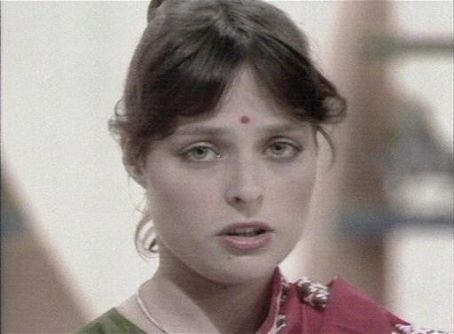
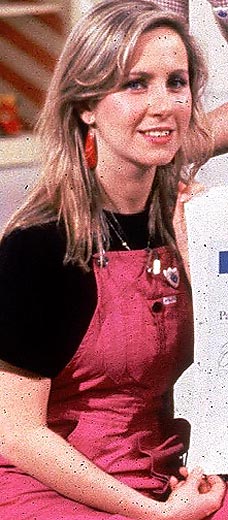
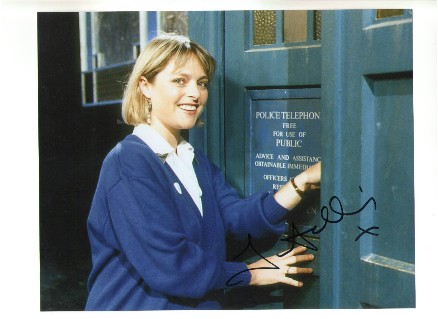
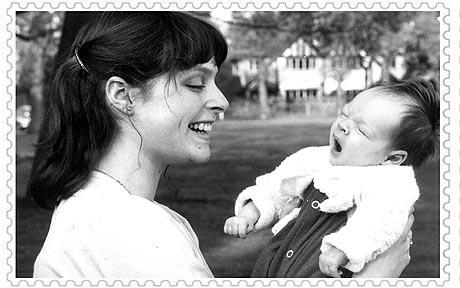
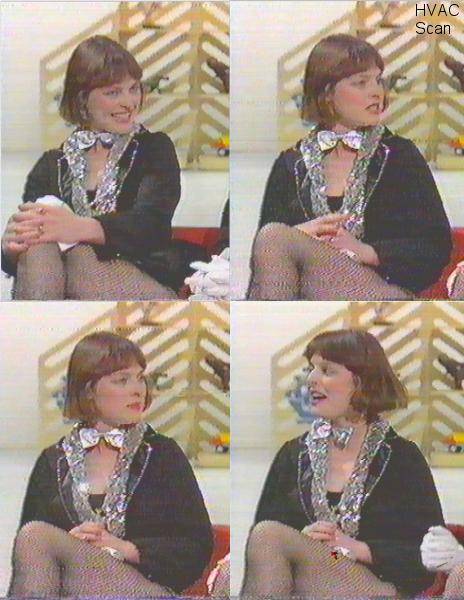
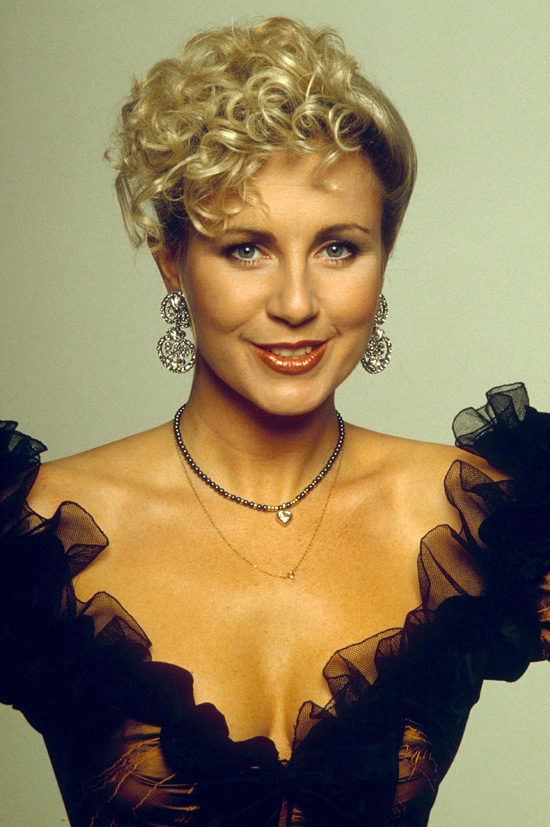
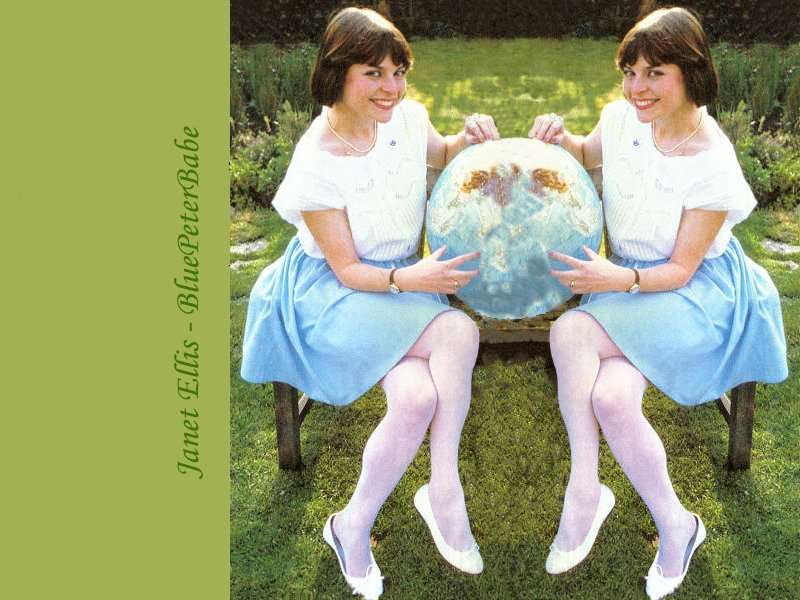
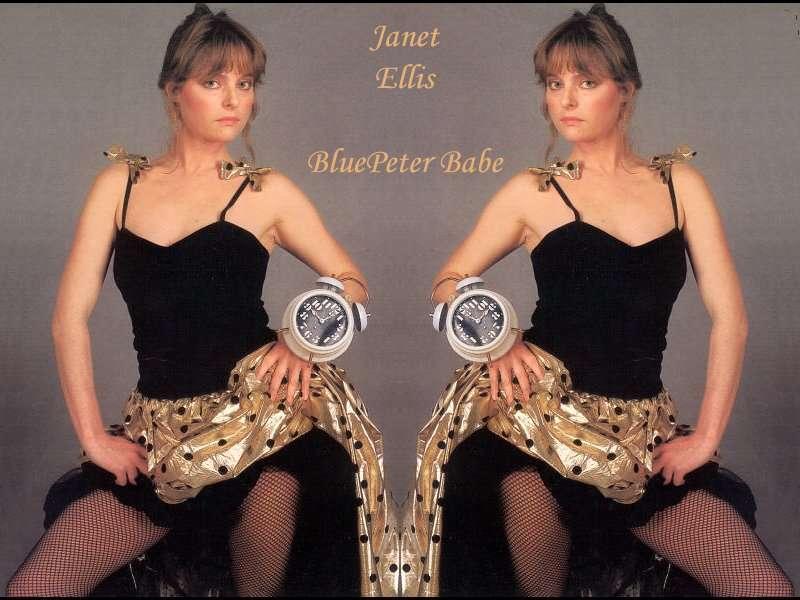
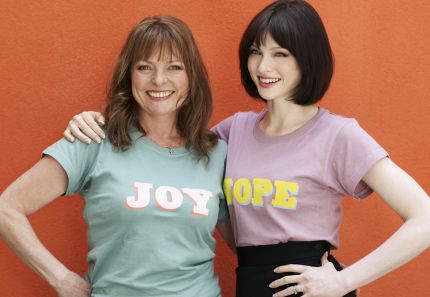
A children’s telly-tastic totty one-two for October – yes, it’s surely the two most desirable belles ever to have graced the old Television Centre Blue Peter studio, Janet Ellis and Sarah Greene. Individually, they lit up drab weekday early-evenings as they gave us history and geography lessons, baked cakes, interviewed celebrities and presented to us ‘something they’d made earlier’; together, they’re simply 1980’s TV deities – and both still look terrific today. Here they are then, the latest couple to enter this blog’s Talent corner…
.
Profiles
Names: Janet Ellis/ Sarah Greene
Nationalities: English
Professions: TV presenters/ Actresses
Born: Janet – 16 September 1955, Kent/ Sarah – 24 October 1958, London
Known for: Janet – presenting classic BBC1 children’s magazine programme Blue Peter (1958-present) for four years (28 April 1983 – 29 June 1987), during which time she achieved fame and acclaim for setting a new women’s European freefall record with the RAF after breaking her pelvis in training, as well as announcing to the nation in November ’83 that the Blue Peter garden in the grounds of BBC Television Centre in London’s Shepherd Bush had been vandalised. Before Blue Peter, she appeared as Teka in the 1979 Doctor Who story The Horns Of Nimon and on the puppet-driven kids’ show Jigsaw (1979-84). Mother of three children, one of whom is pop star Sophie Ellis-Bextor/
Sarah – pre-dating Janet as a Blue Peter presenter (19 May 1980 – 27 June 1983), having been given the job at just 22 years-old; then the youngest ever. After her stint, during which she memorably dived to the wreck of the Mary Rose, she moved on to host BBC1’s lively Saturday morning magazine show Saturday Superstore (1982-87) alongside DJ Mike Read and then to co-host its replacement Going Live! (1987-93) with Phillip Schofield and Gordon The Gopher. Like Janet, she also appeared in a Doctor Who story, as Varne in Attack Of The Cybermen (1985), as well as starring with Michael Parkinson in the hoax paranormal drama Ghostwatch (1992) and competing in the 2008 series of Dancing On Ice (2006-present). Plus, in September ’88 she was famously involved in a helicopter accident with fellow TV personality Mike Smith, whom she married the following year.
Strange but true: Janet was happy for a very young Sophie Ellis-Bextor to appear on Blue Peter several times with her (proving the rumour that the former had to leave the show owing to giving birth to the latter out of wedlock to be untrue), while in 1983 Sarah released a pop single named Eeny Meenie.
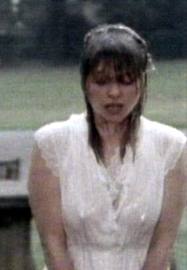
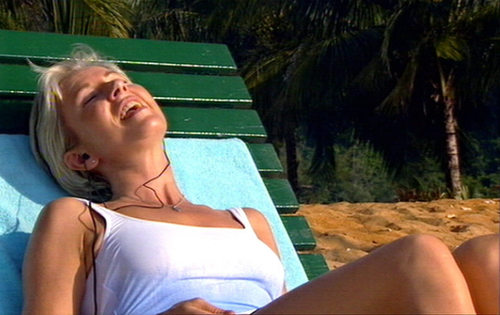
Peak of fitness: Janet – taking a soaking in a Blue Peter feature dressed only in Victorian underwear/ Sarah – appearing in a one-piece swimsuit on Brighton beach and pier for Blue Peter.
.
.
CLICK on images for full-size
.

.

.
.
.


.
.

.

.

.
.

.

.
.
.

.
.

.
.
.

.

.

.


.
Holly hits 50: how Breakfast At Tiffany’s came to the screen and changed everything

Good golly, Miss Holly: Audrey Hepburn as the irrepressible, irresistible Holly Golightly in Breakfast At Tiffany’s – perhaps the signature role of her delightful, unforgettable career
Blogs are supposed to be sources of personal opinions, assertions and divulgences, so perhaps it’s time I offer you up a confession, folks. And here it is. I was 19 years-old and in my first year of university: fashionably, I had a poster on my wall of Jennifer Aniston; unfashionably, I fell hopelessly in love with Audrey Hepburn. And the latter had absolutely everything to do with my very first viewing of Breakfast At Tiffany’s (1961).
Like it had for so many peeps before and has for many more since, that movie and the angelic Audrey in the titular role of Holly Golightly utterly bewitched me. I must have watched my recorded-from-the-TV VHS version of the film God knows how many times over the next year or two. It’s a wonder that, like I had as a 10 year-old with my tapes of The Spy Who Loved Me (1977) and Moonraker (1979), I didn’t wear it out. But why did I fall for it so?
Well, there’s the look; the cool, glamorous yet breezy early ’60s interpretation of Manhattan it features. There’s the contrast of sunshine and heartbreak in the atmosphere it conjures up. There’s the smooth, jazzy score from Henry Mancini that also offers the dreamy, sad signature tune Moon River. There’s the wit, sass and warmth of the script, delivered so wonderfully by a cast including Patricia Neal, Martin Balsam, Buddy Ebsen and George Peppard (whose so-called writer character I so identified with – and still do). And, as said, above everything else there’s Audrey; beautiful and kooky, jubilant and sad, innocent and worldly-wise Audrey with her ginger cat with no name (aside from ‘Cat’, of course).
In hindsight, as a romantic, oft melancholic 19 year-old already in love with the movies and with a penchant for the oh-so cool feel of the early ’60s, it was inevitable I’d fall hook, line and sinker for Holly and co. Yes, me and Breakfast At Tiffany’s; it was kismet.


Truman’s blues: Capote with Audrey Hepburn (and husband Mel Ferrer) (l) and Marilyn Monroe (r) – although friends with both, he far from approved of the former’s casting over the latter
Years later now, I must admit it’s no longer my favourite film. People move on and wistful students grow up. It still holds a fond place in my heart, don’t get me wrong, but it no longer feels like ‘my film’. In fact, since I was that 19 year-old I’ve come to realise in just how many hearts Breakfast At Tiffany’s holds a fond place; just how popular a flick it is – and just how big an impact on popular culture it’s had in its 50-year existence. For, yes, that’s right, this year – in fact, officially last Wednesday (October 5) – Breakfast At Tiffany’s celebrated a half-century since it was first released in cinemas.
But, unlike much in the movie, its journey to the screen was neither sophisticated nor carefree. In 1958, American writer Truman Capote – who would achive great acclaim with the murder-themed ‘non-fiction novel’ In Cold Blood (1966) – authored a novella named, yes, Breakfast At Tiffany’s. It told the tale of a free-spirit named Holly Golightly, who has run away from a marriage in the Dust Bowl to Manhattan’s Upper East Side and earns her keep as (in the words of Capote himself) an ‘American geisha’. Set in the early 1940s and told from the point-of-view of a homosexual, Capote-like observer, it boasts glamorous and faux yet believable characters and drips with atmosphere and melancholia.
Drawn from the author’s own experiences of growing up in Manhattan and, to some extent, people he knew, Breakfast At Tiffany’s first featured in the November ’58 issue of Esquire magazine and went on to be published in book-form with three Capote short stories. Readers quickly drew comparisons between Holly Golightly and Sally Bowles from Goodbye To Berlin (1939) by Capote’s mentor Christopher Isherwood – the character who would later be immortalised by Liza Minnelli in Cabaret (1972), the musical film adaptation of the latter work. Nevertheless, Capote’s tale struck a chord with both critics and the public (contemporary Norman Mailer hailed him: “the most perfect writer of my generation… [I] would not have changed two words in Breakfast at Tiffany’s”), ensuring it became a hit and Hollywood was soon interested in giving it the big screen treatment.
Capote sold the rights to Paramount Pictures and knew what he wanted from the eventual movie. First of all, he was adamant who should play his (anti-)heroine. In the novella, Holly Golightly is an 18-19 year-old; as much an inexperienced teenager as a worldly young woman. She has a hard, flinty-like exterior too, but underneath is so vulnerable it feels she could be snapped in two at any moment. For Capote then, the ideal casting for her would be none other than Marilyn Monroe. Looking at it that way, it makes perfect sense – indeed, Marilyn was actually another influence on Capote’s realisation of Holly. And it seems Paramount had no objections to the idea, so much so they hired scriptwriter George Axelrod – who had written the Monroe-headlined films The Seven Year Itch (1955) and Bus Stop (1956) – to tailor a script specifically for her.
“Paramount double-crossed me in every conceivable way. Holly had to have something touching about her – unfinished. Marilyn had that. Audrey is an old friend and one of my favourite people, but she was just wrong for that part.’’ ~ Breakfast At Tiffany’s author Truman Capote on the casting of Audrey Hepburn instead of Marilyn Monroe as Holly Golightly
However, this idea was fast to hit the buffers, not least because, well, that’s exactly what poor old Marilyn was doing. The demise of both Monroe’s movie career and her life are infamous – almost every film fan knows that her last completed flick was The Misfits (1960) and just how difficult a shoot that was owing to her personal troubles. In actual fact, though, the specific reason why Monroe didn’t take the role was because she was advised against it by her acting guru, the legendary coach Lee Strasberg. He opined that playing a character who was, however you dressed it (or her) up, a prostitute would be very much the wrong step at this stage in her career.
The film’s producers then, Martin Jurow and Richard Shepherd, needed someone else – and it was now that they turned to Audrey Hepburn. Ironically, given how iconic a role in her canon it would become, she wasn’t interested at first. Like Monroe, and you couldn’t really blame her, she wasn’t crazy about playing a hooker. But the producers persisted, telling her that that’s not who Holly was; she was really a ‘dreamer of dreams, a lopsided romantic’. Audrey wasn’t convinced by the director they’d chosen either, as she hadn’t heard of him. In an effort to please her they instead hired Blake Edwards, helmer of recent knockabout submarine comedy hit Operation Petticoat (1959), which had starred Cary Grant and Tony Curtis. The director they’d let go was, in fact, John Frankenheimer who, now free, would instead go on to make two Hollywood classics, Birdman Of Alcatraz and The Manchurian Candidate (both 1962).
In the end, Jurow and Shepherd got their girl. According to a book published this year, Breakfast at Tiffany’s: The Official 50th Anniversary Companion, by Sarah Gristwood, Blake Edwards himself flew out to Switzerland to charm Audrey. Gristwood writes: “Edwards joined Hepburn’s husband, her agent and even her mother in convincing her that the style he would use to shoot the picture would effectively purify the part”. Unsurprisingly, at the news of this casting, Capote got the mean reds. Or just saw red. But, from his point of view, it would only get worse.
As mentioned, in the novella the character of Paul ‘Fred’ Varjak, the sensitive narrator who becomes fascinated with Holly, was most definitely a gay man. For their film version, the producers cast a rising actor, the handsome, strong-jawed George Peppard, who was most definitely not a gay man. It was pretty obvious then, this being the early ’60s, the film version of Paul would be heterosexual – plus, it turned out, a love-interest for Holly. Moreover, a pivotal character in Capote’s book was a bartender named Joe Bell; right or wrong, Joe didn’t make the cut for the movie at all. It must have become increasingly clear to Capote that Jurow and Shepherd really had no intention of filming a faithful adaptation of his book.
.
Still, filming got underway, but it too wasn’t without its problems. Unfortunately, the off-screen chemistry between Hepburn and Peppard was, well, off. It wasn’t that they disliked each other, which nobody has ever suggested they did, but that their approaches to the project clashed.
Audrey had always and would always be an actress of spontaneity and intuition; she was neither trained nor particularly intense in her methods (although she had experienced her fair share of intensity, such as an absent father, two miscarriages and growing up in Nazi-occupied Holland). She was a supreme comedy actress, gifted with perfect timing and an infectious, natural sparkle. Conversely, Peppard was trained and – at least at this early stage of his career, years before he became Colonel John ‘Hannibal’ Smith in TV’s The A-Team (1983-87) – took his craft seriously. If anything, he saw his role as the movie’s main character. But while Paul/ ‘Fred’ is often the audience’s point of reference and arguably the central character, it’s patently clear who the star of Breakfast At Tiffany’s is and, thus, to whom the main role belongs. And it ain’t George Peppard.
Filming was complicated further when the important first scene, over which the opening titles play and which critically dramatises the movie’s title, proved surprisingly difficult to capture. For this was in spite of the fact that its location (outside Tiffany’s jewellery store on Fifth Avenue in the heart of Manhattan) enjoyed an unexpected traffic lull at the precise time the cast and crew had rolled up for filming. Unfortunately, controlling the large crowds who’d turned up to watch, a crewman’s near electrocution in a freak on-set accident and, yes, Audrey’s dislike of pastry (Holly eats a pastry snack along with sipping a coffee as she gazes into Tiffany & Co.’s window) all combined to test the relatively green Edwards’ directorial chops. However, the scene was of course captured and now is revered and recalled as one of the flick’s best loved moments (see video clip above) – full of bittersweet, almost irresistible appeal thanks, in no small part to the theme of Moon River playing over the top of it.
Incidentally, Edwards chose not to use Manhattan locations for every exterior scene – who knows, maybe because of potential crowd-control difficulties. While most exterior shooting did make use of real Manhattan locales (such as the outside of Holly and Paul’s Upper East Side apartment building), the scene in which Audrey and George look for Cat (the film’s final scene), as well as the one in which Audrey sits on a fire escape strumming her dinky guitar as she sings Moon River (probably my favourite of the entire movie; see bottom video clip) were filmed at Paramount’s studio lot in Hollywood, as were the vast majority of the movie’s interior scenes. In fact, even some of the scenes supposedly set inside Tiffany’s – when Holly and Paul visit the store on their day out around New York – were also filmed at Paramount.


Putting on a brave face?: Peppard and Hepburn joke on-set (l), but their opposing approaches led to difficulties for Blake Edwards, whose face (r) suggests the challenge the shoot was
With its somewhat challenging shoot complete, Breakfast At Tiffany’s now needed to find its sound. And, let’s be honest, in the hiring of Henry Mancini as composer, did it ever.
It was Edwards’ choice to bring Mancini on board owing to the former’s previous success in coming up with the memorable theme tune for TV show Peter Gunn (1958-61), on which Mancini had actually worked with the former (the two, of course, would combine again on the highly popular Peter Sellers-starring Pink Panther film series). A protégé of jazz great Glenn Miller, Mancini was always going to go down the jazz route with Breakfast At Tiffany’s. And the score he delivered for the movie perfectly reflected its on-screen smooth urban sheen and sometimes sentimental, other times off-beat feel. Indeed, listen to the theme from the film actually entitled ‘Breakfast At Tiffany’s’ in the video clip below; it’s light, wispy, smooth, cool and uplifting, as well as – although it’s not Moon River – instantly recognisable.
And then, of course, there’s Moon River. The piece of music for which Breakfast At Tiffany’s itself will always be most recalled, it’s the film’s unofficial theme, as well as that of its protagonist, Holly Golightly. Mancini’s tune is complimented by pitch-perfect lyrics by singer and songwriter Johnny Mercer, who actually provided three separate sets of lyrics for the project – the adopted lyrics being chosen by Mancini as best fitting Audrey in the title role, given they seem to refer to the loss of her character’s brother Fred (her ‘huckleberry friend’) and hope for a future better than the present with someone special (‘we’re after that same rainbow’s end, waitin’ round the bend’).
The song has become a firm favourite with the public, having been covered by over 90 artists over the years, but Mancini always felt the best version was recorded by the person for whom it was written: “No-one else has ever understood it so completely [as Audrey Hepburn did]. There have been more than a thousand versions, but hers is unquestionably the greatest.” Bizarrely, prior to the film’s release, Paramount wanted to remove the song from the soundtrack, only for Audrey to exclaim: “Over my dead body!”.
“A movie without music is like an aeroplane without fuel. Your music has lifted us up and sent us soaring. Everything we cannot say with words or show with action you have expressed for us. You have done this with so much imagination, fun and beauty. You are the hippest of cats – and the most sensitive of composers!’’ ~ Audrey Hepburn in a letter to composer Henry Mancini about his film scoring of Breakfast At Tiffany’s
In the end, all the difficult, hard work paid off. Breakfast At Tiffany’s was a big box-office hit – the seventh biggest of its year in the US, in fact, where it made around $14 million; $1 million more than the legendary wartime adventure The Guns Of Navarone (1961).
And the critics lapped it up as much as the punters. On its release, Time magazine recognised that as an adaptation of Truman Capote’s novella, the movie certainly sanitised its story and characters, but that wasn’t necessarily a bad thing, opining that “for the first half hour or so, Hollywood’s Holly (Audrey Hepburn) is not much different from Capote’s. She has kicked the weed and lost the illegitimate child she was having, but she is still jolly Holly, the child bride from Tulip, Texas, who at 15 runs away to Hollywood to find some of the finer things of life — like shoes.”
Meanwhile, in reviewing the film, The New York Times called it a “completely unbelievable but wholly captivating flight into fancy composed of unequal dollops of comedy, romance, poignancy, funny colloquialisms and Manhattan’s swankiest East Side areas captured in the loveliest of colors”.
Moreover, the movie proved a magnet for award nominations. For her performance as Holly, Audrey was nominated for an Oscar for Best Actress, a Golden Globe Award for Best Actress in a Musical or Comedy and a David di Donatello (Italian film industry) Award for Best Foreign Actress; Blake Edwards was nominated for the Directors’ Guild of America award; George Axelrod’s script was nominated for an Oscar for Best Adapted Screenplay and won the Writers’ Guild of America (East)’s award for Best Written American Drama; and, most notable (and maybe most deserved) of all, Henry Mancini won Oscars for both his score and – along with Johnny Mercer – for Moon River (Best Original Song), along with a Grammy for the score.
.
But it’s really over the years since the mere months after its release that Breakfast At Tiffany’s has enjoyed the popularity and acclaim to which so many of us today are familiar. The movie’s acquisition of the oh-so enviable status of ‘Hollywood classic’ wasn’t an overnight thing; like a rolling stone gathering gold dust rather than moss, it took decades for it to be perceived rightfully as the celluloid nugget it is. And, quite frankly, that’s really down to fashion – but in two very different ways.
First, relatively soon after its release and for years afterwards, the genre of the Hollywood romantic comedy and, thus, Breakfast At Tiffany’s itself, was out of fashion. As noted in these two previous posts on this blog (1 and 2), Tinseltown’s output during the ’60s and ’70s went through dramatic changes to reflect the shifting social attitudes and issues of the times. ‘New Wave’-informed, counter-culture efforts and hard, gritty dramas steeped in neo-realism became the order of the day, leaving out in the cold the urbane and sophisticated, but generally pretty innocent rom-coms that’d had made hay in the preceding years. Filmmakers still made romcoms, of course – indeed, Woody Allen scored Oscar-winning success with Annie Hall in 1977 – but such high points tended to be few and far between and, if anything, attempts to revise the genre.
One may argue then, it wasn’t until the end of the ’80s that cinemagoers and, therefore, Hollywood fell back in love with the romcom, thanks to the huge commercial and critical success of When Harry Met Sally… (1989). Full of wit, sass and fine byplay between its two leads like the very best of the genre of old, this was the perfect modern updating of the romcom and fittingly set its female star Meg Ryan off on a career driven by similar fare, as if she were, well, the ’90s Audrey Hepburn.
Indeed, from then right up until now, multiplexes have been bulging with romantic comedies and inevitably yesteryear’s very best efforts such as the Cary Grant/ Katharine Hepburn starrer Bringing Up Baby (1938), the Doris Day/ Rock Hudson-headlined Pillow Talk (1959) and, yes, Breakfast At Tiffany’s have been rediscovered and are happily en vogue once more.


Thoroughly modern Hollies: Natalie Portman in Givenchy’s original Holly Golightly dress for the Harper’s Bazaar September 2006 issue (l), Zooey Deschanel advertising Oliver Peoples sunglasses in summer 2009 (m) and Anne Hathaway in a Vogue November 2010 shoot (r)
In actual fact, despite its modern adoration, the rediscovery of Breakfast At Tiffany’s has resulted in more negative examination of it, owing to one of its characters, than other classic romcoms. And rightly so really. Conceived as knockabout light-relief, the interpretation of Holly’s Japanese neighbour Mr I Y Yunioshi by Hollywood legend Mickey Rooney as an affected Oriental stereotype, complete with a prosthetic mouthpiece, has unsurprisingly fallen foul of modern PC opinion.
I can’t deny I’ve always felt rather awkward watching his moments in the film – by today’s standards the portrayal of the character certainly seems misguided. However, Rooney has maintained that until relatively recently he was aware of no criticism, claiming that whenever he met an Asian-American they had nothing but praise for the role, yet the criticism of today has stung him and he’s said had he been aware people would be offended, he would never have done it. Both Blake Edwards and Richard Sherpherd have admitted regret over the portrayal too.
All the same, this very specific criticism hasn’t seriously impacted on the resurgence of Breakfast At Tiffany’s. And, in no small part, that’s doubtless due to the other reason the movie’s modern popularity can be put down to fashion. And, by fashion, this time I literally mean fashion.
Nowadays, you’d have to be a Buddy Ebsen-style Doc Golightly not to be aware of the fact that Audrey Hepburn is revered as one of the biggest – if not the biggest – of history’s style icons. And her fond place in the hearts of fashionistas the world over owes a vast amount to Breakfast At Tiffany’s. Yes, it’s a film that plays around with the glamorous image that Manhattan projected in the early ’60s and, of course, features the jewel at the heart of the high street diamond business that is Tiffany’s & Co. itself, but the flick’s fashion credentials most of all rest on Audrey’s shoulders in the shape of the garment that rests on her shoulders in that unforgettable opening scene, namely that little black dress.
“[Audrey Hepburn] didn’t go to acting schools, she didn’t hear the word Strasberg, she did not repeat in front of the mirror. She was just born with this kind of quality and she made it look so unforced, so simple, so easy.” ~ legendary Hollywood director Billy Wilder fundamentally disagrees with Emma Thompson on Audrey Hepburn’s acting talent
The creation of legendary French fashion designer Hubert de Givenchy – who first decked out Hepburn in her second Hollywood flick Sabrina (1954) and became firm friends with her thereafter – it was specifically requested as Holly’s night-time dress-up best by Audrey herself and made it into the film after some slight alterations (including the removal of a long slit that would have revealed a great deal of leg) by costume designer Edith Head. A mainstay of modern, elegant female fashion, the ‘little black dress’ is as unavoidable an item of today’s world as the laptop, the alcopop and the hoodie – and, while its origins date back to Coco Chanel’s design from the 1920s, Holly Golightly’s is undeniably one of the most important.
As if to underline that fact, on December 5 2006 (following its modelling in Harper’s Bazaar magazine by Natalie Portman; see image above), one of the original dresses produced for the film was auctioned at Christie’s in London and reached an astonishing £467,200 (US$923,187) – more than six times its asking price. The money raised went to a charity to build a school in Calcutta, India.
But it’s not the dress on its own. Images of Audrey from Breakfast At Tiffany’s (especially those in which she wears the dress and has Holly’s over-long cigarette holder plonked in her mouth) have nowadays become so popular they’re positively iconic. You can buy not just prints of such images, but handbags, wall clocks and mouse pads adorned with them. It’s as if those images, the film and Audrey herself have become the same entity: chic style at its absolute zenith. Indeed, so ubiquitous has the whole thing become that it seems not a year goes by when one of Hollywood’s starlets jumps at the chance to recreate the Audrey/ Holly look – the Portman image and those of Zooey Deschanel and Anne Hathaway above are merely some of the latest. Indeed, you need only look on the ‘Net to see how far the cult of all things Holly-cool has spread: want to get as close as possible a pair of Ray-Bans to those Holly wears? Check these out… want a bathtub-come-sofa just like hers? Check this out… And so on and so forth…
And yet, fashion is, of course, just surface gloss; there’s much more to Breakfast At Tiffany’s than just how it – and Audrey in it – looks. For, though the movie may be 50 years-old, it’s an ageless concoction of cool, off-kilter, romantic, melodic charm that peeps from practically every demographic have fallen for, just as they have for its leading lady. Capote may not have approved, but millions of Holly and ‘Cat’-lovers certainly do. And, well, who am I kidding? I haven’t really moved on that far and, deep down, I’m still that wistful 19 year-old student – there’s little of me that doesn’t still love the film and its star player. Because me, Audrey and Breakfast At Tiffany’s; it was kismet. And always will be.
Playlist: Listen, my friends ~ October 2011
In the words of Moby Grape… listen, my friends! Yes, it’s the (hopefully) monthly playlist presented by George’s Journal just for you good people.
There may be one or two classics to be found here dotted in among different tunes you’re unfamiliar with or have never heard before – or, of course, you may’ve heard them all before. All the same, why not sit back, listen away and enjoy…
CLICK on the song titles to hear them
.
The Rolling Stones ~ Under The Boardwalk
Johnny Rivers ~ Secret Agent Man
Yes ~ Every Little Thing
Aretha Franklin ~ Bridge Over Troubled Water
Alice Cooper ~ No More Mr. Nice Guy
John Denver ~ Annie’s Song
John Lennon ~ Beef Jerky
Andrew Gold ~ Lonely Boy
U2 ~ October
Murray Head ~ One Night In Bangkok
Ken Howard and Alan Blaikley ~ Theme from Agatha Christie’s Miss Marple
Fleetwood Mac ~ Big Love
Bruce Willis and The Temptations ~ Under The Boardwalk
.