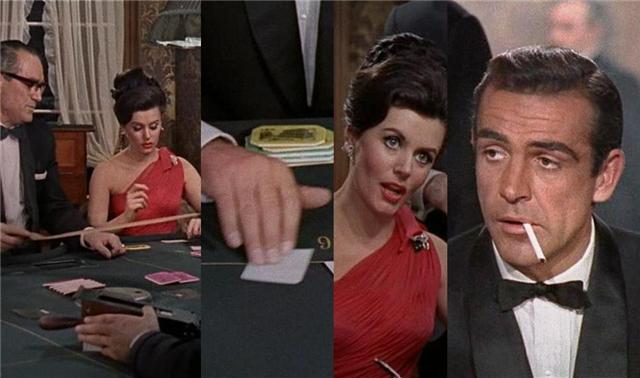
“I admire your luck, Mr…?”: luck had nothing to do with it, the casting of rough, tough Scotsman Sean Connery as 007 in the first significant James Bond film Dr No was a stroke of calculated genius – even if it certainly didn’t appear to be a trump move at the time
On October 5 1962, a critical, pivotal event took place, something that would ensure the cultural zeitgeist – if not the entire world itself – would never be the same again. For it was on this day that the cinematic James Bond was arguably born, with the world premiere of the first Eon-produced 007 film adventure Dr No being staged at the salubrious Odeon Cinema in London’s ritzy Leicester Square.
And rolling up at the venue that evening (surely the biggest night of his professional life to date) was the man who was playing the British superspy himself, Sean Connery. If anything was likely to prove a fly – nay, a scary, creepy-crawly tarantula – in the big-screen Bond’s ointment before he’d really got begun then, by rights, it should have been Connery. To many an observer at the time, his casting as the three-dimensional incarnation of author Ian Fleming’s hero had raised more than a Roger Moore-style eyebrow. Why? Because – and, as we’re talking about Sean Connery here, it almost seems impossible to contemplate this – the Big Tam was a nobody. He’d been plucked from relative obscurity to lead a $1million-budgeted Anglo-Hollywood action adventure; it was a big risk with bells on and it could have gone tits up. But, of course, it didn’t.
Indeed, unquestionably the casting of Connery was one of the reasons why Dr No went on to become such a box-office triumph, setting the whole 007 tyre-slashing Aston Martin wheel in motion. But given his lack of standing in the movie business, how on earth did he land the role? And given his relative lack of leading man acting experience, how come was he such an instant, indubitable success? This, my friends (the latest post in this blog’s continuing series celebrating the movie Bond‘s 50th anniversary), is that story.
Connery primarily owed his casting – and, arguably, success – as James Bond to three men: Dr No‘s producers Albert R ‘Cubby’ Broccoli and Harry Saltzman, and its director Terence Young, but certainly not to the character’s original literary creator Ian Fleming. When the latter heard the Scot had landed the role, he apparently dismissed him as an ‘overgrown stuntman’. He would eventually reverse this opinion, but taking a look at Connery’s credentials you can understand where his priggish, even snobbish stance came from.
.
.
Hailing from the hard, working-class Edinburgh neighbourhood of Fountainbridge, Thomas Connery had earned his nickname ‘Big Tam’ by, well, growing bigger and taller than anyone else. Unsurprisingly, aged just 18 he’d begun body-building and by 21 had competed in the Mr Universe competition. Vocation-wise, he’d had odd-jobs as a lorry driver (his dad’s profession), a milkman, a boxer, a lifeguard, a coffin polisher, an artists’ nude model and he’d enjoyed/ endured a stint as a seaman in the Royal Navy. He eventually discovered his true calling when he helped out backstage at Edinburgh’s Kings Theatre and then won a small chorus line role in a touring production of the Rodgers and Hammerstein musical South Pacific. It was during this tour that, while playing football against a provincial town team, he famously caught the eye of Manchester United’s legendary manager Matt Busby, who supposedly offered him a £25 a week contract with the club. Connery turned it down; it was an actor’s life for him now.
Bit-parts in British films followed (for which he adopted the stage name Sean, actually his middle name), including the Stanley Baker vehicular vehicle Hell Drivers and Action Of The Tiger (both 1957), the latter of which, like Dr No, was directed by Terence Young. The following year he landed a major role in Paramount Pictures’ melodrama Another Time, Another Place opposite Hollywood actress Lana Turner, with whom he had a brief affair and the result of which was fisticuffs (won by Connery) with Turner’s gun-wielding boyfriend, Johnny Stompanato – who just happened to be a heavy working for LA gangster Mickey Cohen.
Mixing it up, Connery’s next starring role was as far away as anything from demonstrating a hard-man persona; it was in the Disney Irish whimsy-themed musical Darby O’Gill And The Little People (1959), in which he not only sang, but also played opposite leprechauns. And as the ’50s slipped into the ’60s, he took on Classical roles, featuring prominently in British TV productions of Anna Karenina (1960) and Shakespeare’s Henry IV (1960) and Macbeth (1961).
So far so good. Connery was slowly but surely building up a catalogue of work that could have resulted in him becoming a recognisable face on UK TV; a tough guy who’d escaped the rough and ready streets of Scotland’s capital for the respectability of the jobbing actor. What happened next, of course, changed all that. Having signed a contract with film studio Twentieth Century Fox, which he soon discovered had merely left him on the shelf like so many Hollywood hopefuls who’d done the same (his biggest role thanks to this contract was a blink-and-you’ll-miss-it appearance in 1962’s war epic The Longest Day), his agents earned their corn like never before – and surely like never since – when they set him up for a meeting with two gentlemen named Broccoli and Saltzman.

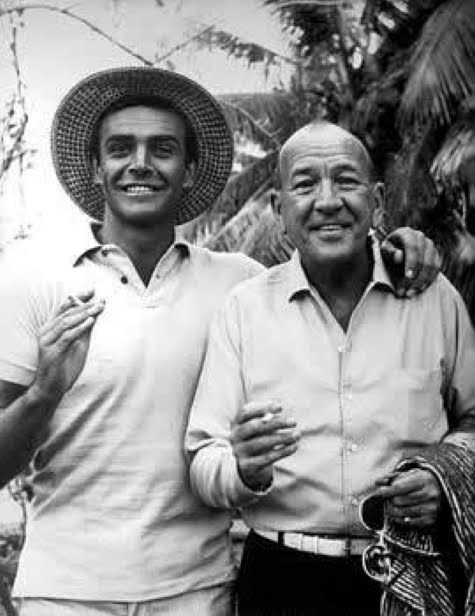
Big Tam and ex-pats: an on-set Connery confers with Bond creator Ian Fleming (l) and goofs around with Fleming’s Jamaican neighbour and one-time possible Dr No, Noël Coward (r)
The Italian-American Broccoli, formerly a New York lawyer, and the Quebec-hailing Canadian Saltzman, who liked to see himself as something of a cinematic showman, had already been in the movie business for years, albeit working separately. In 1961 they came together and formed Eon Productions, a company set up specifically to make film versions of the Bond novels (their Danjaq company – named after both men’s wives, Dana and Jaquie – was set up as a holding company for the films’ intellectual properties).
Broccoli had previously co-founded and run Warwick Films with producer Irving Allen. Warwick was based in London and used many British film professionals as crew-members on its movies (such as future Bond alumni Terence Young, screenwriter Richard Maibaum, cinematographer Ted Moore and stuntman/ stunt arranger Bob Simmons) in order smartly to save money and, thus, well, make more money. Turning out the likes of the Rita Hayworth starrer Fire Down Below (1957), Warwick was finally sunk by the box-office turkey that was The Trials Of Oscar Wilde (1960) – its accurate, but controversial homosexual themes ensuring early ’60s American censorship killed its publicity. Broccoli then was soon looking for a new Britain-based opportunity. He didn’t have to look very far.
Harry Saltzman had moved his family to Britain to further his career as a theatre producer and had quickly entered the film business. In then forming Woodfall Film Productions with dynamic young director Tony Richardson (who would go on to direct 1963’s Best Picture Oscar winner Tom Jones and marry Vanessa Redgrave) and leader of the ‘Angry Young Men’ playwrights John Osbourne, Saltzman had played a spear-heading role in launching the ‘kitchen sink’ genre of late ’50s/ early ’60s UK cinema – he personally produced both the acclaimed Look Back In Anger (1959) and The Entertainer (1960). Yet, always ambitious, he had wanted to make films that would turn a bigger profit and in 1961 he was sure he had found just the vehicle.
Having read Ian Fleming’s 1959 Bond novel Goldfinger, he had become convinced 007 was what he was looking for. Despite notorious legal disputes arising from an aborted screen-treatment for a big-screen Bond adventure knocked up by Fleming, fellow writer Jack Whittingham and eccentric film producer Kevin McClory (which saw the latter two gang up on the former when he turned the treatment into the 1961 novel Thunderball with no formal credit to either of them – read more on that here), Saltzman approached Fleming to buy the film rights of all his novels. The author assuaged and Saltzman got what he wanted (with one or two limitations), albeit for a mere six-month option and at a very pricey $500,000; always the gambler, though, he was confident he could get a first film set up within that half-year window.
.
Factfile-Factfile-Factfile-Factfile-Factfile-Factfile-Factfile-Factfile-Factfile-Factfile
- One evening before Dr No‘s premiere, the first broadcast took place of ITV’s classic spy-fi series The Saint (1962-68), starring, of course, one Roger Moore
- On the exact same day as the Dr No premiere, The Beatles’ very first single Love Me Do went on sale in the UK
- Just nine days after the premiere, the Cuban Missile Crisis began, which saw the United States and the Soviet Union come perilously close to tumbling into nuclear war, only for both to blink at the last moment – in a sort of ‘life imitates art’ manner, Dr No’s evil plan aimed to accelerate the tensions between the US and USSR and push them to nuclear war
Factfile-Factfile-Factfile-Factfile-Factfile-Factfile-Factfile-Factfile-Factfile-Factfile
.
In actual fact, Broccoli too had been interested in pursuing Bond as a big-screen project, but Irving Allen had maintained that the character and his adventures weren’t even good enough for television (Fleming’s first novel, 1953’s Casino Royale, had been adapted into a one-hour TV drama in 1954, which had been pretty forgettable) – Allen had even met with Fleming and snubbed both him and the opportunity to buy the rights for Warwick Films. But now Warwick was no more and, thanks to a meeting with legendary screenwriter Wolf Mankowitz, Broccoli learned Saltzman had bought the rights and approached him. Call it destiny, call it kismet, call it a fait accompli… call it what you will: Saltzman, the relative filmmaking novice with the ‘outside of the box’ thinking, was a natural fit with Broccoli, the hard-nosed and relatively successful industry insider; the former not willing to sell any part of the 007 rights to the latter, they agreed to put Bond on the silver screen together and, yes, chose to adapt the 1958 novel Dr No as their new company, Eon’s first.
And, in one of their canniest moves, Broccoli and Saltzman gathered around them a crew of filmmakers especially familiar to the former from his previous projects, including (as mentioned) Maibaum, Moore, Simmons and – most significantly for this tale – Young. For it was thanks to their masterstroke of hiring Terence Young as helmer of the film that the leading actor they cast as Bond went on not just to play the role, but truly inhabit it.
Speculation, wishful-thinking and, quite frankly, myth-making has been at work since the very beginning on who could have, was in the frame to and ‘should’ have played Bond. Word has it Fleming had always favoured his friend David Niven, who gets a mention in the 1964 novel You Only Live Twice as ‘the only decent man in Hollywood’ and would play one of several Bonds in 1967’s crazy spoof comedy version of Casino Royale, which ironically was co-scripted by Wolf Mankowitz. He was also apparently keen on Cary Grant – supposedly the latter would only commit to one film rather than a potential series, but surely in the end Broccoli and Saltzman would have concluded he was too old by 1962 anyway. Other names that have been bandied about include later Bond Roger Moore,who was committed to TV’s The Saint (1962-68), Patrick McGoohan on the strength of his spy drama series Danger Man (1960-68) and – rather unlikely, yet given the number of times he’s admitted to it in public, it’s probably true – future BBC newscaster Peter ‘Swingometer’ Snow auditioned too.
Apparently, Broccoli and Saltzman even ran a ‘Find James Bond’ contest in an attempt to cast the role (so the story goes, a model named Peter Anthony won this competition, the producers liking a Gregory Peck-esque quality to him), but ultimately this wasn’t how they found their man. As noted, it was through a conventional agent-set-up meeting that they met and auditioned Connery. Yet, by rights, the latter should have blown his chance here before he even got started on the gig.
.
.
An actor of little leading man experience on the screen, Connery ‘put on an act’ in the meeting – displaying an air of nonchalance; even tough-guy devil-may-care. That may have proved to work for him in media interviews for decades to come, but it was a definite gamble in clinching his first major film role. And yet it worked. Broccoli and Saltzman liked what they saw, heard and felt from him in that meeting. But apparently what sealed it was the way he walked; both felt his ‘cat-like’ gait (watch him move as Bond in the early films, it’s like a panther) as they watched him through the window of their Piccadilly office walk away down the street. This was their Bond, they decided.
Now enter Young. Although no doubt pleased to be working with a crew assembled from people familiar to him from his Warwick Films days, he wasn’t with the script. The producers had insisted on adapting Dr No as a detective-style adventure with science-fiction elements (almost playing down the espionage of the literary Bond, although admittedly there’s less of that in Dr No the novel than others), believing this would be the most palatable way to deliver an adaptation to the big-screen audience. Indeed, this may well have been one of the reasons they cast the ‘overgrown stuntman’ Connery – rather than perhaps a lither, David Niven-like, more Fleming-friendly actor – as their 007.
All the same, Young felt the script (having gone through several drafts already and a walk-out by Wolf Mankowitz) required more work still. Thus he charged credited screenwriters Richard Maibaum, Johanna Harwood and Berkely Maher to inject humour into the proceedings. In his eyes, to appeal truly to the audience, Bond needed not only to be burly, handsome and sexy, he also had to be witty, charismatic and charming – as much, if you will, Simon Templar as Richard Hannay.
This too meant Connery needed working on. The actor wasn’t a hack, far from it, but he wasn’t James Bond – certainly not Young’s vision of James Bond. So in the few short weeks before filming began, Young took Connery under his wing and introduced him to the rarefied world of tailoring (dressing him in the suits of Anthony Sinclair, his own tailor), London’s fine dining and how to move and speak like a gentleman (forbidding Connery to talk with his hands – a Young bête noir – and embellishing his cat-like walk, while softening his Scots accent to deliver the script’s witticisms).


Shooting the breeze and suiting you, sir: Broccoli chats with Dr No cast members John Kitzmiller, Sean Connery and Ursula Andress (l); Connery fitted for an Anthony Sinclair suit (r)
In fact, over the years, many have suggested that Connery’s Bond – or even Terence Young’s Bond – was Terence Young. He may be a cold-blooded killer, a man with a razor-sharp mind and an exuder of extreme confidence and unthinking bravery, but the Bond template established in Dr No is also unquestionably a man immaculately turned-out (the best possible Saville Row tailoring, never a hair out of place and minimum body movement), a true bon vivant (an enthusiast of the finest wine and food) and possessing the charm, wit and even superiority complex of an English gentleman.
You may be sceptical of Young’s domineering influence on Connery’s performance (given how much the actor has impressed in a variety of roles throughout his long career), but an insider of the calibre of the sadly departed Canadian actress Lois Maxwell – Miss Moneypenny herself – affirmed this was exactly how the director took the star-to-be in hand. She didn’t outright claim that Connery did a Terence Young impression (given Bond’s latent power, sexiness and at times brutality – that’s all Connery – he didn’t), but she didn’t get far from it.
And by the end of filming, a star-to-be Connery most certainly was. Dr No, with its fairly modest $1million budget, brilliantly inventive, nay unforgettable sets (designed by near genius Ken Adam, but partly made of cardboard) and relative unknown leading man and supporting cast, was genuine box-office boffo. Its worldwide gross of $59.6m (inflation adjusted: $440.8m) ensured it made monstrous profits for its producers and studio backer United Artists. And, of course, thanks to his performance and unquestioned screen magnetism, Connery very quickly became a bona fide moviestar.
It would, as we all know, only get better for him – and Broccoli and Saltzman. His five further Bond films – From Russia With Love (1963), Goldfinger (1964), Thunderball (1965), You Only Live Twice (1967) and Diamonds Are Forever (1971) – rang cinema tills to the colossal combined tune of $563m, making him and them very rich men. Well, actually them supposedly richer than him, which was definitely one of several bones of contention for the star as the series continued through the ’60s and Connery the man became practically indistinguishable from Bond the character in the mass public’s mindset. Eventually then, Broccoli and Saltzman were faced with having to pull off the seemingly impossible: cast someone else as James Bond.
But, as the negative doctor might say, no… no more – all that’s for another blog post, peeps…
.
.

Playlist: Listen, my friends! ~ August 2012



In the words of Moby Grape… listen, my friends! Yes, it’s the (hopefully) monthly playlist presented by George’s Journal just for you good people.
There may be one or two classics to be found here dotted in among different tunes you’re unfamiliar with or have never heard before – or, of course, you may’ve heard them all before. All the same, why not sit back, listen away and enjoy…
.
CLICK on the song titles to hear them
.
John Barry ~ Born Free
Ron Grainer ~ Theme from Man In A Suitcase1
Love ~ You Set The Scene
Richard Harris ~ Camelot (Reprise)2
The Doors ~ Love Her Madly
Cat Stevens ~ Peace Train
John Lennon ~ #9 Dream
Can ~ I Want More
David Bowie ~ Warszawa
Gladys Knight & The Pips ~ Baby Don’t Change Your Mind
XTC ~ Senses Working Overtime
Dave Grusin ~ Theme from St. Elsewhere3
Kate Bush ~ This Woman’s Work4
.
1 The classic theme from the short-lived 1967 spy TV drama Man In A Suitcase, which later became even more recognisable as the opening theme to Chris Evans’ awesome retro-flavoured Channel 4 variety show TFI Friday (1996-2000)
2 The really rather marvellous final scene from the – in my humble opinion, at least – very underrated 1967 Hollywood adaptation of the musical Camelot
3 An extended version of the theme from the classic ’80s US medical drama St. Elsewhere (1982-88), as composed by Grusin and included on his 1985 album Night-Lines
4 From the 1988 John Hughes film She’s Having A Baby – and later released as a single accompanied by this video directed by Bush herself and featuring Blackadder’s Tim McInnerny


The red (hot) arrow: Paralympic archer Antonio Rebollo launches the Olympic flame (on the end of his arrow) towards the cauldron in maybe the greatest opening ceremony moment ever
Like a dignitary who’s just controversially cruised down an ‘Olympic Lane’ in their limousine, we’ve reached our destination, peeps – yes, it’s the finale of George’s Journal‘s celebration of post-war Summer Games past. And this last post in the series offers a look at, well, a unique and intriguing one to say the least. For the 1990s’ opening Olympic shindig (July 25-August 9) was unlike any of its forebear bonanzas and, as such, set more than one first for future Games. So, mis amigos, say ¡Hola! to Barcelona ’92…
.
The Magic
The anticipation, expectation, excitement and, yes, magic of the Olympics coming to Barcelona kicked-off when, four years before the event itself, one of the Games’ official songs was recorded and first released. Barcelona, co-written by Queen’s Freddie Mercury, which he performed alongside opera star and host city native Monseratt Caballé, reached #8 in the UK charts and received heavy airplay overseas, ensuring it was a rather brilliant advert for the Olympics-to-come. It also went on to become a hit worldwide during the event itself, not least thanks to (following Mercury’s untimely death the year before) Caballé performing it at the Games’ closing ceremony in the Olympic stadium.
That very stadium had originally been built for the 1936 Games; instead those went to Berlin, of course. And yet, the stadium would fulfill its purpose when, as Barcelona ’92’s showpiece home, it was part of a multi-venue plan that saw huge investment and construction in a down-and-out area of the city, whose development would ensure the rest of the city would finally be connected to the coast, which – along with hosting the Games and the worldwide exposure that brought – ensured Barcelona became one of Europe’s principal tourist cities, a boast it’s been able to claim practically ever since the Olympics came to town.
.
The Mascot
A huge success, Cobi the Catalan sheepdog was a cleverly ‘ethnic’ (being a Picasso-inspired Cubist-esque take on a Catalan breed of pyrenean dog) and cute creation, designed by modern artist Javier Mariscal. A ready bringer-in of the readies for the Games’ organisers, owing to his likeness appearing on all sorts of merchandise (‘Cobiana’) and starring in his own TV show The Cobi Troupe, the little but perfectly formed pooch was everywhere during the summer of ’92, including tethered as a huge inflatable at Barcelona’s waterfront (itself newly renovated for the Games) – not so little after all, then.
.
.
The Moment
Many Olympic Games opening ceremonies have produced fine moments, such as all those drummers at Beijing 2008 or the inexplicable jetpack display at Los Angeles ’84. Some have also boasted unforgettable takes on that age-old tradition, the lighting of the Olympic flame’s cauldron, the climax of the always months-long torch relay. At Tokyo ’64, a young athlete (Yoshinori Sakai) who’d been born in Hiroshima the morning the US atomic bomb devastated the city was given the job; at Atlanta ’96 it was awarded to former Olympic and three-time world heavyweight boxing champion, the legendary (and then as now afflicted by Parkinson’s Disease) Muhammad Ali and at Sydney 2000 the honour fell to Aboriginee Cathy Freeman. By contrast, the lighting of the torch at Barcelona ’92 offered no such movingly symbolic, socially aware gesture; it simply proved to be a moment of utter ebullience.
As ever, the manner of the act itself was as closely guarded a secret as the Best Picture Oscar winner always is; nobody knew just what would transpire when the penultimate ‘torch bearer’ walked towards a man stepping out of the shadows… The flame was passed from the end of the torch to the tip of an arrow slung in a bow held by the man, who proceeded to lift the bow, draw back the arrow and launch it in a long arch – the flame still burning at its tip – from one end of the stadium to the other, where it landed in and lit the cauldron (see video clip above).
In reality, the arrow overshot its assumed target, but this was deliberate (for safety reasons and because it surely would have been practically impossible to hit the exact spot in the cauldron where natural gas was emitted to provide the flame), so the man himself didn’t actually light the cauldron. But that doesn’t matter a jot – for the moment was pure theatre; surely one of the Olympics’ most magical and most fondly recalled, drawing gasps from millions around the world as they watched it happen live on TV.
For his part though, the man responsible for the moment, archer Antonio Rebollo, was cool as a cucumber – and still is, as a 1996 interview with American broadcaster NBC revealed: “There were no fears; I was practically a robot,” he said. “I focused on my positioning and reaching the target. My feelings were taken from the people who described to me how they saw it. What they felt, their emotions, their cries. This is what made me realise what the moment actually meant”. Oh, he can also claim a double Paralympic silver medal-winning performance and a bronze medal-winning one for Spain. What a guy.
.
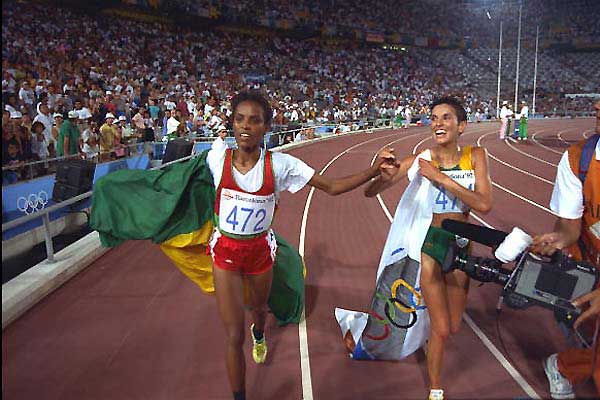
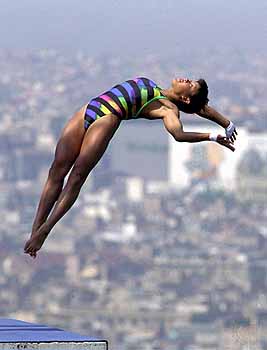
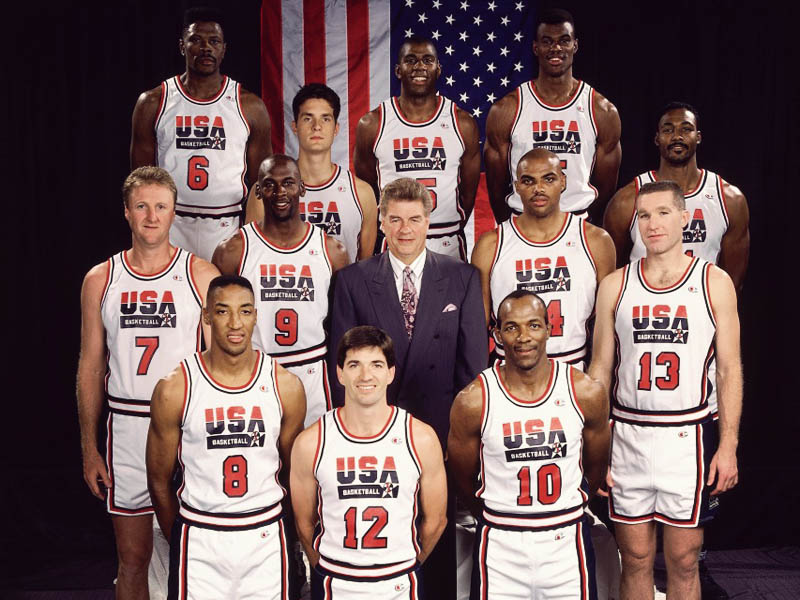
Scene of meaning, genius teen and dream team: Derartu Tulu and Elana Meyer on a symbolic victory lap (l), adolescent diving sensation Fu Mingxia (m) and the US basketball team (r)
.
The Main Man
Derek Redmond ~ although both a one-time British 4x400m record holder and a World, European and Commonwealth Champion in the 400m proper, this English sprinter will forever be remembered for the most tragic moment of his career. Or, at least, it would have been the most tragic were it not for a surprise twist. A likely qualifier for the final of these Games’ 400m, Redmond instead found himself pulling up in pain during his semi-final race; the hamstring in his leg snapping, his Olympics over. And yet, rather than take the obvious, face- and pain-saving option of quietly leaving the track, he hobbled on with one leg. If that wasn’t surprising enough, another chap, fending off officials, quickly entered the fray – Redmond’s father, Jim. Creating a genuinely heart-warming scene, he supported his son and helped him complete the race to a standing ovation from the stadium’s crowd (see video clip below).
The episode became something of a modern Olympic legend, later being selected as the subject of an International Olympic Committe (IOC) ‘Celebrating Humanity’ video for it summing up the spirit that the Games are supposed to be all about, underneath the drive to win medals and the cynical-seeming, if necessary, corporate sponsorship so prevalent nowadays. As for Redmond and his father… just a few weeks ago the latter got to carry the London 2012 torch during its heavily media-featured relay and the former married Sharron Davies. So not too shabby really.
.
The Main Women
Derartu Tulu and Elana Meyer ~ after having raced each other for lap after lap way ahead of the rest of the field in the Women’s 10,000m final, these two athletes eventually took the gold and silver medals. However, while their respective successes were significant in themselves (Tulu, an Ethiopian, was the first black African woman to claim an Olympic gold; Meyer, a South African, rubber-stamped a positive return to the Olympics and wider international sport for her country after the fall of apartheid – until Barcelona ’92, it had been denied entry to every Games since 1960), it was what took place immediately after the race that proved unforgettable. Instead of parading individually on ‘victory laps’, these two African athletes – one black and the other a white South African – instead jogged around the stadium holding hands. Sport, like many visual artforms, has a knack of illustrating in powerful images just what’s achievable in the real world – and reflect just what has been achieved in the real world – and this sporting image was as profound as any other such you care mention.
.
.
Mentioned in dispatches
- Following the break up of the Soviet Union a year before, there was no USSR team at the Summer Olympics for the first time since 1952. Instead, the former Soviet states (excluding Lithuania, Estonia and Latvia, but including Russia, of course) competed at Barcelona ’92 as ‘Unified Team‘ and were represented by the Olympic flag – although the flags of athletes’ individual nations were raised during medal ceremonies. Indeed, these were the last Olympics at which any Soviet states would compete together
- Similarly, following the reunification of Germany in 1990, the East and West German Olympic teams combined as a single, proper German team for the first time since 1936. In actual fact, in the post-war era the IOC hadn’t allowed the two separate nations, as they then had been, to compete separately until 1968 – at Melbourne ’56, Rome ’60 and Tokyo ’64 then, it had been East and West Germany who’d competed together as ‘Unified Team’
- Owing to the recent break up of Yugoslavia (another result of the Soviet Union’s demise), Croatia, Bosnia and Herzegovina and Slovenia all participated as independent nations at these Games, but Serbia and Montenegro wasn’t allowed entry due to UN sanctions thanks to the one-time nation’s role as chief aggressor in the Yugoslav Wars (1992-95). With the arguable exception of the Albertville ’92 Winter Games, these Olympics then were the first time the world witnessed a major event (sporting or otherwise, such as Eurovision) at which were present the ‘new’ Eastern European nations we’re so familiar with today
- An old powerhouse dominated in Men’s basketball, however, in the shape of the United States – yet, thanks to a relaxing of the old amateurs-versus-professionals chestnut, the so-called American ‘Dream Team‘ rolled into town, packed full of NBA stars such as Magic Johnson, Larry Bird and, yes, the legendary Michael ‘Space Jam‘ Jordan. Unlike their disaster at Munich ’72, this American team easily took home the gold medal
- Chinese diver Fu Mingxia pulled off a truly impressive feat by winning the Women’s High Dive event, as she was only 13 years-old. Diving at this Olympics was also memorable for the spectacular view of the Barcelona cityscape it afforded
- Israeli Yael Arad became her nation’s first ever Olympic medalist when she won silver in Women’s judo – on both the 20th anniversary of the ‘Munich Massacre‘ and the 500th anniversary of the Alhambra Decree. One day later, Israel won its second ever medal, Oren Smadja’s bronze in Men’s judo
- With Carl Lewis reaching the twilight of his career, British sprinter Linford Christie had an outstanding opportunity to become ‘the fastest man on Earth’ by winning the Games’ traditional marquee event, the Men’s 100m. He duly did so and went on, for a short time, to dominate the distance, holding the Olympic, World, European and Commonwealth titles all at the same time. Sadly, though, like athletes before him and so many since, he eventually endured a doping scandal and retired in 1999, having tested positive for the anabolic steroid nandrolone. In actual fact, at Seoul ’88, Christie had tested positive for the banned substance pseudoephedrine, but unlike Ben Johnson he’d escaped sanction thanks to an IOC panel voting 11-10 in his favour (although two officials on the panel were reportedly asleep when the vote was taken). Christie also won a silver in the 4x100m Relay at Barcelona ’92
- The Women’s 100m final proved arguably more eventful than the men’s, as five women finished within 0.05 seconds of each other. A photo finish eventually revealed sprint hurdler specialist Gail Devers had won by pretty much a literal whisker. She couldn’t repeat this success in her favoured event, the 100m Hurdles, though – in the final she hit a hurdle and finished fifth. However, in Sebastian Coe-style, she did manage to defend her 100m title at Atlanta ’96, again winning in a dead heat and, again, she failed to medal in the 100m Hurdles. She also won the 100m World title in 1993 – yes, again, in a dead heat
- Further track success for Blighty came in the shape of Sally Gunnell, who won gold in the 400m Hurdles. Like Christie, she went on to win World, European and Commonwealth golds in her event – and broke the world record in her 1993 World title-winning run
- Now always considered (hopefully not too hubristically) a source for a British ‘gold rush’ whenever the Olympics roll around, cycling saw its first ever UK success at these Games when Chris Boardman got the wheels rolling by winning the 400m Individual Pursuit
- Steve Redgrave reached the middle of his marathon five-golds-in-five-consecutive-Summer-Games haul at these Olympics when he won the Coxless Pair with Matthew Pinsent. These two would win the same event four years later and make up half of the triumphant Coxless Four at Sydney 2000 where Redgrave completed his unique achievement. More British rowing glory came in the Coxed Pair, which was won by brothers Greg and Jonny Searle and cox Garry Herbert (the latter creating a classic TV moment when he blubbed uncontrollably on the medal podium as the UK national anthem played).
.


Blooming and blubbering Brits: track stars Linford Christie (left) and Sally Gunnell (right) become household names after winning gold, while cox Garry Herbert – with rowers Greg and Jonny Searle – creates an unforgettable moment as he blubs on the winners’ podium (middle)
.
The Memory
Although perhaps lacking the genuine highs and unforgettable lows of previous post-war Olympics, Barcelona ’92 certainly had a lot of, if you will, sugar without the spice – and, at the time, many were more than pleased by that. Indeed, as these were the first Summer Games to take place following the fall of the Berlin Wall and the break up of the Soviet Union, they were the first since 1960 not to be plagued by a boycott – all the nations who surely should have been there were there (including, as mentioned, South Africa; if not Serbia and Montenegro).
It may sound a little trite today, but it was true then, these games genuinely felt like a major event that reflected a new dawn; a representation of the positivity and progressiveness many hoped the 1990s would bring. As such, while the closing ceremony song Amigos Para Siempre (Friends For Life), written by Andrew Lloyd Webber and Don Black and performed by Sarah Brightman and José Carreras, was a wee bit twee, it was also perfectly fitting – and not a bad listen too, all things said (see bottom video clip).
Moreover, the city of Barcelona was a brilliant host and it was great to see a likeable major country like Spain (who, relatively speaking, hadn’t been at peace with itself for very long) finally do well at a major sporting event, not least its own. In many ways then, Barcelona ’92 was something of a prototype for the open, optimistic, friendly and successful post-millennial Olympics that have been Sydney 2000, Athens 2004, Beijing 2008 and – hopefully – will be London 2012…
.
The Medal Table
| Gold | Silver | Bronze | Total | ||
|---|---|---|---|---|---|
| 1 |  Unified Team Unified Team |
45 | 38 | 29 | 112 |
| 2 |  United States United States |
37 | 34 | 37 | 108 |
| 3 |  Germany Germany |
33 | 21 | 28 | 82 |
| 4 |  China China |
16 | 22 | 16 | 54 |
| 5 |  Cuba Cuba |
14 | 6 | 11 | 31 |
| 6 |  Spain Spain |
13 | 7 | 2 | 22 |
| 7 |  South Korea South Korea |
12 | 5 | 12 | 29 |
| 8 |  Hungary Hungary |
11 | 12 | 7 | 30 |
| 9 |  France France |
8 | 5 | 16 | 29 |
| 10 |  Australia Australia |
7 | 9 | 11 | 27 |
| 13 |  Great Britain & NI Great Britain & NI |
5 | 3 | 12 | 20 |
.
.
.
Olympic lore: Doped and duped ~ the 1988 Seoul Games


Champion of cheats?: Ben Johnson crosses the line clear of Carl Lewis and Linford Christie in the Men’s 100m final – yet ultimately it wouldn’t be glory his victory would wrought, but infamy
Well, it’s less than a week away now, peeps – what you didn’t know? Er, seriously? Yes, on Friday night the London Games finally kick-off and this blog’s nostalgic multi-sport celebration has indeed turned into and is wending down Olympic Way with this post, dedicated, as it is, to an event of supreme highs and extreme lows (two of which were shockingly associated with the exact same event). Yup, for good and bad, Seoul ’88 (September17-October 2) was an unforgettable Olympics – a real news-making Indian (or rather Korean) summer in the autumn of the ’80s…
.
The Magic
Rather like West Germany ahead of the ’72 Summer Games, South Korea had enjoyed an ‘economic miracle’ over the past 15 or so years, during which its economy had not just recovered following the Korean War, but developed rapidly thanks to increased industrialisation and urbanisation. In which case, it saw the opportunity of hosting the Olympics as, if you will, a coming-out party to the rest of the world, in much the same way as fellow South East Asian power-in-waiting Japan had looked to Tokyo ’64 as a chance to announce its arrival on the global stage. As such, the host nation made sure it completed the construction of all new venues a full two years before the Games came to town – in order astutely to host the 1986 Asian Games as a test event.
A major fly in the ointment, however, was perhaps unsurprisingly North Korea. An unlikely agreement had been reached between the two Koreas to hold the ’88 Games together (with the North wanting hosting duties of 11 of the 23 sports, as well as its own opening and closing ceremonies); this agreement was – quel surprise – to founder. And North Korea, rather like the USSR four years before, thus led a Communist boycott that included Cuba and Albania, yet the Soviet Union itself was having none of it and was only too happy to attend. After all, the Cold War was now approaching its end; the major nations of the world had no interest in missing out on another Olympic party.
.
The Mascot
An undeniably happy, cute little chap, Hodori the Tiger was chosen owing to the Amur (or Siberian) tiger’s popular one-time prevalence in South East Asia – it’s now mostly only found in South East Russia. Created by designer Kim Hyun, the tiger cub sports an Olympic medal around his neck and the traditional sangmo hat worn by Korean farmband members. A streamer runs from the top of the hat in the shape of an ‘S’, the first letter of host city Seoul, of course. Hodori’s name is fittingly derived from his nation’s word for tiger (‘horangi’/ ‘Ho’) and a colloquial word for boys (‘dori’). To this day, Hodori remains the emblem of the South Korean taekwondo demonstration team, whose sport was a designated ‘demonstration sport’ during the Games and was also demonstrated by mass participators during the opening ceremony.
.
.
The Moment
It’s an age-old cliché is the ‘everybody remembers where they were when so-and-so happened’ statement, but it really applies in this case. Because everybody really does remember where they were when Jamaican-born Canadian Ben Johnson won gold in the Men’s 100m final (see video clip above)… and where they were just three short days later when he was unceremoniously and instantly stripped of his medal for testing positive for a banned drug. It was an extraordinary sporting event – a man went from relative zero to total hero in less than 10 seconds and, seemingly as quickly, to absolute zero. For the average Joe, there was something unnatural, even unearthly about how Johnson had streaked away from the field to cross the finishing line – in reality, it was scientifically improbable. Sprinters slow down after they’ve run 60 metres of a 100m race; Johnson patently didn’t: he maintained his speed. Of course, it was all a sham. He was found guilty of taking the anabolic steroid stanozolol – and would go on to admit to having taken such drugs for at least a year, which meant two world records he’d set (one in the final itself at 9.79 seconds) were stripped from him.
Following an attempted comeback after a three-year ban, Johnson again tested positive and, this time, was banned for life. Bizarrely and more than dubiously, he went on to train notorious drug cheat footballer Diego Maradona and future war criminal Al-Saadi Gaddafi when the latter was attempting to gain a contract with an Italian football club – after which he too tested positive for drugs. In 2006, Johnson opined that around 40 percent of all sportspeople were taking performance-enhancing stimulants, intimating they were all banned substances. Indeed, four of the sprinters he lined up alongside in that infamous 100m final would go on to face drug-related scandals of their own: his training partner Desai Williams (who was implicated with him), American Dennis Mitchell, Brit Linford Christie and even the great hero of Los Angeles ’84, Carl Lewis.
.


Hot sprinting, heroic sailing and cool runnings: taliswoman with the talons Florence Griffith-Joyner (l), sailer saviour Lawrence Lemieux (m) and Calgary ’88’s Jamaican bobsled team (r)
.
The Main Man
Lawrence Lemieux ~ a rare non-sporting achievement (or mis-achievement) here. This Canadian sailer made himself a true Olympic hero for all-time on September 24 when in the Finn Class event, in which at the time he was lying second in the fifth of seven races, he abandoned quite likely podium glory by rescuing two Singaporeans competing in the 470 Class (whose course was nearby) after their boat capsized owing to heavy winds and, injured, they began to struggle in the water. Thanks to his endeavours, Lemieux trailed in to finish 22nd in his own event. At the its medal ceremony, though, he was given the Pierre de Coubertin Medal for sportsmanship (named after the founder of the modern Olympic Games), of which only 11 have ever been handed out. In June this year, Lemieux commented on the episode: “You spend your life working really hard internationally [in sailing] and you get very few accolades. So that’s the ironic thing; 25 years after this rescue, we’re still talking about it”.
.
The Main Woman
Florence Griffith-Joyner (or simply – and with more than a flashy splash of ’80s cool – ‘Flo Jo’) made rather incredible history at these Games, as she ‘did a Carl Lewis’. Yes, she won four sprinting gold medals (100m, 200m, 400m and 4x100m Relay). But not just that, the camera-friendly American with long and garishly coloured finger nails also set two world records in the process – 10.62 seconds in the 100m and 21.34 seconds in the 200m, the latter of which still stands. A colourful athlete in more ways than one then, Flo Jo wasn’t without controversy, however (in the wake of Ben Johnson’s antics, the late ’80s maybe was the era when controversy first seemed devilishly to spring up around every major sport star, something which we still see today of course). Her rivals questioned whether her performances may have be drug induced, not least because she appeared to have gained a great deal of muscle in the early months of 1988; she was never close to being found guilty of relying on stimulants, though. Having reached an undeniable apex and wanting to start a family, she retired immediately after these Games and, tragically, died 10 years later following an epileptic fit aged just 38.
.
.
Mentioned in dispatches
- This would be the final Olympic Games contested by both the powerhouse teams from the Soviet Union and East Germany, as the Berlin Wall would fall just over a year later when the process of the break-up of the USSR and Eastern Europe began. Many observers had questioned the dominance of East Germany in different Olympic events, not least women’s swimming, and lo and behold after Germany was reunified secret files were discovered verifying that a staggeringly high number of their female Olympians had been taking undetected stimulants for years
- Future unifier of the World Heavyweight boxing belts Lennox Lewis won gold in the Super Heavyweight division – for Canada, that is, rather than the UK, the land of his birth and which he would later represent. Another future professional, Roy Jones Jr. of the United States didn’t fare so well, though. After dominating the Light Middleweight final he was judged to have lost the bout to home favourite, South Korean Park Si-Hun. Jones got the last laugh, mind, for as a professional he became a world champion at four separate weights, including heavyweight, and was named the 1990s’ ‘boxer of the decade’
- Keeping it in the family, Flo Jo’s sister-in-law Jackie Joyner-Kersee won both the women’s heptathlon and long jump, setting a world record in the former (7,291 points) and an Olympic record in the latter; her heptathlon world record still stands today
- American swimmer Matt Biondi attempted to emulate at these Games the Munich ’72 achievements of his countryman Mark Spitz by winning seven gold medals. He came up short, winning only five, as well as a silver and a bronze and setting eight world records. As second bests go, not exactly dreadful then
- For right or wrong, these Games marked an Olympic return for tennis after a 64-year absence. In the women’s singles event, West German superstar Steffi Graf added a gold medal to the four Grand Slams she also won that year (making it a so-called ‘Golden Slam’)
- Evoking memories of ‘1966 and all that‘, the Great Britain men’s hockey team made it all the way to the final of the tournament and overcame the well-fancied West Germany 3-1 to claim the gold medal, in which Asian player Imran Sherwani memorably scored two goals (see video clip above)
- Further success came for Blighty in the pool where, following in the wake of his Montreal ’76 hero David Wilkie, Adrian Moorhouse upset the odds to win the 100m Breaststroke, while rower Steve Redgrave won the second of his five gold medals in five consecutive Summer Games in the Men’s Coxless Pairs, along with Andy Holmes. Meanwhile, in athletics Linford Christie saw his bronze in the 100m upgraded to a silver following Ben Johnson’s disqualification (Carl Lewis was upgraded to silver); Christie also earned a silver in the 4x100m Relay with John Regis; famed long- and middle-distance runners Liz McColgan and Peter Elliott both claimed silver in 10,000m and the 1,500m, respectively, and a silver was also won in 110m hurdles by Colin Jackson
- A British hero of a very different kind emerged at the Calgary Winter Games, held in February, in the shape of ski jumper Eddie ‘The Eagle’ Edwards (see bottom video clip). Amiable and very normal bloke-ish (owing to his wearing thick-lensed glasses and, well, not particularly looking like an athlete, at least in the face), Edwards quickly became a household name and even quicker a national hero in the manner only the British will entertain: because he was crap. He finished last in both the 70m and 90m events and by some way too. Yet his fame also spread globally and goodwill seemed to greet him everywhere he went, even in the Games’ closing ceremony during which organising committee chairman Fran King referenced him in a speech: “At this Games, some competitors have won gold, some have broken records and some of you have even soared like an eagle”
- Even more famous exploits at the Winter Games were made by the Jamaican bobsled team who, contrary to popular belief, were welcomed to participate in the event by rivals despite the very un-Winter Olympics tradition of their country. Their non-finish but walking alongside their overturned bobsled to the finish line was immortalised (albeit with them instead carrying the bobsled) in the popular John Candy-starring Hollywood film adaptation Cool Runnings (1993).
.


Majestic, plastic and desperate Brits: the men’s hockey team delight a nation by winning gold (l), Lennox Lewis back in the days when he considered himself Canadian (r) and our Winter Olympic legend, for all the wrong – or is that right? – reasons, Eddie ‘The Eagle’ Edwards (m)
.
The Memory
No question, the pong of drug-aided cheating (both very real and in other cases only speculated) stunk up these Olympics – and has continued to tarnish its memory in the years since whenever more allegations and revelations have reared their ugly heads. There’s simply no getting away from the fact that Seoul ’88’s Ben Johnson affair is easily the most shocking and most dramatically theatrical doping scandal ever to have rocked the Olympics, nay the entire sporting world, both of which it changed forever. Seemingly every high profile sport suffers from drug-related trauma nowadays, from cycling to football and from baseball to – yes, still – athletics. All this is the legacy of the Seoul Games and Ben Johnson getting caught.
And yet, to dismiss these particular Summer Games like that is to obfuscate the truth, for these were also an Olympics of fine joyful moments (Lemieux and Biondi) and historic achievements (Lewis and Graf). Moreover, they also had a profound, positive effect on their host country – one which would surely have far exceeded its inhabitants’ hopes. Although South Korea had sought and won the right to host the Games as part of a wider desire to reinforce its emergence as a global player, this had been done under the authoritarian administration of President Chun Doo-hwan, who had assumed power in August 1980. However, in the wake of actually hosting the Games in a years’ time and the desire not to have the country presented to the rest of the world as an embittered military dictatorship – and thanks to recent pressure applied by mass political protests – Chun stood down and Presidential elections took place in December 1987, ensuring that by the time the Olympics came to Seoul the host nation was a democratic republic.
All this undoubtedly helped drive improved relations not just between South Korea and the West, but between the nation and China, the USSR (effectively soon to be Russia) and Eastern Europe. In which case, the Olympics played a genuine part in South Korea becoming a more confident, more open and better society that would, economically and otherwise, go from strength to strength in the decades to come.
.
The Medal Table
| Gold | Silver | Bronze | Total | ||
|---|---|---|---|---|---|
| 1 |  Soviet Union Soviet Union |
55 | 31 | 46 | 132 |
| 2 |  East Germany East Germany |
37 | 35 | 30 | 102 |
| 3 | United States |
36 | 31 | 27 | 94 |
| 4 | South Korea |
12 | 10 | 11 | 33 |
| 5 | West Germany |
11 | 14 | 15 | 40 |
| 6 | Hungary |
11 | 6 | 6 | 23 |
| 7 |  Bulgaria Bulgaria |
10 | 12 | 13 | 35 |
| 8 |  Romania Romania |
7 | 11 | 6 | 24 |
| 9 | France |
6 | 4 | 6 | 16 |
| 10 |  Italy Italy |
6 | 4 | 4 | 14 |
| 12 | Great Britain & NI |
5 | 10 | 9 | 24 |
.
.
.

…
All in a Daley’s work: Daley Thompson, possibly Great Britain’s greatest ever sportsman, winds up to produce a monster throw in the discus and effectively win his second consecutive Olympic decathlon, but thanks to his antics-to-come his victory wouldn’t be without controversy
If, as some sort of odd Olympic hermit, you’d been living under a rock since the Moscow Games and had only surfaced four years later for when Los Angeles played host (July 28-August 12), thus, didn’t know what the 1980s were all about, 16 days later you most certainly would have done, all right. With all its glitz, glamour, colour and commercialism, La-La Land’s take on the Olympics was unquestionably very ’80s and very American; it also produced many a memorable moment and some stupendous sporting achievements.
Join me then, peeps, in this latest celebration of Olympics past (in build-up to the now very near London Games), as George’s Journal looks back on what is still for many something of a Californian dream of a modern Olympiad…
.
The Magic
Having bid for the right to host every summer Olympics for the last 40 years, America was determined to put on a show, a very American show, at Los Angeles ’84. Things kicked off, as usual, with the torch relay, which impressively travelled through 33 of the nation’s states and more impressively was carried by runners on the road the whole way (something that even recent Olympics can’t claim). These Games also boasted the introduction of John Williams’ spine-tingling Olympic Fanfare And Theme (as good as anything from his best film scores), which appeared on the album The Official Music of the XXIIIrd Olympiad—Los Angeles 1984, alongside contributions from Quincy Jones, Herbie Hancock, Philip Glass, Giorgio Moroder, Foreigner and Toto.
As to the opening ceremony (during which US President and former Governor of California Ronald Reagan officially opened the Games), well, that provided one the most memorable moments of these Olympics – nay, from all 1980s Olympics – when Bill Suitor flew around the stadium dressed in the colours of the Stars and Stripes flag thanks to a Bell Aerosystems rocket (or jet) pack strapped to his back (see video clip below). After all these years, it’s still hard to work out exactly why this actually took place, aside from the reason it looked cool, flash and because it simply could. In short, it was completely and utterly American – the Olympics had definitely come to the 1980s United States.
.
.
The Mascot
Summing up the unapologetic Americaness of these Games better than anything else, Sam The Olympic Eagle was a bald eagle (the US national animal) wearing, ‘Uncle Sam’-style, a Stars-and-Stripes top hat and bow-tie, and was happened to be designed by major Disney artist Bob Moore. To this day, he remains one of the most well recalled of Olympic mascots. Quel surprise.
.
The Moment
This being an Olympics full of colour, noise and spectacle, it boasted many moments lasting long in the memory, but there probably was one moment that tops them all, or to be specific four moments that tops all the others: the moments when US sprinter and long jumper extraordinaire Carl Lewis won his four gold medals. Lewis, surely the world’s greatest athlete (or was he? see The Main Man below), was all set to have a good Games, a very good Games, even if much of America didn’t know it.
Although already rightly regarded a great sportsman, being a track and field athlete Lewis was an amateur sportsman and thus was yet in his career to achieve the sort of lucrative commercial endorsements that fellow great – but professional – US sportsmen could boast. At Los Angeles ’84 then, he had two aims – to match Jesse Owens’ outstanding haul of four gold medals in the 100m, 200m and 4x100m sprints and the long jump, plus secure those endorsements with the glory those victories would bring. Highly impressively, he achieved his first aim with what appeared to be relative ease: he breezed to victory in the sprints and won the long jump so convincingly he only had to leap twice in the event (his brilliant first at 8.54 m was good enough to win it, he knew, so he ensured his final round jump was a foul). However, in only jumping twice and not pushing to break the world record, as the patriotic home crowd hoped, nay expected him to (by competing as little as possible in the event his plan was to save himself for the sprint finals to come; a plan that worked, of course), they booed him come the long jump’s end.
And following the Games, this along with his general demeanour helped to create the impression across America that Lewis was, well, arrogant. A guy who may have possessed God-given talent, but not much humility; he was incredible, sure, but not that likeable an individual. And the result? Those lucrative endorsements didn’t come his way. Yet, more success at more Olympics did – he ended up winning a total nine golds at the ’84, ’88, ’92 and ’96 Games. Likeable or not, Carl Lewis was an amazing athlete.
.
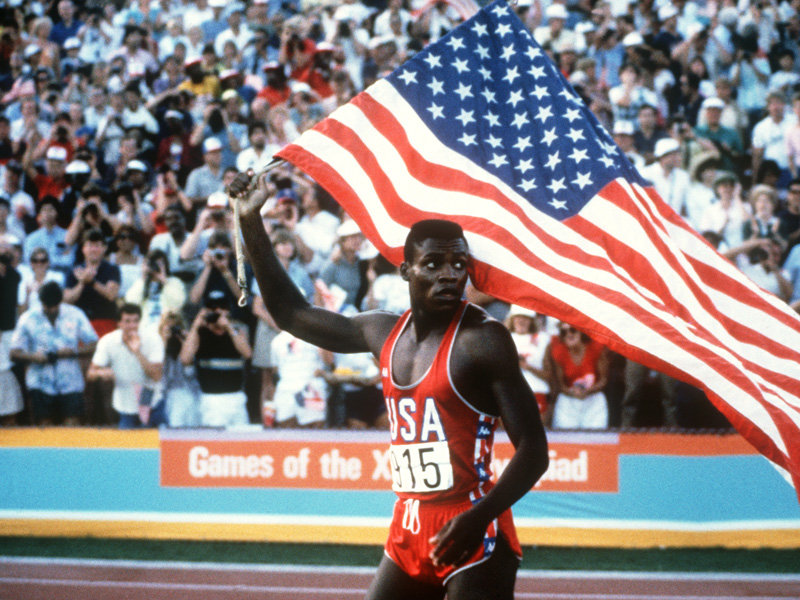


Faster, higher, wheatier: Carl Lewis celebrates one of his four gold medal wins with a giant flag (left), national heroine Mary Lou Retton appears on a Wheaties cereal box following her triumph (middle) and Edwin Moses decimates the field in the 400m Hurdles final (right)
.
The Main Man
Daley Thompson ~ many would say Carl Lewis was surely the man of these Games (and he probably really was), but I’m going to be all parochial and pick a Brit for that honour – so shoot me. Having already won the decathlon by a figurative (and, in at least one track event, seemingly literal) country mile at Moscow ’80, the pressure was on Thompson to do the truly impressive and utterly unforgettable – retain his title four years later. Not that you’d know it to look at and hear him, though.
For Daley had a rather, well, unusual personality. His mixture of supreme confidence, brash sense of humour and incredible dedication to training was unique, but combined with his brilliant talent made him a devastating all-round athlete. In competition, he was simply a beast. Come the ’84 Games, he was surprisingly trailing after the first day of the two-day-long decathlon to his arch rival Jürgen Hingsen of West Germany, but this was just the spur he needed – in the next event, the discus (his weakest), out of nowhere he produced a giant throw that was six metres better than any he’d ever previously produced, a feat that seemed to knock the sails out of Hingsen’s challenge and propel Daley to victory again (another memorable moment of which was the back-flip he delightedly delivered following a top effort in the high jump – see video clip below).
So much for the competing, but as said, that was never all you got with Thompson. For some Brits, his behaviour immediately afterwards was just not on (whistling instead of singing the national anthem on the podium; weirdly suggesting he might copulate with Princess Anne and wearing at a press conference a t-shirt asking ‘Is the world’s second greatest athlete gay?’ – a jokey, but sharp reference to Carl Lewis’s lack of confirming or denying the speculation he may be homosexual, while also implying, of course, that Thompson himself was the world’s greatest athlete). For other Brits, however, his irreverent humour and naughty schoolboy-esque persona was a delight. Indeed, his Los Angeles ’84 performance was recently voted the Britain’s finest in a UK Athletics poll. There was – and will only ever be – one Daley Thompson.
.
The Main Woman
Mary Lou Retton ~ after Daley Thompson and Carl Lewis, here’s a real US heroine of Los Angeles ’84. At 16 years old (although she perhaps looked younger owing to her diminutive 4ft 9in height), this highly talented gymnast became an undeniable American sweetheart when, with no Soviets competing, she engaged in an electric clash with Romanian Ecaterina Szabó in the prestigious Individual All-Round event. Trailing her rival with just two disciplines to go, Retton secured a pair of ‘perfect tens’ in both the Floor Exercise and Vault to claim gold by just 0.05 points – becoming the first non-Soviet and non-Eastern European to win the event. She also won silver in the Team competition and the Vault, as well as bronze in the Uneven Bars and the Floor events. Following the Games, Retton made maximum use of her celebrated public profile (in, yes, contrast to Carl Lewis) by appearing on Wheaties cereal boxes as the food’s official spokeswoman (see above image) and became an outspoken supporter of Ronald Reagan’s 1980s Presidency and, later, the Republican Party in general. As Americans like to say, go figure.
.
.
Mentioned in dispatches
- Following the US-led boycott of the previous Summer Games, perhaps predictably the Soviet Union (which, still a year away from the emergence of Mikhail Gorbechav and glastnost and, thus, enjoying relations as frosty as ever with the US) got its own back and led a boycott of 14 other Eastern Bloc countries – including East Germany and Cuba, but excluding plucky Romania – and sat out these Olympics. Inevitably, this boycott diminished the field in several events – indeed, the top three medal winners at Moscow ’80 were all absent. An official Soviet statement on the stance claimed the decision was taken because of “chauvinistic sentiments and an anti-Soviet hysteria being whipped up in the United States”, as well as security fears for its athletes; US President Ronald Reagan commented the fear some Soviet athletes may have defected could also have been behind it
- In great contrast to this boycott, though, amazingly these Games were the first to be attended by China (excluding a nominal presence at the Helsinki ’52 Games to which it sent just 38 athletes). The first medal the nation won at these Olympics was also the first gold to be won at the Games. China would eventually finish fourth in the Medal Table (see below) with gymnast Li Ning winning six, prove a force at every subsequent Summer Olympics and, of course, go on to host the Games themselves 24 years later in Beijing
- Having utterly dominated his event for a decade, US 400m hurdler Edwin Moses won a gold eight years after claiming one at Montreal ’76, having missed out entirely at Moscow ’80 owing to those Games’ US-led boycott
- Great Britain enjoyed yet another high-profile Summer Games. In addition to Daley Thompson’s heroics in the decathlon, the UK had particular success in athletics, which accounted for nearly half of its total medals, including a gold in the 1,500m and a silver in the 800m for Sebastian Coe (an exact repeat of his Moscow ’80 efforts), a silver in the 1,500m for Steve Cram and a gold for Tessa Sanderson in the women’s javelin (besting her well regarded national rival Fatima Whitbread in this event). Britain won a total 37 medals – the fourth highest total of any country at the Games, with only the US, Romania and West Germany ahead on this count
- These Games marked the first in which the now utterly legendary British rower Steve Redgrave competed and won a gold medal (in the Men’s Coxed Fours) – he would go on to win a gold at a total five consecutive Summer Games
- However, controversial – and often bare-footed – South African runner Zola Budd, who had claimed British citizenship and ran for Britain in order to compete during her country’s apartheid-related ban, had a nightmare Olympics when she accidentally tripped and wiped out home favourite (and favourite for the event) Mary Decker in the 3,000m final, causing her too to fall out of contention and for her pains be booed by the crowd
- Arguably the UK’s greatest Olympic – and all-round sporting – moment of 1984, though, came at the Sarajevo Winter Olympics held five months earlier, when the favourites for the Ice Dancing event Jayne Torvill and Christopher Dean held their nerve to deliver a flawless and artistically brilliant performance to Maurice Ravel’s instantly recognisable Boléro (see bottom video clip). Their effort earned a perfect nine maximum 6.0 points for artistic impression and a further three 6.0s and six 5.9s for technical impression – a feat that’s never been matched. Not only did they win the BBC Sports Personality of the Year award for 1984, but went professional following these Games, achieving great success and fame throughout the world with their innovative shows.
.


Brilliant Britons: Tessa Sanderson throws her way to glory (left), the Men’s Coxed Four rowers – including at second-from-right Steve Redgrave – celebrate on the podium (middle) and Torvill and Dean perform the routine that would bring them gold at the Sarajevo Winter Games (right)
.
The Memory
Owing to their sheer Americaness, the 1984 Los Angeles Olympics will always be well – and, no doubt by many, fondly – recalled. And, in the end, why not? Aside from the Soviet boycott (which back then and today feels very petty), these were a positive, exciting, surprising, vibrant, vivid and very enjoyable Games – especially if you were American or British. Maybe just as important, in the wake of the debt-hampered efforts that were Montreal ’76 and Moscow ’80, LA’s shindig turned a profit. Cannily, aside from a new swimming stadium and cycling velodrome, all venues pre-existed (the opening and closing ceremonies and the athletics took place at the Los Angeles Memorial Coliseum, just as they had at the 1924 Games) and the organisers smartly made maximum use of corporate sponsorship and lucrative TV deals, which together ensured there were no heavy construction costs and a lot of welcome moolah generated – $200 million of it, in fact; ensuring these remain the most financially successful Olympics. Admirably too, the profits were ploughed into a Southern California-focused initiative named the Amateur Athletic Foundation (now the LA84 Foundation) that tasked itself with promoting youth sports, creating coaches and setting up a sports library. The template for ‘Olympic legacy’ – now, rightly, such a big concern for modern Games organisers – had verily begun.
.
The Medal Table
| Gold | Silver | Bronze | |||
|---|---|---|---|---|---|
| 1 | United States |
83 | 61 | 30 | 174 |
| 2 | Romania |
20 | 16 | 17 | 53 |
| 3 | West Germany |
17 | 19 | 23 | 59 |
| 4 | China |
15 | 8 | 9 | 32 |
| 5 | Italy |
14 | 6 | 12 | 32 |
| 6 |  Canada Canada |
10 | 18 | 16 | 44 |
| 7 |  Japan Japan |
10 | 8 | 14 | 32 |
| 8 |  New Zealand New Zealand |
8 | 1 | 2 | 11 |
| 9 |  Yugoslavia Yugoslavia |
7 | 4 | 7 | 18 |
| 10 | South Korea |
6 | 6 | 7 | 19 |
| 11 | Great Britain & NI |
5 | 11 | 21 | 37 |
.
.
.
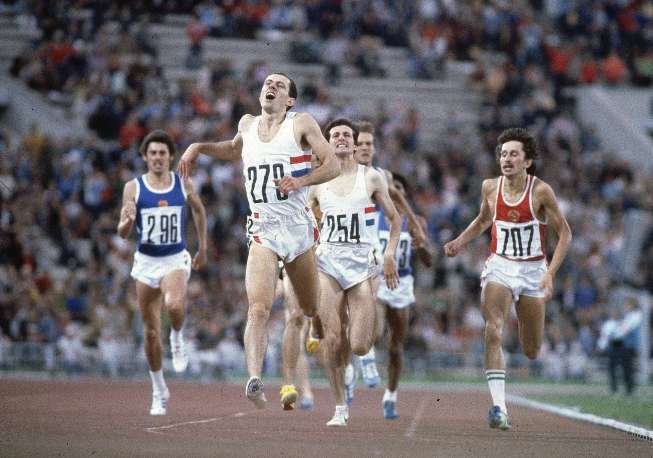
Middle-distance dynamos: Coe and Ovett’s rivalry defined Moscow ’80 in more ways than one
Believe it or not, we’re less than three weeks away from the London Olympics now (a rather shocking realisation that for someone who lives in the South-East of England as I do; there’s been so much hype, it feels like we’ve been waiting for them forever) and now, yes, now this blog’s tribute to Summer Games past is entering its final stretch – the 1980s.
And the first Olympics of the ’80s was one that undeniably belonged in that era – a time when tensions between the United States and the USSR were hotting up once more, ironically shortly before the Cold War would begin to fizzle out. This reality would affect these particular Games in a way no previous Olympics had been by politics (even the Nazi Germany-hosted 1936 effort), yet they’d also prove a dramatic, exciting and unforgettable sporting spectacle for many different reasons. So here we go then – it may have been far from glastnost, but it was one that simply can’t be glossed over: say zdravstvujtye to Moscow 1980, folks…
.
The Magic
For many in the West, the idea of a Summer Olympics in Moscow may not have been very appealing, but in the wake of Olga Korbut’s smiling face at Munich ’72 displaying a different, more open and positive side of the Soviet personality, clearly the Moscow Games could be an opportunity to showcase one of the world’s greatest and most fascinating cultures – if its organisers and the Soviet authorities would allow it. The powers-that-be had certainly put in the time and effort – in staging the Games, the USSR had spent a total 862.7 million rubles (of which it would only recoup 744.8 million rubles) and had spread the events across 28 different venues including the newly built Olympiysky stadium that housed an indoor stadium (boxing and the basketball final) and a swimming pool (swimming, diving and the modern pentathlon), as well as venues in modern day Ukraine (Kiev), Belarus (Minsk) and Estonia (Tallinn). There would also be a total 203 events held; more than ever before. Potentially, these Games could be the biggest and best Olympics ever. Potentially…
.
.
The Mascot
Perhaps the most memorable of all Olympic mascots, Misha (Миша) the bear‘s popularity isn’t exactly difficult to understand – he’s basically a cute brown teddy bear. Designed by children’s book illustrator Victor Chizhikov, Misha was chosen as mascot because obviously the bear is the animal most commonly associated with Russia. And methinks it’s only fair to point out the rather wonderful irony that the first Olympic mascot to achieve widespread commercial success (dolls and soft toys, TV cartoons and associated merchandise) was therefore, yes, a Soviet creation.
.
The Moment
Christmas Eve is always supposed to be a positive day, but an event occurred on December 24 1979 that would have a profound effect on the following year’s Summer Olympic Games. For it was on this day that the Soviet Union’s forces invaded Afghanistan, beginning a conflict that would drag on for an entire decade. And this war’s most immediate consequence for masses around the world came on January 20 1980 when US President Jimmy Carter – who like the vast majority of politicians not just in America but throughout the Western world was against the USSR attempting to spread Communism to the Middle East – issued the ultimatum that if the USSR wouldn’t withdraw from Afghanistan then the USA would boycott the Moscow Games. Of course, Soviet forces didn’t withdraw and the boycott went ahead, ensuring unquestionably one of the two strongest Olympic teams (the other one being the USSR itself) would be absent from every single sport at the Games.
The boycott didn’t end there, though. In total, 64 nations (most notably West Germany, Japan, China, Canada and Argentina) joined the States in sitting this one out, many of which would compete in that summer’s alternative Liberty Bell Classic athletics games held in Philadelphia. A further 16 nations (including the UK, France, Italy, Australia, Spain, the Netherlands, Portugal, Belgium, Denmark, Switzerland and Ireland) supported the boycott but did allow their athletes to compete – their gesture being that in the Opening Ceremony their athletes marched under the Olympic flag rather than their national flags, while at medal ceremonies the Olympic flag was raised in place of their flags and the Olympic Anthem was played instead of their national anthems for gold-winning performances (see middle video clip below).
Yet again, global politics – in this instance, the Cold War – had infected a Summer Olympic Games for right or wrong and in a way that was utterly unforgettable, just as it had in 1936, ’68 and ’72.
.
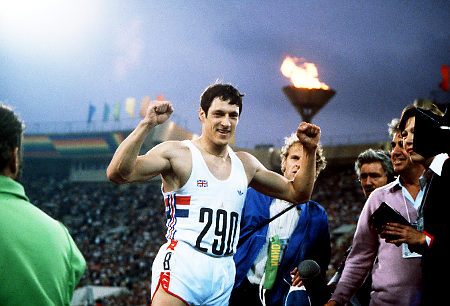

Pleasant surprises: Scot sprinter Allan Wells rocks the world (left) and the Zimbabwe women’s hockey team shocks the world by pulling off one of the great Olympic achievements (right)
.
The Main Men
Sebastian Coe and Steve Ovett ~ were it not for the US-led boycott, the story of these two British middle-distance runners’ rivalry played out at these Games – arguably one of the greatest ever sporting rivalries – would surely be practically everyone’s abiding memory of Moscow ’80. Sebastian Coe was the best 800m runner in the world, while Steve Ovett was the best 1,500m runner in the world (indeed, at this distance and the non-Olympic mile distance he hadn’t lost a race in three years – that’s 45 races). Coe was handsome and well-spoken (he’d later become a Tory MP), while, by contrast, Ovett was seen as rather prickly and stand-offish. The mostly Tory-friendly British newspapers were therefore behind Coe, but – like all the media at large – also recognised Ovett’s equally brilliant talent.
And what happened when they met at these Olympics (only the second time they’d raced against each other in international competition) would be dramatic, climatic and surprising – in short, Coe won Ovett’s specialty event and Ovett won Coe’s. Getting, by his own admission, the tactics of the 800m final all wrong, Coe and the world watched Ovett run clear of him as the latter took the gold and the former the silver, but Coe got his revenge over Ovett in the 1,500m final by holding off the latter over the last few metres to win; Ovett actually ended third – after having claimed in a newspaper article he had a ’90 percent chance’ of winning the event (see bottom video clip for both races).
Both athletes enjoyed a successful next couple of years, but while Coe repeated his Moscow ’80 results at the 1984 Games, an unwell Ovett struggled in the final of both events and was subsequently taken to hospital. After this, their careers wound down and the rest of their lives were just as large contrasts as their athlete personas. Ovett left the UK for relative obscurity in Canada, while , as mentioned, Coe entered politics, became a multi-millionaire health club owner, received a title for his political and sporting efforts and is now overseeing the upcoming 2012 London Olympics.
.
The Main Women
The Zimbabwe women’s hockey team ~ having only found out they’d won a place at the Games 35 days before they began and thus only having chosen the team the weekend before the opening ceremony, and not discounting the facts that none of their players had prior playing experience on an artificial surface, none had properly trained together before the tournament and they’d only warmed up by playing a handful of friendly matches with Soviet club teams, the Zimbabweans upset all the odds by somehow winning the gold medal.
.
.
Mentioned in dispatches
- Cuba managed a record-best performance at these Games, finishing a mightily impressive fourth in the Medal Table and clocking-up eight gold medals. Admittedly, this was mostly due to the boycott, as six of those golds came from boxing, a sport in which (like Cuba) the States is traditionally very strong. All the same, Cuba’s six gold, two silver and two bronze haul from the boxing equalled the best ever achieved in the sport – by the US in 1904’s St. Louis Games
- Also due to the United States’ (and to a lesser extent West Germany’s) absence, European powers France and Italy won four times and three times as many gold medals, respectively, as they did at Montreal ’76. The UK too made hay while others were away, enjoying its best medals haul since Melbourne ’56, as did Ireland
- The most high profile beneficiary of the boycott, British or otherwise, could be said to be Scottish sprinter Allan Wells, who in a photo-finish with Cuban favourite Silvio Leonard won gold in the 100m; both athletes recorded a time of 10.25 seconds (see top video clip). Wells was not only the first Briton to win the ‘blue ribband’ event of the Games since 1924, but also remains the last white man to do so. Not content with that triumph, however, Wells almost made it a double in the 200m, but with just 10m to go lost out to Italian Pietro Menna by 0.02 seconds and had to settle for silver
- More notable British success came in the decathlon, which was won by the charismatic and oustanding Daley Thompson and, following on from David Wilkie’s win in the 200m Breaststroke four years before, memorably bald swimmer Duncan Goodhew became a household name by winning the 100m version of the event (see video clip above)
- Also in the pool, eighteen-year-old Sharron Davies took the silver medal in the 400m Individual Medley behind East German Petra Schneider, who later admitted her victory was drug enhanced. Out of the pool, Davies quickly became a sex symbol and has enjoyed a successful media career, including appearing in the guise of ‘Amazon’ on ITV’s Gladiators (1992-2000)
- As his compatriot John Curry had four years before at the Innsbruck Winter Games, at the Lake Placid Winter Olympics held in February 1980, Brit Robin Cousins triumphed in the Men’s Figure Skating Singles. Also like Curry, Cousins was voted the BBC’s Sports Personality of the Year come 1980’s end, Sebastian Coe was second and Daley Thompson third
- Again, with the absence of American competitors, the Soviet Union easily dominated the Medal Table, yet despite its unquestioned success across many events, it failed to win in football and men’s basketball, was utterly outclassed in sailing by East Germany and didn’t wipe the board in judo – all of which were sports for which it was the strong favourite
.
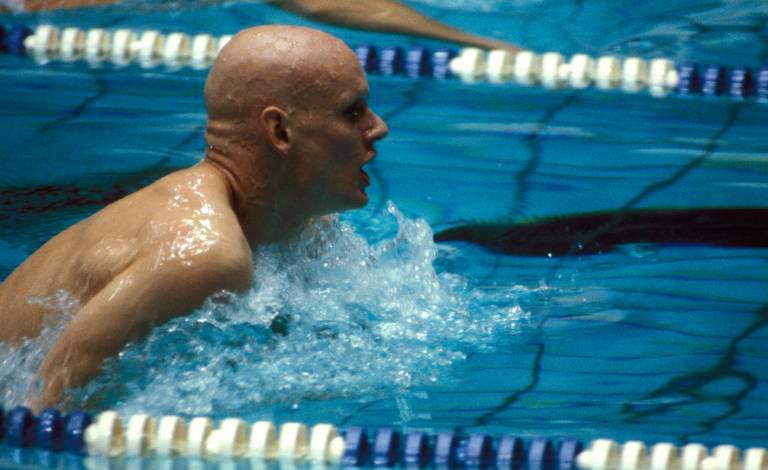


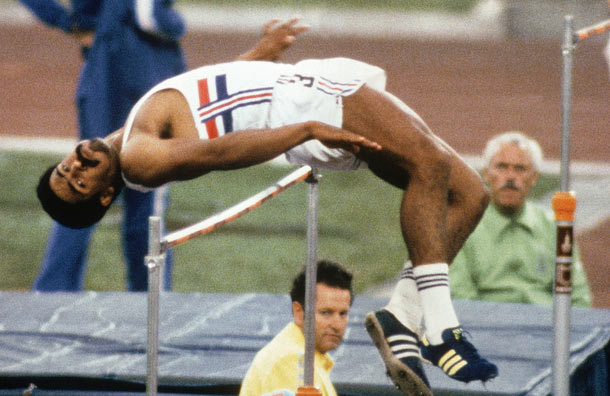
Brits of all right: Duncan Goodhew (top left) and Sharron Davies (bottom left) make a splash in the pool, as Robin Cousins appears on the cover of Radio Times magazine in Winter Olympics week (top right) and Daley Thompson clears the high jump as he goes for glory (bottom right)
.
The Memory
Although the absence of some competing nations (in particular the States and West Germany) clearly diminished these Games’ quality and diversity, on the upside it also gave them something of a unique feel and atmosphere – in addition to that provided by their being held in the USSR, of course. As mentioned, major nations such as the UK, Italy, France and Cuba benefitted greatly owing to others not being there to compete in some events, with the memory of the Coe-Ovett rivalry seeming to define these Olympics’ British success and inevitable lack of any American dominance. However, in the end, Moscow ’80 will always be recalled as the one that the States didn’t attend for disagreeably serious Cold War-related reasons. The next Games would inevitably be very different, given their host would be Los Angeles – surely they‘d not endure any sort of a boycott, would they…?
.
The Medal Table
| Gold | Silver | Bronze | |||
|---|---|---|---|---|---|
| 1 |  Soviet Union Soviet Union |
80 | 69 | 46 | 195 |
| 2 | East Germany |
47 | 37 | 42 | 126 |
| 3 | Bulgaria |
8 | 16 | 17 | 41 |
| 4 | Cuba |
8 | 7 | 5 | 20 |
| 5 | Italy |
8 | 3 | 4 | 15 |
| 6 | Hungary |
7 | 10 | 15 | 32 |
| 7 | Romania |
7 | 6 | 13 | 25 |
| 8 | France |
6 | 5 | 3 | 14 |
| 9 | Great Britain & NI |
5 | 7 | 9 | 21 |
| 10 |  Poland Poland |
3 | 14 | 15 | 32 |
.
.
.
Playlist: Listen, my Olympic friends! ~ July 2012




In the words of Moby Grape… listen, my friends! Yes, it’s the (hopefully) monthly playlist presented by George’s Journal just for you good people.
There may be one or two classics to be found here dotted in among different tunes you’re unfamiliar with or have never heard before – or, of course, you may’ve heard them all before. All the same, why not sit back, listen away to and enjoy this collection of Olympic-themed (some admittedly, er, very loosely, but you know) tracks…
.
CLICK on the song titles to hear them
.
Spyridon Samaras ~ Olympic Hymn1
Peter, Paul And Mary ~ If I Had A Hammer (The Hammer Song)
Pink Floyd ~ Bike
Simon And Garfunkel ~ The Boxer
Carly Simon ~ It Keeps You Runnin’2
Rod Stewart ~ Sailing
Barry De Vorzon and Perry Botkin Jr. ~ Nadia’s Theme3
Emerson, Lake & Palmer ~ Fanfare For The Common Man4
Vangelis ~ Titles (from the 1981 film Chariots Of Fire)
Peter Gabriel ~ I Go Swimming
The Pointer Sisters ~ Jump (For My Love)5
Freddie Mercury and Montserrat Caballé ~ Barcelona6
John Williams ~ Olympic Fanfare And Theme7
.
1 The choral cantata written by opera composer Spyridon Samaras (with lyrics by poet Kostis Palama) for the very first modern Olympic Games held in Athens in 1896; it was declared the official ‘Olympic Anthem’ in 1958 and is thus performed at the opening ceremony – and often the closing ceremony – of every Games
2 A cover of The Doobie Brothers tune and featuring them on backing vocals – in fact, this version was released the same year as the original, 1976
3 Originally named ‘Cotton’s Theme’ and from the soundtrack of the film Bless The Beasts And The Children (1971), this theme was adopted as the opening theme for the CBS soap opera The Young And The Restless upon its launch in 1973, then three years later it was used over a montage of clips of Nadia Comăneci’s routines at the Montreal Summer Olympics on ABC’s Wide World Of Sports programme, proving so popular its composers renamed it ‘Nadia’s Theme’ and released it as a single, which hit #8 in the US charts
4 The legendary rehearsal of the crap and/ or genius prog rock giants’ version of Aaron Copland’s classical piece in an empty Montreal Olympic Stadium, shortly after the 1976 Montreal Games
5 Released in 1984, and in a shameless ride on the back of anticipation for that year’s Los Angeles Games, this pop classic’s video features hurdlers, long jumpers and high jumpers; the song’s title was changed from merely ‘Jump’ to avoid confusion with the hit of the same name released by Van Halen just months earlier
6 Co-written by Mercury (and recorded before his death in 1991), this memorable pop-opera-crossover was selected as the official song for the 1992 Barcelona Games, during which it peaked at #2 in the UK charts
7 This piece opens with Bugler’s Dream, written for the 1968 Grenoble Winter Games, and is followed by John Williams’ goosebumps-inducing Olympic Fanfare And Theme, which the great film composer wrote for the ’84 Los Angeles Summer Games (and has often featured during the BBC’s end-of-year Sports Review/ Personality Of The Year programme)

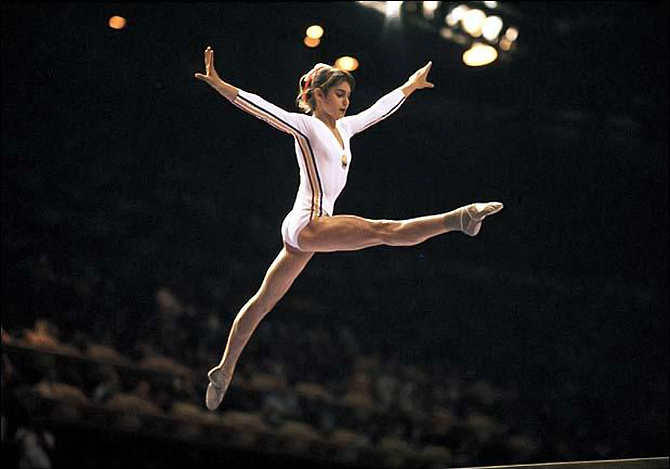
She’s a perfect 10: Nadia Comăneci won three gold medals, delivering several flawless displays
Sandwiched between the Munich ’72 Games – and the horror at the heart of them – and the glamourous, easy to recall Olympics of the 1980s, the Montreal ’76 Summer Games (July 17-August 1) tends to get overlooked by most peeps. But do they deserve better? Well, given they were arguably as fascinating and surprising as any Olympics before or since, with marvellous highs and dramatic lows (at least after the Games themselves for the host city) the answer should surely be a resounding yes.
So here it is then, peeps, this blog’s latest delve into the archives of Olympics past – go on, read on, I guarantee (if unlike Montreal itself perhaps), you’ll regret ne rien…
.
The Magic
There was no avoiding it, the ‘Munich massacre’ that had blighted the ’72 Summer Games had cast a dark pall over the Olympics. And despite a noticeably far higher security presence this time around – many would say necessarily so – and the fact Canada was selected as host over the USA (Los Angeles) and the USSR (Moscow) because the International Olympic Committee (IOC) feared holding a Games in one of the two super powers could cause a political backlash, Montreal ’76 nevertheless represented a chance for the Olympics to get back to what they wanted to be all about: great sporting effort and achievement, global openness and human progressiveness. Indeed, French architect Frank Taillibert’s design for a brand new, state-of-the-art Olympic stadium included both a distinctive modernist tower and a retractable roof whose doughnut shape gave rise to the stadium being nicknamed ‘The Big O’. Also, in a space-age-esque first, the Olympic flame was sent via satellite as an electronic pulse from Greek capital Athens to Canadian capital Ottawa – more conventionally, from there to Montreal it travelled by hand.
.
.
The Mascot
One of Canada’s most distinctive and cutest of mammals, the beaver, was chosen as the subject for Montreal’s mascot. Unfortunately, Amik the beaver proved far less popular than Munich’s cute canine companion, Waldi the daschund, owing to the strange choice made for his design – over the years he’s been described as both flattened roadkill and a bad mullet. Poor little chap.
.
The Moment
Nobody, man or woman, had ever managed it before in gymnastics – let alone at the Olympics – but at the Montreal Games that all changed. On July 18 1976, a 14 year-old, 4′ 11″ Romanian girl by the name of Nadia Comăneci was competing in the Uneven Parallel Bars and her faultless routine was awarded the first ‘perfect 10’ score in history (see video above). A monumental sporting moment, for sure, but it could have dissolved into anti-climax owing to the scoreboard’s designers having not accounted for the possibility a perfect score might occur, meaning the scoreboard read ‘1.00’. A bemused silence descended over the crowd until, after a few seconds, the penny dropped and spontaneous applause broke out around the arena.
.


Legendary leg and fists of fury: Japanese gymnast hero Shun Fujimoto in plaster (l) and US boxer Sugar Ray Leonard on the way to immortality – and beginning a glittering career (r)
.
The Main Man
Shun Fujimoto ~ part of the Japanese team that won gold in the Men’s gymnastics All-Round Team competition, Fujimoto amazingly competed in the event despite having broken his knee in the directly preceding Floor Exercise. He scored 9.5 on the pommel horse and 9.7 on the rings, pulling off a perfect landing from the latter before collapsing in agony – the dismount dislocated his broken kneecap and tore ligaments in his leg (see video clip below). Doctors ordered him to withdraw from further competition or risk permanent disability, one since commenting: “how he managed to do somersaults and twists and land without collapsing in screams is beyond my comprehension”. Fujimoto’s efforts, however, played both an important part in and provided the motivational spur behind his team winning the gold.
.
The Main Woman
Nadia Comăneci ~ in addition to her ‘perfect 10’ in the Uneven Parallel Bars, little Nadia repeated the feat – not once, but six more times in the Bars and the Balance Beam. By the end of the Games she had won three gold medals (Individual All-Round, Bars and Balance Beam), a silver (Team) and a bronze (Floor Exercise). Like Olga Korbut four years before – who competed again at these Olympics, but was overshadowed – and despite an intense rivalry with the USSR’s Nellie Kim (who also won three golds), Comăneci became the face of the Games and a global heroine; albeit one who wasn’t able to indulge in the fruits of her fame owing to restricted travel imposed by her homeland’s government until she defected to the West in 1989; ironically just months before the Ceauşescu regime crumbled. At the end of ’76, the Associated Press had named her Female Athlete of the Year and she’d won the BBC’s Overseas Sports Personality of the Year award. She competed again at the Moscow Olympics where she claimed two further gold and two further silver medals.
.
.
Mentioned in dispatches
- This Olympics wasn’t just about terrific gymnastics achievements, it also featured surely the United States’ greatest ever boxing team, with five of their pugilists all winning golds: Sugar Ray Leonard, the brothers Leon and Michael Spinks, Leo Randolph and Howard Davis Jr. Indeed, apart from Davis, all of them went on to become world champions at different professional weights; Leonard is now regarded as one of the greatest ever boxers, having won world titles at five separate weights
- Great Britain hardly had its most memorable Games this time out, but a somewhat unlikely national hero was born in the shape of bobbing, Mark Spitz-lookalike David Wilkie, who won gold in the Men’s 200m Breaststroke and silver in the 100m version of the same event
- Five months before these Games, the ’76 Winter Olympics took place in Innsbruck, Austria, where Brit John Curry triumphed in the Men’s Figure Skating Singles (see bottom video clip), adding the Olympic title to the World and European titles he’d already won that year. Curry was renowned for incorporating ballet and modern dance influences into his routines that delighted and enthralled crowds and made him popular the world over. He was named the BBC’s Sports Personality of the Year for 1976. Tragically, though, he was diagnosed with HIV in 1987 and, having developed AIDS, died four years later – apparently in the arms of famed actor Alan Bates with whom he’d earlier had a two-year affair
- Following her husband’s participation at Munich ’72, Princess Anne competed for Blighty in Equestrianism at Montreal ’76. Unlike her spouse who’d shared a team gold, however, she finished in 24th place and the overall British team didn’t even manage to finish; presumably because she was royal, Anne was saved having to face the gender determination test, though, something that all other female Olympians had to go through until 1999
- In the first major boycott of the modern Olympics, 28 African nations refused to participate in these Games owing to the International Olympic Committee (IOC) not banning the New Zealand team in response to their country’s rugby union side touring the apartheid-gripped South Africa earlier in the year
- Cuban Alberto Juantoreno became the first man to win both the 400m and 800m at the same Olympics, while Finland’s Lasse Virén pulled off a double in the 5,000m and 10,000m – it was, in fact, a double-double, as he’d achieved the same feat four years earlier. In a classic example of ‘Colemanballs’, David Coleman’s BBC TV commentary featured this exclamation during Juantoreno’s victorious run: “And there goes Juantorena down the back straight, opening his legs and showing his class”
- Soviet modern pentathlete Boris Onishchenko was disqualified from his event when it was found he’d managed to rig his épée (dueling sword in fencing) to register a hit when there hadn’t been one. As a consequence of his cheating, the entire USSR modern pentathlon team was also disqualified, which caused Onishchenko such emnity among his fellow Soviet athletes that apparently volleyball players claimed they’d throw him out of a window if they came across him
- Finishing with a haul comprising five silver and six bronze medals, Canada had the dubious honour of becoming the first host nation not to win a gold medal at its Summer Games (although the same had happened before and has happened since at Winter Games – indeed, it happened again to the hapless Canucks when they hosted the Winter Olympics at Calgary in ’88). Canada finally won its first gold medal at home 34 years later at the 2010 Vancouver Winter Games
.


High and mighty Blighty: David Wilkie (left), John Curry (middle) and Princess Anne (right)
.
The Memory
Canada’s inability to claim a gold was not the only misfortune to befall the host city – far more serious were the financial implications Montreal suffered thanks to hosting the Olympics. After it had been named host, the city’s mayor Jean Drapeau declared that “the Olympics can no more have a deficit than a man can have a baby”; this proved a dreadful tempter of fate. Five years later, when it became blithely obvious building of the Olympic stadium was off schedule, Quebec’s government took over, but to mixed results. Despite most buildings being finished (only just) before the Games’ opening, the stadium’s would be iconic tower wasn’t and its retractable roof has never been installed. All this caused the project’s costs to spiral and Montreal wouldn’t fully pay off the debts it clocked up for 30 years. All told (including inflation), the total bill came to a staggering C$1.61 billion. Unsurprisingly, the stadium’s nickname quickly altered from ‘The Big O’ to ‘The Big Owe’.
Montreal ’76 certainly doesn’t have the tragic legacy of Munich ’72, but with its dreadful debt burden, African boycott and underwhelming host nation performance, it hardly made the Olympic torch burn brightly once more in the ’70s – by the end of the decade everyone associated with the movement must surely have been looking forward to moving on to the ’80s. What Montreal ’76 could proudly boast, though – like Munich ’72 – was an outstanding performance by a young female gymnast who became a global superstar and whose achievements would be etched in people’s memories for all-time.
.
The Medal Table
|
|---|
.
.
.
Loving the alien: 30 things you always wanted to know about E.T.: The Extra-Terrestrial, but were afraid to ask…
You saw the whole of the moon: alien savant E.T. gives human buddy Elliott’s late-night bike ride lift-off and sets up one of the all-time most iconic images of cinema and popular culture
My dad once remarked that the Christmas after E.T.: The Extra-Terrestrial (1982) was released, he saw a little figurine of E.T. himself in a nativity scene. Whether or not the bug-eyed, long-necked, goofy yet loveable alien’s presence in this religious reproduction was a knowing reference to the notion doing the rounds back then that the film was a Christian parable (see below), God – maybe literally – only knows, but unquestionably for my dad this was proof of just how great a phenomenon Steven Spielberg’s movie had oh-so quickly become.
Given E.T.‘s now such an established part of the modern zeitgeist and has been for some time, it’s rather easy to forget just how big it once was. Forget Area 51, in the early ’80s, E.T. was the Studio 54 of box-office excess. Yes, this simple family tale set in small-town American surburbia absolutely conquered the world to become the biggest movie ever made – a sweet little irony that this great fan of the flick has always enjoyed. And earlier this month, the small (and huge), but perfectly formed E.T. celebrated it’s 30th anniversary – yes, believe it or not, it was 30 years ago that E.T. and Gertie screamed at each other; that that pot plant came back to life; that Michael’s friend coined the classic ‘ur-anus’ joke (the old ones are still the best) and, of course, that Elliott and his alien buddy crossed the moon. And in marking the 30th anniversary of the ultimate higher-intelligence-makes-Earth-visit, here’s this blog’s 30 point-by-point celebration. E.T. phones home? Nopes, E.T. comes home, folks…
.
1. Many feel the origins of E.T.: The Extra-Terrestrial, with at its heart the tale of a lonely boy living with his brother, sister and single mother, can be traced right back to 1960 when director Steven Spielberg’s own parents divorced. A 1997 biography quotes him as saying that E.T. could easily have been “a friend who could be the brother I never had and a father that I didn’t feel I had anymore”.
2. After directing friendly-aliens-connect-with-humans hit Close Encounters Of The Third Kind (1977), Spielberg considered for his next project a semi-autographical film he’d shoot in just 28 days entitled Growing Pains, a Close Encounters sequel or a darker sci-fi project with art-house director John Sayles called Night Skies in which aliens would terrorise a family on Earth.
3. He actually next filmed the ill-conceived WWII spoof 1941 (1979) and then the George Lucas-conceived Raiders Of The Lost Ark (1981). It was while working on the latter in Tunisia that he got talking with Melissa Mathison, future wife of Indiana Jones himself Harrison Ford, about the now fallen-through Night Skies project and that would-be film’s sub-plot about a non-malevolent, abandoned alien befriending an autistic boy inspired Mathison so much she wrote a screenplay draft in eight weeks. She called it E.T. And Me.
4. Spielberg loved the screenplay and, following two more drafts, a human sidekick for Elliot was removed, while a bike chase sequence and the E.T. character getting drunk were added.
5. The director approached Columbia Pictures (who had been involved with Night Skies before it fell through) to produce the new film, but the studio dismissed it as ‘a wimpy Walt Disney movie’ – big mistake! Spielberg moved on to Universal (then MCA) instead.
6. Night Skies did make it to the screen in the end, however; albeit in a changed form – much material from it inspired Poltergeist (1982), in which, of course, a ghost terrorises a human family. The movie was officially directed by helmer of The Texas Chainsaw Massacre (1974) Tobe Hooper, but Hollywood legend has it that ironically co-writer and producer Spielberg directed significant portions of the flick.
.
.
7. With studio backing in place, Spielberg set out on the unenviable task of casting the film’s major character… E.T. himself. Raiders art department alumnus Ed Verreaux was paid $700,000 to build a prototype, but Spielberg rejected it and instead turned to the man who had created Close Encounters‘ aliens, Carlo Rambaldi.
8. Rambaldi created three creatures at a cost of $1.5million. This included four animatronic heads and costumes worn by dwarf performers Tamara De Treaux and Pat Bilon and 12-year-old Matthew De Meritt, who was born without legs, while mime artist Caprice Roth wore prosthetics to perform the character’s hands.
9. The look of E.T.’s face was inspired by those of legendary authors Ernest Hemingway and Carl Sandberg and (like that of fellow early ’80s loveable alien pop culture phenomenon Yoda) Albert Einstein. Because she felt they’d be so important in engaging the audience, the movie’s producer Kathleen Kennedy hired staff from UCLA’s Jules Stein Eye Institute to make E.T.’s eyes.
10. Sound effects supremo Ben Burrtt, a master technician on every Star Wars movie and later the voice of the title character in WALL-E (2008), sought out elderly actress Pat Welsh for E.T.’s voice. As she smoked two packets of cigarettes a day, her voice had a unique quality. Burtt also mixed in the voices of Spielberg and actress Debra Winger; the sound of his own wife sleeping, who at the time had a cold; a burp from his old college film professor; as well as sounds made by raccoons, sea otters and horses.
11. In spite of the fact E.T. would become a huge success and an undeniable icon, Spielberg described him at the time as “something only a mother could love”.
12. Yoda and E.T., in fact, actually meet in the film – well, nearly – when supposedly accompanying Elliott and his brother Michael as they go trick-or-treating and hidden under a white sheet (as he pretends to be Elliot’s sister Gertie posing as a ghost), E.T. sees a child dressed in a full Yoda costume walk past him and, appearing to believe this may be an alien of his own race, turns to follow him down the road.
.


Then and now: Spielberg directing Henry Thomas (left) and Drew Barrymore (right) and, altogether again, E.T.’s human leads Robert McNaughton, Thomas, Dee Wallace-Stone, Barrymore and Peter Coyote reunite with Spielberg and Kennedy for 2002’s 20th anniversary
13. After failing to impress in a formal audition (in which he performed in an Indiana Jones costume), nine- going on 10-year-old Henry Thomas was cast as central character – if not protagonist – Elliott following a more successful improvised scene. Robert MacNaughton, who was 14, won the role of Elliott’s older brother Michael, but would eventually give up acting and is now a mail handler living in New Jersey.
14. Six-year-old Drew Barrymore (a member of the Barrymore acting dynasty) won the role of Elliott’s sister Gertie after impressing with a story of how she performed with a punk band – she would go on to endure a classic child-star spiral that saw he enter rehab aged 13. She’s now, however, one of Hollywood’s most successful actresses and the god-daughter of both Spielberg and Sophia Loren.
15. Supporting players included C Thomas Howell, who played one of Michael’s friends involved in the film’s bike-chase climax, and would go on to become a member of the ’80s ‘Brat Pack’, as well as Erika Eleniak as the girl Elliott kisses in biology class, who as an adult would achieve fame in Baywatch (1989-99). Harrison Ford also appeared in a scene as the principal at Elliott’s school in which the latter is brought before him for destroying the biology class. The scene, however, was cut from the finished film.
16. Roughly speaking, the movie was shot in chronological order to emit realistic performances from the young players – this helped them ‘bond’ with E.T., which ensured the hospital-in-the-home sequence, in particular, achieved the emotional punch it does. Filming began in September 1981 and lasted 61 days, taking in locations in California: the towns Northridge and Tujunga, a redwood forest near Crescent City, a school in Culver City and Laird International Studios, Culver City (the interiors of Elliott’s home).
17. Although far from autobiographical, E.T. still took much inspiration from Spielberg’s childhood – one example is Elliott’s trick of heating up his thermometer by holding it under a light-bulb, something Spielberg did as a boy in feigning illness. The shot of E.T. hiding in a cupboard among the children’s soft toys was suggested by Robert Zemeckis, who would go on to make Back To The Future (1985) and its sequels.
18. As he had been for Jaws (1975), Close Encounters and Raiders, John Williams was chosen as composer for E.T., the score he came up strongly featured piano, harp, celesta and keyboards (unlike in his previously heavy orchestral scores) to complement the film’s youthful and childlike focus, as well as the use of polytonality (two different keys played simultaneously). Yet, at times, the score also makes great use of orchestra and especially strings, such as in the goose-pimple inducing signature theme Flying (see bottom video clip).
.
.
19. E.T. premiered at the 1982 Cannes Film Festival closing gala and opened in America on June 11. A week later it topped the US box-office with $11 million, where it stayed for five further weeks and fluctuated between #1 and #2 until October, hitting top spot for the last time in December. By the end of its original run, it had taken $359 million domestically and $619 million worldwide, knocking Star Wars off its perch as the highest grossing film of all-time – a title it held for 11 years until another Spielberg effort Jurassic Park took the mantle. It made $75 million in VHS sales and, thanks to his share deal from the profits, Spielberg made $500,000 a day from its box-office haul.
20. When approached, Mars, Incorporated wouldn’t allow M&M’s to feature in the movie, but Hershey’s saw it as a great opportunity to publicise their new line Reese’s Pieces. It was a smart move – thanks to Reese’s Pieces appearing in the film, Hershey’s saw their profits rise by 65 percent.
21. The movie achieved huge praise from film critics. Roger Ebert said it was “not simply a good movie. It is one of those movies that brush away our cautions and win our hearts”, while Rolling Stone‘s Michael Sragow claimed that “for the first time, Spielberg has put his breathtaking technical skills at the service of his deepest feelings”. Over the years, Spielberg – and, by extension, E.T. – has received criticism for sentimentality, but others have suggested the film portrays American surburbia as dark and even bleak; The New York Times‘ A O Scott wrote in 2008 that E.T.‘s “suburban milieu, with its unsupervised children and unhappy parents, its broken toys and brand-name junk food, could have come out of a Raymond Carver story”.
22. Other critics have tried to draw parallels between the character of E.T. and Jesus Christ. Perhaps savvy of how the film’s content could be interpreted by some, Universal Pictures may have deliberately appealed to the Christian market by coming up with a poster for the flick that strongly echoed Michelangelo’s Creation Of Adam. Spielberg answered such claims in 1984 by saying: “if I ever went to my mother and said, ‘Mom, I’ve made this movie that’s a Christian parable,’ what do you think she’d say? She has a kosher restaurant on Pico and Doheny in Los Angeles”.
23. E.T. had mixed success during the ‘awards season’. While it was named Best Film (Drama) at the Golden Globes, John Williams’ score also won a Golden Globe, a BAFTA award and a Grammy and the movie won Best Foreign Language Film at France’s César Awards, Italy’s David di Donatello awards, Spain’s Cinema Writers Circle Awards and Japan’s Blue Ribbon, it only won for Score, Sound, Sound Effects Editing and Visual Effects out of the nine Oscars it was nominated for. Most notably (and in a surprise) it and Spielberg lost out on the Best Picture and Director Oscars to Ghandi and its helmer Richard Attenborough, who in 1993 admitted “I was certain that not only would E.T. win, but that it should win. It was inventive, powerful, [and] wonderful. I make more mundane movies”.
24. Spielberg considered making a sequel. E.T. II: Nocturnal Fears would have featured Elliott and others kidnapped by evil aliens and appealing to E.T. for help. The project got as far as Speilberg and Mathison working up a screen treatment in July 1982 before the former (surely rightly) knocked the idea on the head.
.

Publicity push: an E.T.-branded thermos flask and lunch box (left), the notorious official Atari 2600 video game (middle) and the Michael Jackson narrated audiobook album (right)
25. Aside from the inevitable multiple soft toys and action figures, cereal packet giveaways and lunchboxes and thermos flasks (see above), a unique and high-profile manner in which E.T. was publicised was an audiobook of the film’s story narrated by Michael Jackson (see top video clip). Back when Jackson was considered a firmly family-friendly figure as well as the biggest recording artist in the world, the album should have proved a huge success, however it was pulled very soon after release owing to contractual issues with Jackson’s regular recording company. It was recorded alongside his enormously successful Thriller album (1983) and won a Grammy in 1984.
26. Another infamous publicity tie-in was the official Arari 2600 video game. Unfortunately, this pretty much proved an unmitigated disaster owing to the fact the game had only a five-week development window by the time Atari secured the rights and before it had to be ready to hit the shelves for Christmas 1982. Millions were sold, but many were returned and many more unsold due to terrible word-of-mouth and reviews. Word has it huge numbers ended up crushed and buried under a landfill in New Mexico.
27. Unofficial, nay illegal, music tie-ins suddenly appeared too, cashing in on the movie’s phenomenal success, namely Extra T’s E.T. Boogie, which became something of a club classic and part of which was later sampled on a Busta Rhymes track, and the actually arguably rather listenable-to Jupiter 8’s E.T. Phones Home (featuring Kitty Woodson on lyrics) – see video clip above.
28. Obviously over the years E.T. has become regarded as an all-time cinema classic. It had widespread re-releases in 1985 and, to mark its 20th anniversary, in 2002 when Spielberg, Kennedy and the cast met up to publicise the event (see image above). When re-released this time, though, the film ‘enjoyed’ controversial updates including replacing the guns of federal agents featured in the bike chase with walkie-talkies, CGI-enhancing E.T. in several scenes and adding in a couple of short scenes cut from the original release. This was the prinicpal version used when the film was made available on DVD.
29. To mark the film’s 30th anniversary this year, it will be released in November for the first time on Blu-Ray and to publicise this an outdoor screening of the movie was shown by the Los Angeles Film Festival on June 15, some of the attendees of which recreated the bike chase sequence by riding to the screening on BMXs wearing red hoodies (similar to the one worn by Elliott in the scene), the leader of which had a plush E.T. seated in the basket on the front of his bike.
And finally:
30. Surely the most memorable few seconds from the entire movie, the moment when E.T. allows he and the bike-bound Elliott to cross the valley by making them fly and pass the moon was immortalised as the logo of Amblin Entertainment, Spielberg’s film and television company, and in 2004 topped a poll held by film magazine Empire of the 50 most magical moments in cinema history. Relive that very magic by viewing the moment in the video clip below – go on, you know you want to…
.
.

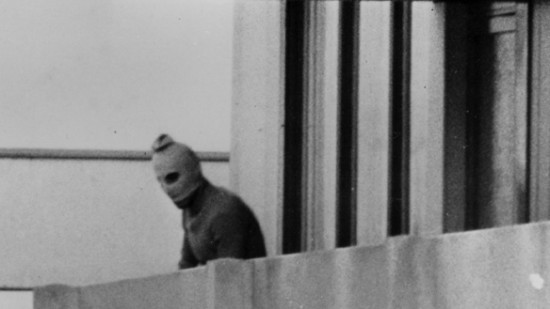
One day in September: a hooded Palestinian terrorist during the siege of a room of Israeli athletes in the Olympic Village – it would disastrously escalate into the ‘Munich Massacre’
So, after the Star Wars-fuelled intergalactic hoopla this blog enjoyed last month, it’s now time to get back to Earth and (in the wake of the London Olympics just weeks away) the celebration of Summer Games of decades past. And following the posts on the Tokyo ’64 and Mexico City ’68 efforts, we’re now turning our attention to that decade of dubious highs and lugubrious lows, the ’70s. And, in those terms at least, that annus dectet‘s first Summer Games, Munich ’72 (August 26 – September 11), didn’t disappoint. An event most remembered for a dreadful development, it also boasted incredible achievements. In which case, one might very objectively say, this Olympics really had it all…
.
The Magic
Much optimism was in the air and hopes were high ahead of the Munich Games. On the back of its Wirtschaftswunder (economic miracle), West Germany hoped these Olympics would be a successful showcase of their relatively rapid development as a peace-loving, self-sufficient global player. And, aiming to banish the memory of Munich’s strong association with Nazism and all it stood for, the host city had built an impressive looking multi-purpose site (Olympiapark/ ‘Olympic Park’), which included an Olympic swimming pool, a giant hall used for several events and a state-of-the-art stadium, designed by architect Günter Behnisch, that featured a roof of sweeping acrylic glass canopies supported by metal ropes. These Games promised to be open, friendly and progressive – just like the now proudly modern West Germany.
.
The Mascot
Still a firm favourite with Olympic fans today, Waldi the Daschund was in fact the first Games mascot to have a proper name and the first to capture the widespread, nay, global imagination. And frankly his enduring popularity isn’t hard to understand, given he’s a very colourful, very cuddly little chap – perfectly in keeping with the image the organisers wanted these Olympics to emit. In another first, the Munich Games were also the first to debut the instant hit that was graphic artist Otl Aicher’s pictograms, used to illustrate the different events.
.
.
The Moment
As mentioned in my previous Olympic post, US 200m medalists Tommie Smith and John Carlos’s podium-bound protest at Mexico City ’68 brought politics to the post-war Games in a profound and unavoidable manner. The event sent a buzz around the world. What happened in Munich on September 5 1972, though, sent shockwaves around the world.
In the early hours of that morning, taking advantage of the lax security (owing to this being the ‘carefree’ Olympic Games) surrounding the ‘Olympic Village’ in which all the athletes and officials were housed, eight assault rifle-toting members of the Palestinian Black September paramilitary group broke into a room in which Jewish officials were sleeping and, within the next few minutes, shot one and forced the others to help find Israeli athletes in another room, then following another murder, proceeded to hold them all together in the first room as hostages. Hours then passed, during which Munich police negotiators attempted to broker a deal with the terrorists in exchange for the lives of the hostages (the former were demanding the release of 234 Palestinians being held in Israeli jails). At one stage, armed police entered the Olympic village, but their positions on roofs near the building containing the hostages and terrorists were broadcast by TV cameras, ensuring that not just the world watched their progress live, but so too did the terrorists on a TV in the room they were holed-up in. Amazingly, the decision to suspend the Games was only taken 12 hours after the crisis had begun.
Eventually around 10pm, following the negotiations, the terrorists and the nine hostages were transported by bus and then in two helicopters to NATO’s nearby Fürstenfeldbruck Air Base, ostensibly so the terrorists could be flown to Egypt. Here though the police enacted an ambush of the terrorists involving snipers, but poor planning meant it went awry (not least because it was believed there were only four or five terrorists). A gunfight ensued and some of the terrorists were killed, but so too were all of the hostages – most of them probably gunned down by the terrorists before the latter exploded grenades in the two helicopters from which the hostages couldn’t escape.
The legacy of this shocking and truly horrendous event proved long and controversial. Immediately afterwards, the Games resumed and, although a Memorial Service took place in the Olympic Stadium on September 8, many competing at the Games, attending them and millions more around the world felt that due respect hadn’t been paid to the slain Israeli athletes and officials. Indeed, down through the years, the moment when the US learned of their horrific fate has become TV legend; sports presenter Jim McKay’s words ‘They’re all gone’ still leaves viewers numb today (see video clip above).
Moreover, almost immediately after what quickly became known as the ‘Munich Massacre’, the Israeli government charged its security service Mossad to enact Operation Wrath of God, whose aim was to hunt down the terrorists who were still alive and those who planned the act. Details as to exactly what went on in the name of this operation remain very sketchy today, but were memorably ‘recreated’ in the Steven Spielberg film Munich (2005), while the entire subject was explored in the documentary One Night In September (1999). However, away from the specific details and the controversies, one irrefutable truth remains: the ‘Munich Massacre’ is by far and away the blackest event with which the Olympics has ever been associated – indeed everything the Olympics is and represents has never been quite the same since that dark day.
.


Gold rush: US swimmer supremo Mark Spitz (l) and Belarusian gymnast ‘giant’ Olga Korbut (r)
.
The Main Man
Mark Spitz ~ Events competed: seven. Gold medals won: seven. World records broken: seven. The greatest performance in a single Olympic Games? It’s hard to say no. His efforts in the 100m Freestyle, 200m Freestyle (see bottom video clip), 100m Butterfly, 200m Butterfly, 4 x 100m Freestyle Relay, 4 x 200m Freestyle Relay and 4 x 100m Medley Relay achieved Spitz utter, unequivocal immortality as easily one of the greatest swimmers and Olympians of all time. As did that oh-so cool ‘tache he sported back in the day. He is simply one of the great heroes of the ’70s.
.
The Main Woman
Olga Korbut ~ at an Olympics at which the USSR and Eastern Europe did particularly well to say the least (see the medal table at the bottom of the post), one Soviet – or, to be exact, Belarusian – athlete stood head and shoulders above all her compatriots, even if she was only 5 feet tall. At the tender age of 17, little Olga won three gymnastics gold medals in Balance Beam, Floor Exercise and the Team Competition. But what instantly endeared her to the world and made her a global superstar was the fact she shattered Western illusions of Soviet stoicism, as she shed tears like an ordinary girl after losing out to a teammate following an unfortunate fall on the Uneven Bars in the All-Round Individual Event, as well as flashing a smile as big as Minsk on the medal podium. And when she executed on the bars a backward somersault and a backward-release back flip (the ‘Korbut Flip‘; see video clip below), she drew gasps of surprise and delight – she was the first gymnast ever to perform either in international competition.
.
.
Mentioned in dispatches
- In perhaps the most notorious Olympics basketball match of all-time, the United States were beaten in the Men’s final by the Soviet Union when the former, leading 50-49, were confused by a time-out at the match’s death that allowed the USSR a few more valuable seconds to score the points needed to take the gold. So unimpressed were the Americans they wouldn’t accept their silver medals
- The Men’s 100m and 200m sprints were both won by Soviet Valeriy Borsov after the favourites for the former event, Americans Rey Robinson and Eddie Hart, missed their quarter-final heats because they were told the wrong start time
- Great Britain’s heroine at these Games was Mary Peters, who won the Women’s Penthalon by just 10 points over the West German favourite, yet set a new world record in the process. A Northern Irish protestant, Peters was the victim of a death threat following her victory, which warned her not to return to her homeland and that her house would be blown up – all in the supposed name of the Irish Republican Army (IRA). She did, however, return to her home city of Belfast and was paraded through the streets , although she didn’t move back in to her house for three months
- American Dave Wottle won the Men’s 800m despite being in last place three-quarters of the way through the final. After 600m had been run, he passed athlete after athlete, finally hitting the front just 18 metres from the line and winning the race by 0.03 seconds
- Equestrian Team Eventing gold went to Great Britain, whose team included Mark Phillips, husband (at the time) of Princess Anne, who would go on to compete in equestrianism herself at the next Olympics, and father of Zara Phillips who will compete in the same sport at this summer’s Games
.

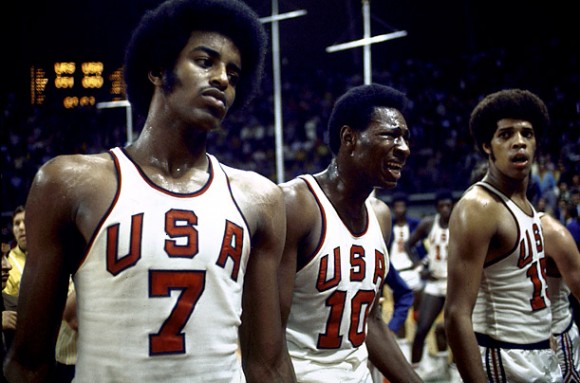
Glory and failure: pentathlete Mary Peters does the business for Blighty and Northern Ireland (left), but the American basketball team can’t believe they’ve lost to the Soviet Union (right)
.
The Memory
The abiding memory of these Games is – and always will be – the ‘Munich Massacre’. There’s no getting away from that. A horrendous event that the Olympics and wider culture is still reeling from today. It’s impossible to separate Munich ’72 from what took place on September 5 and 6 – and surely wrong to do so. However, these Games did throw up magnificent, nay, incredible performances from at least two athletes that will also be remembered for all times – the achievements of Spitz and Korbut will be etched in Olympic history for as long as the acts of those eight terrorist maniacs. And don’t doubt it, there’s more than some good in that.
.
The Medal Table
|
|---|
.
.
.