007/ 50: “My name’s Bond, James Bond” #3 ~ the four years of three Bonds (1969-73)


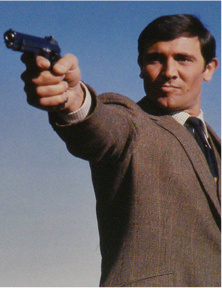
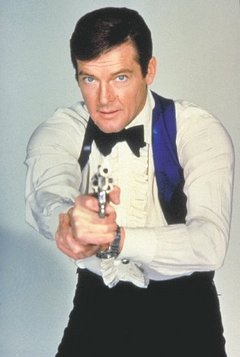
Trio of heroes: the casting of Connery in Diamonds (l), Lazenby in Majesty’s (m) and Moore in The ‘Die (r) is a tale of reluctance, resignation and reignition, but who won and who lost?
What would you do if your little boy kept on throwing tantrums and wouldn’t play with his hollowed-out volcano sets and cool toy gadgets anymore? Ditch him and get a new one, right? Well, surely for right rather than wrong, the real world doesn’t work like that. But the world of the cinematic Bond does. For when the actor who played James Bond throughout the 1960s wanted out, producers Albert R Broccoli and Harry Saltzman didn’t blink; they let him go and hired someone new. Having said that, though, perhaps the world of the cinematic Bond does work like that, because after just one film they actually went back and re-hired their original actor (all right, someone else replaced him again after just one further film, but still).
Yes, between 1969 and 1973 – surely one of the most culturally and socially transformative periods of the 20th Century – the Bond films went through a white-knuckle Louisiana Bayou speedboat ride of change the like of which it’s never experienced since, for in a space of just four years, three different actors played the main man himself, our man Bond. And this blog post, peeps, the latest in celebration of Blighty’s finest‘s big 50 this autumn (and more specifically the third of four looking at the casting of 007) tells that very story, one that’s as intriguing, engaging, surprising and colourful as any plot of an actual Bond film.
Sick and tired of playing a character that, by the end of the stratospherically successful and fun but stratospherically OTT You Only Live Twice (1967), had become more robotic than dramatic, 007 actor Sean Connery had severed his ties with Eon Productions’ Bond film series. In all fairness, as big a reason as the latter was the effect it was having on his downtime from Bond – the intense media intrusion had become just too much; during the filming of Twice he’d even been followed into the loo by an over eager Japanese journalist. In which case, the two-year lead up to the next Eon effort On Her Majesty’s Secret Service (1969) began with the search for the next James Bond. And, from the off, it was as media-fixated and public-aware as Connery’s private life.
Rumour suggests that two familiar names were in the running to slip on the shoulder-holster next. Apparently, Saltzman was keen on travelling to Cambodia to adapt The Man With The Golden Gun with Roger Moore as 007; this didn’t happen (not least because Moore was still committed to playing TV’s The Saint), but of course Golden Gun would eventually get made as his second flick in the role. What certainly seems true is a young Welsh classically-trained actor who’d just made his big screen debut in the acclaimed The Lion In Winter (1968) was considered by Broccoli and Saltzman. But, believing himself too young for the role, the 22 year-old Timothy Dalton took himself out of the running. His chance though, like Moore, would come again…
.
.
In the end, the opportunity to fill Connery’s Conduit cut suit was whittled down from around 400 hopefuls (also apparently including future TV Sherlock Holmes and co-star in 1964’s My Fair Lady, Jeremy Brett) to a shortlist of just five: Englishmen Anthony Rogers and John Richardson, American Robert Campbell, Dutchman Hans de Vries and Australian George Lazenby. Like Connery had been back in ’62 before being cast in Dr No, they were all relative (and, in some cases, complete) unknowns.
Out of the five, Richardson probably boasted the most screen experience, having had lead roles opposite Honey Ryder herself Ursula Andress in She (1965) and Raquel Welch in One Million Years B.C. (1965), while Rogers had played Sir Dinadin in the cinematic adaptation of musical Camelot (1967), had acted opposite John Wayne in El Dorado (1966) and had essayed an alien in five episodes of TV’s Doctor Who. For his part, de Vries had actually appeared in the previous Eon Bond effort You Only Live Twice as a control technician and, sort of ironically, in the Sean Connery-starring western Shalako (1968). Conversely, Campbell seemingly was without a major credit to his name. New to the acting game too – and maybe the least experienced of the five – was Lazenby. And, somewhat surprisingly, after all five wannabes were screen-tested, it was the latter who won the role.
Hailing from New South Wales and a bit of a ‘larrikin’ (a bit of a lad, Aussie-style) while growing up, Lazenby had come to London in ’63 and, while working as a car salesman in Park Lane, had been spotted by a talent scout and quickly hired as a model. His most high-profile work during this time came on TV, though – as a grinning chap holding on his shoulder a box of Big Fry chocolate in a commercial. And yet, in spite of having practically no acting experience and certainly no thespian training, his casting as Bond was arguably no accident – at least, from his point of view.
Knowing full well that the 007 role was open, the 28 year-old Lazenby decided to pursue it. Cannily, he a bought a suit from the Saville Row outlet used by Connery that the star had ordered but not collected, as well as acquiring a Rolex Submariner watch (the model worn by 007 in the films), had professional photos taken of him in Bondian poses around London wearing both and, having found out who Broccoli’s barber was, booked an appointment to get his hair cut at the exact time he knew the producer would be there. Amazingly, his efforts paid off – Broccoli offered him an audition.
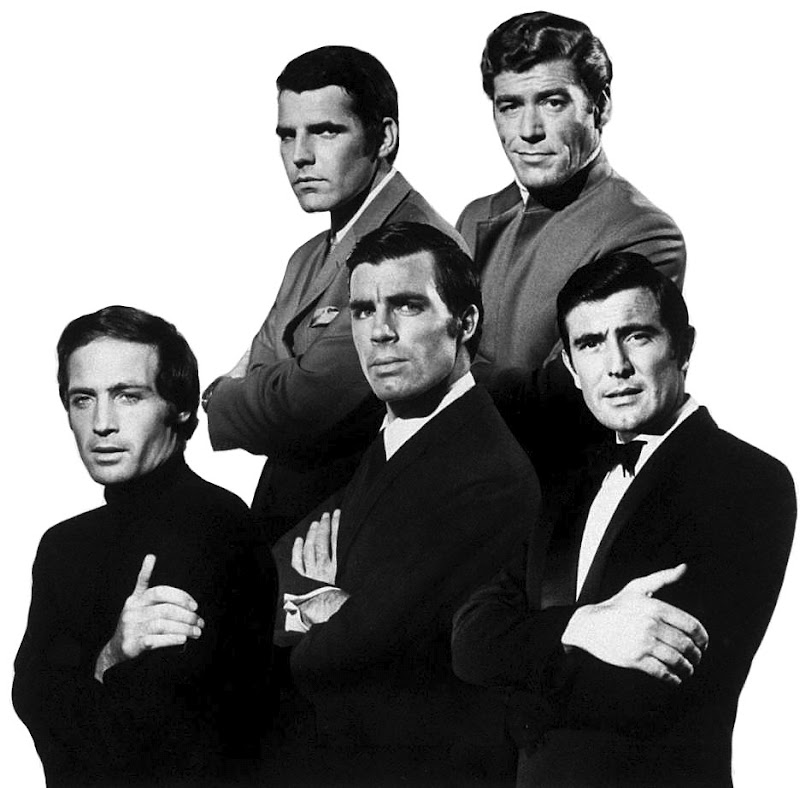
Five down to one: the grandstand media event that was the casting of the new James Bond in 1967 led Life magazine to devote an entire article to the final five, (clockwise from top right) Anthony Rogers, George Lazenby, Robert Campbell, John Richardson and Hans de Vries
And apparently what eventually swung Lazenby the Bond gig was a swing – at a stunt co-ordinator during a mock fight-scene in the screen-test, with the auditonee landing one on the guy’s nose. Impressed then by Lazenby’s physical prowess, as well as his physique, handsome features, swagger and (no doubt) Connery-modelled look, Broccoli and Saltzman decided they’d got their man. But, as has become legend, from now on it was a bumpy ride at almost every turn.
The trouble seems to have stemmed from that fact that, no doubt due to his larrikin nature and an oversized, youthful ego, Lazenby felt because he’d been cast as Bond he was now a star and behaved as such on the film’s set. Broccoli, Saltzman and the film’s helmer Peter Hunt very much felt otherwise – Lazenby had to earn his stripes to become a star; he had to prove himself a success as Bond first. Not only did his attitude rub up the producers the wrong way, but apparently owing to friends of his hanging around the set now and again, Hunt became riled and thus the two went through phases of not being on speaking terms, far from an ideal situation for a lead actor and director to find themselves in.
At the time, the UK press too tried to stir up the idea there was a rift between Lazenby and his leading lady Diana Rigg (well known for having played Emma Peel on TV’s The Avengers) when a reporter overheard her telling her co-star she’d been eating garlic ahead of a love scene to be filmed in the afternoon – apparently she had said it to Lazenby in jest. However, in a BBC interview with Rigg last year, she did admit to Lazenby’s behaviour being a difficulty on-set and his inexperience dooming him from the start (he also even managed to anger M actor Bernard Lee by playfully chasing him while on a horse).
And weeks before the flick opened in December ’69, Lazenby announced to the world he’d decided to move on from Bond already (see video clip above). Thanks to dubious advice from his agent Ronan O’Rahilly and his own assertion that as Anglo-American cultural changes of the time had forced Hollywood to embrace ‘New Wave’ in order to ‘connect’ with the youth (examples being films such as 1969’s Easy Rider and Midnight Cowboy), Bond’s days on the silver screen were numbered. He turned up at the premiere of Majesty’s with a fashionable if very un-007 long hairstyle and beard and announced: “Bond is a brute, I’ve already put him behind me. I will never play him again; peace – that’s the message now.”
.
Factfile-Factfile-Factfile-Factfile-Factfile-Factfile-Factfile-Factfile-Factfile-Factfile
- Years after On Her Majesty’s Secret Service, George Lazenby ‘enjoyed’ another brush with Bond when he cameoed in TV movie The Return Of The Man From U.N.C.L.E. (1983), dressed in a tuxedo and driving an Aston Martin DB5 with the number plate ‘JB007’
- Nearly a decade before Live And Let Die, Roger Moore guest-starred in an espionage-themed sketch on UK variety star Millicent Martin’s TV show Mainly Millicent (1964-66) as one ‘James Bond’
- Despite being good mates off-screen, Connery and Moore have never appeared together on the big screen, although they have both starred opposite their great mutual friend Michael Caine – Connery in classic adventure The Man Who Would Be King (1975) and Moore in madcap comedy misfire Bullseye! (1990)
Factfile-Factfile-Factfile-Factfile-Factfile-Factfile-Factfile-Factfile-Factfile-Factfile
.
But just two years later and in the midst of a stalled acting career (aside from Bond, he’s been most notable for appearing in the 1990s-filmed Emmanuelle soft porn sequels), he apparently appealed to Broccoli and Saltzman to cast him again in the role for the next effort Diamonds Are Forever; unsurprisingly, they didn’t acquiesce. Eventually, in 1992 he admitted in an interview with US TV’s Entertainment Tonight: “I was so naïve, so green. I was a country boy from Australia, basically, who walked into the Bond role.” For his part, Peter Hunt opined before his death in 2002 that Lazenby was “a great looking guy [who] moved very well. I think if things had gone the other way, he would have gone on to be a very good Bond”.
The next man cast as 007 certainly didn’t ‘walk into the Bond role’, for he was the chap who’d walked out on it just two or so years before. Unimpressed with Majesty’s grosses (although it was the #1 film at the UK box-office in its year, it didn’t quite pull in the mega bucks like the Bond epics before it, especially in America), studio backer United Artists put pressure on Broccoli and Saltzman to do all they could to re-cast Connery as Bond. This, rather amazingly given the gruff Scotsman’s very negative recent attitude to the role, they eventually managed to do for Diamonds – but not before checking out other options first.
There’s perhaps no better proof that Diamonds is a very ‘American’ Bond film than the fact a US actor was so strongly considered for 007 the producers offered him a contract (which he accepted and, thus, had to be paid in full when Connery was eventually cast). Yes, that’s right, unthinkable today it may be but an American almost became Eon’s James Bond. Who was he? The middling famous John Gavin, whose most recalled performance is as Janet Leigh’s boyfriend in Hitchcock’s Psycho (1960). Surprisingly another yank was also considered, namely Adam West, who was much more famous for playing ’60s TV’s Batman (1966-68), while now legendary Brit thesp Michael Gambon was apparently in the running too, although he quickly ruled himself out.
In the end, though, when United Artists chief David Picker informed Broccoli and Saltzman that Connery must be hired whatever the price, it seems they caved. And the price turned out to be high, nay astronomical – a cool $1.25 million (£20 million in today’s money). But that wasn’t all; as part of his deal, Connery was assured United Artists would fund two further movies of his choice. One was the Sidney Lumet drama The Offence (1971), which turned out to be rather the box-office turkey, and the other a version of Shakespeare’s Macbeth to both star Connery in the title role and be helmed by him, yet this one wasn’t even made as UA backed out when learning Roman Polanski was filming an adaptation (also 1971). Undaunted, though, Connery put his inordinately high fee to good use – with it he helped set up the Scottish International Education Trust, an initiative to fund promising Scottish artistes so they’d stay in the old country. Alex Salmond would have been very proud.
.
.
And yet, despite the unprecedented deal struck to entice him back into ‘Bondage’, it seems the Big Tam actually enjoyed himself making Diamonds. Not only did he ensure he got much of the afternoons off to play a round of golf, he also appeared to make the most of being in Las Vegas – he was quoted in a July ’71 article of Montreal Gazette saying: “The first week [of filming] I didn’t get any sleep at all. We shot every night, I caught all the shows and played golf all day. On the weekend I collapsed – boy, did I collapse. Like a skull with legs”.
During the Amsterdam leg of filming he appeared to be in good spirits too (see video clip above), while at the time he went on record that he approved of the movie’s script (no doubt owing to Tom Mankiewicz’s über-witty dialogue rather than the plotting) and apparently he especially enjoyed the company of one of his co-stars – years later Lana Wood (Plenty O’Toole) admitted that they’d had a discreet affair during filming.
In the end then, one might even wonder why Connery knocked – at least Eon’s – Bond on the head after Diamonds (he’d return to cinemas in 1983 in ‘rival’ 007 production Never Say Never Again)? Well, perhaps a make-up man who was also quoted in the Montreal Gazette piece, while holding the toupée he’d just removed from Connery’s bonce, had the answer: “You know, I sometimes think that the reason he doesn’t want to do any more Bond pictures is that he hates this bloomin’ thing so much”. Who knows…
Just a handful of months after the release of Diamonds, Broccoli and Saltzman were tasked with finding another actor to portray their hero – yes, the third in four years. This time, though, he’d be neither contentious nor inexperienced, nor would he require a toupée despite actually being born three years before Connery. However, Roger Moore apparently wasn’t the absolute shoe-in to slip on the shoulder holster in Live And Let Die (1973) that legend might suggest.
.


Back in the swing and bright young(?) thing: Connery enjoys himself on the ‘moon’ set of Diamonds Are Forever as Terry O’Neill snaps him playing golf (left), while Albert R Broccoli and Harry Saltzman pose with their new star Roger Moore while filming Live And Let Die (right)
Rather unbelievably, the two producers seemed happy to consider United Artists’ rather illogical desire to see an American star fill the role this time out (names UA bandied about are supposed to include Burt Reynolds for sure and maybe both Paul Newman and Robert Redford) by approaching Clint Eastwood. The latter, though, saw sense immediately and told Broccoli and Saltzman only a Brit should play the part – see, Clint’s a sensible chap if he’s not on a stage and there’s an empty stool next to him.
English thesps whom apparently tested for the role include Jeremy Brett (again), Simon Oates and John Ronane (who?), familiar UK TV face William Gaunt, Julian Glover (who’d go on to play Bond villain Kristatos in 1981’s For Your Eyes Only) and perennial ‘possible 007’ of this era Michael Billington (who would play Ruskkie spy Sergei Barsov in 1977’s The Spy Who Loved Me).
In the end, though, it appears Roger Moore was head and shoulders above the crowd; in fact, according to his 2008 autobiography My Word Is My Bond, so sure was he that he stood a good shot, he stepped away from his cult TV adventure drama The Persuaders! (1971), co-starring Tony Curtis, after just one series. However, it wasn’t entirely plain sailing prior to filming. Apparently Saltzman phoned Moore to tell him Broccoli felt he should lose some weight, then Broccoli phoned him to tell him Saltzman felt he should get a haircut – to be fair, they both had a point, especially Saltzman; Rog couldn’t have sported his Swinging Sixties-esque Persuaders! barnet as Bond.
But following the experience they’d gone through with Lazenby, Broccoli and Saltzman as well as – and in particular – The ‘Die‘s director Guy Hamilton were clearly sagacious in selecting their new Bond and how they introduced him to the world. Hamilton took the smart step of ensuring this 007 (unlike poor George’s ’69 model) didn’t do ‘Connery Bond’ things in the latest film. Thus, watch The ‘Die again and you’ll neither see Moore’s Bond here wearing a tuxedo and bow-tie nor will will you hear him order and drink a ‘shaken not stirred vodka Martini’ (actually, he wouldn’t do that until his third film The Spy Who Loved Me). So ingrained into the identity of the cinematic 007 was it, mind, that the inevitable introduction ‘My name’s Bond, James Bond’ was a line he couldn’t escape from uttering; although in his autobiography he admits he may have been conscious of trying not to do it this with a Scottish accent.
.
.
With time it became abundantly clear, though, that the filmmakers had chosen very wisely. Not only did The ‘Die turn out to be a box-office giant (of all 22 of them thus far, it’s still the third biggest Bond film in cinema takings – inflation adjusted – while its premiere on British TV in January 1980 remains the most watched movie broadcast in UK television history, but it also set up a long and, certainly compared to the Connery years, happy marriage between Eon and their lead actor.
Moore would go on to play 007 in six further flicks, of course: The Man With The Golden Gun (1974), The Spy Who Loved Me, Moonraker (1979), For Your Eyes Only, Octopussy (1983) and A View To A Kill (1985). Some may say that when his era entered the ’80s he went on in the role too long. Fair dues, maybe in hindsight he did. But maybe he didn’t.
His combination of more than effective light-comedy and convincing action-man credentials made for a Bond that was an utterly unflappable, debonair gentleman jet-setting around the world and preventing megalomaniacs from destroying it, with a raised eyebrow here, an innuendo there and many notches on the bedposts everywhere. Together with Broccoli (without Saltzman after Golden Gun), he capably and very stably guided the series through 12 years; for an entire generation he is simply their James Bond.
But every dog – or lucky devil of a dog, as Sir Rog’s Bond was – has its day. And following the release of A View To A Kill and at the age of 58, absolutely rightly Sir Rog had his, hanging up his shoulder holster for the last time. One of the biggest, if not the biggest, roles in all cinema was up for grabs again, so who would claim it this time? Well, it’s a tale as twisty-turny and unlikely as Octopussy‘s plot and one I’ll tell in a future post (the last in this particular series) that’ll come shooting towards you like a ‘007’ bullet from Scraramanga’s golden gun some time soon, peeps…
.

007/50: The Bondathon reviews (1970s)

.
Blogs tend to be rather indulgent entities and, it must be said, none more so than this one (tsk, tsk!). So, living up to its reputation – if it were actually lucky enough to have a reputation, that is – here’s a pretty darn indulgent post on this blog; in fact, maybe the most indulgent that’s ever featured on it (again tsk, tsk!).
Yes, folks, it’s the latest quintet of film reviews derived from me reaching the midway point of my ‘Bondathon’ (chronologically arranged Bond movie marathon) timed to conicide with the cinematic icon‘s 50th anniversary and release of its 23rd official adventure on the silver screen, Skyfall. Before you dip in then, a word of warning: making up quite the indulgent post, the following five reviews are longer than I intended them to be, but I promise they’re worth reading – especially if you’re an avid or casual fan of Eon’s Bond and like indulgent blog posts. Er, yes.
Anyhoo, here we go – it’s time to check in with the 007 of the ’70s, namely the big screen escapades that are Diamonds Are Forever, Live And Let Die, The Man With The Golden Gun, The Spy Who Loved Me and, oh yes, Moonraker…
.
How it works:
- The ‘Bondathon’ takes in all 24 cinematically released Bond films, from Dr No (1962) right through to Quantum Of Solace (2008) – including the ‘unofficial’ efforts Casino Royale (1967) and Never Say Never Again (1983)
- The reviews consist of 10 categories, the inclusion of which tend to define a Bond film as a Bond film (‘Plot‘, ‘Bond‘, ‘Girls‘, ‘Villains‘, ‘Action‘, ‘Humour‘, ‘Music‘, ‘Locations‘, ‘Gadgets‘ and ‘Style‘), each of which are rated out of 10, thus giving the film in question a rating out of 100 – which ensures all 24 films can be properly ranked
- There’s also an ‘Adjuster‘ for each film’s rating (up to plus or minus five points) to give as fair as possible a score according to its overall quality as a film.
.

.
Directed by: Guy Hamilton; Produced by: Harry Saltzman and Albert R Broccoli; Screenplay by: Richard Maibaum and Tom Mankiewicz – loosely adapted from the Ian Fleming novel (1956); Starring: Sean Connery, Jill St. John, Charles Gray, Lana Wood, Jimmy Dean, Bruce Glover, Putter Smith, Norman Burton, Joseph Furst, Bernard Lee, Desmond Llewelyn, Lois Maxwell, Bruce Cabot, Joe Robinson, Lola Larson, Trina Parks, Leonard Barr, David Bauer and Ed Bishop; Certificate: PG; Country: UK/ USA; Running time: 120 minutes; Colour; Released: December 14 1971; Worldwide box-office: $116m (inflation adjusted: $618.5m ~ 8/24*)
* denotes worldwide box-office ranking out of all 24 Bond films (inflation adjusted), according to 007james.com
.


.
Deciding their return to Fleming-basics in On Her Majesty’s Secret Service (1969) hadn’t quite paid off, Bond producers Broccoli and Saltzman turned to what they felt sure would work for Diamonds Are Forever – out-and-out fantasy. Mind you, it’s only in the film’s final third its plot becomes ridiculous; for the first two-thirds it’s actually rather smart. Discovering swathes of British-mined diamonds are going missing at source, wonderfully monikered government charlie Sir Donald Munger turns to MI6 and, just returned from offing super-villain Blofeld (in revenge for killing his wife in OHMSS), Bond is assigned to pose as the next chain in the latest smuggling ‘pipeline’ that’s now reached Amsterdam. There he meets contact Tiffany Case, with whom he travels to Las Vegas to deliver the diamonds to the stockpilers – whom turn out to be space programme minions of tycoon recluse Willard Whyte. On visiting Whyte, though, 007 finds evil Uncle Ernst in his place, whom with the aid of several duplicates of himself has avoided Bond’s assassination attempt and is planning to hold the world’s nuclear powers to ransom via a light-refraction-powered (thanks to the diamonds), giant laser-toting satellite. As you do.
A return to fantasy isn’t the only ‘sure bet’ the filmmakers took on Diamonds; after the gamble of casting the raw George Lazenby as Bond in Majesty’s, they did the inevitable and got Sean Connery back as 007. And maybe surprisingly, given how cheesed off he’d previously become in the role, Connery’s (re-)casting works. Admittedly neither the eager beaver of Dr No (1962) and From Russia With Love (1963) nor oozing the charm of Goldfinger (1964), as well as middle-aged by now (even his hairpiece is greying), Connery’s 007 here is a mature agent who seems tired of chasing megalomaniacs around the globe, but doesn’t know what else to do with his life (actually, Fleming’s Bond had the same problem in the end). And because of that, this Bond portrayal’s full of humour; the Big Tam’s clearly enjoying writer Tom Mankiewicz’s dialogue and Las Vegas’s distractions. He cruises through the film offering oodles of charisma in every scene, knowing that gets the job done nicely with so much crazy sh*t going on around him. This would be Connery’s last hurrah as Eon’s Bond, but he hadn’t properly said sayonara to the role yet…
.

.
The historic template for the ’70s Bond Girls is set in Diamonds – namely bikini-clad near bimbos. Having said that, look closer and there’s more than meets the eye with the flick’s two main female characters – Jill St. John’s larceny-dedicated redhead Tiffany Case and Lana Wood’s bodaciously bosomed good-time girl Plenty O’Toole – as both boast their fare share of sass. Especially Tiffany. In the hands of the very capable St. John, she’s a woman whom, at least in the verbal department, is every bit the equal of Connery’s sardonic Bond, certainly as cynical and sharp-tongued as he is (at one point he even refers to her as ‘dragon lady’). It’s a shame then that as soon as she discovers his real identity and there’s no danger she’ll be thrown in the slammer, the script abandons her and she turns into a wet, rather useless accessory – she even messes up Bond’s mission in the climax and has a ludicrous accident with a machine gun. Worth mentioning too in this section are Bambi and Thumper (Lola Larson and Trina Parks), Willard Whyte’s acrobatic guards, whom Bond has to best in order to free him. A rare instance of the female sex posing a physical threat to 007 (at least before the ’90s), they’re good value indeed.
This flick sees the final proper bow of Blofeld, the biggest of all Bond villains. But he doesn’t go out with a bang. There’s nothing inherently wrong with Charles Gray’s interpretation, his fey, verbose, upper class British gent gone very rotten is generally engaging (we’ll ignore the bizarre drag act for now), yet after the menacing, less comic Blofelds of the last two movies, his just doesn’t really sit right, however many duplicates he has. And his demise, sitting in his bath-o-sub (why’s it called that? Is there actually a bath in there?) with which Bond destroy’s his oil hig HQ’s control room, is a big let-down as the exit for 007’s chief nemesis. Still, at least there’s also Leonard Barr’s crap Vegas comedian Shady Tree, David Bauer’s oily funeral director Morton Slumber, Marc Lawrence’s family of hoods and Ed Bishop’s friendly lab coat-clad jobsworth Klaus Hergesheimer, all of whom are rather surreally part of Blofeld’s operation – and some of whom are offed by the very un-PC, but wickedly witty gay assassin lovers Mr Wint and Mr Kidd (Bruce Glover and Putter Smith), perhaps the two most unexpected supporting characters in Bondom.
.

.
If you like chases, Diamonds may be right up your alley – not least because it contains that notorious moment when, driven by Bond, Tiffany’s red Mustang switches from its right-hand two wheels when it enters an alley to exit on its left-hand pair because of an original continuity gaffe. That bit comes in a night-time car chase when the Mustang’s pursued by a plethora of police cars through the neon-lit streets of Las Vegas. It’s one of the series’ best car chases, but tops-off car-chase overkill – that same car’s already trailed a van to the space programme’s desert centre and, in between, Bond, yes, in a moon buggy’s been chased across the dunes by security charlies on balloon-wheeled trikes; a sequence that aims for amusement but isn’t as funny as it thinks it is. Diamonds‘ action also includes Bond’s claustrophobic elevator-bound scrap with the smuggler he poses as in Amsterdam, a particular highlight, but the film’s climax is rubbish. Oil rigs may have been exotic in ’71, but when your production designer’s Ken Adam why set the action finale on a platform in the sea instead of in a brilliant looking set? Dr No was made nearly a decade before (and for a fraction of the budget) and its conclusion is more explosive than this.
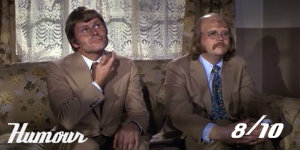
More a comedy than an action-adventure (although the 007 flicks only truly became the latter from 1977’s The Spy Who Loved Me onwards), Diamonds zings with easily the most one-liners, wise-cracks and innuendos of any Bond movie. Some are clever (“I give up; I know the diamonds are in the body, but where?”/ “Alimentary, Dr Leiter”), others saucy (“I tend to notice little things like that, whether a girl’s a blonde or a brunette”/ “And which do you prefer?”/ “Providing the collars and cuffs match…”) and others still are just, well, marvellous (Bond stepping on to Blofeld’s oil rig HQ in the finale: “Good morning, gentlemen: ACME pollution inspection. We’re cleaning up the world, we thought this was a suitable starting point”). A lot of humour‘s also offered by the homicidal homosexuals Wint and Kidd. Some may suggest their presence in this flick strikes a bit of a homophobic line. For me, that’s going a little far; Diamonds is a movie from a very different era. What they definitely sum up is the film’s very black, often successful humour.
.
.
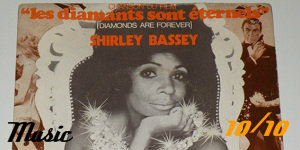
Easily Diamonds‘ most satisfying aspect, its music sees John Barry at very nearly his very best. The tone’s set by the all-time classic Shirley Bassey-performed title song, a dazzling and assertive but rather acidic (listen to its lyrics) anthemic show tune – it may just be the best of La Bassey’s trio of Bond tracks. Taking the Las Vegas-informed, slightly seedy showbiz theme further, other pieces in the score soundtrack scenes as if they’re lounge music playing in the background (Diamonds Are Forever – Source Instrumental; Q’s Trick); there’s something almost satiric about this form of scoring from Barry, perfectly fitting the film’s tone. As a whole, the score’s overtly brassy and overly dramatic (maybe the most of any Bond score – and that’s saying something) and very memorable. Days after watching the flick you’re bound still to have Wint and Kidd’s eerie but damn cool leitmotif (click above image to hear it) stuck in your bonce. And there’s nothing wrong with that. The last of Barry’s ’60s(ish) punchy Bond scores, this is one to savour.
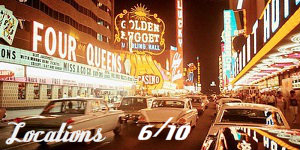
There’s a low-rent Brits-on-a-foreign-weekend-away feel to sending Bond to Amsterdam in the flick’s first half (he even travels on P&O’s ‘cool’ new hydrofoil to get there). Amsterdam’s pretty, but hardly exotic – it’s just not different enough from the UK for that. The (ahem) money shot among Diamonds‘ locations, though, is The ‘Vegas. But this isn’t the faux sophisticated Vegas of Ocean’s Eleven (2001), it’s a Vegas that was in the transition from a Mafia-owned, sparse but cool, Rat Pack-populated entertainment haven to the corporate-backed, gaudy, Times Square-like night-for-day fantasy world it would eventually become. In which case, rather like Diamonds itself, it kind of feels neither one thing nor another; slot machine-packed and crime-filled, but aspirational and glamorous at the same time. It’s the perfect bizarro world in which a perverse Blofeld interpretation should set up camp, I suppose (with the emphasis on camp, obviously).
.

.
There’s some nifty gadgets this time out. The cleverest is either the imitation fingerprints Bond wears for his cover as smuggler Peter Franks – and is able simply to peel off his digits – or the phone-friendly voice alteration device that Blofeld uses to pose as Willard Whyte to underlings. Q sets up an equivalent that Bond uses later to gain intel from his enemy; the latter claiming he ‘made one last Christmas for the kids’. Nice. But the coolest devices 007 uses are the piton gun with which he scales the outside of the Whyte House en route to facing Blofeld in the hotel’s top-floor penthouse and the air balloon thing that floats on water and in which, after dropped from a plane via parachute, he literally walks on water to reach the climax’s oil rig. Also, in his Vegas downtime Q makes the most of one of his own gadgets, an electro-magnetic RPM controller (think 1995’s GoldenEye) that doubles as a ring on one’s finger, with which he’s able to win a fortune on the slots and could have used as a gambit to chat up Tiffany had she not espied Blofeld escaping the casino in drag – that bloody moment’s got so much to answer for…
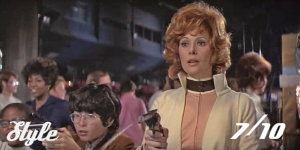
If there’s one word that sums up Diamonds‘ style then it’s ‘sleazy’. With Mankiewicz’s borderline smutty lines (“Tiffany, we’re showing a little more cheek than usual… pity, such lovely cheeks too”) and set-ups (an only-panties-clad Plenty chucked out of a hotel window and into a pool several storeys below: “Hey, what the hell is this, a pervert’s convention?”) and Las Vegas as chief location (‘Circus, Circus’ features, with its mixture of a traditional circus and floor-space filled by slot machines and teens mouthing off when they don’t win prizes on fairground games: “Who’s she, your mother?”/ “Blow up you pants!”), the film was never going to be anything but. This is hardly usual Bond territory, but the series has now entered the ’70s and that decade’s going to be very different to the ’60s; harder-edged, franker and more cynical. Thanks to the Vegas setting and all the US characters, it’s also the first of the ‘American Bond films’ and, again, it’s a very ’70s America – almost the nostalgically naff ’70s of The Towering Inferno (1974) and TV’s Quincy, M.E. (1976-83). Like it or not, the times have changed and Bond’s changed with them.
.
Adjuster: -4
Diamonds Are Forever is an odd beast – on the one hand the sleazy, neon-lit alley cat of the Eon series; on the other arguably as witty and sardonic a cool cat as you’ll see among the Bond films. It has its moments, but perhaps not enough to make up for its loose plot, underwhelming climax and overall lack of quality and substance. And, too often, that vision of Blofeld in drag tends to command attention immediately the movie springs to mind. And that’s hardly a glittering legacy.
.
.
Best bit: Bond scales the outside of The Whyte House
Best line: “Right idea, Mr Bond”/ “But wrong pussy”
.
.
.
.
.
.

.
Directed by: Guy Hamilton; Produced by: Harry Saltzman and Albert R Broccoli; Screenplay by: Tom Mankiewicz – loosely adapted from the Ian Fleming novel (1954); Starring: Roger Moore, Yaphet Kotto, Jane Seymour, Clifton James, David Hedison, Gloria Hendry, Julius W Harris, Geoffrey Holder, Roy Stewart, Bernard Lee, Lois Maxwell, Lon Satton, Arnold Williams, Tommy Lane, Earl Jolly Brown and Madeline Smith; Certificate: PG; Country: UK/ USA; Running time: 121 minutes; Colour; Released: June 27 1973; Worldwide box-office: $161.8m (inflation adjusted: $825.1m ~ 3/24*)
.
.
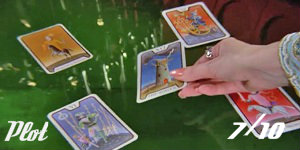
In some ways, Live And Let Die is a very formulaic Bond film; in others, it’s very unusual – and that’s certainly true of its plot. MI6 agents are mysteriously dropping like flies, so 007 visits New York to observe UN HQ-attending Dr Kananga, leader of fictitious Caribbean island San Monique, who may link together the spies’ murders. Our man, though, makes a bee-line for Harlem (having followed a car driven by a would-be assailant), where he’s caught by crime chief Mr Big. Escaping, Bond follows Kananga to San Monique, where a duplicitous CIA contact confesses to the latter’s whereabouts, ensuring 007 drops in and there seduces and ‘kidnaps’ tarot card reader Solitaire. The pair escape to New Orleans and here encounter Mr Big, who steals back the girl and reveals to Bond that he and Kananga are the same man, plus his scheme: to flood the US with free San Moniquian heroin in order to turn swathes of Americans into addicts and monopolise the market. Die‘s copious captures-by- and escapes-from-baddies are familiar Bond fare, of course, but the presence of the Caribbean voodoo cult throughout (whose authenticity is never disproved) lends it a supernatural underscore possessed by no other 007 adventure.
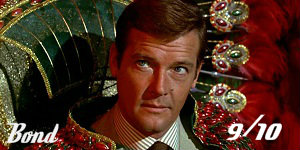
Like Sean Connery’s in Dr No, Roger Moore’s debut as Bond here is confident and solid, but unlike the latter’s it sees a subtle, nuanced evolution of the character through the movie that smartly and smoothly establishes Sir Rog as the new 007. And it’s the film’s unique featuring of voodoo – in particular that cult’s tarot cards – that’s the clever conduit for this. At first, Moore’s Bond is revealed by Solitaire as ‘The Fool’, being easily captured by Mr Big’s goons and looking like a charming British gent out of his depth among the scum of Harlem’s black underworld. By mid-film, however, he’s progressed to become one of ‘The Lovers’, along with Solitaire herself, whom he’s underhandedly but necessarily seduced (and, let’s be honest, she’s not complaining). And if there were a tarot card for ‘The Hero’, then having written-off speedboats, aeroplanes and police cars, jumped across crocodiles, smashed Kananga’s heroin ring and rescued Solitaire for good, that’d be Bond’s calling card come the final reel. Moore plays this development of 007 pitch-perfectly throughout, moving from one stage to the next like he’s been doing it for years.
.
.G
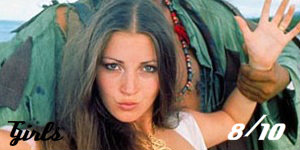
Female characters in early to mid-’70s Bond films were hardly big-screen beacons for the burgeoning women’s lib movement and The ‘Die‘s girls definitely contribute to that trend. Having said that, though, the chief Bond Girl here is one of the all-time best. Not only is Solitaire flamboyant when it comes to her get-up (she’s surely the only character in all Bondom who possesses a costume into which one must sit rather than put on and she wears so much eye-shadow she could keep Clarins going all by herself), she also offers the supernatural dynamic of being able to predict the future, which is nicely used as a narrative driver not a gimmick. Admittedly, when she loses this unique tenet through shagging Bond it rather robs her of an identity, turning her into a damsel in distress, but, hey, them’s the breaks, I guess. Best of all, though, is the fact she’s played by Jane Seymour. Easily one of the most beautiful women to have graced a 007 movie, her plummy tones combine perfectly with her line in innocence then sexual awakening. Die‘s other girls, mind, are either disappointing or predictable (or both): Gloria Hendry’s inept – and treacherous – CIA agent Rosie Carver is annoying (she even gets on Rog’s nerves) and Madeline Smith’s über-buxom Agent Caruso a post-titles titillation, but good fun.
The ‘Die scores big when it comes to villains, but that’s not because of Mr Big. In fact, a cartoonish presence thanks to all the latex make-up, he’s its least impressive. Far better is his ‘real life’ alter ego Dr Kananga, also played by Yaphet Kotto. An often mannered and articulate politico-cum-drug lord, he also shows flashes of sadistic violence (his slapping about Solitaire is particularly distasteful). Pleasingly, Kananga’s double-villain persona ensures that, like Blofeld in Diamonds, he possesses a posse of diverse underlings. Most memorable are Julius W Harris’s Tee Hee, whose hook and claw for an arm and hand secures his place in the pantheon of classic Bond henchmen, and Geoffrey Holder’s ambiguous Baron Samedi, the symbolic demi-god that heads the voodoo cult behind which Kananga hides his opium empire (is he really undead or just a warped performer fit for Covent Garden?). There’s also Arnold Williams’ loquacious taxi driver and Earl Jolly Brown’s gentle giant Whisper. As to the murmurs that all the villains being black amounts to casual racism, for me when characters are drawn this well that amounts to bunkum.
.


.
Action-wise, The ‘Die does the business with bells on. The tone’s set with the moment Roger Moore officially arrives as James Bond… holding on to an NYC building’s fire-escape ladder, he swings towards a goon and incredibly coolly kicks him, crashing his feet into his chest. While wearing an awesome three-quarter-length black coat and gloves. Oh yes. Like that moment, almost all the action in the movie is damn cool. Take the speedboat chase, a 15-minute action-film-within-an-action film that, with its own cast of characters and narrative, could stand on its own outside the movie. Er, maybe. It’s clear that after filming the sequence for weeks, director Guy Hamilton and his editors realised they had such good stuff they decided to include as much as the audience would feasibly take of it. There’s also the crocodile jump, of course; arguably the coolest moment in the movie – and one of the most memorable of all Bondom – and performed by fearless crocodile farm owner Ross Kananga (to whom the filmmakers were so grateful they named the villain after him). Plus, there’s the split climax too, featuring Bond besting Kananga in his lair, Tee Hee on the train afterwards and Samedi at the sacrifice ceremony ( – or does he…?).
For the most part, the humour in Die is a great success. However, there’s one exception. Clifton James’ incompetent redneck Sheriff Pepper would be an odd addition in any Bond film (just watch 1974’s The Man With The Golden Gun), but given his appearance here is during the Louisiana Bayou-set speedboat chase, it does make sense. The problem comes in his cacophony of casually racist remarks. Bandying about phrases like ‘black Russians’ and ‘boy’ at black baddies like they’re going out of fashion (sadly I doubt they were in ’73), he makes for an awkward watch today. The redemption of his inclusion, though, is the fact the joke’s always on him. Elsewhere, however, The ‘Die certainly hits the comic spot – and most of it inevitably involves new Bond Moore. Whether he’s over-complicating the making of a coffee for M (“Is that all it does?”), undoing a dolly bird’s dress with his magnetic watch (“Sheer magnetism, darling”) or, best of all, admitting to Solitaire he more or less seduced her (“The deck was slightly stacked in my favour”), he’s a triumph. As is the featuring of the is-he-or-isn’t-he-dead? Baron Samedi on the front of 007 and Solitaire’s train in the flick’s final shot – one of the series’ best winks at the audience that.
.

.
Musically, The ‘Die is unique on two counts – it’s the first Bond film in a decade not to be scored by John Barry and the only one whose score embraces funk. Taking Barry’s place, Beatles producer George Martin savvily doesn’t try to emulate him, but riskily ‘updates’ the Bond sound, unashamedly bolting it to early ’70s urban Americana by, yup, turning to funk. A canny musical experimenter, though, Martin does a bang-up job. Take this flick’s version of The James Bond Theme (click above image to hear it); it’s transformed from Barry’s eerie, tight arrangement into a swaggering show-boater, just as cool as before but now fitting for James Brown to add customary ‘huh!’s throughout. Just as impressive – and arguably more important – is the title theme, Paul McCartney And Wings’ utterly bombastic effort that very nearly topped the US charts, received an Oscar nom and is still a mainstay of Macca’s concerts today. The first rock track to grace a Bond film, its bass riff is utterly irresistible and features prominently throughout the score too.
With all of its locations to be found in North and Central America, Die is unquestionably the second of the series’ four ‘American Bond films’. But this is no bad thing. How could it be when New York’s Manhattan is – surprisingly? – more like that of The French Connection (1971) than, say, Breakfast At Tiffany’s (1961), eschewing any real or faux Bondian glamour for a more down-at-heel early ’70s milieu? Similarly, San Monique (or Jamaica as it actually is on-screen) is arguably more poppy fields, voodoo-afflicted graveyards and backwaters featuring clapped-out and roof-losing London buses than the bopping and beautiful island encountered by Bond in Dr No. By contrast, though, New Orleans is shown as the relaxed party town its reputation purports, with the colour and break-out celebration of jazz funerals filling in for Mardi Gras. The only non-American locale is actually a set, Bond’s Chelsea flat. Yet its wood-pannelled elegance sort of shattered by its bed seemingly the centre of attention and Sir Rog’s Bond walking around in a cream dressing gown with the ego-massaging ‘JB’ initials emblazoned on the breast pocket are together the height of interior and sartorial design for this particular Bond fan. So shoot me.
.


.
That classic Bond film trope, watches as scrape-escaping gadgets, starts here. Bond’s Rolex Submariner has two awesome functions, in addition to telling the time, of course. First, it becomes an incredibly powerful electro-magnet, supposedly capable of deflecting fired bullets and demonstrably capable of opening ladies’ zipped-up dresses. And, second, its face becomes a buzz-saw, helpful if one gets tied up to a winch above a shark-infested pool in a villain’s lair. Bond also packs a pocket-sized bug detector and a Morse code transmitter doubling as a hairbrush. The villains too get their fair share of cool gadgets: the office chair with its flip-up wrist-holds to keep Bond captive, Samedi’s flute-cum-communicator and the San Moniquian scarecrows with their video-camera eyes and bullet-firing mouths. Plus, lest we forget, there’s also that compressed air pellet from Bond’s shark gun that finishes off Kananga – ridiculous but brilliant.
As is rightly claimed so often, The ‘Die takes a cue from US cinema’s early ’70s ‘blaxpoitation’ phenomenon. Its first third’s landscape of unapologetically assertive black characters on both sides (don’t forget Lon Satton’s CIA agent Strutter) of New York’s urban crime divide is very Shaft. Indeed, black faces are everywhere throughout (so much so that Roger Moore and Jane Seymour’s very white mugs often make for a stark contrast – “It’s like following a cue-ball!”). Without a paradisical European or Asian locale, it’s Die‘s ‘blackness’ that provides its exoticism; Maurice Binder’s titles are chock-full of beautiful black lovelies, Kananga and his goons are unavoidable and the garishly exuberant song-and-dance funerals of New Orleans demand attention. Also, in keeping with the death theme prompted by the flick’s punning title and the voodoo cult, the blood and danger colour that is red features strongly, what with Binder’s titles awash with it (and fiery flames) and interiors of the Fillet Of Soul restaurants and Mr Big’s HQ and the suits of Big himself and Tee Hee all featuring bold red tints. Even the dial of Bond’s watch turns red when it becomes operationally magnetic. This 007 outing may feature none of the refined ’60s style of earlier efforts, but hits a funky, bouncy, very ’70s yet timeless beat all of its own.
.
Adjuster: -2
Thanks to one or two narrative and character mis-steps, Sir Rog’s 007 debut isn’t a perfect film, but it’s surely one of the best recalled Bond films. That speedboat chase; that crocodile jump; those tarot cards; all those villains; Macca’s pumping title tune; Baron Samedi; Jane Seymour and, of course, Roger Moore and his buzz-saw-cum-electro-magnet timepiece. Very few Eon efforts offer this much Bondian iconography – and thus this much entertainment. To paraphrase Mr Big, names may be for tombstones, er, baby, but Live And Let Die is forever.
.
.
Best Bit: the speedboat chase
Best line: “Is there time before we leave for lesson number three?”/ “Absolutely. There’s no sense in going off half-cocked”
.
Read why Live And Let Die is one of the ultimate movies of the 1970s here
.
.
.
.
.
.

.
Directed by: Guy Hamilton; Produced by: Harry Saltzman and Albert R Broccoli; Screenplay by: Richard Maibaum and Tom Mankiewicz – loosely adapted from the Ian Fleming novel (1965); Starring: Roger Moore, Christopher Lee, Britt Ekland, Maud Adams, Hervé Villechaize, Clifton James, Richard Loo, Soon-Taik Oh, Marc Lawrence, Bernard Lee, Desmond Llewelyn, Lois Maxwell, Marne Maitland and Carmen du Sautoy; Certificate: PG; Country: UK/ USA; Running time: 125 minutes; Colour; Released: December 19 1974; Worldwide box-office: $97.6m (inflation adjusted: $448.2m ~ 17/24*)
.

.
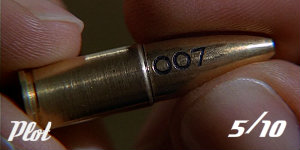
Looking to capitalise on The ‘Die‘s serious box-office success, Broccoli and Saltzman rushed The Man With The Golden Gun into production; but it didn’t pay off, not least in terms of its plot. A golden bullet engraved with ‘007’ has been sent to MI6. In the belief it may be a warning/ boast that he’s the target of an unknown hitman, Bond’s relieved of his duties (pursuing a scientist who’s invented the Solex, a device that’ll prevent an impending energy crisis) to track down his would-be killer. He learns the bullet was made by a bespoke weapons expert, whom leads our hero to his client’s mistress Andrea Anders. Confronting her in Hong Kong, 007 learns her keeper is assassin Francisco Scaramanga – and she sent Bond the bullet so he’d find and free her. With the aid of local MI6 agent Mary Goodnight, 007 discovers his potential foe and big shot Thai businessman Hai Fat have stolen the energy device. Eventually, Scaramanga kills both Hai Fat and Andrea and kidnaps Goodnight, forcing Bond to fly to his island hideaway for a climactic showdown and to retrieve Goodnight and the Solex. Hampered by a ’70s depressing ‘energy crisis’ sub-plot, this intriguing if slight Western-style gunman-versus-gunman narrative just isn’t gilt-edged.
Their second Bond film is all about consolidation for a 007 actor and Roger Moore achieves this consolidation – with a caveat. The seeds of the Moore Bond were sown in The ‘Die and they begin to blossom here: the playfulness that characterises his ability as Britain’s best secret agent, his unbridled appeal to the opposite sex, his ludicrously wide knowledge and quick mind and, perhaps because of all that, his arrogance. Yet there’s also big signs that this 007 is still in its genesis, for both he and the filmmakers are experimenting. Take the scene in which Bond threatens and semi-tortures a just-out-of-the-shower Andrea Anders to get close to Scaramanga. Sure, at this point, 007 may be desperate to find his potential murderer before he finds him, but the sight of Sir Rog slapping about an innocent woman just doesn’t sit right; Connery may have got away with it – now and again – but Moore really is ‘too nice’ for it to work. Tellingly, this Bond would only use women again after a consensually enjoyed bonk and a charming wink.
.

.
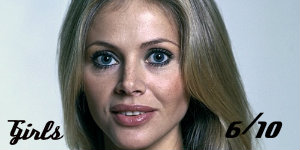
On the one hand, Golden Gun‘s girls are firecrackers; on the other, they’re like lighters going out in the wind. Their biggest plus is the fact they’re gorgeous. Britt Ekland’s Mary Goodnight is a sunshine blonde with a slightly wonky Brit (really Swedish) accent and Maud Adams’ Andrea Anders is a beautiful brunette with more than a wing down. However, they’re both poorly drawn. Although Andrea’s melancholic ‘sacrifical lamb’ is finely played and more than a little engaging, the script invests little in her character; it’s moving when she’s killed, but shouldn’t we care about her more? Worse, Goodnight is surely the wettest, most incompetent Bond Girl in the series thus far (if not of all-time). Her uselessness is supposed to be a gag, of course, and Ekland’s very game, but it’s a gag that gets tired very quickly. Plus, doesn’t Bond need someone not just attractive but witty, spunky and at least interesting to bounce off – instead of a girl whose ultimate aim is to bounce with him under the sheets? There’s also Carmen du Sautoy’s Beirut belly dancer Saida and Françoise Therry’s in-the-nuddy (and thus pretty sexist) Chew Mee – both are window dressing.
Golden Gun‘s villains are easily its best aspect. Together, Christopher Lee’s assassin Francisco Scaramanga and Hervé Villechaize’s henchman Nick Nack shouldn’t work, but this improbable, bizarre duo (by happy accident or genius filmmaking) totally works. Scaramanga is everything a Bond villain should be. Tall, dignifed, sadistic and genuinely menacing, he ensures the film’s always better when he’s on-screen. Cleverly too, he’s presented (especially by himself) as the absolute negative of 007; a sort of Bond gone very wrong. And Lee’s such a dab-hand at making screen villains quality villains, he leaves you in no doubt of the character’s motives, vanity, weaknesses and evil. Nick Nack too is a fine little invention. A manservant as much as he is a henchman (unlikely as it may be he’s also a cordon bleu chef), this vertically challenged baddie is so deliciously, impishly naughty it’s only right he’s caged up rather than bumped off at the end – it’d be too cruel to send him to his maker. Marc Lawrence’s pre-titles gangster and Richard Loo’s Hai Fat round out the villains, but neither come close to the main two; the latter because he’s a bit rubbish and the former because, well, he’s apparently called Rodney. Yes, really.
.

.
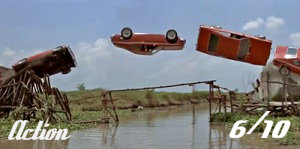
Tonally, Golden Gun has problems. And this is certainly the case with its action. Too many of these sequences are played for laughs and, falling between two stools, end up neither as adrenalin-inducing or as funny as they should. The chief offender is the Bangkok-set car chase between Bond’s AMC Hornet and Scaramanga’s Datsun. Although decent action-wise, it’s hampered by Louisiana’s loutish cop JW Pepper, returning from The ‘Die. Humour-free (more on that below), Pepper’s sidekick role to Bond here is ill-advised, yet the ‘funnies’ continue as the money-shot stunt that’s the ‘Astro Spiral’ jump over the broken bridge performed by the Hornet (truly extraordinary for its day) is pretty much ruined by a slide-whistle as it twists through the air. In a similar vein is Bond’s encounter with two sumos at Hai Fat’s house, one of whom he bests by twisting his mawashi (and presumably crushing the poor chap’s privates) and, even worse, when it all goes kung-fu mid-film and 007 has to be aided in beating up crap martial artists by local ally Lieutenant Hip’s karate-savvy teenage nieces. That has to be one of Bondom’s biggest lows, right there. Things are salvaged, though, by Bond and Scaramanga’s High Noon-like showdown at the end. Genuinely tense and cannily crafted, it’s easily the flick’s best sequence.
For the reasons mentioned above – and others – Golden Gun‘s humour is not a great success. The biggest mis-step is definitely the (let’s be honest) unwelcome return of Pepper. If you find him just about tolerable in The ‘Die, then you’ll be sorely tested here; there’s only so many shouts at ‘poonyheads’ in ‘pu-jamas’ anyone can take surely – and Pepper getting dumped in a river by an elephant surely isn’t punishment enough for his infecting vacation of Thailand. On a brighter note, this flick does boast Sir Rog on decent form, of course (“I am now aiming directly at your groin, so speak or forever hold your piece”) and the diminutive but definitely amusing Nick Nack. Ultimately, though, Golden Gun‘s comic credentials just don’t cut the mustard enough.
.

.
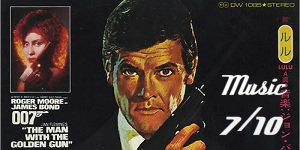
Despite his reliance on slide-whistles and tacky saxophones to sign-post ‘sexy’ moments, John Barry (back after a one-film sabbatical) does a decent job with Golden Gun‘s music. Mind you, it’s far from his best of the series; being several notches down in terms of imagination from his effort for Diamonds – there’s nowhere near the same number of memorable themes and cues. But that does fit with the lack of imagination on-screen, so if Barry was less enthused to do the business here given what he was actually scoring, then it’s understandable. All the same, though, replacing the punchy brass with luscious strings when repeating Lulu’s raunchy title theme throughout the film (Goodnight Goodnight – click on above image to hear it) adds an almost melancholic grandeur to some scenes and both Hip’s Trip and the finale-accompanying Return To Scaramanga’s Fun House are fine examples of flavoursome, tension-building scoring.
Seven years after You Only Live Twice, Bond’s back in the Far East. But this time the exoticism of South East Asia lacks something. Contrasted with the cool modernity of ’60s Tokyo and the beauty of Japan’s volcanic islands, as featured in Twice, the locations that are Hong Kong (briefly visited in the latter movie anyway) and Thailand’s Bangkok feel rather low-rent. Perhaps it’s because of Bangkok’s seedy reputation and/ or because of this flick’s sleazy script and drop in artistry? Whatever the reason, Thailand’s a locale the producers hope would look exotic and beautiful, but oddly ends up looking drab and predictable. Despite that, though, its use is redeemed somewhat by the climax taking place on an island near Phuket (now known in real life as ‘James Bond Island’ – bloody tourists!). Genuinely a place of great beauty, it’s unforgettable thanks to its iconic mushroom-shaped rock – an ideal setting then for a Bond film finale.
.


.
The less satisfying 007 flicks are often helped out by their physical accoutrements (be they their vehicles, sets or gadgets), but on the gadget front, at least, Golden Gun is left wanting as much as it is in other areas. Yes, the movie’s major gadget, the golden gun itself, is an absolute doozy. Swiftly assembled from ‘everyday’ solid gold items (a fountain pen, a cigarette case, a cigarette lighter and cufflinks), this pistol is a very cool if ludicrous piece of kit that’s more memorable than much of the rest of its film’s content. However, it’s a gadget used by the villain, not Bond himself (readers of my ’60s Bond film reviews may recall that, gadget-wise, Eon efforts whose best nifty items are handed out to their villains not Bond are a bit of a bête noire for me). So what does our hero get supplied with then? A fake triple nipple to con Hai Fat into thinking he’s the villain of the piece. In the words of Bond: kinky, but also crap. Oh, and there’s the movie’s sort-of macguffin, the pocket-sized Solex Agitator thing (which harnesses solar energy to power nuclear reactors that generate electricity), but it’s so dull it’s pretty much instantly forgettable.
If Diamonds‘ style is that of sleazy early ’70s Americana, then Golden Gun‘s is that of sleazy early ’70s Britain – even though it’s pretty much entirely set in South East Asia (mind, Hong Kong was very much still a UK territory). Its production values probably weren’t, but they feel cheap and rather tacky, its humour is at best bawdy, at worse smutty and the general atmos, look and tone is more akin to that of the Carry On movies made around then than to many of the previous Bonds. There’s a depressed feel to Golden Gun. The ’70s Britain represented here is one reminiscent of strikes, decay and disappointment – there’s an energy crisis looming, everybody’s angry with each other (especially within MI6), attractive women are dolly birds and browns and bronzes abound everywhere (from the interiors of half-sunk boats serving as MI6’s on-the-fly HQs to one too many offerings from the costume department). And while that sprightly vanguard of ’70s pop culture, kung-fu, turns up, it’s played for laughs and wasted. Phuyuck, indeed.
.
Adjuster: 0
I’ve read somewhere that The Man With The Golden Gun is the ‘artistic nadir’ of the Bond film series – let’s be honest, it’s certainly up (or, rather, down) there. The result of a rushed pre-production, a relationship between Broccoli and Saltzman that was becoming increasingly fractious and perhaps the 007 movie locomotive running out of steam just before it hit double figures, this effort, unlike Scaramanga’s ridiculous car-plane, just never really gets off the ground.
.

.
Best bit: Bond and Scaramanga’s showdown
Best line: “I like a girl in a bikini – no concealed weapons”
.
.
.
.
.
.
.
Directed by: Lewis Gilbert; Produced by: Albert R Broccoli; Screenplay by: Richard Maibaum and Christopher Wood – title taken from the Ian Fleming novel (1962); Starring: Roger Moore, Barbara Bach, Curt Jurgens, Richard Kiel, Caroline Munro, Walter Gotell, Bernard Lee, Desmond Llewelyn, Geoffrey Keen, Lois Maxwell, Shane Rimmer, Valerie Leon, Michael Billington, Olga Bisera, Edward de Souza, Vernon Dobtcheff, Nadim Sawalha and Bryan Marshall; Certificate: PG; Country: UK/ USA; Running time: 125 minutes; Colour; Released: July 7 1977; Worldwide box-office: $185.4m (inflation adjusted: $692.7m ~ 5/24*)
.
.
The big-screen Bond took a three-year sabbatical after Golden Gun‘s arguable debacle. When it was finally back with The Spy Who Loved Me, thanks to the now flying-solo Broccoli it was bigger than ever before – not least the flick’s plot. A pair of British and Russian nuclear submarines have gone missing, so both MI6 and the KGB assign their top agents – 007 for Blighty and XXX (Major Anya Amasova) for the Ruskkies – to recover a microfilm of a missile-tracking system’s plans. Separately, the agents trace the macguffin to Egypt, where inevitably their paths cross. Having recovered it, together they’re ordered to pursue a lead from its otherwise useless contents – marine biologist Karl Stromberg. Now lovers, they meet the reclusive tycoon in Sardinia and find he’s built an enormous super-tanker that looks capable of containing concealed submarines. Boarding an American sub just before the vessel’s swallowed by the super-tanker, 007 and XXX (now at loggerheads as the latter’s discovered the former killed her previous lover) learn of Stromberg’s scheme: destroy the decadent modern world with the subs’ nuclear arsenal and replace it with a utopia beneath the waves. Admirably ambitious fantasy fare, this plot also boasts a refreshing and engaging East-falls-in-and-out-of-love-with-West element.
No question, it’s here that Roger Moore comes of age as Bond. He makes the role his own, stamping the Sir Rog brand all over it. What’s so good about Moore’s performance is it fits the film around it perfectly. Helmer Lewis Gilbert has said he directed his star as a romantic adventure lead, with more than a knack for light comedy, like Cary Grant. Canny? Not much. Like before, Rog is charismatic, charming and light on his feet with the witticisms and action; only even more so. There’s a palpable increased confidence in his essaying the role; he’s more relaxed, smoother and funnier. Thanks too to a scene in which his dramatic acting is given an impressive work-out (where 007 admits to killing XXX’s paramour in the name of duty), audiences as they exited cinemas come the movie’s end may well have been asking themselves: ‘Sean who…?’
.
.
Poor old Mrs Ringo Starr. From some Bond fans she gets it in the neck for her Ruskkie spy Anya Amasova – and it’s such a lovely neck too. Yet, as Bond Girls go, Barbara Bach’s XXX isn’t among the worst; there’s much about her that’s very good. A renowned secret agent, Anya’s cool and calculated, resourceful and resilient, sure-footed and self-reliant (sure, eventually she becomes a damsel-in-distress, but she is a ’70s Bond Girl and none of her ilk have ever been – nor probably ever should be – Bond’s match, apart from perhaps the unique Tracy of Majesty’s). She’s also, of course, stunning to look at, which doesn’t hurt, portrayed as she is by the ravishing former model Ms Bach, whose look – highly defined cheekbones and all – and demeanour make up for her slightly blunt line delivery. Spy also boasts femme fatale Naomi, a hottie who’s a helicopter pilot-cum-killer played by classic Brit crumpet Caroline Munro. Another UK totty favourite Valerie Leon appears as an über-flirtatious Sardinian hotel receptionist, while further eye-candy features in pre-title ski lodges and Egyptian bedouin tents. Just like in real life then.
To be fair, Spy‘s chief baddie isn’t its greatest strength. Stromberg’s a sedentary give-orders-and-push-buttons sort of guy, not surprising given his portrayer Curt Jurgens is carrying quite the paunch. And yet, Jurgens does lend him a disconcerting other-worldliness that surely an ocean-obsessed nutter like Strommers would possess. Much more memorable is Jaws, his titan of a silent assassin with the razor-sharp steel molars, played by gentle giant Richard Kiel. Seven feet and four inches of henchman goodness (or rather badness), Jaws is an all-time icon of Bond. Mostly a light-hearted presence, admittedly (his scenes alongside 007 and XXX at Karnak and in the shark pen are marvellous), he nonetheless offers genuine menace, owing to his physical presence, his penchant for killing victims by biting their jugulars and the fact he appears to be indestructible. There’s also his baldy protégé Sandor (Milton Reid), the Liparus’s put-upon captain (Sydney Tafler) and Anya’s Bond-offed spy lover Sergei Barsov (one-time possible 007 Michael Billington), but frankly, in Spy all the other villains play second fiddle to Jaws.
.

.
Its action is one of Spy‘s many aspects where it’s bigger than any previous Eon effort. Most impressive is the explosive ending. Like he had for Twice, Lewis Gilbert concludes things with a big brilliant battle featuring a Bond-led army versus the villain’s private army. 007 commands the combined UK, US and USSR sub crews trying to wrestle control of the Liparus from Stromberg’s red boiler-suited minions. Sub-machine gunfire is traded, grenades thrown, mini mokes crashed and nuclear warheads dangerously plundered for their explosive charges. It’s a cracking WWII movie climax unexpectedly transposed to the world of Bond. Although much of Spy‘s other action is humour-filled, it’s all top stuff: hand-to-hand scrapes (on a rooftop against Sandor and on a train against Jaws) and vehicular chases (both on-road and underwater in the Lotus Esprit, where it’s pursued by a helicopter, a three-man submersible and, best of all, a motorcycle with a missile for a sidecar). The flick’s best chase, however, is the pre-title ski-bound one. All right, it’s really all about its ending: that dive off the edge of the cliff before Bond’s double, the insanely brave mountaineer Rick Sylvester, opens his parachute emblazoned with a Union Jack to drift down to safety below. Undoubtedly applause-worthy to this day.
As noted, Spy‘s action is peppered with humour. Yet, unlike in Golden Gun, this humour complements the action. That’s not to suggest much of the film’s comedy isn’t bawdy (hey, this is a Sir Rog movie), but it’s not the near-smut of Golden Gun. It’s also witty (girl and Bond, pre-coital: “Oh James, I cannot find the words”/ “Well, let me try and enlarge your vocabulary”; Bond and girl discovered post-coital: “Bond, what do you think you’re doing?!”/ “Keeping the British end up, sir”). Jaws’s presence too turns several scenes comic, yet the slapstick never goes OTT and is always funny (Jaws is encouraged by Bond to get his steel teeth stuck to an electro-magnet: “How does that grab you?”). But perhaps why Spy‘s humour works so well – on top of the amusing script and knowing direction – is Moore himself; his comfort in the role ensures the comedy washes over us, plus he even made contributions himself (he ad-libbed both the ‘Egyptian builders’ line and holding the fish out the Lotus’s window as it emerges from the sea). Pure class.
.
.
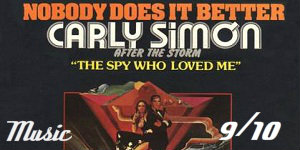
Setting a miss-every-other-Bond-film pattern (which began with The ‘Die and would carry on until the early ’80s), John Barry sat out Spy, allowing white-hot American composer Marvin Hamlisch to step in. Coming off triple-Oscar success for The Sting and The Way We Were (both 1973), Hamlisch succeeded in courting the Academy – and the mass public – again with Spy‘s music, most specifically his title theme Nobody Does It Better (lyrics written by Carole Bayer-Sager). Rightly a pop standard and one of the most popular tunes of the Bond canon, the Carly Simon-sung tune was then a bit of a departure for 007, its smooth, melodic femininity far from what Barry would have delivered, but it’s awesome and works a treat. Barry too would surely have scoffed at Hamlisch’s approach to other of the movie’s music – yes, we’re talking disco, folks. At worse dating the movie a little, at best adding it a unique charm, it ensures Spy‘s score is unmistakably a ’70s piece. Most obvious is Bond ’77, Hamlisch’s take on the Bond Theme with its driving disco rhythm, and the ebullient Ride To Atlantis (click on image above to hear it). Yet much of the rest of the score is more orchestral and Barry-esque, such as Jaws Attacks (featured in the Karnak sequence) and the Liparus-set finale’s bombastic themes and cues. It also goes all ethnic in the marvellous Mojave Club to be heard, yes, in Cairo’s Mojave Club.
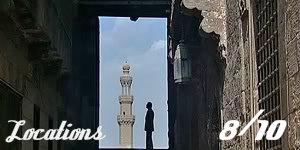
Locations-wise, Spy‘s a bit of a departure. Yes, there’s the exoticism and the sun-kissed beaches of former Eon efforts, but this time the former’s offered by North African ancient sites and the latter by a small island off the coast of Italy. Yet Egypt’s Giza pyramids, Karnak/ Luxor ruins and boat-ride up the Nile, and Sardinia’s family-friendly but rather exclusive seeming sands work a treat. Of the two, Egypt is Spy‘s most boast-worthy locale and the filmmakers make sure we see some of the urbanity of Cairo too – all dusty narrow streets, minarets and dinky, overly cushioned flats – lending the film’s first third a conceivable, almost down-at-heel espionage atmos. Uniquely, the last third of the flick all takes place at sea; supposedly the Atlantic, but mostly filmed off the coast of the Bahamas. Plus, lest we forget, there’s the snowy climes of the pre-titles, which isn’t Austria but actually Switzerland’s Graubünden and Canada’s Mount Asgard.
.

.
Even without the Lotus Esprit, Spy would score decently in the gadgets department. There’s the wetbike that marks the world’s first glimpse of that semi-seafaring vehicle, the firing ski-pole with which 007 dispatches Barsov, the fag case and lighter combo that allows him to examine the microfilm’s contents, Anya’s sleeping drug-spreading cigarette and, best of all, Bond’s Seiko watch that spools a ticker-tape message from Moneypenny (strange, my ’80s digital watches never came with that accompaniment – could have allowed Mum to inform me when to race home on my BMX for dinner). Ultimately, though, the highest plaudits go to the Lotus. Sleek, white and angular ’70s car design at its best, the vehicle’s transformation into a submersible is a flight – or rather dive – of fantasy, but works because it looks sort of credible. With fins instead of wheels, harpoon guns rising from the bonnet, a paint/ oil slick from behind the back number plate, a periscope and an air-to-air missile, it’s ideal transport for a superspy doing underwater reconnaissance – if only it didn’t develop leaks that let in little fish. Ah well, what can you do?
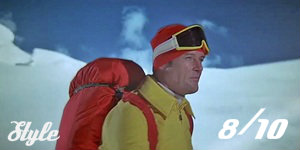
Spy is a very ’70s Bond film: disco additions to the ‘Bond sound’, trouser legs with flare-points so sharpened they’ll have your eye out, Sir Rog’s very smart apparel effectively featuring a ‘safari suit’ jacket and his look-it’s-me-James-Bond! banana-yellow skiing togs. Yet, this flick’s style isn’t foremost remembered as a display of dubious sartorial design and pop stylings. It’s more rightly recalled for high production values. For surely it’s set designer Ken Adam who aids Broccoli most in realising his ‘bigger than ever before’ maxim thanks to building an enormous water-filled stage at Pinewood Studios (the ‘Albert R Broccoli 007 Stage’ as it’s now known). It houses the Liparus set, the movie’s tour de force that’s literally every inch as impressive as Adam’s volcano set for Twice. Overall, Sir Ken’s big design work is full of silver metallic surfaces, aiding to translate Spy‘s aim to present a dynamic Britain ably punching above its weight once more with not just the awesomeness of 007, but also a rather awesome navy. Even Maurice Binder’s titles get in on the act, flourishing Union Jacks and reds, whites and blues as the dads in the audience eye up naked acrobats swinging on pistol barrels. Inspirational stuff, all round then.
.
Adjuster: 0
Yes, The Spy Who Loved Me is a greatest hits package of a Bond film, but when the hits are this great, who cares? Its fantasy may get a tad silly, but it’s entertainment’s very hard to top. Like this year, 1977 was one of big British celebration (the Sex Pistols aside) and, don’t doubt it, alongside Her Maj’s silver jubilee, Spy was a golden Eon offering to Blighty – and the world.
.

.
Best bit: The Union Jack parachute jump
Best line: “But James, I need you!”/ “So does England!”
.
.
.
.
.
.

.
Directed by: Lewis Gilbert; Produced by: Albert R Broccoli; Screenplay by: Christopher Wood – title and other elements taken from the Ian Fleming novel (1955); Starring: Roger Moore, Lois Chiles, Michael Lonsdale, Richard Kiel, Corinne Clery, Toshiro Suga, Bernard Lee, Desmond Llewelyn, Lois Maxwell, Blanche Ravalec, Emily Bolton, Walter Gotell, Michael Marshall, Anne Lonberg and Irka Bochenko; Certificate: PG; Country: UK/ USA/ France; Running time: 126 minutes; Colour; Released: June 26 1979; ; Worldwide box-office: $210.3m (inflation adjusted: $655.9m ~ 7/24*)
.

.
Moonraker takes Bond further than ever before – in terms of plot and everything else. After a ‘Moonraker’ space shuttle is hijacked while on loan from the US space programme to the UK, 007 visits its California-based billionaire manufacturer Hugo Drax. As soon as he meets him, though, he suspects a rat (the eerie tycoon himself) and is shown around Drax’s complex by a female trained astronaut, Dr Holly Goodhead. He then follows a lead to a Venetian glassworks where he discovers the creation of a gas lethal to humans, but harmless to all other living things. Yet Drax clears out this operation before Bond’s superiors arrive. Given the cold shoulder then, 007 travels to Rio on a hunch where he again encounters Dr Goodhead, after having learnt in Venice she’s a CIA agent ordered to monitor Drax. Goodhead is soon kidnapped, so 007 follows his only remaining lead: the source of the gas (a sample of which he purloined in Venice), an orchid from the Tapirapé river in Brazil. In an Incan pyramid there he finds Drax holding Goodhead, but also launching shuttles to an Earth-orbiting space station from which he’ll repopulate the globe with ‘perfect’ human specimens after wiping out the rest of its decadent population with his gas. With no alternative, Bond and Goodhead steal one of the shuttles and follow Drax into space… Pure nonsense from start to finish, Moonraker’s narrative is really a space-themed retread of Spy‘s.
Roger Moore claims his favourite Eon effort is Spy, but it’s this flick in which he appears to be having the most fun. So cannily does he play Bond here, he almost glides above the sometimes ridiculous action going on, as if he’s some sort of eyebrow raising, innuendo-dropping, happily shagging dandy angel sent down to earth – and to Drax’s stud-farm in space – to save all the silly humans incapable of saving themselves. With irresistible knowing, he’s our guide through the wonderfully glamorous, OTT world of Moonraker, never taking any situation too seriously nor holding a grudge for any attempt on his life from ‘old friend’ Jaws so long as he can deliver a wisecrack afterwards. A few years earlier, Roy Wood sang he wish it could be Christmas everyday; I wish I could be Sir Rog’s 007 in Moonraker everyday. Quite frankly, who doesn’t?
.

.
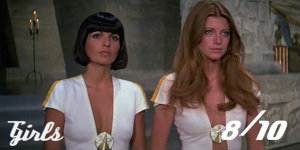
Looks-wise, many would claim Thunderball‘s the Bond movie with the best girls, but I’d argue it’s Moonraker. Mind you, The ‘Raker‘s female lead may be the overall best of the ’70s cinematic 007. Lois Chiles’ Dr Holly Goodhead (despite her innuneduous name) is the first proper instance of feminism finding Eon’s Bond. A CIA operative and trained astronaut, she matches Bond’s smarts and wit. Plus, although 007 technically rescues her, without her ability to fly a space shuttle he wouldn’t get to and from Drax’s space station. She looks damn good too, naturally. Even better looking is Corinne Clery’s ‘sacrificial lamb’ Corrine Dufour, whom may lack brains, but out of a sense of morality, not just Bond’s charms, she helps out our hero. And don’t forget Blanche Ravalec’s Dolly, Jaws’s dinky but lovely love-interest, and Emily Bolton’s Rio MI6 hottie Manuela. But what propels Moonraker into the Bond totty stratosphere (in addition to the other four) is the presence of the Eves with whom Drax aims to mate his Adams to repopulate Earth. Who are they? Irka Bochenko, Françoise Gayat, Christina Hui, Chichinou Kaeppler, Beatrice Libert, Nicaise Jean Louis, Anne Lonnberg and Catherine Serre. Their names’ll mean little to you no doubt, but if you’re a heterosexual male, their appearances’ll surely mean a great deal.
You make think that with its chief baddie’s bananas scheme and a return of the buffoonery of Spy‘s Jaws (that really can’t end well, right?), Moonraker would be embarrassing when it comes to villains, but it’s anything but. Hugo Drax is cut from that same cultured, witty, deluded cloth as Dr No and Blofeld (quite literally too when it comes to the nehru jackets), French actor Michael Lonsdale investing him with an impressively eerie je ne sais quois. His first henchman is also eerie and handy with a kendo sword, being portayed by Toshiro Suga (whom won his role as he was executive producer Michael G Wilson’s judo instructor). And then, of course, there’s Jaws. A bone of contention in Moonraker mostly for his cable car crash and subsequent instant romance with Dolly, the ‘loveable’ lofty’s something of a most with me. His switch from killer to hero is a twist you genuinely don’t see coming – at least if you were eight when you first saw this flick – and somehow after all these years it still works for me. Plus, although ludicrous, his champagne moment with Dolly tugs at the heartstrings. But hey, I love The Muppets too, so, well, you know…
.

.
Weirdly (or perhaps fittingly?) Moonraker’s action shows it at both its best and worse. In the credit column are the utterly done-for-real pre-title’s skydiving scrap and leaping about on the Rio cable car (to be seen in long shots). Ironically, though, in the debit column are the sequences in which these death-defying stunts feature. The trouble is they’re played for laughs, so much so they seem to aim for an audience of twelve-year-olds; a real shame given the staggering stuntwork involved. Less contentiously successful, though, are 007 and Chang’s fisticuffs in the Venetian glassworks and the Tapirapé river battle between Bond’s gadget-laden Glastron and Drax’s minions’ boats (at least before the former turns into a hand glider and one of the latter, complete with Jaws, goes over a waterfall). More ridiculous is the chase through Venice’s canals involving the ‘Bondola’ (the gondola-cum-speedboat), especially when the it mounts St. Mark’s Square as a hovercraft, plus the laser-fest finale as astronauts and Drax-onauts duke it out for control of the universe… or something. Mind you, the flight into space by the shuttles and the ‘That’s-no-moon’-esque revealing of the space station are truly something else. As is arguably the flick’s only tension-filled bits: Bond being tortured/ nearly killed in the G-Force simulator and he and Holly hunting down Drax’s gas-carrying globes come the finish.
Like Diamonds, Moonraker is very much a comedy of a Bond film, but like Golden Gun its humour definitely lets it down. Despite some good comic moments (most of Bond and Holly’s by-play; Jaws passing through airport security and 007 inspecting his enormous Rio hotel room: “Don’t bother showing me the rest, if I get lost I’ll catch a cab”), the movie’s best bits don’t involve any humour. And most of its worse do – Jaws’s skydiving and crashing his cable car, and the Bondola in St. Mark’s Square (cue the double-taking pigeon) foremost among them. At times, it’s as if Cubby and co. forget they’re making a Bond film and go the whole Carry On hog. Having said that, though, one of Moonraker‘s daftest moments is surely its most fondly recalled (and for good reason), namely 007 and Goodhead’s zero-gravity bonk – “My God, what’s Bond doing?”/ (altogether now:) “I think he’s attempting re-entry”. Comedy gold.
.

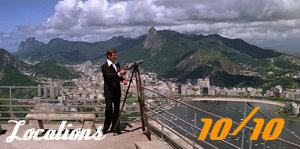
.
It sounds unlikely, but it’s true – if the Shirley Bassey title track were better, Moonraker‘s score may have got a 10/10. A slow, mellow, melancholic tune, La Bassey’s final Bond offering is far from the series’ usual fare, nor its most memorable song. Indeed, the movie’s music as a whole is a departure for composer John Barry. Like Eon’s Bond himself, Barry is older and more experimental; his Bond sound here morphing into what it would be throughout the ’80s – smoother, more orchestral but no less impressive and effective. Take Miss Goodhead Meets Bond, a beautiful, full orchestral rendering of the title theme, or Bond Lured To Pyramid, a flutey, harp-heavy, angelic choral-accompanied whispy piece that’s pure fantasy cinema scoring, or Bond Arrives In Rio And Boat Chase, a samba-style take on the title tune that flows into a markedly smooth take on Barry’s classic 007 theme. But the jewels in the crown are Corinne Put Down and Flight Into Space. Two of the best pieces in Barry’s entire Bond oeuvre, the former sees plucked strings turn to a driving rhythm and the latter is this score’s tour de force, an epic 2001: A Space Odyssey-style march with oh-so noble brass and strings (click on the above image to hear it). Maybe the final word, though, should go to the disco-ified end titles version of Bassey’s tune – a real so-camp-it’s-good experience (especially in this video).
Is there a more impressive Bond film when it comes to locations than The ‘Raker? I’m hard pressed to think of one. Try this on for size: Venice, Rio de Janeiro (complete with its world famous carnival), Brazil’s Amazonian rainforest, Argentina’s Iguaçu waterfalls (doubling for the rainforest), Château de Vaux-le-Vicomte just outside Paris (doubling for Drax’s estate) and, of course, outer space. It’s one hell of a cast list of locales and, like in many Bond films that boast fine location-filming, together they form one of the very best characters of the entire flick. Captured with – at times – breathtaking beauty by cinematographer Jean Tournier, they’re an irresistible on-screen combo that leaves the viewer not just delightedly and vicariously travelling around the world from one exceedingly impressive place to the next, but also dizzy at 007’s seemingly never-ending jet-setter globe-hopping.
.


.
Stuffed full of gadgets, Moonraker may feature one or two very daft devices, but they’re made up for by several other fine Boothroyd-derived items. For every ‘007’ miniature camera (with, yes, ‘007’ embossed across it) and dart-loaded ‘deadly diary’ (one of Goodhead’s CIA-issued items), there’s a safe-cracker doubling as a cigarette case (that cleverly shows x-ray-style the safe’s cogs as its door’s unlocked), a poison-tipped pen (again courtesy of Holly’s collection, which Bond uses to free him of his anaconda ‘crush’) and an exploding digital watch that prevents both 007 and Holly from being fried beneath a launching space shuttle (“Bang on time!”). There’s also the aforementioned gondola-cum-speedboat-cum-hovercraft that’s the ‘Bondola’ (ridiculous, yes, but terrifically realised) and Bond’s hand glider-hiding, floating mines- and torpedo-toting speedboat. But the best of the bunch is his wrist-dart gun, with which he saves himself in the G-Force simulator and despatches Drax. It’s daft as hell (why doesn’t it go off every time he moves his right wrist?), but utterly brilliant.
This Bond effort’s derided for its ridiculousness and puerile humour, yet what arguably makes it a satisfying watch is its style. Moonraker looks – and often sounds – glorious. As mentioned, its clutch of classic locations are gorgeously filmed and, combined with the luscious score, make for a rich feast, indeed – of all the universes presented in the separate Bond movies, Moonraker‘s is definitely the one I’d want most of all to step into and walk around in; it would surely make one feel like a million dollars. And let’s not forget Ken Adam’s sets. The legendary designer seems to have been handed the equivalent of Lichtenstein’s GDP this time, creating a space shuttle-launch HQ shaped like a cathedral and filled with wall-to-wall video screens, a sleek metallic-silver meeting room opening up to become a shuttle bay and Drax’s space station interior itself, all silver steel and glass, tubular corridors and transparent egg chairs. It may be populated by minions (and Bond and Holly) in tastelessly camp yellow fatigues, but it looks awesome, as do master model-maker Derek Meddings’ to-scale space station exterior and shuttles. No question, together these efforts ensure Bond enters space with true bravura.
.
Adjuster: -5
Less James-Bond-meets-Star-Wars than The Spy Who Loved Me taken to the ‘nth’ degree, Moonraker pushes the cinematic 007 as far as it surely can go (although 2002’s Die Another Day runs it close). Granted, it has big faults and is undeniably daft, but if you can overlook these there’s much to savour in its highly impressive production values (luscious score and cinematography and awesome sets). It was the biggest Bond film at the worldwide box-office for more than 15 years (inflation unadjusted) – and there’s clearly a decent reason why…
.
.
Best bit: Bond and Holly hunt down Drax’s globes in the finale
Best line: “Standard CIA equipment – and they placed you with Drax, correct?”/ “Very astute of you”/ ” Not really, I have friends in low places”
.
.
.
Rankings
(All scores out of 100/ new entries in blue/ * denotes a non-Eon Bond film)
1. On Her Majesty’s Secret Service (1969) ~ 90
2. From Russia With Love (1963) ~ 88
3. The Spy Who Loved Me (1977) ~ 87
4. Goldfinger (1964) ~ 85
5. You Only Live Twice (1967) ~ 84
6. Live And Let Die (1973) ~ 82
7. Dr No (1962) ~ 74
8. Moonraker (1979) ~ 73
9. Thunderball (1965) ~ 70
10. Diamonds Are Forever (1971) ~ 66
11. The Man With The Golden Gun (1974) ~ 62
12. Casino Royale (1967)* ~ 48
.
The James Bond reviews will return…
.
Playlist: Listen, my friends ~ September 2012



In the words of Moby Grape… listen, my friends! Yes, it’s the (hopefully) monthly playlist presented by George’s Journal just for you good people.
There may be one or two classics to be found here dotted in among different tunes you’re unfamiliar with or have never heard before – or, of course, you may’ve heard them all before. All the same, why not sit back, listen away and enjoy…
.
CLICK on the song titles to hear them
.
Billy Taylor Trio ~ I Wish I Knew How It Would Feel (To Be Free)1
Shocking Blue ~ Venus
Procul Harum ~ A Salty Dog
Mountain ~ Mississippi Queen
Barbra Streisand and Burt Bacharach ~ (They Long To Be) Close To You2
Emerson, Lake & Palmer ~ Lucky Man
Bachman-Turner Overdive ~ Let It Ride
The Wombles ~ The Wombling Song
The Silver Connection ~ Fly, Robin, Fly
Ram Jam ~ Black Betty
Level 42 ~ Lessons In Love
Art Of Noise ~ Theme from The Krypton Factor (1986-93)
Miami Sound Machine featuring Gloria Estefan ~ Bad Boy3
.
1 Originally written by Taylor himself and a huge hit for Nina Simone, this instrumental version was chosen in 1972 by the Beeb as the title theme for its new Film Programme – and 40 years on it’s still opening the show
2 An intimate performance from The Burt Bacharach Special, broadcast by CBS in 1971, of the The Carpenters’ #1 chart hit written by Bacharach and lyricist Hal David, who died on September 1 this year
3 As featured in the film Three Men And A Baby (1987); one of the two videos that promoted this hit memorably featured Estefan with the costumed cast of musical Cats
007/50: The Bondathon reviews (1960s #2)
.
There’s no rest for the wicked, folks, nor is there for a writer of (ahem) wicked reviews as he blogs his way through a ‘Bondathon’ (a chronologically arranged Bond movie marathon) timed to conicide with the cinematic icon‘s 50th anniversary and release of its 23rd official adventure on the silver screen, Skyfall. That comes in late October; the latest instalment (read the first here) of my Bond film reviews – the mid- to late ’60s efforts: Casino Royale (unofficial spoof), You Only Live Twice and On Her Majesty’s Secret Service – comes right now…
.
How it works:
- The ‘Bondathon’ takes in all 24 cinematically released Bond films, from Dr No (1962) right through to Quantum Of Solace (2008) – including the ‘unofficial’ efforts Casino Royale (1967) and Never Say Never Again (1983)
- The reviews consist of 10 categories, the inclusion of which tend to define a Bond film as a Bond film (‘Plot‘, ‘Bond‘, ‘Girls‘, ‘Villains‘, ‘Action‘, ‘Humour‘, ‘Music‘, ‘Locations‘, ‘Gadgets‘ and ‘Style‘), each of which are rated out of 10, thus giving the film in question a rating out of 100 – which ensures all 24 films can be properly ranked
- There’s also an ‘Adjuster‘ for each film’s rating (up to plus or minus five points) to give as fair as possible a score according to its overall quality as a film.
.
.
.

Directed by: Val Guest, Ken Hughes, John Huston, Joseph McGrath, Robert Parrish and Richard Talmadge; Produced by: Charles K Feldman and Jerry Bressler; Screenplay by: Wolf Mankowitz, John Law and Michael Sayers – very loosely adapted from the Ian Fleming novel (1953); Starring: Peter Sellers, Ursula Andress, David Niven, Orson Welles, Woody Allen, Deborah Kerr, Joanna Pettet, Barbara Bouchet and Daliah Lavi; Certificate: PG; Country: UK/ USA; Running time: 131 minutes; Released: April 13 1967; Worldwide box-office: $41.7m (inflation adjusted: $282.7m ~ 24/24*)
* denotes worldwide box-office ranking out of all 24 Bond films (inflation adjusted), according to 007james.com
.


.
As a spoof of the 1960s Bond films, Casino Royale‘s plot is utterly nuts. Retired superspy Sir James Bond is brought back into the fold by former boss M/ McTarry, whom dies accidentally, to investigate why so many spies are being bumped off. Journeying to McTarry’s Scottish ancestral seat, he foils an attempt on his life by SMERSH – the KGB’s murder wing. Thus, in assuming control of MI6 he decides the situation so dire all British agents must now adopt the ‘James Bond 007’ moniker to confuse the enemy. He then hires, first, baccarat expert Evelyn Tremble, via mercenary Vesper Lynd, to defeat SMERSH operative Le Chiffre from raising funds by beating him at the French-set ‘Casino Royale’ and, second, his own daughter Mata Bond to infiltrate ‘Mother’s International Help’, supposedly the SMERSH HQ in Berlin. But he eventually discovers the real SMERSH chief is his nephew and former agent Jimmy Bond, whose main aim is to make all women fall in love with him and kill all men taller than him. Muddled and messy, Casino Royale‘s story is very difficult to follow and makes little sense, but then that’s arguably totally intentional.
Where to start? Given so many characters in Casino Royale are ‘James Bond 007’ we could be here all day. For the sake of brevity and sense though, I’ll focus on just two: David Niven’s real Sir James Bond and Peter Sellers’ Evelyn Tremble, the film’s most featured and obvious Bond stand-in. Niven’s Bond is actually rather engaging and interesting. A distinguished elder English gentleman and yet world-weary (he still hankers after real-life WWI-era spy Mata Hari whom he sent to a firing squad), this may be no Fleming’s 007, but allows Niven to show-off much of the charm, wit and quiet heroism of many of his best roles; think Phileas Fogg in Around The World In 80 Days (1956). But, again, this isn’t Bond – and Sellers’ Tremble certainly isn’t either. He’s also charming and witty, but owing to script problems – and Sellers’ own – an inconsistent creation, whose role in the narrative (like so many others’) doesn’t altogether make sense.
.

.
Obvious mention on the girls front should go to Ursula Andress’s Vesper Lynd. Honey Ryder-sexy and just as duplicitous as the literary Vesper, she’s one of the film’s better characters; although use of Andress’s real voice here makes clear why she was dubbed for Dr No. The totty quotient is filled out by a mature but lovely Deborah Kerr going all Scots as Lady McTarry/ Agent Mimi; Daliah Lavi as a smart, sassy MI6 operative; beautiful Barbara Bouchet as Moneypenny’s daughter; Jacqueline Bisset as SMERSH agent Miss Goodthighs; future ‘proper’ Bond Girl Angela Scoular as the bath-tub-warming Buttercup and a blink-you’ll-miss-it cameo from ’70s Eon lovely Valerie Leon. But the best of the bunch has to be Swinging Sixties ‘It Girl’ Joanna Pettet as Mata Bond, offspring of Sir James and Mata Hari. Wonderfully willowly, while capturing a mocking tone of mid-’60s Mod cool (and often only wearing the almost-theres of a belly dancer), she comes across in the actually satirically satisfying Berlin sequence as a Cockney Modesty Blaise.
Unlike Casino Royale‘s girls, its villains are pretty much instantly – and thankfully – forgettable. Ostensibly the chief baddie, Orson Welles as Le Chiffre seems perfect casting; the reality’s far from it. Given the film’s incongruously various plot strands, the SMERSH heavyweight doesn’t actually have a hell of a lot of screen-time nor then does he exert much menace. Moreover, as Welles and Sellers found they simply couldn’t get on, their scenes together were filmed while only one of either thesps was present so they didn’t have to face the other. Plus, Welles’ inexplicable penchant for performing magic tricks adds a head-scratching bizarreness to the already strong sense of the surreal. The real villain of the piece, of course, is Woody Allen’s Dr Noah (aka Jimmy Bond). Although one of the movie’s most consistently amusing elements and his villainous reveal wryly Wizard Of Oz-esque, Noah/ Jimmy ultimately ensures its daft and deeply unsatisfying conclusion – and no Bond film should have one of those.
.
.
Given this flick’s spoof aspirations, it’s supposed to be all about the gags (supposed to be), thus action‘s at a premium. The most obvious and lengthy example of this facet is the climax at ‘Casino Royale’. Sadly, it’s one of the weakest points of the entire movie – and many might say that’s saying something. Utterly ridiculous, it begins as a pastiche of a pointless saloon brawl and – fittingly then? – escalates into an all-out battle involving cowboys arriving as if on a cavalry charge and, via look-at-this! deus ex machina, Indians (wearing ‘007’ warpaint) parachuting into proceedings from an overhead plane. It’s obviously all supposed to be absurd anarchy, but none of it’s funny, just embarassing. More successful is earlier on when Sir James’s vintage car is pursued from Scotland to London by a bomb-carrying milk-float, which is operated via remote-control by lovelies at SMERSH control as if the chase is a Scalextric race. Silly but entertaining.
What stumps this movie in the humour stakes – and ultimately stumps the movie as a whole, given it’s clearly a comedy – is the rampant inconsistency. Several official Bond films are inconsistent, sure, but in this supposed spoof inconsistency is a disease. For every decent witticism (Bond to Moneypenny Jr: “Your mother did some of her best work at night”), every useful one-liner (“Which side do you dress on?”/ “Away from the window”) and every good visual gag (Woody Allen jumping over a wall to escape a firing squad only to land in another one on the other side), there’s that slapdash, broad brushstroke, too-many-cooks (or directors) approach that results in inexplicable cameos from Jean-Paul Belmondo, George Raft and even Frankenstein (although a cameo from Peter O’Toole does work – see below for his line) and that truly dreadful closing battle. In the end, Casino Royale needs to be funny, but it isn’t nearly enough.
.

.
At times, though, this film is very nearly saved by its music. All hail then the melodic genius that is Burt Bacharach. His score features themes that mostly fall into two categories. The first is jaunty, mock music-hall fare, which is used very effectively as backing for the most ridiculous British establishment and spy-work p*ss-take scenes; its greatest exponent being the Casino Royale Theme, performed by Herb Alpert And The Tijuana Brass (a chart hit in the States) and sung by Mike Redway over the closing credits. The second category are the lush, luxurious melodies that accentuate the glamour and style of the movie’s look, especially during Vesper’s ‘seduction’ of Tremble, over which the Oscar-nominated, all-time classic Dusty Springfield-sung The Look Of Love plays, as well as during Mata Bond’s introduction, which is accompanied by the awesome second half of Sir James’s Trip To Find Mata (click on image above to hear it).
In spite of some of its posters boasting Casino Royale is packed full of exotic locations, the only significant on-location filming I’m aware of took place in the Scottish Highlands (and at times the Irish countryside, standing in for its celtic counterpart). Still, the sequence in which the Highlands etc. feature is amply rewarded by this atmospheric backdrop (SMERSH’s opening attempt on Sir James’s life where he’s aided by Agent Mimi). Moreover, the use of just a single location is the least of Casino Royale‘s faults – after all, rightly neither the very good spy spoofs that are Austin Powers: International Man Of Mystery (1997) or OSS 117: Cairo, Nest Of Spies (2006) are criticised for their lack of stunning locales.
.

.
Pastiching the largesse of the Eon Bonds as it tries to, Casino Royale features many larger-than-life gadgets. But all of ’em are predictably OTT and pretty irritating. The most memorable is the dippy two-way TV wrist-watch that Tremble’s issued with when he joins MI6 and with which Sir James communicates with Vesper (just as she gets out of the shower so he sees everything, obviously). There’s also exploding hats and Union Jack-emblazoned bullet-proof vests hiding several silly weapons in the flick’s ‘Q’s Lab’ scene. The villains too have their fair share of gadgetry, including the bomb-carrying mik-float (mentioned above) and, of course, Dr Noah’s atomic bomb-containing pill that blows up every character come the film’s very end. Ultimately, though, if the opening scene’s to be believed, one of Casino Royale‘s aims is to mock (in the words of Sir James) the ‘joke shop spies’ of Bond and his ilk, but as the flick goes on, it seems happy enough to wallow in the light entertainment that gadgets provide just as much as its Eon targets.
In addition to its music, Casino Royale‘s other highlight is its look. The film’s interiors, designed by Michael Stringer, are fantastic. While the narrative meanders all over the shop, characters are introduced then dropped a second later and many a gag falls flat, the audience’s eyes are at least bamboozled by the warm reds and oranges of the outlandishly celtic McTarry Castle, Mata Bond’s opulent Indian hideaway and the marvellously surreal interior of Dr Noah’s HQ, with its swirling psychedelic patterns and dizzying, rotating rooms. There’s also the fine filmic in-joke of ‘Mother’s International Help’ looking just like the sets from classic horror The Cabinet Of Dr Caligari (1920). And the outstanding spy-fi-mocking style also extends to the costumes, from Sir James’s elegant tweeds and gentleman’s suits to Vesper’s wispy nightgown and glorious ballgown and from the SMERSH girl minions’ kinky outfits to Mata’s belly-dancing gear.
.
Adjuster: 0
Reviewing Casino Royale as if its a Bond film may be a little unfair, as it isn’t really one. Having said that, reviewing it simply as a film gives one a headache too, as it doesn’t work as one of those either. More a collection of sequences stringed together by a very loose (read: dreadful) narrative, this is an overblown, messy failure of a spoof, yet an intriguing curiosity of the Swinging Sixties that’s worth checking out for its flambouyance and engaging atmos. If only once.
.
.
Best bit: The introduction of Mata Bond
Best line: Peter O’Toole (in cameo): “Are you Richard Burton?”/ Sellers (as Tremble): “No, I’m Peter O’Toole”/ O’Toole: “Then you’re the greatest man that ever breathed”
.
Read the brilliant and bizarre story on how Casino Royale came to the screen here
.
.
.
.
.
.

.
Directed by: Lewis Gilbert; Produced by: Harry Saltzman and Albert R Broccoli; Screenplay by: Roald Dahl – loosely adapted from the novel by Ian Fleming (1964); Starring: Sean Connery, Akiko Wakabayashi, Tetsurō Tamba, Mie Hama, Teru Shimada, Karin Dor, Donald Pleasence, Bernard Lee, Desmond Llewelyn, Lois Maxwell, Ronald Rich and Tsai Chin; Certificate: PG; Country: UK/ USA; Running time: 117 minutes; Colour; Released: June 12 1967; Worldwide box-office: $111.6m (inflation adjusted: $756.5m ~ 4/24*)
.

.
Plot-wise and otherwise, You Only Live Twice marks the first time the Bond films go (almost) stratospheric. A US manned space rocket has been literally swallowed by another malevolent spacecraft and the Americans blame the Soviets. The Ruskkies plead innocence and the Brits (as mediator) agree with them, claiming the new spacecraft came down near Japan. In fact, their ‘man in Hong Kong is working on it right now’. In fact, he – Bond, of course – is not; he’s faking his own death to give him more elbow room to investigate the mystery. 007 travels to Tokyo and, via a quickly offed MI6 contact, discovers industrial giant Osato Chemicals is producing rocket fuel, which (thanks to the work of Japanese SIS and its head, the cool ‘Tiger’ Tanaka) he finds out may’ve been dropped off at a volcanic island. Assuming the identity of a local fisherman, he unearths the site of the secret spacecraft launches (it’s since gobbled up a Soviet one too): a hollowed-out volcano. And who’s behind it all? Good old SPECTRE chief Blofeld, who wants to push the US and USSR to war so China can emerge as the new and only world power, for which the latter will reward the white pussycat-stroker handsomely. Overblown, but wonderful nonsense.
If Connery didn’t really want to play Bond in Thunderball, two years on in Twice it’s patently obvious he doesn’t. The ’67 Connery has let it go, figuratively and literally – not only has he given in to the on-set of middle-age on his waist line, he also doesn’t work hard in the role. Sure, he’s committed still to the physicality of Bond (he’s just as impressive in the fight scenes as he always was), but he isn’t to the dialogue. And yet, even if his acting and reacting lacks impetus, this is still Connery as Bond; there’s still the confidence and cool, as well as the wryness when he enjoys a funny line. But the bottom line is Connery doesn’t want any more to play a character everybody knows so well. Indeed, in an in-joke even everyone in the Bond universe knows who is by now – his ‘death’ is reported in a newspaper and when he’s ‘shot’ lying in a bed a Hong Kong policeman (as a mid-coital gag) says: “Well, at least he died on the job – he’d have wanted it this way”.
.


.
Unlike Connery, Twice‘s Bond Girls definitely wanted to be in the movie – one desperately so, but more of that below. The main girl is Bond’s Japanese SIS aide, Aki (Akiko Wakabayashi). She is, in a word, lovely. Sweet, petite, placid and amenable, yes, she may be rather under-written and subordinate, but who cares? As she’s the movie’s ‘sacrificial lamb’, it’s actually moving when she’s bumped off. Once Bond’s on the island, her replacement is the slightly feistier, slightly more active Kissy Suzuki (Mie Hama). She’s top stuff too. There’s also the Fiona Volpe-a-like redhead villainess Helga Brandt (Karin Dor) and the pre-title sequence girl who wants to give Bond ‘best duck’ (Tsai Chin). And the one that wanted desperately to be in the film? That’d be Mie Hama after she was informed she could no longer play Aki (then named Suki) as her English wasn’t good enough; she apparently threatened suicide if a solution couldn’t be found. It was: she and Akiko (whose English was better) saw their roles switched – then, ironically, both were dubbed.
If you have a main villain in the background of previous films, who’s only been an in-and-out shadowy presence, but this time you want him to be the big-time baddie, how do you go about it? The answer’s two-fold. First, you get Donald Pleasence, who does eerily evil to a tee, to play him. Second, you keep up the teasing of the audience by peppering the flick with underling villains (Teru Shimada’s Mr Osato and Karin Dor’s Helga Brandt), whose attempts to off Bond are easily rebuffed by our hero, before in the final third you unleash hell – or, in other words, you finally reveal the face of Blofeld. On both counts then (the casting of Pleasence and the late revelation of 007’s true nemesis of four previous movies as a diminutive, bald-headed scarface, whose cultured, relaxed but menacing demeanour really has been worth the wait ever since Dr No said he existed five years – and films – before), the main villain of this movie is a masterstroke.
.

.
Kaboom! Ironically, Lewis Gilbert – the director best known outside of Bond for his excellent tragi-comic dramas Alfie (1966) and Educating Rita (1983) – loved to end his three Bond flicks with a good ol’ giant battle and, as such 007 film finishes go, Twice is a king among princes. The hollowed-out volcano-set battle that concludes this movie is, frankly, what the entire thing works its way up to and it’s an absolute stonker. Nifty ninjas abseiling down into the lair (some boasting wonderful sword skills, others throwing ninja stars and others still operating as dead-shot snipers) up against dozens of SPECTRE minions – oh, what’s not to love? Explosions galore and more intimate hand-to-hand combat too, this is what big Bond action is all about, all right. Yet this arguably isn’t even the best slice of action in the movie, which has to be the air-bound scrap between the gadget-laden gyrocopter Little Nellie and its waspish bigger cousins, which one-by-one and oh-so coolly to the backing of the Bond Theme, the former swats out of the sky. And, let’s not forget, there’s the terrific skirmish too between Bond and the goon in Osato’s office during which they use the furniture to fight each other. It’s like the best visit to Ikea ever.
Not all of writer Roald Dahl’s witty gags work (some fall flat owing to poor delivery, such as Bond making no issue of contact Henderson stirring his vodka Martini), but others certainly do – 007’s reaction to Tanaka’s positivity about Japanese SIS’s rocket fags: “It could save your life this cigarette”/ “You sound like a commercial”; Blofeld’s insistence that, with so many screens in his control room, you can watch his ‘war’ unfold “on TV”. Twice is a funny film and much of it’s down to Dahl’s trademark macabre and inventive humour – Blofeld dispatching failed employees via a foot pedal-operated breaking bridge over a piranha pool and Tiger getting rid of goons by picking up their car with a giant magnet suspended below a helicopter and then dropping the car in the sea (“How’s that for Japanese efficiency?”/ “It’s just a drop in the ocean”). The movie’s OTT and it nicely mocks itself for being so (à la 1964’s Goldfinger), like every such Bond film should.
.
.
Approaching the peak of his powers (at least those of his early career), composer John Barry delivers a score for Twice that knocks it out of, yes, the hollowed-out volcano. He takes the cool, urgent, brass-driven action-accompanying sounds of From Russia With Love (1963) and Goldfinger, introduces a full-orchestral, epic sound and weaves in Oriental-inspired, plucked string- and sax-featuring, but elegant stylings to concoct an awesome score that elevates the film, at times, to true greatness (especially when the visuals are the incredible volcano set). In fact, all three of those ingredients to Twice‘s music blend together perfectly in the ebullient, luscious and brilliant Fight At Kobe Dock/ Helga (click on the above image to hear it). Oh, and let’s not forget, there’s the little matter too of the title theme sung by Nancy Sinatra, which is easily one of the best of the series and still a player in pop culture today – it was sampled in Robbie Williams’ chart-topper Millennium (1998) and memorably closed the final scene of this season’s Mad Men.
Producers Broccoli and Saltzman decided in the midst of the ‘Bondmania’ phenomenon of the Goldfinger/ Thunderball period they had to go and make a film in Japan asap because the adoration for the screen 007 was perhaps more intense there than anywhere else on earth. But another reason behind their decision must have been the fact that when it comes to Bond film locations, Japan pretty much has it all. On the one hand, there’s the sleek, modern, neon urbanity of Tokyo (which ironically perhaps felt even more cosmopolitan Western in some ways than much of America and the UK at the time – or, at least, it looks that way in Twice), while on the other, there’s the vistas of the paradisiacal volcanic islands where the second half of the film takes place. In a contest measuring what single countries have offered Bond in terms of locales, Japan may be unbeatable. Additionally, the flick takes in Hong Kong in the pre-titles, which is also where Bond’s ‘funeral at sea’ takes place (and for which Gibraltar doubles for a few seconds).
.
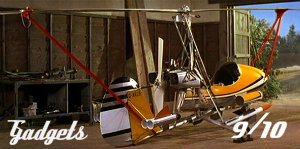
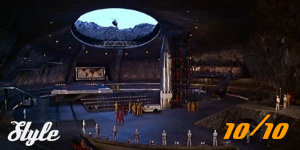
.
All hail Wing Commander Ken Wallis, formerly of the RAF, for it weren’t for this mechanically minded trailblazer, the Wallis-WA116 Agile autogyro (aka Little Nellie) wouldn’t exist – for the record, he also flew it in the film. The dinky yellow and white gadget tour de force features rear flame-throwers, front-mounted machine guns, aerial mines and air-to-air heat-seeking missiles. Frankly, with its arsenal, agility and, well, all-round coolness (it also, fictitiously, can be assembled from suitcases – the mind boggles as to how Q got it through customs), the SPECTRE choppers that dare go up against it simply don’t have a chance. Also on the gadgets front, Twice boasts a pocket-sized safe-cracking device, slip-on suction cups for the arms and legs (with which Bond climbs down the inside of the volcano), the aforementioned rocket cigarette and a smart breathing suit in which 007 survives his ‘funeral at sea’ (basically an underwater-like mouth-breather inside a sealed transparent bag, itself inside what seems to be a waterproof mail bag).
If Goldfinger is the series’ most iconic film, then Twice arguably runs it a close second. Thanks to the combination of Ken Adams’ quite extraordinary volcano set (which cost more than a tenth of the movie’s budget to construct and is unashamedly its piece de resistance) and John Barry’s outstanding score in the movie’s climax, an epic grandeur wafts over the viewer in a way never before experienced watching the series. Add into the mix too the achingly cool mid- to late ’60s look and atmos of a modernist Tokyo, the breathtaking beauty of the Japanese islands and, of course, Donald Pleasence’s Blofeld (there’s a reason why the look of Austin Powers‘ Dr Evil is utterly lifted from him – he’s an icon) and you’ve got a style quotient that’s almost off the chart.
.
Adjuster: -3
Despite definitely delivering on the Bond film formula (check out all those eights-, nines- and 10s-out-of-10s above), You Only Live Twice is far from a perfect film. Connery’s performance is low-rent and it has story issues – Roald Dahl’s script is solid and well-paced, but there are plot holes that the sets, gadgets and score have to cover-up. But, boy, do those three aspects step up to the plate. If there’s one thing this film’s all about then it’s spectacle – and it deals that in spades. It surely takes a hard heart not to be entertained by Twice – and more than twice at that.
.

.
Best bit and best line: Blofeld’s introduction ~ “Allow me to introduce myself, I am Ernst Stavro Blofeld”
.
.
.
.
.
.

.
Directed by: Peter Hunt; Produced by: Harry Saltzman and Albert R Broccoli; Screenplay by: Richard Maibaum – adapted from the novel by Ian Fleming (1963); Starring: George Lazenby, Diana Rigg, Telly Savalas, Gabriele Ferzetti, Ilse Steppat, George Baker, Bernard Lee, Desmond Llewelyn, Lois Maxwell, Bernard Horsfall, Yuri Borienko, Angela Scoular, Catherine Von Schell, Virginia North and Joanna Lumley; Certificate: PG; Country: UK/ USA; Running time: 133 minutes; Colour; Released: December 18 1969; Worldwide box-office: $82m (inflation adjusted: $505.9m ~ 13/24*)
.
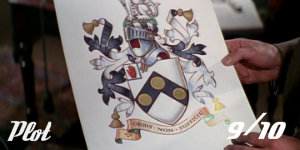

.
Vying with Russia as the most Fleming-faithful big screen Bond adaptation, Majesty’s marks the filmmakers’ first attempt to return Bond to his roots after the huge excesses of the preceding flick – a trend that’s repeated itself at least twice since in the series. Having gone on for two years, following the events of Twice, 007’s hunt for Blofeld is closed down by M, much to Bond’s chagrin. So, against orders, our hero goes off after a girl he saved from suicide in the pre-titles – Teresa di Vicenzo (Tracy) – whose father, Marc-Ange Draco, is a crime syndicate chief and whom 007 hopes can inform him of Blofeld’s whereabouts. This Draco agrees to so long as Bond marries his daughter; Bond balks at the idea but falls in love with her anyway, before (posing as a heraldry expert) he infiltrates an allergy clinic in the Swiss Alps run by old baldy, whose scheme this time is to infect the globe with ‘Virus Omega’, which’ll destroy the world food supply and its economy, unless the noble title he’s seeking is accepted. A barmy scheme for sure, but lifted fully from Fleming, as is the potent love story that lies at the heart of the plot and (perhaps 2006’s Casino Royale aside) distinguishes this from every other Bond film as an engaging romantic drama accompanied by action rather than an engaging action drama accompanied by romance.
Something else that distinguishes Majesty’s from every other big screen Bond effort is Bond himself – for the simple reason he’s played by the first actor to replace another in the role, as well as the only actor to have played the role just once (in the Eon series). Yes, this then was George Lazenby’s only crack at 007, but don’t let the naysayers discourage you because he gives it a good stab. While his lack of thesp training shows (he’s clunky in some dialogue-driven scenes), he literally kicks, punches and knees new impetus into the physical prowess and dexterity of the character, making the Connery Bond of Twice look like an over-the-hill heavyweight boxer. Plus, there’s a youthful vigour to this Bond and a boyish twinkle in his eye (which sort of pre-empts Moore) and, most impressive of all, no doubt thanks to playing opposite someone of the calibre of Diana Rigg, some of Lazenby’s best work comes in the demanding emotional scenes. All the same, though, this is a 007 performance that’s rough around the edges and, at times, at its core.
.


.
Is there a stronger Bond movie when it comes to girls than OHMSS ? You’ll be be hard pressed to find one. Why? Mostly because it features the series’ best female character, Diana Rigg’s Tracy. Nowadays, it seems every latest Bond Girl actress suggests hers is the match of 007, when patently none have been – apart from Tracy, who in almost every way was. Smart, witty, glamorous, resourceful, tenacious, cunning, a strong skiier, an excellent driver at speed, useful in a fight, as well as appealingly glass-half-empty and, of course, beautiful in a refined, elegant way, Tracy truly is terrific. Add into the mix her melancholic doomed fate (à la Vesper in Casino Royale) and she has to be top of the Bond Girl Christmas tree. Yet, OHMSS is surely the ultimate for Bond Girls because she’s not its only one. For who could forget Blofeld’s ‘Angels of Death’? The dozen or so Swinging lovelies hypnotised atop his Alp, whom unwittingly will do his bidding once back home. They’re all beautiful and good value, but the main duo, Angela Scoular’s Ruby and Catherine Von Schell’s Nancy are both delicious, so much so that Bond, despite his real romance with Tracy, can’t help but indulge in their delights – oh, the things he does for England…
Inevitably, after the highs of Donald Pleasence’s Uncle Ernst in Twice, the next interpretation of Blofeld (coming as it does in this very next film) is going to be a come-down and Telly Savalas’s take on the SPECTRE chief is just that. Don’t get me wrong, the man who would become Kojak does an admirable job, investing in the cat-lover an energetic, always on-the-go demeanour and impressive physical attributes (this Blofeld skis and bobsleds, but draws the line at curling), as well as giving the character an urbane loucheness in keeping with the schnaps atmosphere of Piz Gloria. But, for all that, he’s some way short of possessing the ‘x factor’ that all the really good Bond villains do. Blofeld’s joined in his quest to join the nobility by the hard, domineering matron-esque Irma Bunt (Ilse Steppat) – a sort of teutonic Hattie Jacques – and lesser minions including Yuri Borienko’s heavy Grunther (whom notably is bested by Tracy come the climax). Ultimately, like their boss, they’re fine, but a bit sub-par when it comes to Bond villainy.
.

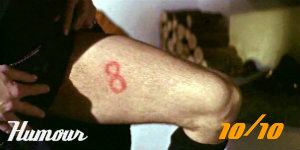
.
It’s rare for a successfully plot- and character-driven Bond film to be equally strong when it comes to action, but Majesty’s most certainly is. The tone’s set by a hotel room skirmish between Bond and a Draco goon. It’s no-holds-barred stuff and only concludes when the foe’s head breaks a balustrade (“Gate crasher – I’ll leave you to tidy up”). Midway through the flick comes a pivotal piece of action – one which proved pivotal for the series too – as its the first ski sequence to feature in the movie Bond. A thrillingly dramatic chase down an Alp, at night too, it displays the daring skills of ski ace Willy Bogner (doubling as 007), features terrific cinematography and demonstrates Bond using his wits to evade and do away with his pursuers. It’s swiftly followed by a car chase, as Tracy’s red Cougar leads Bunt’s vehicle through the snow and a stock-car rally (oddly taking place after midnight on Christmas Eve, but hey). Best of all, though, is of course the flick’s double action climax. Double? Yup, first we have Draco and 007’s raid on Piz Gloria via helicopter (during which the latter oh-so coolly slides along the ice firing his gun, oh yes), then comes Bond’s intense bobsled pursuit of Blofeld. Who could ask for more?
Majesty’s royally does the business in the humour stakes thanks to the fact it’s amusing when it comes to the witty, subtle gags (Draco to Bond on Tracy’s seeming indifference to him: “She likes you, I can see it”/ “You must give me the name of your oculist”; Bond on some avuncular advice from Q: “Thank you, Q, but this time I’ve got the gadgets – and I know how to use them”), but it’s also excellent at delivering the broader brushstroke laughs too – many of the scenes involving the girls at Piz Gloria (and Bond/ Bray’s interactions with them) go for the jugular, anticipating the bawdy humour for which the Moore era is most recalled. This then is a Bond film very reflective of its time – an ever growing openness to sex is represented by the Piz Gloria ‘Angels’ and the light, frank humour that follows them around, but it’s still of a time when subtle, dialogue-driven wit filled well-written scripts. In short, humour-wise, it’s the best of both worlds.
.


.
No question, OHMSS‘s music showcases John Barry’s Bond-scoring at its best. Other scores he delivered, such as Twice‘s, are excellent, but none are as consistently excellent as this flick’s. Both the diversity and the quality of its themes are awesome. The title theme itself (lyricless, still to this day a bold first for a Bond film) is a bass-driven, trumpet-flaring, Moog-synthesised, ominious but stirring, ice-cool tune that gets a perfect re-airing as Ski Chase during, yes, the ski chase. As if pre-empting ’70s prog rock, Moogs feature heavily elsewhere too in the almost menacing take on the Bond Theme and in Over And Out, the excellent tension-inducing build-up to the climax. But there’s a general about-turn to the tone of the mid-film music with theatrically blaring brass accentuating the almost Carry On atmos of Bond/ Bray’s dalliances with the Angels (Bond Meets The Girls; Sir Hilary’s Night Out). And brass is the order of the day too in the scene-setting march Journey To Blofeld’s Hideaway, while Battle At Piz Gloria mixes the title theme with full orchestra to soundtrack the climax. Final mention, though, must go to the Louis Armstrong-sung, early-film-featuring We Have All The Time In The World (whose theme is heard poignantly at other times – especially the end), one of the most enduring of all Bond hits.
Locations-wise, Majesty’s is all about the snow. But, hey, there’s absolutely nothing wrong with that when your main locale is the Swiss Alps in winter. Captured breathtakingly by Michael Reed’s cinematography, the Schilhtorn summit (on which sits the revolving restaurant that doubles as Blofeld’s Piz Gloria hideaway, the name it kept for real-life) and surrounding landscape offer bright white vistas that, with John Barry’s music, are truly inspiring – I haven’t yet skied and lived it up in the Swiss Alps, but still want to and it’s all because of OHMSS. By contrast, the tourist-teeming scenes shot in the nearby village Mürren offer a Christmas-time, almost claustrophobic coming-down-to-earth for Bond (sorry for the pun) after his exploits up the Alp, but are utterly irresistible too. Further locations include Bern (Bond’s visit to lawyer Gumbold’s office) and Lisbon and the picturesque Estoril region of Portugal for the early encounters with Draco and the oh-so fateful ending. Perfect all round, quite frankly.
.
.
In keeping with its back-to-Fleming-basics ethos, Majesty’s doesn’t really do gadgets. This was a very wilful decision on the filmmakers’ part to return the character of Bond to one that relies on his wits rather than the latest must-haves from Q-Branch to get him out of tight scrapes – and given how well the flick executes this, as something of an inverse score maybe its points accrued here should actually be higher. Perhaps the best example of this is when 007 is imprisoned in the impressive Piz Gloria room that houses the inner workings of its cable car system. Here, with no gadget to aid his escape, Bond rips the cloth out of his pockets and uses them as gloves as he works his way along the cable running from a giant wheel to the cable car in the snowy outside. It’s a fine, tension-filled scene. The few gadgets that do pop up, though, number a bulky safe-cracker-cum-photocopier that our man uses in Blofeld’s lawyer’s office (while he passes the time flipping through a Playboy), a nifty small camera and, best of all, a SPECTRE-produced make-up set for each of the ‘Angels’ that ensures they can (under hypnosis) spread the ‘Virus Omega’.
Belatedly, the Eon Bonds caught up with Swinging Sixties style in OHMSS. Not only do those ‘Angels’ reflect the youthful, let’s-have-it-all attitude of London Tahn in the mid- to late ’60s, the winter fashions they sport are unquestionably Quant-esque and moddish (none more so than their most prominent member Ruby Bartlett, with her curly boy’s haircut, round spectacles and penchant for cigarette holders). Bond too is rather dandy; the beige and orange togs he wears when apprehended by Draco’s men would have given the Bond of Dr No a nosebleed, but by ’69 seem perfectly en vogue. And even psychedelia finds its way into a 007 flick, with one-time only Bond helmer (but former editor extraordinaire) Peter Hunt turning outside-office fisticuffs into an hallucinogenic zoom-in and echo-heavy fest, Blofeld’s hypnosis of his girls into reminders of Vietnam-era drug experiments and, most memorably, an epic avalanche into a bad LSD trip for Bond and Tracy. All in all then, with the usual offer of aspirational affluence as well (the casino scene is fine old-school glamour), Majesty’s‘ palette is a slice of boldly colourful ’60s cool.
.
Adjuster: +3
For decades dismissed as ‘that one with the Aussie bloke’ that was a flop (in fact, it was the UK’s #1 film of its year – check out its box-office grosses above), On Her Majesty’s Secret Service is one of the greats (if not the greatest?) of the series. If anything, it seems to get better with age. It has everything you could ever want in a Bond film – and more. Including Joanna Lumley. Surely now, like Lummers’ cause du jour the Gurkhas at last have been, it finally deserves to be welcomed into the loving bosom of the British – and wider movie – mainstream?
.
.
Best bit: Bond and Tracy at the ice-rink
Best line: “It’s all right. It’s quite all right, really. She’s having a rest. We’ll be going on soon. There’s no hurry, you see. We have all the time in the world.”
.
Read why On Her Majesty’s Secret Service is one of the ultimate Christmas movies here
.
.
.
Rankings
(All scores out of 100/ new entries in blue/ * denotes a non-Eon Bond film)
1. On Her Majesty’s Secret Service (1969) ~ 90
2. From Russia With Love (1963) ~ 88
3. Goldfinger (1964) ~ 85
4. You Only Live Twice (1967) ~ 84
5. Dr No (1962) ~ 74
6. Thunderball (1965) ~ 70
7. Casino Royale (1967)* ~ 48
.
The James Bond reviews will return…
.
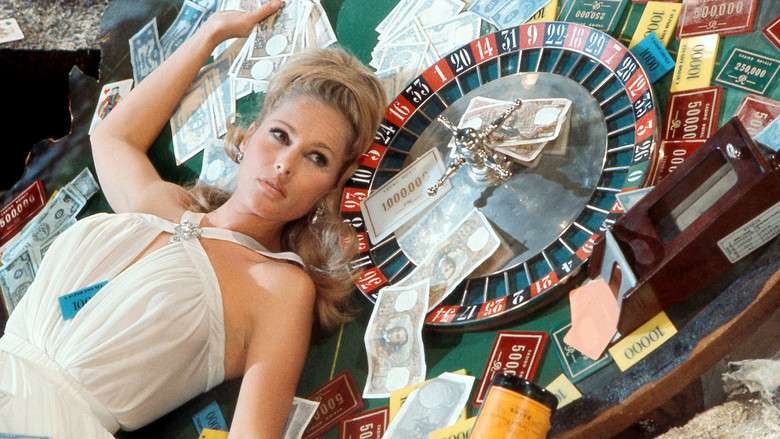
Wheel of fortune?: the spoof James Bond adventure Casino Royale – and first film adaptation of Ian Fleming’s original novel – was a chaotic if luxurious affair, but did it make cinema tills ring?
If you’re at all like me and have ever bothered to sit through 1967’s Casino Royale, the so-called comedy pastiche of all things Bond, you probably concluded as soon as its closing credits, well, closed that that’s two-and-a-bit-hours of your life you’re never getting back. But, again, if you’re at all like me you may also have wondered after watching said flick, just how on earth such a star-packed, dazzlingly looking and beautifully scored, but most of the time incredibly crap, and yet at other times rather amusing grand disaster of a movie ever got made in the first place? And how, coming practically slap bang in the middle of the mid- to late ’60s ‘Bondmania’ of the Connery 007 era, it fared at the box-office?
Well, if you have pondered on those puzzlers, peeps, then dare I say it, this (the latest effort from George’s Journal to mark Blighty’s finest‘s 50th anniversary year) is verily the blog post for you. Just how did this first big-screen effort to offer up another actor to Connery as Bond (actually many of them) come to the screen – especially when the ‘official’ Bond movie people appeared to own the rights to Fleming’s novels as thoroughly as 007 owns the bragging rights when it comes to pulling? And just what did the public make of it? Were they delighted, bemused (like most of us nowadays) or simply disinterested?
So, first things first: it was all Ian Fleming’s fault. Were it not for the uncoordinated manner in which he sold away the rights to adapt his Bond novels into films, Casino Royale would never have been made – at least not by the producer whose ultimately bloated and disfigured baby it was, Charles K Feldman. For it was this one-time Academy Award-nominated producer who brought this flick to cinemas, not James Bond’s regular film chiefs, producers Albert R Broccoli and Harry Saltzman of Eon Productions.
These two had acquired the rights to turn every one of Ian Fleming’s Bond novels into movies when the latter bought them from the author in 1961 and the former teamed up with him to form Eon a few months later. However, as part of this deal, Fleming hadn’t sold them the rights to his very first novel, the breakthrough book that introduced the world to James Bond, 1953’s Casino Royale. That was because three years earlier they’d found their way into Feldman’s mits. Exactly how isn’t important; what is important is Feldman had landed the rights and come the mid-’60s set about filming the book – indeed, filming it as a rival Bond movie to the four highly successful ones Broccoli and Saltzman had by now made.
.
.
Whatever you think of the movie that was eventually churned out, don’t let it discolour your opinion of Charles K Feldman’s career prior to this notorious venture, because it was stellar. Originally a talent agent for Hollywood royalty such as John Wayne, Claudette Colbert, Lauren Bacall and director Howard Hawks (indeed, legend has it that it was Feldman who got Bacall’s debut role bumped up in Hawks’ classic 1946 Humphrey Bogart-starring noir The Big Sleep, a move that made her an instant star), he went on to produce the classics A Streetcar Named Desire (which, of course, made Marlon Brando a total star and got Feldman his Oscar nom), the 1955 Marilyn Monroe comedy The Seven Year Itch (the one with that subway grille scene) and the madcap bedroom farce What’s New, Pussycat? (1965), which co-starred Peter Sellers, Woody Allen, Peter O’Toole and Ursula Andress.
Of all the movies he’d made, it was this latter effort – a big hit notwithstanding – that certainly more than any other pointed the way for what Casino Royale would become. Not only would Casino Royale share those four stars (among all of those it features) mentioned above with What’s New, Pussycat?, but the Swinging Sixties-informed, often crazy and utterly rompish tone of Pussycat could be said almost to be a precursor of Royale‘s. Not just that, but the fact that the former was initially a vehicle for its original writer Warren Beatty (its title apparently was the phrase Beatty used when answering the phone – how very ’60s) and it turned into a project re-written by Allen to such an extent that Beatty jumped ship/ was forced out completely, may well be a sign of the circus Royale would become just a couple of short years later.
Not that Feldman ever intended Casino Royale to turn into a cowboys and Indians-crashing and performing seals-featuring circus, of course – in fact, at the outset his intention was not to make a comedy at all, but adapt the book straight. Just one year after the novel’s original publication, the American TV network CBS had purchased its rights from Fleming and immediately had made an adaptation – so, yes, James Bond first appeared on-screen (the small screen, that is) as early as 1954 (see middle video clip below). The hour-long Casino Royale (Climax!) telly drama wasn’t a success, though; not least because it was filmed live, but also because it rather bizarrely switched around the nationalities of the British Bond and his American sidekick Felix Leiter, ensuring the first screen actor to play the iconic hero was Californian Barry Nelson (although Bob Holness, future host of cult ’80s UK gameshow Blockbusters, had already played the character on British radio – yes, really).
And yet, all this hadn’t deterred Feldman; he was sure that if adapted right, Casino Royale could be a big-screen success. In the late ’50s, he turned to Oscar-winning screenwriter Ben Hecht to have a whirl at a few script drafts. Ironically, as with the ’54 TV version, Hecht’s first attempt retained much of the novel’s content but replaced the British Bond with a card-playing American gangster. Subsequent drafts saw Bond return, but also the gambit that the name ‘James Bond’ is passed on to different agents as a sort of codename to confuse his enemies. For wrong rather than right surely, this idea made it all the way through to the final film, but another Hecht notion that ‘Bond’ escapes from a German brothel disguised as a lesbian mud wrestler did not. Quite frankly, it might as well have done.


Boom and bust: David Niven endures an explosion – figurative as well as literal? – at the start of the film (l), while Joseph McGrath tries to direct Peter Sellers as Jacqueline Bisset looks on (r)
Apparently, in 1966 Time magazine was reporting Hecht had departed the project and the script had been completely re-written by legendary auteur Billy Wilder. Whether that was merely Hollywood tittle-tattle, who knows; similarly, rumour has had it that Catch-22 (1961) author Joseph Heller also contributed to the script. What is true is the flick’s three credited screenwriters would turn out to be Wolf Mankowitz (whom ironically had introduced Broccoli to Saltzman back in ’61 and had written early drafts of their first Bond effort, 1962’s Dr No), former blacklisted Hollywood scribe Michael Sayers and UK comedy writer John Law (whom among other things had penned the all-time classic ’66 Frost Report sketch ‘Class’, which had seen John Cleese, Ronnie Barker and Ronnie Corbert represent Britain’s three classes by standing in line according to their varying heights).
Filming of the movie took place during much of 1966 and, clearly contributing to the almighty mess that was the finished product, was bizarrely chaotic. In the same Time article that had claimed Wilder had worked on the script (a multi-page colour spread on the movie, in fact), star David Niven had admitted: “it’s impossible to find out what we’re doing”. He may have meant that it was impossible for anyone working on the flick to find out what was actually going on. Feldman’s approach to try and better the Broccol-Saltzman Bond efforts was to offer the audience more… and then more and more again and yet more.
Clearly a snowball effect took over, ensuring that not only did the filming process become a seemingly out-of-control Hollywood Frankenstein-like horror monster (Frankenstein does actually feature in the film at one point), but also the budget trumped up by studio backer Columbia Pictures (ironically the financial backers of the Eon Bond today, although they’re now owned by Sony) doubled; it was originally $6million and the end $12million. In this manner at least, Casino Royale bettered the other Bonds – Thunderball (1965) had cost just $11million and You Only Live Twice, released just months after Royale, was a relative snip at $9.5million.
So where did all the money go? Some of it definitely on the cast. As mentioned, Niven, Sellers, Allen and Andress all feature, but so too do Hollywood legends Orson Welles, Deborah Kerr, Jack Holden and John Huston, as well as Swinging Sixties ‘It Girls’ Joanna Pettet, Daliah Lavi, Barbara Bouchet, Angela Scoular and Jacqueline Bisset. There are also cameos from Jean-Paul Belmondo, George Raft, as well as top Brit comedy performers Bernard Cribbins, Anna Quayle and Ronnie Corbett and, in-jokily, Eon Bond alumni Vladek Shebal (Kronsteen in 1963’s From Russia With Love) and Burt Kwouk (Mr Ling in 1964’s Goldfinger and, of course, Cato in the Pink Panther film series).
.
Factfile-Factfile-Factfile-Factfile-Factfile-Factfile-Factfile-Factfile-Factfile-Factfile
- Straight after working on Casino Royale, one of its directors Ken Hughes was hired by Broccoli and Saltzman to helm their classic musical adaptation of Ian Fleming’s children’s book Chitty Chitty Bang Bang (1968)
- One of Casino Royale‘s many female distractions, Angela Scoular became a ‘bona fide‘ Bond Girl just two years later when she was cast as one of Blofeld’s ‘Angels of Death’, Ruby Bartlett, in ‘official’ series entry On Her Majesty’s Secret Service (1969)
- Casino Royale cast member Terence Cooper (who plays the agent that becomes ‘James Bond’ owing to his ability to sexually attract any woman he meets) was considered for the the real thing in On Her Majesty’s Secret Service – only for George Lazenby to land the gig
Factfile-Factfile-Factfile-Factfile-Factfile-Factfile-Factfile-Factfile-Factfile-Factfile
.
As if this incredibly impressive, nay bizarrely diverse, cast couldn’t be cajoled into performing by one helmer alone, the film instead used of half a dozen (hey, at least there’s still less of ’em than there were on-screen Bonds). To be fair, Feldman probably found it necessary to hire so many ringmasters not because of the largeness of his cast, but because of the largesse of the circus threatening to explode out of his big-top. With constant changes of artistic direction and supposed daily re-writes of scenes, no one director could have directed this flick. Enduring the filming process must have been like witnessing the nightmarish development of the final alien in this summer’s Prometheus, a hybrid pulling in inspiration and ideas from all over the shop – Hollywood genre in-jokes, spy-fi satire, moddish nods and psychedelic visuals (sometimes all of them in the same scene).
For what it’s worth, cast member John Huston mostly directed the film’s opening (the scenes at the stately home of Niven’s stately Sir James Bond and McTarry’s Scottish castle with Deborah Kerr); Val Guest directed many of the scenes with Woody Allen (which unsurprisingly were penned by Allen himself) and additional ones with Niven to try and link the whole film together; Ken Hughes (whom Broccoli and Saltzman had originally considered as helmer for Dr No) directed perhaps the film’s wittiest and best bit, the Berlin scenes with the Twiggy-like Pettet; between them Robert Parrish and Joseph McGrath directed the scenes featuring Sellers, Andress and Welles; and, uncredited, stunt arranger Richard Talmadge co-directed the utterly bananas climatic battle at ‘Casino Royale’ itself.
The most legendary leg of the filming, thanks to its referencing in Roger Lewis’s biography The Life And Death Of Peter Sellers (1995) and its pseudo-screen adaptation of 2004, is that which involved Peter Sellers. Cast as Evelyn Tremble, a genius baccarat player enlisted by Niven’s real 007 to smash SPECTRE agent Le Chiffre (Welles) at the gaming tables while assisted by espionage mercenary Vesper Lynd (Andress), Sellers initially invested all his enthusiasm in the project, seemingly seeing Tremble (yet another fake Bond but in the film’s only ‘real’ bit of Fleming adaptation) as the opportunity he’d wanted all his career to play a dashing heroic lead. This then explains why Sellers’ acting seems inexplicably to veer from the slapstick (cavorting on a bed with Andress in costume as Hitler, Napoleon, Charlie Chaplin and Toulouse Lautrec) to the serious (playing it straight in the casino scenes and zealously knocking out an immigration official at an airport like a Bond-esque hard-man).
Whatever aspirations Sellers had for his involvement in the film pretty much went out the window, though, when his involvement became sporadic. A troubled chap and thus an unreliable performee, Sellers’ relationship with Welles quickly turned sour; the scene at the gaming table they share had to be filmed in two parts as neither would act opposite the other. And when Sellers realised the film – or his section of it – was turning into a comedy/ was always supposed to be a comedy (who knows which?) he both started re-writing his own lines and hired Terry Southern to do so it would play straighter. In the end, he totally severed links with the flick and a demise for his character had to be hastily put together from bits already filmed – the strange LSD-esque nightmare sequence in which he’s tortured by Le Chiffre and finally ‘shot dead’ by Vesper. Ironically, it’s one of the most engaging and dramatically satisfying of the entire movie.
.
.
Planned for release at Christmas ’66, Casino Royale finally made it on to screens four months later on April 13 1967. And, after the chaos that had been its production, this date proved far from unlucky for Feldman’s folly because , relatively speaking, audiences of the time actually lapped it up. Sure, Royale was no hit in the league of the Eon Bonds of the mid- to late ’60s (surely it would have been a fantastic achievement, nay a miracle, had it turned out to be), but in grossing about $42million at the box-office – around $283million in today’s money – it was far more than a modest financial success, in spite of its enormous budget. Moreover, not only did hit the #1 spot at the US box-office during its run (see middle image below), but also finished 13th in the list of the highest grossing movies in North America for 1967 – by comparison, the ‘official’ 007 effort that year, You Only Live Twice, finished in seventh place.
So why was it a genuine success and not the utter failure many for decades have assumed it must have been? Part of the reason has to be its marketing. Publicised honestly as something of a Swinging Sixties romp (complete with a body-painted girl à la Andy Warhol on the poster), it was also sold on the line that it was the ultimate Bond film, boasting more girls, more villains, more stunning visuals, more outlandish scenes and, yes, more Bonds than ever before. It simply was ‘more more‘ than the masses had yet seen in any Bond film; in fact, it arguably still is.
In marketing the movie this way, Feldman and his Columbia cohorts were shamelessly hitching a ride on the back of the ‘Bondmania’ phenomenon, of course, which unquestionably must have helped pull in the punters (i.e. it was a film that featured ‘James Bond’, therefore people would go on and see it. But the raison d’être of the finished film was to send up the whole Bond thing that had developed into/ fed an entire spy-fi sub-genre anyway, so technically it could have delivered something of a cinematic surprise or twist for filmgoers expecting a straighter ‘Bond film’. The filmmakers then, if challenged, may well have happily defended the shameless publicity linking it to Eon’s Bond bandwagon given such ‘artistic merits’.
But surely there was more to the film’s success than marketing and the Bond brand – dare one say it, but perhaps the film itself played a role too? There’s no getting away from it, Casino Royale is a car-crash of a movie. But, to spin out that metaphor further, at times it genuinely feels like a pile-up of Rolls-Royces and Bentleys. For the vast majority of the time, it looks fantastic. Unquestionably, one the major reasons why its budget spiralled upwards in the way it did was because of the truly impressive sets designed by Michael Stringer.

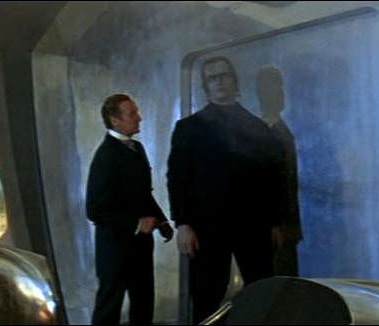
From the ridiculous to the sublime: despite the presence of both sky-diving Red Indians (l) and Frankenstein (r) in its climax, Casino Royale still hit the #1 spot at the US box-office (m)
Often they’re opulent (with Western aristocratic iconography, including at one point real lions), sometimes deliriously psychedelic (full of swirling pinks and oranges and blues and greens) and other times they brilliantly aid the pastiche (the darkly jagged look of the Berlin spy school wonderfully apes the iconic look of 1920’s classic horror The Cabinet Of Dr Caligari). In short, Casino Royale‘s visuals are an unforgettable tour de force.
Not just that, though, for the movie also sounds terrific. Hiring the composer he’d used for What’s New, Pussycat? again proved one of Feldman’s canniest moves on Casino Royale (you may argue there isn’t much competition there given his other decisions, but hey). For the meloldic meastro that is Burt Bacharach, whom rightly was white-hot property when it came to popular music in the ’60s, hit Royale‘s score absolutely out of the park.
Bacharach’s combining of campy, old British music hall-style themes for the moments of high parody and, well, ludicrousness (an example being the film’s fine title theme played by Herb Alpert’s Tijuana Brass – a chart hit – and sung at the end by Mike Redway) with lush, luxurious, romantic melodies that perfectly compliment the opulent look of the movie (listen to the film’s Oscar-nominated and now classic love theme, The Look Of Love, performed by original singer Dusty Springfield in the clip below) worked a total treat. It’s almost worth sitting through the movie for its music alone. Almost. Well, all right, sort of.
And, even if few of today’s film fans have done so, many a film critic back in the day certainly sat through Casino Royale. While some were unsurprisingly far from won over by what they witnessed (Roger Ebert described it as ‘possibly the most indulgent movie ever made’; Variety decried its lack of ‘discipline and cohesion’), others – admittedly the minority – have over the years somewhat reassessed the flick. At Bright Lights Film Journal (Brightlightsfilm.com), Robert von Dassanowsky claims it’s ‘a film of momentary vision, collaboration, adaption, pastiche, and accident. It is the anti-auteur work of all time, a film shaped by the very zeitgeist it took on’, while Allmovie.com reviewer Andrea LaVasseur even heralds it a ‘psychedelic, absurd masterpiece’.
But what do I, deep down, think? Well, folks, you’ll just have to read for yourself when I come to review the flick itself as the first in the next instalment of my ongoing ‘Bondathon‘. For, yes, in the words of Mike Redway, don’t fear, James Bond is here… and here to stay for some time yet at George’s Journal…
.
.
007/50: The Bondathon reviews (1960s #1)
.
You may know this autumn marks the golden anniversary of Blighty’s finest, James Bond, on the silver screen (what you didn’t? Have you never visited this blog before? Ho-de-ho). Yes, and it may prove a rather crazy idea – in fact, I’m already beginning to form the opinion it may well be a bloody stupid one too – but leading up to the anniversary itself (October 5) and the release of the latest Skyfall (October 26), I’ve embarked on a chronological ‘Bondathon’, which to the unititated (read: sane people) is a ‘Bond movie marathon’; wasting copious amounts of time watching all the Bond movies one after the other. Yes, all 22 of them. And yet this one, just to be thorough, will comprise 24, including as it will both the ‘unofficial’/ non-Eon flicks that are the Casino Royale spoof (1967) and Never Say Never Again (1983). But not just that. Oh no. I’ll also be reviewing each and every one of them on this very blog.
But not just that. Yes, in a very Jimmy Cricket manner, there’s more. The reviews themselves will be properly comprehensive, being that they’ll consist of 10 categories, the inclusion of which tend to define a Bond film as a Bond film (‘Plot‘, ‘Bond‘, ‘Girls‘, ‘Villains‘, ‘Action‘, ‘Humour‘, ‘Music‘, ‘Locations‘, ‘Gadgets‘ and ‘Style‘), each of which will be rated out of 10, thus giving the film in question a rating out of 100 – which ensures all 24 films can be properly ranked. Note: there’ll also be an ‘Adjuster‘ for each film’s rating (plus or minus five points) to give as fair as possible a score according to its overall quality as a film. Confused? You soon will be. Am I nuts? To quote George Lazenby’s 007, indubitably.
Anyhoo, without further ado, let’s get the Aston Martin DB5 on the road and tyre-slash our way through the flicks that deserve it and elevate the others to heaven via the ejector seat. Or something like that. Up first, the first four Bond flicks, of course…
.
.
Directed by: Terence Young; Produced by: Harry Saltzman and Albert R Broccoli; Screenplay by: Richard Maibaum, Johanna Harwood and Berkely Mather – adapted from the novel by Ian Fleming (1958); Starring: Sean Connery, Ursula Andress, Joseph Wiseman, Jack Lord, Bernard Lee, Anthony Dawson, John Kitzmiller, Zena Marshall, Eunice Gayson and Lois Maxwell; Certificate: PG; Country: UK/ USA; Running time: 109 minutes; Colour; Released: October 5 1962; Worldwide box-office: $59.6m (inflation adjusted: $440.8m ~ 18/24*)
* denotes worldwide box-office ranking out of all 24 Bond films (inflation adjusted), according to 007james.com
.

.
In this, the very first Eon Bond film, the plot sees the villain of the piece jamming radio signals of US space rockets and deliberately sending them off course. Not particularly bad, you might think, but this is 1962 and it’s the height of the Cold War. The antogonist aims to stoke up serious tensions between the Yanks and the Ruskkies then, all for the selfish gain of his evil overlord Ernst Stavro Blofeld – not referenced by name in this film – who’s the head of criminal organisation SPECTRE (Special Executive for Counter-Terrorism, Revenge and Extortion). It’s fantasy for sure, but with the Cuban Missile Crisis just days away after Dr No opened, the tensions were very much real. Our man Bond is hot on the trail after the murders of two UK civil servants, who’d learnt more than was good for them, brings him to Jamaica, the villain’s locale of choice.
Make no mistake, the big screen Bond was born here; Sean Connery’s opening portrayal set the template for all others to come. And enthusiasts of latest 007 Daniel Craig’s take on the role, will find much that’s familiar here. Bond’s an oh-so confident, consummate professional Brit abroad, better dressed than everyone else, showing fast wits and possessing an air of danger and heaps of masculine allure. And, later, he turns out to be both a sympathetic gentleman when it comes to a damsel-in-distress and a ruthless killer when needs must. Connery’s first Bond means business with bells on; it’s his straightest, hardest performance – and it’s rarely been topped in the series.
.


.
An utter icon, Ursula Andress’s Honey Ryder can not only lay claim to being the first of the great Bond Girls, but also delivering the most well recalled moment of the entire movie when she emerges Venus-like from the sea wearing that bikini. Her mixture of enormous sex appeal and sweet naïveté is hard to resist and she makes a decent companion for Bond, despite lacking the sass and smarts of later hook-ups. The film’s other girls number only two, though – Zena Marshall’s duplicitous sexy secretary Miss Taro and, the first Bond Girl of them all, Eunice Gayson’s Sylvia Trench, whom it’s suggested possesses just as big an appetite for sex as she does for playing golf indoors. Fore!
If ever there’s a Bond film that’s front-loaded – or, rather, er, back-loaded – when it comes to villains, then it’s Dr No. The titular character’s minions are useless. Professor Dent is a cowardly underling (the tarantula he leaves in Bond’s bed offers far more menace) while Miss Taro offers such an obvious honey trap she deservedly suffers true Bond villain ignominy – she gets arrested. But, although stretching until the film’s last third, the wait for Dr No himself is well worth it. So impressive is Joseph Wiseman’s villain, he was the total prototype for the majority of Bond baddies to come. Sporting a physical deformity (metal hands), outlining a barmy scheme, boasting an incredible lair, admonishing 007 (“You’re just a stupid policeman”), wearing a beige nehru jacket (a Blofeld favourite) and laying on lashings of hubris… it’s all here.
.

.
Action isn’t exactly Dr No‘s forte. Aside from Bond’s all too brief confrontation with the villain, the former beating up a would-be assassin and a car chase (which features – surely even in the ’60s – some very dodgy back-projection and results in the pursuing vehicle rolling down a hill and inexplicably exploding), the most memorable action comes in the slightly bizarre but intriguing sequence when 007 escapes from his cell in Dr No’s lair via ventilation tubes and goes through hell – burning heat, gushing water and disorientation owing to, er, weird noises. In this respect, Dr No is very much the cinematic Bond in gestation – and it shows.
One of the Bond movie memes most successfully established in Dr No is the 007 one-liner following a potentially distasteful murder or death: a bunch of baddies fatally crash their hearse (‘They were on their way to a funeral”); a chap notices a cyanide pill-popping goon lying dead in the back of a car (“Make sure he doesn’t get away”). Dr No also scores in the humour stakes thanks to Bond’s sardonic wit, not least in his chiding the villain (“Tell me, does the toppling of American missiles really make up for having no hands?”), and the visual gag of him discovering Goya’s painting of the Duke of Wellington – it had famously been stolen from the National Gallery the previous year – is top stuff (see image above). However, the reliance on Cayman Islander sidekick Quarrel as light-relief thanks to racial stereotyping sits uneasily nowadays, to say the least. Thankfully, such casual racism would rarely be seen again in the series.
.

.
On the one hand, you could say Dr No‘s score suffers because it’s mostly old-fashioned, underwhelming fare put together by composer Monty Norman; on the other hand, you could say its music is a crucial touchstone in film scoring for introducing the stone-cold classic James Bond Theme to an unsuspecting world – the tune that, like 007 himself, would leave it shaken and stirred forever after. Co-written by Norman and rising jazz musician John Barry (who would go on to fight over its legal ownership for decades), the theme features prominently, underscoring our hero’s cool-as-a-frozen-solid-cucumber persona. Mind you, credit should go to Norman for his deft choice of using Jamaican music scene-inspired tunes, including Kingston Calypso, Under The Mango Tree and the fine Jamaican Rock (click on the image above to hear the latter) to add to the overall atmosphere.
As far as Bond film locations go, it doesn’t get much more Fleming – or, if you prefer, ‘pure’ – than Jamaica. After all, this was the setting of three of his novels (Dr No itself, Live And Let Die and The Man With The Golden Gun) and where he lived for half the year while he wrote all the novels. Given this is the early ’60s too, the Jamaica Dr No delivers is old-school; colonialism happily holds sway and Bond (for all his unflappability) constantly fans himself and complains about mosquitoes. What it does lack, though, is what would become a near prerequisite of future series settings: glamour – the exoticism comes from the grubbiness of locals’ locales (ally Puss-Feller’s bar, for instance) rather than a gorgeous vista that makes the viewer green with envy.
.

.
Q, the legendary gadget supplier, isn’t Q here, he’s Major Boothroyd – and M doesn’t even refer to him by name (merely as ‘armourer’). Indeed, the most important of the gadgets – if you can call it one – which ‘armourer’ supplies 007 with in this film is the Walther PPK pistol. Why? Because, with its delivery like a brick through a plate-glass window, this would become Bond’s signature gun. The only ‘other’ gadget of note in this movie is a geiger counter that 007 uses to verify whether rocks supposedly found on the island of Crab Key (the site of Dr No’s lair) are radioactive and, thus, the possible location for the nuclear-fuelled missile ‘toppling’ that’s going on. Clunky and box-shaped, it’s not a very sexy thing – unlike today’s geiger counters, which look like iPods.
With Connery’s oh-so confident incarnation kicking-off here, so too does the iconic look of Bond – the tuxedo in the casino, the perfectly fitted Saville Row suit and the sipping a vodka Martini. And its augmenting by the original and still best arrangement of The James Bond Theme makes for a simple, yet unbeatable combo of cool. Almost as important in the style stakes, the fantastical, nay fantastic look of the interiors (which, again, would quickly become a series staple) starts here with Ken Adams’ sets for Dr No’s lair, including the eerie, cell-like conference room (see image above) and the villain’s private quarters – they’re like a how-the-hell-does-that-work? happy marriage of Mid-Century Modern and surrealism.
.
Adjuster: +5
Bond movies are notorious for their thrills and spills, but as outlined above, Dr No‘s hardly loaded with the latter (nor is it high in the gadget quotient); its much better at delivering the thrills. Essentially a detective story set in the colourful Caribbean and with an explosive ending, it’s one of the tightest, simplest and, in many ways, most effective entries in the series.
.
.
Best bit and best line: Bond’s introduction ~ “I admire your courage, Miss?”/ “Trench, Sylvia Trench”/ “I admire your luck, Mr?”/ “Bond, James Bond”
.
.
.
.
.
.
Directed by: Terence Young; Produced by: Harry Saltzman and Albert R Broccoli; Screenplay by: Richard Maibaum and Johanna Harwood – adapted from the novel by Ian Fleming (1957); Starring Sean Connery, Daniela Bianchi, Pedro Armendariz, Lotte Lenya, Robert Shaw, Bernard Lee, Vladek Sheybal, Walter Gotell, Eunice Gayson, Aliza Gur, Martine Beswick, Nadja Regin, Lois Maxwell and Desmond Llewelyn; Certificate: PG; Country: UK/ USA; Running time: 115 minutes; Colour; Released: October 11 1963; Worldwide box-office: $78.9m (inflation adjusted: $576.3m ~ 10/24*)
.

.
For many Fleming fans, this is their Bond film, and much of that is really down to its plot. It’s brilliant and it’s pure Fleming. In the novel, the KGB cook up a devious, despicable plan (thanks to the mind of a Soviet chess star) to stitch James Bond up like a kipper: a beautiful Istanbul-based Ruskkie girl claims she’s fallen in love with with him and will, if he meets her, defect with a Lektor code-breaking machine (which, like a WWII Enigma machine is highly valuable in the Cold War spy game). So Bond schleps to Istanbul, unknowing a ruthless assassin is waiting to off him (after 007 and the girl have copulated and the act’s been caught on film, that is), while making it look like suicide, stealing back the Lektor and leaving the film on Bond’s body, thereby totally discrediting him. Two alterations are made for the film: the Soviets are actually working for SPECTRE and the plan’s partly in revenge for Bond and MI6’s defeat of Dr No. Clever.
Quite simply, Connery’s effort here is the first flawless Bond portrayal. He’s still the effortlessly cool man abroad, the shag-magnet for every woman he meets, the cold-blooded killer when necessary and he’s sharper and wittier than a quartet of spades, but given the outstanding plot, things threaten to go tits up for Blighty’s finest with alarming regularity (especially during his train-bound flee across Eastern Europe with girl and Lektor), allowing Connery the chance to really show his acting chops, not least in his scenes opposite Robert Shaw (more of him below). Cool, dangerous, sexy, sardonic, heroic and truly tested – what more could you want in a 007?
.
.
There’s arguably more to Daniela Bianchi’s Tatiana Romanova than Honey Ryder, but unlike the latter she’s not among the great Bond Girls. Why? Well, she’s a bit dull. Bianchi certainly looks good – especially under a sheet wearing only a black neck-choker – and the voice artist who dubs her, Nikki van der Zyl, sounds fine (she also dubbed Dr No‘s Ursula Andress and would do the same for You Only Live Twice‘s Mie Hama), but ultimately Tania’s a one-note innocent; a pawn in SPECTRE’s game and a damsel-in-distress for Bond. The other girls this film are Aliza Gur and Martine Beswick’s fighting gypsy camp girls Vida and Zora, whose bout certainly excites (yes, in that way), but their time is very limited. And Eunice Gayson’s Sylvia Trench returns, but this would be her last appearance; presumably the producers realised there already was another unfulfilled-girl-at-home for Bond in the shape of Moneypenny, so why have two?
Conversely, Russia is crammed full of villains and to a, well, villain, they’re practically all perfect. There’s so many of them, it’s hard to say who exactly is the ‘main’ baddie, but let’s start with the clear chief, SPECTRE’s head honcho Ernst Stavro Blofeld in his very first appearance in the series. Or at least the first appearance of his signature white Persian pussy cat, nibbling on the ‘stupid’ Siamese fighting fish he feeds it. Next up is one-time opera soprano Lotte Lenya’s monstrous SMERSH-defector (and possible lesbian) Rosa Klebb with her fatally poisonous shoe spikes. Then there’s the Czech chess grandmaster whose plan is enacted, Vladek Sheybal’s boggle-eyed Kronsteen. And, finally and best of all, Robert Shaw’s assassin par excellence, the blond bombshell of brilliant bad-assery that is Donald ‘Red’ Grant. Beat them, Bond! (Yes, he does)
.

.
You might think that with such a strong story, Russia isn’t the most action-packed Bond film and you’d be right, so why the 8/10? Because it possesses arguably the best fight in the entire 007 canon. ‘Bond versus Grant’ is a full-on, all-out, blue light-dawbed, sometimes sound effect-enhanced, no-holds-barred brawl in a train carriage compartment. It’s so visceral that it comes as something of a shock given it both appears in a PG-rated ‘family friendly’ flick from the early ’60s and alongside the comparatively pedestrian action to be found elsewhere in this flick. That includes a gypsy camp battle set-piece halfway through the movie and a speedboat chase in the finale, the latter of which (as a Bond film action climax) has always disappointed me, must admit.
Wit is the order of the day in Russia. From his reaction to a goon being shot after emerging through a poster of a film star’s face (“She should have kept her mouth shut”) to his fine remark after Klebb’s demise (“She’s had her kicks”), Bond’s sardonic delivery is on top form. Yet it’s the presence of Istanbul ally Kerim Bey (impeccably portrayed by Pedro Armendariz) that provides the most memorable moments of Russia‘s humour. A perfect foil to 007’s suavity, this always upbeat, knowing and eccentric MI6 operative offers fine by-play with Bond and genuine pathos come his an untimely demise. Special mention too should go to the scene in which M and Moneypenny listen to the recorded details of the Lektor (see image above) – just what did 007 and his boss get up to in Tokyo? Sadly we’ll never know…
.

.
The first Bond film to be properly scored by the legend that was John Barry, Russia‘s music certainly benefits from his efforts. Punctuating moments of action and suspense with slightly overly dramatic bursts of brass and orchestra (which would soon develop into the Bond sound), Barry’s score also introduces into the world of 007, er, 007 – the fine 007 march, that is. There’s also the first Bond title theme, Matt Monro’s nice ballad (co-written by Lionel ‘Oliver!‘ Bart), but best of all is this flick’s take on the Bond Theme itself, the marvellosuly monikered James Bond With Bongos (click on the above image to hear it).
Such an emperor of locations is Istanbul, this flick’s primary locale, Bond has visited it twice since (in 1999’s The World Is Not Enough and he’ll do so again this autumn in new effort Skyfall). You simply can’t go wrong with the Saint Sophia Mosque-boasting metropolis; on the one hand Asian exotic, on the other European cosmopolitan, it looks and sounds fascinating, dramatic and utterly seductive. As its patron saint – in Bond terms – Kerim Bey points out too it’s espionage underbelly is appealingly complex and dirty. Plus, let’s not forget, there’s a funky gypsy camp just outside – although clearly that sequence was all filmed back at Pinewood. Venice (another Bond location favourite) also features, but none of the cast actually went there for filming.
.

.
Although Russia sees Bond furnished with his fair share of gadgets, they’re hardly the sexiest. Most come inside a gadget itself, an attaché case that, when opened incorrectly, releases tear gas. Its contents number a telephone bug detector, a hidden knife, a folding rifle and, er, fifty gold sovereigns. Bond also uses a tape recorder hidden in a bulky camera. Frankly, though, you know a Bond film’s a rum-do in terms of gadgets when the coolest (i.e. the most memorable) ones belong to the opponents – who can forget Klebb’s aforementioned poison-spiked shoe and Red Grant’s watch that boasts a garotting wire by which he strangles his victims? Answer: nobody.
Connery in Anthony Sinclair throughout? Check. The exotic highs and grubby lows of Istanbul? Check. A platinum blond anti-Bond assassin? Check. A sojourn in a gypsy camp complete with a belly dancer? Check. And a glimpse at SPECTRE goons training (or, in the words of Mike Myers in Wayne’s World, ‘guys doing James Bond stuff’)? Check. The only blot on Russia’s oh-so coolly subtle style quotient is 007 wearing a tugboat captain’s cap during the Adriatic Sea-set climax (dreadful choice, but he’s been through a hell of a lot by that point, admittedly).
.
Adjuster: +4
With a terrific script that stays true to Fleming, canny direction and excellent casting and performances, From Russia With Love is a triumph of a Bond film. Many efforts in the series feature top sequences; this one segues from one to the next practically its entire running time. Yes, its gadgets aren’t outstanding, but given its delivery in almost every other department it deserves an ‘adjustment’ of four more points – anything less just wouldn’t be kulturny.
.
.
Best bit: Bond and Grant finally fight it out
Best line: “Red wine with fish – well, that should have told me something”
.
.
.
.
.
.
Directed by: Guy Hamilton; Produced by: Harry Saltzman and Albert R Broccoli; Screenplay by: Richard Maibaum and Paul Dehn – adapted from the novel by Ian Fleming (1959); Starring: Sean Connery, Honor Blackman, Gert Fröbe, Shirley Eaton, Tania Mallet, Harold Sakata, Bernard Lee, Cec Linder, Martin Benson, Desmond Llewelyn, Lois Maxwell and Margaret Nolan; Certificate: PG; Country: UK/USA; Running time: 110 minutes; Colour; Released: September 17 1964; Worldwide box-office: $124.9m (inflation adjusted: $912.3m ~ 2/24*)
.

.
Fleming purists will tell you it was with Goldfinger that the fantasy began to out-muscle the conceivable in the films – and yet, ironically its plot is very close to that of Fleming’s novel. Fearing tycoon Auric Goldfinger is smuggling copious amounts of gold out of the UK, the Bank of England enlists MI6’s services. Bond, having botched his first Miami-based observation of his target (by seducing his mistress, resulting in her death via full-body-painting), meets him again for a sparring game of golf and then tails him to a Swiss base where, by being captured and transported to the rogue’s stud farm in Kentucky, he learns the depths of his villainy: Operation Grand Slam. Teaming up with Chinese communists, Goldfinger plans to detonate a nuclear device inside America’s gold reserve Fort Knox, contaminating its contents for the best part of a century, thereby crippling the West’s finances, establishing China as the predominant economic power (er, hello 2012!) and making his own gold astronomically valuable. Barmy but brilliant.
The irresistibility of Connery’s Bond in Goldfinger is not down to his sex-appeal and screen magnetism; although, as ever, they both play an important part. Instead, I’d argue it’s down to something his take on the role had yet to demonstrate: his terrific capacity for light comedy. With this flick’s heightened fantasy and higher number of comic predicaments, he glides through it all as smoothly as the vodka Martini goes down that he quaffs from a golden glass on Goldfinger’s jet. Enjoying his wittiest one-liners so far, yet seemingly accepting all the gadgets the script supplies him, the actor appears to relax, delivering a 007 whom, despite his serious moments (Jill and Tilly’s deaths, for instance), blithely cruises through his mission, sure everything will turn out fine in the end. For right or wrong, Connery wouldn’t be this good in the role again.
.

.
For me, the irony of Pussy Galore is that in spite of her unquestionably iconic moniker, she may be the least memorable of the Bond Girls this movie. The most memorable is surely Shirley Eaton’s Jill Masterson. The sight of her covered in gold paint, which unrealistically has killed her, is utterly unforgettable, of course, but so too is Bond’s first glimpse of her, lying face down on a sun-lounger, dressed only in black underwear. And yet, like her avenging sister Tilly (played by lovely Tania Mallet), Jill is hardly a well rounded character. Both really exist to become this flick’s ‘sacrificial lambs’. Pussy Galore herself, although Honor Blackman inhabits her with judo-kicking conceivability, is also underwritten; a hard-hearted if sexy lesbian pilot whom 007 turns very easily. There’s also Nadja Regin (who appeared in Russia) as the opening sequence bathing girl and Margaret Nolan as Dink (the ‘golden girl’ in the titles), whom suffers Bond’s ‘man talk’ gag.
Despite featuring a gang of embarassingly cartoonish American gangsters in the stud farm gamesroom scene, Goldfinger scores big when it comes to villains thanks to its two heavy hitters: basically they’re both cast-iron classics. Who can forget Auric Goldfinger? In Fleming’s novel he’s an ugly bear of a redheaded man; in the film, his exterior as a charming, likeable rogue belies the ruthlessly evil, madcap megalomaniac he really is – and the terrific Gert Fröbe (with a fine vocal dubbing performance by Michael Collins) captures the character brilliantly. And who can forget Oddjob? Russia‘s Red Grant is, yes, surely a better all-round character, but former weightlifter and wrestler Harold Sakata’s silent-but-deadly, square-shaped heavy with his bizarre accoutrement (a steel-rimmed bowler hat) would become, like so many things in this film, a terrific template for so many of the henchmen that followed him in the series.
.


.
Perhaps oddly for such a fondly recalled Bond film, Goldfinger is far from the most action-packed. One of its most eternally popular sequences is certainly all about action, though: the car chase around Goldfinger’s Swiss factory buildings involving Bond’s gadget-laden Aston Martin DB5. Although stop-and-start and thus not as fast-paced as it might be, it’s one of the highlights of the film, no question (in a movie of many highlights), allowing 007 to show all his ingenuity, all of the car’s horsepower and all of its toys as he attempts to out-run, out-fox and generally try to escape from his opponent’s minions. The only other real action sequences are the opening fight (with the goon’s classic electrocuted-in-the-bath demise) and Bond’s showdown with Oddjob inside Fort Knox while US troops raid the outside, which to be fair is mostly played for laughs to demonstrate how indestructible the grinning villain is until our hero uses his nous to defeat him.
Being it’s maybe the wittiest of all Bond films, Goldfinger is easily one of the funniest – humour is the order of the day pretty much throughout. As mentioned, 007 gets to deliver some of his most delicious lines of the series (when Oddjob doesn’t open a door for Pussy: “Manners, Oddjob, I thought you always took your hat off to a lady”; on Goldfinger’s horse: “Certainly better bred than the owner”; on his car’s ability to track targets: “Ingenious, and useful too – allow a man to stop off for a quick one en route”). It’s also replete with some of the series’ best visual gags, what with the little old lady who stops baking to operate the Swiss factory’s gate only to turn out to be a machine gun-toting first line of defence and, of course, the nuclear bomb’s timer in the finale stopping exactly on ‘007’. The oh-so appealing facet of the Bond films laughing at themselves, which would run throughout the rest of the series, properly began here.
.


.
Goldfinger‘s score may not be cinematic Bond music at very best, but it’s damn close. And the reason why is because if in Russia John Barry’s ‘Bond sound’ was in its genesis, in Goldfinger it properly matures. Accompanying the on-screen action with smooth saxophones, blaring brass, soaring strings and shimmering harps, it’s a masterclass in a more-is-more score enhancing a more-is-more movie (listen to the ebullient Oddjob’s Pressing Engagement by clicking on the above image). And that, of course, isn’t even to mention the (fittingly) gold disc-attaining title song written by Barry, with lyrics by Leslie Bricusse and Anthony Newley, and performed unforgettably by Shirley Bassey. It was the hit that made Bassey’s career and the tune that made the Bond title song; every subsequent one would be an event – and most live in its shadow.
This flick’s a little let down by its locations. Dr No has Jamaica; Russia has Istanbul; what does Goldfinger have? Er, Switzerland in spring/ summer and Kentucky. Now, don’t get me wrong, there’s nothing inherently wrong with Switzerland (mostly the Alpine Furka Pass) as a Bond film locale; it’s pretty, even picturesque thanks to Ted Moore’s excellent cinematography. However, it’s hardly exotic, thus rather bland. And Kentucky? well, sure, it’s the state in which Fort Knox resides so Bond has to dip into it at some point, but there must be more exciting places 007 could have visited in mid-’60s America? Like Miami, say. Wait, he goes there after the title sequence, doesn’t he? Er no, it’s back-projection-o-rama – none of the cast actually did. Ho-hum.
.

.
That age-old tradition of Bond setting off on a mission after seeing Q like a freebie-toting presenter of The Gadget Show starts here, folks. Yes, the head of Q-Section becomes a real character for the first time in Goldfinger and he and Bond get off to the best (or worst) possible start; the latter irritably putting up with the former’s workman-like pride in the seemingly ridiculous alterations he’s made to his new motor, the oh-so iconic Aston Martin DB5, and irritating the former as he ‘jokes about his work’. But those alterations prove far from ridiculous when he gets out into the field. Not only are the DB5’s revolving number plates, tyre-slashers, oil slicks, rear bulletproof shield, machine guns mounted from behind the front indicators and, yes, that ejector seat all invaluable, collectively they ensure the DB5 is easily the coolest of all the gadgets in the Bond canon. 007 also has a couple of tracking homers; one that’s magnetic, so it’s attachable to opponents’ vehicles, and a dinky one that fits in the sliding heel of his shoe.
Frankly, any Bond film that contains the moment Sean Connery, dressed in that white dinner jacket with that red carnation, checks his watch seconds before he nonchalantly endures the explosion he’s created would have to score highly in the style stakes, but Goldfinger‘s style doesn’t peak with this pre-titles moment, it arguably kicks-off with it. Of all the series’ movies, this one probably gets the wizard combination of look and sound as right as can be. Barry’s music perfectly underscores the cool, sophisticated, sleek treats on-screen, including Ken Adam’s outlandishly wonderful interiors (Fort Knox is utterly to die for, as is the baddie’s room in which a pre-tuxedoed Bond sets the explosives in the pre-title sequence) and the film’s practically perfect costume choices (yes, really, even Connery’s pale blue towelling robe in Miami).
.
Adjuster: -1
Surely the most iconic of all Bond films, Goldfinger is an absolute, bona fide classic of the series – and properly set the formula that every subsequent one has variously adhered to and divulged from. But it’s not perfect. For me, although boasting an excellent setting, the Fort Knox finale oddly disappoints; it’s just not as thrilling as it might be. Perhaps if Goldfinger could have surrendered its otherwise marvellous self-mockery here (and upped the action ante elsewhere), it’d be the series’ true 24-carat entry.
.

.
Best bit: The triple combo that is the climax of the car chase, followed by the laser-table sequence, seguing into Bond meeting Pussy
Best line: “My name is Pussy Galore”/ “I must be dreaming”
.
Read why Goldfinger is one of the ultimate movies of the 1960s here
.
.
.
.
.
.

.
Directed by: Terence Young; Produced by: Kevin McClory (Presenters: Harry Saltzman and Albert R Broccoli); Screenplay by: Richard Maibaum and John Hopkins – adapted from the Ian Fleming novel (1961), itself based on a script by Fleming, McClory and Jack Whittingham; Starring: Sean Connery, Claudine Auger, Adolfo Celi, Luciana Paluzzi, Rik Van Nutter, Bernard Lee, Martine Beswick, Guy Doleman, Philip Locke, Desmond Llewelyn, Molly Peters and Lois Maxwell; Certificate: PG; Country: UK/USA; Running time: 130 minutes; Colour; Released: December 29 1965; Worldwide box-office: $141.2m (inflation adjusted: $1,014.9m ~ 1/24*)
.
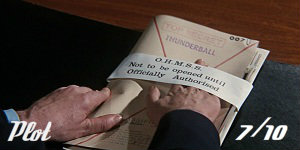
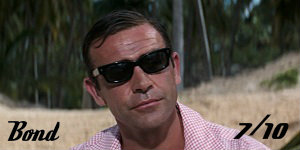
.
Thunderball‘s plot is big, brash fantasy, but very Fleming-faithful. Through a plan cooked up by its ‘Number 2’ Emilio Largo, SPECTRE – back again – sets about stealing two nuclear warheads via a NATO Vulcan bomber. Enlisting a fall-guy who’s had plastic surgery to assume the identity of bumped-off pilot Francois Derval, the criminal organisation sabotages a test flight of the Vulcan, crash-landing it in the Caribbean just off the coast of The Bahamas. Here Largo and his goons, murdering the fake Derval, hide the jet and its warheads, ensuring the UK Government can be held ransom to the tune of £100m in cut diamonds – a major UK or US city will be destroyed with the bombs unless it pays up. All the ’00’s including Bond are put on the case (‘Operation Thunderball’), yet fortuitously 007 has a lead: he was at the clinic where Derval was offed and the operative had his face done, in which case he pursues Derval’s sister Domino – in The Bahamas…
It’s no secret that after three films Connery was growing tired of playing Bond. Not that it shows enormously here, but all the same, the 007 of Thunderball is not that of the previous film and certainly not that of the first two. More reliant on gadgets and less on his own wits, which thanks to the script seem strangely to take a backseat for the middle third of the movie where our hero appears content, well, to bugger around a bit in The Bahamas before getting a wiggle on to find the missing warheads, he spends a hell of a lot of time getting wet. Connery himself is game, for sure – and up to the mark sardonically, especially in the early Shrublands Clinic scenes – but while his Bond this time definitely delivers the muscle, he somehow lacks the spark of before.
.


.
Recalled by many as quality Bond totty, Thunderball‘s girls are not all outstanding; specifically – and unfortunately – the leading female character: Claudine Auger’s Domino. A former Miss France, Auger looks the part and, like Connery, she literally spends a lot of time wet, but unlike Connery, she’s figuratively wet too. Tossed this way and that by the men around her, she suffers perhaps more than anyone else in the film from being under-written thanks to the script’s flaws. The rest of the ‘Thunderbirds’ do live up to that moniker, mind. There’s former model Molly Peters’ spunky nurse Pat Fearing and Martine Beswick’s gives-as-good-as-she-gets (until ending up the flick’s ‘sacrificial lamb’) Bahamian MI6 contact Paula Caplan. Both are also gorgeous. As is the film’s best character, Luciana Paluzzi’s Fiona Volpe. More on her below…
The casting of Adolfo Celi as bad guy Emilio Largo is a mixed blessing. He looks terrific (cruelly handsome with his black eye-patch and physically imposing, along with the requisite glamour and vulagrity of a tycoon-turned-evil), but owing to his Italian tones he can’t make work the tepid and sometimes inept lines the script offers him, ensuring Largo – not one of Fleming’s best antagonists to start with really – comes off as a bit of a B-movie baddie. The evil Emilio is joined by a dismembered Blofeld (as in Russia, merely a voice and hand stroking a white cat), Guy Doleman’s charming but lightweight UK SPECTRE agent Count Lippe and Philip Locke’s Vargas, who given his pointlessness is rather ironically skewered by Bond’s harpoon bolt (“I think he got the point”). But then there’s Fiona. Yup, she’s so damn good she probably raises this film’s Girls and Villains scores by two points each. Incredibly sexy and sultry, very cunning and dangerous and an utterly ravishing redhead, Volpe the Voluptuous is surely the series’ best ever villainess.
.


.
Its underwater action scenes are Thunderball‘s biggest flaw. You can imagine the pre-production meetings: let’s have Bond constantly grapple with goons in the sea and have a unit of black-clad baddies face-off against US frogmen in orange wetsuits in a huge harpoon battle surrounded by sharks! It’ll be awesome! Sadly, it’s not. Unlike on Fleming’s written page, on-screen underwater action is really slow. And, given the script sets much of the movie’s action beneath the waves, it’s a big problem. To off-set it, in a surprising mis-step, overly blunt, even crude editing is applied to these sequences (as well as more oddly in one or two other scenes, such as the pre-titles fight, while the film is sped-up an unforgivably high number of times – not least during Bond and Largo’s desperate final face-off). Disappointing.
More successful is this film’s humour. Its script may not zing with the one-liners of Goldfinger, but those it offers are ably delivered by (mostly) Connery, while his interactions with nurse Pat (sexy and sassy) and Paula (sardonic – this time from the girl) are very good value, as is the fast developing meme of Q demonstrating his wares to a bored, playful 007 – and, in a first, out in the field. Other highlights include Bond hitting a widow just returned from a funeral, whom he works out is the widow’s supposedly deceased husband (an enemy assassin) because ‘she’ opened the car door instead of waiting for it to be opened for ‘her’. Inexcusable in the ’60s that, obviously.
.


.
Its music often may be one of its stronger elements, but Thunderball‘s John Barry-penned score simply isn’t up to the quality of the previous two flicks’. It’s at its best – like the film itself – when setting mood. An example is Dance With Domino/ Bond’s Apartment (click the above image to hear it); the first half of which is slow, smooth and lilting, almost sad, but fits perfectly with the cool that Bond adds to the high-living Nassau world he encounters, while the second half sets suspense through an equally slow, but eerie theme (which seems to echo the other-worldly drift of the sea). At its worst, though, the score goes crazy at moments when the underwater action doesn’t thrill enough in an effort to up the ante. Not classic stuff. Tom Jones’ Barry-written theme, with lyrics by Don Black, is fine – although the turned-down effort from Dionne Warwick, Mr Kiss Kiss Bang Bang (orchestral versions of which feature in the film), is better.
For many, The Bahamas (and its capital Nassau in particular) is one of the classic Bond film locations – and it’s hard to disagree with that. After all, not only like Dr No‘s Jamaica does it offer (especially back in the day when foreign climes were less easily reached) the colour and mild exoticism of the Caribbean, but it also delivers the glamorous, rarefied jet-setter atmosphere of a Monte Carlo or a St. Mortitz. Other locales include Paris (seen very briefly as the setting for SPECTRE’s HQ) and the Château d’Anet (which, not far from Paris, features in the pre-title sequence). The Shrublands Clinic exteriors were shot in Buckinghamshire, which while not very Bondian do add an old-world English charm to proceedings.
.
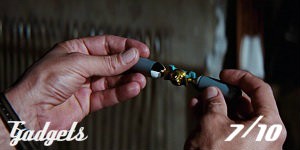
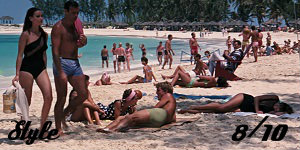
.
When it comes to gadgets – and, well, the wider film itself – Thunderball‘s tone is set right from the off when Bond throws on his conveniently placed Bell Texton jet-pack and flies away from his pursuers. It’s cool, no question, even if the mop-top haircut-style helmet 007 has to wear when using it is not. A more practical and better gadget though is the natty mini-breather he can use if he has to abandon conventional underwater breathing equipment at any point (which, naturally, he does). In fact, it’s a gadget-and-a-half. Bond also uses a swallowable homer pill, an underwater camera with infra-red film and in-built geiger counter, as well as an underwater propulsion unit, which boasts spear guns and searchlights, but perhaps the less said about that one the better.
In many ways, Thunderball sums up mid-’60s style. The faraway paradise with its aspirational affluence that is The Bahamas is beautiful (especially in the bold tones of Technicolor caught in oh-so wide Panavision) and, frankly, still very inviting a fantasy destination today, not least with the added appeal of Connery and his ‘Thunderbirds’. Talking of whom, the swimsuits and ballgowns of the female talent are pretty unforgettable, especially Volpe the Voluptuous’s striking blue dress and boa combo. And, being this is the mid-’60s, the technology is starkly cool and almost crazily ambitious; especially Largo’s Disco Volante yacht, which splits away from its outer shell to become a high-powered hydrofoil – reminiscent of something that might be used by those other Thunderbirds (1964-66), the ones dreamt up by Gerry Anderson, that is.
.
Adjuster: -1
Thunderball sets the ‘the fourth Bond movie mis-step’ trend. It’s simply too big for its – and director Terence Young’s – boots. The latter said that, contrasted with those of his previous efforts Dr No and Russia, its budget was so large that the spare real crab left over from dining scenes was offered to the crew, but as archetypal Brits they just wanted fish and chips. In The Bahamas. Which kind of sums things up. It has its moments (most of them involving Fiona), but a slow tone, crazy editing and boring underwater scenes threaten to sink it. Not that the public of the day cared – released at the height of mid-’60s ‘Bondmania’, it made an absolute mint.
.
.
Best bit: Fiona’s scrub in the tub
Best line: “Do you mind if my friend sits this one out? She’s just dead”
.
.
Rankings
(All scores out of 100)
1. From Russia With Love (1963) ~ 88
2. Goldfinger (1964) ~ 85
3. Dr No (1962) ~ 74
4. Thunderball (1965) ~ 70
.
The James Bond reviews will return…
.
007/50: Designing 007 ~ Fifty Years Of Bond Style at The Barbican (until September 5)

Man(nequin) and motor: Bond’s iconic Aston Martin DB5 and a mocked-up Sean Connery in his classic grey suit from Goldfinger welcome visitors, but does the exhibition have a midas touch?
If I was that talented Scottish thesp Alan Cumming then I’d buy the full-scale model of him in the guise of the roguish ‘pooter nerd Boris Grishenko that features in The Barbican’s Designing 007: Fifty Years Of Bond Style exhibition (and which was used in the 1995 film GoldenEye when the character has just been frozen solid by exploding liquid nitrogen tanks). Why? So I could put it in my lounge and whenever I come home from a heavy night on the tiles look at it and consider, whatever state I’m in, I’ve always looked worse. I’m not Alan Cumming, though, but if I had a lot more spare cash than I do, I’d still definitely buy that model, plus many more things from this exhibition, for the simple reason they’re utterly iconic and, what’s more, they ensure this exhibition itself is an unqualified success.
Just to clarify, you can’t buy anything that’s on show here – they’re much too special. Bond’s Walther PPK and passports of the character in various actors’ guises? Oddjob’s steel-rimmed bowler hat from Goldfinger (1964)? Jaws’ teeth from The Spy Who Loved Me (1977) and Moonraker (1979)? Tee Hee’s metal arm and claw from Live And Let Die (1973)? Models of the Lotus Esprit from Spy and the Q-Boat from The World Is Not Enough (1999)? The torture chair from that same movie? And Francisco Scaramanga’s golden gun from, er, The Man With The Golden Gun (1974)? Yes, they’re all on show. All of ’em. As is much more besides.
And yet it’s not just the breadth of this exhibition (which itself is considerable) that impresses, it’s the design of it too. Much thought, effort and no little money has gone into the way the space offered up by The Barbican is used to showcase all this stock that’s featured in all 22 Bond epics brought to us by film company Eon Productions across a remarkable half-century. Yup, its curators (aided by the not inconsiderable input of 1990s and 2000s Bond film costume designer Lindy Hemming) have done a fine job.
Having passed the frankly brilliant opening gambit of a Connery mannequin leaning against a battleship grey Aston Martin DB5 (complete with correct Goldfinger number plates and would-be tyre-slashers), you enter the exhibition, which kicks off with a room simply titled ‘Gold’. This unsurprisingly is themed around that most precious of materials that has quite the association with the world of 007 and his films – and works as a loose testament to the iconic legacy and thus mass success of the movie series, introducing the engaging and well executed props-and-audio-visual mixture of content that continues throughout the rest of the exhibition.
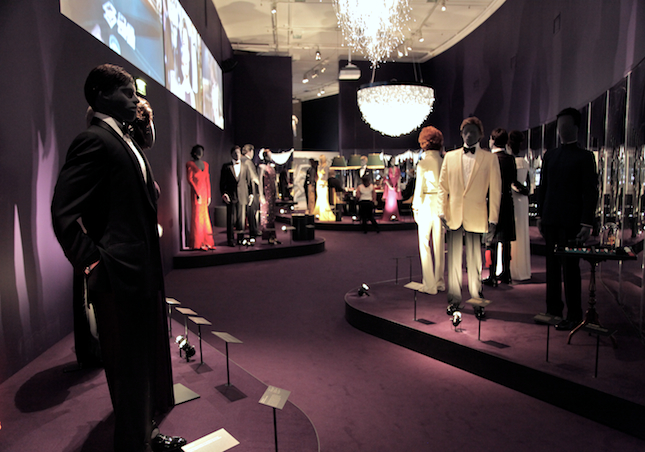
Dressed for success: the exhibition’s ‘Casino’ room is fittingly full to the rafters with iconic costumes worn by Bond stars from Dr No right through to the latest film, the upcoming Skyfall
From here it’s into a space dedicated to Bond’s original creator, the great thriller writer that was Ian Fleming, which impressively boasts several first editions of his novels, with their colourfully captivating covers catching the eye. Next it’s back into the Eon film universe, as on one side you pass mock-ups (using real props) of two of M’s offices and on the other side paraphernalia of the character of Bond himself (including, yes, the aforementioned PPK and passports). Fittingly, the next space is named ‘Q Section’ and features a (pleasingly over-)abundance of gadgets supplied by the incomparable Q and used by our man Bond throughout the series – clever weapons, bug detectors, vehicle models and, yes, even that Amstrad 64-esque ATAC thingee from For Your Eyes Only (1981) litter this room; there’s something familiar literally wherever you look.
Without pausing for breath, you’re quickly on to another delight: the room monickered ‘Casino’. Here you’re immediately faced with mannequins lined around the space wearing (mostly) original suits, ballgowns and costumes originally worn by Bond stars throughout the series. Highlights are obviously the tuxedos worn by several Bonds themselves (each mannequin for which features a face supposedly resembling that of the appropriate actor, the results of which are admittedly rather comical but fit with the overall exhibition’s somewhat self-mocking tone; much like that of the films themselves then, you might say).
Still, worth checking out too during your gander of all these garments are Valentin Zukovsky’s enormous tuxedo from The World Is Not Enough (designed by actor Robbie Coltrane’s own tailor), Sylvia Trench’s striking gown from Dr No (1962), Vesper Lynd’s beautifully elegant purple effort from Casino Royale (2006) and – as something of a teasing taster – new girl Sévérine’s outstandingly vampish dress from this year’s Skyfall. Oh, and this room also offers an unexpected gem (as it were) in the shape of the Fabergé egg made specially for Octopussy (1983).
After a quick sojourn through a space that’s open to the public, but still filled with Bond-related artefacts, it’s now on to a ‘Villains’ room, featuring alongside the liquid-nitrogen-afflicted Boris, Jaws’ molars and Tee Hee’s arm and claw, further costumes and props worn by and wielded by the baddies of Bond’s universe. Notable inclusions are scale models of the Rio de Janeiro cable car and the space shuttle and figurines of Hugo Drax and his minions aboard his space station, all of which were used for the filming of Moonraker, of course. Why’s the Drax figurine so memorable? Because close-up he resembles Japanese TV favourite Monkey rather than that film’s megalomaniac villain. A coincidence maybe, but rather marvellous to my mind.

Model perfection: Eon artefacts such as this miniature of The Spy Who Loved Me’s Lotus Esprit – one of several used in the movie’s filming – ensure Designing 007 swims rather than sinks
The exhibition’s final space ‘Ice Palace’ is separate from the rest of the rooms and accessed via lifts (festooned with quotes from the Bond films), but that’s no matter, and, yes, its centre-piece is a large model which was used for the filming of Die Another Day (2002)’s ice palace, while a general snow-cum-ski theme is maintained by several props and costumes associated with snow-bound action from the flicks, including the so-tasteless-it’s-awesome banana-yellow ski suit worn by Sir Rog in the terrific pre-title sequence from The Spy Who Loved Me.
And so, that’s that? Well no, actually. Because now you can visit a rather sleekly appealing martini bar – which, yes, fittingly only serves martinis – and quaff a very Bondian beverage following your hard morning’s/ afternoon’s/ evening’s work re-familiarising yourself with so many 007 delights. And sort of pretend you’re 007 yourself while you sip your Vesper, of course.
Overall then (and not least because it also boasts the martini bar) this exhibition is a resounding success. Both its comprehensive collection and quality curating ensure that for a massive Bond fan like myself it’s a cornucopia of 007 goodness; an Aladdin’s cave of Eon wonders. And making its (present) home The Barbican is an excellent choice too – not least because the stark modernism of that fine venue’s interiors echo the design of so many Bond films, but also as its exterior actually featured in a Bond film, 2008’s Quantum Of Solace, that is. So, if you’re an inhabitant of these isles, this scribe’s advice to you is definitely to give Designing 007 a visit – before September 5 when, oh-so Bond-like, it disappears on a deserved tour of different destinations around the world.
.
Further reading (and for opening times and ticket prices):
http://www.barbican.org.uk/bond
.
.
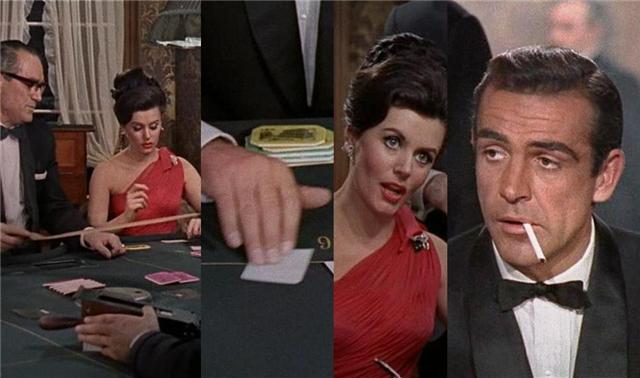
“I admire your luck, Mr…?”: luck had nothing to do with it, the casting of rough, tough Scotsman Sean Connery as 007 in the first significant James Bond film Dr No was a stroke of calculated genius – even if it certainly didn’t appear to be a trump move at the time
On October 5 1962, a critical, pivotal event took place, something that would ensure the cultural zeitgeist – if not the entire world itself – would never be the same again. For it was on this day that the cinematic James Bond was arguably born, with the world premiere of the first Eon-produced 007 film adventure Dr No being staged at the salubrious Odeon Cinema in London’s ritzy Leicester Square.
And rolling up at the venue that evening (surely the biggest night of his professional life to date) was the man who was playing the British superspy himself, Sean Connery. If anything was likely to prove a fly – nay, a scary, creepy-crawly tarantula – in the big-screen Bond’s ointment before he’d really got begun then, by rights, it should have been Connery. To many an observer at the time, his casting as the three-dimensional incarnation of author Ian Fleming’s hero had raised more than a Roger Moore-style eyebrow. Why? Because – and, as we’re talking about Sean Connery here, it almost seems impossible to contemplate this – the Big Tam was a nobody. He’d been plucked from relative obscurity to lead a $1million-budgeted Anglo-Hollywood action adventure; it was a big risk with bells on and it could have gone tits up. But, of course, it didn’t.
Indeed, unquestionably the casting of Connery was one of the reasons why Dr No went on to become such a box-office triumph, setting the whole 007 tyre-slashing Aston Martin wheel in motion. But given his lack of standing in the movie business, how on earth did he land the role? And given his relative lack of leading man acting experience, how come was he such an instant, indubitable success? This, my friends (the latest post in this blog’s continuing series celebrating the movie Bond‘s 50th anniversary), is that story.
Connery primarily owed his casting – and, arguably, success – as James Bond to three men: Dr No‘s producers Albert R ‘Cubby’ Broccoli and Harry Saltzman, and its director Terence Young, but certainly not to the character’s original literary creator Ian Fleming. When the latter heard the Scot had landed the role, he apparently dismissed him as an ‘overgrown stuntman’. He would eventually reverse this opinion, but taking a look at Connery’s credentials you can understand where his priggish, even snobbish stance came from.
.
.
Hailing from the hard, working-class Edinburgh neighbourhood of Fountainbridge, Thomas Connery had earned his nickname ‘Big Tam’ by, well, growing bigger and taller than anyone else. Unsurprisingly, aged just 18 he’d begun body-building and by 21 had competed in the Mr Universe competition. Vocation-wise, he’d had odd-jobs as a lorry driver (his dad’s profession), a milkman, a boxer, a lifeguard, a coffin polisher, an artists’ nude model and he’d enjoyed/ endured a stint as a seaman in the Royal Navy. He eventually discovered his true calling when he helped out backstage at Edinburgh’s Kings Theatre and then won a small chorus line role in a touring production of the Rodgers and Hammerstein musical South Pacific. It was during this tour that, while playing football against a provincial town team, he famously caught the eye of Manchester United’s legendary manager Matt Busby, who supposedly offered him a £25 a week contract with the club. Connery turned it down; it was an actor’s life for him now.
Bit-parts in British films followed (for which he adopted the stage name Sean, actually his middle name), including the Stanley Baker vehicular vehicle Hell Drivers and Action Of The Tiger (both 1957), the latter of which, like Dr No, was directed by Terence Young. The following year he landed a major role in Paramount Pictures’ melodrama Another Time, Another Place opposite Hollywood actress Lana Turner, with whom he had a brief affair and the result of which was fisticuffs (won by Connery) with Turner’s gun-wielding boyfriend, Johnny Stompanato – who just happened to be a heavy working for LA gangster Mickey Cohen.
Mixing it up, Connery’s next starring role was as far away as anything from demonstrating a hard-man persona; it was in the Disney Irish whimsy-themed musical Darby O’Gill And The Little People (1959), in which he not only sang, but also played opposite leprechauns. And as the ’50s slipped into the ’60s, he took on Classical roles, featuring prominently in British TV productions of Anna Karenina (1960) and Shakespeare’s Henry IV (1960) and Macbeth (1961).
So far so good. Connery was slowly but surely building up a catalogue of work that could have resulted in him becoming a recognisable face on UK TV; a tough guy who’d escaped the rough and ready streets of Scotland’s capital for the respectability of the jobbing actor. What happened next, of course, changed all that. Having signed a contract with film studio Twentieth Century Fox, which he soon discovered had merely left him on the shelf like so many Hollywood hopefuls who’d done the same (his biggest role thanks to this contract was a blink-and-you’ll-miss-it appearance in 1962’s war epic The Longest Day), his agents earned their corn like never before – and surely like never since – when they set him up for a meeting with two gentlemen named Broccoli and Saltzman.

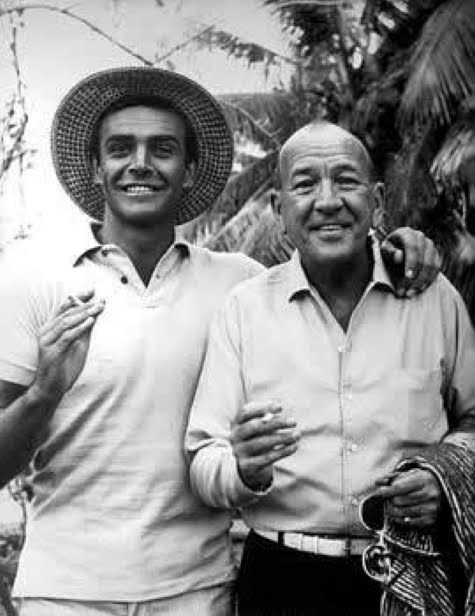
Big Tam and ex-pats: an on-set Connery confers with Bond creator Ian Fleming (l) and goofs around with Fleming’s Jamaican neighbour and one-time possible Dr No, Noël Coward (r)
The Italian-American Broccoli, formerly a New York lawyer, and the Quebec-hailing Canadian Saltzman, who liked to see himself as something of a cinematic showman, had already been in the movie business for years, albeit working separately. In 1961 they came together and formed Eon Productions, a company set up specifically to make film versions of the Bond novels (their Danjaq company – named after both men’s wives, Dana and Jaquie – was set up as a holding company for the films’ intellectual properties).
Broccoli had previously co-founded and run Warwick Films with producer Irving Allen. Warwick was based in London and used many British film professionals as crew-members on its movies (such as future Bond alumni Terence Young, screenwriter Richard Maibaum, cinematographer Ted Moore and stuntman/ stunt arranger Bob Simmons) in order smartly to save money and, thus, well, make more money. Turning out the likes of the Rita Hayworth starrer Fire Down Below (1957), Warwick was finally sunk by the box-office turkey that was The Trials Of Oscar Wilde (1960) – its accurate, but controversial homosexual themes ensuring early ’60s American censorship killed its publicity. Broccoli then was soon looking for a new Britain-based opportunity. He didn’t have to look very far.
Harry Saltzman had moved his family to Britain to further his career as a theatre producer and had quickly entered the film business. In then forming Woodfall Film Productions with dynamic young director Tony Richardson (who would go on to direct 1963’s Best Picture Oscar winner Tom Jones and marry Vanessa Redgrave) and leader of the ‘Angry Young Men’ playwrights John Osbourne, Saltzman had played a spear-heading role in launching the ‘kitchen sink’ genre of late ’50s/ early ’60s UK cinema – he personally produced both the acclaimed Look Back In Anger (1959) and The Entertainer (1960). Yet, always ambitious, he had wanted to make films that would turn a bigger profit and in 1961 he was sure he had found just the vehicle.
Having read Ian Fleming’s 1959 Bond novel Goldfinger, he had become convinced 007 was what he was looking for. Despite notorious legal disputes arising from an aborted screen-treatment for a big-screen Bond adventure knocked up by Fleming, fellow writer Jack Whittingham and eccentric film producer Kevin McClory (which saw the latter two gang up on the former when he turned the treatment into the 1961 novel Thunderball with no formal credit to either of them – read more on that here), Saltzman approached Fleming to buy the film rights of all his novels. The author assuaged and Saltzman got what he wanted (with one or two limitations), albeit for a mere six-month option and at a very pricey $500,000; always the gambler, though, he was confident he could get a first film set up within that half-year window.
.
Factfile-Factfile-Factfile-Factfile-Factfile-Factfile-Factfile-Factfile-Factfile-Factfile
- One evening before Dr No‘s premiere, the first broadcast took place of ITV’s classic spy-fi series The Saint (1962-68), starring, of course, one Roger Moore
- On the exact same day as the Dr No premiere, The Beatles’ very first single Love Me Do went on sale in the UK
- Just nine days after the premiere, the Cuban Missile Crisis began, which saw the United States and the Soviet Union come perilously close to tumbling into nuclear war, only for both to blink at the last moment – in a sort of ‘life imitates art’ manner, Dr No’s evil plan aimed to accelerate the tensions between the US and USSR and push them to nuclear war
Factfile-Factfile-Factfile-Factfile-Factfile-Factfile-Factfile-Factfile-Factfile-Factfile
.
In actual fact, Broccoli too had been interested in pursuing Bond as a big-screen project, but Irving Allen had maintained that the character and his adventures weren’t even good enough for television (Fleming’s first novel, 1953’s Casino Royale, had been adapted into a one-hour TV drama in 1954, which had been pretty forgettable) – Allen had even met with Fleming and snubbed both him and the opportunity to buy the rights for Warwick Films. But now Warwick was no more and, thanks to a meeting with legendary screenwriter Wolf Mankowitz, Broccoli learned Saltzman had bought the rights and approached him. Call it destiny, call it kismet, call it a fait accompli… call it what you will: Saltzman, the relative filmmaking novice with the ‘outside of the box’ thinking, was a natural fit with Broccoli, the hard-nosed and relatively successful industry insider; the former not willing to sell any part of the 007 rights to the latter, they agreed to put Bond on the silver screen together and, yes, chose to adapt the 1958 novel Dr No as their new company, Eon’s first.
And, in one of their canniest moves, Broccoli and Saltzman gathered around them a crew of filmmakers especially familiar to the former from his previous projects, including (as mentioned) Maibaum, Moore, Simmons and – most significantly for this tale – Young. For it was thanks to their masterstroke of hiring Terence Young as helmer of the film that the leading actor they cast as Bond went on not just to play the role, but truly inhabit it.
Speculation, wishful-thinking and, quite frankly, myth-making has been at work since the very beginning on who could have, was in the frame to and ‘should’ have played Bond. Word has it Fleming had always favoured his friend David Niven, who gets a mention in the 1964 novel You Only Live Twice as ‘the only decent man in Hollywood’ and would play one of several Bonds in 1967’s crazy spoof comedy version of Casino Royale, which ironically was co-scripted by Wolf Mankowitz. He was also apparently keen on Cary Grant – supposedly the latter would only commit to one film rather than a potential series, but surely in the end Broccoli and Saltzman would have concluded he was too old by 1962 anyway. Other names that have been bandied about include later Bond Roger Moore,who was committed to TV’s The Saint (1962-68), Patrick McGoohan on the strength of his spy drama series Danger Man (1960-68) and – rather unlikely, yet given the number of times he’s admitted to it in public, it’s probably true – future BBC newscaster Peter ‘Swingometer’ Snow auditioned too.
Apparently, Broccoli and Saltzman even ran a ‘Find James Bond’ contest in an attempt to cast the role (so the story goes, a model named Peter Anthony won this competition, the producers liking a Gregory Peck-esque quality to him), but ultimately this wasn’t how they found their man. As noted, it was through a conventional agent-set-up meeting that they met and auditioned Connery. Yet, by rights, the latter should have blown his chance here before he even got started on the gig.
.
.
An actor of little leading man experience on the screen, Connery ‘put on an act’ in the meeting – displaying an air of nonchalance; even tough-guy devil-may-care. That may have proved to work for him in media interviews for decades to come, but it was a definite gamble in clinching his first major film role. And yet it worked. Broccoli and Saltzman liked what they saw, heard and felt from him in that meeting. But apparently what sealed it was the way he walked; both felt his ‘cat-like’ gait (watch him move as Bond in the early films, it’s like a panther) as they watched him through the window of their Piccadilly office walk away down the street. This was their Bond, they decided.
Now enter Young. Although no doubt pleased to be working with a crew assembled from people familiar to him from his Warwick Films days, he wasn’t with the script. The producers had insisted on adapting Dr No as a detective-style adventure with science-fiction elements (almost playing down the espionage of the literary Bond, although admittedly there’s less of that in Dr No the novel than others), believing this would be the most palatable way to deliver an adaptation to the big-screen audience. Indeed, this may well have been one of the reasons they cast the ‘overgrown stuntman’ Connery – rather than perhaps a lither, David Niven-like, more Fleming-friendly actor – as their 007.
All the same, Young felt the script (having gone through several drafts already and a walk-out by Wolf Mankowitz) required more work still. Thus he charged credited screenwriters Richard Maibaum, Johanna Harwood and Berkely Maher to inject humour into the proceedings. In his eyes, to appeal truly to the audience, Bond needed not only to be burly, handsome and sexy, he also had to be witty, charismatic and charming – as much, if you will, Simon Templar as Richard Hannay.
This too meant Connery needed working on. The actor wasn’t a hack, far from it, but he wasn’t James Bond – certainly not Young’s vision of James Bond. So in the few short weeks before filming began, Young took Connery under his wing and introduced him to the rarefied world of tailoring (dressing him in the suits of Anthony Sinclair, his own tailor), London’s fine dining and how to move and speak like a gentleman (forbidding Connery to talk with his hands – a Young bête noir – and embellishing his cat-like walk, while softening his Scots accent to deliver the script’s witticisms).


Shooting the breeze and suiting you, sir: Broccoli chats with Dr No cast members John Kitzmiller, Sean Connery and Ursula Andress (l); Connery fitted for an Anthony Sinclair suit (r)
In fact, over the years, many have suggested that Connery’s Bond – or even Terence Young’s Bond – was Terence Young. He may be a cold-blooded killer, a man with a razor-sharp mind and an exuder of extreme confidence and unthinking bravery, but the Bond template established in Dr No is also unquestionably a man immaculately turned-out (the best possible Saville Row tailoring, never a hair out of place and minimum body movement), a true bon vivant (an enthusiast of the finest wine and food) and possessing the charm, wit and even superiority complex of an English gentleman.
You may be sceptical of Young’s domineering influence on Connery’s performance (given how much the actor has impressed in a variety of roles throughout his long career), but an insider of the calibre of the sadly departed Canadian actress Lois Maxwell – Miss Moneypenny herself – affirmed this was exactly how the director took the star-to-be in hand. She didn’t outright claim that Connery did a Terence Young impression (given Bond’s latent power, sexiness and at times brutality – that’s all Connery – he didn’t), but she didn’t get far from it.
And by the end of filming, a star-to-be Connery most certainly was. Dr No, with its fairly modest $1million budget, brilliantly inventive, nay unforgettable sets (designed by near genius Ken Adam, but partly made of cardboard) and relative unknown leading man and supporting cast, was genuine box-office boffo. Its worldwide gross of $59.6m (inflation adjusted: $440.8m) ensured it made monstrous profits for its producers and studio backer United Artists. And, of course, thanks to his performance and unquestioned screen magnetism, Connery very quickly became a bona fide moviestar.
It would, as we all know, only get better for him – and Broccoli and Saltzman. His five further Bond films – From Russia With Love (1963), Goldfinger (1964), Thunderball (1965), You Only Live Twice (1967) and Diamonds Are Forever (1971) – rang cinema tills to the colossal combined tune of $563m, making him and them very rich men. Well, actually them supposedly richer than him, which was definitely one of several bones of contention for the star as the series continued through the ’60s and Connery the man became practically indistinguishable from Bond the character in the mass public’s mindset. Eventually then, Broccoli and Saltzman were faced with having to pull off the seemingly impossible: cast someone else as James Bond.
But, as the negative doctor might say, no… no more – all that’s for another blog post, peeps…
.
.
Playlist: Listen, my friends! ~ August 2012
In the words of Moby Grape… listen, my friends! Yes, it’s the (hopefully) monthly playlist presented by George’s Journal just for you good people.
There may be one or two classics to be found here dotted in among different tunes you’re unfamiliar with or have never heard before – or, of course, you may’ve heard them all before. All the same, why not sit back, listen away and enjoy…
.
CLICK on the song titles to hear them
.
John Barry ~ Born Free
Ron Grainer ~ Theme from Man In A Suitcase1
Love ~ You Set The Scene
Richard Harris ~ Camelot (Reprise)2
The Doors ~ Love Her Madly
Cat Stevens ~ Peace Train
John Lennon ~ #9 Dream
Can ~ I Want More
David Bowie ~ Warszawa
Gladys Knight & The Pips ~ Baby Don’t Change Your Mind
XTC ~ Senses Working Overtime
Dave Grusin ~ Theme from St. Elsewhere3
Kate Bush ~ This Woman’s Work4
.
1 The classic theme from the short-lived 1967 spy TV drama Man In A Suitcase, which later became even more recognisable as the opening theme to Chris Evans’ awesome retro-flavoured Channel 4 variety show TFI Friday (1996-2000)
2 The really rather marvellous final scene from the – in my humble opinion, at least – very underrated 1967 Hollywood adaptation of the musical Camelot
3 An extended version of the theme from the classic ’80s US medical drama St. Elsewhere (1982-88), as composed by Grusin and included on his 1985 album Night-Lines
4 From the 1988 John Hughes film She’s Having A Baby – and later released as a single accompanied by this video directed by Bush herself and featuring Blackadder’s Tim McInnerny


The red (hot) arrow: Paralympic archer Antonio Rebollo launches the Olympic flame (on the end of his arrow) towards the cauldron in maybe the greatest opening ceremony moment ever
Like a dignitary who’s just controversially cruised down an ‘Olympic Lane’ in their limousine, we’ve reached our destination, peeps – yes, it’s the finale of George’s Journal‘s celebration of post-war Summer Games past. And this last post in the series offers a look at, well, a unique and intriguing one to say the least. For the 1990s’ opening Olympic shindig (July 25-August 9) was unlike any of its forebear bonanzas and, as such, set more than one first for future Games. So, mis amigos, say ¡Hola! to Barcelona ’92…
.
The Magic
The anticipation, expectation, excitement and, yes, magic of the Olympics coming to Barcelona kicked-off when, four years before the event itself, one of the Games’ official songs was recorded and first released. Barcelona, co-written by Queen’s Freddie Mercury, which he performed alongside opera star and host city native Monseratt Caballé, reached #8 in the UK charts and received heavy airplay overseas, ensuring it was a rather brilliant advert for the Olympics-to-come. It also went on to become a hit worldwide during the event itself, not least thanks to (following Mercury’s untimely death the year before) Caballé performing it at the Games’ closing ceremony in the Olympic stadium.
That very stadium had originally been built for the 1936 Games; instead those went to Berlin, of course. And yet, the stadium would fulfill its purpose when, as Barcelona ’92’s showpiece home, it was part of a multi-venue plan that saw huge investment and construction in a down-and-out area of the city, whose development would ensure the rest of the city would finally be connected to the coast, which – along with hosting the Games and the worldwide exposure that brought – ensured Barcelona became one of Europe’s principal tourist cities, a boast it’s been able to claim practically ever since the Olympics came to town.
.
The Mascot
A huge success, Cobi the Catalan sheepdog was a cleverly ‘ethnic’ (being a Picasso-inspired Cubist-esque take on a Catalan breed of pyrenean dog) and cute creation, designed by modern artist Javier Mariscal. A ready bringer-in of the readies for the Games’ organisers, owing to his likeness appearing on all sorts of merchandise (‘Cobiana’) and starring in his own TV show The Cobi Troupe, the little but perfectly formed pooch was everywhere during the summer of ’92, including tethered as a huge inflatable at Barcelona’s waterfront (itself newly renovated for the Games) – not so little after all, then.
.
.
The Moment
Many Olympic Games opening ceremonies have produced fine moments, such as all those drummers at Beijing 2008 or the inexplicable jetpack display at Los Angeles ’84. Some have also boasted unforgettable takes on that age-old tradition, the lighting of the Olympic flame’s cauldron, the climax of the always months-long torch relay. At Tokyo ’64, a young athlete (Yoshinori Sakai) who’d been born in Hiroshima the morning the US atomic bomb devastated the city was given the job; at Atlanta ’96 it was awarded to former Olympic and three-time world heavyweight boxing champion, the legendary (and then as now afflicted by Parkinson’s Disease) Muhammad Ali and at Sydney 2000 the honour fell to Aboriginee Cathy Freeman. By contrast, the lighting of the torch at Barcelona ’92 offered no such movingly symbolic, socially aware gesture; it simply proved to be a moment of utter ebullience.
As ever, the manner of the act itself was as closely guarded a secret as the Best Picture Oscar winner always is; nobody knew just what would transpire when the penultimate ‘torch bearer’ walked towards a man stepping out of the shadows… The flame was passed from the end of the torch to the tip of an arrow slung in a bow held by the man, who proceeded to lift the bow, draw back the arrow and launch it in a long arch – the flame still burning at its tip – from one end of the stadium to the other, where it landed in and lit the cauldron (see video clip above).
In reality, the arrow overshot its assumed target, but this was deliberate (for safety reasons and because it surely would have been practically impossible to hit the exact spot in the cauldron where natural gas was emitted to provide the flame), so the man himself didn’t actually light the cauldron. But that doesn’t matter a jot – for the moment was pure theatre; surely one of the Olympics’ most magical and most fondly recalled, drawing gasps from millions around the world as they watched it happen live on TV.
For his part though, the man responsible for the moment, archer Antonio Rebollo, was cool as a cucumber – and still is, as a 1996 interview with American broadcaster NBC revealed: “There were no fears; I was practically a robot,” he said. “I focused on my positioning and reaching the target. My feelings were taken from the people who described to me how they saw it. What they felt, their emotions, their cries. This is what made me realise what the moment actually meant”. Oh, he can also claim a double Paralympic silver medal-winning performance and a bronze medal-winning one for Spain. What a guy.
.
Scene of meaning, genius teen and dream team: Derartu Tulu and Elana Meyer on a symbolic victory lap (l), adolescent diving sensation Fu Mingxia (m) and the US basketball team (r)
.
The Main Man
Derek Redmond ~ although both a one-time British 4x400m record holder and a World, European and Commonwealth Champion in the 400m proper, this English sprinter will forever be remembered for the most tragic moment of his career. Or, at least, it would have been the most tragic were it not for a surprise twist. A likely qualifier for the final of these Games’ 400m, Redmond instead found himself pulling up in pain during his semi-final race; the hamstring in his leg snapping, his Olympics over. And yet, rather than take the obvious, face- and pain-saving option of quietly leaving the track, he hobbled on with one leg. If that wasn’t surprising enough, another chap, fending off officials, quickly entered the fray – Redmond’s father, Jim. Creating a genuinely heart-warming scene, he supported his son and helped him complete the race to a standing ovation from the stadium’s crowd (see video clip below).
The episode became something of a modern Olympic legend, later being selected as the subject of an International Olympic Committe (IOC) ‘Celebrating Humanity’ video for it summing up the spirit that the Games are supposed to be all about, underneath the drive to win medals and the cynical-seeming, if necessary, corporate sponsorship so prevalent nowadays. As for Redmond and his father… just a few weeks ago the latter got to carry the London 2012 torch during its heavily media-featured relay and the former married Sharron Davies. So not too shabby really.
.
The Main Women
Derartu Tulu and Elana Meyer ~ after having raced each other for lap after lap way ahead of the rest of the field in the Women’s 10,000m final, these two athletes eventually took the gold and silver medals. However, while their respective successes were significant in themselves (Tulu, an Ethiopian, was the first black African woman to claim an Olympic gold; Meyer, a South African, rubber-stamped a positive return to the Olympics and wider international sport for her country after the fall of apartheid – until Barcelona ’92, it had been denied entry to every Games since 1960), it was what took place immediately after the race that proved unforgettable. Instead of parading individually on ‘victory laps’, these two African athletes – one black and the other a white South African – instead jogged around the stadium holding hands. Sport, like many visual artforms, has a knack of illustrating in powerful images just what’s achievable in the real world – and reflect just what has been achieved in the real world – and this sporting image was as profound as any other such you care mention.
.
.
Mentioned in dispatches
- Following the break up of the Soviet Union a year before, there was no USSR team at the Summer Olympics for the first time since 1952. Instead, the former Soviet states (excluding Lithuania, Estonia and Latvia, but including Russia, of course) competed at Barcelona ’92 as ‘Unified Team‘ and were represented by the Olympic flag – although the flags of athletes’ individual nations were raised during medal ceremonies. Indeed, these were the last Olympics at which any Soviet states would compete together
- Similarly, following the reunification of Germany in 1990, the East and West German Olympic teams combined as a single, proper German team for the first time since 1936. In actual fact, in the post-war era the IOC hadn’t allowed the two separate nations, as they then had been, to compete separately until 1968 – at Melbourne ’56, Rome ’60 and Tokyo ’64 then, it had been East and West Germany who’d competed together as ‘Unified Team’
- Owing to the recent break up of Yugoslavia (another result of the Soviet Union’s demise), Croatia, Bosnia and Herzegovina and Slovenia all participated as independent nations at these Games, but Serbia and Montenegro wasn’t allowed entry due to UN sanctions thanks to the one-time nation’s role as chief aggressor in the Yugoslav Wars (1992-95). With the arguable exception of the Albertville ’92 Winter Games, these Olympics then were the first time the world witnessed a major event (sporting or otherwise, such as Eurovision) at which were present the ‘new’ Eastern European nations we’re so familiar with today
- An old powerhouse dominated in Men’s basketball, however, in the shape of the United States – yet, thanks to a relaxing of the old amateurs-versus-professionals chestnut, the so-called American ‘Dream Team‘ rolled into town, packed full of NBA stars such as Magic Johnson, Larry Bird and, yes, the legendary Michael ‘Space Jam‘ Jordan. Unlike their disaster at Munich ’72, this American team easily took home the gold medal
- Chinese diver Fu Mingxia pulled off a truly impressive feat by winning the Women’s High Dive event, as she was only 13 years-old. Diving at this Olympics was also memorable for the spectacular view of the Barcelona cityscape it afforded
- Israeli Yael Arad became her nation’s first ever Olympic medalist when she won silver in Women’s judo – on both the 20th anniversary of the ‘Munich Massacre‘ and the 500th anniversary of the Alhambra Decree. One day later, Israel won its second ever medal, Oren Smadja’s bronze in Men’s judo
- With Carl Lewis reaching the twilight of his career, British sprinter Linford Christie had an outstanding opportunity to become ‘the fastest man on Earth’ by winning the Games’ traditional marquee event, the Men’s 100m. He duly did so and went on, for a short time, to dominate the distance, holding the Olympic, World, European and Commonwealth titles all at the same time. Sadly, though, like athletes before him and so many since, he eventually endured a doping scandal and retired in 1999, having tested positive for the anabolic steroid nandrolone. In actual fact, at Seoul ’88, Christie had tested positive for the banned substance pseudoephedrine, but unlike Ben Johnson he’d escaped sanction thanks to an IOC panel voting 11-10 in his favour (although two officials on the panel were reportedly asleep when the vote was taken). Christie also won a silver in the 4x100m Relay at Barcelona ’92
- The Women’s 100m final proved arguably more eventful than the men’s, as five women finished within 0.05 seconds of each other. A photo finish eventually revealed sprint hurdler specialist Gail Devers had won by pretty much a literal whisker. She couldn’t repeat this success in her favoured event, the 100m Hurdles, though – in the final she hit a hurdle and finished fifth. However, in Sebastian Coe-style, she did manage to defend her 100m title at Atlanta ’96, again winning in a dead heat and, again, she failed to medal in the 100m Hurdles. She also won the 100m World title in 1993 – yes, again, in a dead heat
- Further track success for Blighty came in the shape of Sally Gunnell, who won gold in the 400m Hurdles. Like Christie, she went on to win World, European and Commonwealth golds in her event – and broke the world record in her 1993 World title-winning run
- Now always considered (hopefully not too hubristically) a source for a British ‘gold rush’ whenever the Olympics roll around, cycling saw its first ever UK success at these Games when Chris Boardman got the wheels rolling by winning the 400m Individual Pursuit
- Steve Redgrave reached the middle of his marathon five-golds-in-five-consecutive-Summer-Games haul at these Olympics when he won the Coxless Pair with Matthew Pinsent. These two would win the same event four years later and make up half of the triumphant Coxless Four at Sydney 2000 where Redgrave completed his unique achievement. More British rowing glory came in the Coxed Pair, which was won by brothers Greg and Jonny Searle and cox Garry Herbert (the latter creating a classic TV moment when he blubbed uncontrollably on the medal podium as the UK national anthem played).
.


Blooming and blubbering Brits: track stars Linford Christie (left) and Sally Gunnell (right) become household names after winning gold, while cox Garry Herbert – with rowers Greg and Jonny Searle – creates an unforgettable moment as he blubs on the winners’ podium (middle)
.
The Memory
Although perhaps lacking the genuine highs and unforgettable lows of previous post-war Olympics, Barcelona ’92 certainly had a lot of, if you will, sugar without the spice – and, at the time, many were more than pleased by that. Indeed, as these were the first Summer Games to take place following the fall of the Berlin Wall and the break up of the Soviet Union, they were the first since 1960 not to be plagued by a boycott – all the nations who surely should have been there were there (including, as mentioned, South Africa; if not Serbia and Montenegro).
It may sound a little trite today, but it was true then, these games genuinely felt like a major event that reflected a new dawn; a representation of the positivity and progressiveness many hoped the 1990s would bring. As such, while the closing ceremony song Amigos Para Siempre (Friends For Life), written by Andrew Lloyd Webber and Don Black and performed by Sarah Brightman and José Carreras, was a wee bit twee, it was also perfectly fitting – and not a bad listen too, all things said (see bottom video clip).
Moreover, the city of Barcelona was a brilliant host and it was great to see a likeable major country like Spain (who, relatively speaking, hadn’t been at peace with itself for very long) finally do well at a major sporting event, not least its own. In many ways then, Barcelona ’92 was something of a prototype for the open, optimistic, friendly and successful post-millennial Olympics that have been Sydney 2000, Athens 2004, Beijing 2008 and – hopefully – will be London 2012…
.
The Medal Table
| Gold | Silver | Bronze | Total | ||
|---|---|---|---|---|---|
| 1 |  Unified Team Unified Team |
45 | 38 | 29 | 112 |
| 2 |  United States United States |
37 | 34 | 37 | 108 |
| 3 |  Germany Germany |
33 | 21 | 28 | 82 |
| 4 |  China China |
16 | 22 | 16 | 54 |
| 5 |  Cuba Cuba |
14 | 6 | 11 | 31 |
| 6 |  Spain Spain |
13 | 7 | 2 | 22 |
| 7 |  South Korea South Korea |
12 | 5 | 12 | 29 |
| 8 |  Hungary Hungary |
11 | 12 | 7 | 30 |
| 9 |  France France |
8 | 5 | 16 | 29 |
| 10 |  Australia Australia |
7 | 9 | 11 | 27 |
| 13 |  Great Britain & NI Great Britain & NI |
5 | 3 | 12 | 20 |
.
.
.











 George's Journal