They’re only rock and roll, but I like them: George’s top 10 Rolling Stones tracks

Old gold: in a career spanning 50 years, the greatest rockers in the West (alias Mick, Keith, Ronnie and Charlie, among others) have turned out some truly top tunes, but what are this blog’s all-time 10 best?
The Rolling Stones, eh? They’re everywhere right now, aren’t they? On the radio; in UK and American venues; even opposite toothy lovely Alex Jones on The One Show sofa the other night. Yup, you can’t move for the promotion and celebration of their 50th year in The ‘Biz (I don’t know, precious stone jubilees; they’re all the rage this year – Her Maj, James Bond and Melton Mowbray pork pies. All right, maybe not that last one).
Having said all that, though, Mick and Keef and co. have always been everywhere really. First the ‘dark alternative’ to The Fabs, then the ’60s-into-the-’70s survivors and then the ever ageing rockers who still couldn’t get no satisfaction (they’ve been in that incarnation most impressively for the last 30-ish years, actually).
Still, you might loathe them, but I love ’em. At their best, their bluesy, down-at-heel, genuine, quality rock is what made them enormously popular in the beginning – and what ensures they’re even more popular the whole world over as each year passes. And to mark their 50th anniversary in this wee, little corner of The ‘Net, please put up with me as I indulge you with my 10 favourite Stones tunes. Yup, someone wake up Keef, ’cause here we go…
.
.
Paint It, Black (Album: Aftermath/ US release, 1966)
.
.
Why I love it: Kicking-off the list with perhaps The Stones’ bleakest song, it is itself a list of dark, depressive things the narrator’s mind seems to have fixated on, but is driven along by an irresistible bass line, Charlie Watts’ crashing percussion and the tragically late Brian Jones’ oh-so ’60s sitar.
You’ll know it from: The closing credits of both Stanley Kubrick’s equally bleak paean to the darkness of the Vietnam experience Full Metal Jacket (1989) and, er, The Devil’s Advocate (1998).
Did you know?: It was originally recorded as something of a comedy track; the lyrics – written by Jagger – were apparently about a girl’s funeral.
.
.
Let’s Spend The Night Together (Album: Between The Buttons/ US release, 1967)
.
.
Why I love it: Perhaps my all-time favourite Stones tune… perhaps. I find it’s rolling piano and driving rhythm utterly infectious. And its constant building and building towards Mick’s “Well, m-m-m-ma“s is all kinds of wonderful. Plus, its (nowadays) almost innocent, nudge-nudge sauciness of anticipation of casual sex – deemed as outrageous back in the day – is rather delightful.
You’ll know it from: Hundreds of provincial pubs’ jukeboxes.
Did you know?: During the ‘break’ around 1:40, the percussion is provided by two policemen’s truncheons, whose owners had turned up at the recording studio because the front door had been left open.
.
.
She’s A Rainbow (Album: Their Satanic Majesty’s Request, 1967)
.
.
Why I love it: Seriously, who doesn’t love She’s A Rainbow? The album from which it comes is wilfully psychedelic p*ss-take nonsense, but the tune itself is as patently beautiful as anything the Stones have ever turned out. Its sprightly piano, use of mellotron and tambourines make one believe the band’s taking peace and love et al seriously… well, for about four minutes at least.
You’ll know it from: Recent adverts for Apple and Sony products, as well as earlier this year Kristen Wiig’s final few moments on Saturday Night Live.
Did you know?: Led Zeppelin band member-to-be John Paul Jones arranged the song’s strings.
.
.
Sympathy For The Devil (Album: Beggars Banquet, 1968)
.
.
Why I love it: An infamous classic, this one became instantly controversial for ‘confirming’ The Stones as devil worshippers in the minds of some whom felt the ever social liberalising of the ’60s was getting out of hand. With its samba-like rhythm, it’s an almost hypnotic listen, punctuated by brilliant hard guitar riffs and Jagger’s impressive lyrics.
You’ll know it from: Footage from the Altamont Speedway Free Concert in California in December 1969, at which 18-year-old Meredith Hunter died owing to heavy-handed tactics from Hells Angels, who’d been bizarrely hired as security (she, in fact, died during the performance of Under My Thumb, not this song).
Did you know?: Jagger’s lyrics were inspired from reading French writer Baudelaire and possibly Russian literary figure Mikhail Bulgakov’s novel The Master And The Margarita (1937).
.
.
Gimme Shelter (Album: Let It Bleed, 1969)
.
.
Why I love it: Possibly The Stones’ coolest song – and, ergo, one of the coolest ever recorded – Gimme Shelter is a mid-tempo rocker that slowly pulls you in and won’t let you go, not least because of Keef’s almost brass-like blaring guitar flourishes. Yet, it’s a dark piece of work. All rather apocalyptic-suggestive with guest female vocalist Merry Clayton’s continual delivery of the line “Rape, murder, it’s just a shot away… just a shot away” only somewhat tempered by her and Mick’s later line “Love, it’s just a kiss away… a kiss away“.
You’ll know it from: The 1970 Rolling Stones documentary film of the same name, the Scorsese films Goodfellas (1990), Casino (1996) and The Departed (2006) and a clutch of UK TV car adverts.
Did you know?: Merry Clayton experienced a miscarriage when she returned home following her work on the track, many claiming it was because of the effort she put into her performance on it.
.
.
Happy (Album: Exile On Main St., 1972)
.
.
Why I love it: A simple, slight, real rocking, Keith Richards tune it may be, but this primarily Keef-written and -sung effort, is indeed a truly happy, smile-inducing one. The blaring brass additions ain’t at all bad either.
You’ll know it from: Any Stones concerts you’ve seen on the box – it’s the one that always comes on around halfway through and for which Keef steps forward to croon.
Did you know?: The whole thing was pretty much conceived, performed and recorded in just four hours at Richards’ Nellcôte mansion in Southern France where the band notoriously recorded Exile On Main St.
.
.
Let It Loose (Album: Exile On Main St., 1972)
.
.
Why I love it: Long, langurous, epic and almost theatrical like the much better known You Can’t Always Get What You Want (1969), this tune – perhaps because it’s from the raw, awesome Exile On Main St. – feels more genuine and not at all contrived, despite being an obvious gospel inspired anthem. It’s slow, builds beautifully and is serenaded by soulful supporting voices and rising brass. It’s simply a thing of beauty.
You’ll know it from: Again, it features on the soundtrack to Stones fan-and-a-half Martin Scorsese’s multi-Oscar-winning movie The Departed (2006).
Did you know?: Some of the song’s lyrics come directly from American folk song Man Of Constant Sorrow; The Stones have never performed it live.
.
.
Angie (Album: Goat’s Head Soup, 1973)
.
.
Why I love it: An out-and-out acoustic ballad from the best rockers around, this really is a hell of a ballad, with beautiful guitar work from Richards and Mick Taylor, as well as Nicky Hopkin’s invaluable piano playing and an excellent, heartfelt vocal from the one, the only Mick Jagger.
You’ll know it from: Possibly German Prime Minister Angela Merkel’s CDU party’s 2005 election campaign (its use for this was far from endorsed by The Stones), as well as on almost every radio station under the sun.
Did you know?: Many have speculated on whom the ‘Angie’ of the title and lyrics is, from David Bowie’s first wife Angela to film star Angie Dickinson and even Keef’s daughter Dandelion Angela. However, in his autobiography Richards revealed ‘Angie’ was in fact heroin and the song (which he almost entirely wrote himself) about his attempt finally to kick its habit.
.
.
Fool To Cry (Album: Black And Blue, 1976)
.
.
Why I love it: An unquestionably gospel-ly offering from The Stones again, this one’s so relaxed it’s positively horizontal, a far (ahem) cry from much of their output a decade earlier. Still, it’s quality stuff, pretty irresistible and gets rather funky towards the end.
You’ll know it from: Possibly the vastly under-seen, certainly underrated film drama Beautiful Girls (1996), starring Matt Dillon, Uma Thurman, Timothy Hutton and Natalie Portman.
Did you know?: Testament to how slow-paced a track this in the band’s repertoire, Keef fell asleep while performing it on stage in Germany in ’76.
.
.
Mixed Emotions (Album: Steel Wheels, 1989)
.
.
Why I love it: Far from The Stones’ best and far from a great rock tune, this still is a fine ’80s pop/ rock song that, for me, has something truly infectious about its chorus. The sort you’ll find yourself surprisingly humming or singing under your breath hours after you last heard it. It’s also testament to how these veteran rockers could still come up with a decent tune nearly 30 years after they first came together.
You’ll know it from: Most likely on the compilation albums Jump Back: The Best Of The Rolling Stones (1993) and Forty Licks (2002).
Did you know?: It was the band’s last single to reach the US charts’ top 10.
.

007/50: Old dog, new tricks?: Skyfall (2012) ~ Review


.
Directed by: Sam Mendes; Produced by: Michael G Wilson and Barbara Broccoli; Screenplay by: Neal Purvis, Robert Wade and John Logan; Starring: Daniel Craig, Judi Dench, Javier Bardem, Ralph Fiennes, Naomie Harris, Bérénice Lim Marlohe, Albert Finney, Ben Whishaw, Ola Rapace, Rory Kinnear and Helen McCrory; Certificate: 12A; Country: UK/ USA; Colour; Running time: 143 minutes; Release date: October 26 2012
.
Note: for those who are somehow still to see Skyfall, this review mostly features no spoilers. Mostly…
.
Ah, Great Britain in 2012. While it abounds with increasing austerity and north-of-the-border peeps (including leading politicos) are intent on dismantling the Union, at the other end of the scale the Queen’s Diamond Jubilee and – more significantly – London’s Olympics and Paralympics have reflected a multi-culturally dynamic, vibrant and tolerant nation whose capital has (supposedly) taken back its place at the very centre of the globe.
And joining that party this autumn is Blighty’s most popular hero (Bradley Wiggins aside) James Bond, celebrating his own Golden Jubilee in brand spanking new film Skyfall. The movie features London and other British locations prominently, as it marks both 007’s 50th anniversary and (more likely by happenstance than design) the aforementioned ‘UK’s 2012’. But with all this bunting hanging off it, does Skyfall work? Well, you bet your perfectly formed arse it does. And often in ways you’d probably not expect from a Bond film.
Not only is it all of 50 years since Bond debuted on the silver screen in Dr No, it’s also all of six years since Daniel Craig took on the mantle of 007 in Casino Royale and all of four years since he last appeared in the role in Quantum Of Solace. So, after only two films under his belt, he – and audiences – have had to endure the longest gap between Eon efforts within any single Bond actor’s tenure. Yet, he now definitely feels like James Bond; perhaps most of all because of his marvellous appearance in the Olympics opening ceremony insert Happy And Glorious alongside Her Maj. And, rest assured, his appearance in Skyfall only underlines the fact he’s our James Bond. Indubitably so, in fact.
And that’s because he’s no longer the wet-behind-the-ears ’00’ agent of Royale and (to a lesser extent) of Solace. He joins us in 2012 with, it seems, the years since we’ve last seen him having passed for him too. Now a properly senior, long-in-the-tooth, seen-it-all and M-trusted ‘old dog’ of the department, he’s more sardonic, less laconic; more suave, less raw; more charming and human, less harming and robotic. And yet, he’s still just as hard-as-nails, action-oriented and dangerous as he was four and six years ago respectively. He’s now just… more. More James Bond.
That’s surely to be expected in the third instalment of a successful Bond actor’s stint, though. Arguably the other major reasons why Skyfall works are not, however – its writing and directing. Taking (to some extent) previously unused inspiration from the Fleming novels You Only Live Twice (1964) and The Man With The Golden Gun (1965), the plot – shaped by screenwriters Neal Purvis, Robert Wade, John ‘Gladiator‘ Logan, Peter ‘The Queen‘ Morgan (who departed the project in pre-production) and helmer Sam Mendes – sees a presumed dead 007 having to resurrect himself just as MI6 has to resurrect itself under ambiguous bureaucrat Mallory (Ralph Fiennes) following a devastating attack on its very core at Vauxhall Cross, which takes out several operatives before more are exposed throughout the world, thanks to a grudge against Intelligence chief M (Judi Dench) from former agent Raoul Silva (Javier Bardem) being enacted in a twisted, visceral plan of evil abandon and destructive de-crediting.
.

Hold your breath and count to 10: Daniel Kleinman returns with his boldy brilliant, can’t-take-your-eyes-off-them opening titles to the tune of Adele’s awesome (name-checking) song
The strength and, thus, success of Skyfall‘s writing is its commitment to its three main characters – Bond, M and Silva. Essentially the story can be reduced (and has been come the climax) to a three-hander between the trio; Silva’s maddened plan of revenge aimed at his mother figure M, but put in action through the involvement of her other recovering ‘son’ Bond. And, don’t doubt it, following a botched pre-title mission, this miles-on-the-clock Bond is definitely in the throes of recovery, being put through his paces at a makeshift, atmospherically subterannean MI6 HQ physically, mentally and sardonically by young whippersnappers Eve (Naomie Harris’s flirtatious but green field agent) and Q (Ben Whishaw’s über-IT-savvy quartermaster for the new millennium) – one exchange sees the latter inform Bond “age is no guarantee of efficiency”, to which our hero ripostes “and youth is no guarantee of innovation”.
Indeed, the shock of the new and the potential fading of the old (eventually transisting into the reassertion of the old) is one of the main themes of this movie. Yes, Skyfall is a Bond film that has themes – it’s that sort of a flick we’re talking here. And, obviously, this is a fitting theme for the Eon effort that celebrates the series’ 50th anniversary. Not only is there Eve and Q coming up behind 007, there’s also the suggestion (a quite intelligent one) that Silva’s nihilistic worldview – that Bond and M’s belief in loyalty to and fighting for one’s country and its secrets is pathetically passé – may not be the myopic one of the two. Moreover, there’s Silva’s (and Q’s) pioneering use of the high-tech (computers and their ilk) versus Bond’s reliance on the low-tech (brawn, guns, daggers and in the climax the mechanical wonder that’s the gadgets of his Aston Martin DB5 – just how the DB5 of Craig’s Bond possesses these Goldfinger gadgets is an anomaly, admittedly, but one only continuity freaks need worry about).
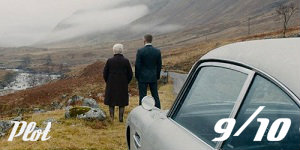
And at one point in the climax, which itself deliciously delves into the near mythical origins of the Bond character thanks to its setting in the Scottish Highlands, even the ‘old man’ persona of Bond is reversed when his father’s former game-keeper Kincade (a game Albert Finney) amusingly refers to him as a “jumped up little sh*t”. In this Straw Dogs-like high octane culmination of action, Bond’s dynamism and physical prowess is what finally seals his resurrection and sees him prevail – a climax in which director Mendes wilfully ensures no technology that features is younger than the series itself.
Indeed, much credit to the telling of Skyfall‘s dedicated and engaging if simple story (and the quality of playing by the quality cast – many of whom were attracted to the project because of the director as much as the Bond brand) must go to Mendes. The helmer of Road To Perdition (2002), Jarhead (2005), Revolutionary Road (2008) and, of course, the multi-Oscar-winning American Beauty (1999) isn’t just a genre-hopping, chameleon filmmaker, he’s also a hugely acclaimed mover-and-shaker of hot ‘event theatre’, ensuring he’d come to Bond then with a commitment not just to quality storytelling and dedicated direction of his thesps (even Skyfall‘s production allowed for his famed lead actor rehearsal period), but also genuine visual flair.
Together with his regular cinematographer Roger Deakins, Mendes ensures this Eon effort is exceptionally – sometimes truly beautifully – filmed. From the near opening shot of the partially shadowed-out face of Craig to the capture of the sweeping vista of Istanbul moments later in the pre-titles and from the modernist, sophisticated, almost sterile neon of Shanghai’s cityscape to the stark, barren beauty of Bond’s celtic ‘homeland’, the movie offers up many a memorable visual flourish. But it’s not just about the look. Mendes also shows a commanding hand when it comes controlling the movie’s tone.
.
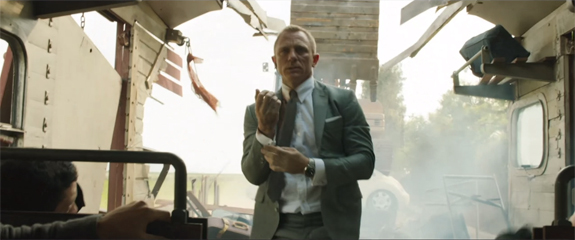
Cuff adjuster: Craig introduces a (Brosnan-esque?) sartorial tic to his 007 in the pre-titles’ Turkey-set sequence, reflective of Skyfall’s satisfyingly lighter, ‘classic Bond’ moments
Unlike in the last two sombre efforts in the series, Skyfall‘s mood and atmos isn’t set in sober stone. It’s unquestionably serious for long stretches (dealing as it does with ‘realistic’ espionage settings and shenanigans, not to mention the darkly violent finish), but switches to lighter, more traditionally ‘Bondian’ moments (the introduction of the DB5 and reminder of its passenger-ejecting capability; the fisticuffs in the Macau casino following the fine introduction of the vampish but delicately affeared Sévérine (Bérénice Marlohe) – what’s a couple of CGI-ed komodo dragons between friends?). And Mendes smoothly delivers the tonal shifts, ensuring these bits nodding to Bond of lore aren’t just crowd-pleasingly funny and satisfying, but not at all out of place in the Craig 007 era either.
Indeed, in many ways what makes Skyfall such a successful Bond film is it’s not just a satisfying follow-up to Royale and Solace, but also fits near seamlessly into the lineage of the Connery and Moore Eon eras. In addition to those ‘Bondian’ nods are Thomas Newman’s thoroughly solid score. David Arnold-esque with a reliance on electronica here and there it may be, but it also mixes things up in its cues and themes, some featuring Oriental flourishes, others pulling out all the stops orchestrally (such as the simply awesome Chimera – click on the ‘Music’ image below to hear it). All told, it sounds a little subtler, yet a little more adventurous than Arnold’s efforts. It’s only enhanced too, of course, by chart-topper Adele’s near-chart-topping, near-classic Bond tune, itself accompanied by truly classic, macabre and original opening titles from the great Daniel Kleinman.
Something Skyfall offers too that no other 007 flick has for some time is a genuinely flamboyant, genuinely memorable villain. The great Javier Bardem (deserved Oscar-winner for 2007’s No Country For Old Men) creates a marvellously unhinged, opaquely sexually ambiguous, horribly deformed, Max Zorin-esque pexoide blond villain in the shape of Raoul Silva. Sure, there’s no other baddies of note (Ola Rapace’s operative-for-hire Patrice is uttlery forgettable), but when there’s such a gloriously OTT, yet convincingly cruel and dangerous antagonist as this, who cares? Bardem’s performance is – like much from many top Eon efforts – unlikely to win an Oscar, but deserves its place in the larder of the Bond series’ best ingredients.
And ultimately, then, that too goes for Skyfall as a whole. This is a 007 escapade that continues the tenor and action-intensity of the previous Craig ventures (the pre-titles motorbike-cum-train sequence in Turkey and the foot-cum-Tube-set chase through the heart of London are both excellent), while offering the aforementioned Bond gold of old. Yet, with Mendes at the helm, it also serves up something completely different and new to the series – a tight, simple but fine human drama, nay tragedy, focused around its three major players, as well as an action climax that’s satisfyingly darker, more intense and more interesting than any other the series has so far offered. In this year of Bondian celebration, Skyfall fittingly celebrates both London and Britain at large and (very cannily) Bondness itself… and it’s great to see with oh-so noisily till-ringing box-office returns, the world is celebrating Skyfall too. So, here’s a deserving toast to our man Bond – mine’s a vodka Martini, shaken and stirred.
.
And, just to be thorough, here’s Skyfall‘s ratings according to the reviews system employed in my recent (nay, back-breaking) ‘Bondathon’ – and, thus, its ranking therein…
.




.
Adjuster: +5
.
.
Best line: “Some men are coming to kill us… we’re going to kill them first”
Best bit: The very final pair of scenes – a Bond fan’s delight
.
.
.
Final rankings
(All scores out of 100/ new entry in blue/ * denotes a non-Eon Bond film)
1. Casino Royale (2006) ~ 90
= On Her Majesty’s Secret Service (1969) ~ 90
3. Skyfall (2012) ~ 89
4. From Russia With Love (1963) ~ 88
5. The Spy Who Loved Me (1977) ~ 87
6. GoldenEye (1995) ~ 85
= Goldfinger (1964) ~ 85
8. You Only Live Twice (1967) ~ 84
9. Live And Let Die (1973) ~ 82
10. A View To A Kill (1985) ~ 75
11. Dr No (1962) ~ 74
12. Moonraker (1979) ~ 73
13. Quantum Of Solace (2008) ~ 72
14. Thunderball (1965) ~ 70
15. For Your Eyes Only (1981) ~ 69
16. Never Say Never Again (1983)* ~ 68
= Tomorrow Never Dies (1997) ~ 68
= The World Is Not Enough (1999) ~ 68
19. The Living Daylights (1987) ~ 67
20. Diamonds Are Forever (1971) ~ 66
21. Octopussy (1983) ~ 64
22. The Man With The Golden Gun (1974) ~ 62
23. Die Another Day (2002) ~ 61
24. Licence To Kill (1989) ~ 50
25. Casino Royale (1967)* ~ 48
.
.
The End of the James Bond reviews
.
.
.
007/50: The Bondathon reviews (2000s)

.
So, here it is, peeps, the final trio of reviews following the completion of my ‘Bondathon’ – a chronologically-ordered Bond film-watching marathon (check out reviews of the 1960s era here: 1 and 2; the 1970s’ here; the 1980s’ here: 1 and 2 and the 1990s’ here).
And it ends, inevitably, with the ’00s, a decade of contrasts thanks to boom-and-bust; globalisation and terrorist paranoia; Bush and Obama; QI and blinkin’ X Factor. And the cinematic Bond went through a right about-turn in the ’00s too, what with The Brozzer’s fantastical final bow Die Another Day giving way to the ‘realism’ of Daniel Craig’s Casino Royale and Quantum Of Solace. But just how do they rate and rank according to yours truly? Well, read on and find out, my dear blog-friendly friends…
.
How it works:
- The ‘Bondathon’ takes in all 24 cinematically released Bond films, from Dr No (1962) right through to Quantum Of Solace (2008) – including the ‘unofficial’ efforts Casino Royale (1967) and Never Say Never Again (1983)
- The reviews consist of 10 categories, the inclusion of which tend to define a Bond film as a Bond film (‘Plot‘, ‘Bond‘, ‘Girls‘, ‘Villains‘, ‘Action‘, ‘Humour‘, ‘Music‘, ‘Locations‘, ‘Gadgets‘ and ‘Style‘), each of which are rated out of 10, thus giving the film in question a rating out of 100 – which ensures all 24 films can be properly ranked
- There’s also an ‘Adjuster‘ for each film’s rating (up to plus or minus five points) to give as fair as possible a score according to its overall quality as a film.
.
.
.
Directed by: Lee Tamahori; Produced by: Michael G Wilson and Barbara Broccoli; Screenplay by: Neal Purvis and Robert Wade – influenced by the Ian Fleming novel Moonraker (1955) and the Kingsley Amis Bond novel Colonel Sun (1968); Starring: Pierce Brosnan, Halle Berry, Toby Stephens, Rosamund Pike, Rick Yune, Judi Dench, John Cleese, Samantha Bond, Colin Salmon, Michael Madsen, Emilio Echevarría, Michael Garevoy, Lawrence Makoare, Will Yun Lee, Kenneth Tsang, Rachel Grant and Madonna; Certificate: 12; Country: UK/ USA; Running time: 133 minutes; Colour; Released: November 20 2002; Worldwide box-office: $431.9m (inflation adjusted: $543.6m ~ 11/24*)
* denotes worldwide box-office ranking out of all 24 Bond films (inflation adjusted), according to 007james.com
.


.
Just as Connery had with Thunderball (1965) and Moore with Moonraker (1979), Pierce Brosnan suffers his ‘fourth movie mis-step’ with final effort Die Another Day. Why? It’s big, brash and overblown bunkum, not least its plot. Bond infiltrates a North Korean arms deal held by young Colonel Tan-Sun Moon, but his cover’s blown by an MI6 mole. With his operation gone tits up, 007’s incarcerated for 14 months until diplomatically swapped for Moon’s henchman Zao, who’d been caught by the West. Put out to pasture by M, our man hunts down Zao in Cuba, where he finds the latter in a DNA-face-changing clinic and meets US NSA agent Jacinta ‘Jinx’ Johnson. Tracing diamonds he took from Zao, before the latter escaped his clutches, to an Icelandic diamond mine run by Argentine tycoon Gustav Graves (who’s appeared out of nowhere during his time away), 007 travels to London to meet Graves. Reinstated by M, he’s ordered to visit a demonstration of ‘Icarus’, a diamond-powered, mega solar-power delivering space satellite, at the Icelandic mine-cum-ice-palace, where he’s shadowed by MI6 agent Miranda Frost (doubling as Graves’ assistant) and again meets Jinx. Bond finally realises Graves is Moon, having had his face DNA-changed to that of a Caucasian, and learns Frost is the latter’s accomplice, thus, the MI6 mole that betrayed him.
Ironically, as Pierce Brosnan’s 007 films took a step backwards with each new offering, he arguably stepped further forward with each new performance. By the time of Day, his Bond‘s at the height of its smooth and cool, ultra confident, yet vulnerable and human Bondness – even if in this one he’s forced to sport that Robinson Crusoe makeover following his Korean incarceration (indeed, his I’m-Bond-so-I-don’t-care walk through the hotel lobby with dreadful hair and dripping wet pyjamas is a highlight). Moreover, he delivers with panache both the inane dialogue (post-coital with a girl: “I’m so bad”/ “Even when you’re good”; the shoehorning in of the film’s title: “So you live to die another day”) and the decent lines he’s given (on a cache of diamonds hiding a bomb: “Don’t blow it all at once”; ordering his drink at an ice bar: “Vodka Martini with plenty of ice – if you can spare it”). Overall then, he’s the heartbeat of the film that, when possible, keeps it grounded and engaging – far from a bad way for him to bow out of Bondage.
.

.
Despite deploying big names as main characters in the past, the Eon series has never suffered from ‘stunt casting’; this time it definitely does. Hiring Hollywood star Halle Berry to appear opposite Brosnan as NSA operative Jinx reeks of opportunism and obviousness. There was nothing subtle about her marketing as a co-star (she shared Brosnan’s ‘Bondian pose’ on the main posters), neither is there much subtlety about her performance – not least the overdone Ursula Andress in Dr No (1962) homage that’s Jinx’s entrance, rising (less Venus-like, more orgasmic) from the sea in a bikini that just keeps Ms Berry’s bosom in place. The latter’s a competent actress, but for all her screen-time and publicity, her character’s an underwritten, clichéd Bond-as-action-girl, saddled like everyone else with hokey dialogue. Much better among the girls, though, (and nearly saving this facet of the film) is the perfectly lovely Rosamund Pike as the far from English Rose-like Miranda Frost. The Pikelet delightfully gets her teeth stuck into this duplicitous British agent, barely tolerating Bond as she sexily beds him and coming undone in her action showdown with Jinx thanks only to her hubris. Don’t doubt it, Pike’s Frost may just be the best thing in Day.
On the one hand, given Gustav Graves is supposed to be a mock-Bond clone, you could say Toby Stephens’ snidely sneering, overtly sartorial and overall Elliot Carver-like pantomimic baddie works; on the other, you could say he’s a crap villain delivered by an otherwise more than decent actor. And afraid I’ll have to go for the latter option, guys – but I’d blame ill-conceived direction from Lee Tamahori (far from his only mis-step on this flick) and the daft script much more than Stephens here. The rest of Day‘s villains are no better. Will Yun Lee’s pre-Graves Moon is a spunky young hothead, but limited only to the pre-titles; Michael Garevoy’s tecnho aide Vlad is a bit of a Boris Grishenko from GoldenEye (1995), but without the humour; and Lawrence Makoare’s heavy Mr Kil seems to exist only for a terrible pun on his moniker (“That’s a name to die for” – ouch!). In appearance alone, the movie’s best badguy is Rick Yune’s Zao, his diamond-encrusted, blue-eyed visage and half-DNA-transformed bald bonce a memorably dynamic look, but lacking any personality, let alone charisma, he’s ultimately a forgettable let-down.
.

.
In many ways, its action is Day at its worst; in others, it’s actually strangely satisfying. There’s something of the watching-a-car-crash about Bond’s bad CGI para-surfing a tidal wave with parts of Graves’ ice-speeder as the latter uses Icarus to destroy the very ice on which it was speeding, just as there is about the huge Antonov plane-set climax getting ever more ridiculous as Bond and Jinx veer the thing towards Icarus’s pathway of pure sunlight destroying everything on its way to the Korean 37th Parallel, while, respectively, Jinx and Frost and Bond and Graves (the latter wearing, yes, a Robocop-esque suit) duke it out like they’re in a Jean-Claude Van Damme ‘bargain bin’ flick from the ’80s. Better (if only by degrees) are the pre-titles’ hovercraft chase towards the South Korean border and the Icelandic ice lake-set duel between Bond’s gadget-laden Aston Martin Vanquish and Zao’s exactly the same gadget-laden green Jaguar XKR. Easily the best sequence, though, is the introductory showdown between Bond and Graves at the London fencing club. Moving from foils via several blades all the way up to broadswords, it’s little more subtle than the aforementioned scenes, but genuinely finds the right blend of self-mockery and blood-pumping spills, while standing alone as a rare example of sword-play in the cinematic Bond.
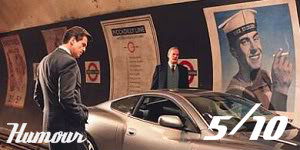
As much – if not more – than any other Bond flick, Day mostly strives for a very light tone, but too often its humour falls as flat as a wrong-side-up slice of toast. There are a few funny moments, such as the satisfying Q scene in the abandoned Tube station (its 40th anniversary homages executed well, unlike those in the rest of the flick), in which the rolling in of the invisible car prompts Bond to observe of Q: “Maybe you’ve been down here too long”. Yet there’s too many other ‘funny’ moments that make one wince; Bond and Jinx’s first meeting on the Cuban beachfront being a prime example – its dialogue, including Jinx commenting on 007’s claim he’s an ‘ornithologist’ by glancing at his crotch and punning “Boy, now there’s a mouthful”, is like something out of the craptastic ’70s Confessions series. Admittedly, now and again subtle humour glints through too, such as Brosnan and Dench’s (by now) well honed witty byplay and his interactions with Emilio Echevarría’s splendid Cuban agent Raoul, but it’s all too fleeting.
.

.
Let’s face it, the inclusion of Madonna’s techno-inspired warble-fest as this flick’s title song is pretty unforgivable – it sounds like the result of her and a producer buggering about in the recording studio after a boozy lunch. (Indeed, the inclusion of the chanteuse/ sort-of movie actress in a cameo at the start of the fencing club scene’s unforgivable too, but really that’s got nothing to do with Day‘s music). As if uninspired by what’s going on on-screen – as the great John Barry seemed to be when composing for that other 007 mis-step The Man With The Golden Gun (1974) – David Arnold turns in a score here that’s down on his usual standard. Taking up the scoring trend he started for himself in directly preceding entry The World Is Not Enough (1999), that is (like Madonna’s dire tune) sound-tracking visuals with techno-esque beats, he runs with it yet further (Gunbarrel/ Surf’s Up, Hovercraft Chase, Whiteout, Ice Palace Car Chase, Iced Inc, Antonov – take your pick). Better, though, is the recurrence of the love theme from the final scene of TWINE (Christmas In Turkey) in this one’s final scene: Going Down Together. But by far the best theme – and easily one of the best of Arnold’s entire Bond canon, mind you – is Cuba/ Cuban Car (click above image to hear it), which, yes, accompanies our man’s arrival in Havana. Full of Latin rhythms and perky brass, it weaves the Bond Theme wonderfully into a fine ethnic scene-setting cue.
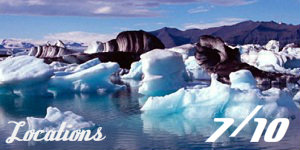
Like with too many of the Brosnan Bond films, you come away from this one thinking he’s visited more exotic locations than he actually has. Thanks to the (admittedly sensible) finding of cheaper and/ or more realisable alternatives for others, the only genuinely impressive locale in Day is Iceland with its unearthly white-blue jagged clumps of ice. Or, to be specific, Vatnajökull, on whose ice lake the explosive car chase takes place. As said, you wouldn’t know it, but the Havana and ‘Los Organos’ DNA clinic scenes were filmed in Cádiz in Spain’s Andalucia region, while the bio-domes of Cornwall’s Eden Project stand in for Graves’ Icelandic diamond mine and UK locales as exotic as Aldershot were substituted for North Korea (especially in the opening hovercraft chase). At least London’s Westminster Bridge and Buckingham Palace are the real thing, although the drowning out of the shot of the latter with The Clash’s London Calling has always been an overly modernist bone of contention for many Bond fans.
.


.
As an OTT Eon entry, it probably comes as no surprise that Day does all right on the gadgets front – one or two of them are actually quite cool, dinky, subtle and useful. Take the sonic agitator ring that, when twisted on the wearer’s finger, causes a glass surface next to which it’s placed to shatter owing to the high-pitched squeal it emits (Bond deploys it to escape capture by his foes in Graves’ ice palace bio-dome HQ thingee). Take too maybe the movie’s neatest and best ’40th anniversary homage’, a slightly sleeker and more modern-looking mini breather (updated from the one in Thunderball), which he uses for some underwater activity in Iceland. Less impressive is yet another laser cutter boasted by 007’s latest Omega Seamaster watch, a surfboard with a hidden panel that contains explosive, a knife and a mini-computer and, worst of all, Graves’ ‘dream machine’, which he uses for a couple of hours each day to keep him sane because he has permanent insomnia following his gene-therapy treatment (WTF? How does that even work?), looking as it does like a Rastafarian’s psychedelic face-mask thanks to its trailing dreadlocks.
Although from the halfway point on, Day descends into fantastical nonsense, very often it looks darn good. Indeed, at times, its style is a saving grace. In his final appearance, The Brozzer looks as dapper as ever – and when not is cool-as-you-like in his Cuban shirt and shades, bombing around in his Ford Fairlane retro roadster, smoking cigars and drinking mojitos; or alternatively escaping from HMS MI6 for a salubrious Hong Kong hotel looking like something the cat dragged in (which, for the funnies, equally works). There’s also, of course – and importantly so – the return of the Aston Martin to Bond, in the shape of the modern but beautiful Vanquish. And yet, eccentrically, what’s good about this flick’s often what’s bad about it too. Not least the Vanquish, which infamously becomes the ‘Vanish’ (finally a daft gadget too far for all 007 fans), while director Tamahori’s colouful, luxurious visuals and good pacing inexplicably give way to a jerky, The Matrix-style slo-mo gimmick, presumably employed to make scenes look ‘cooler’, and over-cooked, crazy action sequences that would fit better in Looney Tunes cartoons (the ice lake chase and the Antonov climax). And all that’s not even to mention Graves’ Robocop suit…
.
Adjuster: 0
Actually rather well executed (mostly) until Halle Berry’s entrance, if not until the jaunt to Iceland, Die Another Day from then on descends into utter overblown codswallop. Clearly the series required a re-think after this entry, but it remains something of a wicked pleasure ‘crap movie’ to lose yourself in after a boozy Friday night down the pub – and that certainly can’t be said of, yes, Licence To Kill (1989).
.

.
Best bit: Bond and Frost’s diversionary snoggage
Best line: “You know, you’re smarter than you look”/ “Better than looking smarter than you are”
.
.
.
.
.
Directed by: Martin Campbell; Produced by: Michael G Wilson and Barbara Broccoli; Screenplay by: Neal Purvis, Robert Wade and Paul Haggis – adapted from the Ian Fleming novel (1953); Starring: Daniel Craig, Eva Green, Mads Mikkelsen, Judi Dench, Giancarlo Giannini, Jeffrey Wright, Caterina Murino, Simon Abkarian, Ivana Miličević, Isaac de Bankolé, Jesper Christensen, Sébastien Foucan, Ludger Pistor, Richard Sammel, Tobias Mendes, Claudio Santamaria, Tsai Ling and Verushka; Certificate: 12; Country: UK/ USA/ Czech Republic; Running time: 144 minutes; Colour/ black and white; Released: November 14 2006; Worldwide box-office: $596.4m (inflation adjusted: $669.8m ~ 6/24*)
.

.
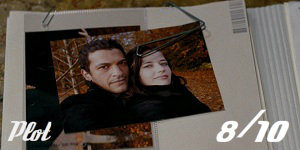
Before, when Eon’s series had gone too far one way, they jerked it back the other way, but in following up Day they do more – they ‘reboot’ the entire Bond brand. Casino Royale‘s plot opens with Bond earning his ’00’ status by killing two targets. From here he goes to Madagascar to hunt down terrorist Mollaka, whom instead of allowing to escape, he kills. Unhappy with the ‘blunt instrument’ she’s promoted, M banishes him, but he gets on with the mission – connecting Mollaka to his client, Bahamian-based fixer Alex Dimitrios, whom he seeks out in Nassau, tails to Miami Airport and prevents the blowing up a huge airliner. M next sends him after Dimitrios’s employer Le Chiffre, banker for a criminal organisation, whom has lost a fortune of clients’ money in selling their stock of the would-be blown up plane’s airline. 007 travels to Montenegro, with UK Treasury liaison Vesper Lynd, to defeat Le Chiffre at poker, ensuring he doesn’t make back the money he’s lost. Allied too by MI6 contact René Mathis and CIA agent Felix Leiter, Bond beats Le Chiffre, only for the latter to kidnap Vesper, but be mysteriously offed by his own people with Bond and Vesper’s lives spared. The two fall in love, only for him to discover Vesper, whom commits suicide, was always going to hand the winnings over to the organisation in ransom for a previous boyfriend it holds hostage. Heart-broken but now the Bond we know (more or less), he goes after the money and the next chain in the organisation, Mr White… Using Fleming’s first, slight and tragic 007 novel as its basis, this plot brilliantly blends with it modern terrorist fear and its Bond ‘becoming’ Bond subtext.
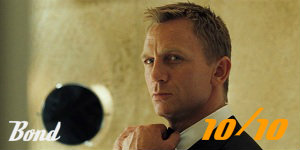
Lambasted for being too short, too ‘ugly’ and, well, blond, Daniel Craig proved many wrong when they finally saw his 007. Crudely, one may say his Bond mixes the smooth, animal-magnetim and physical prowess of Connery with the (supposedly) ruthless, hard realism of Dalton; but there’s much more to it than that. Coming to the role as perhaps its best actor yet, Craig lends him conceivability, a hell of a lot of physicality and brutish charm, yes, but his Bond too goes through one hell of a character arc – from robotic ex-SAS man to fully-fledged 007 via a heart-opening doomed love affair – the like of which, in 20 previous escapades, our hero hadn’t been allowed, not even in the otherwise awesome On Her Majesty’s Secret Service (1969). By their standards then, Craig’s performance in Royale is indeed magisterial.
.
.
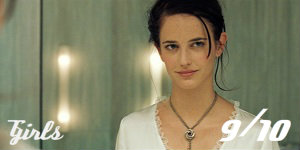
Eva Green’s Vesper Lynd is the best Bond Girl since Diana Rigg’s Tracy in Majesty’s. For this film to work, she has to be too – being that Vesper is the only other of his many girls he genuinely falls in love with (at least in Fleming, but as both flicks are ‘faithful’ Fleming adaptations that statement stands up here). In league with the screenplay’s tip-top outlining of her (a cold, confident over-achiever whose exterior belies a damaged soul), Green nails her character, playing her as cool, witty, caustic and very sexy, but as the film goes on peeling back her skin to show the vulnerability beneath and hinting at why she wears her Algerian love-knot necklace (which Bond, of course, guesses correctly), until the devastating denouement. It’s heart-breaking stuff and all because Vesper’s a complex and convincing character (despite the French Green’s slightly wobbly English accent; a very minor quibble). Royale also boasts the glamour and beauty of Caterina Murino’s Solange, whom as Dimitrios’s wife becomes the flick’s ‘sacrificial lamb’ thanks to Bond’s interference, and a blink-and-you’ll-miss-it cameo from supermodel Alessandra Ambrosio, whom along with Craig’s on-set assistant Veronika Hladikova, walks past 007 outside the Bahamian Ocean Club.
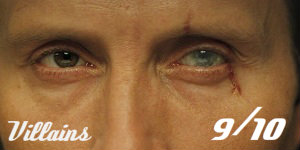
Why Royale‘s villains work so well is because they’re such cruel, ruthless, evil b*stards. They’re grown-up Bond villains in a grown-up Bond film whom, with its serious tone and twisty-turny plot, make you wonder whether they may actually get the better of our rookie hero. Chief – and best – among them is Mads Mikkelsen’s cruely handsome Le Chiffre. More a nightmarish accountant than an Alec Trevelyan, he shows he can mix it, though, by beating Bond’s crown jewels with a rope as well as trying to beat him in the pivotal poker sequence. He also has an awesome deformity – a tear duct that weeps blood. There’s also Isaac de Bankolé’s genuinely scary Ugandan warlord Obanno; Simon Abkarian’s slimy (and curly haired) bugger Dimitrios; Sébastien Foucan’s free-jumping Mollaka; Claudio Santamaria’s Miami-based terrorist Carlos; Richard Sammel’s one-lens-tinted-black-glasses-wearing and panama hat-sporting Gettler (whom appears in Fleming’s novel) and, best of all, Jesper Christensen’s coldly angular-faced and enigmatic Mr White. To say this bunch is memorable is like saying the Munch Bunch are reminiscent of foodstuffs.
.


.
One of the reasons why Royale kicks arse is because, as well as offering gripping drama, it kicks arse – boasting the series’ best action since Majesty’s. There’s the fast-paced chase and punch-up between Bond and Carlos on Miami Dade’s runway; there’s the climactic set-piece in which our man sinks a Venetian villa by shooting away its air-filled supports and shooting up the heavies; there’s the brutal fisticuffs that see Bond come to bloody blows with Obanno and his henchman (so visceral it seems to defy the flick’s ’12’ rating); there’s the would-be car chase following Vesper’s kidnapping, cut short by 007’s Aston Martin DBS swerving to avoid her in the middle of the road and executing a spectacular world-record-breaking barrel roll; and best of all there’s the sequence that opens everything: Bond’s pursuit of Mollaka. Essentially a foot chase up a crane, dizzyingly on a crane, down a crane, on road and in an Embassy (ending with our man shooting up the joint as he attempts to apprehend his quarry), it’s an utterly thrilling, vertigo-inducing sequence that not only properly introduces to the world Craig’s 007, but also Foucan’s jump-on-and-off-outdoor-things ‘sport’ parkour (free-running). youtube would never be the same again.
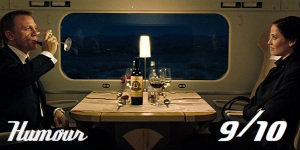
Royale is not a ‘funny’ Bond film, yet, in keeping with its overall quality, its humour is perfectly fitting and thoroughly satisfying. Mostly dialogue-driven, it’s a galaxy away from the slapstick and blunt punning of Day; far closer to the successful if slight comedy of Dr No and From Russia With Love (1963). The highlight’s the train scene in which Bond and Vesper meet. Analysing each other and trading witty barbs, the two strike up a sparring banter that continues until the poker game escalates, with Bond (after Vesper’s mock-takedown of him) answering how his lamb was with “skewered – one sympathises”. Elsewhere, Le Chiffre’s torture of a naked, strapped-to-a-chair Bond is defused – but effectively so – by humour (“I’ve got a little itch down there, would you mind”/ “To the right! To the right!”/ “Now everyone’s going to know you died scratching my balls”). Also, our man’s mis-treatment of a tourist’s car and tossing away its keys (to divert security peeps at the Ocean Club) when the latter arrogantly mistakes him for a valet are pure Bond, while Ludger Pistor’s Swiss banker lends an amusing camp lightness that’s never out of place.
.

.
Hands down, David Arnold’s Royale score is his best Eon effort. Like John Barry before him and John Williams for the Star Wars series, his music here plays a critical role in making key scenes work, thereby elevating the overall flick. His best contribution – easily his 007 repertoire’s outstanding composition – is Vesper (click above image to hear it). Piano-led and rather stripped back before it opens up orchestrally, it beautifully, melancholically, even achingly soundtracks Bond and Vesper’s doomed romance from its tentative beginnings right up to its tragic Venetian conclusion (City Of Lovers, Death Of Vesper). Also, Arnold very smartly reflects the plot’s efforts to show Bond’s development into the 007 we know by never giving us the full Bond Theme; just notes of it here and there at choice Bondian moments, often mixing them with the title song You Know My Name‘s theme, which thus works nicely as a one-off substitute for Bond’s most recognisable musical cue (Trip Aces, Dinner Jackets, Bond Wins It All). The aforementioned song, performed as it is by Chris Cornell and written by him and Arnold, is indeed an utter stonker. Finally, though, as Bond at last delivers his trademark line at the movie’s end we get The Bond Theme good and proper in the predictably titled but awesomely swaggering The Name’s Bond… James Bond.
Cannily, this Bond film plays it safe by visiting a pair of ‘classic’ series locations. The Bahamas’ New Providence and Paradise Islands are used not just for the sun-kissed beach- and Nassau-set scenes (nicely echoing Thunderball‘s locales), but also for the Madagascar chase sequence. Venice, of course, is the setting for the heart-tugging finale; as a backdrop for (doomed) romance here, it’s just as – if not more – memorable as it was in Russia and Moonraker. By contrast, Royale also offers a pair of modern classic Bond locations. The first is the languid, expansive, almost melancholic beauty of Italy’s Lake Como, where Bond both recuperates (Villa Balbianella) and Mr White resides (Villa Gaeta) and the second several locales in the Czech Repubulic – whose Barrandov and Modrany Studios are primarily used for interiors shooting. These number the capital Prague (for, surprisingly, the Miami Airport scenes among others), Locket (the Montenegro town square) and the exquisite Karlovy Vary (mostly the casino exteriors).
.


.
Like deliberately serious Eon efforts before it, Royale doesn’t really do gadgets – their minor involvement a conscious effort to get Bond back to basics, as he does quite literally in this movie. Like in Majesty’s then, our man has to use his wits (his pursuit of Mollaka) and his brawn to overcome opponents (his unceremonious killing of both Dryden’s pre-titles contact and later Obanno). In spite of that, though, a couple of devices play pivotal roles plot-wise. The first is the bug that’s injected into his wrist for M to keep tabs on her raw rookie, only to be removed when he’s kidnapped by Le Chiffre. And the second is particularly good, as is it’s the mini-defibrililator that can be accessed in a hidden compartment of the Aston Martin DBS’s dashboard and comes into its own in the tense scene when Bond has to try and save his own life after being poisoned by Le Chiffre’s girlfriend Valenka (Ivana Miličević). For sure, if he existed yet in this new timeline and/ or universe, Q would be proud of that particular gadget.
Make no mistake, Royale‘s delivery in the style department is as hard-hitting as Craig’s Bond in the Hotel Splendide’s stairwell. Thanks to the re-pairing of director Martin Campbell and his cinematographer Phil Meheux (who collaborated so well on GoldenEye), the latter film’s glamorous ‘heightened reality’ is gloriously rediscovered, not least in the capture of the Bahamian, Italian and Czech locations, but also of the ‘Casino Royale’ interiors (hats off then to veteran production designer Peter Lamont for his realisation of this perfect set). The movie’s irresistible look is finely tempered, though, by radical filming choices: the black-and-white pre-’00’-Bond pre-titles; the stark close-ups as Bond and Obanno duke it out; the coldly and austerely shot torture of our man; and the out-of-focus, severe filming of a drugged 007 trying desperately to get the poison out of his system are all departures for the Eon series, but highly effective. Perhaps most memorable of all, mind, are the little touches, such as Vesper’s devastating, unforgettable purple and black ballgowns and the fleeting focus on Craig’s incredibly blue eyes (sat in the dark in his accelerating DBS and as his face, bit by bit, is blacked out at the end of Daniel Kleinman’s dynamic, outstanding opening credits). Overall then, Royale‘s style is a veritable straight flush.
.
Adjuster: +1
Ostensibly an origin tale, Casino Royale does oh-so much more than just reset Eon’s series – from start to brilliant end, it revitalises the big-screen Bond in a way really unlike any before. An excellent adaptation of Fleming’s quite un-Bondian original Bond novel, it introduces Daniel Craig’s new 007 perfectly – hard, urgent, ruthlessly efficient and irresistible, just like the film whose beating heart he is throughout.
.

.
Best bit and best line: Bond ‘becomes’ Bond ~ “The name’s Bond, James Bond”
.
.
.
.

.
Directed by: Marc Forster; Produced by: Michael G Wilson and Barbara Broccoli; Screenplay by: Paul Haggis, Neal Purvis and Robert Wade – title taken from the Ian Fleming short story Quantum Of Solace from For Your Eyes Only (1960); Starring: Daniel Craig, Olga Kurylenko, Mathieu Amalric, Judi Dench, Giancarlo Giannini, Jeffrey Wright, Gemma Arterton, Jesper Christensen, Joaquín Cosío, David Harbour, Anatole Taubman, Rory Kinnear, Tim Piggot-Smith, Stana Katic and Simon Kassianides; Certificate: 12; Country: UK/ USA; Running time: 106 minutes; Colour; Released: October 31 2008; Worldwide box-office: $591.7m (inflation adjusted: $622.2m ~ 9/24*)
.

.
It may be the 22nd, but Quantum Of Solace is a Bond film first – the first direct sequel; its plot kicking-off just an hour after Royale ends. Arriving in the Italian city Siena, Bond (with M) questions Mr White, but the interrogation’s cut short by her turncoat bodyguard helping White escape. 007 follows a lead to Port-au-Prince, Haiti, where he meets a woman named Camille, whom he observes with ‘person of interest’ Dominic Greene. Actually a Bolivian spy trying to get to Greene’s associate, Bolivian army general Medrano, Camille attempts to assassinate the latter, only for Bond (misreading the situation) to ‘save’ her. Bond follows Greene to an opera performance in Bregenz, Austria, where the latter consorts with fellow members of Royale‘s crime organisation, now referred to as ‘Quantum’. Disrupting this meeting, he seeks out ally Mathis, whom has contacts in Bolivia, where Greene’s up to no good. There he meets Camille again and finds Greene’s ecological project is a front to launch a coup that’ll see Medrano take power, then force the latter to agree Quantum runs Bolivia’s water supply for inflated prices. Mathis is killed, but the CIA’s Felix Leiter informs Bond where the deal will be struck so he can prevent it, learn from Greene the location of Vesper’s ‘boyfriend’ (who’s responsible for her blackmailing and suicide) and Camille can take down Medrano. With its political backdrop and emotional backbone, Solace‘s story’s intriguing, engaging stuff.
While Royale‘s crowd-pleasingly perfect ending suggested Craig’s Bond ‘became’ Bond there and then, Solace refutes that. On his sophomore mission, 007’s still in his genesis; he’s still to get Vesper out of his system, find his ‘quantum of solace’ – a bit disappointing admittedly, given his ‘becoming Bond’ was done so well in Royale, but maybe for the best as it gives actor-and-a-half Craig something substantial to play with. Sure, there’s his 007’s becoming smoother and more of a playboy (his introduction to Camille; his swagger at the opera; his treatment of Fields), yet he’s also nursing a broken heart (his drunken, middle-of-the-night Martini binge; his final scene with Camille). He’s more monosyllabic, more robotic than our usual Bond; more Royale than Skyfall (2012). Craig portrays him with aplomb, of course, but when, at the film’s end, in reply to M’s assertion it’s good to have him back, he claims “I never left” and drops Vesper’s love-knot necklace in the snow, for better or worse it’s this moment he becomes Bond (cue the gunbarrel).
.

.
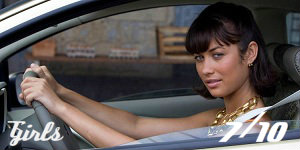
Despite her being one of the most beautiful women to have graced a Bond film and displaying decent acting chops, Olga Kurylenko’s character curiously isn’t the most memorable of Bond Girls. Camille Montes, daughter of a Bolivian army big-wig murdered by Medrano (whom then assaulted her family), is smart, gutsy and believable, thanks to her own Bond-like motivation to hunt down the bad guys and, thus, her own narrative. Yet maybe in this very sober Eon effort she’s just too realistic and not glamorous and flamboyant enough to shine as much as she might opposite Craig’s strong 007 performance. To be fair, mind, Vesper casts a long shadow over this film, thus Camille’s never going to compete in his – and maybe our – eyes. By contrast, lending far more feminine lightness is Gemma Arterton’s perky British Consulate girl in Bolivia, Fields (“…just Fields”; whose first name, the end credits reveal, is ‘Strawberry’ – Solace‘s idea of a gag that). A thorn in Bond’s side before becoming an easy lay and ally, she inevitably ends up the movie’s ‘sacrificial lamb’. She’s killed, covered deflectively in oil, in a neat but almost Die Another Day-esque homage to classic Bond lore (Jill Masterson’s death-by-gold-paint in Goldfinger).
Solace‘s villains, despite all being despicable, feel like they pose nothing like the danger Royale‘s did. And as this flick’s its sequel and so its villains belong to the same organisation that film’s did, it’s bit of a problem. It’s most true of chief baddie Mathieu Amalric’s Dominic Greene, an evil, cruel, devious, almost frog-faced terrorist wheeler-dealer – a Kronsteen from Russia for the 21st Century. But then, had they met, wouldn’t Bond have swatted Kronsteen like a fly? And that’s the point: eventually Bond does just that to Greene; in fact, he doesn’t even kill him, merely leaving Quantum to do so as he gives up the intel Bond wanted all along and is left in the desert. There’s also Joaquín Cosío’s Medrano, more an ’80s action flick baddie than Bond villain; Anatole Taubman’s Elvis, an utterly unthreatening henchman; and Simon Kassianides’ Yusef, Vesper’s ‘boyfriend’ whom Quantum pretended to hold for ransom, yet he’s ultimately more a student than worthy foe for 007. The best of the lot’s easily Jesper Christensen’s Mr White. As enigmatic as he was in Royale, he was originally to be polished off by Bond, but this scene was cut, presumably in case Eon want him and Quantum to return at a later date. Let’s hope one day they do…
.


.
A bone of contention with many Bond fans is Solace‘s action. The conventional wisdom is that, under the supervision of the Bourne film series’ second unit director Dan Bradley, if Solace‘s action sequences don’t entirely solidify the claim Craig’s Bond era has been heavily influenced by Bourne, then this flick’s action detrimentally is. A fair summation? Well, yes and no. While the pre-titles car chase offers dynamic, visceral thrills, its filming and editing’s deliberately disorientating effect irritates as much as it entertains, just as does Bond’s first hand-to-hand skirmish when he’s forced to kill a lowly Quantum operative in Haiti (it’s far from clear how the latter actually dies), while the CGI-ification of Bond and Camille’s single-parachute skydive following the aeroplane dogfight above the Bolivian desert looks rather daft. Yet the action climax in the middle of said desert at the Perla De Las Dunas hotel is satisfying; hard, violent, fiery and fraught, it comprises a real sense of danger and potential death (nay, maybe too dark realism?) for our heroes that few other Bond climaxes can claim to. Even better, though, is the best action sequence, 007’s pursuit of the Quantum-turned MI6 agent Mitchell through Siena’s colourful Palio horse-race, over its rooftops and inside its towers, churches and claustrophobic tunnels. ‘Grittily’ cut like the car chase it may be, but culminates in a riveting few seconds on a rickety scaffolding that’s nail-biting indeed.
Sober and often sombre (owing to its much better quality, it’s darker even than ’89’s Licence To Kill), Solace doesn’t do humour like other Eon efforts, but there are amusing moments. Most obviously the section featuring Fields, as 007 has fun at her inexperience of (ahem) field work by claiming they’re teachers on a sabbatical who’ve won the Lottery as cover for booking into the best hotel in town and seduces her merely by asking her help looking for the hotel room’s stationery. Yep, that line never fails (if you’re Bond). During this section too comes the moment Mathis has to ask their taxi driver, rabbiting on about how he took up his profession, to shut up while he’s on the phone trying to tie up local contacts. Owing to script issues (a writers’ strike forced helmer Forster and star Craig to improvise some dialogue), Solace struggles to deliver decent one-liners, yet Bond opening his near-written-off car’s boot at the car chase’s end to reveal where he’s stashed the accosted Mr White with “It’s time to get out” is quality stuff.
.

.
Just as it had a decade before with Tomorrow Never Dies (1997), Eon’s plumping for a profit-chasing title track in favour of a better song whose theme features prominently detrimentally affects this flick’s music. Jack White and Alicia Keys’ Another Way To Die is a pants attempt at a rocking Bond tune, while composer David Arnold’s fittingly melancholic No Good About Goodbye not only sits well with the score owing to its theme cropping up now and again, but its tone and words also fit the flick perfectly (it appears on Shirley Bassey’s excellent Arnold-produced 2008 album The Performance). In the credit column, mind, is the use of Latin jangly guitars and pipes; lending a pseudo-Spaghetti Western feel in tune with the Central/ South American settings (Have You Ever Killed Someone?/ Perla De Las Dunas/ The Dead Don’t Care About Vengeance), while the reappearance of Vesper’s theme from Royale is welcome and most effective (What’s Keeping You Awake?/ Forgive Yourself/ Camille’s Story/ I Never Left). But the score’s at its best during the the film’s best bit, the Tosca section, when the airy, smooth, memorable and scene-building Night At The Opera takes centre-stage (click on above image to hear it).
Locations-wise, you certainly get bang for your buck from Solace – Bond jet-sets all over the shop. Most obvious and (for this film series) unique are the locales of the Americas, although such tricky filming spots are Haiti and Bolivia that Panama, Mexico and Chile double for them. All the same, they’re impressive stand-ins. Panama’s cities Colón and, er, Panama City do nicely for Port-au-Prince and La Paz (Bolivia) respectively, while the aerial sequence is filmed in the Baja California region of Mexico and the blistering, desolate Atacama Desert in Chile is used for Bolivia’s ‘Perla De Las Dunas’-set climax. Europe, of course, is represented by the seasonally-open floating opera stage at Austria’s Bregenz for the Tosca sequence and Italy’s Tuscany area of Talamone is where Mathis’s Lake Garda-set retirement home can be found, while London’s arts venue The Barbican doubles for the outside of MI6’s HQ. Best of all, though, is the oh-so Italian, picturesque cool of Siena with its Palio horse-race – a Bond film location-and-a-half that one.
.


.
If Royale stripped back the Bond film gadgets quotient, then Solace deepens this trend. Our man’s only proper device is a mobile phone (a Sony Ericsson C902 for those who care), which he deploys as, er, a mobile phone. Granted, it’s connected to MI6’s data files so he can receive intel on Greene immediately he needs it, but now just four years on he could probably do the same through an app. Admittedly, it can also display the faces of photographed individuals when the shooter has merely managed to capture them from the side, which is demonstrated as 007 picks off Quantum members at their Tosca meeting. But then you can probably get an app for that too now. The only other gadgets this film are the cool earpieces the Quantum peeps (and Bond) wear along with their natty ‘Q’ lapel pins at the opera and the rather pointless, out of place touchscreen data desk thing at MI6 HQ. It’s stylish and impressive, but surely more fitting for Star Trek or Star Wars. Or Die Another Day.
At one point Camille comments ‘there’s something horribly efficient’ about Bond – that could be said of Solace‘s style. Not only does helmer Forster employ starkly clean yet cool shots (Bond in a black shirt against a Kubrick-esque, totally white corridor; M and Rory Kinnear’s Tanner exiting an ultra-high tech MI6 set this film inside the almost cruelly modernist Barbican), he also sometimes cuts dramatic scenes to within an inch of their lives, ensuring dialogue from one shot overlaps into the next few ones (Bond’s suspension by M in the hotel room; his and Camille’s journey from the desert back to La Paz on foot and then in a bus). Mind, all this is done with aplomb and sophistication. And ‘sophisticated’ really is the word when it comes to Solace‘s look. This is a Bond movie that contains some artily satisfying visual flourishes; not the ‘New Wavey’ touches of Majesty‘s, but beautiful brief imagery such as a slo-mo flourishing flag as MK12’s (admittedly underwhelming) main titles segue into Siena’s Palio, a lizard relaxing on a desert rock as we move into the climax and a second-long focus on ornamental coloured balls in a bowl in the Perla De Las Dunas. It may all sound facetious, but makes quite the impression, as does the climax’s desert setting, an unendingly oppressive expanse that mirrors our hero’s emotional turmoil. Clever.
.
Adjuster: 0
Short and sweet (or rather, sour), the mere hour-and-three-quarters-long Quantum Of Solace is the Bond film gone art-house. Sort of. An intriguing, often surprising, almost experimental Eon entry, its near unremittingly bleak tone may put off some, just as its blink-and-you’ll-miss-it edited action may put off others, but it remains a solid, desert-set dessert of a sequel to the main course that’s Casino Royale.
.

.
Best bit: The Tosca opera sequence
Best line: “Can I offer an opinion? I think you people really should find a better place to meet”
.
.
.
Rankings
(All scores out of 100/ new entries in blue/ * denotes a non-Eon Bond film)
1. Casino Royale (2006) ~ 90
= On Her Majesty’s Secret Service (1969) ~ 90
3. From Russia With Love (1963) ~ 88
4. The Spy Who Loved Me (1977) ~ 87
5. GoldenEye (1995) ~ 85
= Goldfinger (1964) ~ 85
7. You Only Live Twice (1967) ~ 84
8. Live And Let Die (1973) ~ 82
9. A View To A Kill (1985) ~ 75
10. Dr No (1962) ~ 74
11. Moonraker (1979) ~ 73
12. Quantum Of Solace (2008) ~ 72
13. Thunderball (1965) ~ 70
14. For Your Eyes Only (1981) ~ 69
15. Never Say Never Again (1983)* ~ 68
= Tomorrow Never Dies (1997) ~ 68
= The World Is Not Enough (1999) ~ 68
18. The Living Daylights (1987) ~ 67
19. Diamonds Are Forever (1971) ~ 66
20. Octopussy (1983) ~ 64
21. The Man With The Golden Gun (1974) ~ 62
22. Die Another Day (2002) ~ 61
23. Licence To Kill (1989) ~ 50
24. Casino Royale (1967)* ~ 48
.
.
The James Bond reviews will return…
.
.
.


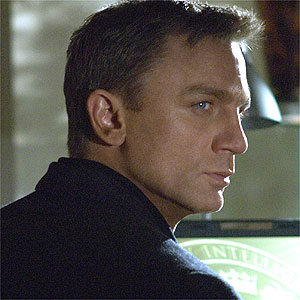
Three (not) of a kind: Timothy Dalton (left), Pierce Brosnan (middle) and Daniel Craig (right) offered very different incarnations of 007 – and three very eventful passings-on of the Bond actor baton
For an entire generation (and-a-half) there’d only ever been two proper James Bonds: Sean Connery and Roger Moore. Loosely speaking, Connery had been the Bond of the ’60s and Moore the Bond of the ’70s and into the ’80s. However, by 1985 both the critics and the public had seemingly decided that, at the age of 58, Sir Rog should hang up the shoulder holster. They weren’t the only ones; both legendary Bond film producer Albert R ‘Cubby’ Broccoli and Moore himself agreed: ’85’s A View To A Kill would be his last Eon effort and he officially vacated the role the following year. For the fourth time then, surely the most coveted (certainly the most media-obsessively pondered on) role in all cinema was up for grabs once more – but who would grasp it and hold on to it now? (Indeed, this time around, the emphasis in that question perhaps should be on the ‘holding on to it’ part).
So, edging ever closer now to the conclusion of this blog’s season of all things 007 in celebration of Blighy’s finest‘s fiftieth anniversary on the silver screen (don’t worry, it’s not far off now), with this post – the fourth and final in the series looking back at the casting of the 007 role – we’re one step closer, peeps. But the story this post tells doesn’t actually start in 1986 – no, it starts way back when Sir Rog was firmly and happily ensconced in Bondage; to be precise, 1981.
For it was that year when a relatively young and, certainly when it came to screen acting, inexperienced Irish-born thesp met Bond’s head honcho himself, Cubby Broccoli, for the very first time – namely, one Pierce Brosnan. This wasn’t a George Lazenby-style meeting of deliberate aspiration, though, it was a perfectly cordial meeting made over dinner that, at the time, would profit neither party. The two met each other through shared acquaintance Cassandra Harris, whom at the time was playing Bond Girl ‘Countess’ Lisl in the 007 adventure Broccoli was filming, For Your Eyes Only (1981), and also happened to be Brosnan’s wife.
Over the years, myth-makers have liked to suggest that at this meeting Broccoli told Brosnan ‘one day he’d be James Bond’; whether he did or not is something that’s fun to speculate, but isn’t important. What is important, of course, is that eventually he did play the character, as is the fact it didn’t happen until nearly a decade after he expected to. Hailing from County Meath, Brosnan moved to London as a 10 year-old boy and shortly afterwards saw his very first film at the cinema – kismet-like, it was Goldfinger (1964).
.
.
Growing up, the handsome youngster drifted towards the boards and in 1975, as a novice actor, was plucked by Tennessee Williams himself to fill a role in the legendary playwright’s latest effort The Red Battery Sign. Making his film debut in the British gangster classic The Long Good Friday (1980), Brosnan moved with wife Cassandra to Hollywood in an effort to kick-start a movie career in the States. The result was him landing the lead in knockabout private eye TV show Remington Steele (1982-87), a role that saw him essay a charming, suave playboy type not a million miles away from Roger Moore’s James Bond. And then, as the popular comedy-drama reached the end of its several seasons-long run in 1986, Brosnan was tapped up by one Cubby Broccoli to replace Sir Rog and play the real thing.
This, however, is where fate first played a cruel hand in the Brosnan story. Recognising they now had a hugely hot property on their hands, Remington Steele‘s studio NBC decided to fulfil an option they had in the contract for the show they were about to cancel – by extending it to another final season. This left Brosnan very much up the proverbial creek without a paddle, for Broccoli baulked; he didn’t want to make a new Bond film (1987’s The Living Daylights) with a debuting actor who was appearing as a Bond-esque character in a TV show while the movie was in cinemas. Brosnan was let go by Broccoli and forced to film one final half-season of Remington Steele feature-length episodes – adding insult to injury, they didn’t even receive decent ratings. He’d had the 007 role in his grasp, but it had slipped through his fingers… to whom, though? Well, to an unlikely inheritor of the tux, actually.
There was very little in Timothy Dalton’s acting back catalogue that, many the layman might say, would suggest he’d become James Bond. But Cubby Broccoli had always had his beady eyes on him as a potential 007. As early as 1968 when Sean Connery had first extricated himself from Bondage after You Only Live Twice (1967), Eon Productions’ head honcho had looked at Timbo as a replacement for the next instalment On Her Majesty’s Secret Service (1969). Wisely, he swiftly removed himself from the running and the part, of course, ultimately went to George Lazenby. Wisely? Well, Dalton was only 24 at the time – surely too young to play Fleming’s hero – and, in any case, although he’d only just made his cinematic debut in the critically acclaimed, Oscar-friendly drama The Lion In Winter (1968), movies weren’t his priority.
In fact, they weren’t for much of the next 20 years of his career. Dalton’s biggest love and biggest pull as an actor was always the stage. A native of Colwyn Bay, the Welshman had fallen for the acting bug after witnessing a performance of Shakespeare’s Macbeth at the Old Vic when he was a mere 16 years-old. After training with the Royal Academy of Dramatic Arts (RADA), he quickly established his name in classical stage roles, appearing in many of the Bard’s works (with both the Royal Shakespeare Company, or RSC, and in BBC TV productions), including Henry IV Parts 1 and 2, Henry V, King Lear, Love’s Labour’s Lost and Romeo and Juliet.
.


Man and wife, trouble and strife: Brosnan with Cassandra Harris at the For Your Eyes Only premiere (l); with producers Michael G Wilson and Broccoli as he agrees to become Bond (for the first time) in ’86 (r)
Perhaps, though, it was Dalton’s lugubrious and smouldering anti-hero performances in a feature film version of Wuthering Heights (1970), a Beeb adaptation of Jane Eyre (1983) and, yes, as Prince Barin in the camp spectacular that is Flash Gordon (1980) that had most of all alerted Broccoli to his Bond potential? Who knows. It’s moot, for in 1986, with Brosnan in and then out of the 007 hotseat, it was Timbo to whom Cubby turned to jump into the Aston Martin. However, in far from the first (and far from the last) twist in this tale, Dalton was effectively taking Brosnan’s place as the new Bond following Brosnan effectively having taken his place as the new Bond. Yes, that’s right – and this fact’s often skated over in the telling of this story – it seems Dalton had actually been supposed to become Bond in ’86 from the off.
When he was once more offered to audition for Bond (many claim he was given this chance for Eyes Only too, when Sir Rog was out of contract and taking his time to decide to carry on, or at least his agent was), this time he did he take up the offer. As he’d probably expected to be, Broccoli was impressed by Dalton’s screen-test – more so than he was by future Jurassic Park (1993) star Sam Neill’s – and would have given him the part had the actor been in a position to star in the flick. For, at this stage, embroiled as he was in the over-schedule crap Brooke Shields vehicle Brenda Starr (1989) – which would sink without trace – Timbo was deemed not to be available when The Living Daylights had to begin shooting (filming of the Bond movies are tightly scheduled, as time’s money and all that).
So, now Broccoli turned to Brosnan… and then Brosnan’s Remington Steele debacle happened… and by the end of that delay things had altered with Brenda Starr‘s filming. As the latter flick was now nearing completion, Broccoli realised he could rearrange Daylights‘ filming schedule (second unit work would be extended, putting back the start of first unit work) and with Dalts now free and The Brozzer not, the former was hired. Apparently, he finished work on Brenda Starr on a Saturday, flew to the Gibraltar Bond set on the Sunday and started work on Daylights on the Monday morning. Swift work, to say the least.
As it turned out, Dalton’s overall work on Bond was swift – he only got to make two flicks. The trouble wasn’t Daylights (a relatively successful effort, it’s box-office up on A View To A Kill‘s; although both critics and audiences were lukewarm about Timbo’s sober, rather sombre Bond) and the trouble wasn’t entirely his second one Licence To Kill (despite it being both a critical and public mis-step – a dark, violent version of a 007 movie that was badly marketed and disliked by many filmgoers); the trouble was mainly what came next. In spite of Licence To Kill‘s poor reception, Dalton was always supposed to have a third stab at Bond with a film pencilled in for release in the summer of ’91, but it never materialised because Broccoli’s Eon Productions found itself enmeshed in a lengthy legal dispute with the studio that bankrolled the films, MGM/UA, which was under new management and wanted to sell the series’ TV rights without Eon’s say-so.
.
Factfile-Factfile-Factfile-Factfile-Factfile-Factfile-Factfile-Factfile-Factfile-Factfile
- Timothy Dalton starred as anti-hero Lord Asriel in a 2003 London National Theatre adaptation of Philip Pullman’s books His Dark Materials; four years later Daniel Craig played the same role in the cinematic version of the first of the trilogy, The Golden Compass
- Following his ‘sacking’ from the role of 007, Pierce Brosnan achieved artistic and existential closure by playing an anti-Bond; a washed-up, crumpled assassin in The Matador (2005), a peformance so good it earned him a Golden Globe Award nomination (Best Actor in a Comedy/ Musical)
- Dalton, Brosnan and Craig have all played Bond on the small screen as well as the big – Dalton (for right or wrong in hindsight) on UK children’s show Jim’ll Fix It! (1987), Brosnan (sort of) on variety show Muppets Tonight (1997) and Craig opposite The Queen in Happy And Glorious, the filmed insert featured in the Opening Ceremony to this summer’s London Olympics
Factfile-Factfile-Factfile-Factfile-Factfile-Factfile-Factfile-Factfile-Factfile-Factfile
.
By ’94, though, everything was settled and the delay was over, but so was Dalton as 007. Deciding that enough was enough and he was now too old for the part, he officially stepped down on April 12 to pursue further stage and occasional film work. The Marmite-esque like-it-or-loathe-it Dalton era was over and it was time for the next one… the Brosnan era. Yes, that’s right, Pierce Brosnan was now finally about to become Bond.
Following that final disappointing Remington Steele series, Brosnan’s career had seemed to go into decline; moreover, fate had played him another cruel hand when, just a few short years later in ’91, his wife Cassandra contracted ovarian cancer and died days after her 43rd birthday. Brosnan set about rebuilding his life and career, eventually landing relatively high profile roles – the lead in the 1992 adaptation of Stephen King’s virtual reality tale The Lawnmower Man and as a supporting player opposite Robin Williams in Mrs Doubtfire (1993). Then, of course, in ’94 it properly all changed as he started a relationship with his now wife Keely Shaye Smith and on June 7 he was finally announced as the fifth ‘official’ James Bond.
Somewhat riding the crest of a wave generated by a British pop culture that was more confident and at ease with itself than it had been at any point since the ’60s (thanks to Britpop music and genuinely innovative TV and cinema), the Brosnan Bond brand launched with GoldenEye (1995), which immediately rejuvenated the series, back on the big screen after a full six years away. With his debut breaking 007 box-office records (it was financially the most successful since 1979’s Moonraker), Brosnan and Eon kept up the momentum through his next two audience pleasing efforts Tomorrow Never Dies (1997) and The World Is Not Enough (1999).
Across these three films, Brosnan proved he was unquestionably the perfect suave, witty, somewhat cheeky but sexy fit for 007 for the retro ’90s. Names that had been bandied about before his casting included Sean Bean (who’d actually play GoldenEye‘s villain), Liam Neeson, Paul McGann, Lambert Wilson, Hugh Grant and even Mel Gibson, but in hindsight it’s nigh-on impossible to imagine anyone but The Brozzer as Bond during that decade.
.
.
As the world blinked into a new millennium, however, things – like they have a habit of doing so – changed again. For the overly outlandish Die Another Day (2002) would be Brosnan’s fourth and final 007 outing. It was just as financially successful as his previous Bonds, but as the dust settled following its release critics, fans and the general public agreed that in a very Moonraker-esque manner it had gone too far. Eon – now under the control of Cubby’s daughter Barbara and the former’s step-son Michael G Wilson, following his sad passing in ’96 – decided that a change in direction was needed. Not only less fantasy and more gritty ‘realism’ for the post-9/11 ’00s was the way forward, it was deemed, but also a change of leading man.
After nine years in the role and now at the age of 51, in July 2004 (with contract negotiations between him and Eon having broken down and/ or both parties having totally fallen out), Brosnan finally announced he was stepping down from the role. The truth is he may have been pushed, but we can only guess. All the same, given how popular and successful his stint as 007 had been, it was disappointing his departure from Bondage finished in the ugly, disagreeable way in which it did. But the Bond actor casting merry-go-round was about to get uglier still.
Many months before Brosnan officially vacated the role, the media were happily suggesting the usual mix of credible and inappropriate thesps to follow him – to name but a few, Clive Owen, Hugh Jackman, Christian Bale, Gerard Butler, Ioan Gruffudd, James Purefoy (of TV’s Rome fame), Colin Salmon (Robinson during the tenure of Brosnan and actually suggested by the latter), Ewan McGregor (apparently his name was bandied about at his own instigation, just for the hell of it) and, most bizarre of all, Ewan Stewart (the balding first mate in 1997’s Titanic). Yet, the media weren’t only to blame this time round. By the mid-’00s the Internet had most definitely arrived and Bond fans’ daily musings and speculations spewed out exactly the same names and more – to the extent that it became something of a twisted, symbiotic relationship; who was feeding who when it came to Bond rumour mill now? The media or the ‘Net-savvy obsessives?
Eventually, though, Eon seemed to settle on a small shortlist of actors; the only ones whom they actually screen-tested. They were Croat hunk Goran Visnjic (famous for appearing in hit TV medical drama ER), New Zealander Julian McMahon (formerly star of TV’s Nip/ Tuck), Australian Alex O’Lachlan (whose brush with 007 is still really what he’s most famous for) and two Englishman, Superman-in-waiting Henry Cavill and versatile actor Daniel Craig. Apparently, for Barbara Broccoli and Michael G Wilson (the first Eon peeps ever to face making the casting decision without Cubby’s involvement), it came down to these last two and Craig got the nod over the then 22-year-old. Yes, on October 14 2005 then he was unveiled as the sixth ‘official’ 007, even though his mum had let slip the news to a local paper beforehand, ensuring the UK tabloids ‘announced’ his casting on October 13. Ah well, nothing’s secret anymore – certainly not and incongruously (or should that be fittingly?) if it involves the world’s most famous secret agent.
.

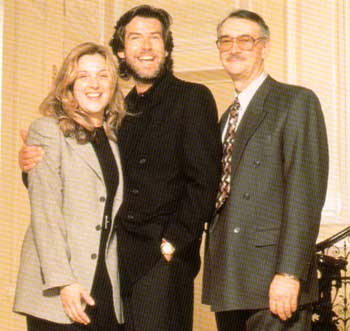
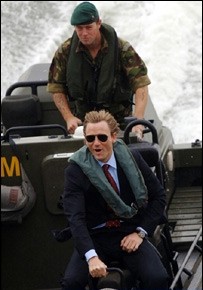
Valley boy, unbridled joy and Bond ahoy: Timothy Dalton on the set of The Living Daylights with Michael G Wilson and Cubby Broccoli in 1986 (l); Barbara Broccoli and Wilson flank Pierce Brosnan when cast in 1994 (m) and Daniel Craig en route to meet the press as the new James Bond in 2005 (r)
But in some ways, with the latest Bond actor casting made and announced to the world, it was ironically only now that the trouble began. The problem was that the world – or most specifically its media – wasn’t enormously impressed by the prospect of Daniel Craig as the next 007. The UK tabloids, in particular, seemed to get their knickers in a twist over the fact he wasn’t particularly tall (at under six feet he’s definitely the shortest actor to fill the role), dark (he’s obviously blond) and terribly – or traditionally – handsome (his almost craggy features are a world away from Brosnan’s, being more more strikingly, dynamically handsome as they are). They also delightedly ran an entirely incorrect story about how he apparently couldn’t drive a manual car while filming the next Bond film. In short, ever since Craig’s (by his own admission) rather underwhelming unveiling as the inheritor of the shoulder-holster as he wore an un-Bondian safety jacket and bounced around on an SAS-manned speedboat on the Thames, they’d had it in for him.
But, it seems, all that only spurred on the new man to do his very best in his debut film Casino Royale (2006). And, frankly, looking at his CV, it’s really no surprise he’d endeavour to deliver the goods to the utmost of his ability. Born 38 years earlier in Chester, near Liverpool, he’d learnt his trade first at London’s Guildhall School of Speech and Drama and cut his teeth in National Theatre productions and on British TV, most notably alongside future Doctor Who star Christopher Eccleston, Mark Strong and Gina McKee in the epic and awesome BBC drama Our Friends In The North (1996).
From here, he’d moved into cinema, churning out critically acclaimed performances in the dramatic films Love Is The Devil (1998), The Trench (1999), Some Voices (2000), the Sam Mendes-directed and Tom Hanks-starring Road To Perdition (2002), opposite Gwyneth Paltrow in Sylvia (2003), the Ian McEwan adaptation Enduring Love (2004) and the Steven Spielberg-helmed, Oscar-nominated thriller Munich (2005). However, it was as a stoically confident and impossibly cool drug dealer in the innovative Layer Cake (2005) that he clearly showed Eon his Bondian credentials – it was the role that maybe won him the 007 gig and most prepared him for the conceivably hard and earnest drama but irresistible and aspirational glamour of Casino Royale, Eon’s long awaited – and brilliantly realised – straight adaptation of Ian Fleming’s very first 007 novel, whose making allowed for a re-boot of the cinematic Bond himself in the shape of the bulked-up, pugnacious, Steve McQueen-handsome, Connery-esque smoothly cool Craig as Blighty’s finest.
And, as we all know, it worked with bells on. Much of the film-going public, the media and, yes, even the UK tabloids almost instantly changed their opinion of Craig as soon as they watched him ‘become’ Bond. Casino Royale broke box-office records for a Bond film (and remains the sixth most financially successful with inflation adjusted), while – perhaps the just released Skyfall aside – it may be the best reviewed and most critically acclaimed effort Eon’s ever produced, being nominated for eight BAFTA awards (Craig as Best Actor among them) as it was.
And now we’ve reached the present, with Daniel Craig having followed up his debut with almost equally as acclaimed performances in the massively successful Quantum Of Solace (2008) and Skyfall. After six official incarnations (and several, of course, in 1967’s zany Casino Royale spoof), the cinematic Bond is in as good – if not better – health than its ever been at any point in its illustrious 50-year history. What does the future hold, though? Who’ll follow Daniel Craig as the next 007 when he finally hangs up the shoulder-holster? Frankly, who knows. It’s been a long, twisty-turny, sometimes tawdry, always terrifically intriguing tale has the casting of our hero, which means we can say surely one thing’s for sure, James Bond will return – and for some time yet at that…
.
.
Playlist: Listen, my friends! ~ November/ December 2012



In the words of Moby Grape… listen, my friends! Yes, it’s the (hopefully) monthly playlist presented by George’s Journal just for you good people.
There may be one or two classics to be found here dotted in among different tunes you’re unfamiliar with or have never heard before – or, of course, you may’ve heard them all before. All the same, why not sit back, listen away and enjoy…
.
CLICK on the song titles to hear them
.
Peter Sellers ~ A Hard Day’s Night
Nancy Sinatra and Lee Hazlewood ~ Some Velvet Morning1
Mina ~ Quelli Che Hanno Un Cuor2
The Gun ~ Race With The Devil
Sarah Vaughan ~ Fly Me To The Moon
The Commodores ~ Machine Gun
Gloria Gaynor ~ (Reach Out) I’ll Be There
Eddie & The Hot Rods ~ Do Anything You Wanna Do
Graham De Wilde ~ Newsweek (Theme from Whicker’s World – 1980 onwards)
Cliff Richard ~ Wired For Sound3
The Lotus Eaters ~ The First Picture Of You
Jesus And The Mary Chain ~ Just Like Honey4
Chesney Hawkes ~ The One And Only5
.
1 An on-location performance filmed for the 1967 NBC TV special Movin’ With Nancy
2 Legendary Italian chanteuse Mina’s cover of the Burt Bacharach/ Hal David standard Anyone Who Had A Heart
3 This video of the pop ‘classic’ features the unforgettable vision of Cliff roller-skating around the concrete centre of Milton Keynes while listening to a walkman – it truly has to be seen (and heard) to be believed
4 As featured in the closing scene of the film Lost In Translation (2003)
5 Arguably one of the all-time classic one-hit wonders (it was #1 in the UK for five weeks), this Nik Kershaw-penned tune appeared both in the Chesney Hawkes-starring film drama Buddy’s Song and over the ending credits of the Michael J Fox comedy Doc Hollywood (both 1991)
.
007/50: The Bondathon reviews (1990s)
.
So, after reaching the Bond fan’s promised land that’s attending the Royal Premiere of Skyfall last week – oh yes! (my thoughts on that flick later) – it’s back to the grindstone of review-writing thanks to my ‘Bondathon’, a James Bond film-watching marathon (the 1960s era’s here: 1 and 2; the 1970s’ here and the 1980s’ here: 1 and 2) this week.
But surely the 1990s Bond film era’s far from a grindstone, boasting as it does the tank-chasing of GoldenEye, the Rupert Murdoch-bashing of Tomorrow Never Dies and the Thames-speedboating of The World Is Not Enough. Or is it? Do – as Elliot Carver’s more ethical peers (certainly in these post-phone hacking days of ours) may ask – the facts fit that story? Well, read on and find out, my blog-friendly friends…
.
How it works:
- The ‘Bondathon’ takes in all 24 cinematically released Bond films, from Dr No (1962) right through to Quantum Of Solace (2008) – including the ‘unofficial’ efforts Casino Royale(1967) and Never Say Never Again (1983)
- The reviews consist of 10 categories, the inclusion of which tend to define a Bond film as a Bond film (‘Plot‘, ‘Bond‘, ‘Girls‘, ‘Villains‘, ‘Action‘, ‘Humour‘, ‘Music‘, ‘Locations‘, ‘Gadgets‘ and ‘Style‘), each of which are rated out of 10, thus giving the film in question a rating out of 100 – which ensures all 24 films can be properly ranked
- There’s also an ‘Adjuster‘ for each film’s rating (up to plus or minus five points) to give as fair as possible a score according to its overall quality as a film.
.
.
.
Directed by: Martin Campbell; Produced by: Michael G Wilson and Barbara Broccoli; Screenplay by: Jeffrey Caine, Bruce Fierstein and Michael France – title Fleming’s Jamaican home where he wrote Bond; Starring: Pierce Brosnan, Sean Bean, Izabella Scorupco, Famke Janssen, Joe Don Baker, Robbie Coltrane, Judi Dench, Gottfried John, Alan Cumming, Tchéky Karyo, Desmond Llewelyn, Samantha Bond, Michael Kitchen, Serena Gordon and Minnie Driver; Certificate: 12; Country: UK/ USA; Running time: 130 minutes; Colour; Released: November 13 1995; Worldwide box-office: $356.4m (inflation adjusted: $529.5m ~ 12/24*)
* denotes worldwide box-office ranking out of all 24 Bond films (inflation adjusted), according to 007james.com
.

.
Finally, after six years away, the cinematic Bond is back in GoldenEye, whose plot aims to place him slap-bang in the ’90s, but with a retro glance back at his past glories. A pre-titles teaser sees 007 and MI6 colleague 006 (aka Alec Trevelyan) in deepest Soviet Russia on a mission to infiltrate and destroy a chemical weapons facility. The job soon goes awry, though, when Bond’s buddy is captured and seemingly executed. Escaping, 007 completes his mission – but without 006. Nine years later, an attack is made on the former USSR’s Severnaya space programme centre by the electromagnetic pulse-toting satellite weapon it controls (‘GoldenEye’). Presuming the attack’s ensured the ability to control the weapon’s been half-inched, a new female M puts Bond on the case. Arriving in St. Petersburg, he has CIA contact Jack Wade put him on to ex-KGB agent Valentin Zukovsky, whom has many hands in many Russian underworld pies. Reluctantly, Zukovsky leads 007 to ‘Janus’ – a big-wig in post-Soviet Ruskkie crime – whom our man finds is a ‘resurrected’ Trevelyan. Escaping from the latter with useful Severnaya ‘pooter expert Natalya Simonova, the pair trace Trevelyan to Cuba, where they discover he’s stolen the ‘GoldenEye’ and with it plans to strike the UK, destroying its economy in revenge for its treatment of his Cossack parents. Post-Soviet- and IT-centric, GoldenEye‘s narrative is wilfully modern, but also unashamedly fantastical.
With its 1986-set kick-off, is this flick pretending Brosnan became Bond that year as he (and Broccoli) had intended and the Dalton years don’t exist? Perhaps not, but no question, in his first foray as 007, The Brozzer makes up for lost time. Yet not in a swaggering manner. His Bond is smooth, urbane and ’90s male model-handsome for sure, but more quietly confident, witty and efficient than cocksure, innuendo spouting and brazen. ‘James Bond’ and ‘his new film’ are the stars here not Brosnan. There’s nothing at all wrong with him, but it’d be over his next three films he’d grow into the role. Note: it’s also with this 007 portrayal that properly for the first time (maybe or maybe not since 1969’s On Her Majesty’s Secret Service), the hero’s introspection became a Bond movie trope – his and Natalya’s “How can you be so cold”/ “It’s what keeps me alive”/ “No, it’s what keeps you alone” exchange was quite the revelation.
.

.
The first Bond film of the pro- or even post-feminist era, GoldenEye was publicised as not featuring ‘Bond Girls‘, but ‘Bond Women’ – and it actually lives up to that hype. Both female leads are excellent. Izabella Scorupco’s Natalya Simonova (two names you’d struggle to pronounce with a mouthful of Q’s baguette lunch) may just be the best ever ‘real world’ female foil to Bond. While she realistically screams at a near death experience in the exploding Severnaya base and is scared amid a machine gun battle, she’s also competent, sure of herself, a fast-learner when it comes to espionage techniques and, yes, very sexy. And I mean very sexy. Indeed, she’s the sort of Bond Girl whose presence would certainly improve lesser Eon efforts. Conversely, Famke Janssen’s marvellously monikered Xenia Onatopp is a gloriously fantastic creation, getting off on killing victims by snapping their spines with her thighs during coitus, finding firing guns similarly orgasmic and generally flouting her Georgian background by dressing vampishly, smoking cigars and speeding around in Ferraris. She’s the series’ best villainess since Thunderball‘s (1965) Fiona Volpe. GoldenEye‘s also notable for featuring Brit film star Minnie Driver’s near big screen debut as Zukovsky’s chanteuse squeeze Irina, whom humorously murders a version of Stand By Your Man.
To a nasty-piece-of-work, GoldenEye‘s villains are all intriguing, unusual, satisfying foes. First up is Alec ‘Janus’ Trevelyan. As he’s played by fit and handsome thirty-something Sean Bean, he’s not just a genuine physical match for Brosnan’s Bond, but also a dark alternative to our hero (an almost clichéd fictional villain type, sure, but pulled off well here). Not only does the fact both were one-time mates add unique spice to their tête-à-têtes, but there’s also a sense Trevelyan’s insight into Bond’s psychosis may give him a genuine edge. It’s a shame then that Bean’s accent can’t decide between being an RSC brogue or his native Sheffield tones, but what can you do? Elsewhere, Gottfried John gives a hard, almost earthy performance as former Soviet turncoat General Ourumov (a hundred times more conceivable than Steven Berkoff’s pantomimic Orlov in 1983’s Octopussy), while at the other end of the spectrum, Alan Cumming’s weaselly nerdish rogue Boris Grishenko may be an acquired taste, but I’ve a huge soft spot for him.
.
.
When it comes to GoldenEye‘s action the first thing that springs to mind is the tank chase. It’s the mid-movie money-shot – or sequence – that must have sounded irresistibly bombastic on paper (‘Bond destroys half of St. Petersburg – in a tank!’), but it’s smartly planned and executed, as 007’s borrowed battering-ram chases Ourumov’s car – the latter having kidnapped Natalya – through the sites of Russia’s most picturesque city. Yet, for me it never quite delights as much as it might – not to say it’s pedestrian, but it doesn’t hit the heights of, say, Live And Let Die‘s (1973) speedboat chase. Or those of this flick’s outstanding pre-title sequence, which opens with a very ’90s-friendly, damned dangerous looking bungee jump down a huge dam and closes with a seemingly law-of-physics-defying free-fall as Bond successfully catches up with a pilotless plane by diving after it over the edge of a cliff. Mention too should go to the destruction of the Severnaya centre, which with Natalya caught right in the middle plays like a disaster movie set-piece; explosions here, falling masonry there, life threatening danger everywhere. And top marks go to the flick’s finale. The series’ best climax since The Spy Who Loved Me (1977), it sees an underground lair go boom, while 007 faces off with 006 dizzyingly high above it on a satellite dish – with a brutal punch-up between them that echoes Bond versus Grant in From Russia With Love (1963).
In keeping with Brosnan’s laconic new 007, GoldenEye‘s humour (the tank chase apart) is less-is-more. The movie’s comedy mostly comes in the shape of sardonic wit (Xenia tries to kill Bond via her favourite method, cue his killer line as he points his PPK at her: “No more foreplay – take me to Janus”; M on MI6’s impressive state-of-the-art satellite-delivered monitoring of Severnaya’s destruction: “Unlike the CIA we prefer not to get our news from CNN”). It’s the early Eon humour of Russia and Goldfinger (1964) and, as such, visual gags include the likes of Bond’s double-take to Natalya’s sarcastic “Either way, I’m fine thank you” after they’ve just scarpered from Trevelyan’s exploding lair and, of course, the very first, nicely understated, but self-mocking tie-straighten from The Brozzer mid-way through an action sequence (the tank chase). Admittedly, the comedy provided by Robbie Coltrane’s knowingly vulgar Zukovsky and Cumming’s Boris (“I’m invincible!”) is pretty broad, but as it’s good stuff, it’s more than welcome for me.
.

.
A bone of contention for many Bond fans is GoldenEye‘s music. Few have many gripes about U2 pair Bono and The Edge’s marvellously flamboyant title song performed with Bassey-esque bombast by Tina Turner. Instead, their grief is aimed at composer Éric Serra’s idiosyncratic score. Favouring guitar-ish electronica and, to the layman’s ear, what seems like metallic sound effects over the strong showtune and/ or orchestral melody and brass highlights of the John Barry ‘Bond sound’, the man behind the music of Luc Besson’s The Big Blue (1988), Nikita (1990) and Léon: The Professional (1994) delivers a radical departure for Bond scoring here. As far as mainstream cinema goes, Serra’s contribution to Bondom is definitely avant garde, but for me, must admit, it works. Its reliance in some sequences on echoing Russian-esque bells offers the onscreen action effective eeriness, while its very electronic percussive-heavy rendition of The James Bond Theme (with synthy delivery of its high notes) is unique and pretty memorable – and suits the murky, concrete grey but unstable, unsure St. Peterburg underworld of the flick’s first half (listen to a sample by clicking on the above image). Mention too should go to Brit movie and TV ad composer John Altman, whom provided music for the tank chase owing to the producers deciding Serra’s scoring for that sequence was just that bit too radical. Ah well, may’ve been for the best.
Fittingly for quite the retro 007 movie, GoldenEye boasts a classic complementary collision of two major locations. The use of St. Petersburg in the flick’s second third could have been a ‘stunt setting’, being the first time the Eon team went to Russia to film, but it works admirably. The beautiful architecture of its wide Contintental boulevards and the crumbing Stalinist-era statues of its abandoned squares evoke a somewhat glossy, yet down-to-earth espionage-y air. By fine contrast are the bright and vertiginous beaches, jungles and vistas of Puerto Rico (standing in for Cuba) of the final third, as 007 and Natalya stretch their legs, throw on summer- and swimwear and cruise around in sportscars and planes in sunny Central America. Furthering GoldenEye‘s glamour credentials are Monaco (and its famed casino) in the post-titles scenes, while several locales in and around London double for St. Petersburg counterparts, as well as Cambridgeshire’s Nene Valley Railway (last seen in Octopussy) for that city’s train scene.
.
.
GoldenEye‘s gadgets may not be the sexiest, but they’re very worthwhile. Chief among them’s the Parker pen that, when clicked three times, becomes a bomb. It features when Boris, whom by absent-mindedly clicking it sets off the fuse, leads Bond to knock it out of his hand and begin the explosive demise of Trevelyan’s base. Bond also wears an Omega Seamaster wristwatch (now an iconic 007 accoutrement, but making its first appearance here), which boasts a laser that cuts through thick metal and a button that detonates magnetic attachable mines. Other highlights are a pair of piton guns – the first in the pre-title sequence ensures Bond safely reaches the Arkangel dam’s bottom following his bungee leap (and also offers a laser option), the second ensures he escapes the archives room in Ruskkie army HQ by firing a rappelling cord hidden in his belt, on which he swings over an impasse and out through the room’s window.
Coming as its release did in autumn ’95 at the height of a resurgent British popular culture brimming with swaggering self-confidence (Britpop, groundbreaking cinema and TV and controversial art), all of which nodded to Blighty’s ’60s and ’70s cultural heritage, GoldenEye offers not just a slick, modern version of Bondian style, but also a look and feel that owes much to Eon’s Connery era. The script features a high-tech macguffin, the Internet, email, a very feminist leading lady and Boris’s geek chic – this is unquestionably a movie of the ’90s. Yet Brosnan’s suave, perfectly moving, one-liner-delivering 007 in his Aston Martin DB5 is something of an echo of both Connery and Moore’s versions, while the glamorous but unfussy ‘heightened reality’ of the St. Petersburg sequences and a luxuriant, almost luscious palette in the Monaco and Cuba sequences thanks to cinematographer Phil Meheux harks back to the smooth richness of Goldfinger, Thunderball and You Only Live Twice (1967). Additionally, director Martin Campbell’s dynamic shots (for instance, the first showing of Brosnan’s face is merely a close-up of his eyes à la Lazenby’s introduction in OHMSS), is reminiscent of the playful, arty, almost avant garde ‘New Wavey’ cinema of the Swinging Sixties. Style-wise, GoldenEye is definitely the cinematic Bond at its best.
.
Adjuster: 0
Granted, GoldenEye is not perfect (its pace slackens in its middle third), but like The Spy Who Loved Me nearly 20 years before, it’s one hell of a greatest hits package. Marrying the style, wit and confidence of the ’60s 007 with the trademarks of Eon’s fantastical efforts (a subterranean villain’s lair and Bond Girls with innuendos for names) and the ‘real world’ aspirations of the ’80s offerings (the hard espionage of St. Petersburg and Severnaya), this is an ambitiously conceived, smartly realised renaissance Bond flick.
.
.
Best bit: The entire pre-title sequence – the best in the series
Best line: “For England, James?”/ “No, for me”
.
.
.
.

.
Directed by: Roger Spottiswoode; Produced by: Michael G Wilson and Barbara Broccoli; Screenplay by: Bruce Fierstein; Starring: Pierce Brosnan, Jonathan Pryce, Michelle Yeoh, Teri Hatcher, Joe Don Baker, Götz Otto, Judi Dench, Desmond Llewelyn, Samantha Bond, Colin Salmon, Vincent Schiavelli, Ricky Jay, Geoffrey Palmer, Julian Fellowes and Cecilie Thomsen; Certificate: 12; Country: UK/ USA; Running time: 119 minutes; Colour; Released: December 12 1997; Worldwide box-office: $339.5m (inflation adjusted: $478.9m ~ 16/24*)
.
.
The second movie of a long-serving Bond actor’s tenure is about consolidation and Tomorrow Never Dies is no exception. Its plot is a driver here – going for a ‘classic’ Bond film narrative. Our man sets out to discover who’s behind the sinking of a Royal Navy vessel, made to look like the work of the Chinese. The clues the superpower’s not to blame lie in the facts the Brit ship thought it was in neutral territory when actually in Chinese waters, while at a recent arms bazaar Bond broke up a device that sends satellite GPS systems off course was sold and media mogul Elliot Carver’s network somehow gained exclusive video footage of the ship’s sinking. 007 goes to Hamburg to monitor Carver, where he reconnects with old flame Paris (now Carver’s wife) and discovers the GPS-altering device hidden in the tycoon’s HQ. Escaping the latter’s goons, he makes for the sunken ship off the Vietnam coast and finds one of its missiles missing. There, he and Chinese operative Colonel Wai Lin are caught and, again escaping Carver’s clutches, conclude he aims to provoke war between the UK and China (pushing things further by launching the British missile into Beijing), thus creating instability in the latter power so a rogue general can gain control and grant him broadcast rights there for the next 100 years. With its Rupert Murdoch-echoing villain yet rather formulaic Bond plot, Tomorrow Never Dies‘ narrative is both ’90s modern and 007 traditional.
Following his understated 007 debut in GoldenEye, Pierce Brosnan gets the chance to flex more Bond muscles in Tomorrow. Our hero this time possesses more of a swagger and more obvious confidence, dresses with more ostentatious style and delivers more quips and cocky mannerisms. It’s as if he’s more centre-stage; somehow a bigger presence – and ultimately he’s more memorable than he was in the preceding film. The Brozzer’s Bond is developing (and fast) as a sort of cross between Connery and Moore, which is frankly perfect for the times. He does distinct himself excellently, though, in the Hamburg hotel scene, in which (very rarely for 007) he lets his guard down by loosening his bow-tie, drinking too much vodka and coming clean with Paris on why he finished with her years before. It’s arguably the most dramatically satisfying and – in its way – most genuinely Bondian moment of Brosnan’s entire tenure.
.
.
This flick’s girls promise much, but are ultimately underwhelming. Leading lady duties fall to Michelle Yeoh as Chinese 007 counterpart Wai Lin. With her martial arts movie credentials, plus not insubstantial acting abilities (2001’s Crouching Tiger, Hidden Dragon‘s certainly testament to that), Yeoh makes for an intriguing and unique Bond Girl prospect. Yet her character never really catches fire. She’s self-assured, very capable and more than comfortable in the action moments (mind, her Saigon base-bound minute or so of martial arts action feels more like the filmmakers indulging her than it does seamless fisticuffs), but despite being a one-time Miss Malaysia she’s not the most beautiful 007 squeeze and the script doesn’t invest enough in her character to make her an always engaging, eye-catching watch. Tomorrow‘s secondary girl is Teri Hatcher’s Paris Carver. More a desperate housewife than a Lois Lane, Hatcher lends her charisma and empathy along with a very American beauty, but Paris is pretty obviously ‘sacrificial lamb’ material – and thus receives little screen time. Even less featured (in a manner of speaking) is Cecilie Thomsen’s clothes-less Professor Inga Bergstrom, the Danish dolly – or boffin – bird with whom Bond shares an Oxford college bed and gives rise to the flick’s best line (see bottom of the review).
A media baron as chief of villains is a radical, dynamic departure for a Bond film – and, due to both the could-be-better screenplay (script rewrites went on during filming) and could-be-better performance from Jonathan Pryce, it’s one that rather disappoints. Unfortunately, Pryce takes too many opportunities to chew the scenery as Elliot Carver (grabbing the hair of a minion fallen asleep at his post as he berates him; performing chopsocky karate as he mocks Wai Lin and referring to the latter and Bond as ‘b*stards’ during the climax). Mind you, Carver’s über-branded media empire is well realised, as is his madness (“the distance between insanity and genius is measured only by success”). There’s also Götz Otto’s main henchman Stamper (a sort muscular Necros from 1987’s The Living Daylights) and Ricky Jay’s ursine techno-geek Henry Gupta, but both are dull as dishwater. Although, Vincent Schiavelli’s cameo as stiffly Teutonic assassin Dr Kaufman is full of dark humour thanks to understatement and faux modesty.
.

.
While Tomorrow delivers some of the best action of the Brosnan era, it also offers some of the silliest. Hands-down, the biggest highlight is the pre-titles sequence, in which our man destroys a Khyber Pass arms bazaar with the weapons of a jet fighter, then flies it and its nuclear torpedoes out of harm’s way seconds before the site’s struck by a British warship’s missile. Finely paced and thrilling, it’s simply one of the best ever Eon openings. There’s also the excellent motorcycle chase through the streets – and buildings and balconies – of Saigon, culminating in the bike’s outstanding jump over a helicopter and the underground car-pack chase in which Bond’s pursued in his remote-controlled BMW 750i car; funny and clever, a pity then it features such a dull vehicle. Less successful, though, is the daft OTT HALO jump (a parachute leap Felix Baumgartner’d proud of) and the climax aboard Carver’s stealth boat. Sure, it’s bombastic, but too much; it’s far too Die Hard for Bond. I mean, why on earth is 007 packing a machine gun in one hand and in the other his new Walther P99 pistol – the latter with its silencer on? Ridiculous. Worth noting here is it was during this flick 007 acquires the P99, ensuring it replaced the PPK as his weapon of choice for the rest of The Brozzer’s reign and up to the end of Casino Royale (2006) – an unsubtle, unnecessary effort to update the Bond brand. Thank goodness the PPK’s now back once more.
They may be less subtle than GoldenEye‘s, but Tomorrow certainly has its moments of humour – many of which tap into the broad comedy of the ’70s Moore era. Take Bond having to ‘pull out’ while brushing up on his little Danish at Oxford or the car-park chase and especially its conclusion that sees 007 ‘return’ the car by crashing it in through the window of an AVIS vehicle rental centre. There’s also a Q scene that sees the latter demonstrate how to remotely drive the BMW (only for Bond to rather ridiculously outdo him) and a scene in which Bond checks out Chinese Intelligence’s latest gadgets in Wai Lin’s Saigon HQ. Less funny though is, as mentioned, Carver’s worst, near toe-curling efforts at humour. Still, at least there’s Kaufman – although quite how Bond’s so quickly able to shrug off the latter’s murder of his one-time love in the film’s second half, during which he’s often just as chipper as ever, is a bit of a mystery.
.

.
Arguably Tomorrow‘s best facet is its music. Scored by composer David Arnold, it’s very much of the John Barry school, boasting full-out orchestral themes, blaring brass, soaring stings and an all-round style that’s the biggest and boldest to soundtrack a Bond film for many a year. Arnold unquestionably positions himself as heir to Barry here (bringing back the stonking electric guitar solo of the Bond Theme as 007 merely coolly walks about and the familiar staccato-like brass cue from Russia), a ploy that pays off big time – not least for him as it landed him the gig for the next four Eon efforts. The score’s probably at its best in White Knight, which accompanies the awesome opening sequence (click above image to hear it), and in the rich, Eastern-esque Kowloon Bay, then shows a different hand – and something of what Arnold would later bring to the table – in the car-park chase-backing Backseat Driver, with its techno-like electronic rhythms (courtesy of Propellerheads’ Alex Gifford). Surely wrongly though, the rather excellent Bassey-esque song Surrender (performed by k.d. Lang and written by Arnold with lyricist Don Black), whose theme nicely appears throughout the score, is shunted to the end titles as Sheryl Crow’s rather drab title song takes centre stage over the opening titles. Not Eon’s finest hour that decision.
Tomorrow is let down by its locations – especially its first half’s major setting. Seriously, what the hell is James Bond doing in Hamburg? I’ve nothing against the place (as a Beatles fan, I’m grateful for the crucial role it plays in their story), but exotic, unique and Bondian it’s not. Sure, its best parts on display here (rather than the parts The Beatles frequented) are handsome, but that shouldn’t be enough for 007. I mean, he might as well have visited either Manchester or Birmingham; both at their best are as handsome as Hamburg. Things pick up in the second half when Bond, Wai Lin and Carver decamp to Saigon. Sadly, though, despite what we’re offered brimming with Eastern flavour, we’re not actually in Vietnam, as the filmmakers deemed it too difficult to film there; instead it’s Bangkok and other bits of Thailand again (previously visited in 1974’s Golden Gun), and, apparently to a surprisingly large extent, mocked-up street scenes shot at Pinewood. A bit of a shame then. In which case, Tomorrow‘s most unusual and best locale may actually be Oxford and its dreaming spires, which we’re in for about 30 seconds.
.


.
Tomorrow doesn’t lack on the gadgets front, but (not unlike other aspects of this film) its devices aren’t exactly the most imaginative. Indeed, the primary gadget is, erm, a mobile phone. Mind you, it does open up to reveal a pad that can be used to remotely-drive the BMW, as well as fire electric sparks that can separately pick door locks and stun assailants with up to 2,000 volts. Wai Lin sports a rather nifty device in the shape of a bangle that doubles as a piton, which she fires into the wall of Carver’s Hamburg HQ, allowing her simply to descend by walking down the wall. Her Saigon base also boasts several gadgets, of course, most of which exist merely for comedy value, though (this scene coming off rather like Bond’s reveal of Holly Godhead’s CIA gadgets in 1979’s Moonraker). But Tomorrow‘s most significant gadget is surely the GPS encoder thing itself. A very clever piece of kit, even if it’s a little difficult to pick up exactly what it does, it’s being stolen by 007 ensures he can locate the real resting place of the Brit warship off the coast of Saigon, somewhat turning the tables on Carver, whom originally used it send the ship off-course.
For the most part, Tomorrow certainly looks good. Taking the ‘heightened reality’ glamour of GoldenEye and running with it, the result’s a very self-confident style informed by a mid- to late ’90s ‘Cool Britannia’ swagger (Bond getting briefed in M’s limousine as, flanked by outriders, it speeds through Westminster; British Navy bods on warships; the classic DB5 cruising through London and Oxford; and Bond’s look itself, dark suits under long, light brown overcoats) and the then rising phenomenon that is the global 24-hour media (as represented by Carver’s empire consisting branded buildings in Hamburg and Saigon, full of TV screens displaying constantly changing images). Palette-wise, the side may be let down a little by the sterile Hamburg and drab BMW saloon cars, but Saigon/ Bangkok throws into the mix welcome colour and exoticism, as well as the unusual sight of 007 in a baggy blue shirt and sneakers following capture by Carver’s goons, which contrasts nicely with the earlier vodka-quaffing, hotel room-residing Bond looking dishevelled but still irresistibly smoother even than a Tony Blair New Labour speech.
.
Adjuster: -2
.
A film of two halves, Tomorrow Never Dies opens as a superior if disappointingly Hamburg-set espionage thriller, flushed with style and ‘realist’ fantasy, but then ups sticks to the Far East where the careful pacing and plotting disappear just as Caver’s face-banner is ripped apart, with the action ramping up to dizzying levels. Rather a missed opportunity then, this Eon effort nonetheless gets the job done competently.
.

.
Best bit: Bond escapes from the Khyber Pass in a jet
Best line: “You always were a cunning linguist, James”
.
.
.
.

.
Directed by: Michael Apted; Produced by: Michael G Wilson and Barbara Broccoli; Screenplay by: Neal Purvis, Robert Wade and Bruce Fierstein – title taken from a passage in the Ian Fleming novel On Her Majesty’s Secret Service (1963); Starring: Pierce Brosnan, Sophie Marceau, Robert Carlyle, Robbie Coltrane, Judi Dench, Maria Grazia Cucinotta, Goldie, Desmond Llewelyn, John Cleese, Samantha Bond, Michael Kitchen, Colin Salmon, David Calder, Ulrich Thomsen, John Seru and Serena Scott Thomas; Certificate: 12; Country: UK/ USA; Running time: 128 minutes; Colour; Released: November 8 1999; Worldwide box-office: $361.7m (inflation adjusted: $491.6m ~ 14/24*)
.


.
The ‘millennium’ Bond film, The World Is Not Enough fittingly looks back as much as forward – and its plot plays a big role here. Having retrieved a suitcase of money in Bilbao, Bond returns it to its owner, British oil magnate Sir Robert King. Unbeknownst to the latter and 007, the money notes themselves are topped with chemicals that when in proximity with King’s duplicate lapel pin cause an explosion, killing him. Sensing M (an old friend of King) is hiding something, Bond gets it out of her – several years ago King’s daughter Elektra was kidnapped by former KGB killer-turned-terrorist Renard and, rather than pay the ransom, M oversaw a botched operation to rescue her, ensuring an arduous captivity. Bond realises the money ‘returned’ to King was the same amount as the ransom, thus deduces it was stolen and returned by Renard, so Elektra must be in danger again. He’s ordered to ‘shadow’ her in Azerbaijan where she now runs her father’s oil business and eventually learns she turned Renard when in captivity, scheming with him to kill her father and inherit the oil. The pair then kidnap M and hijack a submarine in order to explode its nuclear reactor in Istanbul and destroy a Russian oil route under the Bosphoros, leaving Elektra’s pipeline far more valuable. Aiming for On Her Majesty’s Secret Service-style emotional complexity with turn-of-the-century touches, TWINE‘s narrative is ambitious, but oddly underwhelming.
There’s a great drinking game to be played when watching Brosnan’s Bond in TWINE: imbibe whenever he touches his face (especially his lips), walks with a hand in one of his pockets, puts another in his suit jacket (à la Admiral Nelson) or delivers a ‘pain face’ – a letterbox-mouth grimace. Why’s it so good? It gets you plastered. Unlike in GoldenEye and Tomorrow, he noticeably falls back on suave but obvious tics here – ‘Brosnanisms’, if you will – which after more than one viewing tend to diminish his impact. Yet he isn’t alone with this rather soapy acting, practically every one of the flick’s leads are culpable (certainly Marceau and Carlyle), suggesting heavy-handed direction from helmer Michael Apted and melodrama from its scribes. For all this though,The Brozzer’s as smooth, confident and indispensable a presence here as you’d want from a 007 actor. It’s his third effort and, don’t doubt it, he’s definitely James Bond.
.

.
Impressively, Sophie Marceau could be said to be the series’ first lead villainess (although Russia‘s Lotte Lenya aka Rosa Klebb may have something to say about that). And she makes the unique Elektra King memorable – sultry, seductive, egotistical and seemingly driven to psychopathic evil owing to her father and M’s non-attempt to rescue her from Renard years before the events of TWINE. Offering undeniable beauty, charisma and youthful abandon, her quality as a thesp often shines despite the hokey dialogue with which the script lumps her and others. Indeed, this movie’s girls would certainly receive a higher score were its others to get nearer Elektra’s standards. But Denise Richards’ nuclear scientist Dr Christmas Jones is a throwaway Bond Girl. Richards tends to get the brunt of the blame here from the series’ fans, but its more the screenplay’s fault; she’s given little characterisation to work with, coming off as a far more straightforward, bimbo-ish Bond companion than Elektra in the flick’s second half (the tone’s set from her entrance, undressing to reveal a Lara Croft outfit and strutting towards Bond, and moves on little from there). There’s also Maria Grazia Cucinotta’s ‘Cigar Girl’ assassin under Renard’s employ and Serena Scott Thomas’s MI6 medic, the nicely named Dr Molly Warmflash, but both appear only briefly.
While TWINE‘s main baddie is Elektra, lead villainy duties are actually shared with Robert Carlyle’s Renard. The latter’s a missed opportunity. Starting off a chaos-loving, deranged, diminutive git whom seems a nightmare for 007, as soon as it’s apparent Elektra’s the object of his affection (an unusual twist for such a hard-arsed villain) and the brains behind their scheme, he loses his early menace, now a love-lorn freak who’ll do anything for his seductress. Still, he possesses a great bad guy deformity, a bullet lodged in his brain that, while handily and eerily making him impervious to pain, will eventually kill him. A shame then during the submarine-set climax it’s not this that does him in (which surely would have added to the poignant figure he’s become), but a a nuclear bolt launched by Bond into his stomach. Further villains number Ulrich Thomsen’s Davidov, John Seru’s (‘Vulcan’ on ITV’s Gladiators) Gabor and DJ Goldie’s Mr ‘The Bull’ Bullion, a comedic but two-faced sidekick for returning ally Valentin Zukovsky.
.
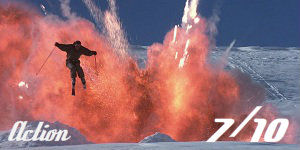

.
Things kick off in the action stakes with the pre-titles chase in which Bond in his ‘Q-Boat’ pursues The Cigar Girl on the Thames. Taking in riverside sights from Westminster through to the Millennium Dome, it’s an epic, imaginative sequence, what with 007 taking out the gun mounted on his opponent’s boat by launching his mini-vessel at it, passing under a closing bridge by plunging underwater and propelling his boat through Docklands streets and even a restaurant as he chases his quarry. As TWINE‘s action goes, it’s the highlight. The trouble with the rest is it isn’t memorable. It sounds good (007 and Elektra attacked by parahawks – motorised sleds with parachutes – in snow-topped mountains; a fire-fight between Bond and Renard in a subterranean Kazakhstan nuclear weapons facility; 007 and Christmas pursuing a bomb in one of Elektra’s oil pipes; Bond, Christmas and Zukovsky surviving an attack on his caviar factory from buzz-saw-toting helicopters; and a final showdown between our man and Renard aboard the stolen submarine). The trouble, contrasted with other modern Bonds’ action sequences, is they don’t get the pulse going. Least of all the damp squib of the submarine finale (pun intended), in which Bond seems to be giving Christmas and us a lesson in how a submarine works as much as trying to defeat his foe.
Many Bond fans blame new in-house Eon writers Purvis and Wade for TWINE‘s clunky one-liner-driven humour, but hey, they just wrote the lines – along with GoldenEye and Tomorrow scribe Bruce Fierstein, I might add – they don’t deliver them. Yes, as soon as The Brozzer offers up the pre-titles double entendre about The Cigar Girls’ ‘figures’ as if he’s spelling it out to a 13 year-old (“I’m sure they’re perfectly rounded”), we know what we’re in for. There’s too many sledge-hammer-like clever-clever puns from Brosnan and co. Still, there are comic highpoints. The last ever Desmond Llewelyn-Q scene’s one to savour (this would be the magnificent servant to the series’ final appearance), nicely introducing new quartermaster John Cleese. Plus, the return of Robbie Coltrane’s grubby Zukovsky’s a delight, getting the flick’s best line as he does – after the attack on his caviar factory it literally collapses in two halves, leaving him to exclaim: “The insurance company is never going to believe this”.
.
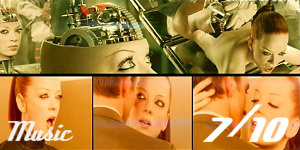
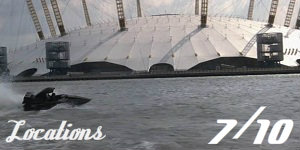
.
It has its moments, but David Arnold’s music for TWINE is a comedown after his 007 debut for Tomorrow. It’s at its best with the lilting, melancholic Elektra’s Theme that soundtracks her story during the second third of the film (click the above image to hear it). In something of a rare instance for the modern Bond, Arnold himself co-wrote the title song – along with its performers rock band Garbage – meaning its theme is woven into his score at choice intervals and ensuring, musically speaking, the movie might be more of a cohesive whole than Tomorrow. Yet, the title tune, although decent, is a bit dull. And Arnold’s insistence of falling back on repetitive techno-esque electronica to back the action sequences instead of Barry-esque brass and percussion is a mis-step (Come In 007, Your Time Is Up; Ice Bandits; Caviar Factory), doing little to enliven these under-performing sequences. However, there are moments that blend perfectly with the on-screen visuals such as Casino, a flutey and jazz-inflected version of Elektra’s Theme, and the OHMSS-style soaring brass and strings of Snow Business, as the camera swirls panoramically around the mountains Bond and Elektra are about to ski down.
In a first for the Eon series, TWINE puts London front and centre in the Bond universe (hello, Skyfall!). Showing off Westminster, Docklands and the Millennium Dome by water offers an unusual cinematic view of The Big Smoke and works well as a Bond-friendly one-sequence-only locale. Sadly, this film’s other locations don’t get the juices going as much. There’s nowt wrong with taking 007 to Central Asia; after all, the post-Cold War Bond flicks are fittingly sprinkled with after-the-collapse-of-the-USSR touches, so former Soviet locales for Brosnan’s Bond feel naturalistic and right. The trouble is Azerbaijan (and Kazakhstan, for which parts of Spain is used) is dull. It’s neither glamorous nor exotic – I mean, a strip of land featuring old oil pumps just outside Swindon doubles for it at one point and you can’t tell the difference. Things are better when old favourite Istanbul is called on for the last third, yet aside from the iconic Maiden’s Tower we don’t get that much of the colour this terrific city lent Russia. Bilbao makes a welcome but very brief cameo at the pre-titles’ start and the French Alps stand in for the ski sequence.
.

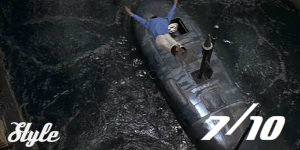
.
TWINE does well when it comes to gadgets, but none are amazing. Chief among them is the Q-Boat. It’s cool, fun and works well in its sequence, but ultimately it’s a variation on a vehicular theme in Bond – a mini-helicopter, a mini-jet and now a mini-speedboat. By now, the Bond brand isn’t complete without an Omega Seamaster and 007’s model boasts a nifty grappling hook and an extra-powerful light-up display that he uses when deploying the spherical security cushion thingee, via pulling a tag on his ski jacket, that encases him and Elektra during an avalanche. Bond’s also armed with a Visa card that splits to become a lock-pick, a switch on a pair of fake glasses that detonate a blinding flash from his P99 pistol and silly blue-tinted x-ray-esque shades. The movie’s simplest and coolest gadget is Zukovsky’s, though, a walking stick doubling as a one-shot gun, which he uses with his dying breath, having been shot by Elektra, to free Bond’s hand from one of the binds that keep him captive in the villainess’s torture chair.
In the words of The Brozzer, first things first – the man has never looked (and will never look) better as Bond than he does in TWINE. Still in good shape and with a trendy, shorter haircut, he wears each of his dark jackets (including the customary tux) with consummate ease and cool, while looking bloody brilliant in the awesome white suit, blue shirt and brown shoes combo he sports for the Istanbul finale. His delivery of the script’s one-liners may be a little cringe-worthy, but his look is light-years ahead of where the Dalton Bond was a decade before. Elsewhere, the movie doesn’t quite match its lead’s style, but has a good stab. The London opening offers a nod to the dying embers of ‘Cool Britannia’ – 007 operating in his nation’s capital looks and feels right, even if its climax is an advert for the once white elephant that’s the Millennium Dome. Meanwhile, Elektra’s semi-Asian-suggesting lilac and purple robes offer genuine glamour as she sashays about in Istanbul and the exoticism of that locale’s boosted by the smart inclusion of the supposedly ancient executioner chair, which brings back the torture scene (very much a Fleming trope) to the cinematic Bond. The appearances of both the buzz-saw helicopters and the parahawks are very welcome in the Azerbaijan section, but as mentioned that setting adds little to TWINE‘s style.
.
Adjuster: -2
Those across-the-board ‘7/10’s suggest The World Is Not Enough is the ultimate mediocre Bond film – it may well be. It looks good and has a top cast, but its action underwhelms and its efforts to deliver satisfying emotional depth and human drama have since been put heavily in the shade by the Craig era.
.
.
Best bit: The torture chair sequence
Best line: “I never miss”
.
.
.
.
Rankings
(All scores out of 100/ new entries in blue/ * denotes a non-Eon Bond film)
1. On Her Majesty’s Secret Service (1969) ~ 90
2. From Russia With Love (1963) ~ 88
3. The Spy Who Loved Me (1977) ~ 87
4. GoldenEye (1995) ~ 85
= Goldfinger (1964) ~ 85
6. You Only Live Twice (1967) ~ 84
7. Live And Let Die (1973) ~ 82
8. A View To A Kill (1985) ~ 75
9. Dr No (1962) ~ 74
10. Moonraker (1979) ~ 73
11. Thunderball (1965) ~ 70
12. For Your Eyes Only (1981) ~ 69
13. Never Say Never Again (1983)* ~ 68
= Tomorrow Never Dies (1997) ~ 68
= The World Is Not Enough (1999) ~ 68
16. The Living Daylights (1987) ~ 67
17. Diamonds Are Forever (1971) ~ 66
18. Octopussy (1983) ~ 64
19. The Man With The Golden Gun (1974) ~ 62
20. Licence To Kill (1989) ~ 50
21. Casino Royale (1967)* ~ 48
.
.
The James Bond reviews will return…
.
007/50: The Bondathon reviews (1980s #2)
.
On the surface, the second half of the ’80s wasn’t kind to the cinematic Bond. With the likes of Indiana Jones, the Lethal Weapons and Die Hards and all those Arnie and Sly vehicles making boffo box-office and pushing the envelope when it came to action cinema, for the first time 007 not only had serious competition but also, for many, had its thunder stolen. Under the surface, though, this semi-era of Eon was an intriguing one, with the conclusion of Sir Rog’s Bond and the short and controversial stint of Timothy Dalton.
Yes, folks, welcome then to the latest in this blog’s celebration of Blighty’s finest reaching his silver screen big 50 (and, in particular, the latest post of my ‘Bondathon’ – James Bond film-watching marathon – see the first four here: 1, 2, 3 and 4). This one, of course, features reviews of A View To A Kill, The Living Daylights and Licence To Kill…
.
How it works:
- The ‘Bondathon’ takes in all 24 cinematically released Bond films, from Dr No (1962) right through to Quantum Of Solace (2008) – including the ‘unofficial’ efforts Casino Royale(1967) and Never Say Never Again (1983)
- The reviews consist of 10 categories, the inclusion of which tend to define a Bond film as a Bond film (‘Plot‘, ‘Bond‘, ‘Girls‘, ‘Villains‘, ‘Action‘, ‘Humour‘, ‘Music‘, ‘Locations‘, ‘Gadgets‘ and ‘Style‘), each of which are rated out of 10, thus giving the film in question a rating out of 100 – which ensures all 24 films can be properly ranked
- There’s also an ‘Adjuster‘ for each film’s rating (up to plus or minus five points) to give as fair as possible a score according to its overall quality as a film.
.
.

.
Directed by: John Glen; Produced by: Albert R Broccoli and Michael G Wilson; Screenplay by: Richard Maibaum and Michael G Wilson – title taken from the Ian Fleming story From A View To A Kill from For Your Eyes Only (1960); Starring: Roger Moore, Christopher Walken, Tanya Roberts, Grace Jones, Patrick Macnee, Patrick Bauchau, Fiona Fullerton, David Yip, Alison Doody, Willoughby Gray, Desmond Llewelyn, Robert Brown, Geoffrey Keen, Walter Gotell and Lois Maxwell; Cert: PG; Country: UK/ USA; Running time: 131 mins; Colour; Released: May 22 1985; Worldwide box-office: $152.6m (inflation adjusted: $321.2m ~ 22/24*)
* denotes worldwide box-office ranking out of all 24 Bond films (inflation adjusted), according to 007james.com
.

Eon’s Bond has reached 1985 and that means one thing: with A View To A Kill, it’s now going to fully embrace the ’80s – and none more so than in terms of its plot. Having recovered a microchip on 003’s dead body in Siberia, Bond is assigned to monitor über-industrialist Max Zorin, whose corporation made the microchip – a copy of a British one impervious to electromagnetic interference. After his contact’s murdered atop the Eiffel Tower by Zorin’s henchwoman, 007 visits a racehorse sale at the tycoon’s Chantilly stables, where he learns he’s using microchips to release steroids into horses’ bodies and win races. Surviving an attempt on his life, Bond then travels to San Francisco to find the mysterious Stacey Sutton, whom Zorin’s paid off for a cool $5 million. Learning the pay-off was for Stacey’s family oil business, Bond and she discover Zorin (a former KGB trainee) aims to flood Silicon Valley by exploding a bomb beneath the San Andreas and Hayward Faults that run underneath it, thus ensuring he can corner the world microchip market. Including microchips then and global corporations, Kill‘s narrative is very ’80s, even if it’s effectively just an updating of Goldfinger‘s (1964).
Unburdened by having to dress in clown and gorilla suits and spout semi-racist gags (as in 1983’s Octopussy) or play up to his age (as in 1981’s For Your Eyes Only – four years on now it’s so obvious he looks too old to be James Bond, everybody wisely ignores it and just gets on with things), Sir Rog is left simply to play Bond as only he can. For this Bond fan at least – and I appreciate I may be in a minority – there’s something irresistible about Moore’s avuncular yet naughty, charming gentleman Brit of a 007 in Kill‘s flashy and glossy mid-’80s. It’s a combination that somehow shouldn’t work, but indefatigably does – the two complement rather than repel each other. With as much dry wit and charisma as ever, the nearing 60 years-young Moore looks like he’s genuinely having fun here (reveling in his ‘James St. John-Smythe’ Chantilly cover and rustling up quiches in the kitchen for Stacey). At one point he says he’s ‘been known to dabble’ – don’t doubt it, this is a more than decent swansong to Sir Rog’s dabble at being 007.
.
.
The ‘Kill boasts the best looking collection of girls since Moonraker (1979). However, as one might say for much of ’80s aesthetics, scratch below the surface and there isn’t as much there as you thought. The obvious starting point here is Tanya Roberts’ leading lady Stacey Sutton. With her Californian beach babe looks and big blonde hair, she’s very easy on the eye, but Roberts – who’s far from a talentless actress – plays her more as a girl from a typing pool out of her depth in the duplicitous, dangerous world of 007 (hence her propensity for becoming a damsel-in-distress – “Jeeeyames!“), than a credible high-achieving state geologist. Still, she does look damn good in a ludicrously short satin nightdress. There’s also Fiona Fullerton’s Pola Ivanova (a former Soviet spy squeeze of Bond) and Alison Doody’s Jenny Flex (a jodhpurs-sporting filly in the villain’s employ), both of whom are sexy, but could certainly feature more, as well as Mary Stavin’s Kimberley Jones (pilot of MI6’s Siberian iceberg, er, yes), who’s eye candy. Arguably the flick’s best girl, though, is it’s surprise package, Grace Jones’ May Day – more on her below…
All hail one of the best realised villain-hench(wo)man combos of Bondom. First, idiosyncratic Oscar-winner Christopher Walken lends welcome unexpectedness as Max Zorin. With his Bowie-esque bleached blond barnet and a youthful, yuppie take on this twisted, genius East German tycoon (the result, like May Day, of genetic tampering in Nazi concentration camps), he’s easily the best baddie since Christopher Lee as Scaramanga in The Man With The Golden Gun (1974). Second, his lover-cum-right-hand-assassin May Day, whose similar background affords her superhuman strength, is even more unexpected; a gloriously flamboyant figure, thanks to Grace Jones’ striking features and OTT costumes. Plus, her double-crossed fate come the end is actually rather moving – in a silly way. Further villains come in the shape of Patrick Bauchau’s facially scarred, er, Scarpine and Willoughby Gray’s Nazi camp experimenter (thus daddy figure for Zorin) Dr Carl Mortner, but the former’s one-note and the latter a comic book character.
.


.
Being an ’80s Bond flick, The ‘Kill certainly doesn’t disappoint in terms of action. The stand-out sequence is clearly its climax, the spectacular silver mine flooding. Using the legendary 007 Stage at Pinewood Studios (following a hasty rebuild after it burnt down during filming of 1985’s Legend), it’s a feast for the eyes, set as it is in this vast, subterranean, almost other-worldly space, yet dramatic (Zorin gunning down innocent workers and May Day sacrificing herself) as well as explosive. It’s followed by the second half of Kill‘s finale, Bond and Zorin’s showdown atop San Fran’s Golden Gate Bridge – an unforgettable locale for a Bondian conclusion. Ironically, though, this sequence is so satisfying because Moore and Walken were able to perform much of the fisticuffs themselves in close-up as a convincing mock-up of one of the bridge’s towers was built at Pinewood. Further highlights are the runaway firetruck and police car chase through night-time ‘Frisco (mostly played for laughs, but entertaining), its preceding scene in which, Superman-like, 007 saves Stacey from the burning City Hall and Zorin’s Chantilly horse race challenge for Bond with unfairly moving jumps, bruising ‘exercise boys’ and one very errant nag.
Given that, in this his final Eon fling, Sir Rog is giving it both barrels in the saucy humour stakes, The ‘Kill features its fair share of ‘seaside postcard’ comedy (Jenny Flex to Bond: “I love an early morning ride”/ “I’m an early riser myself”; Pola Ivanova switching on a hot-tub’s jacuzzi as Bond changes the music: “The bubbles, they tickle my… Tchaikovsky!”). Fair dues, you may find all this a little cringeworthy owing to Moore’s advanced years; but me, I just love vintage Rog. And yet, Kill also offers subtler laughs thanks to Walken’s terrific tics and touches as Zorin, Bond proving a dab hand at dabbling up an omelette after polishing off goons at Stacey’s house with a rocksalt-loaded shotgun and, best of all, his by-play with Patrick Macnee’s MI6 horse racing expert Sir Godfey Tibbett. Why British Intelligence should possess an expert in the gee gees is anyone’s guess, but frankly who cares when Moore’s 007 takes so much delight in reducing the legendary Macnee (who played the rather similar John Steed in TV classic The Avengers) to a chauffer, valet and general butt of japes and teases? It’s a delightful double act.
.


.
John Barry ensures The ‘Kill‘s music scores very big, indeed. Best remembered is the title theme from the ’80s’ answer to The Beatles, Duran Duran (and co-written by Barry and the band). An outstanding pop/ rock tune, it plays a pivotal part, for me at least, in ensuring this Bond film’s such a piece of the flashy, energetic mid-’80s – and rightly peaked at #1 in the US charts and #2 in the UK (making it still, even after the very recent successes of Adele’s Skyfall theme, the most successful Bond song). Yet this movie’s music is far from only about those Duranies. Barry’s score is a triumph. The recurring signature theme is the action-oriented He’s Dangerous (click on the image above to hear it), mixing the blaring brass and squealing strings of a full orchestra with the moaning notes of an electric guitar – a kind of blending of Barry’s ’80s orchestral ‘Bond sound’ with the vibrancy of guitar-driven ‘modern’ rock. Just as effective is the lyrics-free version of the title tune (Wine With Stacey – A View To A Kill), a beautifully lilting flute-centric version of the theme that perfectly soundtracks the softer moments between Bond and Stacey, adding a touch of melancholia to her story. Meanwhile, the soaring brass cue that’s Destroy Silicon Valley adds an unnerving but irresistible quality to Zorin’s ‘view to a kill’ of the Golden Gate Bridge.
It seems a bit close to home for 007 to pop across the channel and spend half the film in Northern France, yet given Paris is the locale of the short story from which this flick takes it title (and those two facets are the only two the movie shares with its source), it’d be kind of rude if he didn’t take in the Parisian sights. And that he certainly does. Bond films have a knack of taking what are stereotypical landmarks (Venice’s St. Mark’s Square and Rio’s Sugar Loaf Mountain in Moonraker, say) and not making them seem obvious choices – having Bond chase a baddie down the Eiffel Tower, while dressed in a black tux, is inspired stuff. And the Renaissance-era Château de Chantilly as Zorin’s European pad gets a big tick too. But the biggest mark has to go to San Francisco and it’s gleaming golden bridge. The filmmakers were given great access throughout the city and they made the most of it (City Hall, downtown, Fisherman’s Wharf and the bridge itself). Additionally, Iceland’s Höfn and Switzerland’s Vadretta di Scerscen double for Siberia and Sussex’s Amberley Working Museum for the silver mine exteriors, but Ascot is Ascot.
.
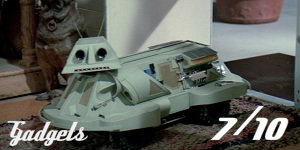

Aside from Q’s rather pointless albeit cute robot dog Snooper, Kill‘s gadgets are all rather quiet, subtle devices, which in this often florid, even gaudy flick surely isn’t a bad thing. Two of them are used by Bond in the same scene, Zorin’s pre-horse sale party – his polarising sunglasses, which can be adjusted to remove the tint from darkened windows, and a finger ring that doubles as a sly, unnoticed miniature camera. Our man also sports a lock-pick that hides in a credit card, which he uses to gain access to Stacey’s abode, and a bug detector masquerading as an electric shaver. The baddie too possesses his fare share of gadgetry this time out, what with the the electronic transmitter that slides into a rider’s cane and, when pressed, can alert an implanted syringe to release steroids into a horse. And, lest we forget, there’s also Zorin’s airships – the Skyships 600 (the larger one in which he briefs the tycoons) and 500 (the smaller one that features in the finale). Together they’re effectively this film’s equivalent of the villain’s lair.
Along with John Barry’s tip-top score, The ‘Kill‘s style is really what makes it – at least for me – such a memorable and engaging watch. As noted enough already, this is a very ’80s Bond film with its microchip-concerned plot, as well as paraphernalia of the decade that previous Eon efforts had yet to showcase: PCs and their Amstrad-y monitors, credit cards, electric shavers, rock music blaring out of cars, causal black leather jackets, and, yes, Grace Jones’ dress sense and airships. Yet the ’80s-ness maybe feels so ’80s because this is unquestionably an ‘American’ Bond film (the third of the series’ four, if we’re keeping count). The jaunt to San Francisco halfway through ultimately defines the movie’s feel and tenor. Suddenly we find ourselves in City Hall rooms with Californian politicos, in mines filled with Texan oil men and teamsters, on board a very American firetruck pursued by very American police cars (both of which boast very American sirens), while everyone else drives around in big trucks or flash Corvettes. Eon’s Bond hasn’t quite leapt into the world of Miami Vice (although the tacky stylings of the hot tub-o-torium has that vibe), but we’re not a million miles from it. Plus, of course, there’s the sun-orange Golden Gate Bridge set against a cloudless blue sky of a summer’s day. Frankly, it doesn’t get much more American aspirational – and, thus, ’80s retro heady – than that.
.
Adjuster: -3
Often dismissed as tired and dated (presumably owing to Sir Rog’s age), A View To A Kill is in fact sunny, energetic, vibrant hokum, not least because of how much fun its leading man and main villain are having. It’s far from perfect (often as improbable as May Day’s costumes), but it blends its dafter action moments and humour with its ‘real world’ moments nicely, ensuring it’s tonally the strongest Bond film of its era, plus its glossy, Americanised, very ’80s sheen is hard to resist.
.
.
Best bit: The Taiwanese tycoon takes a tumble out of Zorin’s airship
Best line: “So, does anyone else want to drop out?”
.
Read why A View To A Kill is one of the ultimate movies of the 1980s here
.
.
.
.
Directed by: John Glen; Produced by: Albert R Broccoli and Michael G Wilson; Screenplay by: Richard Maibaum and Michael G Wilson – adapted from the Ian Fleming story The Living Daylights from Octopussy And The Living Daylights (1966); Starring: Timothy Dalton, Maryam d’Abo, Jeroen Krabbé, Joe Don Baker, John Rhys-Davies, Art Malik, Andreas Wisniewski, John Terry, Thomas Wheatley, Desmond Llewelyn, Robert Brown, Geoffrey Keen and Caroline Bliss; Certificate: PG; Country: UK/ USA; Running time: 131 minutes; Colour; Released: June 29 1987; Worldwide box-office: $191.2m (inflation adjusted: $381.1m ~ 20/24*)
.


.
Enter Timothy Dalton in The Living Daylights and Eon’s Bond shifts to ‘real world’ seriousness – not least in its plot. 007 is in Bratislava, Czechoslovakia, to aid Soviet General Koskov’s defection by neutralising his potential assassin, whom turns out to be cellist Kara Milovy. As she’s not a professional, Bond barely injures her. Once Koskov’s in Blighty, he’s seemingly stolen straight back by the KGB; the only intel he’s shared with MI6 being a list of British spies whom new KGB chief General Pushkin will kill in an operation: Smiert Spionam (‘Death to spies’). Bond’s ordered to eliminate Pushkin. He visits Kara, whom it turns out is Koskov’s lover, making him doubt Koskov’s kidnapping. Visiting Tangier, Morocco, via Vienna in Austria, he finds Pushkin, whom believably claims the list’s nonsense. So 007 fakes killing Pushkin to dupe Koskov, only for the latter to take him and Kara to Afghanistan, where escaping they discover Koskov’s true scheme: get Bond to bump off Pushkin so he can freely smuggle opium out of Afghanistan (paid for with Soviet funds) and use some of the profit it makes to supply his masters with guns via his business partner, rogue US arms dealer Brad Whitaker. Cold War-themed and espionage twisty-turny, Daylights‘ plot eventually loses its way and becomes frustratingly over-complicated.
Timothy Dalton may have come to the 007 role with strong thespy credentials, but a great Bond he is not. He’s just too theatrical. Unlike previous and later incumbents of the shoulder holster, there’s just not enough light and dark in his interpretation. He’s good at the brushstroke gestures and at looking angry (his Bond’s always angry), but not at the lighter stuff. Mind, he looks the part here and the more earnest narrative and tone Daylights strives for fits him well, but the Jekyll-and-Hyde script does him no favours (it was written before Moore had departed the role), thus he’s stuck with one-liners he variously struggles with, sorely lacking as he does the flip of a charming Connery or Moore. Plus, this 007 is no womaniser; in the era of AIDS paranoia, he’s the Bondian equivalent of the late ’80s ‘New Man’, with more respect for his leading lady than, well, her mum probably has. Womanising may be a vice, but Bond – and Fleming’s Bond at that (Dalton’s supposed inspiration) – is a man of vices; he’s an aspirational male fantasy figure and then some, but this overly world-weary, nay near depressive 007 rarely is.
.


.
Strongly reflective of Bond’s chasteness in Daylights is the fact it barely offers Bond Girls in the plural – there’s only one significant female character, Maryam d’Abo’s Kara Milovy. Mercifully then, she isn’t bad for the most part. Beautiful, sweet and conceivably naïve and slow on the uptake, she’s far from one-note though, being a talented cellist and eventually – perhaps because she’s seen enough and had enough at being played by Koskov – becomes a gutsy heroine who risks her life to fly to Bond’s aid and side, even if she’s still pretty ditsy doing so. She’s nowhere near the feminist-friendly ’90s Bond Girl, mind, and stronger writing for her in the flick’s second half would have helped her here – and surely made her more memorable. The flick’s other girls (for what they are) are notable for including Catherine Rabett as a CIA dolly bird (she’d go on to appear as a lesbian toff in BBC sitcom You Rang M’Lord) and Caroline Bliss’s Barry Manilow-loving, rather tasty Moneypenny, following Lois Maxwell’s legendary stint in the role.
Daylights‘ villains are, in a word, crap. And there’s no excuse for it. Chief among them is Jeroen Krabbé’s General Koskov. Cultured and urbane, he’s a duplicitous Soviet mover-and-shaker who tries to play the East off the West, and vice versa. But he’s so slippery, he lacks any menace at all, coming across as some sort of comical Soviet wheeler-dealer baddie from an episode of Minder (1979-94), rather than a dangerously rogue KGB operative. Krabbé’s villain in The Fugitive (1993) is far more a threat than Koskov – and he only appears in that movie for about five seconds. To add insult to injury, Koskov doesn’t even get a villain’s death; he’s merely arrested by Pushkin. Henchman duties fall to Andreas Wisniewski’s Necros. A KGB killer, he’s deadly and clever with accents at least, but a dull blond Red Grant clone with a rubbish name who’s ultimately forgettable. Worst of all though (and sadly not forgettable) is Joe Don Baker’s American black-market arms dealer Brad Whitaker. Again burdened with a dreadful Bond villain name, he offers no menace whatsoever (just like Koskov), coming off instead as deeply unlikable and irritating. Why it takes Bond two hours-plus to swat this trio of doofuses is anyone’s guess.
.
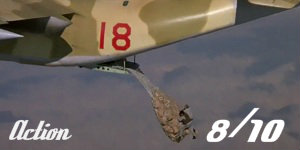

.
Like for pretty much every ’80s Bond film, one of Daylights‘ most satisfying aspects is its action. Things kick off with the ’00’ training manoeuvres that go awry on the Rock of Gibraltar, climaxing in Bond clinging on to the roof of a Land Rover (a stunt that admirably – and rather nuttily – Timbo did himself). It’s a top introduction for a new 007. Next up is the car chase towards the Czech-Austrian border, which allows our man’s Aston Martin V8 Volante to show off all its ’80s-style DB5-esque tricks (missiles behind its headlights and lasers shooting from its wheels). It’s frothy, humorous fun that’s more suitable to a Moore Bond film, thus rather jars in this flick. And yet, most impressive as well as least satisfactory of all is the Afghan-set finale involving the enormous Hercules plane, a bomb in one of several opium bags, the Mujahideen on horseback and many ticked off Ruskkie soldiers. It’s epic, desert-bound stuff, jam-packed with disparate action (the Bond-Necros bout out of the back of the Hercules is a top stunt), but overcooked, what with Bond disappearing ‘to defuse a bomb!’, then disappearing again ‘to drop a bomb!’ amid myriad taking off, landing, diving and exploding planes. For much of its running time, Daylights strives to be a tight, conceivable espionage thriller – in this climax the plot whirls into complex knots (what exactly is Koskov up to?) and the movie turns into an action-fest.
Daylights‘ humour is one of its weakest attributes. The comic moments are at their best when subtle situational laughs, playing to Timbo’s strengths (Kara forgets her cello so Bond has to begrudgingly speed back in his Aston for it; Kara calls him the Russian for ‘a horse’s arse’ in the Mujahideen hideout), but at their worst when he’s embroiled in a played-for-laughs car chase with his gadget-laden Aston Martin and trying to deliver one-liners he’s just not comfortable with (on the number of hours it’ll take him to get back to base after discovering a lovely on a yacht: “Better make that two”; how Necros snuffed it by plunging to his death from the Hercules plane while gripping Bond’s shoe-wear: “He got the boot”). Daylights wants to be a From Russia With Love (1963) sort of Bond film and should fully aim for that film’s canny, adroit wit, rather than mix it with the knockabout humour of a Moonraker (1979) or Octopussy (1983).
.

.
Boasting a record of 25 years, 11 scores and countless title song and theme compositions, John Barry brought down the curtain on his immeasurable contribution to the cinematic Bond with this flick. Is his music for Daylights a fitting finale to his 007 era? Yes, but it’s not among his very best. As if encouraged by the ’80s pop synth of A-ha’s decent title tune (which he co-wrote), Barry takes the rather unexpected move of using synthesized percussion when soundtracking action in the movie’s first two-thirds (Exercise At Gibraltar/ Ice Chase). It’s effective, even if it dates the film in the way disco in Bond scores did a decade before. Less experimental and perhaps more satisfying is his incorporation of themes from The Pretenders’ two songs If There Was A Man and Where Has Everybody Gone? (yes, for the first and only time, a Bond flick features three original songs). The latter theme works well as a dark, menacing motif for Necros (Necros Attacks), while the former is especially effective as a beautiful, melancholic, flute-heavy backing to the early Bond and Kara scenes (Kara Meets Bond). But the score’s surely at its best when playing a big role in ensuring the epic sweep of the later Afghanistan section – the full-out orchestral swelling and soaring of Mujahideen And Opium is outstanding (click on image above to hear it). Fittingly in his final 007 film, Barry actually has a cameo – as Kara’s conductor in the penultimate scene.
The first of Daylights‘ locations, Gibraltar, is maybe its most memorable, with its towering Rock and scampering monkeys as the backdrop to the ’00’ exercise that goes wrong in the pre-title sequence. Next up is the Austrian capital Vienna; definitely a pretty, cultured locale for a Bond film, but it hardly offers the ‘x-factor’ of a Jamaica, a Bahamas or, more recently in the canon, an India or a San Francisco – and, lest we forget, Vienna was unforgettably used in The Third Man (1949) (especially its murky underbelly and its ferris wheel, which Daylights itself features). From here, Bond moves on to Morocco’s Tangier, adding welcome North African exoticism. But now the filmmakers pull a fast one, as Vienna also doubles for Bratislava (understandable; in ’87 they could hardly film behind the Iron Curtain) and Morocco’s Atlas Mountains mostly double for Afghanistan (again understandable; the real Soviet-Afghan War was going on in the actual locale). Locations-wise then, Daylights‘ ain’t bad, but they lack a certain something.
.
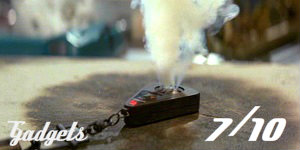

.
Probably owing to a fair number of its bits written before Sir Rog departed Bondage remained come the final draft, Daylight‘s script surprisingly allows serious old Dalts’ first 007 adventure to showcase a good number of gadgets. The most obvious is clearly those boasted by his new motor, the Aston Martin V8 Volante. As mentioned, there’s the missiles and laser-cutters, but also spiked wheels (for driving on ice) and an outrigger and a turbo boost hiding behind the back number plate (to escape from driving on ice). The flick’s most satisfying gadget, though, is Bond’s nifty electronic key-ring, which via whistling ‘Rule Britannia’ emits stun gas that can disable opponents, while a wolf-whistle turns the thing into an explosive. Most memorable, mind, has to be the ‘ghetto-blaster’ as demonstrated early on in Q’s Lab. A very ’80s portable stereo system, it can be rested on one’s shoulder and, deployed like a bazooka, used to fire rockets at targets. Q proudly states it’s been developed for the Americans – clearly, aside from the devices with which Holly Goodhead was furnished in Moonraker, the CIA’s gadget department is pants.
In many ways, Daylights is just as obviously an ’80s Bond film as The ‘Kill, but the 1980s it puts on screen is a very different one. Where the latter flick’s style was all about flashy and vivid American-led largesse, this one’s is for the most part less colourful, murkier and less simple. The fall of the Berlin Wall may only have been around the corner, but the geo-political complexities of the ’80s (glastnost, perestroika and détente; the Soviet-Afghan War) strongly inform Daylights‘ plot and thus, in turn, its feel and tone, while the sobering, even bubble-bursting of ’80s-esque hedonism that was the AIDS epidemic seems to be in the air in the ‘New Man’-ish portrayal of Dalton’s Bond. If The ‘Kill is rather ’80s Hollywood, then Daylights feels more ’80s European art-house – with its Eastern Bloc settings, Norwegian pop balladeers, Viennese whirls on fairground ferris wheels, long navel-gazers’ grey raincoats, soulful and idealistic cellist leading ladies and Bond himself dressing down in a leather jacket over a black pullover. Things open out as 007 and co. hit the desert of Afghanistan for the finale, but this is still a region where Soviet influence is heavy and Bondian alliances are uneasily forged with local freedom fighters whose agenda is individual, complex and conflicted. If Daylights were a song it would probably be The Scorpions’ Wind Of Change.
.
Adjuster: +3
The Living Daylights may be one of the most ambitious of Eon’s Bond efforts (hence its ‘+3’ adjuster score), with aspirations of Le Carré-like plotting and a ‘dynamic’ new lead, but a lack of courage in their convictions and/ or the challenge being beyond them (the plot twists itself up its own wazoo, while daft humour and step-out-of-the-action action set-pieces sit awkwardly next to the rest of the film and Dalton’s performance), the filmmakers don’t really pull off the Bond film they must have hoped they would.
.
.
Best bit: Bond and Kara escape from her apartment – and return for her cello
Best line: “Why didn’t you learn the violin?”
.
.
.
.
.
Directed by: John Glen; Produced by: Albert R Broccoli and Michael G Wilson; Screenplay by: Michael G Wilson and Richard Maibaum – contains an element from the Ian Fleming novel Live And Let Die (1954); Starring: Timothy Dalton, Carey Lowell, Robert Davi, Talisa Soto, Anthony Zerbe, Benicio Del Toro, David Hedison, Frank McRae, Everett McGill, Priscilla Barnes, Desmond Llewelyn, Robert Brown and Caroline Bliss; Certificate: 15; Country: UK/ USA/ Mexico; Running time: 133 minutes; Colour; Released: June 13 1989; Worldwide box-office: $156.2m (inflation adjusted: $285.2m ~ 23/24*)
.


.
Presumably to fit with the serious, sober approach Timothy Dalton brought to the 007 role, Licence To Kill broke with Bond film convention by aspiring to play as a hard-edged, violent thriller – and its plot definitely bears the mark of this change of direction. Bond is in the Florida Keys to attend the wedding of best mate and former CIA, now Drug Enforcement Agency (DEA), operative Felix Leiter, but on the way to the nuptials the pair become embroiled in a DEA operation to apprehend big-time Central American drug lord Franz Sanchez. This they do, only for Sanchez to swiftly escape and murder Leiter’s wife and mutilate him. In loyalty to his friend, Bond defies MI6 orders and sets out on a mission of revenge that brings him into contact with CIA plane pilot Pam Bouvier, whom (after Bond has jeopardised a Sanchez drug deal) flies him down to Isthmus, the small nation in which the latter resides and has free rein. There 007 ingratiates himself with the drug baron, aiming to destroy his operation from within. Simple, predictable and dull, this Bond-out-on-total-revenge narrative is far more ’80s run-of-the-mill violent action movie territory than a conceivable, inspiring, even interesting Fleming/ Bond film plot.
Yes, your eyes doth not deceive you, that is James Bond in the above image. Not Indiana Jones at the end of Temple Of Doom (1984) nor John McClane having survived a Die Hard. Looking like he’s been through hell come Licence To Kill‘s conclusion, sure, this Bond does replicate Fleming’s 007 (which for Dalton and maybe the rest of the Eon team at the time was very much the aim), but doesn’t much otherwise. Without the one-liners Dalton struggled with in Daylights, Bond this time should surely be leaner as well as meaner, but oddly isn’t. Instead of feeling dynamic, he just comes off even angrier than he did a film ago – he’s happy to throw away his entire MI6 career and, with it, his dedication to putting Blighty first by thoughtlessly leaping into his Leiter-inspired revenge quest. Sorry, folks, James Bond just wouldn’t do that. And no 007 (let alone Fleming’s) would wear the baggy clobber nor sport the untidy haircut and badger-like slicked-back casino mane that this full b(l)oodied but charm-free version does.
.

.
There are few larger victims of Licence To Kill‘s lazy filmmaking (by Eon standards) than its Bond Girls. None are memorable, let alone classic 007 crumpet. Looks-wise, though, the flick’s two principal females don’t disappoint. Carey Lowell’s Pam Bouvier, for the most part, looks, er, the part. Facially, she’s pretty if a little WASP-ish bland, but otherwise she’s a damned sexy lady with outstanding legs. But she’s woefully underwritten; starting out as gutsy, independent if foolishly risk-taking, but as things progress her raison d’être seems merely to get bonked by Bond. Her rival in that respect (she surmises) is Talisa Soto’s gorgeous but deathly dull Lupe Lamora. Sanchez’s mistress, Lupe is used to being the plaything of and punchbag for cruel, ruthless men, but when the opportunity rises for her at last to show something other than clichéd tragic vulnerability, she merely appeals to Bond’s allies to help him out as she’s meekly fallen for our man, yet another dangerous, ruthless feller. Felix’s ill fated wife Della (Priscilla Barnes) features too, of course, but only briefly and again with little characterisation, coming off as a trophy wife.
This flick’s major baddie ain’t a bad one, but he’s certainly not among the greatest of Bond villains. Robert Davi’s drug baron extraordinaire Franz Sanchez is a menacing presence, full of quiet power and flashes of both considered and crazed violence. The problem with him stems from Licence To Kill‘s big problem itself – it’s essentially a graphic ’80s action-thriller, not really a Bond film. And that means Sanchez is a villain who fits with the former not the latter. At the time of the movie’s release, the publicity purred that he could have been ‘torn from today’s newspaper headlines’; he’s quite a conceivable bad guy, yes, but that means he’s also rather obvious, predictable and unoriginal. The only nod to the bizarre glamour of Bond villains of lore is the pet iguana he lets perch on his shoulder like a parrot. Sanchez boasts almost a private army of henchmen, but they’re all sub-par and utterly forgettable apart from a very young Benicio Del Toro as psycho assassin Dario (an interesting if dull baddie) and Anthony Zerbe as marine biologist-cum-drug smuggler Milton Krest – whom, adapted as he is from the Fleming short story The Hildebrand Rarity (1960), is a bit of a waste of an intriguingly grotesque literary creation.
.

.
Given Licence To Kill‘s an ’80s John Glen-helmed Eon effort, it’s no surprise what’s its closest thing to a saving grace. Its action is far from groundbreaking, but its three major action sequences are engaging. The first is Bond and Leiter’s pre-title sequence pursuit of Sanchez, culminating in the former being winched down from a helicopter to attach a cord around the back of the latter’s plane. A genuinely impressive stunt, it showcases just the sort of energy and inventiveness the rest of the movie lacks. The next decent sequence closes the flick’s second half when Bond, having tracked Sanchez’s drug smuggling operation to Krest’s boat, sabotages a big cocaine deal by escaping in a seaplane containing the deal’s profits after waterskiing barefoot behind the plane. The third and final set-piece is the film’s climax, in which Bond finally puts Sanchez out of business by (following the destruction of his desert-based lair) one-by-one blowing up the convoying tankers that carry his remaining cocaine in fluid form. It’s overlong and has many daft moments (villains firing bazookas, one truck losing its brakes when the hydraulic brake-line for its trailer is cut and another rising up on its back wheels like a hot rod motorbike – what the hell?), but also decent moments too: Bond driving his truck through a fireball and minions attempting to do the same in their car only to become a fireball themselves and, best of all, exploding tankers and cars rolling down and flying off cliffs, nearly colliding with the plane Pam’s piloting as they do so.
Licence To Kill is not a very funny film; fair enough, it doesn’t exactly set out to be. Most of its humour derives from the larger than usual presence of Desmond Llewelyn’s Q, whom – don’t doubt it – is the movie’s most satisfying character. Taking it upon himself to use up his leave by aiding a rogue Bond in the field (which obviously is a total nonsense – old Boothers would look down his nose at anyone from MI6 doing that, let alone do it himself), he rather pleasingly has some fun, deploying his gadgets and throwing them away into bushes when done in the insouciant manner of Sir Rog’s 007, offering cod amorous advice to Pam With The Pins and dressing up as Central Americans with fake comedy moustaches. Sadly, almost every moment aiming at humour that doesn’t involve Q falls flat on its coup de grâce.
.

.
True to form, Licence To Kill‘s score is rubbish. With John Barry having hung up his Bond film baton with the preceding flick, movie scorer Michael Kamen takes over. With his CV boasting work on Brazil (1985), the first three Lethal Weapons (1987-92) and Die Hards (1988-95) and Robin Hood: Prince Of Thieves (1991), he should have been a more than capable replacement, but it seems the Licence To Kill curse struck once more, because his music is underwhelming to say the least. He chooses to forego memorable themes and cues for Cuban-style guitar punches and flaring trumpets (click on above image for a sample), whose use during action sequences too often is mis-timed (for instance, the tanker finale would benefit from more scoring for sure), giving the impression – rightly or wrongly – of lazy rather than truly competent scoring. Jazz-esque sax-heavy bursts may work for the Lethal Weapons, but that sort of understated scoring is never going to cut the mustard for the cinematic Bond. The title theme, performed by Gladys Knight, isn’t the worst, but highly dependent on the ludicrous number of times the soul chanteuse repeats the title line and there’s also the inclusion of Patti LaBelle’s rather nice If You Asked Me Too over the end credits – which is an achingly ’80s Hollywood, rather than Bondian, touch.
Quite the sin for a Bond film, Licence To Kill‘s locations are truly forgettable. The filmmakers rely on different locales throughout Mexico (Mexico City, Mexicali and Acapulco) to double for the fictitious nation of Isthmus, all of which ensure there’s a strong if repetitive Latin American feel throughout the movie’s second half. Exteriors in the first half of the film are restricted to Florida (the Florida Keys and Miami-Dade Airport), which are clearly far from the most exotic and inspiring to feature in a Bond flick – and ensure this first half is filled, more than ever, with an overly US, very un-Bondian flavour (making this unquestionably ‘American Bond film’ number four of four). Exoticism is somewhat thrown into the mix, mind, by the use of Toluca’s Estado de México for Sanchez’s income-generating fake cult HQ, the Olimpatec Meditation Institute, with its Gaudi-esque, almost childish spherical pyramids et al.
.


.
Clearly this is meant to be a hard-hitting Eon effort, but the prevalence of Q in its second half ensures it features a few rather fantastical gadgets. Chief among them is the combination of a signature gun (capable of being operated only by one user owing to it taking a palm print of the latter) and plastic explosive disguised as ‘Dentonite’ toothpaste, itself triggered by a detonator hidden in a fake packet of cigarettes. Bond uses this trio of devices in his attack on Sanchez’s HQ above Isthmus’s casino. There’s also a Polaroid camera that emits a hazardous laser from its flash as it takes x-ray photos (striking more of a bum note than a humorous one when Pam fiddles around with it) and a broom whose handle splits in the middle to reveal a transmitter, which is deployed by its inventor himself as he gets to dabble ‘in the field’.
Aside from its underwhelming script (most of which was written by co-producer Michael G Wilson than well-worn veteran scribe Richard Maibaum owing to a WGA strike), Licence To Kill‘s most significant mis-step is surely its style. More than even The Man With The Golden Gun‘s (1974), this flick’s production values are disappointing. Maybe because of the rising cost of making movies in the UK and thus a decampment of interior filming to Mexico’s Estudios Churubusco or just a lack of the usual high creativity and inventiveness of Eon’s cinematography, art and costume departments, the movie’s look is creamy and beigey drab and, worst of all, feels comparatively cheap. Sure, this is the tail-end of the ’80s and much takes place in Central America, so sartorially things are hardly going look like we’re in Monaco, but there’s little excuse (again) for Timbo’s baggy togs – even his tux looks tacky. Moreover, the movie’s choice of shots and their content are far from imaginative; it all feels diluted rather than offering Bondian flair and dazzle. The only high-point is Pam’s glinting sequinned casino dress, but that’s really because she peels off its lower half to reveal those pins of hers. Even those legs can’t make up for this film’s woeful palette.
.
Adjuster: 0
Hampered by weak pre-release marketing, but mostly performing poorly against the serious summer blockbuster rivals that were Batman, Lethal Weapon 2 and Indiana Jones And The Last Crusade due to its own plethora of shortcomings, Licence To Kill proved itself both the financial and critical low-point for Eon’s Bond. Fans would have to wait another six years for 007’s return, which surely added insult to injury after having to sit through this (blessedly, thus far, first and only) full-out failure of a Bond film.
.

.
Best bit: Bond water-skis barefoot
Best line: “Look, don’t judge him too harshly, my dear. Field operatives often use every means at their disposal to achieve their objectives”/ “Bullsh*t!”
.
.
.
Rankings
(All scores out of 100/ new entries in blue/ * denotes a non-Eon Bond film)
1. On Her Majesty’s Secret Service (1969) ~ 90
2. From Russia With Love (1963) ~ 88
3. The Spy Who Loved Me (1977) ~ 87
4. Goldfinger (1964) ~ 85
5. You Only Live Twice (1967) ~ 84
6. Live And Let Die (1973) ~ 82
7. A View To A Kill (1985) ~ 75
8. Dr No (1962) ~ 74
9. Moonraker (1979) ~ 73
10. Thunderball (1965) ~ 70
11. For Your Eyes Only (1981) ~ 69
12. Never Say Never Again (1983)* ~ 68
13. The Living Daylights (1987) ~ 67
14. Diamonds Are Forever (1971) ~ 66
15. Octopussy (1983) ~ 64
16. The Man With The Golden Gun (1974) ~ 62
17. Licence To Kill (1989) ~ 50
18. Casino Royale (1967)* ~ 48
.
The James Bond reviews will return…
.

It was fifty years ago today: for a full half-century the cinematic James Bond has thrilled and spilled, excited and entertained and, yes, shaken and stirred the world, none more so than this iconic, Union Jack-tastic moment from the pre-title sequence of The Spy Who Loved Me
Happy ‘James Bond Day’! Yes, that’s right, peeps, today officially marks the fiftieth anniversary of the official Eon Productions James Bond film series. Half a century ago this very day, the very first 007 movie produced by Albert R Broccoli and Harry Saltzman, Dr No, premiered at the Odeon Leicester Square cinema in London – and the rest, as they like so often to say, is history. And, boy, what a history it’s been.
So, as a sort of mid-match goal rush in this blog’s golden anniversary celebrations of Blighty’s finest, this post celebrates this day in a way better than any other my wee bonce could come up with – to compile a list of the ten greatest moments from the (thus far) 22-film series. Just one stipulation: as there’s more than a score of Bond flicks in existence now and thus methinks the following list shouldn’t reflect just their greatness but also their breadth, none of the following moments come from the same Eon effort.
And so, with that, let’s together and each and every one of us, slip on that Walther PPK-carrying shoulder holster, put on that black tux jacket, tie that bow-tie and, as we admire ourselves in the mirror in front of us, mockingly cock an eyebrow, thoughtfully put a finger to our mouths or simply pout our lips (whether we resemble Roger Moore, Pierce Brosnan or Daniel Craig, that is). Or, if we don’t look much like any of them, indulge in this following list regardless and wallow in fifty years of marvellous Bondness. Cue John Barry…
.
.
Bond’s introduction ~ Dr No (1962)
.
Setting the scene: Following the bumping off of an MI6 operative and his secretary in Jamaica, one of the service’s ’00’ agents is sought out to visit MI6’s chief M in order to look into the matter. A lowly Intelligence charlie finds him in salubrious West End casino ‘Le Cercle’, where he’s embroiled in a game of Chemin de Fer with a beautiful brunette who’s just about to introduce herself – in turn, inviting him to introduce himself…
So good because: It’s the first time the world clapped eyes on Eon’s Bond in the shape of the original Sean Connery and also the first time he uttered the immortal line ‘Bond, James Bond’. He’s dressed in an immaculate black tux and bow-tie, gambling at a casino and looking incredibly cool as he lights a pre-PC non-friendly cigarette. This is the cinematic 007’s first moment and it may never have been topped. Maybe not.
Strange but true: Sylvia Trench (Eunice Gayson), a character intended as a frustrated female interest for Bond whom never got around to bagging him because he always had to rush off on a mission, was dropped after only the second film From Russia With Love (1963).
.
.
.
.
The ejector seat ~ Goldfinger (1964)
(From 4:00 onwards)
Setting the scene: Having staked out villain Auric Goldfinger’s Switzerland HQ, Bond is spotted by his goons and flees in his Q-Department-altered Aston Martin DB5. A chase ensues, in which 007 deploys several of the car’s ‘optional extras’, but leaves the best for last – its passenger ejector seat. Captured by the minions, he’s forced by one who gets in the car – with a gun trained on him – to drive back to the base, only at the most opportune moment to rid himself of the chap and attempt to escape once more…
So good because: Surely the ultimate Bond vehicle/ gadget moment, the DB5’s ejector seat is arguably, more than any other of its fantastic features, the attribute that entered it into 007 lore – and the one that everyone rightly remembers. Funny, ridiculous and genius all at the same time, it’s one of the iconic moments in the iconic Bond film.
Strange but true: The DB5 was, of course, mass-produced in miniature by UK toy car manufacturer Corgi, going on to shift millions of units over the decades – yet, with stunning shortsightedness, they failed to get the item into toy shops in time for Christmas ’64 when its demand would surely have been astronomical.
.
.
.
.
“I am Ernst Stavro Blofeld” ~ You Only Live Twice (1967)
.
Setting the scene: Locating a base hidden in a volcano on an idyllic Japanese island, from which a literal mouth-opening space rocket has swallowed both US and USSR spacecrafts in order to try and provoke nuclear war between the two superpowers, James Bond clandestinely enters the volcano, but is caught when he poses as an astronaut boarding the hostile space rocket, aiming to sabotage its final, defining flight. He’s then brought face-to-face with the evil genius who’s masterminded the incredible scheme…
So good because: As the head of the criminal organisation that dominated the ’60s Bond flicks (SPECTRE – Special Executive for Counter-Intelligence, Terrorism, Revenge and Extortion), Ernst Stavro Blofeld was ultimately behind all – except one – of the devious plans of that decade’s movies, yet had always been a shadowy presence; the camera only ever showing his torso and hands as he stroked his white Persian pussycat. Finally, though, as the signature villain in You Only Live Twice, Bond and the audience at last saw his face – and it being Donald Plesance’s fantastically scarred, unnervingly childlike visage, it’s an awesome one.
Strange but true: Plesance (an instant iconic villain – years later, his appearance was shamelessly stolen for Austin Powers‘ Dr Evil) wasn’t actually the first choice for Blofeld. He was parachuted into the role at the eleventh hour when the already cast Czech thesp Jan Werich fell ill.
.
.
.
.
“We have all the time in the world” ~ OHMSS (1969)
.
Setting the scene: By the end of a mission that’s seen him best his nemesis Blofeld (yet again) and meet the love of his life (or at least the last love of his life – see bottom moment), Bond’s got his girl in a way more profoundly than ever before – he and she have got married. On their way away from the wedding and presumably to their honeymoon location, Bond and his bride Tracy are bantering like urbane, loved-up newlyweds and stop momentarily to remove all the flowers from their vehicle. At which point, another car speeds past them and we hear machine gunfire…
So good because: Pre- (and maybe post-) Casino Royale (2006), this was easily the most moving and emotionally satisfying moment in big-screen Bond’s history. It helps that On Her Majesty’s Secret Service is such a good film, ensuring Bond and Tracy’s romance is a believable one that genuinely pulls us in, thus, this unapologetically visceral twist of an ending hits us like a thunderbolt. It’s the ultimate ending to a Bond film because it’s unquestionably the best.
Strange but true: Two takes were filmed of Lazenby delivering the final lines; one in which he shed tears and one in which he didn’t. Ultimately, the tearless take was chosen, as director Peter Hunt decided James Bond shouldn’t cry. Hunt maintains, though, that Lazenby aced them both.
.
.
.
.
Jumping the crocodiles ~ Live And Let Die (1973)
(From 2:20 onwards)
Setting the scene: Having been captured in New Orleans by villain of the piece Mr Big, Bond is transported by the heroin king to his Louisiana Bayou drug development plant, conveniently located on a crocodile farm; convenient because it’s easy to dispose of opponents here (‘Trespassers will be eaten!’). Having been given a tour of the crocs’ habitat during feeding time by hook-for-hand henchman Tee Hee, 007 suddenly finds himself stranded on a little island in a lake occupied by hundreds of the sharp-toothed prehistoric hunters – for Tee Hee has retracted the bridge from the mainland and buggered off…
So good because: The absolute classic ‘how will he get out of this?’ moment from a Bond movie, this one’s utter genius in both its creation and execution. Simple but stunningly brilliant, it’s a cunning stunt, indeed, involving 007 put in a genuinely adrenalin-inducing perilous situation and his resolving it in a manner only he would attempt and pull off with such ease. Just as well really – those are clearly very hungry crocodiles.
Strange but true: The man who performed this extraordinary stunt, Ross Kananga, owned the crocodile farm on which it was filmed. So grateful were the filmmakers for his contribution (in one take he got his shoe caught in the teeth of one of the crocs; proof of how easily it could have gone disastrously wrong), they named the villain’s real identity after him: Dr Kananga.
.
.
.
.
The Union Jack parachute jump ~ The Spy Who Loved Me (1977)
.
Setting the scene: Having received a spooled message from his sleek new digital watch informing him he must get out of the Austrian Alps for a briefing with M, a banana-yellow skisuit-clad Bond bids farewell to his chalet dolly bird and takes to the slopes outside. Only he quickly realises he’s being pursued by a troupe of menacingly black-clad Soviet operatives. Performing one or two flash manoeuvres to keep ahead of them (including shooting one with his firing ski-pole while going backwards), 007’s full escape will only be complete if he skis off the edge of a cliff – but wouldn’t that be suicide…?
So good because: Perhaps the most recalled stunt in all Bondom, this effort by the legendary Rick Sylvester purportedly caused audiences all over the world to jump to their feet in applause for its audacity, tongue-in-cheek patriotism and all-round entertainment. It’s probably the most iconic moment in James Bond’s half-century on the big screen.
Strange but true: Despite painstakingly ensuring safety procedures were followed (including waiting for the wind to be exactly right), Rick Sylvester’s leap, which actually took place off Mount Asgard on Canada’s Baffin Island, almost went disastrously wrong when, as he released one of his skis, it clipped the just opening parachute; had it done so with more force, it almost certainly would have prevented the chute from the opening – it can be seen in the filmed footage.
.
.
.
.
“I think he’s attempting re-entry, sir” ~ Moonraker (1979)
.
Setting the scene: Bond and his lovely CIA-agent-cum-astronaut cohort Dr Holly Goodhead have just the saved the world’s human population from instant wipe-out thanks to destroying big bad space craft manufacturer Hugo Drax’s globe-like containers of toxic nerve gas he’d released into the Earth’s atmosphere. So, aboard Drax’s sole remaining space shuttle, they’re now indulging in some how’s-your-father in their well deserved down-time. Only a ‘genius’ back at Houston’s NASA has chosen this exact moment, by way of celebration, to relay images of them both (yes, engaging in weightless coital activity) to both The White House and Buckingham Palace. Bond’s superiors, not least M, look on disgusted. ‘My God, what’s Bond doing?’ demands Minister of Defence Frederick Gray; inspecting the shuttle’s position on a monitor, Q delivers an unforgettable answer…
So good because: Surely the most fondly recalled saucy innuendo kiss-off to a Bond film, this line is probably also the perfect example of the double entendre in the Eon series. It’s short, simple and utterly satisfying – just like a shag in space with Holly Goodhead, no doubt. And it’s made even better by Bond, realising he’s being filmed live when he looks up into a camera lens just before switching it off, shows absolutely no shame at being caught out, merely the flick of a knowing, almost proud smile instead. What a lad.
Strange but true: This was M actor Bernard Lee’s last Bond film moment; he died just as filming began on the next movie For Your Eyes Only (1981). As a mark of respect for his passing and contribution to the series, that film’s script was altered so the character didn’t appear, claiming he was on leave. M would return in Octopussy (1983) played by Robert Brown.
.
.
.
.
The best pre-title sequence ~ GoldenEye (1995)
.
Setting the scene: It’s 1986 and James Bond (looking distinctly unlike either Roger Moore or Timothy Dalton, but let’s not worry about that right now), is tasked with destroying a Soviet chemical weapons facility in deepest, darkest Russia. Once he’s broken in, having effectively bungee-jumped down to the bottom of a dam, he teams up with MI6 colleague Alec Trevelyan – or 006 – to place timed explosives on the weapon canisters, but Trevelyan is soon caught and held at gunpoint by the facility chief, Colonel Ourumov, who’s backed up a horde of troops. Bond is given the choice to give up or see his fellow agent killed – his mission or his friend…?
So good because: Mostly because of the awesome, awesome Union Jack parachute stunt above, The Spy Who Loved Me‘s pre-title sequence is often claimed the best of the series, but I’d argue this one tops it. Why? Because it’s got everything: a bungee-jump stunt; a a pair of ’00’s buddy-buddying up on a mission; a cruel, ruthless baddie; lots of gun-play and exchange of whip-crack dialogue; a sprint on foot and then on a motorbike to reach an escaping plane; an outrageous second stunt where the bike goes over a cliff after the pilot-less plane and, of course, the eventual blowing up of a villains’ lair. One of the most thoroughly satisfying sequences of the entire series and, thus, the perfect introduction of a brand new Bond actor (Pierce Brosnan) after 007’s six years away from the silver screen.
Strange but true: The final stunt of the sequence, in which a free-falling Bond manages to catch up with a seemingly free-falling plane has been the stuff of controversy for years. However, many posit what’s presented on-screen, although looking like pure fantasy, is quite credible because a free-falling human’s terminal velocity would be greater than a plane that’s free-falling but accumulating drag as it also has wings, therefore 007 could catch up with the plane.
.
.
.
.
The hotel room scene ~ Tomorrow Never Dies (1997)
.
Setting the scene: A British warship has been downed in Chinese waters by a hostile enemy and, not suspecting the Chinese but an unknown guilty party, Bond is sent to monitor media tycoon Elliot Carver (as his corporation dubiously managed to get exclusive footage of the event) at the Hamburg launch of his new TV channel. Having run into old flame Paris at the party, who’s now married to Carver, an off-the-clock 007 is moodily sitting alone in his hotel room, when someone appears in his doorway – Paris…
So good because: Arguably for the first – certainly the most effective – time in decades, Bond’s psychosis is explored in this scene, tapping perfectly into the acidie (melancholy-inducing nature) of what he does for a living and, thus, who he is that became an important part of his characterisation in creator Ian Fleming’s later novels. In his down-time, tux jacket off, bow-tie untied and quaffing shots from a vodka bottle as he silently broods on his re-acquaintance with a woman he loved but had to let go, she reappears and when asks him the question, he’s disarmingly honest about why he let her go. Then they share a passionate snog. But, of course.
Strange but true: When working on her scenes as Paris Carver for Tomorrow Never Dies, Teri Hatcher was actually pregnant. Well designed costumes and clever filming techniques were employed to hide her belly’s slight bump.
.
.
.
.
Bond ‘becomes’ Bond ~ Casino Royale (2006)
.
Setting the scene: Having only just earned his ’00’ stripes, James Bond is tasked with ensuring poker ace Le Chiffre doesn’t raise a huge sum of money to get him out of a hole with the criminal organisation he works for (Quantum) by beating him at Montenegro’s Casino Royale in, er, a poker game. Good for Bond then that he’s a poker ace himself and does the business. Unfortunately though, post-poker, a vengeful Le Chiffre almost does the business on him and his British Treasury liaison Vesper Lynd. Doubly unfortunately, when both survive the baddie’s torturing them, 007 discovers Vesper has been double-crossing him all along – she’s been blackmailed by Quantum to deliver the money on a plate whatever happens in the poker game, or it’ll murder her previous lover. In a Venice-set finale, Vesper sacrifices herself, but the money’s taken anyway by a mysterious figure named Mr White, whose mobile number, though, Vesper leaves for 007 to find. Heartbroken Bond may be, but ‘the bitch is dead’ and the mission goes on – he seeks out White and the money…
So good because: This scene isn’t just a thoroughly satisfying resolution to an excellent Bond film, but also a thoroughly satisfying final act in this well documented ‘reboot’ Eon effort that ‘reveals’ how James Bond became James Bond – in short, this scene showcases Bond becoming Bond. How? He finally gets the better of an opponent in a fantastic suit, with a bloody big gun and a confident swagger that only an ‘arrived’ 007 could possess. He’s been through hell to get here (he’s lost the first love of his life – long before losing Tracy, if that’s still to happen in this timeline, that is), but without that, he couldn’t become Bond. And, of course, sealing the deal is this new oh-so dynamic 007 (Daniel Craig) delivering the ‘Bond, James Bond’ line for the first time – and, in this flick at least, the audience hearing The James Bond Theme in full for the first time. Oh yes.
Strange but true: The next film in the series – and Casino Royale‘s effective sequel – Quantum Of Solace (2008) was also intended to conclude with a scene in which Bond tracks down Mr White, but this time put him out of his misery. Perhaps deciding the scene would have robbed that film of the emotional impact its directly preceding scene delivered (007 facing down Vesper’s ‘fake’ boyfriend) and would have been too similar an ending to Royale‘s, it was filmed but dropped from the final edit – thus, leaving the door open for Mr White to (ahem) die another day.
.
.
.
Playlist: Listen, my friends! ~ October 2012
In the words of Moby Grape… listen, my friends! Yes, it’s the (hopefully) monthly playlist presented by George’s Journal just for you good people.
There may be one or two classics to be found here dotted in among different tunes you’re unfamiliar with or have never heard before – or, of course, you may’ve heard them all before. All the same, why not sit back, listen away and enjoy…
.
CLICK on the song titles to hear them
.
Mireille Mathieu ~ Le Derniere Valse
Marvin Hamlisch ~ Theme from The Swimmer (1968) (Send For Me In Summer)
Fapardokly ~ Mr Clock
Jefferson Airplane ~ Volunteers1
The Troggs ~ The Raver
Al Green ~ Let’s Stay Together2
Lulu ~ The Man Who Sold The World
Van McCoy ~ The Shuffle
Boz Scaggs ~ Lowdown
Marvin Gaye ~ Got To Give It Up
Nick Lowe ~ I Love The Sound Of Breaking Glass3
Mike Batt ~ Better Than A Dream5
.
1 Performed at the Woodstock Festival, August 1969 in Bethel, New York
2 Performed in 1972 on the legendary US TV music show Soul Train (1971-2006)
3 This was pub rock, punk and New Wave mover-and-shaker Lowe’s biggest hit in the UK, where it peaked at #7 in 1978; by sheer coincidence, his follow-up single Cruel To Be Kind peaked at exactly the same chart position – #12 – in the UK, the US, Australia and Canada
4 This 1985 UK #11 hit’s seemingly indecipherable lyrics actually refer to the Nicholas Roeg films Performance (1970), Walkabout (1971), Don’t Look Now (1973), The Man Who Fell To Earth (1976) and Insignificance (1985) and features dialogue from Performance throughout
5 The unforgettable ballad that opened the ITV cartoon series The Dreamstone (1990-95)
.
007/50: The Bondathon reviews (1980s #1)
.
Ah, the 1980s… in the world of the cinematic Bond that means the era of John Glen, when action set-pieces, a maturing Roger Moore 007, innuendos aplenty and an ‘MI6 family’ including a new M (Robert Brown) and strangely an acceptably avuncular KGB chief (Walter Gotell) were the order of the day. But the ’80s brought more than that to the big-screen Bond – yup, it also shockingly brought back Sean Connery to the British Secret Service fold. Who’da thunk it?
Well, folks, you yourselves verily will, if you check out the below post – the latest of this blog’s celebration of Blighty’s finest reaching his silver screen big 50 (and, in particular, the latest post of my ‘Bondathon’ – James Bond film-watching marathon – see the first three here: 1, 2 and 3). This one features then reviews of the early ’80s 007 efforts that are For Your Eyes Only, Octopussy and, yes, Never Say Never Again…
.
How it works:
- The ‘Bondathon’ takes in all 24 cinematically released Bond films, from Dr No (1962) right through to Quantum Of Solace (2008) – including the ‘unofficial’ efforts Casino Royale(1967) and Never Say Never Again (1983)
- The reviews consist of 10 categories, the inclusion of which tend to define a Bond film as a Bond film (‘Plot‘, ‘Bond‘, ‘Girls‘, ‘Villains‘, ‘Action‘, ‘Humour‘, ‘Music‘, ‘Locations‘, ‘Gadgets‘ and ‘Style‘), each of which are rated out of 10, thus giving the film in question a rating out of 100 – which ensures all 24 films can be properly ranked
- There’s also an ‘Adjuster‘ for each film’s rating (up to plus or minus five points) to give as fair as possible a score according to its overall quality as a film.
.
.

.
Directed by: John Glen; Produced by: Albert R Broccoli; Screenplay by: Richard Maibaum and Michael G Wilson – containing elements from the Ian Fleming short stories For Your Eyes Only and Risico, both from For Your Eyes Only (1960); Starring: Roger Moore, Carole Bouquet, Topol, Lynn-Holly Johnson, Julian Glover, Cassandra Harris, Michael Gothard, John Wyman, Jill Bennett, John Moreno, Jack Hedley, Desmond Llewelyn, James Villiers, Walter Gotell, Geoffrey Keen and Lois Maxwell; Certificate: PG; Country: UK/ USA; Running time: 127 minutes; Colour; Released: June 24 1981; Worldwide box-office: $195.3m (inflation adjusted: $486.5m ~ 15/24*)
* denotes worldwide box-office ranking out of all 24 Bond films (inflation adjusted), according to 007james.com
.

.
One of the most obvious instances when the Eon film series returns to terra firma – pun entirely intended – after the OTT highs of an immediate preceding entry (1979’s Moonraker), For Your Eyes Only features a relatively ‘real’ espionage plot. When a UK vessel containing a device that can launch submarines’ ballistic missiles goes down at sea, MI6 enlists marine biologist Sir Timothy Havelock to locate the boat’s resting place, but the latter’s killed by a hitman. Bond’s tasked with locating the device so first travels to Spain to find out who hired the assassin, yet just before the latter’s paid-off he too is offed – by Havelock’s avenging daughter Melina. Having identified the hitman’s employer as another killer, Emile Locque, Bond visits Alpine resort Cortina for intel on him from informant Aris Kristatos, whom tells Bond that Locque was hired by KGB-friendly smuggler Milos ‘The Dove’ Columbo, to whose Corfu casino he next travels. Columbo, though, eventually convinces our hero it’s actually Kristatos who’s the guilty guy in league with the KGB. Having been won over by him then, 007 calls on his aid (after our man’s recovered the ATAC with Melina’s help, only for it to be stolen by Kristatos) to snatch the ATAC back from Kristatos’s base atop a Greek mountain before he hands it over to the KGB. Twisty-turny, Fleming-faithful and quite conceivable, Eyes Only‘s plotting is good stuff, indeed.
By this stage in his, er, Bondage, Roger Moore is so comfortable in the role (thus fitting it like a glove), he could play it blindfolded and the audience would still know when he’s lifting that eyebrow of his. The filmmakers then make a definite mis-step this flick by, instead of just allowing him to play Bond, writing and encouraging him to play up to his age – Moore is now 54 and, it has to be said, his looks are starting to catch up with his years. That’s not to say Sir Rog doesn’t invest the character with the same wit, naughtiness and fun that he had before, but him so obviously rebuffing a teenager’s advances (“Now put your clothes back on and I’ll buy you an ice-cream”), not romancing young main squeeze Melina until the end and hanging out so much with similarly middle-aged blokes (Kristatos, Columbo, Q and ally Ferrara) robs 007 of some of his vitality, urgency and definitely a lot of his cool. And that should never happen to our man Bond.
.
.
In many ways, Eyes Only‘s girls are an odd bunch. Chief among them is Carole Bouquet’s heroine Melina; easily one of the ’80s’ best Bond Girls. Beautiful, brave, ballsy, yet vulnerable and a little rash, she’s a fine avenging angel with her trick-shot crossbow skills, ability to pilot a two-man sub and seething but stunning eyes and lovely grin when the script lets her flash it. Eyes Only‘s second girl is the stuff of Bond lore, being the one our hero rejects in favour of offering to buy her an ice-cream. Variously pig-tailed and naked under 007’s bed sheets, Lynn-Holly Johnson’s ice-skating Bibi is an incorrigible teenager-going-on-flowering-young-woman far better suited to spring break than the sponsorship of ‘Uncle’ Aris. Indeed, aside from providing comical eye candy and ending up an eventual ‘reward’ for Topol’s Columbo, one rather wonders what she’s really doing here. The flick’s ‘sacrificial lamb’ is ‘Countess’ Lisl, Columbo’s girlfriend who’s offed after spending the night with Bond. She’s most notable for being portrayed by the tragically late Cassandra Harris, at the time wife of one Pierce Brosnan, whose casting in this role set up The Brozzer’s first meeting with Cubby Broccoli – and the rest, as they say, would be history…
The main narrative hook of Eyes Only concerns its villains, but doesn’t come off as well as it probably should. Why? Maybe because the chap who’s supposed to be the flick’s main baddie but isn’t is a top character, while the chap who’s not supposed to be the main baddie but is, well, isn’t. I speak, of course, of Columbo and Kristatos. Technically an ally then not a villain, Topol’s Columbo is a charismatic rogue who relishes a bottle of ouzo, a pretty girl and a bag of pistachio nuts as much he does destroying dodgy rival smugglers’ hide-outs. Conversely, Julian Glover’s manipulative, morally bankrupt Kristatos (Columbo’s old Greek resistance buddy employed by the KGB while posing as a British informant) isn’t a ‘champagne villain’. He may sport a nicely clipped goatee beard, but he’s neither particularly menacing nor very flashy (preferring ’80s leisure wear to stylish threads). Eyes Only also features several minions, most notably Emile Locque – a real world-ish, eerie villain with his hexagonal glasses – and John Wyman’s biathlon-competing Soviet heavy Erich Kriegler, but both are rather forgettable.
.


.
Its action is surely Eyes Only‘s best attribute. So action-packed is it, it might be a precursor of many ’90s Bond efforts (its dramatic scenes are almost brief interludes between each action set-piece, which actually may not be a good thing). Anyway, there’s underwater shenanigans (submarine encounters and face-to-face diver fisticuffs – more engaging than in Thunderball); big baddie saloon cars chasing Bond and Melina in a Citroën 2CV (played for laughs, but amusing and clever); a long snow-based pursuit (Bond on skis followed by motorbikes with handlebar-mounted-guns, Kriegler the biathlete, a charlie down a ski-jump and even a bobsleigh run); a raid on Kristatos’s warehouse and, best of all, the excellently vicious keelhaul sequence and the big climax that sees 007 and co. scale a mountain to reach Kristatos’s hideout. The latter’s tension-filled stuff (look, Bond’s fallen from a great height…! And again…! And again!), if a little silly (why, after 007’s climbed for ages, does it take mere seconds for the basket containing his accomplices to travel the same height?). Overall, maybe all of Eyes Only‘s action suffers a little from over-editing with everything happening in a flash, but that may because so much is crammed in.
By now, the saucy Bond film finale pay-off was in full rein. And the filmmakers pull out all the stops here, for the superior whom catches Bond’s pants down is British PM Margaret Thatcher (Janet Brown). Or at least she would if she weren’t duped into getting chatted up by a parrot (by way of Bond’s two-way radio-toting watch). This amusing if daft moment is a fine example of Eyes Only‘s humour. Indeed, earlier on Q, disguised as a priest, meets Bond in a church confessional, cue the lines: “Forgive me, father, for I have sinned”/ “That’s putting it mildly, 007!”. There’s also, of course, Bibi’s Bond-crush and the ‘cameo’ by Blofeld – Broccoli couldn’t actually bring back this classic villain (the rights to him were owned by rival producer Kevin McClory), so as a pre-title wheeze a character that looks just like Uncle Ernst is dumped down a chimney stack by Bond while begging for his life with the inexplicable claim: “I’ll buy you a delicatessen in stainless steel!”. Mind you, thoroughly satisfying in the comedic stakes is Topol’s excellent ally Columbo, a charm-heavy wrong-‘un-doing-good; the movie perks up whenever he’s on-screen.
.

.
Four years after Marvin Hamlisch delivered a score peppered with disco for The Spy Who Loved Me, what does John Barry’s replacement this time around dish up? Er, that’s right, more disco. To be fair, though, Rocky (1976) composer Bill Conti’s music for Eyes Only doesn’t rely solely on a pop chart sound that was already on the way out. Yes, disco certainly is there to be heard during the several-minutes-long snow chase with the (not bad at all) Runaway theme, but with both this and other themes, cues and flourishes to moments of tension and action, Conti actually takes something of a studio-developed leaf out of Barry’s book, using synthesised pianos and brass to good, dramatic effect. What really elevates Eyes Only‘s music, though, is obviously the Sheena Easton-sung title track (an Oscar nominee and actually performed by Easton in the opening credits). Far less notable, mind, is the flugelhorn saturated Take Me Home, which is basically elevator music, while so-bad-it’s-good ’80s pop/ rock rears its ugly head in the shape of Rage’s song Make It Last All Night (click above image to hear it); although being damn catchy and its lyrics incredibly suggestive, it’s actually sort of so-bad-it’s-very-good.
Let’s face it, when it comes to movie locations, you can’t go wrong with Greece. Just as The Guns Of Navarone (1961) and Escape To Athena (1979) made hay from Hellenic locales, Eyes Only does too. Its chief exterior is the idyllic sun-kissed island of Corfu, where all the on-land Melina-related Greek scenes were filmed, as was the early Gonzales sequence (standing in for countryside just outside Madrid). And the stark and stunning mountain that stars – so impressive is it, it arguaby is a co-star – in the climax is to be found in Meteora in mid-mainland Greece. However, perhaps the flick’s most beautiful, definitely its most aspirational, location is Cortina d’Ampezzo, the Italian Alpine tourist town used for its snow sport-littered segment, while the brilliant blue of the waters off the Bahamas feature too in the diving and keelhauling scenes.
.


.
One of Eyes Only‘s aspects most affected by it’s more down-to-earth approach to delivering the big -screen Bond goods is definitely its gadgets. Its two most promient Q-supplied devices are Bond’s latest Seiko digital watch, with its two-way radio and an LED update on the spooled tape message from Spy‘s watch, and the Identigraph. The latter is actually located in Q-Department and using very ’80s computer technology (even its screen is black with green graphics), it can nattily match a recalled face with photos from international police records. Really, though, the emphasis this time out is, like in On Her Majesty’s Secret Service (1969), on Bond using his wits rather than a gadget to get out of a scrape. For instance, when scaling a mountain he uses regular mountaineering tools and even a shoelace from his boot, while he communicates with an Italian contact via codewords and by steaming up a mirror on which has been left a finger-written time and meeting place. And, I guess, many might say after the bordering on ludicrous high-technology of Moonraker, that’s quite refreshing.
To my mind, glamour and aspiration are as much as anything what the cinematic Bond should be all about, but they’re not exactly high on the agenda in Eyes Only. That may be down to the fact the film’s a more ‘real-world’ effort than its most recent Eon forebears, but methinks the fact it dates from the early ’80s has more to do with it. This is a movie made by a British crew in a Britain hardly boyant and at ease with itself. The strikes of the ’70s may have largely passed and Mrs T may be in Number 10, but her ‘economic miracle’ was some way off yet, ensuring unemployment was very high, racially-concerned riots were the order of the day and seemingly the only thing the mass populace could smile about was Charles and Di getting married. And this is the Britain that Eyes Only seems to reflect: greys, browns and dull greens abound in its design (especially costumes), characters stay in motels rather than expensive hotels (and one or two still seem to be walking around in flares), while the goodies attack the baddies’ HQ by going rock-climbing (yes, I know it’s a decent action sequence, but it’s hardly one of the series’ sexiest or most spectacular). Mention this movie to a non-Bond (or non-film) fan and you’ll probably draw a blank – and that’d probably most be because of its bland style.
.
Adjuster: +2
If there’s a Bond movie fit for rainy Sunday afteroons then it’s surely For Your Eyes Only. It has earnest, admirable aspirations to be a strong, credible thriller – hence its ‘+2’ adjuster score here – and its moments (many of them, in fact, and mostly the fine action sequences), but with its action-versus-dramatic-scenes-imbalance, a Bond only too aware of his advancing years and early ’80s humdum atmos, it’s probably the most forgettable 007 effort for the mass public.
.

.
Best bit: Bond goes rock-climbing
Best line: “I love a drive in the country – don’t you?”
.
.
.
.
.
.

.
Directed by: John Glen; Produced by: Albert R Broccoli; Screenplay by: Richard Maibaum, Michael G Wilson and George MacDonald Fraser – containing elements from the Ian Fleming short stories Octopussy and The Property Of A Lady, both from Octopussy And The Living Daylights (1966); Starring: Roger Moore, Maud Adams, Louis Jourdan, Kristina Wayborn, Kabir Bedi, Steven Berkoff, Vijay Amritraj, David and Anthony Meyer, Desmond Llewelyn, Robert Brown, Walter Gotell, Geoffrey Keen, Douglas Wilmer, Lois Maxwell and Michaela Clavell; Certificate: PG; Country: UK/ USA; Running time: 131 minutes; Colour; Released: June 6 1983; Worldwide box-office: $187.5m (inflation adjusted: $426.2m ~ 19/24*)
.
.
The crux of post-WWII espionage, the Cold War had only featured on the fringes of Bond films until Eyes Only, but the East-versus-West nuclear deterrent game and its danger of annihilation if its participants got it wrong is the thrust of Octopussy‘s plot. MI6’s 009 turns up dead in East Berlin dressed as a circus clown and clutching a jewel-encrusted Fabergé egg from the Kremlin’s horde of priceless objets d’arts. Except the egg is actually a fake. M wants answers and sends Bond to observe the real thing’s sale at Sotheby’s auction house, where (after ill-advisedly switching it with the fake) he espies its buyer: Kamal Khan, an exiled Afghan prince. Assuming he’ll be a tad angry he’s bought a fake, Bond follows him to Udaipur in India, where he learns he’s in league with both a circus and all-women jewel-thief gang chief named Octopussy and, more seriously, an unhinged Soviet general named Orlov. Having dallied with Octopussy, 007 tails her to West Germany where he finds (unknown to her) Khan and Orlov are using her circus as a cover to explode a Soviet atomic bomb that’s indistinguishable from a US version, so its setting off will be assumed an accident, thus lead to Western nuclear disarmament and allow Mother Russia to roll her tanks into the West. Arguably overcooked, Octopussy‘s story’s a bit muddled, while the disparate jewel-thieving and Cold War narratives don’t really mesh together very well.
Understated and actively showing his age in Eyes Only, 007 in Octopussy is the full Roger Moore Bond all right. Back is the scatter-gun womanising, cheeky nudge-nudge-wink-wink quips and looks, and teenage innuendos and misbehaviour (including zooming in on the abundant decolletage of Q’s assistant through a video camera). But, as this flick, in Eyes Only-style, fancies itself as a ‘serious’ Bond film in its second half, this 007 also gets the opportunity to do the hard-headed agent stuff (facing off with and lambasting Orlov for his mass murderous plans). And yet it’s a big pity he has to perform his climactic world-saving act this time dressed – à la 009 at the film’s start – as a circus clown. Yes, the Bond films are full of moments of eerie oddness (its an important part of their rich flavour and appeal), but this just feels a step too far into the bizarre.
.


.
As Octopussy‘s title character is, er, Octopussy, you’d expect her to be a strong presence. And she is; yet, aside from her exquisite, billowing pale blue robes, she’s not that memorable. It’s the script’s fault, not returning actress Maud Adams’ – previously Andrea Anders in The Man With The Golden Gun (1974) – whom lends her glamour, gutsiness, conceivability and sadness (Bond formerly granted her father suicide in place of facing court martial for Intelligence indiscretions). She helps drive the plot in the flick’s Indian first half (but enough?), then is rather left on the shelf in the German second half; a bit of a crime for potentially this good a character. The secondary girl is Magda, Kristina Wayborn’s sexy blonde, enigmatically both Kamal Khan’s mistress and an on-off member of Octopussy’s circus-cum-acrobatic-thief team (allowing her to wear a ring master-esque leotard and top hat, mmm). Oddly, she’s perfect ‘sacrificial lamb’ material, but survives to the last reel; a little forgotten then like Octopussy is earlier. On the girls front too is the rest of Octopussy’s gang, attractive and nimble to a scarlet catsuit all of them (not least Midge, played by Pans People‘s Cherry Gillespie), Tina Hudson’s pre-titles Cuban contact Bonita and Michaela Clavell’s Moneypenny assistant, the marvellously monikered Penelope Smallbone.
None of Octopussy‘s villains deliver quite the punch they should. The top baddie honours are shared by Louis Jourdan’s Kamal Khan and Steven Berkoff’s General Orlov. Khan is a suave, sophisticated noble who doesn’t batter an eyelid at killing thousands of innocent Germans in Orlov’s harebrained scheme if it helps fund his lavish lifestyle. In a way, Jourdan’s line in smooth – and the script – ensure few of Khan’s layers are peeled back, which is a shame; he really should be asked to do more to satisfy the audience than say ‘Oc-to-pussssy’ over and again. On paper, Orlov’s a fine nightmarish Ruskkie madman, but Berkoff chews scenery every time he’s on-screen, so too often the character’s irritating rather than menacing. There’s also Kabir Bedi’s turban-wearing heavy Gobinda, who should be better than the one-note baddie with a steely stare he is, while David and Anthony Meyer’s twin knife throwers-cum-assassins Mishka and Grishka are eerie, intriguing presences, but boast far from abundant screen-time.
.

.
Action sequences have always been greatly relished ingredients of Bond films, but it was arguably in the ’80s – when former second unit director John Glen landed the full director gig – that action truly took centre stage. Indeed, just as it was in Eyes Only, Octopussy‘s action is its best attribute. The most involved is the foot-cum-car-chase that revolves around (and on top of) Octopussy’s circus train. It’s here that Bond’s pursued by Orlov as he himself follows the atomic bomb-carrying train in the latter’s Mercedes that’s, yes, riding rail tracks (only for 007 to have to leap from the car before it’s flung from the rails by an oncoming train) and, best of all, is chased atop the train’s carriages by a kirpan sword-toting Gobinda and knife-wielding Grishka. There’s also the climactic raid on Kamal’s palace by Octopussy, her girls and Bond, which leads to him clinging to the villain’s mid-air-bound plane to save his kidnapped paramour, but these sequences are less imaginative and less impressive, while the daft humour that overtakes an earlier tuk-tuk chase through Udaipur almost sinks it. Much better, though, is the pre-title Acrostar jet set-piece that very memorably sees Bond escape villainous clutches in Cuba via a Little Nellie-esque mini-jet aeroplane. Shame it has to come right at the start of the film then really.
While, as noted, Sir Rog is back on full bawdy form this time (a charlie climbs a mechanically-rising rope in Q’s Indian workshop that bends in half: “Having problems keeping it up, Q?”; mockingly offering the indurate Gobinda a euphemistic ‘night-cap’ after Magda turns him down), too much of the rest of Octopussy‘s humour might be its achilles’ heel. Often the comedy on offer is utterly puerile – and rather uncomfortable too in the India-set first half when racial stereotyping comes to the fore (Bond handing an Indian MI6 employee wads of rupees: “That should keep you in curry”; when he throws a minion of Kamal’s on to a fakir’s bed of nails the latter cries: “Get off my bed!”). I mean, this is 1983 now; Ghandi cleaned up at the Oscars earlier in the year, for goodness sake. But perhaps most sadly recalled of all are the instances when, during the jungle Bond-hunt, 007 orders a tiger to ‘sit!’ and a Tarzan yell is dubbed over his vine-to-vine swinging escape. Thank goodness for Rog otherwise being back to his bawdy best then.
.

.
Free once more to score a Bond film (this would be only his third out of the last six), John Barry delivers the goods yet again in the music department. His last 007 effort, 1979’s Moonraker, showcased an almost maturing of his ‘Bond sound’ with lush orchestral themes joining the party of his classic brassy, jerky cues and bass guitar-driven motifs. And it’s in this direction he continues here. It’s a smart move that fits a, well, ever maturing Sir Rog as Bond – mixing dignity with the innuendos, if you will. Indeed, although the Rita Coolidge-performed, MOR-tastic title song All Time High is far from the series’ best, its instrumental version (That’s My Little Octopussy) is a slow, melancholic, flutey delight, while much faster paced but just as successful are the equally flutey, high tempo Yo Yo Fight and the outstanding The Chase Bomb Theme (click on above image to hear it), on which clarinets, deep brass and martial, snarey drums build up tension acutely well as, on-screen, Bond witnesses the baddies’ arming and setting the timing of the atomic bomb that threatens to blow Octopussy’s big top sky high, er, so to speak.
Octopussy owes a great deal to its locations – more than perhaps any other Bond film, they play a crucial role in influencing the tone and pacing of the parts of the film in which they appear. Obviously, the headline locale is Udaipur in the north-eastern Rajasthan state of India. A totally new and, thus, unique place to send Bond (given it’s neither in Europe, North America or South East Asia), the filmmakers make the absolute most of it. Cinematographer Alan Hume’s shots utterly ooze exoticism and local flavour, as the opulence of the Monsoon Palace (Kamal’s abode) and the Taj Lake Palace (Octopussy’s island hideaway) vie for the audience’s attention with earthy and gritty down-town Udaipur, in which ‘poor’ extras bustle and look-on. The film’s second half shifts gear dramatically as we move to, comparatively speaking, the down-to-earth and almost dour Berlin (complete with the now no longer standing Checkpoint Charlie) and the Cambridgeshire countryside in which lies the Nene Valley Railway (very successfully doubling as the German railway on which Octopussy’s train hurtles along). Must admit, for me these latter locales, while effective, are rather a comedown after the bombardment of Indian flavour. The nicely named Hurricane in Utah, USA, doubles as Cuba for the pre-titles jet sequence too.
.


.
Despite it’s second half’s hard-arse thriller aspirations, Octopussy has no problem ensuring Bond’s flushed with gadgets. Most feature in the movie’s light first half, mind. The most ingenious are Bond’s latest Seiko digital watch and the homer it picks up, the latter being placed in the Fabergé egg by Q. This proves fine foresight on the his part when the egg’s stolen back by Kamal and its proximity to the latter and Orlov as they discuss their plans allows Bond to listen in on a speaker located in a fountain pen – the nib of which secretes an acid that burns through metal (especially the metal bars on the window of a cell in which 007’s incarcerated). And another watch carries a liquid-crystal TV relay. Mind you, it’s assassins working for Khan that boast the coolest devices with their razor-sharp steel yo-yo saws, yet the most memorable gadget is definitely the, well, silliest – the crocodile skin in which Bond travels to and from Octopussy’s remote island hideaway, the way in and out of which is its motorised opening jaws. Naturally.
To say Octopussy‘s style‘s inconsistent is an understatement as big as Sir Rog’s whipped back hair. The Indian first half feels like a movie from another age, as if ’50s Hollywood is sending Allan Quartermain to the jewel in Blighty’s imperial crown (the semi-racist undertones certainly contribute). Although, Bond and Octopussy’s scenes (and one also with Kamal) have an early ’80s soapy gloss to them, think Dynasty in India, while 007 and Khan’s dinner scene is very Indiana Jones And The Temple Of Doom (1984), except the delicacy here’s sheep’s head rather than chilled monkey brains. Octopussy‘s second half jarringly drops the heavily George MacDonald ‘Flashman‘ Fraser-influenced ‘colonial’ travelogue for dowdily dressed ’80s ‘real world’ extras, Ruskkie soldiers carrying AK-47s, Mercedes saloon cars, humdrum train lines and Checkpoint Charlies – in fact, it’s far more like The Fourth Protocol (1987) than previous Bond fare, let alone the first hour. Then, of course, there’s the circus-set finale, which throws another curve-ball – knife throwers, acrobats and human cannonballs are the order of the day, while Sir Rog’s safari suit is replaced by a clown costume. Featuring an elongated circus section like this in a Bond film almost offers a ‘show within a show’ quality, but it comes off less arty, more distractedly weird.
.
Adjuster: -5
A real Jekyll-and-Hyde of a Bond film, Octopussy suffers from its two halves’ quite disparate and opposing aspirations and tones, while the plot has trouble combining its jewel-thieving capering and this-is-serious-now Cold War-meltdown prevention. It’s a 007 effort that feels like it’s almost trying to be two different kinds of Bond movie at the same time – and while, at times, the action hits new highs, the whole certainly doesn’t hit an (ahem) all-time high.
.

.
Best bit: The Acrostar jet sequence
Best line: “I don’t suppose you’d like a night-cap? … No”
.
.
.
.
.
.
.
Directed by: Irvin Kershner; Produced by: Jack Schwartzman; Screenplay by: Lorenzo Semple Jr, Dick Clement and Ian La Frenais – adapted from the Ian Fleming novel Thunderball (1959), itself based on a screen treatment by Fleming, Kevin McClory and Jack Whittingham; Starring: Sean Connery, Klaus Maria Brandauer, Max von Sydow, Barbara Carrera, Kim Basinger, Bernie Casey, Rowan Atkinson, Edward Fox, Alec McCowen, Pamela Salem, Prunella Gee and Valerie Leon; Certificate: PG; Country: UK/ USA; Running time: 134 minutes; Colour; Released: October 14 1983; Worldwide box-office: $160m (inflation adjusted: $363.7m ~ 21/24*)
.

.
The product of ‘rogue’ Bond producer Kevin McClory finally getting 007 back in cinemas outside of Eon’s control, Never Say Never Again is, in plot-terms, a retread of Thunderball (1965) – the only Bond story that McClory could re-film on his own. Global crime gang SPECTRE hires NATO officer Jack Petachi to substitute (via fake eye-recognition) two harmless missiles for nuclear warheads on a test flight, so the the terrorists can half-inch them and hold them for ransom. They’re retrieved off the Bahamas coast by baddie Max Largo, whose mistress is Petachi’s sister Domino – the only lead MI6 has. So that’s where M sends Bond. There 007 learns Largo has moved on to the French Riviera, where he makes contact with the tycoon and ‘works on’ Domino, revealing to her Largo’s plot and her brother’s involvement. Both Bond and Domino are captured and held in North Africa, yet on their escape our hero realises one of the warheads’ location (where its detonation would destroy swathes of Western oil fields) is suggested by the necklace Largo recently gave Domino, ‘The Tears of Allah’, that’s in reality a nearby cove, to which he rushes to prevent NATO having to pay up or Largo using the warhead – or both. It’s a decent Bond film narrative, of course, but only bothers to differ from Thunderball in two respects – Domino’s nifty necklace macguffin and the fact her brother’s actually culpable this time around.
Twelve years after his supposed final flourish, Connery’s back as Bond. Not only have the years been kind to him, but also he and the filmmakers have this version of 007 down pat. Like in Eyes Only, Connery plays up to his age (he’s a veteran agent who, one suspects, is on the verge of retirement, given he’s been stuck training subordinates by Edward Fox’s new, younger M). Yet unlike in Eyes Only, it totally works. Connery’s sardonic wit is deployed well to suggest this is a middle-aged yet enormously capable operative (he’s still the boldest, hardest and smartest guy in the room) who’s pleased to be back in the field (providing some ‘gratuitous sex and violence’), but like old colleague Q (or Algernon) resents the modern ‘lunatics’ who’ve taken over the MI6 ‘asylum’. Maybe we’re supposed to assume the Roger Moore years never happened and, following Diamonds Are Forever (1971), eventually this is where the Big Tam’s Bond ended up…?
.

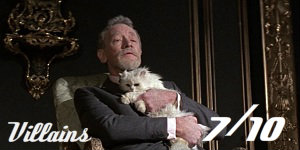
.
It rarely gets claimed (mostly because most Bond fans ignore this flick), but Never actually features probably the best Bond Girl since XXX in Spy. Barbara Carrera’s Fatima Blush is a fine creation for a lighter-than-many Bond flick. Cartoonish in her OTT-ness, but gloriously so at times (even Bond Girl alumnus Grace Jones might balk at her outrageous early ’80s threads), she’s a femme fatale who’s not just unhinged, but genuinely dangerous and – let’s not, er, beat around the bush – very sexy. All right, Fiona Volpe she may not be, but a proto-Xenia Onatopp of GoldenEye (1995) she might just be. The main girl this movie is, of course, Domino, though. If anything, to contrast her with Thunderball‘s heroine, Kim Basinger’s blonde disco-dancing good-time girl is a mite more believable than Claudine Auger’s mid-’60s Euro-glamour puss; she’s more natural. Yet she’s not allowed to be as emotionally rocked by her brother’s fate – and she’s just as much a damsel in distress. The talent quotient’s filled out nicely by Prunella Gee’s comely nurse Pat Fearing at Shrublands (not as memorable as Molly Peters’, mind) and, six years on from Spy, Valerie Leon doing a ‘Maud Adams’ and returning to Bond Girl duties as Caribbean bait for Connery – she may be visibly older here, but frankly looks just as tasty.
On the surface, German actor Klaus Maria Brandauer’s Maximilian ‘Max’ Largo doesn’t look much, but as the movie progresses one comes to realise his is a nicely delivered villain performance. Seemingly a Kristatos-esque downbeat baddie at first (a geeky little genius who’s made a mint and joined SPECTRE because he has a very big chip on his shoulder?), this Largo slowly starts to display neurotic little tics that suggest, aside from his ruthlessness in wealth and power, he’s not entirely all there – and, maybe wrongly, this sort of thing is rarely part of a Bond baddie’s repertoire. As this is ‘Thunderball Rebooted’ (sort of), Blofeld’s back too. And, having taken the decision to portray him as a dignified aristocrat (albeit with his trademark Eon white pussycat), the filmmakers call on the perfect thesp for the part: the legend that is Max von Sydow. Blofeld features little, to be fair (in just three brief scenes), but von Sydow’s such a great screen presence in, well, everything you care mention, he’s almost as memorable as Largo.
.

.
Although Octopussy owned 1983’s Bond action highs, its rival 007 flick that year didn’t do badly in the action stakes either. The movie’s tone is set by Connery reintroducing himself by rescuing a damsel from a hideout via zip-wires, blow-darts and swinging through windows – only ultimately to be stabbed by her. Turns out this was a training exercise and Bond’s fallen foul to his ultimate weakness – women. The biggest action high is the chase involving his jet black Yamaha XJ 650 Turbo motorbike (which he rather coolly rides in his jet black tux). It’s a visceral, exciting sequence through Nice’s streets culminating in Fatima Blush’s demise. There’s also the ‘Tears of Allah’ (a stone statue-laden cave) climax that uniquely sees Bond team up with Felix Leiter for a finale, even if it ends in an underwhelming underwater chase – but, unlike Thunderball, Never wisely limits the underwater action. The most amusing and, in its way, satisfying action sequence, though, is the Shrublands scrap between Bond and Pat ‘Auf Wiedersehen Pet‘ Roach’s Lippe. Basically, their fisticuffs break up the joint – until our hero bests his foe by throwing into his face the toxic contents of a beaker labelled: ‘James Bond – urine sample’.
What makes Never tick is its humour; it distinguishes it from the Eon efforts – as much as borrowing the Broccoli Bonds’ tropes (007’s introductory line, vodka Martinis and black tux et al), it subtly spoofs them. Perhaps thanks to TV sitcom writers Dick Clement and Ian La Frenais’ uncredited rewrites, Never lies somewhere between Eon’s 007 and Austin Powers – and successfully so too. It winks at the audience all the time (Connery even does so in the closing shot), going further here than the Eon genuine articles can. For instance, until Largo reveals to Bond and Domino he’s finally captured them, for the entire second third of the flick he and 007 have been playing a light-hearted, figurative poker game (with the ‘Domination’ computer game within the game at one point – “Can we play one more time for the rest of the world?”/ “You know what that could mean?”). Further fun comes with the mocking of Brit governance in the guise of Edward Fox’s M and Rowan Atkinson’s Bahamas jobsworth Nigel Small-Fawcett, as well as many a witty line throughout (see for example the flick’s best line at the review’s bottom).
.

.
As this isn’t a Broccoli production, its composer was never going to be John Barry, so instead Michel Legrand, scorer for The Umbrellas Of Cherbourg (1964) and The Thomas Crown Affair (1968), holds the baton. And he turns to jazz for this flick’s one-off ‘Bond sound’ (click image above to hear an excerpt from it). It’s a choice that on the whole works, it’s only fair to say (the smooth rhythms are a good fit for the Bahamian and French Riviera locales and Connery’s middle-aged 007), but inevitably the peerless cool and bombastic excitement of Barry’s bursts of brass and martial-esque drive are lacking. Like with Bill Conti’s efforts for Eyes Only, Legrand’s score also falls foul of that early ’80s mis-step of using elevator music at times (having said that, for a few brief seconds Barry’s otherwise fine work on Octopussy mis-steps there too). Although, the most well recalled element of Never‘s music is, of course, its title theme sung by the now little known Lani Hall. It’s a good example of the sort of jazz-influenced, MOR-friendly combo that’s the rest of the score. Yes, it’s far from the best Bond tune, but it has a redeeming feature for sure – it boasts a rather fine trumpet solo from none other than Herb Alpert.
There’s something of a confidence in sending Bond back to The Bahamas for Never, given that this was the primary locale in Thunderball – surely if you wanted to distinguish this flick from the one it’s ‘remaking’, an obvious option would be to go somewhere completely different? But one can’t deny Nassau and the rest of The Bahamas, with their sun-kissed, louche cool, fit Bond like a glove, especially this mature, relaxed Connery incarnation. However, the most prominent of Never’s locations is, in fact, the French Riviera, in particular Nice, Roquebrune Cap Martin, Villefranche-sur-Mer and Monaco’s world famous casino (for the casino interiors, naturally). Offering a slightly more real-world, but just as bright, breezy and prostrate feel as The Bahamas, they’re certainly attractive and aspirational. Yet they’re hardly very different from them either – frankly, if you weren’t paying attention, you’d probably fail to notice Bond’s actually left The Caribbean, which isn’t ideal if your movie’s deliberately globe-hopping. The North Africa-set finale was mostly filmed in Southern France too and the underwater work in Bahamian waters.
.

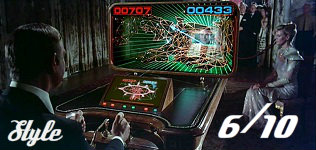
.
There aren’t a hell of gadgets on show here, but by and large they ain’t bad. And they also carry an air of mockery of the Eon Bond. Chief among them is the Union Jack-decorated fountain pen that fires rocket projectiles (it’s by this means that 007 dispatches Fatima Blush, with amusingly just her heeled shoes remaining after she’s exploded). The other major device with which 007’s issued is a wristwatch whose strap features a metal-cutting laser (worth noting here is the fact that later ‘official’ series entry GoldenEye includes a watch boasting almost exactly the same feature). There’s also Bond’s Q-supplied Yamaha motorbike, whose speedy attributes are aided by a turbo boost, and 007’s armed with not a Walther PPK, but a Walther P5 pistol – apparently included in this film because, as a new model, Walther wanted to promote it, even though the Octopussy Bond also uses it at one point.
Like with all Bond films, its style plays an important part in defining Never. Contrasts are easily made with Thunderball – for instance, the Shrublands clinic and warhead-stealing scenes are played more modern; there’s no suggestion Pat Fearing’s dallying with Bond is scandalous as was the case in the former film, while the more state-of-the-art technology of the warhead scenes shortens and arguably improves them (eye-recognition devices and the warheads fly with their own wings like mini jets). Elsewhere, mind, Never does feel a bit early ’80s naff – but always tongue-in-cheek: Bond walks around in Nassau in a fisherman’s blue denim dungarees, Domino sports a full tiger-print swimsuit and the glamorous bubble of a casino is deliberately burst by a room full of arcade games. But the oncoming storm of information technology is also embraced in the shape of the ‘Domination’ video game – a smartly realised, very effective ’80s updating of the classic opening duel between Bond and the villain. It dates the movie considerably, of course, but for a retro enthusiast like me certainly in a good way. The final word, though, should go to the director. Helmer of the awesome The Empire Strikes Back (1980), arty-leaning Irvin Kershner does a good job, not just delivering humour throughout, but also injecting proceedings with unusual, interesting camera angles and shots. A John Glen Bond film then, this ain’t.
.
Adjuster: 0
Named by Connery’s wife (in witty answer to his oft-repeated claim he’d never make another Bond film), Never Say Never Again is far from the car crash such a non-Eon effort could have been. In fact, playing as almost an alternative to the ‘official’ series since Connery left, with the sardonic level turned up to 11, it’s more entertaining than some of the Broccoli-backed ones.
.

.
Best bit: Bond and Largo face off over the ‘Domination’ game
Best line: “Oh, how reckless of me – I made you all wet”/ “Yes, but my Martini’s still dry”
.
Read the troubled and twisted tale behind the making of Never Say Never Again here
.
.
.
Rankings
(All scores out of 100/ new entries in blue/ * denotes a non-Eon Bond film)
1. On Her Majesty’s Secret Service (1969) ~ 90
2. From Russia With Love (1963) ~ 88
3. The Spy Who Loved Me (1977) ~ 87
4. Goldfinger (1964) ~ 85
5. You Only Live Twice (1967) ~ 84
6. Live And Let Die (1973) ~ 82
7. Dr No (1962) ~ 74
8. Moonraker (1979) ~ 73
9. Thunderball (1965) ~ 70
10. For Your Eyes Only (1981) ~ 69
11. Never Say Never Again (1983)* ~ 68
12. Diamonds Are Forever (1971) ~ 66
13. Octopussy (1983) ~ 64
14. The Man With The Golden Gun (1974) ~ 62
15. Casino Royale (1967)* ~ 48
.
The James Bond reviews will return…
.











 George's Journal