Second best? The 20 greatest UK #2 singles ~ Side A

Lighting up the charts: The Beatles may dominate this list, but if some of their greatest hits – and those of other acclaimed, heavy-hitting bands and solo artists – only reached #2, what on earth beat them to #1?
Number One. Número Uno. Nummer Ein. αριθμός ένας. It’s all about coming first, isn’t it? Being top of the pops. Indeed, it’s been that way in the music industry ever since the charts began – and in the UK that was way back in 1952. Since then, each week a new #1 has been announced (or, if a tune or artist has proved popular enough, sometimes the same #1 as the week before). But has the best song in the charts always been at #1? Well, obviously no, of course it hasn’t. In fact, sometimes, nay many times, a particular week’s #1 hasn’t been as good as that week’s #2.
But which weeks? What are those great singles that, for one reason or another and surely wrongly, rose no higher than #2 in the UK charts? And what was the tune that prevented them from hitting top spot? Moreover, did it deserve to? Well, peeps, get ready, get set and, yes, wind up that record player because here it comes – it’s the first half of George’s Journal‘s countdown of the 20 greatest pop/ rock songs that managed to reach #2 (and, rightly or wrongly, the singles that were singularly ‘more popular’ than them). Cue Bruno Brookes…
.
CLICK on the song titles to hear them…
.
20. God Save The Queen ~ The Sex Pistols
Date reached #2: June 11 1977 (1 week)
Kept off the top by: I Don’t Want To Talk About It ~ Rod Stewart
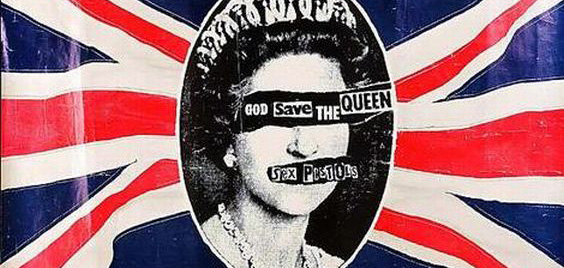
The chanson: One of the punk pioneers’ most memorable efforts from their cannily marketed Never Mind The B*llocks album (their one and only LP), it’s the pseudo-satirical protest song targeting Britain’s constitutional monarchy (a ‘fascist regime’).
The cachet: Squeezing on to the list not for its quality (frankly, it pretty much lacks any) but for its indubitably marvellous infamy, this is the track that years and years later folks still claim actually achieved the sales to hit the top spot, but was wrongly denied its place by the chart authorities in order not to rock the boat the very weekend of Her Maj’s silver jubilee in the summer of ’77. Blame The Sex Pistols’ manager Malcolm McClaren; the whole thing, like the band themselves, was a smart PR stunt.
The challenger: Actually not a terrible, if rather monotonous, effort from Rod’s pop balladry phase; Indigo Girls’ version (1994) is definitely better, mind.
~~~
19. Gold ~ Spandau Ballet
Date reached #2: August 20 1983 (2 weeks)
Kept off the top by: Give It Up ~ KC And The Sunshine Band
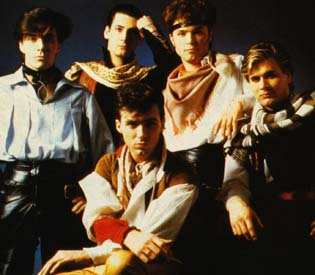
The chanson: The insanely-costumed East-End New Wavers’ iconic – if now clichéd – auric-monickered pop classic.
The cachet: With its rich, echoey, studio-produced sound, precious-metal themed lyrics and catch-it-if-you-can tempo, The Spandaus’ hit still seems to sit happily alongside mind’s-eye images of City yuppies quaffing Tattinger on yachts and poseurs speeding around in garishly coloured Lambourghinis. Yes, we’re talking the soundtrack of ’80s excess, folks, but, dammit, it’s still so appealing a sound all of 30 years later.
The challenger: A decent floor-filler from the fag-end of the Disco era, with its memorable and/ or annoying ‘Ne-ne-ne-ne-ne-ne-ne-now’-opening chorus, it may be, but it’s not up to the Gold standard. Ouch!
~~~
18. Golden Brown ~ The Stranglers
Date reached #2: February 13 1982 (2 weeks)
Kept off the top by: Town Called Malice ~ The Jam

The chanson: The post-punkers’ harpsichord-driven pop masterpiece whose lyrics are still just as indecipherable today as they were back when Charles and Di were (pretending to be) in newly wedded bliss.
The cachet: Proof of the fact there was a future for talented musicians beyond the cynical, one-trick-pony simplicity of punk, this charming yet eerie ballad is the result of The Stranglers looking back to the baroque, thus their genius employment of unusual (for pop at least) alternation of 6/8 and 7/8 time. Is its lyrics really about heroin? According to Stranglers drummer Jet Black, they’re about Marmite. He may not be entirely serious.
The challenger: Perhaps the public’s most easily recalled Jam hit, it’s a melodically fine, lyrically excellent standard of the era. Better than Golden Brown? Just as good as it? Hard to call that one…
~~~
17. Young Hearts Run Free ~ Candi Staton
Date reached #2: July 10 1976 (1 week)
Kept off the top by: You To Me Are Everything ~ The Real Thing

The chanson: Do you want Candi? Back in ’76 many peeps did – or, that is, they wanted this toe-tapping tune of hers, but not enough of ’em to get it to #1…
The cachet: A torch song disguised as a Disco groover, this to my mind, at least, is one of that pop era’s cast-iron classics. Moving at a fine lick, featuring a sax solo for a bridge, rising to a crescendo at the opening of every chorus and boasting Ms Staton’s belter of a performance, it makes you feel like a million dollars whenever it comes on at a nightclub – especially if you pretend it’s 1976.
The challenger: Another popular Disco classic, it’s easy to understand why this strings-backed ballad connected so well with Joe Public, it really grooves, washing over you like a svelte Barry White. Er, yes. Is it better than Candi’s effort, though? That’d be a no.
~~~
16. We Gotta Get Out Of This Place ~ The Animals
Date reached #2: August 14 1965 (1 week)
Kept off the top by: Help! ~ The Beatles

The chanson: The raw, ominous, heavy bass- and jazz organ-driven anthem of the mid-’60s that seemingly struck a chord with everyone who, well, felt they had to get out of a place.
The cachet: The most significant place that original fans of the song wanted to get out of was, of course, Vietnam, this most bodacious tune of the Geordieland-hailing Animals’ back catalogue connecting, as it did, with US troops of the era perhaps more than any other song – which, given the plethora of rock standards still associated with Vietnam, is saying something.
The challenger: The effort John Lennon knocked off when the foursome realised they needed a title song for their follow-up to pop musical movie masterpiece A Hard Day’s Night (1964), Help (the song) is urgent, anxious and pretty much perfect. Is it better than We Gotta Get Out Of This Place? Maybe, just maybe – but, hey, I may be biased.
.
15. Brown Sugar ~ The Rolling Stones
Date reached #2: May 15 1971 (3 weeks)
Kept off the top by: Knock Three Times ~ Tony Orlando and Dawn

The chanson: The Stones’ cast-iron classic, familiar as a staple of radio station plays ever since it was released four decades ago.
The cachet: A one-song groove armada of blues-rock, this instantly recognisable tune is almost the epitome of the Mick Taylor-featuring, early to mid-’70s ‘middle period’ of The Stones, with its dubious title, even more dubious lyrical content (interracial sex, cunninlingus, probably heroin and possibly even slave rape), it’s somehow nowadays – and seems always to have been – perfectly acceptable middle-of-the-road popular rock listening fodder. And to think they kicked up such a rumpus over Let’s Spend The Night Together in 1967…
The challenger: Catchy as hell and daft as a brush (with its own knocking-on-a-pipe sound effect) and, thus, raiser of a whimsical smile, Knock Three Times may be, but if it’s half as good as Brown Sugar, then my name’s Tony Orlando. Or Dawn.
~~~
14. Take On Me ~ a-ha
Date reached #2: October 26 1985 (3 weeks)
Kept off the top by: The Power Of Love ~ Jennifer Rush

The chanson: The falsetto-chorus-concluding, state-of-the-art pencil-drawing-video-boasting pop music masterpiece from the Norwegian trio with the name that may have been dreamed up by Alan Partridge.
The cachet: An utter iconic slice of ’80s synth pop, Take On Me is unquestionably up there with the greatest of New Wave efforts, and for a brief time, it rightfully hoisted a-ha up to the giddy heights of super-stardom alongside your Duran Durans, Culture Clubs and Simple Minds. Bizarrely, this epic floor-filler of a tune required three goes at cracking the UK charts before (aided by an instant MTV darling of a brilliant video), it did the business both here and over the pond and became one of the biggest selling singles of all time, moving a staggering seven million units worldwide. A-ha!
The challenger: Here it is, one of the largest injustices on this list, for this drivel of a power ballad prevented Take On Me hitting top spot for, yes, three whole weeks in the autumn of ’85. Uniquely, three tunes called The Power Of Love were released that year (the others being the efforts from Huey Lewis And The News and Frankie Goes To Hollywood), and this one is by far and a way the least worthy of chart success. Let alone worthy of getting to #1. And preventing a-ha’s all-time classic from doing the same. Gah-ha!
.
13. American Pie ~ Don McLean
Date reached #2: March 4 1972 (2 weeks)
Kept off the top by: Son Of My Father ~ Chicory Tip/ Without You ~ Nilsson
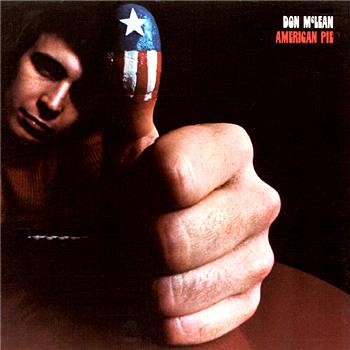
The chanson: The eight-and-a-half minute-long, folk anthem-and-a-half from Stars-and-Stripes-thumb-palmed singer-songwriter Don McLean.
The cachet: Undeniably McLean’s magnum opus (but not his only hit; the beautifully bittersweet Vincent is also his), American Pie is a melodically memorable, but – perhaps more significantly – lyrically ambiguous and verbose epic of songwriting. Essentially about the plane crash that tragically wiped out rock ‘n’ roll legends Buddy Holly, Richie Valens and ‘The Big Bopper’ in 1959 and the effect it had on the then young and impressionable McLean, it’s utterly unforgettable, strangely intoxicating stuff. At least, it always has been for me – I’ve never forgotten any of its lines and, to this day, I’m not sure why I love the song quite as much as I do.
The challengers: A mixed bag if ever there were one. Harry Nilsson’s cover of Brit rockers Badfinger’s Without You is, of course, the definitive version of that plaintive power ballad, yet Chicory Tip’s Son Of My Father (which kept American Pie off top spot for the first of its two weeks at #2) is Glam Rock bargain bin fodder.
.
12. Radio Ga Ga ~ Queen
Date reached #2: February 11 1984 (2 weeks)
Kept off the top by: Relax ~ Frankie Goes To Hollywood

The chanson: The double-hand-clap-inducing anthem that is Queen’s canny paean to the wireless. If not also (supposedly) to baby-speak.
The cachet: To this blogger’s mind, the rock god quartet’s best single of the ’80s (all right, it’s actually maybe just behind their awesome Bowie collaboration Under Pressure), Radio Ga Ga was actually written by Queen’s drummer Roger Taylor – proof surely of how talented they were a band both collectively and individually. The song’s success was also aided, ironically given its subject matter, by its ace Flash Gordon (1980) meets Metropolis (1927) video – another MTV instant favourite – which helped to promote the unique fan hand-clap that accompanied it at Queen concerts and, most notably of all, during their outstanding set at Live Aid, where its performance may just have been the highlight of the whole damn thing.
The challenger: A worthy adversary for a top-of-the-charts battle, for sure, Frankie’s Relax was one of the in-transit-to-Hollywood Liverpudlians three #1’s in ’84 (the first time any artist had scored a hat-trick of chart-toppers with their first three singles since fellow Scousers Gerry and the Pacemakers in ’63) and it is, frankly, brilliant, straddling the line between naughty and nice – accompanied as it was, by another top video, whose full version was notoriously banned by the Beeb. It’s simply ’80s pop culture at its finest.
.
11. Downtown ~ Petula Clark
Date reached #2: December 19 1964 (3 weeks)
Kept off the top by: I Feel Fine ~ The Beatles
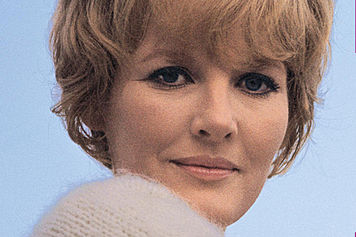
The chanson: Blighty’s premier songbird for more years than you’ve had hot dinners’ smooth, savvy and rich tribute to city nightlife.
The cachet: Ebullient, luscious and utterly glorious, with a very sexy sax solo come the end, Pet’s hit-and-a-half was inspired by New York City rather than Swinging London, despite its release coinciding with the ‘British Invasion’ of UK pop and rock acts in the States, where Downtown easily – and rightfully – sealed a #1 in January ’65. Intriguingly, so vast and eclectic were the musicians involved in its recording that both Jimmy Page (then a budding session guitarist) and Vic Flick, the man responsible for capturing the guitar work on the original and classic James Bond Theme (1962), were among their number.
The challenger: Yes, it’s The Fabs’ bouncy, upbeat, feedback-featuring ballad about a chap happily ensconced in a relationship with his love. How nice. Fans – of whom they had, well, kajillions in late ’64/ early ’65 – thought it very nice (and, no doubt, fab) too, as they made sure it topped the charts for five weeks, including over Crimbo and the New Year. Frankly then, Downtown was never going to topple this Beatles behemoth of a single. But did it deserve to? That’s a very good question…
.
Don’t fret, my blog-friendly friends, for ‘Side B’ of The 20 Greatest UK #2 Singles will be along faster than you can flip over a .45. Well, you know, more or less…
.


She’s just a devil woman?: arguably both the hero and villain of Spitting Image, the presence of Maggie Thatcher was omnipresent in 1980s TV, whether as on-screen puppet or as more subtle sub-text
So here it is, you loyal readers of George’s Journal, the third and final entry in the elongated series of posts that offers up essential dectets of TV classics of decades past (click here for the ’60s and ’70s posts); themselves a sister trio of posts to those three offered by this very blog looking back on movie classics from each of the decades this corner of the Internet like to concern itself with most (ultimate film posts: ’60s, ’70s and ’80s).
And, of course, we’re concluding this blog series then with the decade in which so much that we associate with today’s modern world began, such as mobile phones, yuppies, leg-ins and the British obsession with property ownership. In its way, 1980s telly started much that we take for granted today on our goggleboxes too: the near domination of prime-time by soap operas and their ilk; the doctors-and-nurses-are-fallible, social issue-featuring medical dramas; the anarchic alt-sit-coms and, er, Neighbours. So slip off your Ray Bans, hang up on the wall that cream jacket over your pastel shirt and settle down with that piña colada as we travel back to those 10 years of diverse, divisive TV that were the ’80s. Cue Rick Astley…
.
CLICK on the TV show titles for video clips
(Warning: eighth clip contains strong language)
.
Dallas (1978-91)
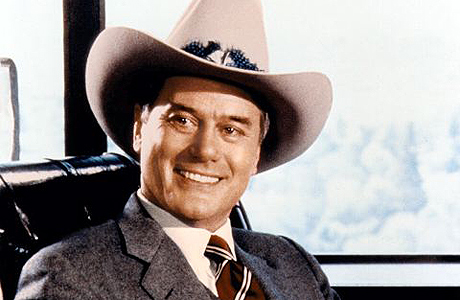
The legend: Of the big cultural reveals of the early ’80s (Darth Vader as Luke’s father in 1980’s The Empire Strikes Back; Mikhail Gorbachev as the new Soviet leader in ’85) for right or wrong the revelation of who shot JR Ewing in the November ’80-aired fourth episode of Dallas‘s fourth season proved the one that millions upon millions around the world were most captivated by. It was the summit of the popularity and influence of this – surely the biggest ever – prime-time soap opera, with its tales of Texan oil industry wheeler-dealers that made a star of Larry Hagman as the devilishly appealing break-out character JR himself. And its tri-split-screen opening titles over its grandiose-cum-funky opening theme are the stuff of pop culture lore.
The lowdown: A sort of cowboy version of ‘Reagan’s America’ (sort of), Dallas originated as a five-part mini-series melodrama broadcast by the US network CBS and grew to become a 13-season hit so monstrous it was arguably bigger than JR’s ego-enriching hats. A(n likely?) winner of four Emmy Awards and the #1 most watched show Stateside three times in four successive years (1981-84), it made stars not just of Hagman, but also Patrick Duffy (Bobby Ewing), Linda Gray (JR’s wife Sue Ellen) and Victoria Principal (Pamela Barnes-Ewing). Oh, and that JR-shooting reveal drew its episode Who Done It? the largest ever US TV audience (per household share) – until it was eclipsed three years later by the final episode of classic sitcom M*A*S*H (1972-83).
The line: “Don’t forgive and never forget; do unto others before they do unto you; and third and most importantly, keep your eye on your friends because your enemies will take care of themselves!” (JR)
The unlikely but true: Hollywood star Donna Reed replaced fan favourite Barbara Bel Geddes as JR and Bobby’s mother Miss Ellie for the eighth season; realising they’d goofed, the producers enticed Geddes back for the next season only for them having to pay Reed a $1 million out-of-court settlement for her dismissal.
The legacy: Although Coronation Street (1960-present) had certainly got there first in the UK, in the States and worldwide Dallas‘s enormous success legitimised the soap opera not only as a prime-time television show, but also as a bankable evening schedule monster, with the likes of spin-off Knots Landing (1979-93) and its Joan Collins-toting rival on ABC Dynasty (1981-89) following in its wake, as well as eventually EastEnders (1985-present), as over the pond the Beeb finally caved in and got in on the action.
.
Only Fools And Horses (1981-2003)

The legend: Utterly unavoidable for the past 30 years, Only Fools is surely the UK’s most enduringly popular sitcom, featuring the Peckham-based wheeler-dealer antics of Del Boy, Rodders, Grandad and (later) Uncle Albert, and spanning and reflecting the decade of economic inequality, yuppies and Harvey Wallbangers – and beyond.
The lowdown: Far from envisaged as a vehicle for fine comedy actor David Jason of Open All Hours (1976-85) fame (originally Jim Broadbent was favourite to play lead character Del), it was a sitcom follow-up to writer John Sullivan’s successful Citizen Smith (1977-80) that, until two years into its run, recorded mediocre ratings. With great foresight though, the Beeb stuck with it and arguably thanks to hugely popular Christmas specials from the mid-’80s onwards, it became one of Blighty’s most popular shows of the decade – if not the most popular. Its seventh series in 1991, which saw the birth of Del’s son, was its last, but seasonal specials continued the saga in ’91, ’92, ’93, ’96 (that year’s trilogy included the 24.4 million viewers-achieving Time On Our Hands), 2001, ’02 and ’03.
The lines: “This time next year we’ll be millionaires”/ “You plonker, Rodney!”/ “Lovely jubbly”
The unlikely but true: Owing to its first two series’ less than impressive viewing figures, the show was almost cancelled in 1983; creator Sullivan believed a major factor in it being commissioned in the first place was the success of its later great rival, ITV’s comedy drama Minder (1979-94), which featured very similar settings and themes.
The legacy: Not only did Only Fools make household names of David Jason and Nicholas Lyndhurst (Del’s brother Rodney), it also established the sitcom as a Christmas TV schedule giant – the Beeb’s later efforts Bread (1986-91), Birds Of A Feather (1989-98), Men Behaving Badly (1992-98), The Vicar Of Dibley (1994-2007) and The Royle Family (1998-present) have all tried to take on its mantle – and made such terms as ‘plonker’, ‘cushty’, ‘triffic’ and ‘(nice little) earner’ nationwide colloquialisms, as well as soften the images of the tri-wheeled Reliant Regent car and the yuppie, as Del ill-advisedly attempted to join their number in the late ’80s. Moreover, it generated the successful spin-off comedies The Green Green Grass (2005-09) and Rock And Chips (2010-11).
.
Family Ties (1982-89)

The legend: Arguably the most memorable of the slew of hugely popular, US family-oriented sitcoms of the ’80s, Family Ties was the middle class, Middle America show that made Michael J Fox a heart-throb throughout the land before – and during – his making the leap into the stratosphere thanks to Back To The Future (1985).
The lowdown: Although as accessible and easy-to-consume as a giant tub of Häagen-Dazs, Family Ties, alongside promoting family values, rather smartly showed up the conflict between the ideals presented by liberal Baby Boomer, ex-hippie parents Steven and Elyse Keaton (Michael Gross and Meredith Baxter-Birney) and those of the changing Reaganite America in which they brought up their teenage son Alex (Fox) and daughters Mallory (Justine Bateman) and Jennifer (Tina Yothers) and, eventually, their youngest offspring Andrew (Brian Bonsell). This was only exacerbated by Alex’s conservatism and ambitions to become a Republican politician, a role that quickly established Fox as the show’s break-out star and won him three consecutive Emmy Awards in 1986, ’87 and ’88.
The line: “Alex is reading me Robin Hood where he steals from the poor and gives to the rich” (Andrew)/ “That’s not Robin Hood, that’s Ronald Reagan” (Steven)
The unlikely but true: Fox was only cast as Alex after Matthew Broderick turned down the role; although Friends‘ (1994-2004) Courtney Cox memorably appeared as his girlfriend towards the end of the show, Alex’s first long-term girlfriend was played by Tracy Pollan – whom years later became the real-life Mrs Michael J Fox.
The legacy: Family Ties clearly proved a huge launchpad for Fox’s career; without its early success it’s unlikely he’d have been cast as Marty McFly in Back To The Future. Moreover, the show was created by Gary David Goldberg, whom was also behind the ’90s Fox-fronted, political sitcom hit Spin City (1996-2002), in which Fox’s character Mike Flaherty left the show by moving to Washington DC where he encountered a senator named Alex P Keaton.
.
Boys From The Blackstuff (1982)
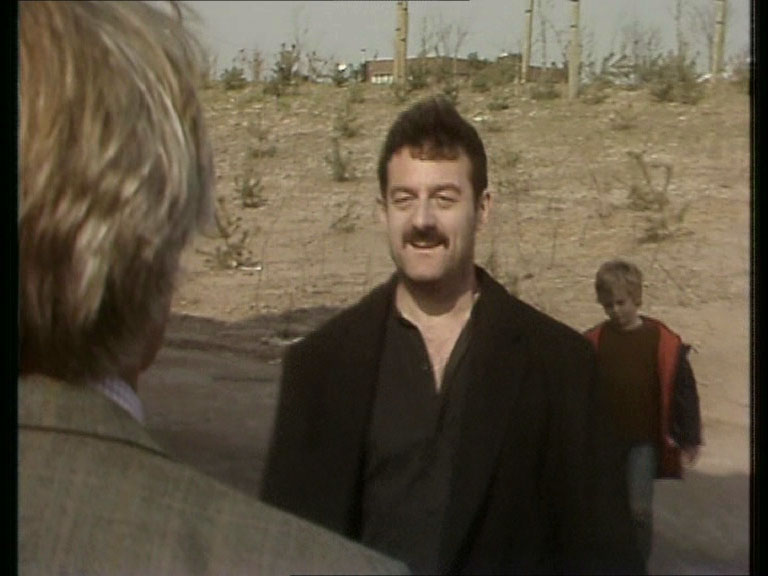
The legend: The definitive slice of anti-Thatcherite TV, this was the short drama serial that imprinted Yosser Hughes’ desperate employment-seeking greeting on the national consciousness – and made it a catchphrase for an era.
The lowdown: Commissioned by BBC2 after Liverpudlian dramatist Alan Bleasdale’s Play For Today (1970-84) one-off The Blackstuff (about laid-off tarmac layers) had aired on the channel in 1978, his follow-up tragi-comic drama Boys From The Blackstuff aired in autumn ’82 in five parts, each of which followed the lows of one of the unemployed working class fellers, including mouthy, mentally-disintegrating Yosser Hughes (Bernard Hill) and Chrissie (Michael Angelis), the end of whose episode sees him shoot his family’s pet geese for food. As such, featuring a high quotient of quirky humour, it presented a gritty, undiluted view of the demise of Northern, male-driven, working class culture.
The lines: “Gizza job!”/ “I’m desperate, Dan” (Yosser)
The unlikely but true: Although eventually filmed and broadcast in ’82 at the height of Margaret Thatcher’s divisive economic policies, much of the drama was actually written three years earlier, straight after The Blackstuff was made – thus one could say (in a way) it dates from James Callaghan’s fag-end of ’60s and ’70s Labour dominance as much as Thatcher’s era.
The legacy: Thanks to Blackstuff‘s success, Bleasdale became a left-wing dramatist du jour in the ’80s, penning the controversial The Monocled Mutineer (1986) for the Beeb and G.B.H. (1991) for Channel 4. Inevitably, it also made Bernard Hill’s face a more than familiar one; he’d be seen most notably again as Captain Smith in Titanic (1997) and King Théoden in The Lord Of The Rings trilogy (2001-03), plus in the role of Chrissie’s wife Angie, Julie Walters landed herself a prominent role. Moreover, as the ’80s progressed, further Northern England-centred, employment issue-focused dramas and comedies found their way on our screens, including Auf Wiedersehn, Pet (original run: 1983-86 – see below), and, to a lesser extent, soap opera Brookside (1982-2003).
.
St. Elsewhere (1982-88)

The legend: The near decade-long spanning hospital melodrama that triumphed with viewers and at award ceremonies with its mixture of vivid ensemble characters, contemporary social issues and, at times, broad comedy, St. Elsewhere was as big a bastion of US TV in the ’80s as any other – if not more.
The lowdown: Created (among others) by Gwyneth Paltrow’s dad Bruce, the show was set in the fictitious Boston hospital St. Eligius (nicknamed ‘St. Elsewhere’ owing to its semi-rundown state in a depressed part of town) and was an immediate hit. Something of a sister piece to the groundbreaking police procedural drama Hill Street Blues (1981-87), which was made by the same production company, Mary Tyler Moore’s MTM Enterprises, this show at its best blended soap opera with gritty drama, featuring the complicated and pressured work and home lives of the hospitals’ various employees and maturely tackling contemporary subjects such as race, feminism, rape, autism, single-parenting and in the shape of the first prime-time TV character to contract the scare du jour, AIDS. Overall, it won 13 Emmys for its acting, writing and direction – including a double win in ’86 for real-life spouses Bonnie Bartlett and William Daniels (Mr Braddock in 1967’s The Graduate and the voice of K.I.T.T. in fellow ’80s TV classic Knight Rider).
The lines: “You moron!” (Dr Craig to Dr Ehrlich)/ “You’re a pig, Ehrlich!” (various)
The unlikely but true: The show’s final episode (‘The Last One’) concluded in infamous fashion with the autistic son of main character Dr Westphall (Ed Flanders) seemingly dreaming the entire six seasons’ (137 episodes’) events, as it suggests his father’s not a hospital doctor but a blue-collar construction worker and St. Eligius may only exist in the boy’s mind thanks to him imagining what might take place in a building called ‘St. Eligius’ inside a snow-globe he holds (see the Tommy Westphall universe theory).
The legacy: Undeniably, St. Elsewhere was a big influence in style and story on ’90s mega-hit medical drama E.R. (1994-2009), while its producers and writers went on to make a slew of later prime-time hits such as Moonlighting (1985-89), L.A. Law (1986-94), Northern Exposure (1990-95), Homicide: Life on the Street (1993-99), NYPD Blue (1993-2005) and Chicago Hope (1994-2000). Moreover, it launched – and, for several years, sustained – the careers of several small- and (later) big-screen stars including Ed Begley Jr, Bruce Greenwood, Mark Harmon, Helen Hunt, Howie Mandel, David Morse, Cindy Pickett, Nancy Stafford, Alfre Woodard and one Denzel Washington.
~~~
The Young Ones (1982 and ’84)

The legend: The ultimate exponent of ’80s ‘alternative comedy’, The Young Ones was a surrealist, non sequitur-driven sitcom that broke all the rules and poked fun at everything from house-sharing students to shady landlords and from University Challenge (1962-present) to the Queen Mother of Pop himself, Cliff Richard.
The lowdown: Growing out of Britain’s ‘alternative comedy’ movement centred at London’s The Comedy Store/ The Comic Strip clubs, the two series (12 episodes)-toting The Young Ones debuted on BBC2 only a week after the first Comic Strip Presents… film was broadcast on Channel 4’s opening night in autumn ’82, which featured many of the same performers. Utilising the talents of Rik Mayall, Adrian Edmondson, Nigel Planer (as the über-exaggerated student stereotypes Vyvyan, Rick and Neil, along with previously dramatic actor Christopher Ryan as Mike) and Alexei Sayle as members of landlord family the Balowskis, its almost throw-everything-and-see-what-sticks combo of highly improbable plotting, OTT comic-book violence, mock political satire, Muppet-like talking animals and florid fourth-wall-breaking was quite unlike anything telly in Britain (or anywhere else) had seen before, or maybe has since.
The line: “Vegetable rights and peace!” (Neil)
The unlikely but true: Stephen Fry can lay claim to appearing on University Challenge three times – he was on the quiz as an actual student, then years later in a celebrity edition and in the classic scene from The Young Ones‘ second series opener ‘Bambi’ (along with fellow former Cambridge Footlights alumni Emma Thompson, Hugh Laurie and show writer Ben Elton) as a member of Footlights College’s team opposite Vyvyan, Rick, Neil and Mike’s Scumbag College team.
The legacy: Although far from mainstream, The Young Ones was too widely consumed to be called cult (its stars teamed up with Cliff to record a version of Living Doll for an early Comic Relief appeal); as such, it played a big role in popularising ‘alternative comedy’ in the ’80s. Indeed, owing to its visual alternative-ism it was perfect import fodder for the then new and dynamic MTV cable music channel in the States. And its success paved the way not only for Mayall and Edmondson’s re-teaming in anarchic effort Bottom (1991-95) as well as the alt sitcom hit Absolutely Fabulous (1992-2012), but also for Ben Elton’s burgeoning comedy writing career – just a year after the show’s first airing, the Elton-penned Blackadder (1983-89) would make its bow.
~~~
The A-Team (1983-87)

The legend: Colonel John ‘Hannibal’ Smith. Lieutenant Templeton ‘Faceman’ Peck. Captain H M ‘Howling Mad’ Murdock. Sergeant First Class Bosco ‘Bad Attitude (BA)’ Baracus. And, of course, the cool-as-hell metallic grey GMC Vandura van with its red stripe. The A-Team was the infantile, rompish yet awesome icon of’80s TV.
The lowdown: First screened on NBC straight after the Super Bowl in January ’83, it immediately hit #4 in the ratings and proved an enduring, much loved show throughout all five of its seasons. With its unlikely, disparate but legendary quartet of Vietnam-vets-on-the-run (George Peppard, Dirk Benedict, Dwight Schultz and Mr T) and its tried-and-tested formulaic plots (including our heroes fashioning flame-throwers or the like out of three paperclips and a Pritt-Stick, and BA having to be rendered unconscious to take a flight in a plane/ helicopter/ autogryro/ hand-glider – delete as appropriate), it made the most hay of all the daft but terrific, killer theme tune-toting prime-time action adventure dramas of the era (1979-’85’s The Dukes Of Hazzard, 1980-’88’s Magnum, P.I., 1982-’86’s Knight Rider and 1984-’87’s Airwolf) with their very ’80s preoccupation with muchos military paraphernalia, cartoon violence and aiding the small-town America little guy.
The lines: “I love it when a plan comes together” (Hannibal)/ “Shut up, fool!”/ “I ain’t gettin’ on no airplane!” (BA)
The unlikely but true: Hollywood legend James Coburn was initially considered for the role of Hannibal before lesser name George Peppard was cast. According to Dirk Benedict, Peppard’s friend Robert Vaughn was added to the cast as an antagonist in the final season to help temper the ‘difficult’ Peppard’s on-set relationship with Mr T; both Coburn and Vaughn appeared in the classic Western The Magnificent Seven (1960), while Peppard almost did.
The legacy: Undeniably one of the easiest and fondest recalled TV efforts of the ’80s, The A-Team achieved huge popularity especially with the all-important youth demographic, spawning novelizations, Marvel comic adaptations and (of course, given this was the ’80s) the requisite action figures. At the show’s height, even a cola-flavoured popsicle of Mr T was available for avid fans. As for the break-out star himself, he instantly became a kids’ favourite, curious role model of the age and pop culture icon, famously appearing as Santa as Nancy Reagan sat on his knee at the White House in ’83, voicing himself in the Saturday morning cartoon Mister T (1983-86) and recording the once-heard-never-forgotten maternal endorsement ditty Treat Your Mother Right (Treat Her Right) (1984).
~~~
Spitting Image (1984-96)
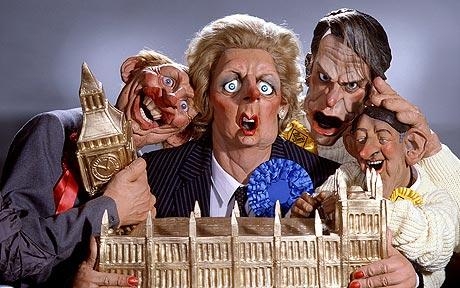
The legend: ITV’s late-night-Sunday, chaotic, car crash-like satirical sideswipe of ’80s Britain (and the wider world) with its cast of grotesque rubber puppets
The lowdown: Owing as much a debt to the moving-into-the-mainstream ‘alternative comedy’ movement as it did to ’60s UK TV satire giant That Was The Week That Was (1962-63), Spitting Image‘s calling card was its latex puppets made by Peter Fluck and Roger Law, but its focal point was the barbed, often fantastically twisted writing of a mainly left-leaning bunch of scribes, most notably Rob Grant and Doug Naylor who were brought onboard early on to save the show before leaving two years later to develop sci-fi sitcom Red Dwarf (1988-present). Although its satire often came across as more slapdash than pointed owing to its largesse and outlandishness, the show’s stars – the puppets – made it unmissable. From a male suit-wearing, urinal-using Maggie Thatcher to a panicky, ‘nuke button’ obsessed Ronnie Reagan and from a Lester Piggot so unintelligible he needed subtitles to tabloid hacks who were actually pigs, the parodies of the great and good, the famous and the bad were unforgettable and often genius.
The lines: “I am neither in this sketch nor not in it, but somewhere in-between” (’90s Lib Dem leader Paddy Ashdown)/ “I didn’t touch her on the left leg, or the right leg, but somewhere in-between” (Ashdown on the revelation of his extramarital affair)
The unlikely but true: In the early ’90s the show poked fun at British Tory PM John Major by depicting him as entirely grey (read: insufferably boring) and embarking on a far-fetched affair with Cabinet colleague Virginia Bottomley. Years later, another member of his Cabinet, Edwina Currie, admitted she’d, in fact, had an affair with him while in Government – apparently, the writers had considered Currie for this story-line, but plumped for Bottomley instead.
The legacy: Once a ratings success, Spitting Image became a phenomenon, even securing a UK #1 with its pop at nonsensical-lyric-featuring novelty tunes The Chicken Song (1986) – much more barbed was its b-side, the apartheid protest effort I’ve Never Met A Nice South African. Also, the show’s OTT caricatures caught the imagination of the nation’s youth and the politicos featured would eventually admit to enjoying the exposure it brought them. Most significantly, though, its success gave ‘alternative comedy’ a further push into the mainstream – for instance, the Rik Mayall-starring political sitcom The New Statesman (1987-92) featured a very similar style – and it helped forge the careers of many of its voice artists, including Rory Bremner, Chris Barrie, Steve Coogan, Harry Enfield, Alistair McGowan, Jon Culshaw, Phil Cornwell, John Sessions, Hugh Dennis, Steve Punt and John Thomson.
~~~
Miami Vice (1984-89)
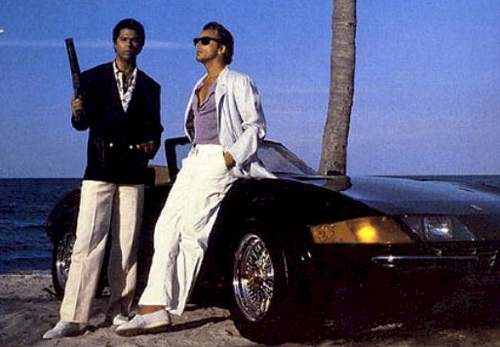
The legend: Maybe the most unmistakeably ’80s show on this list – it’s the one that adapted the cop show for the MTV generation, featuring Don Johnson and Philip Michael Thomas as the Floridian drug-busters Crockett and Tubbs, whose look almost influenced an entire decade’s menswear.
The lowdown: While every boy was watching The A-Team, practically every grown-up boy was watching Miami Vice, the ideal entertainment for the decade awash with gaudy visual flair; electronic-driven pop music; infantile, gung-ho male heroism and general style over substance. In a nutshell, Vice was all about style – and is recalled far more for that than its tales about hard-nosed cops in a drug-ravaged if sunny South Florida. (Possibly) born thanks to US broadcaster NBC’s big-wigs deciding in a brainstorming session they wanted an ‘MTV Cops’ show, it was helmed for the majority of its run by executive producer Michael Mann, whom honed its stylish cinematography, its use of chart stars’ latest singles as incidental music, its featuring of Ferrari sportscars and Scarab speedboats and, of course, its t-shirt-under-Armani-jacket costumes, the pastel tones of which were intended to reflect the art deco architecture of Miami’s South Beach. The effect was long portions (if not entire) episodes resembled music videos rather than traditional cop dramas, thanks too to composer Van Hammer’s US #1 hitting title theme and his frequently featured Crockett’s Theme (later to be used ad infinitum in ’90s Nat West bank ads).
The line: “How do you go from this tranquility to that violence?” (Girl)/ “I usually take the Ferrari” (Crockett)
The unlikely but true: So concerned with style were the production team that when filming scenes in genuine parts of the drug-addled, downtrodden South Beach, they painted rundown buildings’ walls to fit the show’s colour scheme.
The legacy: Frankly, it’s immeasurable. As noted, Vice inspired a men’s fashion trend that’ll forever be associated with the ’80s – for example, After Six formal wear introduced a Miami Vice jacket line, Kenneth Cole a Crockett and Tubbs shoe line and in ’86 a Stubble Device razor appeared promising punters Don Johnson-like ‘five o’clock shadow’. Moreover, its use of pop music and cinematic visuality changed TV drama and comedy forever – every trendy US show of the ’90s and beyond owes it a huge debt. And still the show’s influence lives on… check out the very stylistically similar Bad Boys movies (1995 and 2004) and the practically pastiching video game Grand Theft Auto: Vice City (2002). Not to mention too, of course, Mann’s big-screen ‘adaptation’ (2006) and the show’s glamourising, popularising and thus revitalising of Miami – it’s been estimated the city has benefited $1 million per episode.
.
Neighbours (1985-present)
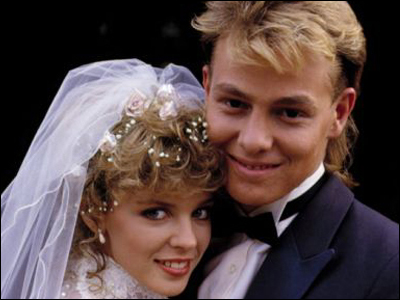
The legend: The Antipiodean weekday-early-evening monolith of a soap that addicted a generation and made stars of good-looking Aussie performers (and inexplicably the bloke who played Harold Bishop).
The lowdown: Back in the day, Oz had given Blighty Barry Humphries (and his alter-ego Dame Edna Everage), Clive James and Rolf Harris, but in the mid-’80s it gave us something we really could have done without. Yes, Neighbours hit UK screens in October ’86, 18 months after it had started in its homeland, and quickly became a daytime telly hit, regularly drawing a staggering 10-15 million plus audience at its peak. Created by soap opera king Reg Watson for Grundy Television, it hit its stride in its second season, from whence its tales of the young members of the Ramsay, Robinson and Clarke clans living in Ramsay Street (in Melbourne’s fictitious Erinsborough) transfixed viewers throughout Australia and even more in the UK, so much so that 20 million over here watched golden boy Scott and sexy dungaree-sporting mechanic Charlene tie the knot in November ’88. Neighbours is, of course, still on our screens (on Five over here; on Eleven in Australia), but while maintaining its popularity throughout the ’90s, it’s never managed to scale the dizzy, innocent, sun-kissed, frizzy perm-fuelled heights of its early years.
The lines: “Ah… ah, Madge…” (Harold)
The unlikely but true: The song that played at Scott and Charlene’s wedding, Angry Anderson’s Suddenly, was years later chosen by Kylie Minogue to play at her real-life wedding.
The legacy: The delight/ trouble (depending on your view) with Neighbours is what it spawned. Not content with opening the door for the similarly breezy but vacuous Australian soap Home And Away (1987-present) to invade UK screens from ’89 onwards, it also led to an influx of its best loved talent plying their trade over here. Those who didn’t carve out pop music careers (unlike Natalie Imbruglia, Delta Goodrem, Holly Valance, Stefan Dennis and, of course, to great Stock, Aitken and Waterman-driven success, Jason Donovan and the ‘Pop Pixie’ herself Kylie) tended to fill out pantomime protagonist roles in the soap’s off-season (our winter/ Australia’s summer), such as Ian Smith (Harold Bishop), Anne Charlestone (Madge Bishop), Kimberley Davies (Annalise Hartman) and Dan Paris (Drew Kirk). The show also played a significant role in popularising with Brits Aussie cultural clichés; in particular terms such as ‘arvo’ (afternoon), ‘wagging’ (playing truant from school) and ‘throwing a wobbly’ (tantrum), as well as the notion of holding a barbecue when the weather’s decent for one’s friends and, yes, neighbours.
.
Five more to check out…
The Krypton Factor (1977-95)
The Gordon Burns-fronted, it’s much-more-than-a-quiz gameshow, featuring rounds including an assault course, landing an airline simulator, spot-the-difference and, er, a quiz
.
Auf Wiedersehen, Pet (1983-86 and 2002-04)
Dick Clement and Ian Le Franais’ dramedy about Brit construction workers journeying to Germany in search of work, which made familiar faces of Jimmy Nail, Ian Healy and Timothy Spall
.
Threads (1984)
BBC2’s one-off ‘consequences of the Cold War boiling over’ drama that scared the living sh*t out of the entire nation
.
The Secret Diary Of Adrian Mole, Aged 13¾ (1985)
Channel 4’s bittersweet adaptation of Sue Townshend’s novel of an awkward, anti-Thatcherite, ordinary teenager growing up in Nottinghamshire that spoke to and enchanted millions of real-life ’80s teens
.
Howards’ Way (1985-90)
The Beeb’s unapologetically go-out-and-take-it Sunday-night semi-soap set amidst the power politics of a South Coast boating business community
.
… And five great shows about the ’80s
Our Friends In The North (1996)
Excellently observed, epic drama serial following the lives of a quartet from Newcastle, whose penultimate section takes in the ’80s
.
Friends And Crocodiles (2005)
Stephen Poliakoff’s smart if dreamy take on the everything-is-possible-in-business ethos of the mid- to late ’80s, starring Damian Lewis, Jodhi May and Robert Lindsay
.
Ashes To Ashes (2008-10)
Philip Glennister’s Gene Hunt returns and is teamed with Keeley Hawes’ Alex Drake in early ’80s Lahndon Tahn in the three-series-toting sequel to Life On Mars (2006-07)
.
This Is England ’86 and ’88 (2010 and ’11)
Shane Meadows’ follow up TV comedy-drama to his acclaimed 2004 film about the influence of the fascist skinhead trend in the poverty-stricken urban Britain of the early ’80s
.
Royal Wedding (2011)
Jodie Whittaker plays a young wife and mum in a tight-knit Welsh community whose world falls apart the day Charles marries Di in the summer of ’81
.

Silver-lining playback: just a few short months after Please Please Me’s release, The Beatles pose with producer George Martin in celebration of the album hitting 250,000 sales and making it to ‘silver’ status
Now, everyone who’s got something to hide (except for me and my monkey) know that The Beatles got started that fateful day way back in July 1957 when John Lennon and Paul McCartney met at a little fête in Liverpool. If you want to put their start later than that, mind, then there’s an argument for it coming with their brotherly-bonding and dynamic-forming trips to Hamburg between ’60 and ’62, or you may even be able to push it to the moment when Ringo Starr replaced Pete Best as the quartet’s drummer in August ’62 and the fab foursome’s true line-up was at last formed. But no later than that surely. Certainly not as late as ’63.
To this Beatles fan’s mind, though, they really got started at the beginning of that very year, for it was 50 years ago last Monday (February 11 1963) that their first album Please Please Me was recorded and, within weeks, nay days, the whole Beatles phenomenon truly got started. Yes, it was the recording (merely within an amazing 12 hours) and the release to the world at large of this collection of 14 songs that established The Fabs as a fabulous, own-musical-writing entity – as well as marvellous Mop Topped superstars for the early ’60s bobby-soxers and beyond.
So here follows this blog‘s pictorial, musical and, yes, quotable tribute to the golden anniversary of the beginning of Please Please Me – and with it then the ‘beginning’ of The Beatles…
.
.
.
“There wasn’t a lot of money at Parlophone. I was working to an annual budget of £55,000 and I could spend it however I wished, but I had to produce a certain amount of records a year. So I wanted to get The Beatles’ first album recorded in a day and released very quickly, because once we’d made the first single, my commercial mind told me that I had to have an album out very soon. So I got the boys together and asked them: ‘What have you got? What can we record quickly?’ They replied by telling me: ‘Only the stuff we can do in our act!’ I then chose the stuff that would appeal to the kids of the day, things like ‘Anna’ and ‘Chains’, and lots of rock and roll standards. We recorded ten titles in one day, starting at 10 o’clock in the morning and finishing at about 11 o’clock at night and completed the album” ~ George Martin, All You Need Is Ears, 1979
.
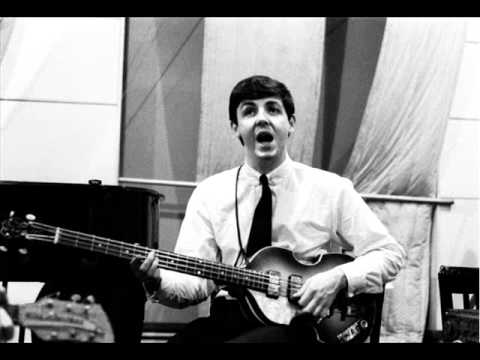

It takes two, baby: Paul gets on with the job (left), while John’s caught out having a tea break (right)
.
“The first LP we did at 10 o’clock in the morning, just after a night out. We played the stage act right through, and then went home. We sat and talked about it (the recording), recorded the tracks, we went home and they just mixed it. They’d ring us in a couple of weeks, and we would say: ‘Is our record ready yet?’ It was like putting a film in the chemist” ~ Paul McCartney
.
.
“Most of their debut album was recorded in a single session on February 11 1963. It was released on March 22 1963 and reached the top spot in the British charts. In America it was titled ‘Introducing The Beatles’, and released on the little-known Vee Jay label. The US version didn’t include ‘Please Please Me’ or ‘Ask Me Why’ and failed to make the charts” ~ Steve Turner, A Hard Day’s Write, 1994
.


A day in the studio with George: the band converse and collaborate with producer ace George Martin
..
“It wasn’t always going to be called ‘Please Please Me’. George Martin thought of naming it ‘Off the Beatle Track’ and Paul even doodled a few cover ideas before the idea was dropped. (George clearly retained a liking for it however, for on 10 July 1964 he released an orchestral LP of Beatles tracks with that title)” ~ The Beatles Recording Sessions, Mark Lewisohn, p.32, 1988
.
.
“In all the busy years since pop singles first shrank from ten to seven inches I have never seen a British group leap to the forefront of the scene with such speed and energy. Within the six months which followed the Top 20 appearance of ‘Love Me Do’, almost every leading deejay and musical journalist in the country began to shout the praises of The Beatles. Readers of the New Musical Express voted the boys into a surprisingly high place via the 1962/3 popularity poll… on the strength of just one record release. Pictures of the group spread themselves across the front pages of three national music papers. People inside and outside the record industry expressed tremendous interest in the new vocal and instrumental sounds which The Beatles had introduced” ~ from Please Please Me’s sleeve notes written by The Beatles’ press officer Tony Barrow
.


Guitar men; studio brethren: Paul and John together (l); Ringo and John listen with George Martin (r)
..
“Between them, The Beatles adopt a do-it-yourself approach from the very beginning. They write their own lyrics, design and eventually build their own instrumental backdrops and work out their own vocal arrangements. Their music is wild, pungent, hard-hitting, uninhibited… and personal. The do-it-yourself angle ensures complete originality at all stages of the process” ~ from Please Please Me’s sleeve notes written by The Beatles’ press officer Tony Barrow
.
.
“I was a fellow of London Zoo and, rather stupidly, thought that it would be great to have The Beatles photographed outside the insect house. But the zoo people were very stuffy indeed: ‘We don’t allow these kind of photographs on our premises, quite out of keeping with the good taste of the Zoological Society of London,’ so the idea fell down. I bet they regret it now…” ~ George Martin, The Complete Beatles Recording Sessions, Mark Lewisohn
.
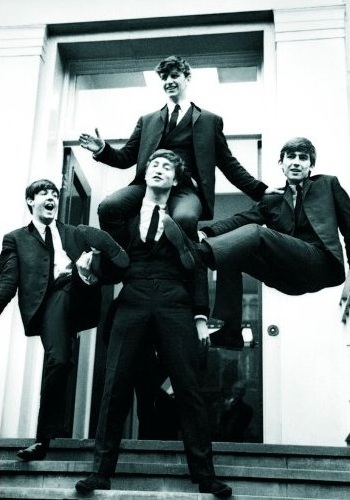

Let it be McBean: two of Angus McBean’s iconic images captured for the album’s artwork – John holding Paul, Ringo and George outside EMI/ Abbey Road Studios (l) and an alternate version of the classic album cover shot of the band looking down the staircase of EMI’s London HQ in Manchester Square (r)
..
“We rang up the legendary theatre photographer Angus McBean, and bingo, he came round and did it there and then. It was done in an almighty rush, like the music. Thereafter, though, The Beatles’ own creativity came bursting to the fore” ~ George Martin on the shooting of Please Please Me’s album artwork
.
.
More:
BBC4’s ‘Please Please Me: Remaking A Classic’ on the iPlayer (available in the UK and Northern Ireland for the next few days)
.
Playlist: Listen, my Valentined friends! ~ February 2013



.
In the words of Moby Grape… listen, my friends! Yes, it’s the (hopefully) monthly playlist presented by George’s Journal just for you good people.
There may be one or two classics to be found here dotted in among different tunes you’re unfamiliar with or have never heard before – or, of course, you may’ve heard them all before. All the same, whether you’re loved up or unloved come this Valentine’s Day, why not sit back, listen away and enjoy…
.
CLICK on the song titles to hear them
.
Jimmy Durante ~ Make Someone Happy1
Sylvie Vartan ~ Nostalgia2
Badfinger ~ Without You3
Roxy Music ~ If There Is Something4
Terry Callier ~ What Color Is Love
Slade ~ Everyday
Joe Cocker ~ You Are So Beautiful
Linda Ronstadt and The Muppets ~ Blue Bayou5
ABC ~ All Of My Heart
Paul Nicholas ~ Just Good Friends6
Frances Ruffelle ~ On My Own7
Patrick Swayze ~ She’s Like The Wind8
Kevin Kline ~ La Mer9
.
1 As featured over the closing credits of the movie Sleepless In Seattle (1993) – and in many a TV commercial
2 The legendary French chanteuse’s 1969 version of Dream A Little Dream Of Me, a major chart hit in Italy; she also covered the tune in French under the title ‘Les Yeux Ouverts’
3 The original version of the Harry Nilsson classic as written and performed by The Beatles’ favourite band
4 As heard on the soundtrack of the ’70s-set nostalgia fest flick Flashbacks Of A Fool (2008)
5 La Ronstadt’s performance of her chart classic (backed by The Electric Mayhem and a chorus of swamp frogs) on a May 1980 episode of The Muppet Show (1976-81)
6 The opening and closing credits theme from John ‘Only Fools And Horses’ Sullivan’s other hit ’80s sitcom
7 From the 1985 cast recording of the original West End production of mega-musical Les Misérables; Ruffelle originated the role of Éponine and is the mother of British pop star Eliza Doolittle
8 Written by Swayze himself and as featured in his signature film Dirty Dancing (1987)
9 Kline’s semi-mocking, French-language take of the ballad standard from the film French Kiss (1996)
.
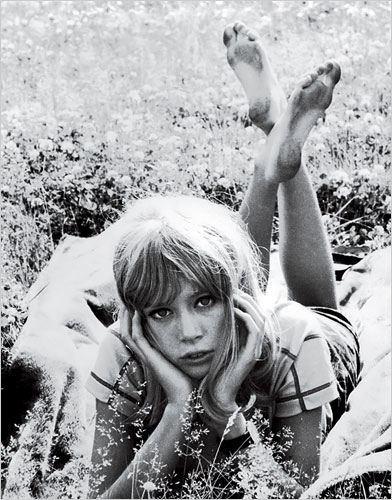
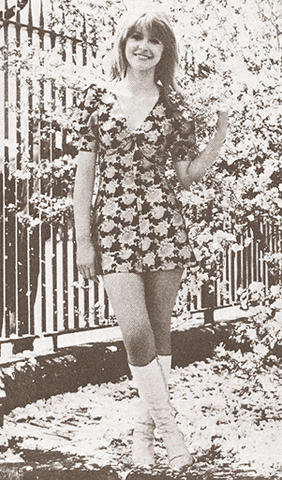
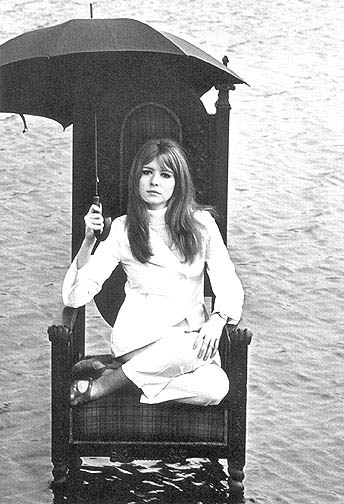
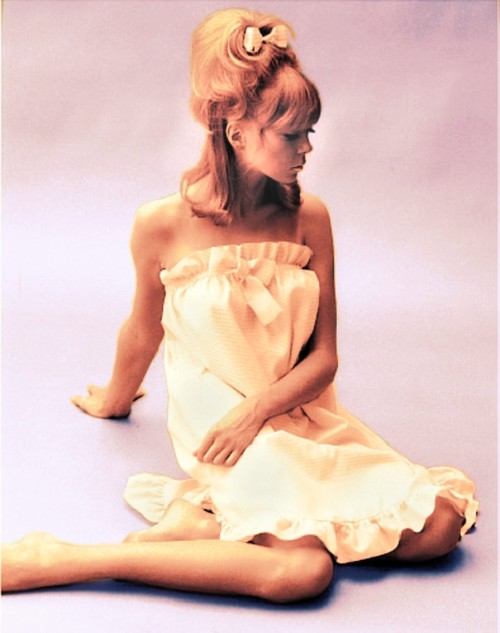
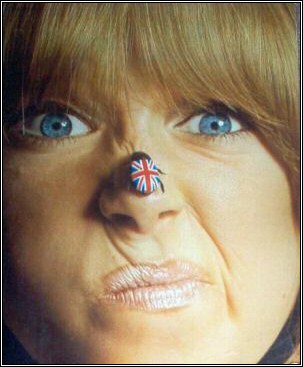
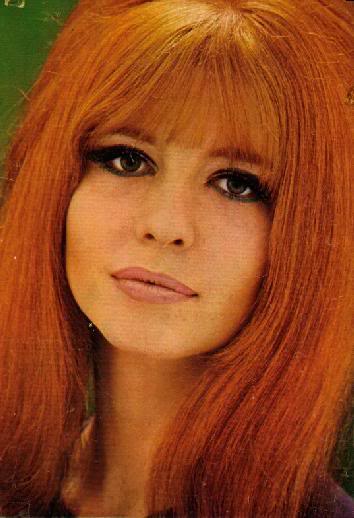
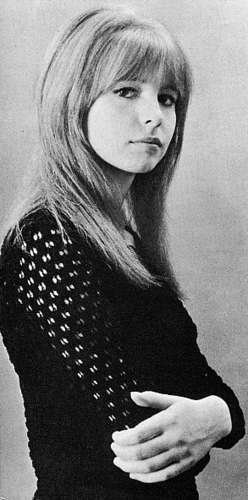
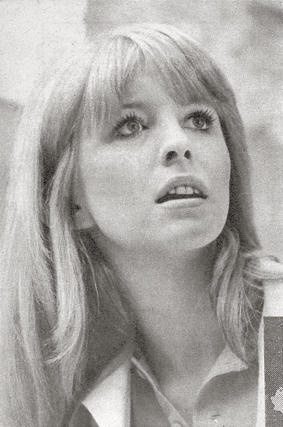
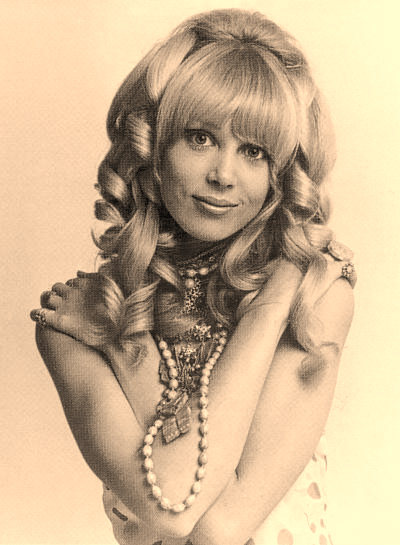
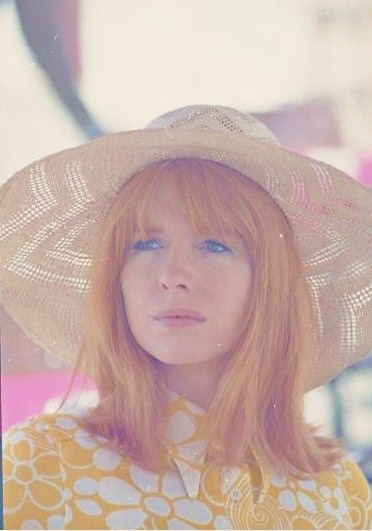
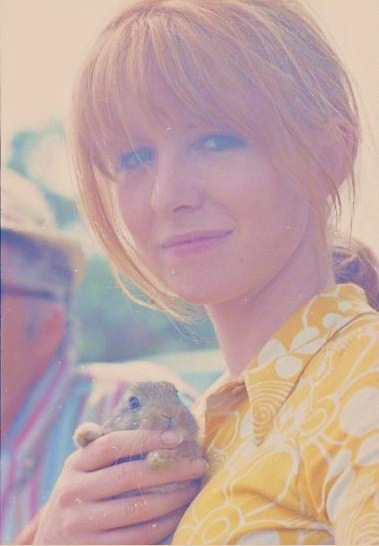
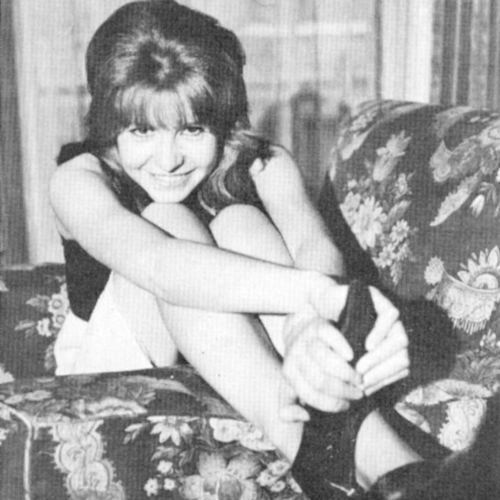
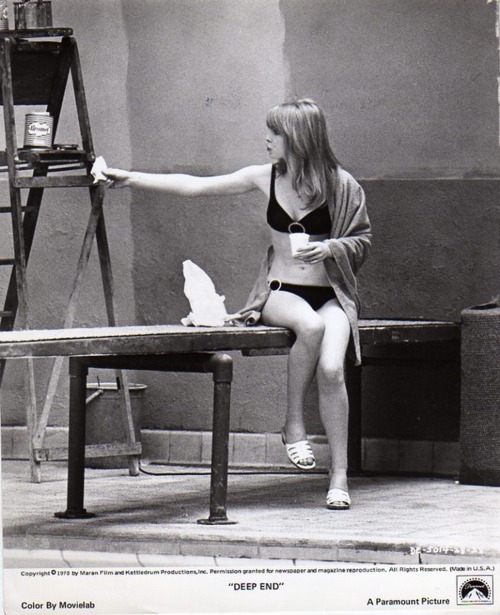
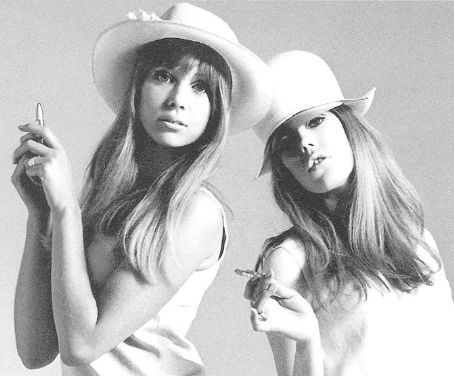
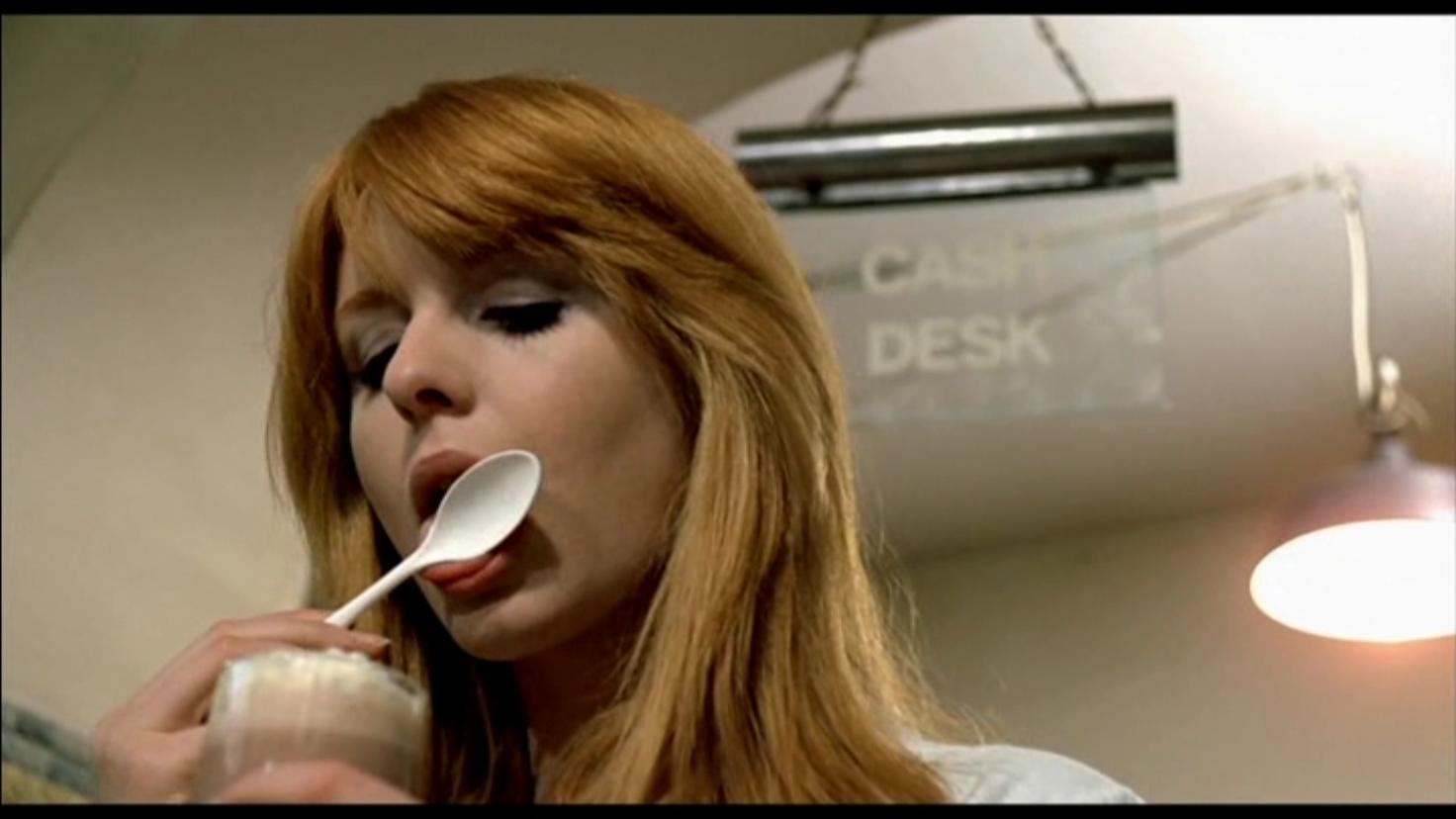
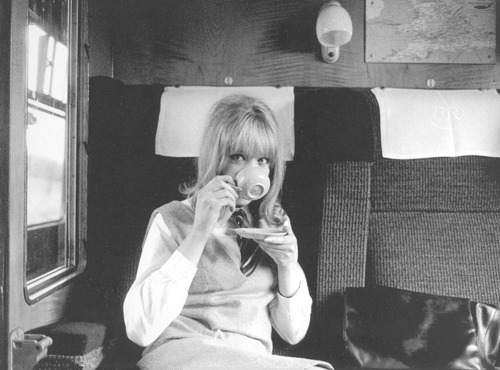
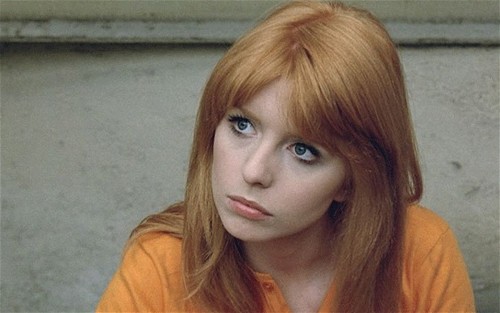
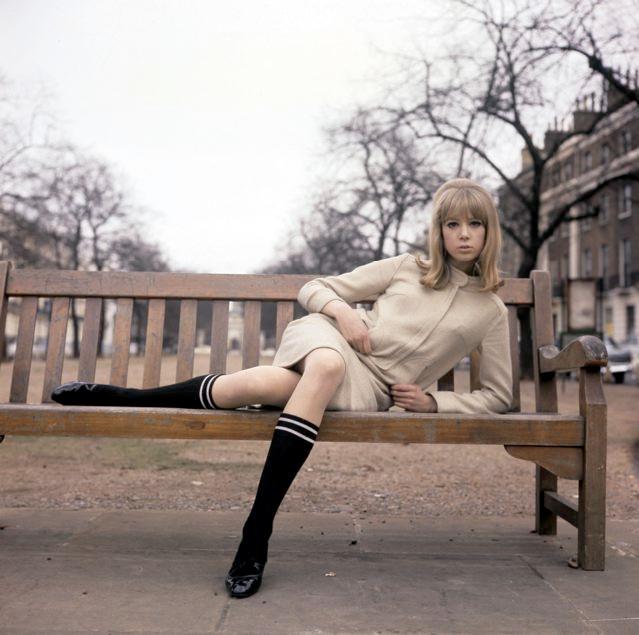
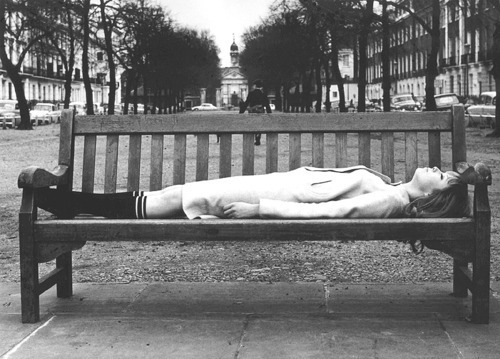
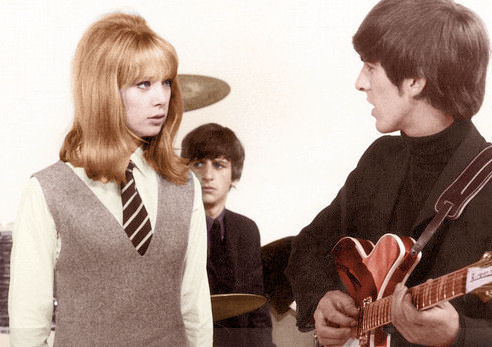
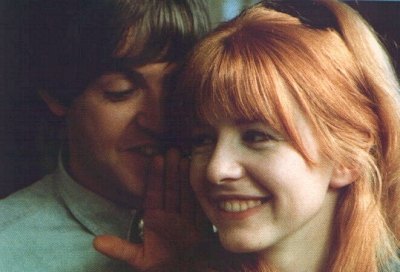
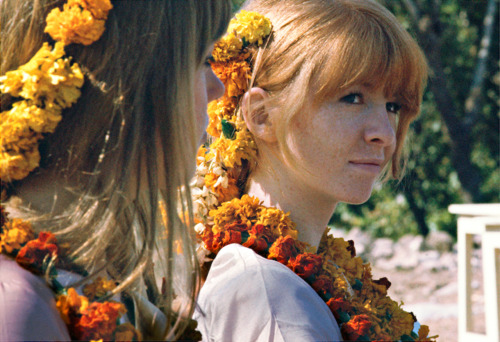
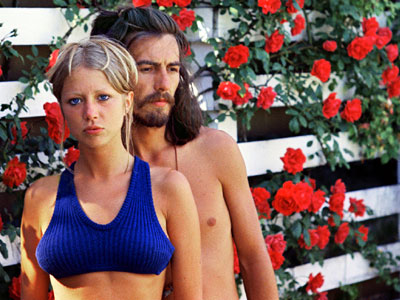
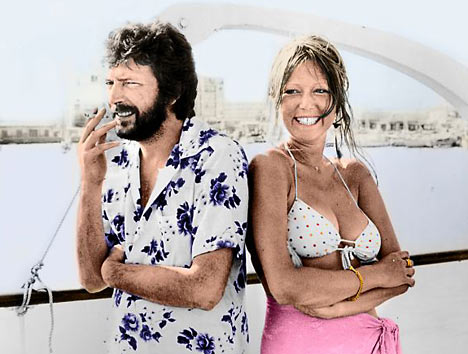
Jane Asher/ Pattie Boyd: Fab Fancies

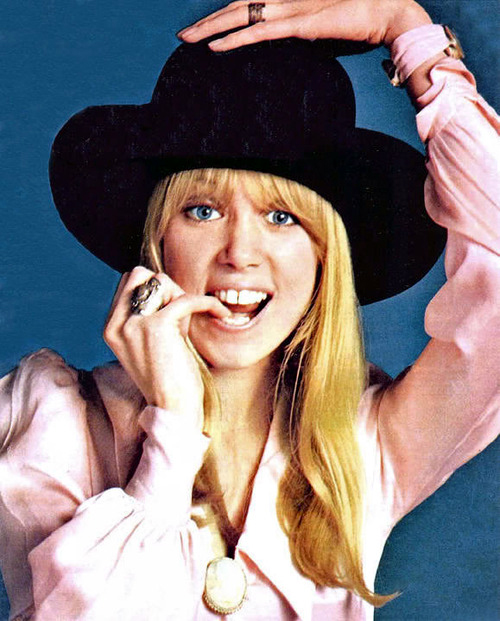
Talent…
.
… These are the lovely ladies and gorgeous girls of eras gone by whose beauty, ability, electricity and all-round x-appeal deserve celebration and – ahem – salivation here at George’s Journal…
.
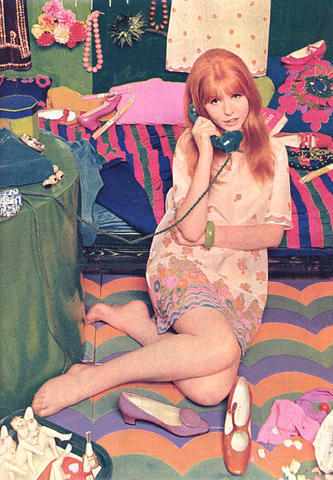
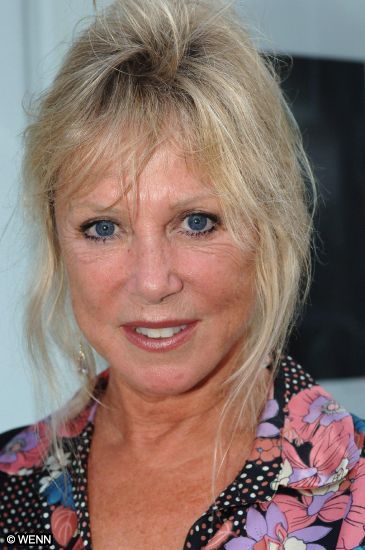
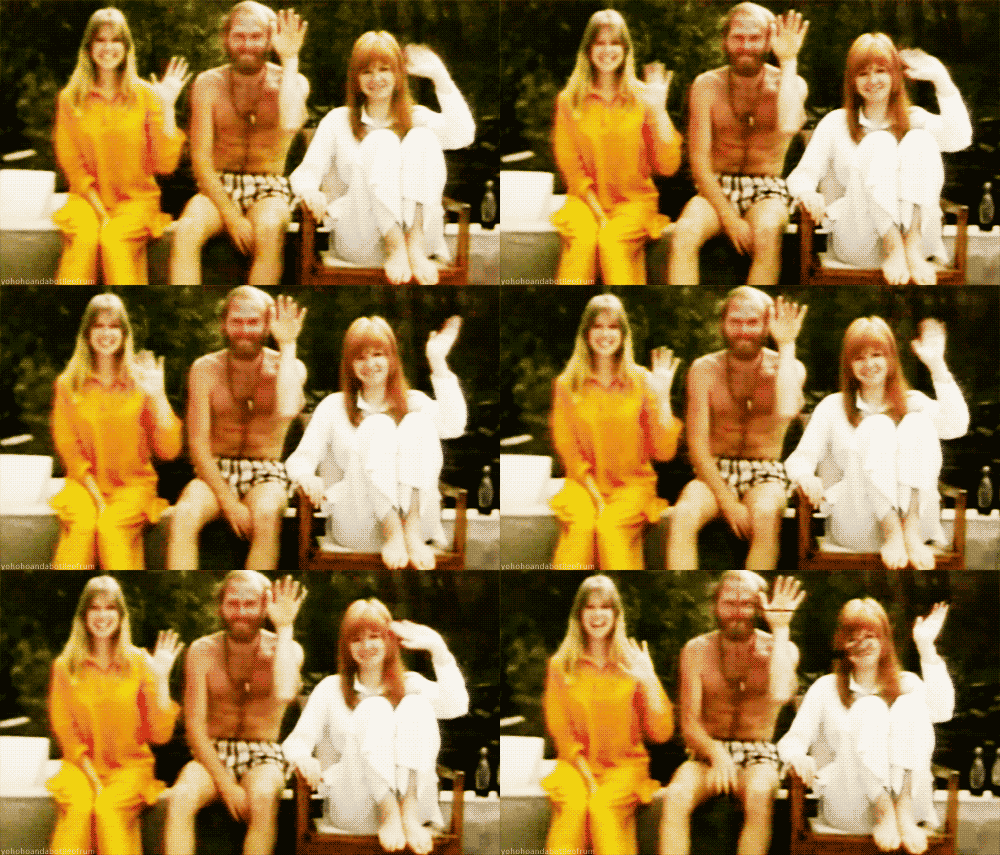
The Beatles, in their infinite genius, brought to us masses many things: beautiful music, fashionable togs, Eastern mysticism-trendiness and dodgy beards. They also brought to us (whether they liked it or not) their other halves, all of whom were intelligent, inspired and artistic souls themselves – and many of them were also, well, pretty tasty. Not least these two. One was a hot-to-trot actress of the age; the other a major fashion model of the era – in short, Jane Asher and Pattie Boyd. Here comes the sun then, indeed, as together they’re the latest fab pair to enter this blog’s Talent corner, peeps…
.
Profiles
Names: Jane Asher/ Patricia Anne ‘Pattie’ Boyd
Nationalities: English
Professions: Actress, author and cake-maker/ Model, photographer and author
Born: April 5 1946, Willesden, London/ March 17 1944, Taunton, Somerset
Height: 5′ 6″/ 5′ 7″
Known for: Jane – an established actress of stage and screen for nearly fifty years, her most famous role is playing one of Michael Caine’s bits-of-all-right in Alfie (1966). She also appeared in the incest-themed drama The Buttercup Chain and the art-house curio Deep End (both 1970), played Jane Seymour in Henry VIII And His Six Wives (1972), starred in ITV’s acclaimed adaptation of Brideshead Revisited (1981) and the Beeb’s female WWII spy drama Wish Me Luck (1987-89) and more recently took TV parts in the resurrected Crossroads (2003) and Holby City (1999-present). She’s perhaps most famous, though, as Paul McCartney’s girlfriend in the ’60s, for whom she was the muse for his songs You Won’t See Me, I’m Looking Through You (both 1965) and For No One (1966) and with whom she and the other Beatles and their squeezes travelled to India for transcendental meditation with the Maharishi Mahesh Yogi in February 1968. Later she met cartoonist Gerald Scarfe, whom she married in 1981. She’s also penned several books, including three novels, and notoriously owns a cake-making business.
Pattie – a leading fashion model in the ’60s and ’70s in London, New York and Paris, she wore Mary Quant and was snapped by the likes of David Bailey and Terence Donovan and on whose appearance the legendary Twiggy has claimed she based her own. Even more so than Asher, though, she’s most famous for being the girlfriend then wife of a Beatle, George Harrison (whom she met on the set of the 1964 film A Hard Day’s Night, in which she appeared), and then of Harrison’s close friend Eric Clapton. Indeed, almost as well known is the fact that the former’s classic song Something (1970) is reputed to be inspired by her, as are the latter’s much-loved tunes Layla (1970) and Wonderful Tonight (1977). She also had an affair with Rolling Stone Ronnie Wood in the early ’70s. Recently she published an autobiography and has displayed photographs she took during the rock ‘n’ roll era of her life at exhibitions throughout the world.
Strange but true: Jane’s father was an eminent medical professional whom was responsible for the first published description and naming of Münchausen syndrome, while through her mother she can trace her lineage back through centuries of English aristocracy; Pattie’s sister Helen (whom she nicknamed ‘Jenny’, the name by which she became known) was also a ’60s fashion model and the inspiration for a classic song of the era – Jennifer Juniper (1968) by Donovan, with whom she had a relationship.
Peak of fitness: Jane – flirting and then cavorting in the nuddy with the hormonally-charged teen lead in Deep End/ Pattie – an abstract choice this, but I’d say as Harrison and Clapton saw her in both Something and Layla; after all, as the former maintained in Yellow Submarine (1968), ‘it’s all in the mind’…
.
.
CLICK on images for full-size
.

.
.
.
.

.


.

.

.
.

.
.
.
.
.
.
.

.
.

.
.
.
.
.
.

.
.
Going (London) Underground: happy 150th birthday to The Tube
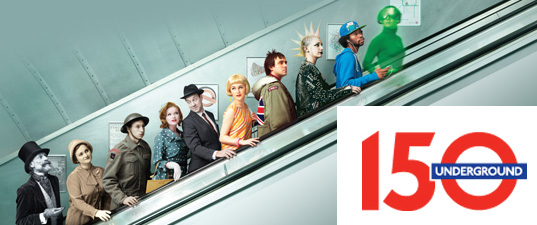
Time travellers: from Victorian times, through WWII, the Swinging Sixties and punk, right up to the present, the great and the good, the bold and the bad (read: everyone) has enjoyed/ endured The Tube
In a previous life I used to write for a magazine for the employees of one of the (now disbanded) London Underground contractors. While penning pieces on said publication, one always had to bear in mind its style-guide was quite adamant on the fact that in referring to London’s underground railway by its colloquial, affectionate moniker the ‘Tube’, one always had to write the proper noun as ‘The Tube’; the upper-casing of the first letter of its preceding article all important. But, thought I whenever I mused on it, that was quite a fitting stipulation, because The Tube is such an awesome form of public transport (when it’s working properly) it deserves not to be referred to as the Tube, but definitely as The Tube.
I mention this, of course, because today the world’s first metropolitan underground railway (are there any underground railways outside of metropolitan areas? Whatever) celebrates its 150th birthday. Yes, The Tube opened on 9 January 1863. No, there were no electronic trains back then (presumably it was a very stuffy, smoke-filled environment), no buskers and no tourists with incredibly bulky luggage whom inexplicably stand right in front of platform entrances and exits. For better or worse. But that’s when the world’s first, oldest and surely most famous underground railway network began.
Since then it’s seen everything from serving as a haven for sheltering Londoners during WWII’s Blitz to a central location for the most recent Bond film Skyfall (2012). It is one of my favourite cornerstones of my favourite city – when there aren’t any delays, which admittedly there often are (what can you do?). And for that reason, today George’s Journal is saluting the terrific and very tubular Tube by presenting to you this blogger’s five favourite stations. So commute away, peeps – and remember to mind the gap…
.
5. St. John’s Wood

Opened: 1939
Tube Line: Jubilee
Location and distinction: To be fair, there’s nothing remarkable about this station – although it’s a fine example of the rounded-themed, tiled, Modernist 1930s style of many – it’s all about its location (er, location, location). Yes, the brilliant thing about this stop on The Smoke’s superior subterranean transport network is its delightful proximity to one of the city’s all-time classic landmarks, namely that pedestrian crossing outside Abbey Road Studios across which The Beatles strolled in order to capture that utterly iconic image for their penultimate and near-perfect album Abbey Road (1969). Seriously, although it’s located on the corner of Acacia Road and Finchley Road, you need only take a seconds-long very pleasant, very suburban stroll down Grove End Road, turn right and, yes, you’re right there. Fab-tastic, to say the least.
You’ll know it from: That’d be that time you visited the Abbey Road crossing then
Coolest bit: Stepping out of the station and realising exactly where you are…
.
4. Piccadilly Circus
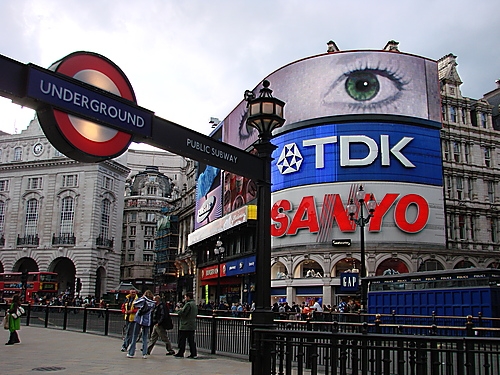
Opened: 1906
Tube Lines: Piccadilly and Bakerloo
Location: Literally underneath Piccadilly Circus
Distinction: This one features an entirely (and fittingly for The Tube) circular ticket hall. And its a stonker of a ticket hall. With confusing exits leading you up to different sides of different streets peeling off the world famous road junction above and public telephone booths, public toilets, Tube ticket machines, cash machines and (at first oddly) a below-ground entrance to the entertainment venue The Trocadero, it’s a tourist-teeming, dizzying, Central London hub that’s practically as busy as the more notorious street-level site above. But given its location in the heart of the West End, it’s filled with and fuelled by an excited buzz of chatter and air of expectation – especially in the evening.
You’ll know it from: That New Year’s Eve when you headed home with the inebriated – but invariably happy – throng after seeing out the old annus on the town
Coolest bit: The ‘world clock’ artwork near the escalators in the centre of the ticket hall that old-school-style attempts to display the world’s time zones (a band runs across its map of the world at the same speed as the sun crosses the globe)…
.
3. Angel
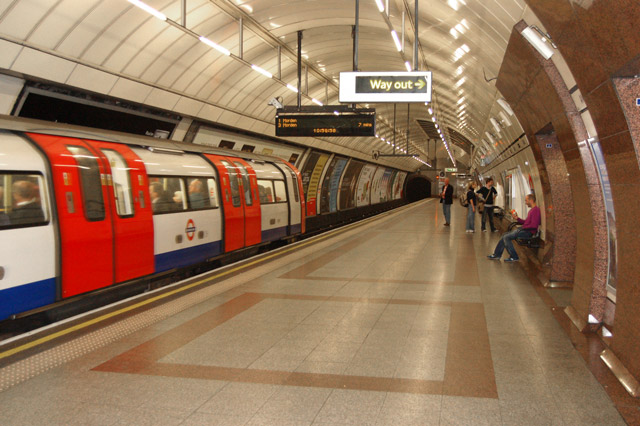
Opened: 1901
Tube Line: Northern (Bank branch)
Location: Underneath ‘The Angel’ district of London on the southern tip of the borough of Islington
Distinction: Angel station has a very modern, nay, hip (for The Tube at least) feel to it. It owes this not least to where in The Smoke it resides – the bottom of the fashionable Upper Street with all its boutiques, bars and restaurants; the King’s Road of North London, if you will. It also comes from its two distinguishing features. The first is the uniquely wide, highly polished and frankly rather cool southbound platform, which owes its unusual width to the fact it was once an ‘island platform’ serving tracks on either side, one of which has obviously been removed. The other is the higher of its two escalators (which transports travellers to street-level), whose length of 60 metres and vertical rise of 27 metres makes it the third longest in Europe behind one on the Stockholm Metro and another on the Helsinki Metro.
You’ll know it from: The video for the trendy (and very Islington) singer-songwriter Ed Sheeran’s single The A-Team (2011)
Coolest bit: The level between the two escalators at which you’ll often find a busker or two. Once this very blogger witnessed there an amateur songster performing Oasis’s Don’t Look Back In Anger (1995) while spontaneously and joyously joined by a chorus of 20+ thigh-slapping, quite impressively in-tune students. A sight – and sound – to behold, let me tell you…
.
2. Westminster

Opened: 1868
Tube Lines: Circle, District and Jubilee
Location: The corner of Bridge Street and Embankment – literally underneath the MPs’ offices building opposite the Houses of Parliament
Distinction: Westminster Tube station is all about the internal architecture – basically, to walk around in it is for us mere mortals the closest we’ll get to being inside a Bond villain’s lair. Seriously, it’s just like one. Sleek, shiny, tubular, with deep, open, appealingly lit industrial-like chasms, this is a Blofeld-esque space to say the least. Thanks to its deep-level construction work to connect it to the Jubilee line (completed in 1999), it’s modern, smart and easily the coolest Tube station there is. And even has a central control room near the barriers where chaps in hi-viz jackets sit looking at monitors like minions working for some deluded megalomaniac’s world domination-seeking operation.
You’ll know it from: Er, visiting the Houses of Parliament, Downing Street or Westminster Abbey. Like, obviously.
Coolest bit: Going down the escalators and pretending you’re 007…
.
1. Bank
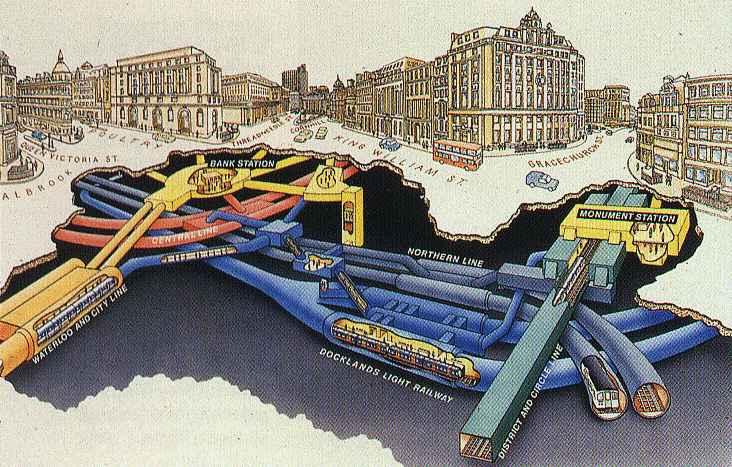
Opened: 1900
Tube Lines: Central, Circle, District, Northern, Waterloo and City and Docklands Light Railway
Location: Bank junction – the intersection of Threadneedle Street, Cornhill, Lombard Street, Mansion House Street, Poultry and Princes Street in the heart of the City of London
Distinction: The daddy of all Tube stations, Bank-Monument (to give it its full name) is a monster. You could walk around in it for an hour. Easily. Especially in, er, rush-hour. Multi-levelled, labyrinthine and seemingly endless, this effort is so impressive it’s technically two stations in one, as it lumps Monument (Circle and District Lines) in with the tri-Tube Line serving and ice-cool named Bank (after the above-ground Bank of England, of course). The ninth busiest station within the Tube network, it can be an absolute bugger to get around in when populated by peeps, not least because it’s usually filled by besuited banker and City-working bods, yet its epicness is unquestioned. It even boasts a direct Tube Line straight to Waterloo Tube/ railway station, which is not least handy but also proves just how essential a stop Bank is.
You’ll know it from: Those times you’ve got lost within its never-ending tunnels when you feel like you’re miles away from where you want to get to – and, indeed, above-ground civilisation (mind you, directly above Bank is the City, so it’s hardly civilisation, fnarrr!)
Coolest bit: Getting on a train at the Waterloo and City platform for the first time and realising you really are about to whizz right beneath the capital, not stopping once until you reach the legendary Waterloo station. It sort of feels like getting on your own private, dinky underground train. Sort of…
.
Further reading:
georgesjournal.wordpress.com/2011/03/27/mapping-the-stars-the-great-bear-1992-simon-patterson
tfl.gov.uk – the official Tube website
themanwhofellasleep.com/tubegossip.html
.
Playlist: Listen, my friends! ~ January 2013
.
In the words of Moby Grape… listen, my friends! Yes, it’s the (hopefully) monthly playlist presented by George’s Journal just for you good people.
There may be one or two classics to be found here dotted in among different tunes you’re unfamiliar with or have never heard before – or, of course, you may’ve heard them all before. All the same, why not sit back, listen away and enjoy…
.
CLICK on the song titles to hear them
.
The Glenn Miller Orchestra ~ Auld Lang Syne
Jackie Brenston And His Delta Cats ~ Rocket 881
Michel Legrand ~ The Boston Wrangler2
Serge Gainsbourg ~ La Horse3
Crosby, Stills, Nash & Young ~ Our House4
Buddy Rich ~ Norwegian Wood5
Brotherhood Of Man ~ Angelo
Shirley Bassey ~ I Was Born To Be Bad6
Cheap Trick ~ I Want You To Want Me
Peter Howell ~ Theme from The Shock Of The New7
Rod Stewart ~ Young Turks
Su Pollard ~ Back In The USSR
Billy Crystal and Meg Ryan ~ New Year’s Eve party from 1989’s When Harry Met Sally… (backed by Auld Lang Syne)
.
1 Recorded in 1951 and considered by many to be the very first rock ‘n’ roll song, its performers’ name was actually a pseudonym for Ike Turner and his backing band Kings Of Rhythm; months later it was covered by rock ‘n’ roll legend-to-be Bill Haley
2 From the Oscar-nominated score to The Thomas Crown Affair (1968)
3 From the Gainsbourg-written and -performed score to the film La Horse (1970)
4 Memorably featured in both a 1990s advert for UK building society Halifax and ‘Time On Our Hands’ (1996), the record audience-achieving episode of classic sitcom Only Fools And Horses
5 As performed on a 1973 edition of the Beeb’s legendary Parkinson (1971-82) chat show
6 As featured on a 1979 edition of the BBC’s The Shirley Bassey Show (1976 and ’79)
7 Composed by original BBC Radiophonic Workshop member and Doctor Who scorer Peter Howell, this was the title theme to Robert Hughes’ classic BBC series on the history of modern art The Shock Of The New (1979-80)
.
Golden sands: Lawrence Of Arabia ~ fifty years of the movie masterpiece

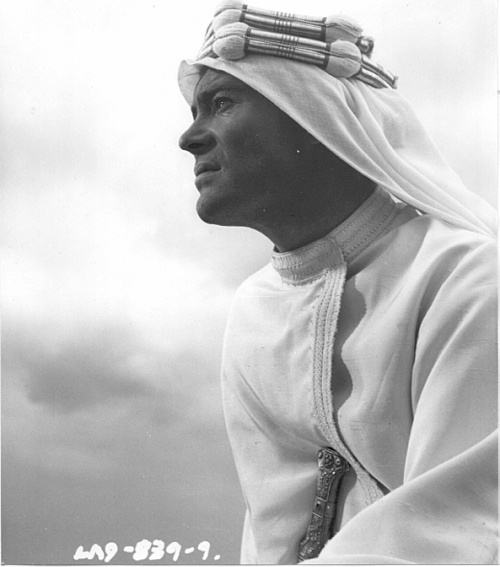
Darling of the desert: impossibly blue-eyed and indubitably brilliant, Peter O’Toole’s Lawrence was just one genius ingredient of David Lean’s multi-Oscar-winning movie masterpiece
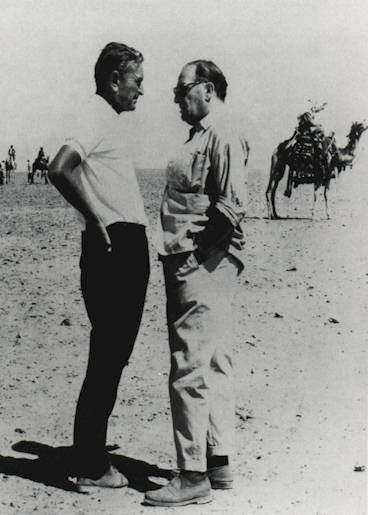
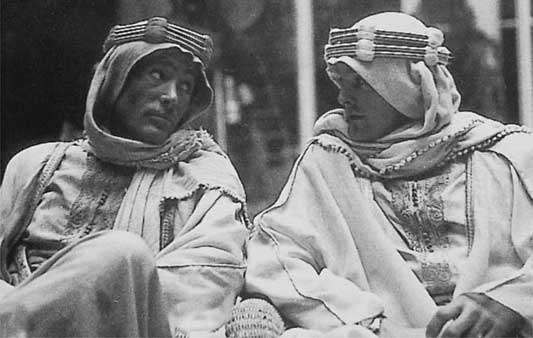
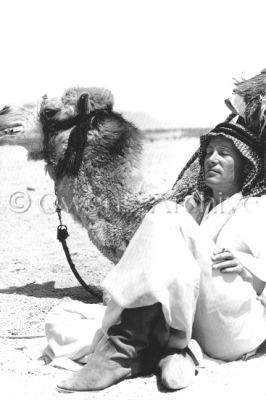
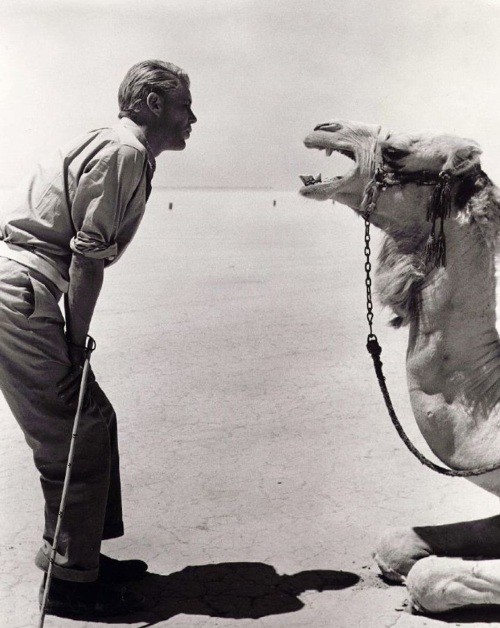
Well, went the year well? Yes, if you were a British Olympian, Her Maj, a blond secret agent employed by Her Maj or, erm, a rain-lover. If you were any of them then you had much to celebrate, indeed. Yup, there were more than one several-year anniversaries in there. And here’s another. For, as 2012 just ducks out of sight, George’s Journal is seeing out the old and ringing in the new by celebrating the golden anniversary of one of the greatest films this very blogger’s ever seen – if not the greatest he’s ever seen. Peeps, I give you a tribute, (still just about) in its fiftieth year, to the seven-time Oscar-winning, 20-minutes-shy-of-four-hours-long, utterly awesome Lawrence Of Arabia (1962). Happy New Year…!
.
PASS MOUSE over the images for more detail about their contents
.
.
Lawrence: “No prisoners! No prisoners!”
.


.
Did you know?
Marlon Brando, Montgomery Clift and Anthony Perkins were all considered for the role of Lawrence and Albert Finney even turned it down before Peter O’Toole was cast after acing his screen-test
.
.
Lawrence: “I killed two people. One was… yesterday? He was just a boy and I led him into quicksand. The other was… well, before Aqaba. I had to execute him with my pistol, and there was something about it that I didn’t like”
Allenby: “That’s to be expected”
Lawrence: “No, something else”
Allenby: “Well, then let it be a lesson”
Lawrence: “No… something else”
Allenby: “What then?”
Lawrence: “I enjoyed it”
.


.
Dryden: “If we’ve been telling lies, you’ve been telling half-lies. A man who tells lies, like me, merely hides the truth. But a man who tells half-lies has forgotten where he put it”
.


.
Did you know?
Boasting a bladder-challenging running time of 220 minutes, Lawrence is by just one, single minute the longest Best Picture Oscar winner ever made. Gone With The Wind (1939) lays claim to the #2 spot
.
.
Did you know?
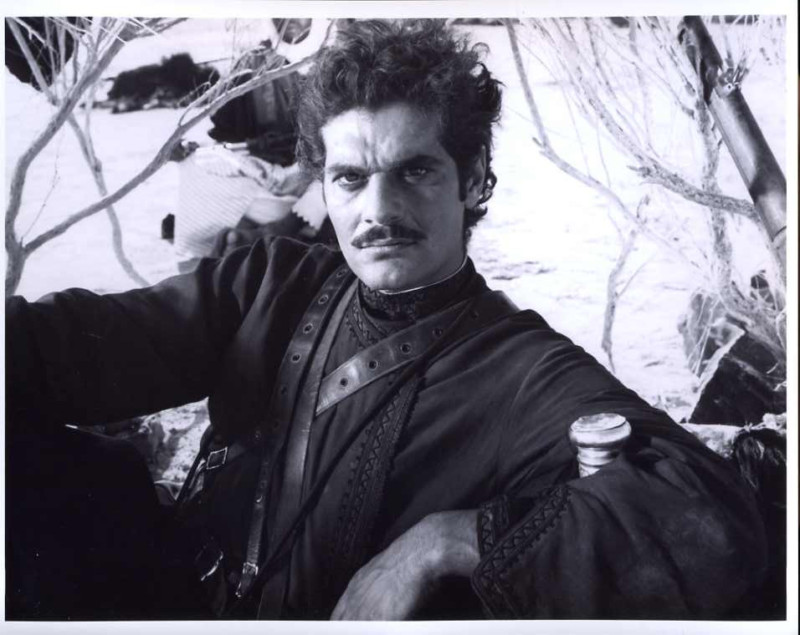
Omar Sharif’s role, Sherif Ali (Lawrence’s closest Arab ally), is a fictional composite of two real-life figures, as is Claude Rains’ slippery politician Dryden. Sharif was originally cast in the tiny role of Lawrence’s guide Tafas, before being upgraded to playing Ali
.
.
Allenby: “You acted without orders, you know”
Lawrence: “Shouldn’t officers use their initiative at all times?”
Allenby: “Not really. It’s awfully dangerous”
.


.
Colonel Brighton: “Are you badly hurt?” Lawrence: “I’m not hurt at all. Didn’t you know? They can only kill me with a golden bullet”
.

.
Did you know?
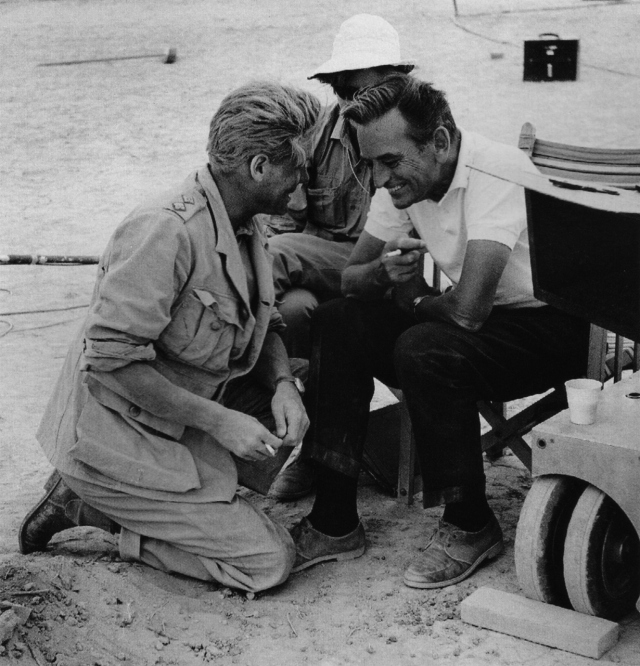
The film’s copious desert scenes were shot in Jordan, Morocco and Almería and Doñana in Spain. The shooting schedule was notoriously long, partly because its third screenwriter Robert Bolt was arrested for an anti-nuclear weapons demonstration and producer Sam Speigel had to broker his release from jail
.

.
Dryden: “Well. It seems we’re to have a British waterworks with an Arab flag on it. Do you think it was worth it?”
Allenby: “Not my business. Thank God I’m a soldier”
Dryden: “Yes, sir. So you keep saying”


.
Lawrence: “Nothing is written”
.
.

Retro Crimbo 2012/ Legends: Father Christmas ~ Saint or Santa?

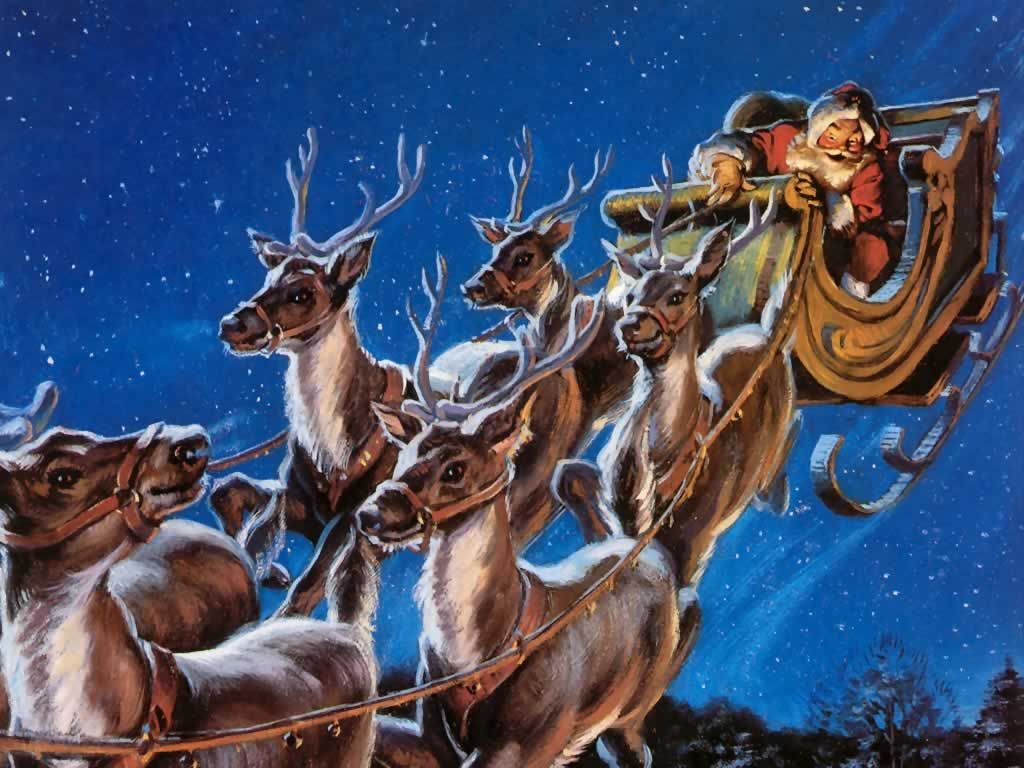
‘Twas the night before Christmas: a visual interpretation of the classic 1823 poem that’s the inspiration for Santa Claus (and his reindeer transport), yet the roots of Crimbo’s modern hero go back much farther
Time for a confession, folks – and not the I’ve-been-naughty-or-nice-this-year sort – rather the fact that, despite the cynicism and ill-feeling some feel towards the yuletide and its central player, the tubby, jolly chap with the long white beard, that – yes – that very merry icon has always been something of a must with me. Why else for the past few years would I have been – another confession here – writing a festive children’s novel in which he plays a critical role? Yes, for me, the sensational St. Nick certainly deserves a big, comfy armchair in front of the roaring fireplace in the ‘Legends‘ corner here at George’s Journal – and especially at this time of year.
What really underlines his legendary status for me, mind, is that, looking beyond him balancing an ankle-biter on his knee in a carboard grotto in a department store, he’s actually a universal, historical figure. You see, if my once-completed novel – and I – were ever lucky enough, it would be adapted into a movie (oh, well, of course, it would!), but who would play the stocking-filling feller himself? Well, I always envisaged Donald Sinden, but now that he’s seriously getting on, methinks (and because it would ideally be a big-budget Hollywood effort, naturally) Dick Van Dyke would be a fine substitute.
And that brings me to the nub of the matter. At almost any point or in almost any place in the last millennium you care to imagine, the subject of this post would have meant something to someone. And something different too. Whether he’s called Father Christmas (Britain), Santa Claus (America), Père Noël (France) or Saint Nicholas (his primary origin), or whether we see him as Donald Sinden or Dick Van Dyke or indeed anyone else, he’s always been around as Crimbo’s (more or less) human trademark – well, second only to that bloke Jesus, of course.
Conventional wisdom has it that the red coat-wearer’s introduction in his modern (or, today’s ‘traditional’) guise to boys and girls of all ages came in 1823, when the poem A Visit From St. Nicholas – or ‘Twas The Night Before Christmas – was anonymously published in the American town of Troy, New York (listen to a recently recorded version of it read by, yes, Dick Van Dyke by clicking on the bottom video clip below). It was later attributed to writer Clement Clarke Moore, although some claim it to have been composed by poet Major Henry Livingston Jr. (and that either drew great inspiration for the poem’s hero from a passage from 1809’s A History Of New York by celebrated scribe Washington Irving). Whoever wrote it, though, the poem quickly became enormously popular across the US – and as the 19th Century progressed the notion of ‘Santa Claus’ spread across the pond to both Blighty and Continental Europe.
.


Saint nicked?: an icon of St. Nicholas from Lipnya Church, Novgorod, Russia, c. 1294 (top l); ‘Woden The Wanderer’ by Georg von Rosen, 1886 (top r); Thomas Nast’s ‘Merry Old Santa Claus’ from Harper’s Weekly, January 1 1881 (btm l); Father Christmas in green from a Christmas card, 1890-1910 (btm r)
Indeed, the name ‘Santa Claus’ actually predates ‘Twas The Night Before Christmas, first appearing as it did in a New York-published book A New-Year’s Present, To The Little Ones From Five To Twelve (1821) as ‘Old Santeclaus’, a man on a reindeer-drawn sleigh delivering presents to children. But it was Clement Clarke Moore’s aforementioned poem that seems first to have suggested Santa and St. Nicholas are one and the same and introduced/ popularised his familiar paraphernalia: an utterly jolly demeanour, a pipe, a red coat and black boots, a team of reindeer with Germanic-sounding names, a penchant for entering homes by descending chimneys and, most important of all, delivering gifts to kids during the night of Christmas Eve.
And key too to spreading Santa/ St. Nick far and wide was the artist Thomas Nast. His cartoon Merry Old Santa Claus, which appeared in the New York-produced magazine Harper’s Weekly over the 1880/81 festive season immortalised the chap according to the then near 60-year-old poem’s description. Furthermore, an 1866 work by Nast may have given rise to the notion Santa resides at the North Pole. Yet, Nast’s very first image depicting our man appeared in Harper’s Weekly way back in 1863 (at the height of the American Civil War), in which he was draped in a Stars and Stripes flag and held court surrounded by Yankee soldiers. Hmmm, good to know he’d grow in future not to discriminate against sides in wars – in short, he’d become an obvious pacifist, peace-loving emblem of Christmas.
But just why does our jolly hero specifically represent Christmas? Where’s the original Christian connection? This, dear readers, is where St. Nicholas comes in. Originally a 4th Century Greek bishop, Nicholas was beatified after his death and, over the centuries, became patron saint (with a feast day celebrated usually in early December) to nations and cities throughout the Balkans and Western Europe, as well as to groupings of people such as sailors, merchants, pawnbrokers, archers and, er, students and even thieves. Oh, and to children, of course.
The last one’s important here, as is the legend that became attributed to him that he’d leave coins in shoes that peeps would leave out for him – making him then, a secret gift-giver (similar to Santa then whom fills not shoes, but stockings that peeps leave out for him). Indeed, one legend has it that Nicholas saved three poor – and, thus, dowry-less – girls from a future of prostitution by dropping sacks of gold coins down their home’s chimney the night before each of them came of age. Hmmm, (taking the sexual overtones out of the myth), sound familiar?
.
.
However, the notion of an old man gift-giver as a central figure during mid-winter festivals far pre-dates the Christianisation of Europe. The tradition can be traced back through European folklore to Odin (Old English: Wōden), one of the major Norse gods, whom would lead the ‘wild hunt’ during the mid-winter Yule festival of the pre-Christian German peoples (Yule also being the festival from which the warming ‘yule log’ was borrowed for Crimbo). Good old Odin also possessed an eight-legged horse named Sleipnir (a precursor to Santa’s eight-strong team of reindeer perhaps?).
Other European pre- ( and contemperaneous of) St. Nick winter festival gift-givers include the Central European Christkind (‘Christ Child’, whom was promoted by Martin Luther to lessen the Catholic/ Orthodox St. Nicholas’s popularity), the Norwegian Julenissen and Swedish Jultomten (elderly men/ dwarves/ gnomes, whom perhaps gave rise to Santa’s dwarfish physicality in ‘Twas The Night Before Christmas), the Danish Julemanden (the ‘Christmas Man’ who hails from Greenland – maybe why Santa comes from the North Pole?), the Finnish Jolupukki (er, a goat) and, of course, the British Father Christmas.
Aha, Father Christmas! Nowadays the oh-so Anglo-Saxon sounding chap is generally accepted as Blighty’s equivalent to Santa, or essentially the name us Brits use for him. Yet that most certainly wasn’t always so. Check out the fact the French gift-giver’s name (Père Noël) is an exact Gaulish version. And that ain’t all. A similar name is used for equivalent figures in cultures throughout Eastern Europe (including Bosnia, Serbia, Latvia, Lithuania and Romania) as well as Spain and Latin America (Argentina, Brazil and Chile) and among Christian communities in Africa and the Middle East (Egypt, Iran and Syria). Although, traditionally in Wales he’s ‘Siôn Corn’ (Chimney John). Ah, the Welsh, eh?
All this isn’t a coincidence, mind you. For Father Christmas, traditionally speaking, is effectively a personification of Christmas itself, rather like, if you will, the personifications in literature, art and music of nations (for example, ‘John Bull’ for Britain/ England and ‘Marianne’ for France). Indeed, in past centuries his English version was alternatively known as Old Father Christmas and even Sir Christmas and Lord Christmas. As such then, the ‘English’ Father Christmas was never actually a gift-giver.
.


Politically incorrect?: an old-school Coca-Cola ad (l) and the Dutch Sinterklaas and his Zwarte Piets (r)
He was merely a jolly, bearded and elderly chap whose spirit reflected, well, the spirit of the festival with which he was associated and he was old to reflect the fact Christmas had been celebrated for centuries. Plus, he had much more a link to adult feasting than he was a St. Nick-esque benefactor for children, developing in the mid- to late 16th Century as a focal figure of opposition to the Puritan movement (which had its zenith when Oliver Cromwell became Lord Protector following the English Civil War and, yes, the celebration of Christmas was outlawed).
His earliest mentions in English literature seem to date from a pair of 15th Century carols, while he also appears (very much as his festival’s personification) in Ben Johnson’s play Christmas His Masque (1616). Actually, to get a real hold on who he was, check out the classic seasonal novella A Christmas Carol (1843) and/ or its subsequent movie adaptations. For Charles Dickens‘ Ghost of Christmas Present is basically the old-fashioned Father Christmas – right down to the green (not red) trimmed coat he wears, which was the figure’s traditional garb until late Victorian times.
Inevitably then, as the late Victorian era gave way to the 20th Century and Santa became better and better known to the wider Western world, Father Christmas and Santa Claus slowly merged into one in the minds of millions of Crimbo revellers and gift-receiving, stocking-hanging and mince pie- and glass of sherry-leaving-out children. But all of that assumes that Santa Claus (and/ or later Father Christmas) naturally inherited his mantle from St. Nicholas. How did that happen? After all, Santa Claus doesn’t exactly sound like St. Nicholas, does it? Well, no, but both sound a lot like Sinterklaas (or more formally ‘Sint Nikolaas’), which is the Dutch for St. Nicholas.
Standing out from the crowd somewhat when it comes to the modern take on the St. Nick/ Santa/ Father Christmas tradition, the Netherlands and Benelux countries still make a big deal out of celebrating Sinterklaas on his feast day (December 5), when his arrival in towns, dressed in red like a Christian bishop and with a staff, to give out presents to deserving children is often televised. Curiously, at least on the surface, Sinterklaas is accompanied not by pre-Christian, Northern European folklore-derived elves, but by blacked-up companions named Zwarte Piets (Black Petes).
.
.
Nowadays this practice may seem rather inappropriate, even xenophobic or racist, but the origin of the Zwarte Piets is worthy of divulging. The tradition of the Sinterklaas feast, in an anticipating-the-birth-of-Jesus sort of way, is all about good (light, represented by his white beard) overcoming evil (black, represented by the ‘skin tone’ of his minions), thus the Zwarte Piets were originally supposed to represent Moorish non-Christians taken under Sinterklaas’s wing (owing to the tradition coming from Catholic Spain) and later they came to represent African slave boys Sinterklaas was supposed to have saved from the Dutch/ Belgian colonies. All a little odd to an Anglo-Saxon mindset maybe, but logical nonetheless.
Logical too, of course, was the rise and rise our familiar Crimbo figure that is the modern Santa experienced during the 20th Century. Initially, at least, one monolith of a company in particular can be thanked (and/ or blamed) a great deal for this: Coca-Cola.
So identified with the sugar (and one-time cocaine-)fuelled soft drink was our hero that some – especially in the States – not only believe the company was responsible for creating his red costume, but also for creating him. Fortunately, that’s not true, of course. But it is true that thanks to ad artist Haddon Sundblom’s interpretation of the jolly chap, originally conceived and used by Coca-Cola in the 1930s, the image of him we’re all oh-so familiar with became the eternal one. Indeed, Sunblom’s original effort is still used by Coca-Cola to this day. Lesser known is that earlier still another soft drink manufacturer White Rock Beverages used images of Claus to advertise both mineral water (1915) and ginger ale (1923).
Although, Santa/ Father Christmas’s persona as a benevolent giver, despite – one may cynically observe – regularly coming to appear as a Christmas-period promotional tool in department stores and in their sponsored parades (especially for Macy’s in New York City), was aided by the dressing up of fundraising volunteers in his now traditional red-robed garb to collect donations from charitable peeps on street corners. And this thoroughly selfless, utterly self-sacrificing interpretation (along with all the reindeer-owning, sleigh-riding, gift-giving and North Pole-inhabiting acoutrements) was the one that TV and Hollywood writers, producers and directors were only too happy to give us when casting him as the hero and/ or kindly paternal figure in many family-friendly, seasonal-market-aimed productions.
.


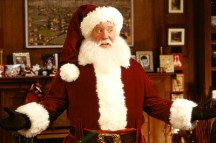

Santa on screen: Edward Woodward’s Ghost of Christmas Present in 1984’s A Christmas Carol (top l); Rankin-Bass’s version in 1970’s Santa Claus Is Comin’ To Town (top m); David Huddleston in 1985’s Santa Claus: The Movie (top r); Tom Allen in 1994’s The Santa Clause (btm l); ‘Weirdy Beardy’ in 1999’s Hooves Of Fire (btm m); and James Cosmo in 2005’s The Lion, The Witch And The Wardrobe (btm r)
Arguably as much as Coca-Cola did earlier (and, yes, later) in the 20th Century, in the second-half of that century, television and film have immortalised old Santa for millions around the globe; although he first appeared on screen in, yes, 1898 (see top video clip above). Essentially, the Rankin-Bass animators (1970’s Santa Claus Is Comin’ To Town), the people behind the cinematic Superman (1985’s Santa Claus: The Movie), Disney (1994’s The Santa Clause and its sequels) and oh-so many more have presented us with same figure.
More recent screen interpretations have tried different things – turning him into a grumpy bloke of British suburbia (1991’s Father Christmas), making him tackily but lovably trendy (1999’s Hooves Of Fire) or presenting him in the guise of Narnia author CS Lewis’s supposedly Anglo-centric ‘Father Christmas’, whom doesn’t wear scarlet but still gives gifts (2005’s The Lion, The With And The Wardrobe) – yet they’ve still mined the familiar and popular version of Claus, if turned it up at the corners for variety’s sake.
To this day, the most original, interesting and enduring screen take on Santa (see middle video clip above) is one that dates back as far as 1947. The presentation of the character as the playfully ambiguous is-he-or-isn’t-he-really-Santa? Kris Kringle in the Hollywood classic Miracle On 34th Street mixed the reality of Claus as a commercial commodity for cosmopolitan department stores with him as something altogether more innocent, truer and purer. A kindly old man do-gooder who offers a little peace and goodwill for peeps at a particularly stressful time of year.
And, when you come down to it at amid all the soot at the bottom of the chimney, it’s for this reason that, despite him being year-on-year, ever increasingly associated with (for a better way of putting it) capitalist greed, the white bearded one always appeals, delights and fills joy in the hearts of children of all ages this time of year.
As US Santa performer from Cambridge, Massachusetts, Jonathan Meath put it in a November 2011 interview with Yankee Magazine: “Santa is really the only cultural icon we have who’s male, doesn’t carry a gun, and is all about peace, joy, giving, and caring for other people. That’s part of the magic for me, especially in a culture where we’ve become so commercialised and hooked into manufactured icons. Santa is much more organic, integral, connected to the past, and therefore connected to the future. I like that representation of Santa because I’m not a Coca-Cola Santa. I’m much more of a Santa of the woods, a Santa of the snow, a Santa of the solstice.” Quite so. And if that doesn’t fill your tummy, nay, your heart with a deep, rumbling ‘ho ho ho!’ then nothing will. Happy Christmas to all – and to all a good-night…!
.
.

Retro Crimbo 2012: Yule love the look of this ~ a pictorial tribute to the yuletide
Festive favourites: with their classic Christmas TV offerings, comedy legends Eric Morecambe and Ernie Wise were real-life Santa Clauses in the 1970s and early 1980s for households up and down Britain
A picture can speak a thousand words, so they say. That’s a Christmas cracker of an old cliché, I know – but then the images below are clichés too, containing as they do Christmas trees, Santa suits, gift-wrapped presents, mock – and real – snow, stockings, tinsel, fixed smiles, awkward group poses and some very dubious ’70s fashions (as well as several other clichéd words).
What they also contain though are the great and the good, the famous and the talented, the whimsically recalled and the sadly nearly forgotten in some sensational and so-bad-they’re-good seasonal settings, few of which, I suspect, you’ll have ever seen before.
So crack out the mulled wine, folks, as down George’s Journal‘s chimney of yuletide imagery we go…
.


Bing-Dong-Merrily: Bing Crosby in Santa get-up in promotion of 1954 festive film favourite White Christmas (left) and with co-stars Rosemary Clooney, Vera-Ellen and Danny Kaye (right)
.
Family (and friends) album: the cast of classic Christmas movie It’s A Wonderful Life (1946)
.

Santa’s little helper: Angelic Audrey Hepburn helps Old Saint Nick dish out presents to children
.

Silver belles: Debbie Reynolds (left) and Natalie Wood (right) make festive cheesecake poses
.


A family Christmas: John F and Jackie Kennedy pass The White House’s Blue Room Christmas tree in 1961 (left); Humphrey Bogart, Lauren Bacall and their son Stephen in front of theirs (right)
.


Rat Pack and Bat Girl: Dean Martin, Sammy Davis Jr. and Frank Sinatra on the set of Robin And The Seven Hoods (1964) (left) and ’60s TV’s Catwoman Yvonne Craig on a Christmas sleigh (right)
.

Filling stockings: Marilyn Monroe in a pair of particularly appealing yuletide images
.



Fab-tastic festivity: The Beatles with their presents from the tree (above left and right) and in Dickensian clobber (bottom left) and pantomime costumes from the 1963 Christmas shows tour (bottom right)
.
Likely lads: A very 1960s Rolling Stones toast the best of the season (left) and outfitted-as-Santa footballers George Best and Mike Sumberbee are surrounded by very tasty totty (right)
.

Brits of all right: UK stars Diana Dors (l) and Julie Christie (r) in cheesecake yuletide poses
.

Family affair and French fancy: Dean Martin and Frank Sinatra perform with their daughters Gail and Nancy on a 1967 Christmas edition of The Dean Martin Show (left); Jean-Paul Belmondo and Catherine Deneuve in a snowy scene from the legendary François Truffaut’s film Mississippi Mermaid (1971) (right)
.

Dizzying and fizzing: the head-twisting beauty of a leopard-print-clad Ann-Margaret surrounded by Christmas presents (left) and Sammy Davis Jr. advertising Alka-Seltzer for the festive season (right)
.
The princess’s presents: Grace Kelly wrapping Christmas gifts most likely in the 1960s
.


Double-O-Crimbo: Poster art of George Lazenby as James Bond with Santa hat (left) and Telly Savalas as Ernst Stavro Blofeld delivering seasons greetings in On Her Majesty’s Secret Service (1969) (right)
.

Merry Motown: Diana Ross and The Supremes on a sleigh (left) and The Jackson Five (right)
.

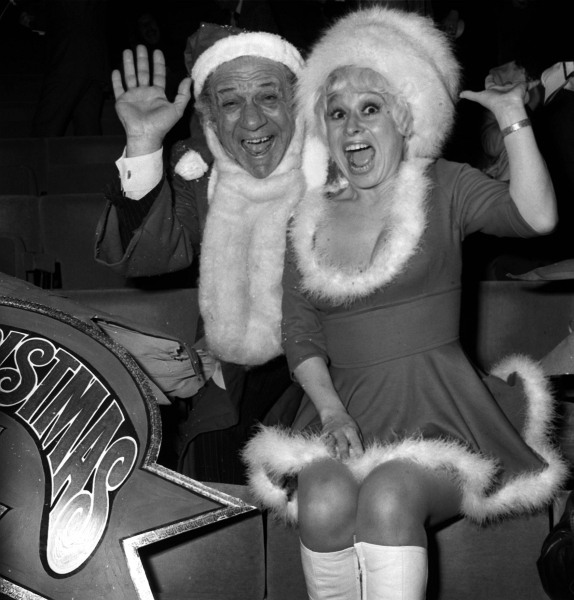
Carry on Christmas: Sid James and Barbara Windsor in Santa outfits for the cover of the Christmas 1973 edition of TV Times magazine (left) and greeting guests at a ’70s ITV yuletide party (right)
.


Rudolfs and Forsyth: Morecambe and Wise and Brucie in a sketch from their 1975 Christmas Show
.

Tinsel-tastic: Julie Andrews guest-starring in a 1977 festive edition of The Muppets Show (left) and presenter John Noakes with the legendary Blue Peter advent crown from the ’70s (right)
.
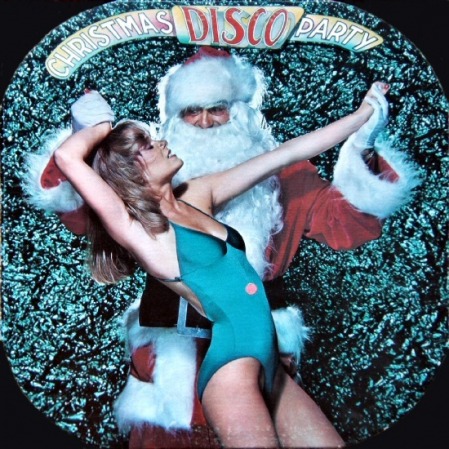
Festive Fonzie and yuletide disco: a scene from the 1974 Happy Days episode Guess Who’s Coming To Christmas? (left) and an unmistakably ’70s Christmas disco party image (right)
.


It’s Chriiiiiiiiiiiiiiiistmas!: Noddy Holder’s Slade (l) and Roy Wood’s (with white hair) Wizzard (r) performing respectively 1973’s Merry Xmas Everybody and I Wish It Could Be Christmas Everyday
.


Robot turkey: the infamously ill-received Star Wars Holiday Special broadcast in the States on the CBS TV network in November 1978 (left) and an antlered R2D2 and C3P0 dressed in festive garb (right)
.
Winter wonderland: Top Of The Pops’ in-house ’70s dancers Pan’s People hoof it up in the snow
.
Advent albums: Top Of The Pops discs of chart hits from December 1971 (left) and December 1979 (right)
.


Having a scarf laugh: David Bowie introduces the classic animation The Snowman (1982)
.

Sitting on San-T’s knee: Nancy Reagan and Mr T merrily pose for the cameras in the 1980s
.
Merry musicians: Andrew Ridgely and George Michael in artwork from Wham!’s 1984 seasonal single Last Christmas (left) and Kylie Minogue in yuletide get-up from the late ’80s (right)
.

Hitting the right note: Gizmo dons a Santa hat in the seasonally-set comedy hit Gremlins (1984)
.
Sitcom Christmas: Michael J Fox and cast in the 1983 Family Ties episode A Keaton Christmas Carol (left) and loveable, iconic alien Alf on the cover of a Christmas issue of the Alf magazine (right)
.

Christmas in New York: Santa’s sleigh flies over Manhattan in Santa Claus: The Movie (1985)
.
Game for a laugh: Blankety Blank host Les Dawson with (clockwise from left) Syd Little, Samantha Fox, Lynda Barron, Wendy Richard, Frank Carson and Eddie Large on the 1986 Christmas show
.

Alice dalliance: The Two Ronnies starring in their ’85 Christmas special’s Alice In Wonderland sketch
.

Seasonal spirits: the ghoul hunters get festive and spread goodwill in Ghostbusters II (1989)
.
.
.
.