.
Talent…
.
… These are the lovely ladies and gorgeous girls of eras gone by whose beauty, ability, electricity and all-round x-appeal deserve celebration and – ahem – salivation here at George’s Journal…
.
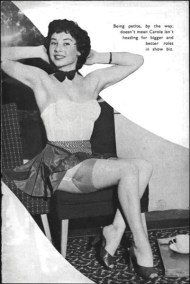
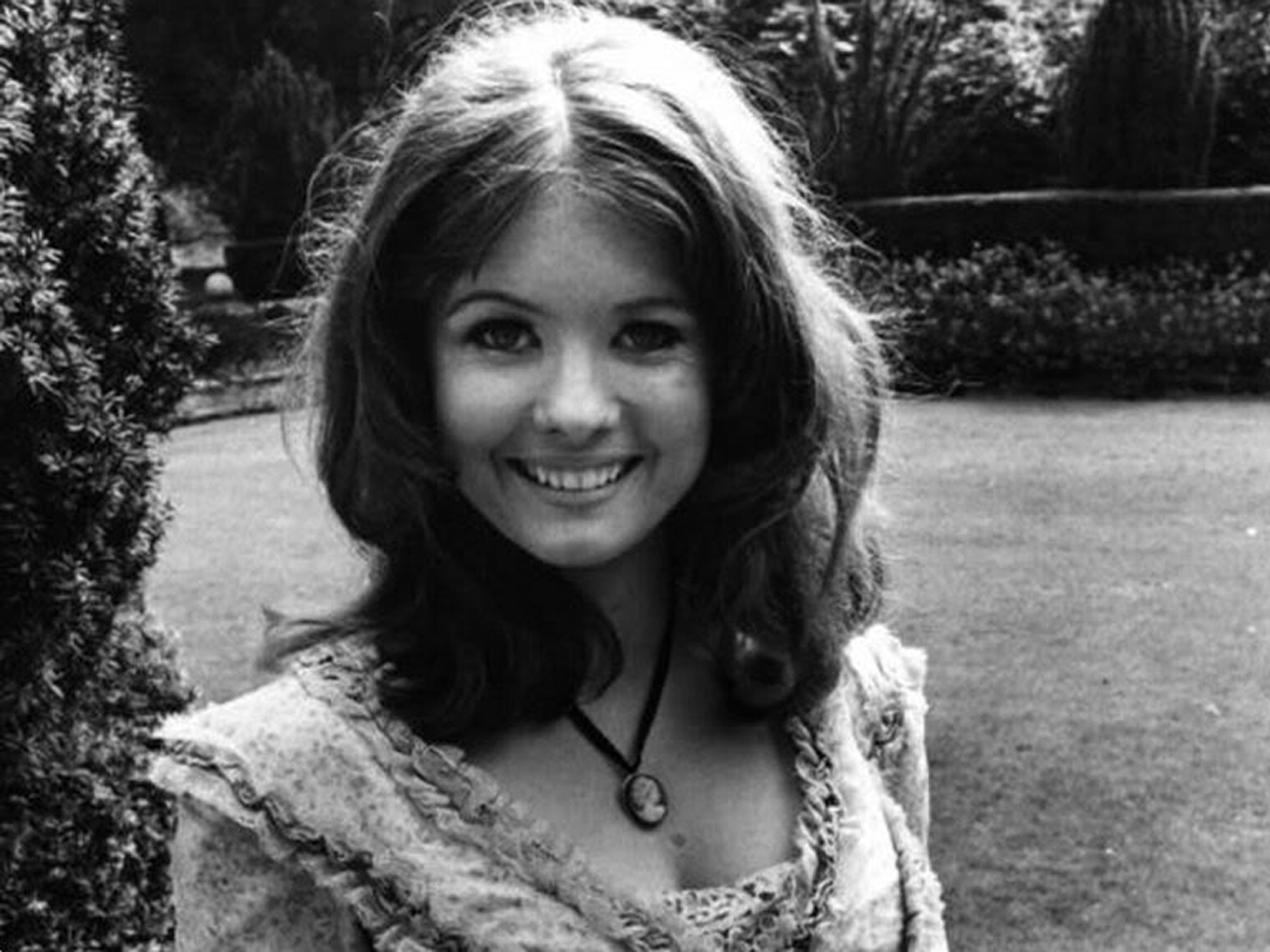
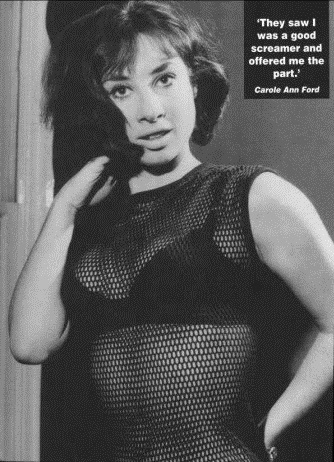
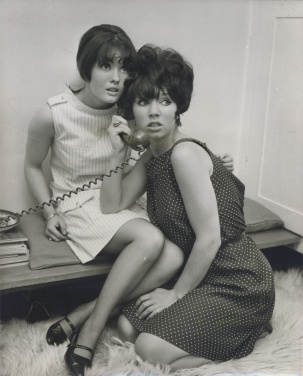
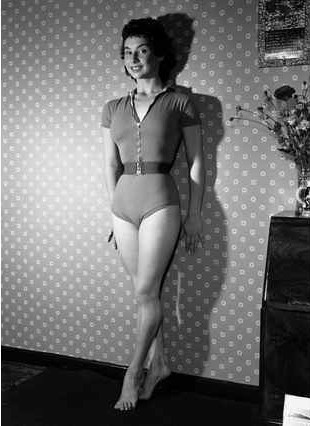
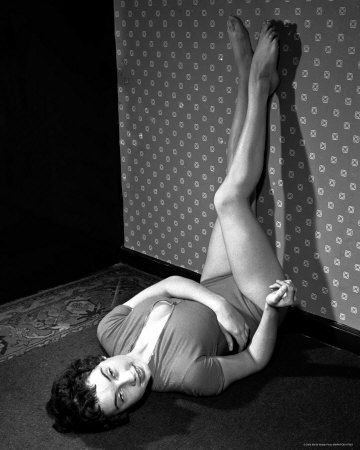
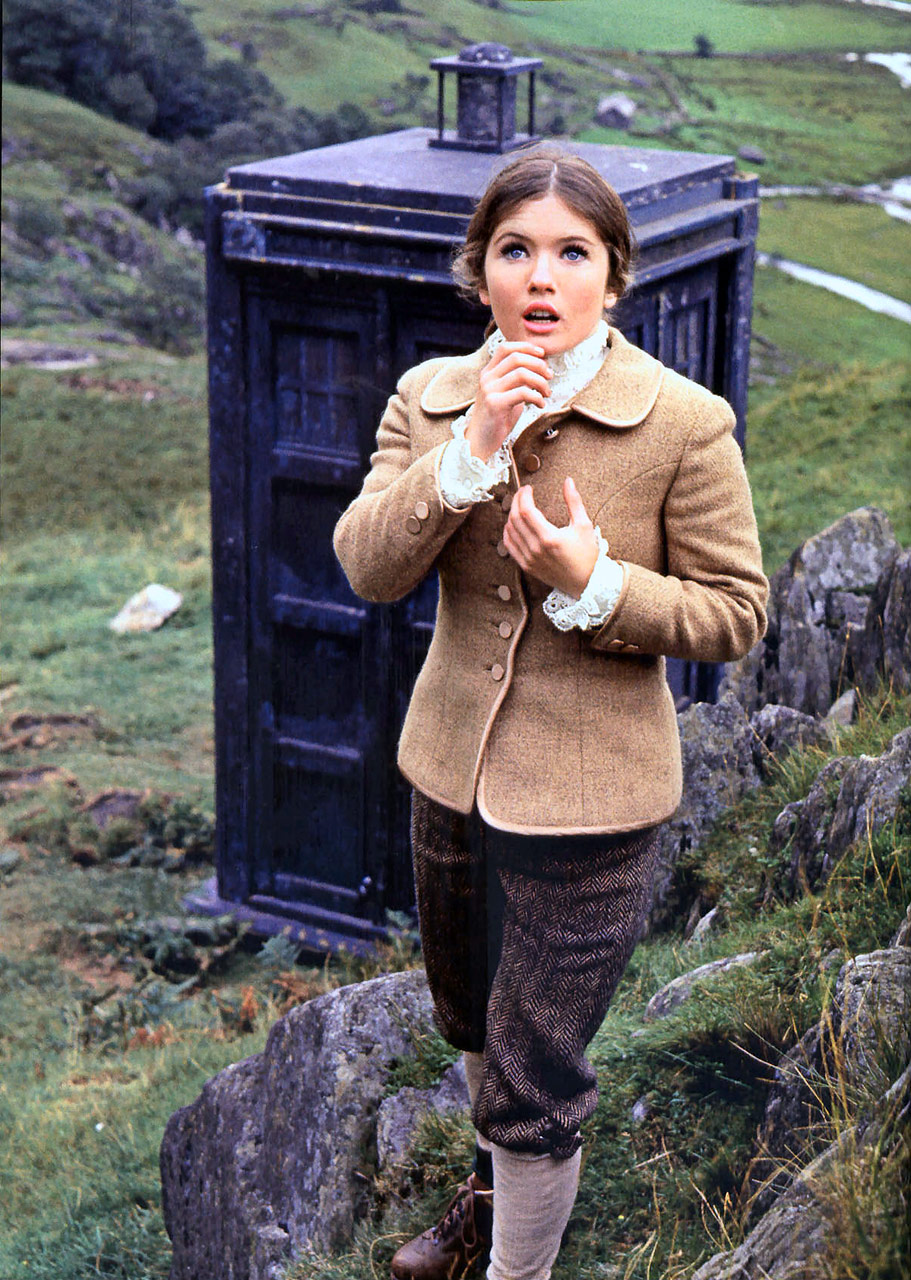
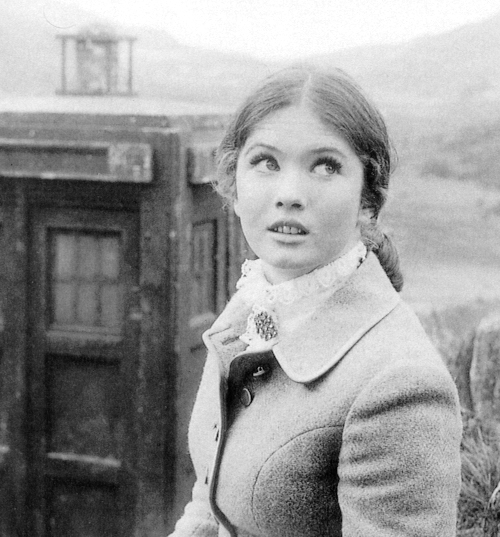
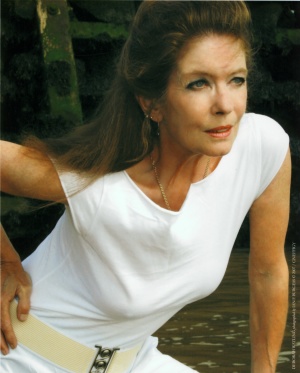
So even the most causal of visitors to this blog would surely realise that, at present, celebrating a wee little sci-fi show that’s been running for a full five decades is something of a must with it. And the latest post committed to this cause is surely itself a cause for celebration as it celebrates one of Doctor Who‘s most well observed aspects – yup, its protagonist’s penchant for picking rather attractive members of the opposite sex with whom to travel in his TARDIS. And the two such female sidekicks focused on here are classic lookers all right, Carole Ann Ford (The Doc’s own grand-daughter Susan) and Deborah Watling (the fair Victorian maiden Victoria). Time then, indeed, for these two time-travellers to be inducted into this blog’s Talent hall of fame…
.
Profiles
Names: Carole Ann Ford/ Deborah Watling
Nationalities: English
Professions: Actress and voice coach/ Actress and author
Born: June 16 1940/ January 2 1948, Fulmer, Buckinghamshire
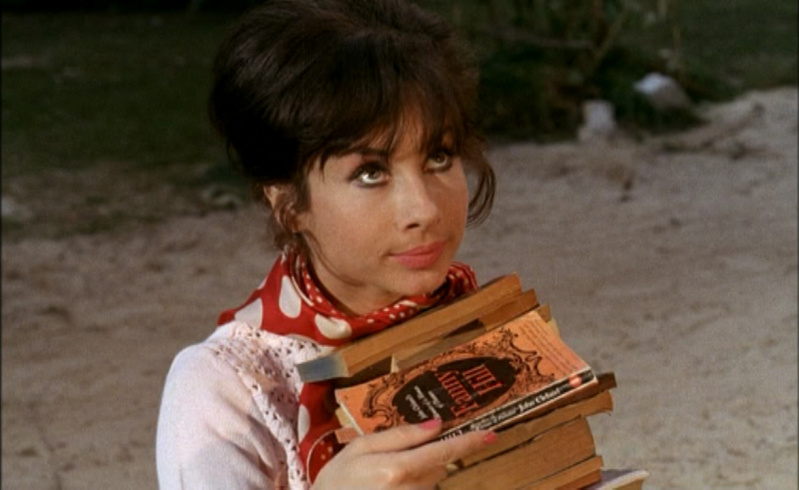
Known for: Carole – playing the original companion in Doctor Who, namely The Doctor’s grand-daughter Susan (Foreman). She came to the attention of the director of the show’s first serial An Unearthly Child (1963) after appearing in an episode of the BBC’s long-running police procedural drama Z-Cars (1962-78) and left at the end of 1964’s The Dalek Invasion Of Earth, before returning for the anniversary specials The Five Doctors (1983) and Dimensions In Time (1993). Following her stint on Who, she cropped up in Whatever Happened To The Likely Lads? (1973-74) and on the panel of classic Saturday night pop music showcase Juke Box Jury (1959-67) a week before Doctor Who began. She has appeared numerous times on stage and her film credits include The Day Of The Triffids (1962) and The Great St. Trinian’s Train Robbery (1966). She will play a minor role in this year’s BBC drama An Adventure In Time And Space (about the making of An Unearthly Child), in which she herself will be portrayed by newcomer Claudia Grant.
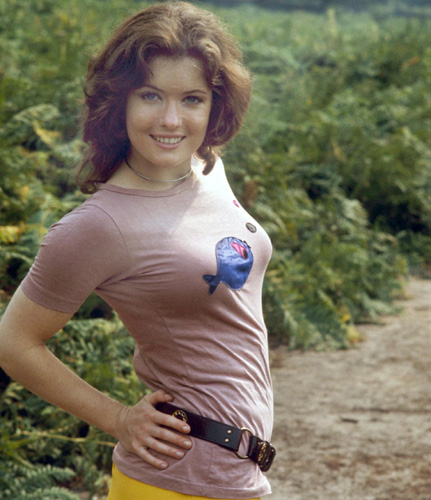
Deborah – daughter of respected actor Jack Watling and older sister of fellow sex symbol and actress Dilys Watling, Deborah essayed the role of Second Doctor companion Victoria Waterfield, beginning with the serial The Evil Of The Daleks (1967) and culminating in Fury From The Deep (1968) – she also appeared in Dimensions In Time, though. A former child actress in the series The Invisible Man (1958) and as Lewis Carroll‘s heroine in Dennis Potter’s BBC version of Alice In Wonderland (1965), she followed up her stint in Who with a supporting role in the David Essex headlined rock ‘n’ roll flick That’ll Be The Day (1973) and as the promiscuous Norma Baker in ITV’s London Blitz drama Danger UXB (1978).
Strange but true: In the 1970s, Carole had a bizarre brush with near death when severe back pain on holiday in Spain resulted in a doctor prescribing her medication that made her allergic to a vast array of different things, including aspirin, the use of backfired and required a shot of adrenalin literally to save her life/ Despite appearing in seven serials across Seasons 4 and 5, the only Doctor Who serial in which Deborah appears to exist in its entirety is The Tomb Of The Cybermen (1967), owing to the Beeb’s 1970s policy of wiping tapes of its old shows.
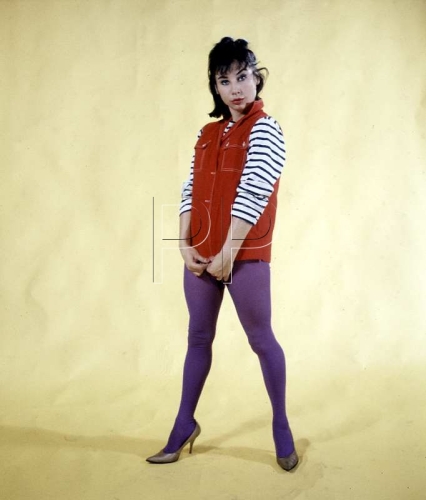
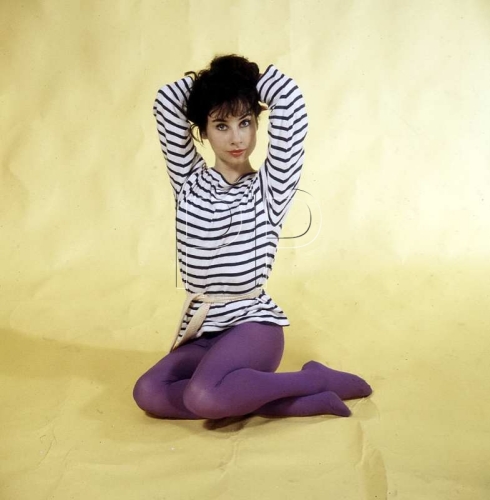
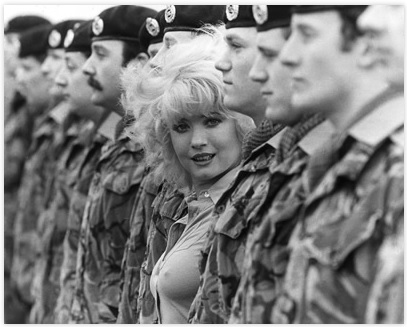
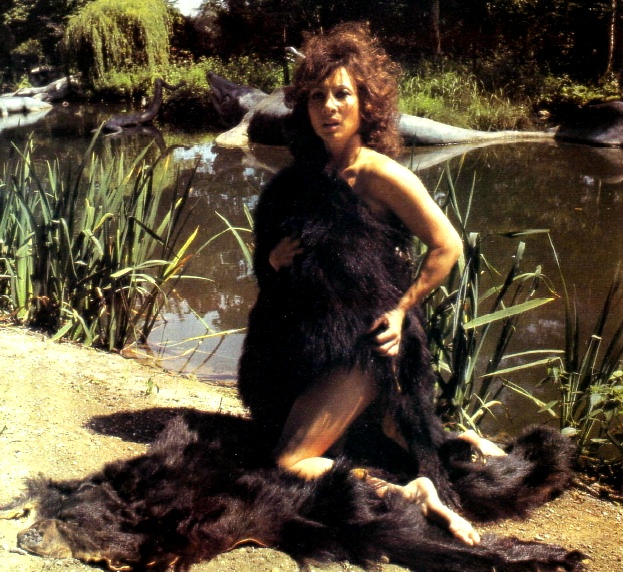
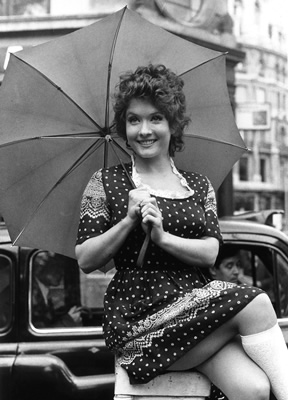
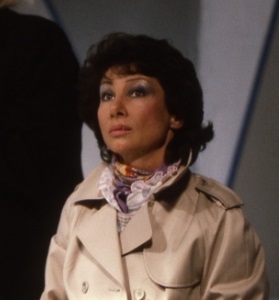
Peak of fitness: Carole – although cute as a button when playing the somewhat otherworldly Susan, she was never really allowed to showcase her charms, unlike in the pre-Who ‘cheesecake’ images she posed for (see below)/ Deborah – again, lovely as the delicate Victoria was, it was as ‘naughty’ Norma in Danger UXB that Watling was allowed to be at her most sexiful; on-screen that is, for surely in promotional images for a 1978 theatre production of the farce Two And Two Make Sex she most blatantly proved what a hot property she was (see below)
.
.
CLICK on images for full-size
.

.

.
.
.

.
.

.
.
.

.
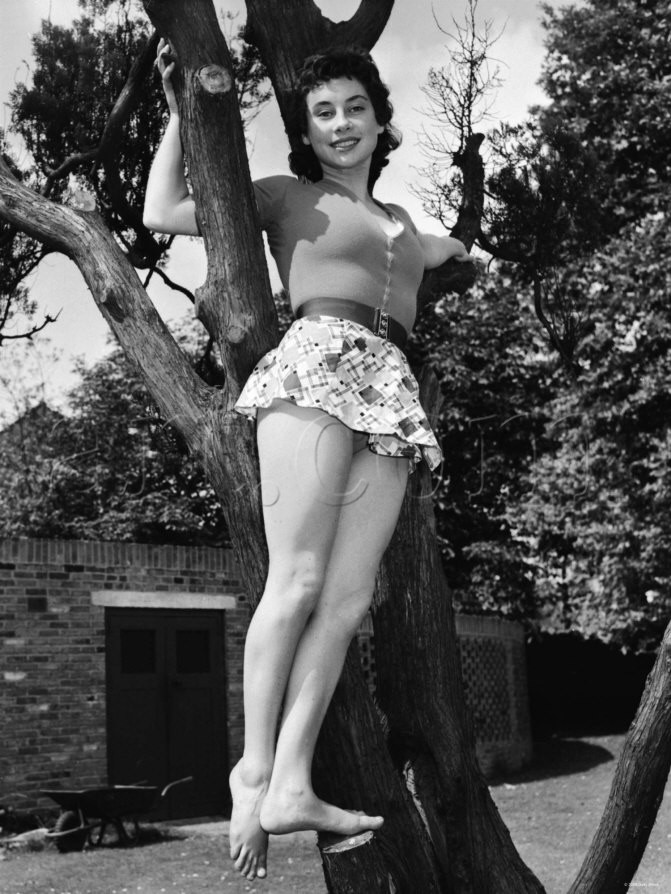
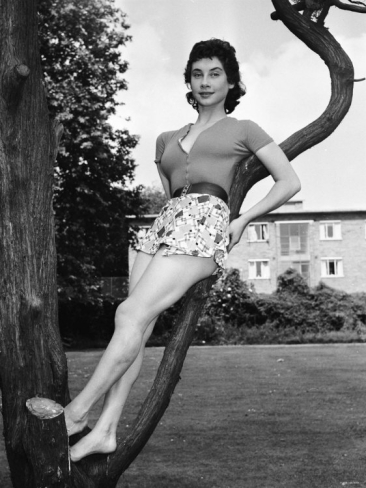
.
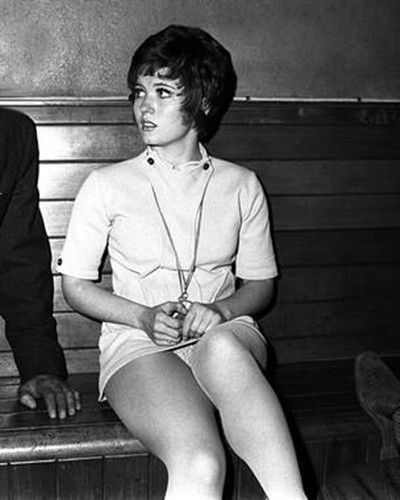
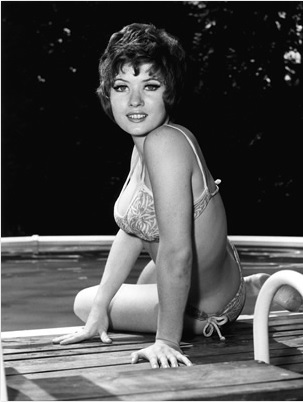
.


.


.
.

.

.
.


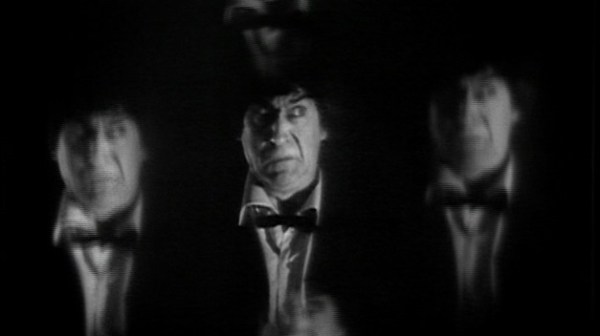
Dizzy! My head is spinning: The War Games brought to a close the black and white, 1960s Doctor Who, as well as Patrick Troughton’s era as he underwent a forced regeneration…
Despite it being, by the tail-end of second lead Patrick Troughton’s era, not quite the essential viewing it was at its mid-’60s ‘Dalekmania’ high, Doctor Who came up with one of its most essential ever serials to close out Troughton’s tenure in the shape of The War Games.
That’s right, following up this blog’s opening close-up look at classic Who serials comes its second (the latest post in celebration of the sci-fi show’s 50th anniversary year), focusing as it does on the serial that boasts a truly epic length, more Time Lords than you can shake a stick at, villains in John Lennon glasses and, oh yes, that regeneration…
.
.

.
Doctor: Patrick Troughton (The Second Doctor)
Companions: Frazer Hines (Jamie McCrimmon); Wendy Padbury (Zoe Heriot)
Villains: Philip Madoc (War Lord); Edward Brayshaw (War Chief); James Bree (Security Chief)
Allies: David Savile (Lt. Carstairs); Jane Sherwin (Lady Jennifer Buckingham); Michael Napier-Brown (Arturo Villar)
Writers: Malcolm Hulke and Terrance Dicks
Producer: Derek Sherwin
Director: David Maloney
.


.
.
.

.
Season: Six (seventh and last serial – comprising 10 25-minute-long episodes)
Original broadcast dates: 19 April-21 June 1969 (weekly)
Total average viewers: 4.9 million
Previous serial: The Space Pirates
Next serial: Spearhead From Space (Season 7)
.
.
.
.

.
After many adventures in his second incarnation, The Doctor and his latest companions, 18th Century Scots soldier Jamie McCrimmon and 21st Century astrophysicist Zoe Heriot, step out of the TARDIS into what appears to be a World War One battlefield. Their appearance inexplicable, they’re taken prisoner by British forces, specifically a Lt. Carstairs and an army nurse Lady Jennifer Buckingham. However, things don’t add up for The Doctor. His suspicions eventually prove founded when he and his companions discover this theatre of war is actually a ‘war zone’ encircled by a mysterious mist that separates it from another zone in which a Roman army is in battle. With Carstairs and Buckingham similarly convinced, the group realise that their ‘war zone’ – and all its players – are being manipulated via hypnosis by the British and (supposedly) opposing German generals, whom receive their orders from a ‘Central Control’ zone that they visit via wardrobe-like space-shifting machines named SIDRATs (pronounced ‘side-rats’).
The similarity of the word SIDRAT to TARDIS (the former being the latter spelt backwards) is not a coincidence, as The Doctor discovers when using the former to transport himself surreptitiously to Central Control, for the former is a TARDIS-like time- and space-machine created by the War Chief, whom is a member of The Doctor’s race, the Time Lords, and second-in-command of the widespread operation that oversees thousands of warring peeps who’ve been unwittingly kidnapped from Earth and plonked down on this planet’s several different war zones.
Learning that others across the war zones have, over time, also deduced something of what’s going on and created a resistance movement, The Doctor and his allies join forces with this band (effectively led by Mexican fighter Artruro Villar) and take on Central Control. During their raid, the War Chief outlines his own plan to The Doctor – to use the scores upon scores of fighting humans to gain control of the galaxy himself – and, working out the former’s a fellow Time Lord, tries to convince him to join in his efforts. The Doctor refuses, of course, and realises he has no alternative once the raid succeeds than to call reluctantly on the help of the Time Lords themselves to return the thousands of fighters to Earth, something he won’t be capable of himself.
Before the Time Lords use their power to steer him, Jamie and Zoe in the TARDIS to their – and his – home planet of Gallifrey, the War Chief (his alterior plan revealed and the war zones’ overall war called to a halt) is killed by his master the War Lord. The latter then is put on trial by the Time Lords and, for his crimes, receives the ultimate sentence – he’s erased from history as if he never existed. The Time Lords then turn on The Doctor, accusing him of breaking the code of their people by interfering in the affairs of others throughout the universe via a TARDIS he stole from Gallifrey centuries before to gallivant around in. He defends himself by saying he’s done much good, which only relents the Time Lords to the extent that they allow him, once they’ve returned Jamie and Zoe to their own times and places, to be free on planet Earth but unable to fly the TARDIS away. And they ensure his appearance changes via a forced regeneration…
.
.
.

.
Unlike the modern Who (for instance, Journey’s End, A Good Man Goes To War and The Wedding Of River Song of the Tennant and Smith eras), the ‘Classic Series’ could rarely be said to get epic; too little money ensured a very Beeb approach to production values. Yet, in another sense, The War Games is as epic as the show gets. At a bladder-inducing 10 episodes in length (that’s a total 250 minutes), its narrative scope and depth is impressive to say the least. The setting out of the different dramas in the different ‘war zones’ (especially the opening WWI section) are engaging and characterised by believable figures, while the the gradual, trickle-down introduction of Central Control and the zones’ resistance movement is nicely done.
Moreover, the generally slow-burn nature of the story-telling allows for the plot’s twists to rear their heads with wonderfully effective abruptness (The Doc, Jamie and Zoe discover they’re not stuck in the middle of WWI but on a planet of ‘war games’; The Doc having to call on his people to sort things out in the last two episodes). But, at the same time, there’s no getting away from it – The War Games is damned long, too long really; quite frankly, all that takes place could be condensed into five or six or even the usual four episodes.
And yet, sitting through it all is certainly worthwhile for that rather terrific climax – one too that was crucial for the future of the show to come. Not only does the serial’s last two episodes culminate brilliantly in the Second Doctor’s final moments (his tear-inducing goodbye to Jamie and Zoe – they won’t even remember their adventures? Sniff!) and the beginnings of his very painful looking, bad trip-like regeneration, but it also marks the first time he – and we – travel (back) to Gallifrey and (properly) meet his people, the Time Lords.
And how sombre and uppity they are; no wonder our hero wanted away from this über-powerful, overly proud bunch with their long black robes and stoically hard rule-making. They bring a jolt of adult sobriety to these journeyings of an ages-old yet rather childish hermit; indeed, one that ensures his adventures will never be quite the same again – not least as their forced transformation and exiling him to Earth leads directly into Jon Pertwee’s Third Doctor era of the early ’70s, of course.
.


.
.
.

.
As mentioned above, The War Games was not only the last serial to feature Patrick Troughton, Frazer Hines and Wendy Padbury in their original run on the show (making it still the only one to do away with both a Doctor and one or more of his companions), it was also the last of the 1960s, bringing down the curtain on the combined Hartnell and Troughton era of black and white Who, which had been guided first by TV legend Verity Lambert as producer, then John Wiles, Innes Lloyd, Peter Bryant and finally Derrick Sherwin in that role (Barry Letts would take over as producer for the next four seasons’ Pertwee era).
Speaking of Sherwin, an unusual cast note concerns him, as he cast his own wife Jane as ally Jennifer Buckingham (although this producer/ cast member combo would actually be something of a precedent for the show), while Philip Madoc – whose smooth, psychedelic round-lensed glasses-wearing War Lord is such a fine villain – would go on to appear again in the serials The Brain Of Morbius (1976) – as villain Mehendri Solon – and in The Power Of Kroll (1978-79) – as spaceship crew member Fenner – and he also had a part in the non-canonical film Daleks’ Invasion Earth 2150 AD (1966). Plus, Bernard Horsfall and James Bree both appeared just months after The War Games‘ broadcast in the Bond film On Her Majesty’s Secret Service (1969).
Meanwhile, Frazer Hines moved on from Who to carve out a successful soap opera career in Emmerdale (Farm), at one time appearing opposite Padbury in it. And, for her part, Padbury later became an actors’ agent; one of her discoveries reputedly being a certain Matt Smith…
.
.
.
Next time: Inferno (Season 7/ 1970)
.
Previous close-ups/ reviews:
An Unearthly Child (Season 1/ 1963/ Doctor: William Hartnell)
.
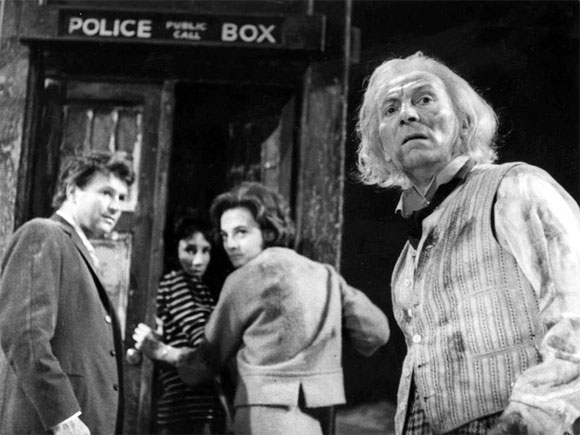
They are the fire-starters: Ian (William Russell), Susan (Carole Ann Ford), Barbara (Jacqueline Hill) and The Doctor (William Hartnell) arrive back at the TARDIS safe and sound – sort of…
Whuuu-rooom, whuuu-rooom, whuuu-room… Pray tell, could that be the familiar groaning of the TARDIS re-materalising in this blog? Well, yes, it very much could be because it is. Yup, just as the brand new series is getting its mojo going – or its second half, if you’re keeping count – and following on from last month’s third-anniversary-of-the-blog-acknowledging posts that treated you lucky peeps to rare Doctor Who images from throughout its five decades (check them out here: 1, 2, 3 and 4), this post is the next of this very blog’s to celebrate the Who Doctor’s 50 years this, er, year. Oh yes.
And it’s also the first of several to take a close-up look back at serials and/ or episodes of the sci-fi TV giant’s past that have been either heralded as classics by fans or, in retrospect, have proved critical, pivotal touchstones in its history. Or, in most instances, both.
And where better – or when better – to start than with the show’s very first serial, An Unearthly Child. The one that introduced us to William Hartnell’s First Doctor, his original trio of companions, the show’s original theme music and title sequence and, yes, that original TARDIS sound. Whuuu-rooom, whuuu-rooom, whuuu-rooom…
.
.

.
Doctor: William Hartnell (The First Doctor)
Companions: Carole Ann Ford (Susan Foreman); Jacqueline Hill (Barbara Wright); William Russell (Ian Chesterton)
Villain: To varying degrees, the Tribe of Gum – including Derek Newark (Za), Alethea Charlton (Hur) and Jeremy Young (Kal)
Writer: Anthony Coburn and (Episode 1; uncredited) C E Webber
Producer: Verity Lambert
Director: Waris Hussein
.


.
.
.

.
Season: One (first serial – four 25-minute-long episodes officially titled An Unearthly Child, The Cave Of Skulls, The Forest Of Fear and The Firemaker)
Original broadcast dates: 23 November-14 December 1963 (weekly)
Total average viewers: 5.9 million
Next serial: The Daleks
.
.
.
.

.
Everything has to have a beginning and Doctor Who‘s (its opening shot, no less) takes place in a Shoreditch scrapyard containing ramshackle, random items, which include an old fashioned police telephone box that’s surprisingly ignored by a ‘bobby’ as he does his rounds. It won’t be ignored for much longer, though, as a history and a science teacher from the nearby Coal Hill School, Barbara Wright (Jacqueline Hill) and Ian Chesterton (William Russell), out of curiosity visit the the scrapyard, being its the given address – 76 Totters Lane – of a girl who’s been behaving oddly in both their lessons, Susan Foreman (Carole Ann Ford). It seems Susan’s a teenager of highly developed historical and scientific knowledge, but underdeveloped knowledge of 1960s Britain.
On reaching the scrapyard, Barbara and Ian spy an elderly gentlemen in Edwardian clothes attempting to enter the police box. Hearing Susan’s voice from inside (addressing the old man as ‘grandfather’), they barge in, only to discover they’re standing in a light, futuristic-looking room with a central console, all of which is far larger than the exterior of the police box would suggest possible. The elderly man (whom declares himself a ‘doctor’) and Susan find themselves explaining the police box is actually a bigger-on-the-inside machine that can travel through time and space. To prove the fact, ‘The Doctor’ sends the machine – and its occupants – back 100,000 years to the Stone Age, whereupon a disbelieving Barbara and Ian join their companions in investigating their surroundings.
Soon, however, the foursome are kidnapped by a tribe of savages concerned with rediscovering the knack of creating fire (which has been lost with a previous generation). An attempted escape foiled, the disparate quartet realise their only means of avoiding death is to create fire and pass on its ‘secret’ to the tribe. This they eventually manage and scarper back to the police box, whose co-ordinates are re-set to another time and place by The Doctor, hurriedly so, though; it’s obvious they won’t be returning to London in 1963…
.
.
.
.

.
An undisputed classic serial, An Unearthly Child (to use that moniker for the entire four episodes as many fans do) gets Who off to a cracking start – and, in doing so, also gets off and going several significant elements of the show’s formula.
Much of its appeal undeniably lies in the setting up of those show-defining elements (an other-worldly, old, genius time-and-space-traveller; his quirky transport in the shape of a bigger-on-the-inside blue police telephone box; leaping into an adventure with one human companion or more; and that gang, both together and individually, getting into scrapes, escaping from them, getting into more scrapes and then escaping from them etc.).
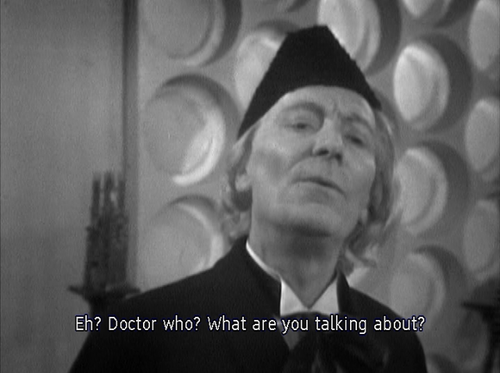
Yet, arguably its greatest strength as very watchable TV drama, is its characterisation and the chemistry of its players – Hartnell’s very irascible old feller spending much of his time being frustrated and irritated by his ‘simple’ human teacher companions (and, in turn, frustrating and irritating them) sets him up in this opening serial as far more an anti- (almost accidental) hero rather than the out-and-out hero future Doctors would be.
Overall, An Unearthly Child may be stripped back, very expository fare – with simple storytelling – compared to much that was to come (even in the Hartnell era), but it’s clearly conceived with care and intelligence and executed with aplomb.
.
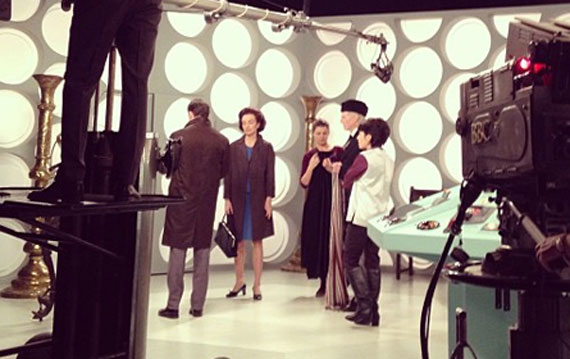
.
.
.

.
Envisaged as an early-evening-Saturday sci-fi adventure drama for all the family with historical reasonance (hence its inclusion of a history and science teacher each as two main characters), Doctor Who was originally dreamt up up the Beeb’s Head of Drama, the Canadian Sydney Norman, whom put up-and-coming producer Verity Lambert in charge of the project. The show had come into being following brainstorming sessions involving writer C E Webber, whom had been charged with scripting the first serial, which would have been called The Giants. When she came on to the show, though, Lambert was far from crazy about Webber’s effort and opted for a script from Australian Anthony Coburn as the season opener – this would eventually become An Unearthly Child (originally intended for later in the season), when combined with some suitable exposition storytelling scoured from Webber’s The Giants.
An Unearthly Child (the first of the serial’s four episodes, that is; not the entire serial) originally went before the cameras on September 27 1963 at London’s Lime Grove Studios, helmed by young director Waris Hussein. Yet this ‘pilot’ episode was beset by technical problems and actors fluffing their lines, thus Newman ordered it to be filmed again (October 18). And, happily, this decision allowed for Hussein and co. to make further tweaks, namely the clothing of both Susan (whom changed from alien-seeming futuristic garb to more ’60s Mod-ish fashions) and The Doctor himself (from a modern suit and tie to the Edwardian-like togs we’re familiar with as the Hartnell Doc’s appearance – indeed, no question, his costume set the crucial trend of the ‘old fashioned’, certainly non-present-day clothing of every subsequent Doctor). Another critical change was made to the script – a line suggesting The Doctor and Susan were from (presumably Earth’s) 49th Century was altered to say they were from ‘another time, another world’ (i.e. they’re aliens).
Infamously, owing to a week’s broadcast delay due to the pilot’s re-filming, An Unearthly Child hit screens the day after US President John F Kennedy was tragically shot dead. This ensured that, because of the Beeb’s constant news bulletins on the unprecedented event, the show’s very first episode actually started late; beginning more than a minute later than its scheduled 5.15pm start-time – ironic for a drama focused around a time machine!
.
.
.
Next time: The War Games (Season 6/ 1969)
.
Playlist: Listen, my friends! ~ April 2013



.
In the words of Moby Grape… listen, my friends! Yes, it’s the (hopefully) monthly playlist presented by George’s Journal just for you good people.
There may be one or two classics to be found here dotted in among different tunes you’re unfamiliar with or have never heard before – or, of course, you may’ve heard them all before. All the same, why not sit back, listen away and enjoy…
.
CLICK on the song titles to hear them
.
Charles Gounod ~ Funeral March For A Marionette1
Louis Armstrong ~ Cabaret2
Mary Hopkin ~ Those Were The Days
Johnny Hallyday ~ Hey Joe
Ten Wheel Drive with Genya Ravan ~ Ain’t Gonna Happen
Les Crane ~ Desiderata3
Manfred Mann’s Earth Band ~ Blinded By The Light
Yvonne Elliman ~ If I Can’t Have You4
Jeff Wayne featuring Justin Hayward ~ The Eve Of War – Disco Remix (from the 1978 album Jeff Wayne’s Musical Version Of The War Of The Worlds)
Sheena Easton ~ Morning Train
Rush ~ Spirit Of The Radio
Asia ~ Heat Of The Moment5
Dusty Springfield Featuring Pet Shop Boys ~ Nothing Has Been Proved6
.
1 Originally written by the composer for his unfinished Suite Burlesque, this piece became more famous as the opening theme of the classic US TV suspense drama Alfred Hitchcock Presents (1955-65); it was one of the tracks Hitch selected when he appeared on the Beeb’s legendary radio show Desert Island Discs in 1959
2 This take on the instantly recognisable ditty from the musical Cabaret (later to be immortalised by the Liza Minelli/ Michael York-starring film adaptation) was the other tune on the Double A-Side #1 UK single more famous for featuring What A Wonderful World – the best selling single in Britain in 1968
3 Controversial American DJ and talk show-host Crane’s 1971 US chart hit and Grammy Award-winning (mostly) spoken-word version of Max Ehrmann’s 1927 prose poem, itself regarded as something of a devotional work with its philosophical, nay, Biblical-esque observations
4 Written by The BeeGees and as featured, alongside many other self-performed hits-to-be of theirs, in the box-office disco smash Saturday Night Fever (1977)
5 As memorably featured in the films The Matador (2004) and The 40-Year-Old Virgin (2005), as well as a 2001 episode of the animated TV series South Park
6 From the soundtrack to the ‘Profumo Affair’-dramatising film Scandal (1989), starring John Hurt, Ian McKellen, Joanne Whalley and Bridget Fonda
.
Tardis Party: Who’s birthday? #4 ~ rare but brilliant pics from Doctor Who (’00s/ ’10s)

The changing man: Tenth Doctor David Tennant handed over the keys to the TARDIS – and eternal televisual fame – to the Eleventh, Matt Smith, at the end of The End Of Time Part Two (2010)
So, peeps, it feels no sooner did we begin than we’ve ended (that’s timey-wimey-ness for you), because, yup, we’ve reached the final regeneration of our pictorial tribute to Doctor Who – celebrating the sci-fi TV giant’s 50th anniversary this year and this very blog’s recent third birthday – with this fourth of four celebratory posts (check out the first three here, here and here).
And, yes, it is – and could only be – the Who of the ’00s and (so far) the ’10s. Affectionately, or not, referred to as ‘NuWho’ by fans, the revived series under the outstanding stewardship of show-runners Russell T Davies and Steven Moffat, while headlined by the brilliant talents of leads Christopher Eccleston, David Tennant and now Matt Smith, has been a huge favourite with the populace, a consistent hit with the critics and a conspicuous cash cow for the Beeb.
Yup, fezzes off to the modern Doctor Who then – bow-ties may not be cool, but its success most certainly has been marvellous. Geronimo…!
.
CLICK on images for full-size
.

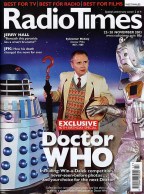


Forty not out? Doctor Who had continued in novels and comics etc since its TV demise, but hopes were high for a TV series resurrection as (from l to r) Colin Baker, Sylvester McCoy, Tom Baker and Peter Davision posed for collectable Radio Times covers to celebrate its 40th anniversary in November 2003
.
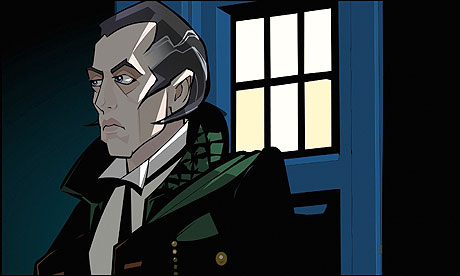
Cartoon caper: that same month, future official villain Richard E Grant lent his voice to a then official (now unofficial) Ninth Doctor in the Internet-only animated adventure Scream Of The Shalka (2003)
.
.
.

Because we want to: Doctor Who finally returned to screens as a fully-fledged, Saturday evening series in March 2005; run by executive producer/ chief writer Russel T Davies, it starred Christopher Eccleston as The Doctor and – in less a supporting, more a female lead, role – Billie Piper as companion Rose Tyler
.
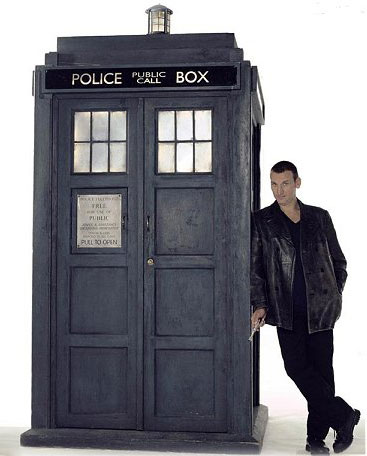

Rose-tinted TARDIS: Eccleston and Piper pose with the new show’s third lead – gloriously unchanged from the ‘Classic series’ (or actually looking better than before), the one, the only TARDIS
.

Are you sitting comfortably? Then he’ll begin: Eccleston’s Ninth Doctor was a post-Millennial, almost post-modern Time Lord hero; dressed down, no-nonsense but excitable and unashamedly Northern
.

Card sharp? He may have been rubbish at card tricks, but Eccleston proved a dab-hand at bringing The Doctor back to the masses – energetic, accessible, ever-slightly-alien and always engaging
.
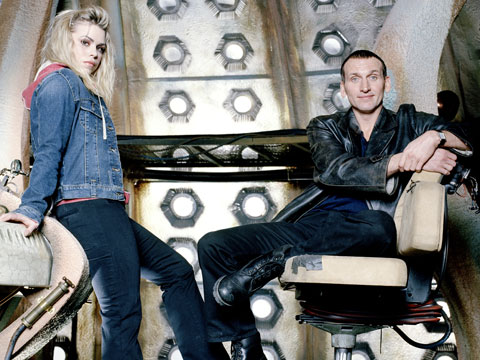
Welcome aboard: Eccleston and Piper pose in the new TARDIS interior – a sort of steam punk/ organic hybrid; a design that would remain for the next five years of of the Davies-led era
.

Two-man girl: after just one season Eccleston left the show (l), but the presence of the highly popular Piper’s space-and-time-travelling chav Rose eased the fast transition to David Tennant’s Tenth Doctor, whom debuted in the show’s first ever proper yuletide special The Christmas Invasion (2005) (r)
.
.
.

Pajama-rama: Tennant and Piper bonded immediately and became firm friends on- and off-set – good news for the show, indeed, as from The Christmas Invasion onwards their partnership proved dynamite
.

Let there be light: Tennant and Piper watch a firework display as they switch on 2005’s Christmas lights in Cardiff – the city of whose BBC’s studios are home of Doctor Who’s interior filming in its modern era
.
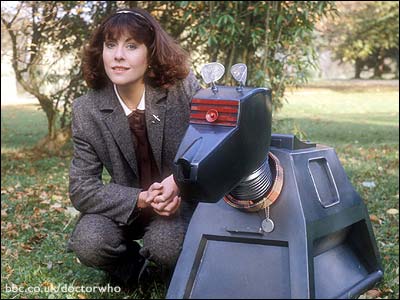

What Sarah did next: at Christmas 1981, Lis Sladen enjoyed a one-off return as Sarah Jane Smith in the special K-9 And Company (l); 25 years later she was back – and back with K-9 – in Season 2’s story School Reunion (r), whose success led to a spin-off series, The Sarah Jane Adventures (2007-11)
.

Catherine the Great: the 2006 Christmas special The Runaway Bride gave The Doctor a new (at first, one-off) companion, the lippy, bolshy, loveable would-be-bride Donna Noble played by Catherine Tate
.

Designer digs: Tennant gained his new full-time companion in Season 3’s opener Smith And Jones (2007) in the sexy shape of Freema Agyeman’s Martha Jones, here posing with Tennant in a GQ magazine shoot
.

Hark! Is that a Harkness? Agyeman and Tennant goof about (perhaps ineviatbly) with John Barrowman as the ever-returning (often from death) breakout star that was time agent Captain Jack Harkness; so popular did he prove he headlined the adult-oriented spin-off series Torchwood (2006-11)
.

Flash Harry: acclaimed Life On Mars (2006-07) actor John Simm camped it up as the Tennant-era resurrection of The Master, here posing as his alter-ego, irresistible British-PM-to-be Harold Saxon
.

Blink and you’ll miss her: in her first notable screen role, Carey Mulligan was Sally Sparrow, lead in Season 3’s Doctor-light Blink (2007), which also saw the debut of monsters the Weeping Angels
.

Flogging thesps: Tennant and Agyeman at the launch of Season 3’s DVD box-set at HMV’s Oxford Street store; much of the modern show’s success can be measured by its post-broadcast popularity
.

Pop goes the Dalek: the modern Who’s guest star coups reached their zenith with the casting of Kylie Minogue as companion Astrid Peth in 2007’s Christmas special Voyage Of The Damned; here the Pop Pixie homages Katy Manning’s unforgettable naughty Dalek photo pose in publicity for her appearance
.

Ensemble assembles: the Tennant era gang of companions all came together in the Season 4 two-part-climax Stolen Earth/ Journey’s End (2008); from left to right – Camille Coduri (Jackie Tyler), Barrowman, Agyeman, Piper, Tennant, Noel Clarke (Mickey Smith) and Sladen
.


Fur and antlers: Tate – Season 4’s regular companion – in The Planet Of The Ood (2008) and the legendary Bernard Cribbins as her grandfather Wilfred Mott, companion (and a critical regeneration component) in Tennant’s final adventures The End Of Time Part One (2009) and Part Two (2010)
.

Desert dessert: after his third season, Tennant only played The Doctor in five further 2008- and ’09-broadcast, feature-length specials, the second of which was Planet Of The Dead (2009) and featured Michelle Ryan as one-off companion Lady Christina De Souza
.
.
.
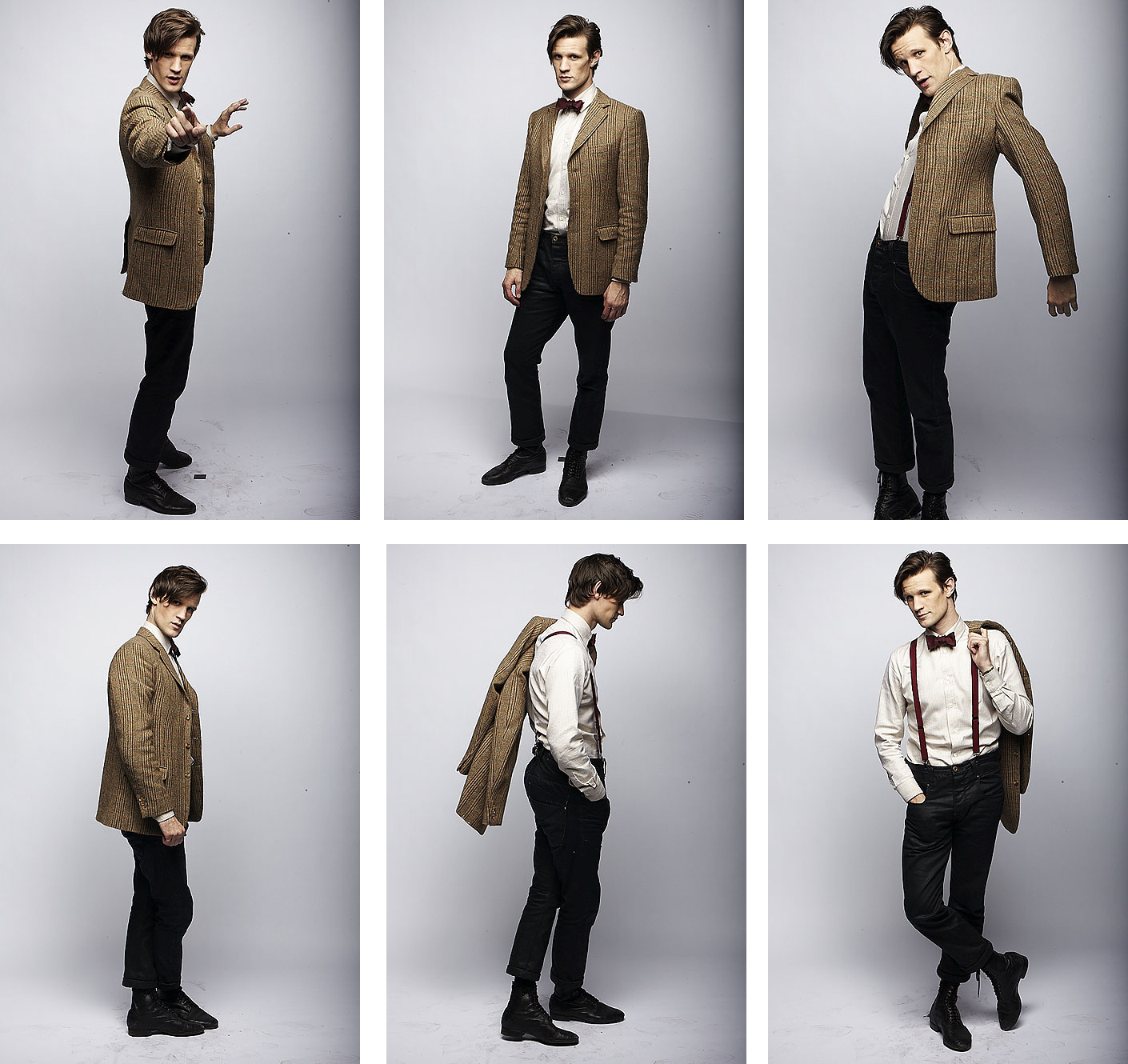
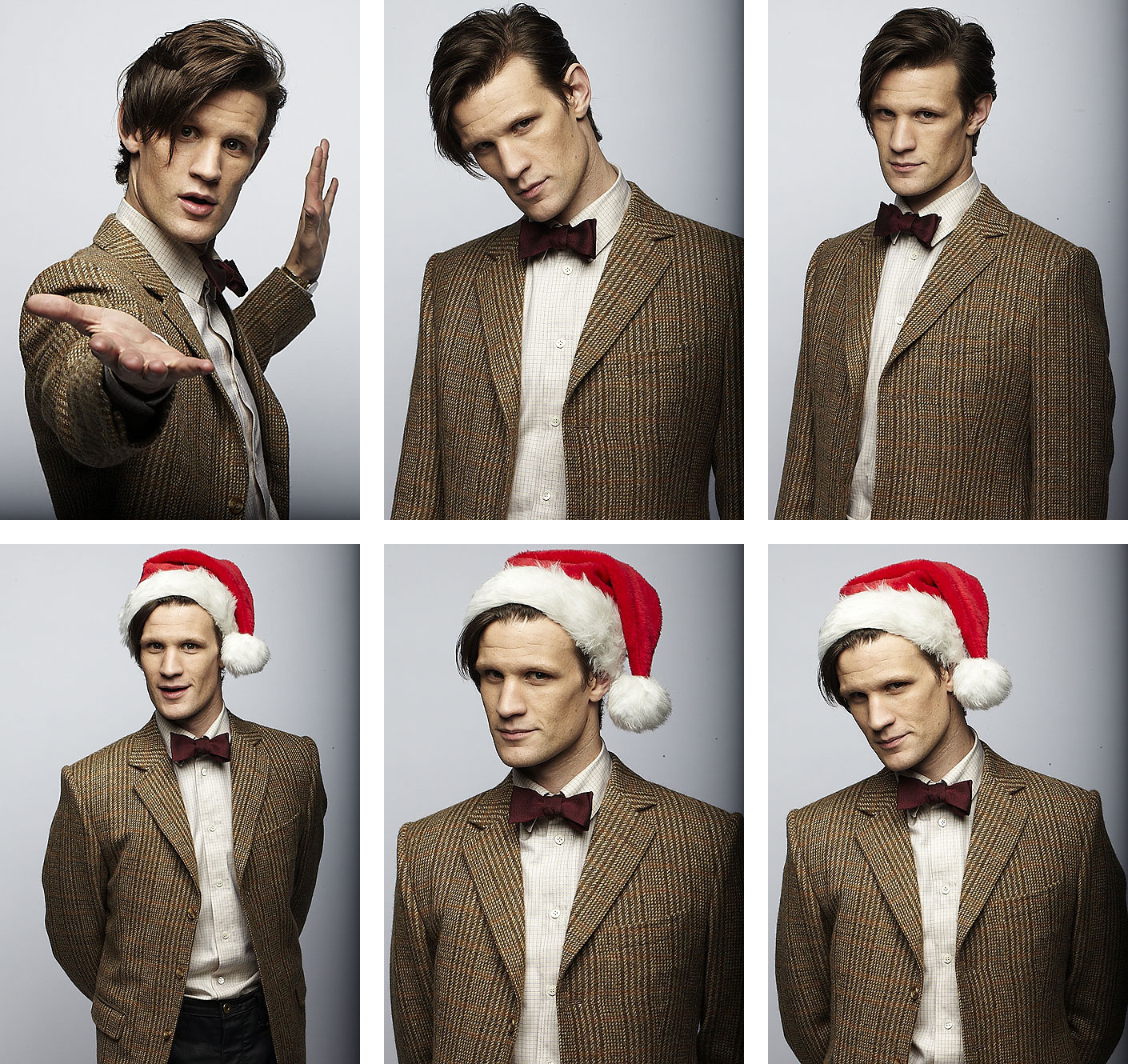
Time for Elevenses: the youngest actor ever to be cast in the role, 27-year-old Matt Smith made his full debut as The Eleventh Doctor in the cracking Season 5 opener The Eleventh Hour (2010)
.


Moff the boss: with the arrival of Smith, Who also gained new show-runner (executive producer/ chief writer) Steven Moffat, whom had written several previous ‘NuWho’ stories including Blink
.

Trio hello: joining Smith’s Doctor as a genuine duo of companions (and thus turning the show into a three-lead-driven series) were Karen Gillan (Amy Pond) and Arthur Darvill (Rory Williams)
.

Three’s a crowd? Darvill, Smith and Gillan were a tight gang on-set, lending chemistry to every scene – and the trio’s dynamic was inevitably challenged by Amy and Rory’s nuptials at the end of Season 5
.

Taking the plunge(r): surely no actor can claim to have properly played The Doctor until he’s played opposite the Daleks; Smith underwent this baptism of fire in Season 5’s Victory Of The Daleks (2010)
.


Little and large: more important to the show than even it had been before, merchandise has been critical to the modern Who’s (wider) success – here Gillan gets to grips with her (and Smith’s) action figure
.

Snow moment: Smith and crew filming a scene from the 2010 seasonal special A Christmas Carol
.

Abigail’s (Christmas) party: much loved opera-crossover guest star Katherine Jenkins lent A Christmas Carol beauty and class – as well as a truly exquisite tune in the shape of Abigail’s Song
.

Flying the flag: a sign of the modern show’s success at making Doctor Who an ever bigger institution was the (surely costly) decision to up-sticks from Wales and film Season 6’s two-part opener The Impossible Astronaut/ Day Of The Moon (2011) in the United States’ Utah desert, much to Gillan’s delight, it seems
.
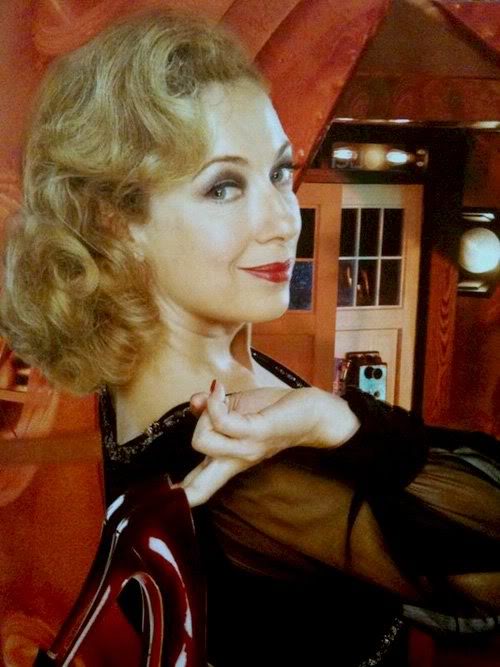
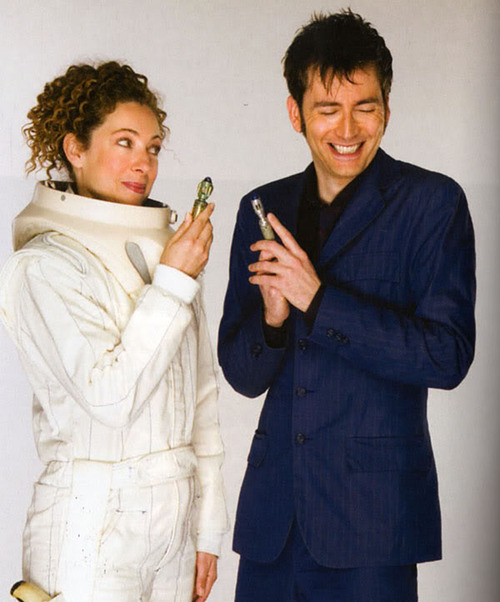
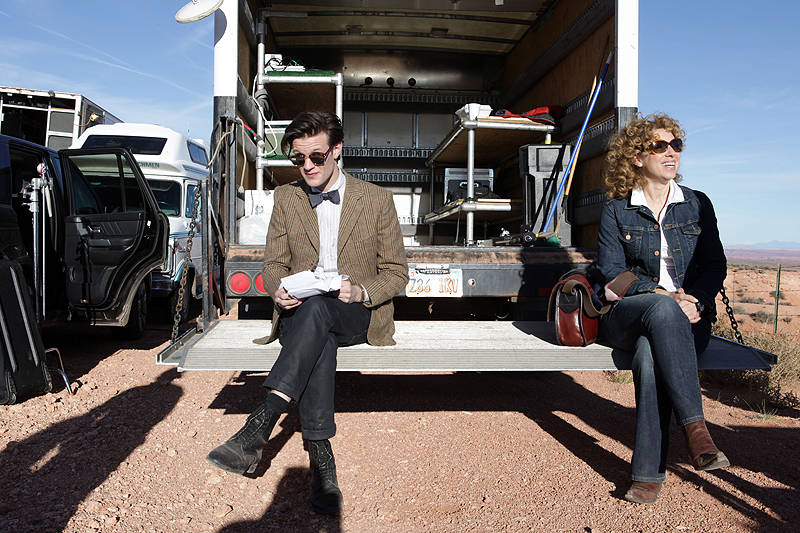

A River runs through it: an icon of ‘NuWho’, Alex Kingston’s River Song was introduced by Moffat in his Tennant-era two-parter Silence In The Library/ Forest Of The Dead (2008) and has featured prominently – often to delightedly head-scratching effect – in the Smith-era Moffat-penned episodes
.

Lizzard lovin’: an instant hit with fans in Season 6’s A Good Man Goes To War (2011), Silurian/ human Victorian-era detective duo Madame Vastra (Neve McIntosh) and Jenny Flint (Catrin Stewart) next appeared in 2012’s Christmas special The Snowmen and will be seen again in Season 7’s second half
.

Central perk: Smith and Gillan in Central Park filming Season 7’s The Angels Take Manhattan (2012)
.

Trio cheerio: The Angels Of Manhattan marked the tear-inducing departure from the show of Gillan and Darvill’s ‘The Ponds’, leaving the TARDIS door open for a new companion to walk through…
.


.

New girl: Jenna-Louise Coleman made her earlier-than-expected debut as Smith’s new, enigmatic to say the least companion Clara (Oswin) Oswald in Season 7 opener Asylum Of The Daleks (2012)
.

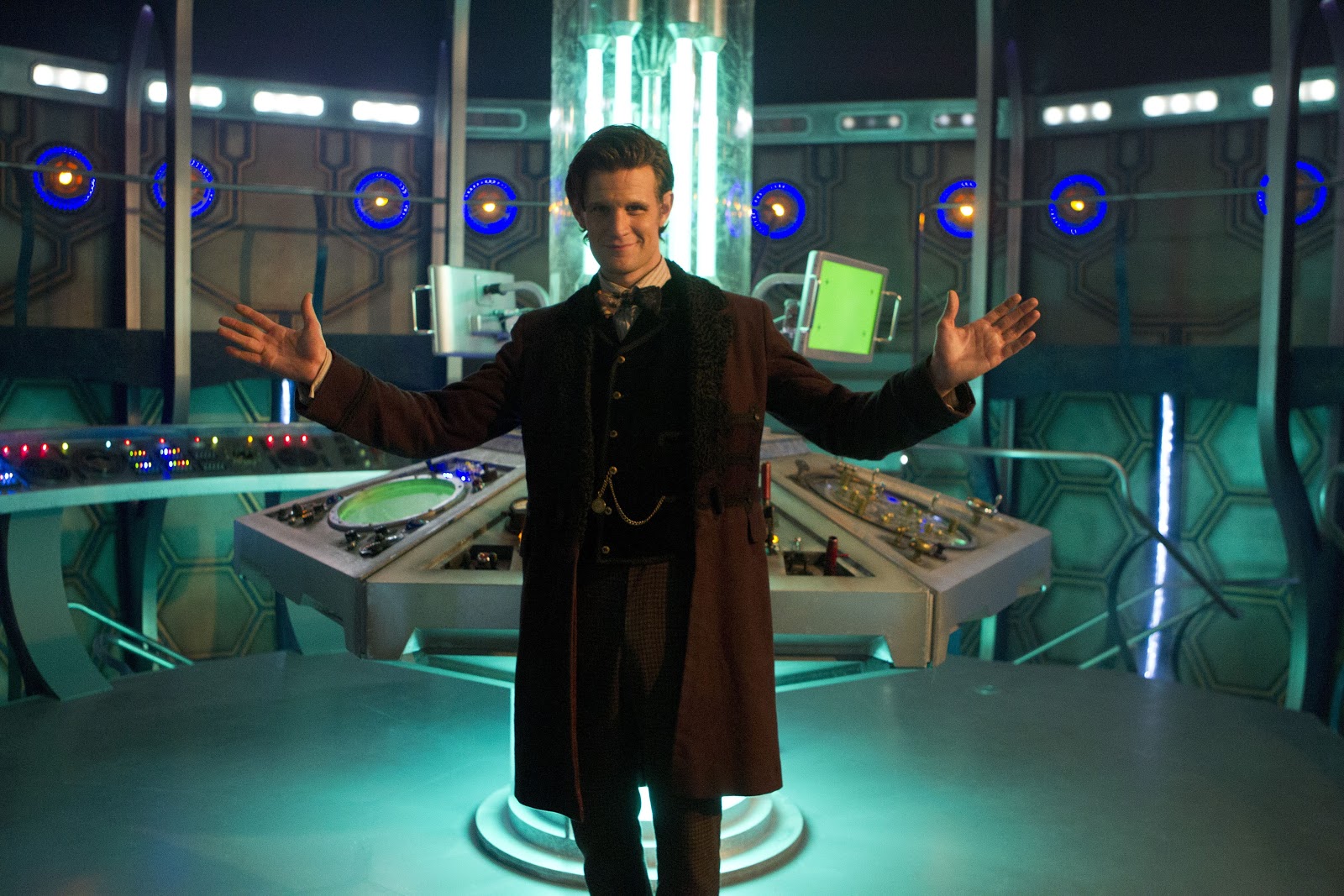
New look: The Doctor shows off the new, pleasingly retro interior of the TARDIS to new companion Clara in 2012’s Christmas special The Snowmen – expect to see more of it and her very soon…
.
.
Doctor Who returns in The Bells Of Saint John on Saturday March 30 at 6.15pm on BBC1 (in the UK and Northern Ireland), later that day on BBC America in the US and on Space in Canada and at 7.30pm on Sunday March 31 on ABC1 in Australia
.
.
Tardis Party: Who’s birthday? #3 ~ rare but brilliant pics from Doctor Who (’80s/ ’90s)

Supersonic celery: Peter Davison’s Fifth Doctor (1981-84) came face to face with one of the ’80s’ greatest icons Concorde in the serial Time-Flight (1984), in which the aircfraft travelled back to prehistory
To be fair, the 1980s was a decade of dubious taste. Big hair; even bigger trousers; skin-tight footballers’ shorts; even skin-tighter womens’ leggings; oh, and Colin Baker’s ludicrously multi-coloured outfit as The Sixth Doctor. Indeed, talking of the latter, The Who Doctor had quite the decade in the ’80s.
While there were the highs of the one of the greatest serials in the show’s history, the breathless The Caves Of Androzani (1984), and the 20th-anniversary-celebrating hokum of The Five Doctors (1983), there were also the lows of the daft-Sylvester McCoy introducing Time And The Rani (1987), the dreadful Colin Baker-introducing The Twin Dilemma (1984) and, of course, the catastrophe of the show’s cancellation altogether.
But then came the ’90s and, surprisingly and controversially, Who was back – yes, back in the fine guise of Paul McGann. But in a TV movie. Hmmm. The ’80s and the ’90s then… Doctor Who‘s lost and found years? Maybe. What’s for sure, though, is this third of four George’s-Journal-third-birthday- and Doctor Who-golden-anniversary-celebrating posts (see the first two here and here) is a doozy, all right. Well, I think it is, at least…
.
CLICK on images for full-size
.
.
.
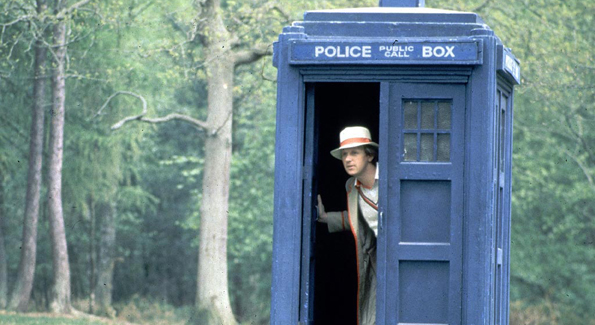
Howzat? Doctor Who opened the door on a new era as All Creatures Great And Small (1978-90) actor Peter Davison stepped into Tom Baker’s not insignificant shoes dressed in cricket-esque togs
.

The ’80s new man: a deliberate step away from the Baker years, the young, blond Davison offered a softer, maybe less sure but just as resilient and heroic version of everyone’s favourite Time Lord
.

Definite article: a Radio Times feature on Davison as the new Doctor from January 1982
.

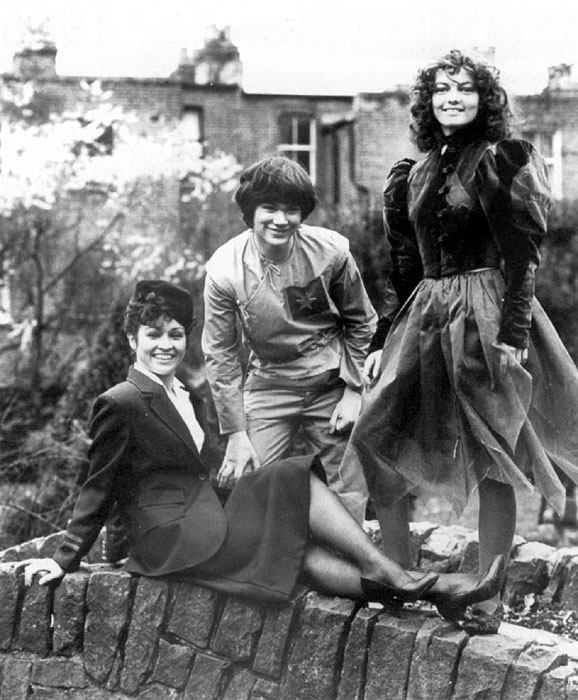
The power of three: Davison poses with two of his three main companions, Sarah Sutton (Nyssa) and Janet Fielding (Tegan) and the latter pair with third companion Adric (Matthew Waterhouse)
.

The Mouth with the scarf: Fielding wrapped in previous Doctor Tom Baker’s second scarf
.
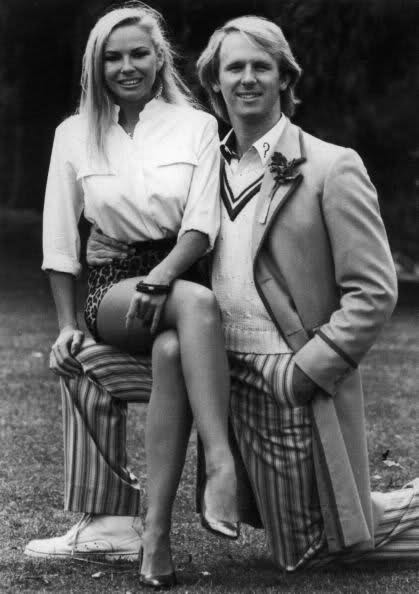
Billy’s missus: it’s not fit for the Nine O’Clock News but quite the day for Davison surely, as he poses rather randomly for a publicity shot with comedy actress Mrs Billy Connelly, Pamela Stephenson
.

Southbank sandwich: Fielding helps Davison free from the clutches of two Daleks at Tower Bridge
.
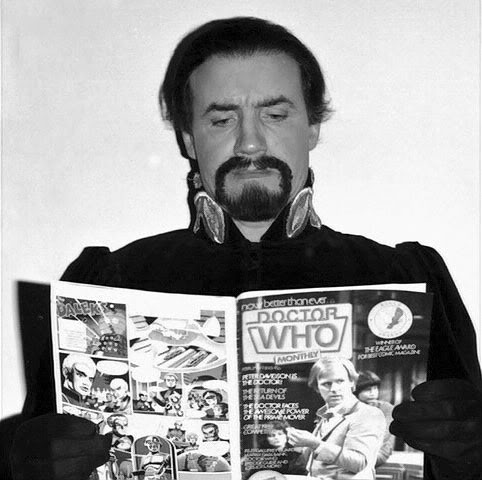
Goatee devotee: here catching up on Whoniverse gossip in Doctor Who Monthly magazine, Anthony Ainley filled Roger Delagdo’s shoes as The Master for eight years between 1981 and ’89
.
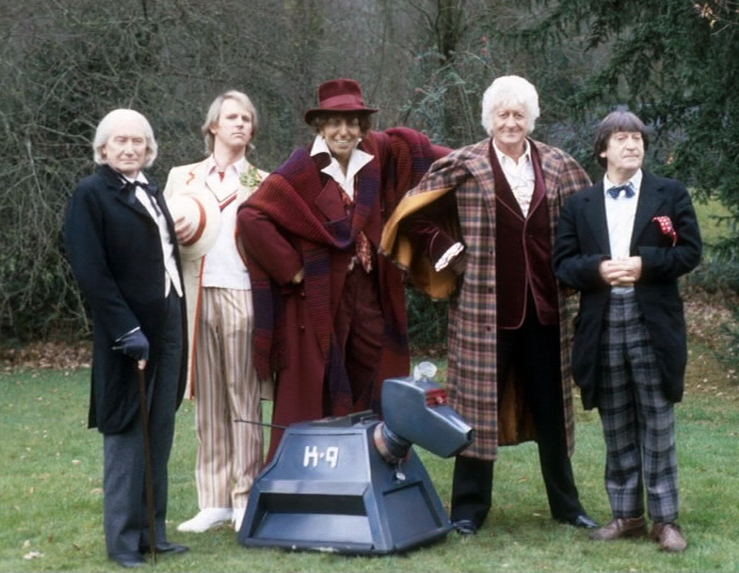

The famous five? In fact, just two former Docs – Patrick Troughton and Jon Pertwee – joined Davison for 20th anniversary-celebrating story The Five Doctors (1983); William Hartnell had by then died, so the hero’s first incarnation was played by Richard Hurndall and Tom Baker decided not to appear, forcing a Madame Tussauds’ likeness to be used for publicity shots and the others to goof around
.
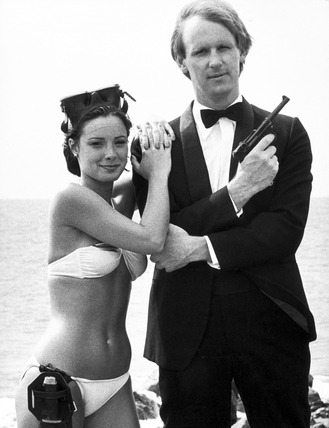
The name’s Bryant, Nicola Bryant: as Peri Brown, Nicola Bryant had only a brief time with Davison’s Doc, but was companion for his all-time classic swansong serial The Caves Of Androzani (1984)
.


Children’s (half-)hour: Davison – with host Sarah Greene – and Colin Baker on BBC kids’ show Blue Peter
.
.

.

Hats off to ’em? It was all smiles for Bryant and Colin Baker as he became the Sixth Doctor in 1984, but troubled waters lay ahead for both him and the show over the next two years
.


Look who’s back: Baker welcomes back Patrick Troughton for the serial The Two Doctors (1985)
.
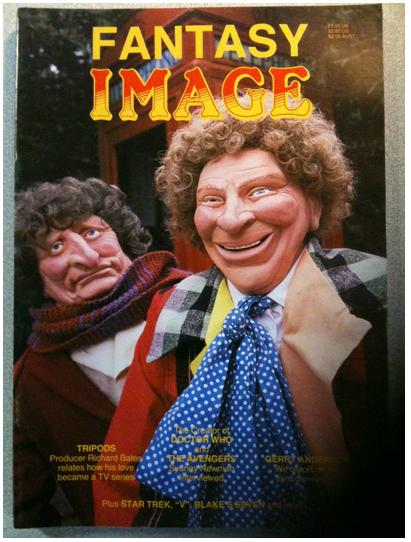
A Baker’s double: puppets of Tom and Colin Baker in their guises as The Doctor from an ’80s magazine
.

Feeling blue? Baker (with Bryant) sports a rather fetching blue mourning cloak over his garish usual costume in Revelation Of The Daleks (1986) – a sartorial touch dreamt up by the serial’s writer in order to cover up his colourful togs, which the scribe deemed unsuitable for TV drama. For his part, Baker had wanted to wear an all-black costume (at least at first) to reflect his Doctor ‘s darkness, but got lumbered with a costume he described as ‘like an explosion in a rainbow factory’
.

Unfurled curls: new companion Bonnie Langford (Mel Bush) posing with an even more curly-than-usual Baker, pretending she intends to cut off his beard, which he’s presumably sporting for another role
.

She’s a scream: Bonnie Langford’s Mel doing what she did best – scream like a little girl
.
.
.

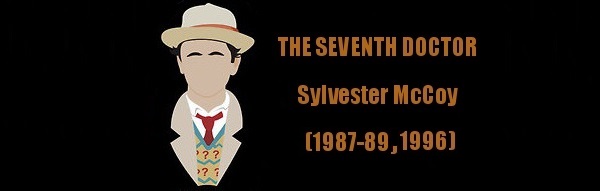
Never cross a woman permed: a be-wigged Kate O’Mara (as The Rani) dresses as Langord’s Mel for newly cast Doctor Sylvester McCoy’s first serial of the show, Time And The Rani (1987)
.

Steel feel: McCoy and Sophie Aldred (companion Ace) on location with Cybermen at the wasteland site on which The O2 (The Millennium Dome) would eventually be built in London’s Greenwich for the long-running show’s silver anniversary-celebrating serial Silver Nemesis (1988)
.

Modern girl: Sophie Aldred poing as Ace, the ‘Classic’ series’ final companion; a tearaway ’80s youth
.

Tunnel vision: McCoy’s attempts to take the character and the show in a darker, less infantile direction were eventually thwarted by its expected cancellation – after 26 years and seasons – in 1989
.
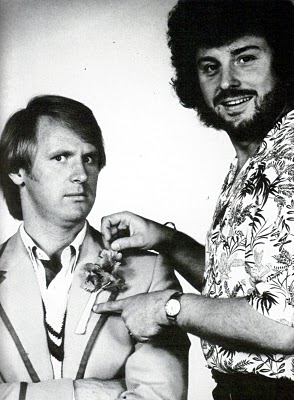


John the Don: almost as exuberant a character as The Doc, producer John Nathan-Turner guided Doctor Who (often controversially) through its choppy ’80s waters – here with his three show leads
.

Old friends: 1970s Doctor Who alumni Katy Manning (Jo Grant), Nicholas Courtney (Brigadier Lethbridge-Stewart) and Jon Pertwee (The Third Doctor) meet up at a 1980s event
.

An ad man’s dream? Jon Pertwee, Peter Davison and Tom Baker appeared in commercials for the Volkswagen Golf Estate car in the ’90s. The tagline? ‘Bigger on the inside’. But of course.
.
.
.

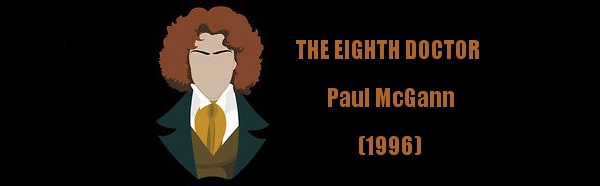
Hello, goodbye: seven years after its demise, Doctor Who was back as an Anglo-American-Canadian TV movie in which McCoy handed over the TARDIS key to the Eighth Doctor, Paul McGann
.

Millennium bug-bear: set in 1999, the TV movie saw McGann team up with Daphne Ashbrook (Dr Grace Holloway) against his old Time Lord foe The Master in the human form of Julia Roberts’ brother Eric
.


Bad hair days? McGann turned up to filming with a crewcut (l), felling it a radical, interesting departure for the role; the TV movie’s makers didn’t agree, insisting he wear a long wig (r) – ironically, a decade later Christopher Eccleston’s Ninth Doctor sported pretty much the look McGann had envisaged
.

Pudsey’s pals: (clockwise from top l) Peter Davison, Sylvester McCoy, the Bakers Colin and Tom and Jon Pertwee resurrected all their Docs in a Children In Need 1993 Night special to mark Doctor Who’s 30th anniversary, in which their TARDISes rather bizarrely interracted with the cast of EastEnders
.


Parody players: a more satisfying, if spoofy charity-driven (non-canonical) special came in 1999 for Comic Relief, in which Rowan Atkinson’s Doctor faces Jonathan Pryce’s Master and undergoes regeneration-after-regeneration, transforming into Richard E Grant, Jim Broadbent, Hugh Grant and finally Joanna Lumley. Fittingly, the special was written by future show-runner Steven Moffat.
.


Boho hero: arguably the ultimate Doctor, Tom Baker portrayed the legendary Gallifreyan adventurer for seven years and seasons (1974-81), here posing with Daleks outside the iconic BBC Television Centre
For many, Blighty in the ’70s was a decade, well, to forget. Three-day-weeks, streets-strewn-with-rubbish-causing strikes, crap jalopies, and, of course, the rise of Margaret Thatcher ‘Milk Snatcher’. At the same time, though, during those 10 years Brit telly might be said to have hit its stride – Parkinson and Top Of The Pops in their pomp, Morecambe and Wise and Brucie/ Larry Grayson’s Generation Game uniting a divided nation and The World’s Greatest Sci-fi TV Show™ glorying in a golden age.
Yes, thanks to a combination of ever improving writing and plotting, unforgettable monsters, legendary leads Jon Pertwee and Tom Baker and colour TV, Doctor Who‘s popularity soared in this era – beyond Britain itself, in fact. The ’60s Who may have given rise to ‘Dalekmania’, but in the ’70s Baker with his multi-coloured scarf enveloped fans from around the world in his time- and space-travelling bosom.
So, here it is then, the second of four pictorial-tribute posts marking George’s Journal‘s third birthday and this year’s 50th anniversary of Doctor Who. Rev up the TARDIS, peeps, because here we go…
.
CLICK on images for full-size
.
.
.
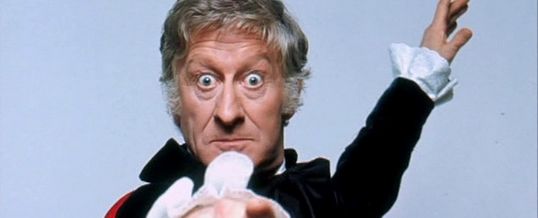
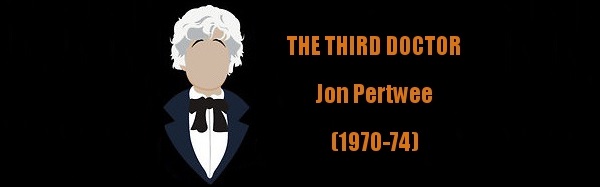
The eyes have it: Jon Pertwee became The Third Doctor in 1970, making his dandyish bow in Auton-introducing serial Spearhead From Space (1970), the show’s very first story to broadcast in colour
.

Getting hairy: Pertwee checks out Who’s listing in the Radio Times as a Yeti looks set to act as his barber
.

Arousing trousers: an out-of-costume, yet nonetheless colourfully tailored Jon Pertwee rehearses a scene with Caroline John (companion Liz Shaw in his first season) from her final serial Inferno (1970)
.
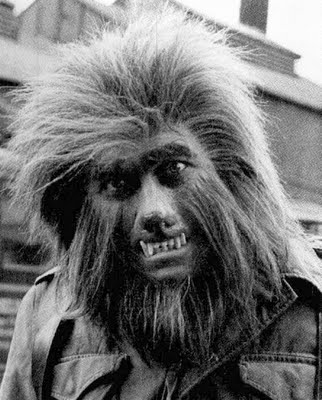
Preen(ed) wolf? A victim is inexplicably transformed into a werewolf-like monster in Inferno (1970)
.

Bessie bezzies: classic companion actress Katy Manning (Jo Grant) poses with Jon Pertwee on board The Third Doctor’s favourite mode of Earth-bound transport, his beloved vintage car Bessie
.

All smiles: to this day, rumours persist that Katy Manning and Jon Pertwee enjoyed an affair during their starring stint together on the show – just what would the upstanding Third Doctor made of that, eh?
.

Lunch bunch: Pertwee, Manning and ‘UNIT Family’-member John Levene (Benton) lunch in Bessie
.

Three’s company: Roger Delagado (the original Master), Katy Manning, Jon Pertwee and Nicholas Courtney (Brigadier Lethbridge-Stewart) pose in front of the TARDIS and, er, a camper van
.

Three’s company #2: the awesome foursome in Bessie for another publicity pose
.

Perfect negative: the best ever Doctor-Master combo – the very first, Roger Delgado and The Pertwee
.

Honey, I’ll shrink the kids: Roger Delgado posing as The Master with his devilish miniaturiser
.

Move over, Dalek: The Doc’s in a pickle as he’s surrounded by the ole pepperpot menaces in Death To The Daleks (1970) – sartorially-speaking, he does look super, though, let’s be honest
.

Trio of heroes: the first three Doctors (Patrick Troughton, Jon Pertwee and William Hartnell) posing together in a publicity shot for the 10th anniversary-celebrating serial The Three Doctors (1973)
.

Trio of heroes #2: Troughton, Pertwee and Hartnell get chummy in another Three Doctors publicity shot
.
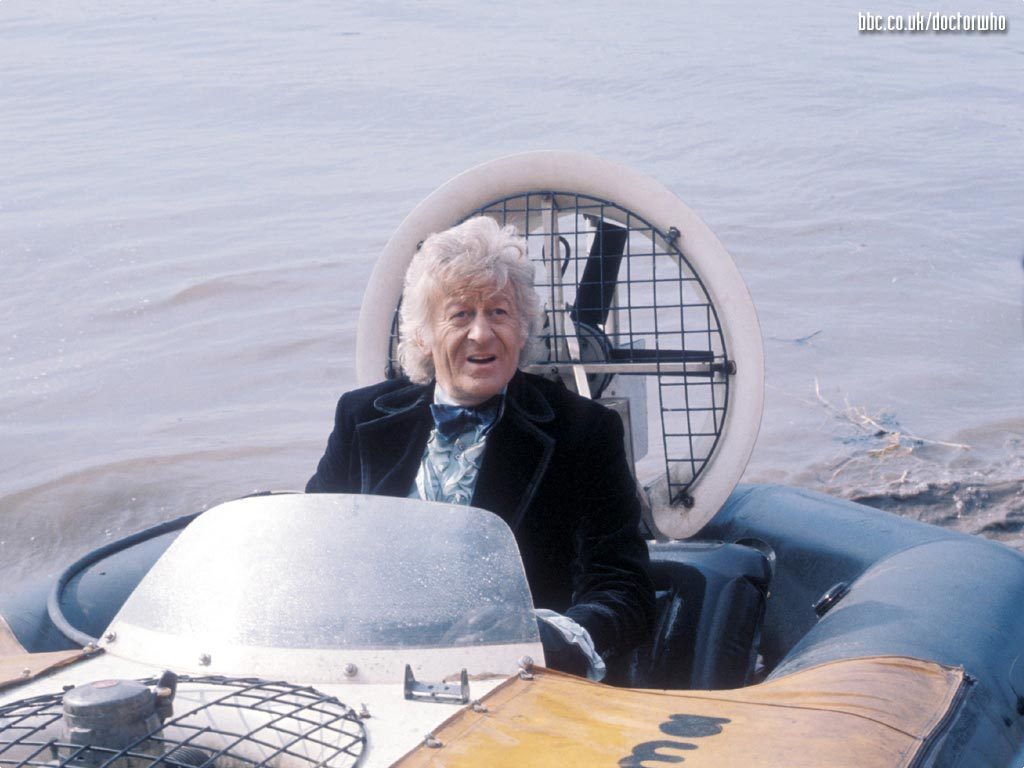
Hover lover: gadget enthusiast extraordinaire Jon Pertwee was in his element when able to get behind the wheel of something that moved fast – this one did on water, a hovercraft in The Sea Devils (1972)
.

Village people: Jon Petwee and Katy Manning pose with local children and a baby from the village of Albdbourne in Wiltshire during a break in filming of The Dæmons (1971)
.

Monster mash: a cracking confrontation of The Third Doctor, a Dalek, a Cyberman and a Sea Devil
.

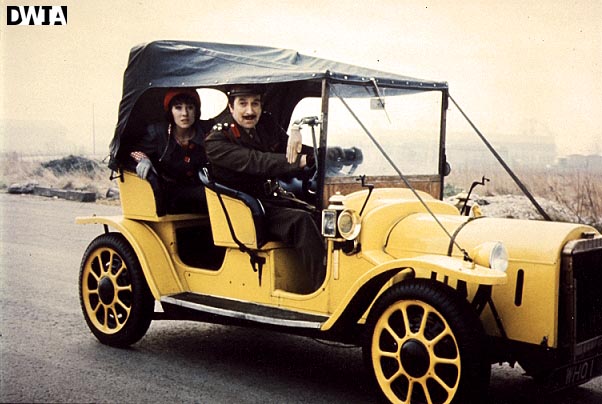
He’s got wheels: Courtney with Bessie and companion actresses John (l) and Elisabeth Sladen (r)
.


Judo chop? Far from getting the chop, Pertwee left the series in The Planet Of The Spiders (1973), as he missed the cast that had left before him – Tom Baker debuted as The Fourth Doctor in Robot (1973)
.
.

.

Super duo: surely the best loved Doctor-companion pairing, Baker’s Doctor and Elisabeth Sladen‘s Sarah-Jane Smith, got his Who era off to a cracking start and lasted for two-and-a-half seasons
.


Salad days on the sands: Baker and Sladen goof around for the camera in sepia-tinted glory as the former ‘directs’ the latter (left) and the pair go for a spin on a motorbike (right)
.
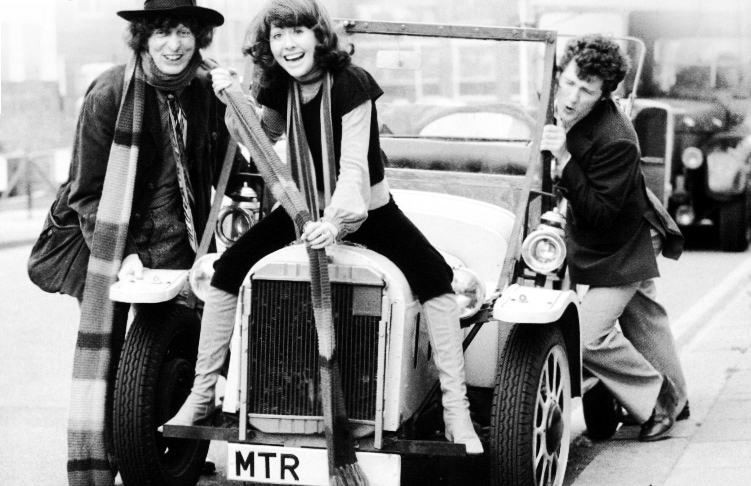

Tom, Liz and Harry: Baker and Sladen play around on Bessie with fellow companion actor (from Baker’s opening two seasons) Ian Marter, who played UNIT physician Harry Sullivan
.
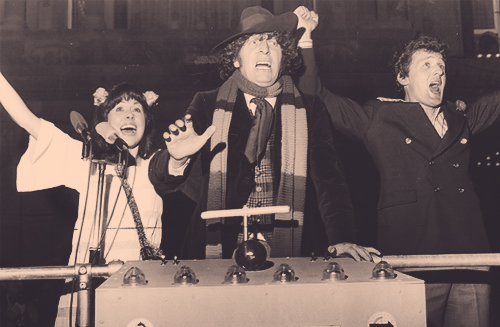
Advent adventure: Baker, Sladen and Marter switch on Blackpool’s Christmas lights in 1975
.

Gripping, the Nation: Baker poses with Daleks creator Terry Nation for a publicity photo for the latter’s cast-iron classic serial Genesis Of The Daleks (1975), which tells how the ultimate TV villains came to be
.

Origin story: Michael Wisher as Davros, the Daleks’ (fictional) creator, in Genesis Of The Daleks
.

Hitting the spot? Baker’s interpretation of The Doctor, in a marvellous marriage with producer Philip Hinchcliffe and script editor Robert Holmes’ sometimes horror-inspired, other times rollicking adventure-driven, but always well written and engaging serials, certainly did with the public
.


Out and about: so popular was Baker’s take on the character, he always drew a crowd when he made public appearances (especially if sporting his Doctor togs) – here he ‘pulls’ some nurses at the Royal Edinburgh Hospital (left) and meets locals in Boston, Lincolnshire (right)
.


Mirror images: after Lis Sladen left the show, Baker was joined by future EastEnder Louise Jameson as new companion Leela in the computer-gone-haywire-featuring serial The Face Of Evil (1977)
.


She: a leather-clad savage from humanity’s far future, Leela’s relationship with The Doctor was inspired by that of Pygmalion/ My Fair Lady’s Henry Higgins and Eliza Doolittle; her costume was anything but
.


One man, a woman and their dog: in the serial The Invisible Enemy (1977), Baker and Jameson were joined by the show’s ‘cuddliest’ companion, the incredibly intelligent, armed-to-the-teeth robot dog K-9
.


The Tamm and the ham: come Season 16, Baker gained yet another new companion, Mary Tamm’s Romanadvoratrelundar – Romana for short – a Time Lady from The Doctor’s own planet
.

Dubious blue: every one of Season 16’s episodes were connected by a ‘story arc’ – The Doctor and Romana searching for ‘The Key to Time’ – fortunately, their actual TARDIS had a back to it
.


Postcards from Paris: Mary Tamm only lasted a season, but Romana lived on; played in Season 17 (and thereafter) by Lalla Ward, including in the Paris-set, Douglas Adams-written serial City Of Death (1979)
.

The Time Lord and his Lady: Baker and Ward became close colleagues, indeed – they fell in love and wed in December 1980. The marriage didn’t last, though; having drifted apart, they divorced 16 months later
.

Intrepid explorer: Baker (and wonder scarf) pose before another wonder of the world, a Giza pyramid
.

Stop! In the name of Mov-ellon: Baker and Ward stage a rather brilliant photo with an actress in alien Movellon dress from the Season 17 serial Destiny Of The Daleks (1979)
.

Dreamscape: a mise-en-scène from an episode of the Season 17 serial Nightmare Of Eden (1979)
.
 …….
…….
.
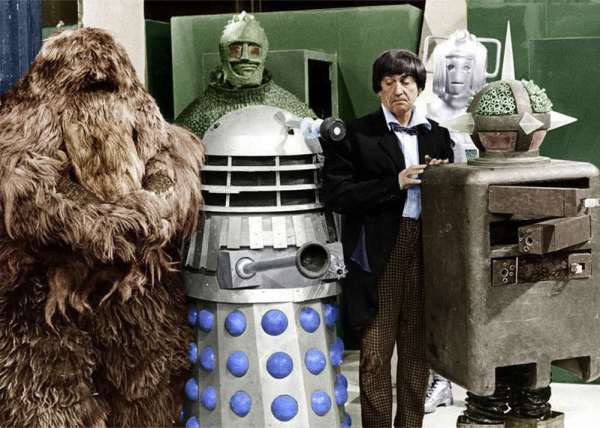
Monsters vs alien: fans’ favourite The Second Doctor (Patrick Troughton) seemingly in a moment of truce with iconic villains from the 1960s era of Doctor Who, including a Dalek, a Cyberman and a Yeti
Ah, yes, dear readers, cast your minds back to March 16 2010 and you might well recall coming across this article on the Internets – the very first post offered by this very blog. And cast your mind back to 1963 (few of you out there will be capable of doing this, I appreciate, but stick with me here) and you might well recall that in that year (to be precise late November, but still) debuted a wee, little family-oriented, children-friendly, Saturday-early-evening fantasy drama on the Beeb, namely Doctor Who.
That’s right then, respectively today and this year mark the third birthday of George’s Journal and the golden anniversary of the greatest sci-fi show on telly. What better way then, may I propose, to mark this day than by offering up a post that’s the first of four pictorial-based tributes to The Who Doctor? What better way, indeed. Especially when the three further similar posts to come will come over the next three days.
Up first, though, let’s take a trip down memory lane – through time and space, of course – and revisit The Doctor’s televisual adventures of the 1960s. Cue the Radiophonic Workshop…
.
CLICK on images for full-size
.
.
.
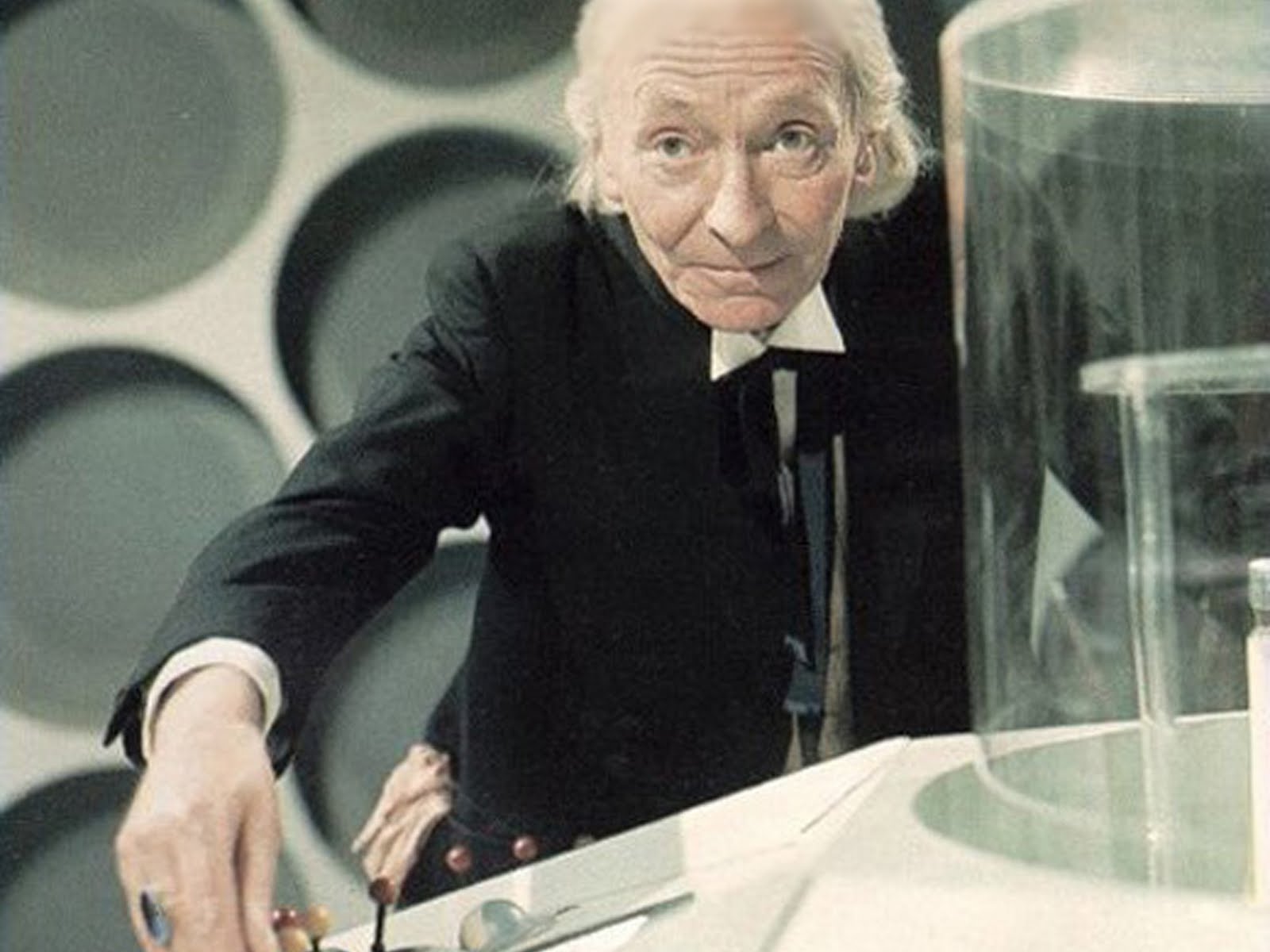
Irascible old rascal: the first Doctor, the centuries-old time and space-traveller from the planet of Gallifrey, was played by William Hartnell and debuted in the serial/ story An Unearthly Child (1963)
.
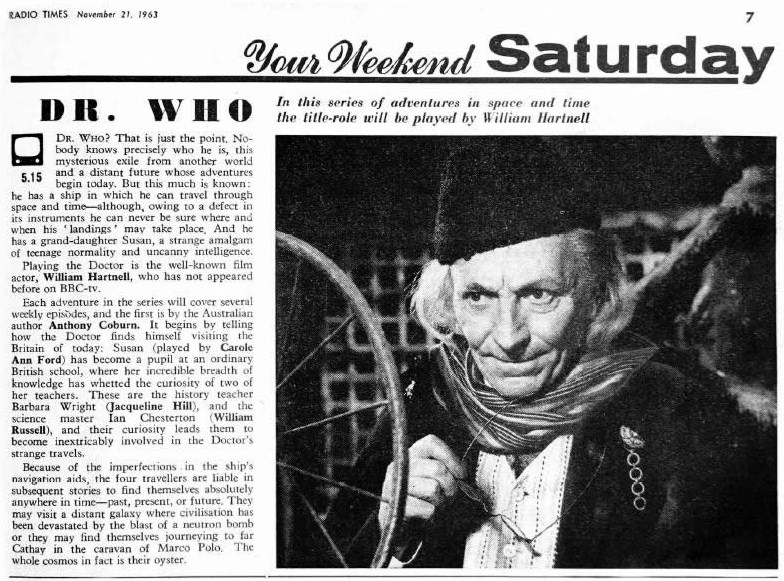

The Radio Times a-changin’: a preview of the show and the first episode’s – An Unearthly Child – original listing in Radio Times magazine for its BBC1 broadcast at 5.15pm on November 23 1963
.

The gang of four: The Doctor and his original trio of companions, William Russell (Ian Chesterton), Carole Ann Ford (his grand-daughter Susan Foreman) and Jacqueline Hill (Barbara Wright)
.
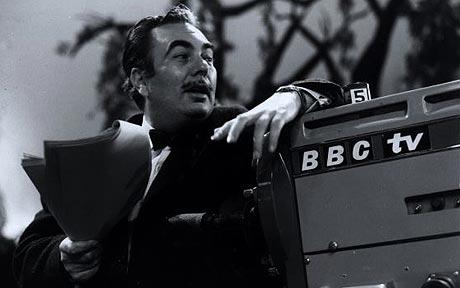
Man with the plan: TV giant Sydney Newman is generally regarded as ‘creator’ of Doctor Who
. .


.

Verity and a veritable beauty: the show’s original producer Verity Lambert with Carole Ann Ford
.

Exterior…: Ian and Barbara spy on The Doctor as he enters a blue police telephone box, little knowing it’s actually the Time And Relative Dimension In Space (TARDIS) machine, in An Unearthly Child (1963)
.

… Interior…: the inside of the TARDIS as first seen by Ian and Barbara – and us – in An Unearthly Child
.

… Pre-hysteria: filming the studio-set environment in An Unearthly Child that faces The Doctor’s new companions the first time they step out of the TARDIS – Earth’s Stone Age
.
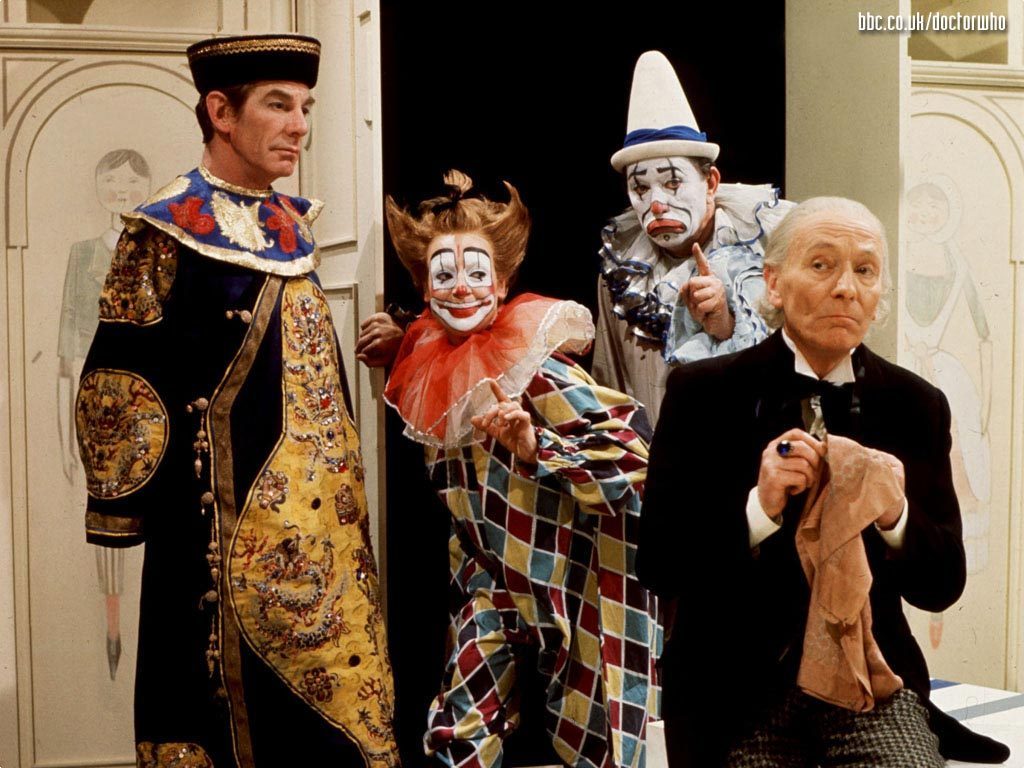
Toy story: Hartnell and co. clown about in a promo shot from The Celestial Toymaker (1966)
.
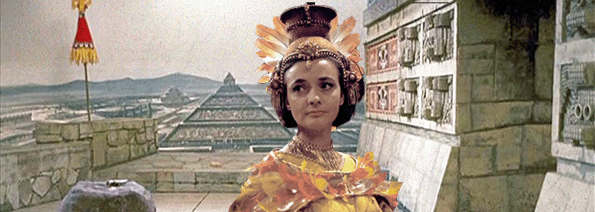
Aztec idol: Hill in The Aztecs (1964), the serial in which Barbara‘s mistaken for a reincarnated high priest
.
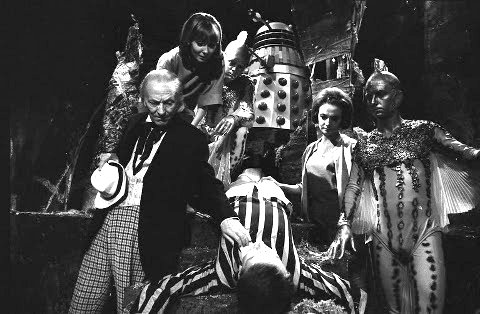
Ace chase: Hartnell, Hill and company in the roller-coaster adventure of a serial that’s The Chase (1965) – silly it may’ve been, but it did feature the departure of the original companion pair Ian and Barbara
.
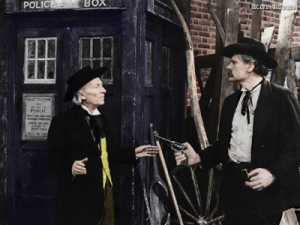
Stick ’em up! Hartnell’s Doctor bumps into Wyatt Earp in The Gunfighters (1966)
.

Getting carried away: Jackie Lane as short-lived companion Dodo Chaplet getting literally swept off her feet by a Monoid in the serial The Ark (1966) – not really against her wishes, to be fair
.

TARDIS trio: Hartnell with penultimate companions Maureen O’Brien (Vicki) and legendary Blue Peter presenter-to-be Peter Purves (Steven Taylor), whom appeared in Seasons 2 and 3 (1965-66)
.

Eye-stalker: a Dalek comes stalk-to-lens with a strangely rather similar looking BBC camera
.
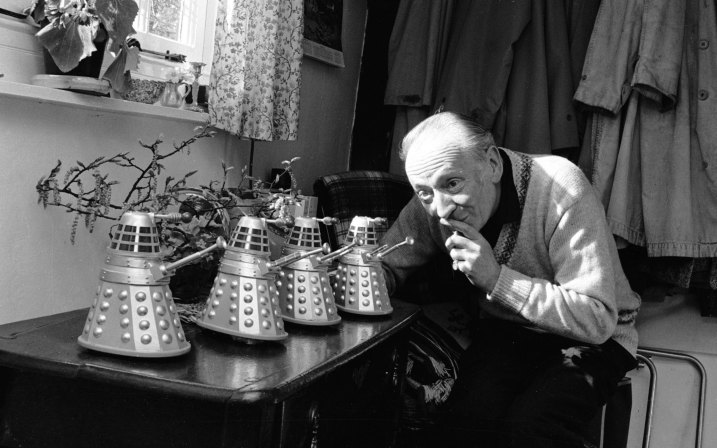
Keep your enemies close: a (probably retired) William Hartnell studies with some amusement a quartet of Daleks – either he’s grown to a giant or he’s miniaturised them, it seems…
.
.
.

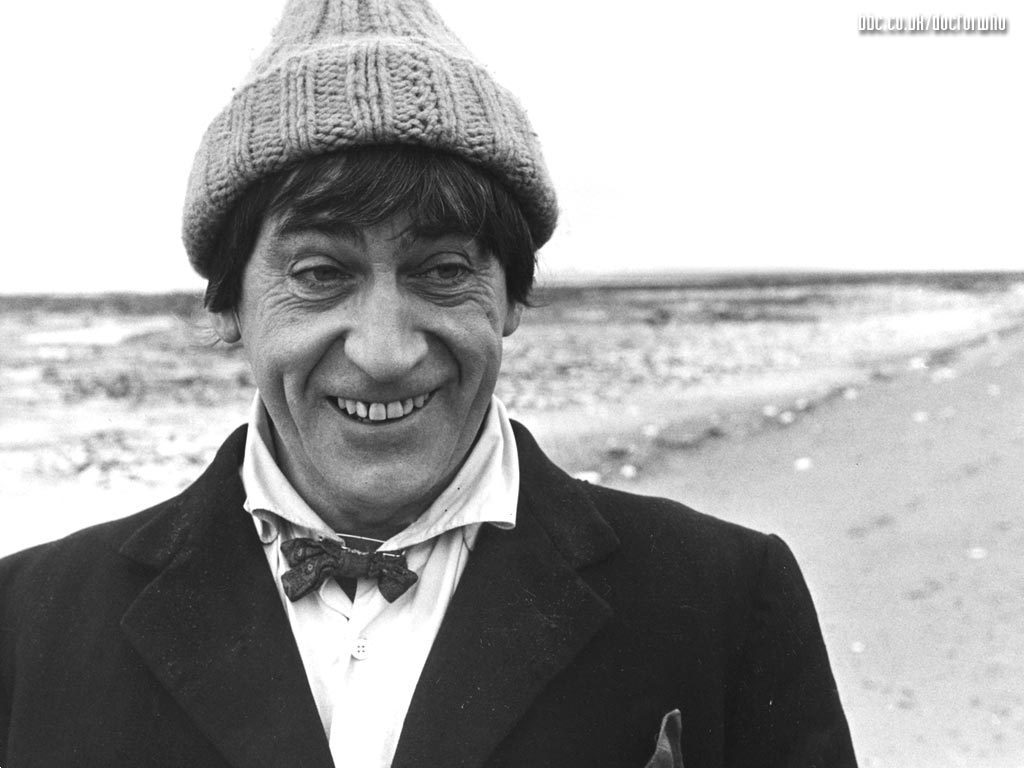
Hat-tricks: a couple of classic chapeaux worn by Patrick Troughton’s Second Doctor, whom made his full debut – recorder in tow – in the fourth season’s third serial The Power Of The Daleks (1966)
.

Through the triangle window: Troughton and his first companions Michael Craze (Ben Jackson) and Anneke Wills (Polly) encounter his fast-becoming greatest foe in The Power Of The Daleks
.

Pebble dash: Craze and Wills in a publicity photo pursued by the unmistakeable Cybermen
.

Hairy escape: the Second Doctor’s second companion pair Frazer Hines’ Jamie McCrimmon and Deborah Watling’s Victoria Waterfield flee a Yeti in a promo shot for The Abominable Snowmen (1967)
.

Cagouls and cuppas: Watling and Troughton taking a break while filming The Abominable Snowmen
.

Combing the script? Troughton between takes with a Yeti on location for The Abominable Snowmen
.

Brolly folly: Troughton flanked by two beheaded Yeti actors on location for The Abominable Snowmen
.

The coach and his young charges: Hines, Troughton and Watling chatting on a cast and crew coach
.

Miss Tardis 1966: Doctor Who’s high popularity quickly gave rise to the popularity of Daleks in the mid-’60s – a phenomenon coined ‘Dalekmania – as shown by this dolly bird-in-a-bikini-toting photo
.

Jamie and his magic scorch-er: Hines and latest companion, the purple jumpsuited Wendy Padbury (Zoe Herriott), are sucked out of reality with The Doctor in The Mind Robber (1967)
.

Console trouble: Padbury and Hines cling to the TARDIS console for dear life in The Mind Robber
.

Fant-ass-tic effect: more Zoe-on-the-console-action from The Mind Robber
.
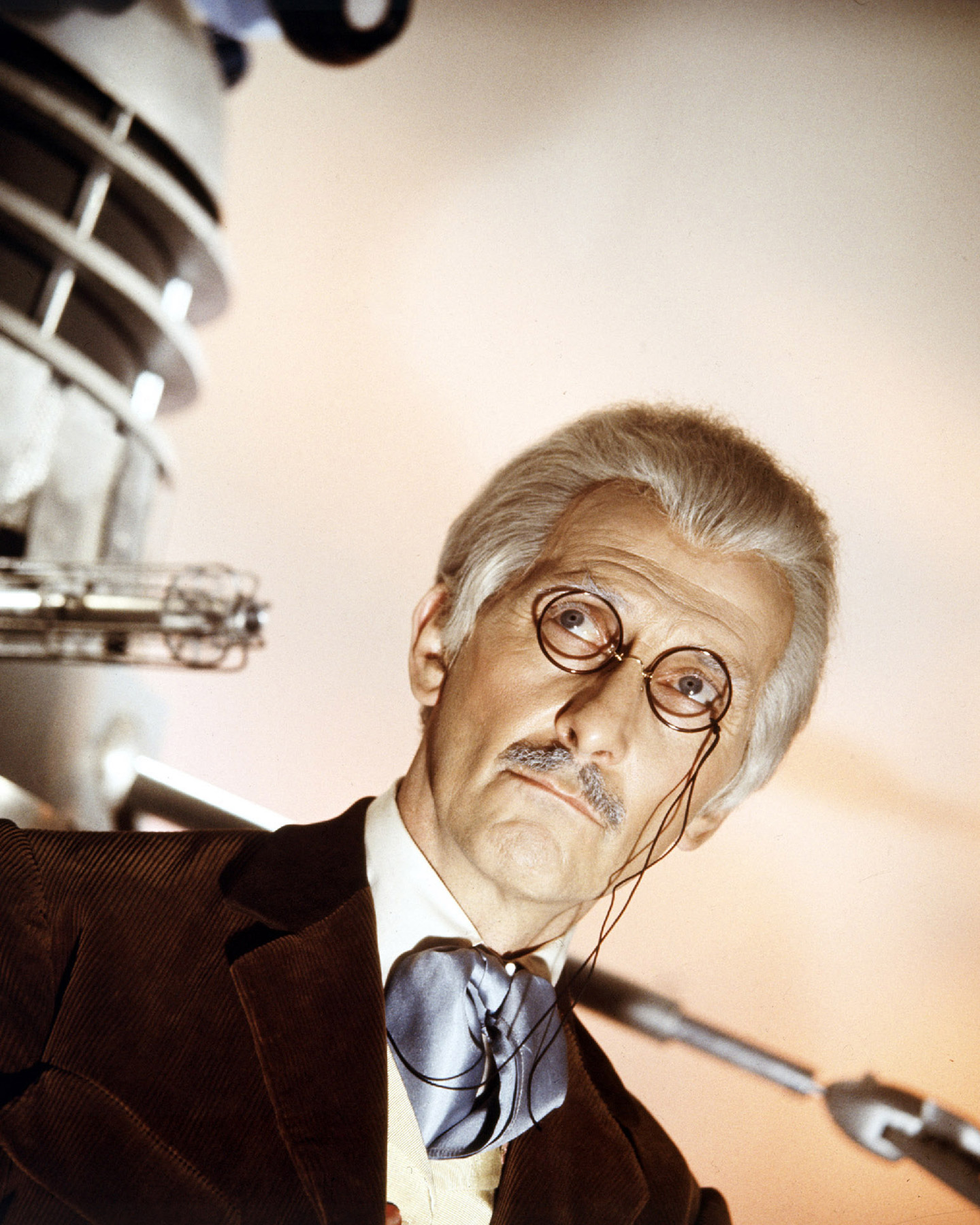

An awfully big-screen adventure (or two): Peter Cushing in publicity shots for the cinematically released Daleks – Invasion Earth: 2150 AD (1966) (left) and, with Roy Castle (Ian), Jennie Linden (Barbara) and Roberta Tovey (Susan), for its far more popular predecessor Dr Who And The Daleks (1965) (right)
.
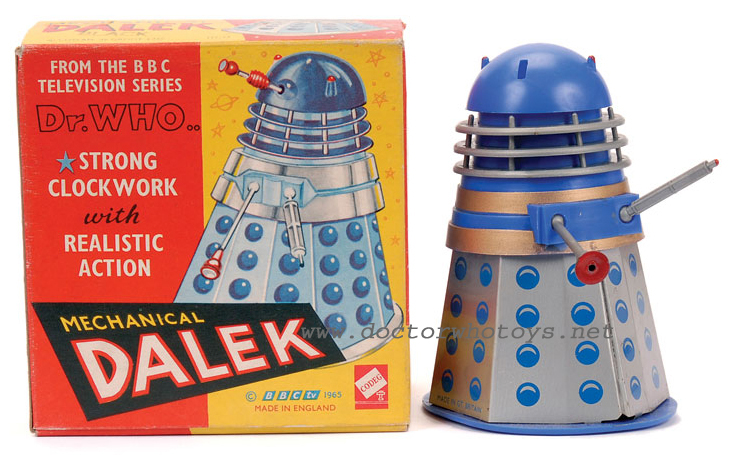
Dalek delirium: a mid-’60s must-have for ankle-biters – an officially licensed wind-up Dalek
.

Flame thrower: Daleks first gained this serious hardware in the serial The Daleks’ Master Plan (1965)
.

Do you stop at Skaro? in this marvellous mid-’60s publicity shot, the bus conductor and punters look like they’ve waited their entire lives to see a real, live Dalek – and then two have come along at once…
.
Cockney octogenarian: happy 80th birthday, Michael Caine

Specs appeal: the man who made wearing glasses cool, Michael Caine was a unique star from the start – and has maintained his stratospheric status thanks to natural talent and charisma for nearly 50 years
Cary Grant. Laurence Olivier. Sean Connery. Richard Burton. David Niven. There are some outstanding candidates for the greatest ever British movie star. My vote, though, goes to the one, the only Michael Caine. The one and the only man who can claim to have played the Hollywood game and come out on top for very nearly 50 years. Over that entire half-century, he’s made a constant stream of flicks both here and in the States (some good; some very good; some mediocre; and some godawful – Jaws The Revenge, anyone?). And, like all great movie stars, whatever he’s done, he’s seemed to come up smelling of roses. Because he’s a much-loved legend. An undisputed icon. A global phenomenon. And today, indeed, is the first of his ninth decade on this fair Earth
Yes, 80 years ago today, Maurice Micklewhite (to use the marvellous moniker with which he was originally bestowed) was born. He grew up in the Elephant & Castle district of South London (something of a school of hard knocks), had a spell in the British Army, decided to become an actor, lived with film composer extraordinaire John Barry and knocked about Swinging London with fellow Sixties heart-throb Terence Stamp (before they were both famous). Then, after a supersonic hat-trick of hits (1964’s Zulu, 1965’s The Ipcress File and 1966’s Alfie), he verily became the star Roger Moore told him he’d become (when he and Terence Stamp bumped into the latter before they were both famous, but he was).
Not long later, he was watching the gogglebox and declared he’d marry a gorgeous dancer on a show he was viewing, only actually to do so (he’s been blissfully wed to Shakira Caine for 40 years now). Along the way he’s also accumulated two Oscars for Best Supporting Actor (for 1986’s Hannah And Her Sisters and 1999’s The Cider House Rules), picked up a BAFTA for Best Actor (for 1983’s Educating Rita) and received three further Oscar noms and five further BAFTA noms. Moreover, he’s run several restaurants in his time, given rise to millions of impressions and had a hit single by ska-cum-pop giants Madness named after him (for which he also supplied his voice). More of that at the foot of this post, though.
It is then – and could only be – Sir Michael The Caine. And, in honour of the great man’s 80th, here’s George Journal‘s top 10 (in reverse order, naturally) of his greatest screen moments; or, at least, the 10 greatest that are available to see on youtube. Because for him, it’s a full-time job, all right…
.
.
10. “Dr Emil Schaffhausen the Third!” ~
Dirty Rotten Scoundrels (1988)
.
.
.
9. “Nobody, not even the rain, has such small hands” ~
Hannah And Her Sisters (1986)
.
.
.
8. “When did everything change?” ~ The Quiet American (2002)
.
.
.
7. “You were only supposed to blow the bloody doors off!” ~
The Italian Job (1969)
.
.
.
6. “Hats on! Hats off!” ~ The Man Who Would Be King (1975)
.
.
.
5. Making breakfast ~ The Ipcress File (1965)
.
.
.
4. “P*ss-holes in the snow” ~ Get Carter (1971)
.
.
.
3. “What’s it all about? Know what I mean?” ~ Alfie (1966)
.
.
.
2. “Hang on a minute, lads; I’ve got a great idea…” ~
The Italian Job (1969)
.
.
.
1. “I’ve done a fine job on you, haven’t I?” ~ Educating Rita (1983)
.
.
.
Oh, and as promised, here’s that moment of ’80s Michael-Caine-musical-mastery courtesy of Madness. The Cainester only agreed to appear on the song at the behest of his daughter – not a lot of people know that. Yes, that’ll do now, methinks…
.
.
.
Further reading:
.
Second best? The 20 greatest UK #2 singles ~ Side B

Guitar man: Elvis rarely put a foot wrong when it came to churning out chart hits, yet two of them made it no higher than #2 over here – what were they and just what beat them…?
So, following a week’s interval after the sampling and digesting of ‘Side A’ of this special two-part pop/rock post, it’s time to flip over the record and take in ‘Side B’. Oh yes.
Because, peeps, here they verily are – the top 10 greatest #2’s in UK chart history. The best dectet of singles that almost made it all the way to chart supremacy, only – usually unjustly – to miss out on top spot by the merest of whiskers. And, in most cases, the reason why this happened is intriguing, surprising, amusing and in some cases downright bizarre. What all 10 of the singles have in common, though, is they’re brilliant – they’d all be #1’s in my record collection. Would they be in yours…?
.
CLICK on the song titles to hear them…
.
10. Everybody Wants To Rule The World ~ Tears For Fears
Date reached #2: April 20 1985 (2 weeks)
Kept off the top by: We Are The World ~ USA For Africa

The chanson: The Tearsters’ absolutely infectious shuffle beat-driven tune that happily and oh-so melodically bounces through the ear and into one’s bonce – so much so that by just 1994, it had achieved at least two million US radio plays.
The cachet: With its hours-of-studio-honed synth work, this utterly cracking song is inescapably ’80s in every way. Like Spandau Ballet’s Gold (featured in this post’s ‘Side A’ companion piece), its ’80s luscious pop-ness springs to mind sunshiny days on speedboats and expensive nights out in garish wine bars, yet a listen to (and a consideration of) its – admittedly – ambiguous lyrics’ll suggest a cynical take on the status quo; it’s, in fact, a critique of humanity’s appetite for power and the war-mongery that comes with it. Either way, Everybody was lapped up by both the public (it hit top spot in the US, if not quite over here) and the critics (it won its year’s Brit Award for Best Single and was nominated for the Mercury Music Prize; in a typical fit of immodesty, its primary songwriter Roland Orzabal opined it should have won that prize over the victor, Paul Hardcastle’s 19, because few of the latter’s lyrics were actually original).
The challenger: The get-out clause for We Are The World languishing in the #1 spot ahead of the greatness that is Everybody is the fact, of course, it raised a hell of a lot of dosh for a damn good cause. The charge against it, though, is it’s undiluted saccharine pop pap. Inspired by Band Aid’s Do They Know It’s Christmas? released just six months earlier, the Harry Belafonte-driven USA For Africa project and this single it spawned is similarly naff, for sure, but being its as American as apple pie it lacks the likeable, very knowing naffness of Band Aid. Plus, Do They Know It’s Christmas? is actually an enduring tune. Still, it did make $11m – and the wider project around $45m – which ain’t to be sniffed at.
.
9. In The Ghetto ~ Elvis Presley
Date reached #2: July 5 1969 (3 weeks)
Kept off the top by: Something In The Air ~ Thunderclap Newman

The chanson: The Pelvis’s urban narrative with a conscience, a slow-burner of a classic dripping with atmosphere and meaning.
The cachet: This was the first Top 10 hit in his homeland for three years for Elvis (making it to #3) and went one better here; and rightly so. A departure for the undisputed King of Rock and Roll for sure, it’s a stripped-back, langurous, disciplined but dilligent ditty that owes all its effect and success to its lyrical power and the power of its singer’s delivery. About the generational poverty trap in which too many find themselves in modern towns and cities (specifically Chicago), it’s a tune Elvis wasn’t keen on recording at first owing to its social message, but sadly still resonates all too well throughout the world of today.
The challenger: One of Elvis’s most unique, most enduring and thus most important hits In The Ghetto may have been, but in retrospect it’s pretty obvious it was never going to get past the awesomely monikered Thunderclap Newman’s one-hit-wonder-and-a-half Something In The Air. An epic ‘flower-power’-can-change-the-world effort that’s driven by genius chord changes and performed by a group The Who’s Pete Townshend assembled around the latter band’s roadie John ‘Speedy’ Keen (whom wrote the song), it became – and has remained – something of a phenomenon with the public at large, featuring in everything from the movie du jour Easy Rider (1969) to those irritating Noughties Talk Talk mobile phone network TV ads.
.
8. My Generation ~ The Who
Date reached #2: November 27 1965 (2 weeks)
Kept off the top by: The Carnival Is Over ~ The Seekers

The chanson: The Mod-tastic testament of youthful rebellion, whose sentiments and toe-tapping brilliance has far exceeded the era in which it was created and at first seemed to define.
The cachet: Such a classic of mid-’60s youth culture it maybe could be described as the anthem of the Mod movement, My Generation is surely The Who’s signature tune and, as noted above, the song that best summises rebel youth of every generation. And that’s frankly because it’s so terrific. Employing an irresistible hard, driving bass line (à la The Kinks’ All Day And All Of The Night of the year before), a genius R&B-inspired call-and-respond lyrical style and an exploding chorus prefixed by Roger Daltrey’s serendipitous stuttering (‘fffff-fade away’), this is a rock standard that’s always been impossible to resist, whether consumed back in the day, during the late ’70s/ early ’80s Mod revival or in every other TV trail and/ or ad of today.
The challenger: How the hell did My Generation not get to #1? Because The Seekers’ The Carnival Is Over did instead. No, I can’t fathom how that happened either. But it did. In this travesty-of-pop-history’s defence, mind, the top comment on its youtube link as I compose this very sentence comes from one marcel911, whom writes: “Why only 600,000 or so views [for The Carnival Is Over]? Gangnam Style has millions. Just shows what crap people will listen to these days.” You can’t argue with that, at least.
.
7. Magical Mystery Tour (EP) ~ The Beatles
Date reached #2: January 6 1968 (2 weeks)
Kept off the top by: Hello, Goodbye ~ The Beatles

The chanson: The double-disc ‘single’ that featured six of the songs written for the Magical Mystery Tour movie (1967).
The cachet: A sort of shortened version of the Magical Mystery Tour album (1967), itself an accompaniment to the film first shown on the Beeb on Boxing Day that year which left the nation shrugging, the EP boasted half a dozen real doozies: the classic title tune itself; the music-hall inspired Your Mother Should Know; the iconic psychedelia of I Am The Walrus; the wistful The Fool On The Hill; the playful instrumental Flying and the druggy mantra of Blue Jay Way. If anyone unleashed the likes of this on the single charts today it’d surely cause an utter sensation.
The challenger: Despite the last statement, the Magical Mystery Tour EP didn’t, of course, reach the summit of charts. What did? That’d be another song from the Magical Mystery Tour film then. Yes, really. Utterly uniquely, Macca’s chipper, chorus-dominated and unforgettable Hello, Goodbye not only kept off top spot these six other tunes from the same source, but was also there for six weeks, ensuring it was 1967’s Christmas #1. Not that John Lennon was impressed, mind, his I Am The Walrus was its ‘B-Side’, which understandably he much preferred. To be fair, posterity probably has too, but hey.
.
6. Suspicious Minds ~ Elvis Presley
Date reached #2: January 17 1970 (1 week)
Kept off the top by: Two Little Boys ~ Rolf Harris

The chanson: The tune that makes The King, er, The King? You better believe it, kids.
The cachet: There’s a theory that goes if you don’t like Suspicious Minds you’re not a human being. Well, all right, it’s not a theory; I’ve just just made it up. But it should be one because it holds water, don’t doubt it. I’m not saying Suspicious Minds is the greatest song Elvis ever recorded (I’m nothing like a Presley aficionado, so wouldn’t dream of going there), but it has to be surely his most accessible, coolest and most enjoyed effort of all-time. A swaggering, sweltering belter of a classic, it was effectively the song that marked his late ’60s/ into the ’70s jumpsuit-fuelled comeback following the Vegas-set televised ’68 Comeback Special (1968). It was his 17th and last #1 in the States, but ridiculously failed to scale the summit of the charts over here. Despite all its arm-pumping awesomeness.
The challenger: We’re an eccentric lot us Brits. Only we could look Suspicious Minds full in the face and then plump instead for an Australian cartoonist-cum-veterinary-reality-TV-presenter’s recording of an obscure Antipodean folk song – and make it ’69’s Christmas #1 in the process. Fair dues, Two Little Boys is a decent ditty with, in its quaint way, a rather affecting ‘message’, but six whole weeks at the top of the charts? Talk about a ’60s hangover.
.
5. Vienna ~ Ultravox
Date reached #2: February 14 1981 (4 weeks)
Kept off the top by: Woman ~ John Lennon/ Shaddap You Face ~ The Joe Dolce Orchestra

The chanson: ‘A man in the dark in a picture frame/ So mystic and soulful…’ Yes, it is – and could only be – the glorious marriage of New Wave synthy, lyrical b*llocks with epic pop brilliance and gloriousness that is the early ’80s masterpiece Vienna.
The cachet: Pompous and overblown with its grand piano and viola and somewhat inspired by the classic Vienna-set Brit flick The Third Man (1949), Ultravox’s Vienna is four minutes and 40 seconds of studio-honed musical mastery from the man who would later (for what it’s worth) mastermind Do They Know It’s Christmas?, the magisterially monickered Scot Midge Ure. Rightly, it scooped the Brit Award for Best Single of its year, became somewhat immortalised in the ’80s-set time travel drama Ashes To Ashes (2008-10) and was the UK’s fifth biggest selling song of 1981. But it did get to #1? Did it eccers like.
The challengers: Among connoisseurs of UK #2’s (don’t worry, there aren’t many), Vienna is legendary for being kept off the top spot for four successive weeks. A rather amazing occurrence when you think about it, given it took two separate singles to prevent it from getting to the summit. First up was an extremely worthy opponent, the recently, tragically deceased John Lennon’s warm, marvellous ballad Woman, but second – inexplicably for three of those four weeks – was Joe Dolce’s crap novelty effort Shaddap You Face. We Brits are not only eccentric; we also have a hell of a sense of humour. A very bad one at times.
.
4. Waterloo Sunset ~ The Kinks
Date reached #2: May 27 1967 (2 weeks)
Kept off the top by: Silence Is Golden ~ The Tremeloes
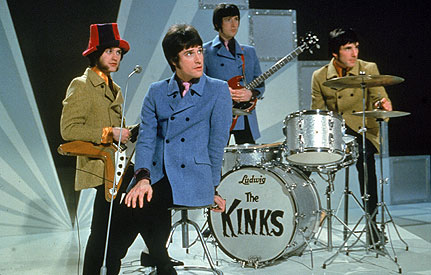
The chanson: The utterly iconic ode to The Big Smoke from Ray Davies’s Norf London Mods-turned-English myth-makers The Kinks.
The cachet: One of The Kinks’ best recalled and best loved efforts with its unforgettable tumbling bass riff, Waterloo Sunset was conspicuously inspired by band vocalist, songwriter and unequivocal leader Davies’s cherished moments spent standing on Waterloo Bridge taking in the impressive and clearly highly inspiring view. A love song about a man and the city he adores then, it’s maybe Swinging London’s quintessential ballad. Sha-la-lah!
The challenger: Originally the B-Side of a hit for Frankie Valli & The Four Seasons, Silence Is Golden ironically proves the opposite is true. For, thanks to Rick West’s frequently soaring falsetto, The Tremeloes turned a mild, sweet ditty into a three-week chart-topper over here and a #11 hit in the US. Considered a classic of its era, it’s a worthy chart champion, but for me Waterloo Sunset hitting top spot in its place would have made for a redder sky at night.
.
3. Let It Be ~ The Beatles
Date reached #2: March 14 1970 (1 week)
Kept off the top by: Wan’drin Star ~ Lee Marvin

The chanson: The Fabs’ penultimate single and (variously) considered one of their greatest, Let It Be is Paul McCartney’s sprawling, epic ballad and the corner-piece of ‘Side A’ of the album with which it shares its name (1970).
The cachet: Instantly recognisable as soon as those piano chords open proceedings, this soaring all-Macca masterclass in song composition and delivery may have been poked at by John Lennon for its sanctimoniousness (‘Mother Mary comes to me/ Whispering words of wisdom/ Let it be’), but it most definitely found an audience with the punters at large and the majority of critics, hitting #1 in the US, Australia, Italy, Norway and Switzerland and placing 20th on Rolling Stone magazine’s 2004 list of ‘The 500 Greatest Songs of All-Time’. Globally embraced as much as any other Beatles hit might have been, yet not quite as much in Blighty – why?
The challenger: Why is the three-week chart-topper Wand’rin Star. And, yes, that’s bizarre. A breakout hit from the cinematic flop that was the Lee Marvin-starring Western musical Paint Your Wagon (1969), it’s a gentle, atmospheric tune, while Marvin’s more-warbling-than-actually-singing throughout adds it an undeniable eccentric charm. Yet this unique performance from the film star could also be said to be, well, a bit crap. Ah well, Lennon felt much the same about Let It Be. Bizarre all round then, really.
.
2. Wouldn’t It Be Nice/ God Only Knows ~ The Beach Boys
Date reached #2: August 27 1966 (2 weeks)
Kept off the top by: Yellow Submarine/ Eleanor Rigby ~ The Beatles

The chanson: A double whammy (and then some) from the legendary Californian sand-lovin’ band – it’s only their two best songs on one Double A-Side single.
The cachet: Quite simply, this has to be one of the greatest singles ever released. After all, it does feature the two best tunes from the seminal, sensational Pet Sounds album (1966), the one-time surfer-sound-band-now-most-dynamic-pop-act-in-the-States’ deliberate answer to The Fabs’ goal-posts-moving Rubber Soul (1965). Wouldn’t It Be Nice is The Beach Boys of old grown into musical muscle men (led, of course, by the masterful maestro Brian Wilson); the soaring multiple vocals, pop-sensibility paciness and adolescent yearning is all there, sure, but now there’s an additional unadulterated artistry. To listen to it is to take a divine soak in pure pop perfection. Conversely, God Only Knows is just musical perfection itself. An utterly glorious song up there with the best popular music has ever produced (cf. the best of The Beatles; Simon & Garfunkel’s Bridge Over Troubled Water), its beautiful, beautiful melody; overlapping harmonies come the end; luscious orchestral über-sound and simple overall quality has always called to my mind what it must sound like in heaven. If heaven exists and all that.
The challenger: Ironically (or not) for Brian Wilson – whom, born just days apart from Paul McCartney, liked to see himself as an innovating rival of the latter – his group’s outstanding Double A-Side was trumped at the summit of the UK charts by another Double A-Side. By Paul McCartney’s Beatles too. And one that featured two ditties from the Revolver album (1966) no less. To be perfectly fair, though, benchmarks themselves of pop innovation Yellow Submarine (the first song to feature ‘sampling’) and Eleanor Rigby (a sombre pop song with amazing Bernard Herrman-like jolting, unnerving strings) may have been, Wouldn’t It Be Nice/ God Only Knows has to be recognised as the better single and thus deserved to be #1. But has their ever been such a dynamic, inspiring one-two at the top of Blighty’s charts before or since?
.
1. Strawberry Fields Forever/ Penny Lane ~ The Beatles
Date reached #2: March 4 1967 (3 weeks)
Kept off the top by: Release Me ~ Englebert Humperdinck

The chanson: Yes, that’s right, it’s the best single the world has ever heard. And, yes, it didn’t get to #1 in the nation that can lay claim to it.
The cachet: This kind of thing is all opinion, of course (after all, some of you reading this may not even rate The Beatles much – if so, one wonders why you’re reading this blog at all really, but let’s leave that aside right now), but to my mind – like God Only Knows – Strawberry Fields Forever is one of the very greatest pop songs ever. As innovative as an X-Wing is cool, as enigmatic as John Travolta can dance and as glorious after all these years as Audrey Hepburn is, well, glorious too, it’s a by turns downbeat, by others soaring and by yet more awe-inspiring four minutes of music. The definitive chart hit as art, it’s the perfect exemplar of just pop can pull off. And, to be fair, in it’s way so is Penny Lane. A sort of psychedelic upbeat answer from Macca to Lennon’s existential angst on the first half of the single (thus combining to form the perfect Double A-Side), it’s bright, breezy and utterly infectious, yes, but brazenly brilliant too – not only does it make distinctive use of the piccolo trumpet, but also it employs a profoundly smart chord progression thanks to the the chords it pivots around (an endeavour the like of which no pop composer, nay arguably no composer outside of ‘classical music’, had ever before attempted), which results in the listener being ebulliently pulled up at critical points throughout and why the song’s such a damned satisfying experience. Both songs, named after places in Liverpool dear to their writers, were awesome, personal projects – thank goodness that Fab pair decided to share them with this.
The challenger: The one problem, if there was one, with these two tunes is that they not only came from an era when The Beatles were withdrawing from the public gaze seemingly to become ultra-cool behemoths more interested in dabbling with Class-A drugs than connecting with the average Brit at large, they also proved that this was what The Fabs were doing. There’s no doubt both songs were the products of LSD experimentation. And that, one can fairly safely assume, made Blighty a little uncomfortable. Indeed, the visual accompaniment to this incredible Double A-Side single was (in yet another significant innovation) one of the first music videos, featuring as it did Lennon and McCartney astride white stallions in a gloomy park with what seemed to be a piano borrowed from a scrapheap tied up to a tree. What the hell had happened to those lovely lads that used to be the Mop-tops? And what was this ‘challenging’ music they were now coming out with? The inevitable result was the UK, in all its barmy eccentricity, did what only it would – it didn’t send Strawberry Fields Forever/ Penny Lane to the top of the charts; it made Englebert Humperdinck’s MOR-tastic, faintly naff ballad Release Me #1 for six weeks. The late ’60s were, to paraphrase Jim Morrison, strange days, indeed.
.