President profiles #1: The happy warrior ~ Franklin D. Roosevelt (1933-45)
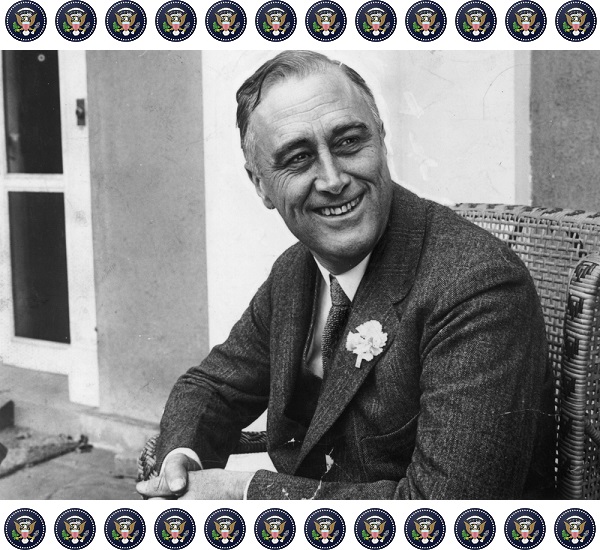
Happy times are here again? Caught in an economic maelstrom, the US turned to amiable patrician Franklin D. Roosevelt to lead it through one of its most turbulent eras – was he up to the titanic task?
Unless you’ve been hiding under a rock these past few months – and who could blame you, given the state of the world, right now – it won’t have escaped your notice this summer and autumn look set to deliver potentially era-defining elections in the UK and the United States.
In which case, this blog, albeit much neglected of late, is marking the fact with a series of politically-themed posts (hey, why not, given it has a wee bit of form in this area), focusing, as they will, on the good, the bad and, yes, the ugly of post-war Anglo-American leaders, right up to the end of the 20th Century.
Well, that’s the theory anyway. But, hopefully, we will indeed make it all the way to the millennium via these US President/ UK Prime Minister profiles – each of them packed full of facts and pics and a tinsy bit of expert and personal opinion.
Because, down through the decades in question, from FDR to Slick Willy and Churchill to Teflon Tony, we’ve been offered up a coterie of curious, nay fascinating Cabinet chiefs.
Variously, they’ve been driven by ambition, fuelled by good, flawed or plain bad intentions, and defined by their reactions to events. And, of course, they were defined, too, by the simple fact they were the right/ wrong person to scale the greasy pole at the right/ wrong time.
So, let’s kick things off, then, with the oh-so charismatic chap who was in the Oval Office as the US successfully emerged from the Great Depression and World War Two – yes, the triple-initial trend-setter himself, Franklin D. ‘FDR’ Roosevelt…
.
.
The details
.
Born: Franklin Delano Roosevelt (January 18th 1882)
Birthplace: Hyde Park, New York, United States
Died: April 12th 1945; Warm Springs, Georgia, United States (Resting place: Hyde Park, New York)
Political party: Democrat
Presidential terms: 3 full 4-year terms (March 4th 1933-April 12th 1945; died in office)
Education: Groton School, Massachusetts; Harvard University; Columbia Law School
Occupation prior to politics: Lawyer
Political roles prior to Presidency: Representative in New York State Senate (26th District; 1911-13); Assistant Secretary of the Navy (Wilson administration; 1913-20); Democrat nominee for Vice President of the United States (1920 Presidential election); Governor of New York (1929-32)
Spouse: Eleanor Roosevelt (married: March 17th 1905; First Lady)
Notable nicknames: ‘FDR’; ‘Sphinx’; ‘That Man in the White House’; ‘Feather Duster’ (childhood nickname)
Strange but true: Belonging to the elite Roosevelt family of New York, FDR and wife Eleanor were first cousins, while her uncle, Theodore ‘Teddy’ Roosevelt, had served as both Governor of New York and as the hugely successful, liberalising 26th President of the United States (1901-09).
FDR suffered from poliomyelitis to such an extent that during the 1920s he lost the ability to walk. Having withdrawn from public life, he eventually returned with renewed zeal and was elected and served as Governor of New York and US President despite considerable physical challenges (including occasional facial paralysis, fevers, and bowel and bladder dysfunction) and by hiding his condition from the public, in part thanks to a complicit media.
.

United front: the union of Franklin and Eleanor Roosevelt (together here with pet dog Meggy) may have evolved into a marriage of convenience but it was a partnership that suited both of them; the latter used it to become the most crusading and acclaimed of all First Ladies – a great humanitarian in her own right, Eleanor Roosevelt is simply one of the greatest Americans to have ever lived
.
The pros
.
♦ In his first term, FDR forced through fundamental ‘New Deal’ legislation that delivered economic aid to America’s unemployed citizens, struggling farmers and impoverished elderly in the wake of the Great Depression; the deep, unrelenting recession that swept through the world following the 1929 US stock market crash.
♦ To be exact, there were two New Deal Acts (1933-34 and 1935-36), which included programs that reformed the US banking system, delivered economic relief, introduced protections for labor organizing (trade unions) and pushed through employment-boosting make-work projects. The latter helped deliver more than 39,000 new schools, 2,500 new hospitals, 8,000 national parks, 300 airports and notable construction projects like the Hoover Dam, the Lincoln Tunnel and the Tennessee Valley Authority.
♦ Roosevelt recognised that ambivalence to the ever-growing threat of fascism and eventual war in Europe and South East Asia was incompatible to ongoing US economic and social (and arguably democratic) recovery. Realistically, then, there was no alternative than for the US to enter the conflict. Following Japan’s attack on Pearl Harbor in December 1941, the issue was forced; Roosevelt faced down opponents to entering the fray and mobilised US forces, providing the Allies with a critical boost in military numbers, weapons and hardware, and tactical options and leadership (not least his own as US Commander-in-Chief). This eventually paved the way to victory shortly after his death in spring/ summer 1945.
.
.
♦ Via the supercharging of US industry to produce all the weaponry and hardware required for the war effort, securing victory also indirectly pulled around the nation’s economy, ending the Great Depression and ensuring America’s status as the world’s only remaining democratic superpower, leading to its socio-economic, military and cultural dominance in the decades to come.
♦ Elected on less a wave than a tremble of optimism in the face of the onerous Great Depression, Roosevelt’s unbridled charisma and optimism was, nonetheless, a direct contrast to the seemingly uncaring businessman persona of his doomed predecessor, Herbert Hoover. It was, indeed, FDR’s reaching out to the public via his (albeit relatively infrequent) radio broadcasts – quickly referred to as ‘fireside chats’ – which helped endear him to them as an avuncular first among equals, and build and keep their trust during the dark, challenging days of the 1930s and ’40s. It revolutionised the personality of the Presidency, too – none of his successors could afford to come off as standoffish and stiff lest they lose support or not get elected in the first place.
♦ FDR won four consecutive, greatly lopsided Presidential election victories, ensuring he not only served 12 straight years in the top job (far longer than anyone before or since) but bestrode US politics throughout the 1930s and the first half of the 1940s. This established an era of American liberalism, which was sustained by his ‘New Deal coalition’ of voters – not just labor union members, urbanites, liberal intellectuals and blacks and other minority voters, but also Southern (usually conservative-minded) Democrats. As a result of which the so-called ‘Fifth Party System’ began, running until at least the early 1950s or, depending on your viewpoint, longer.
.
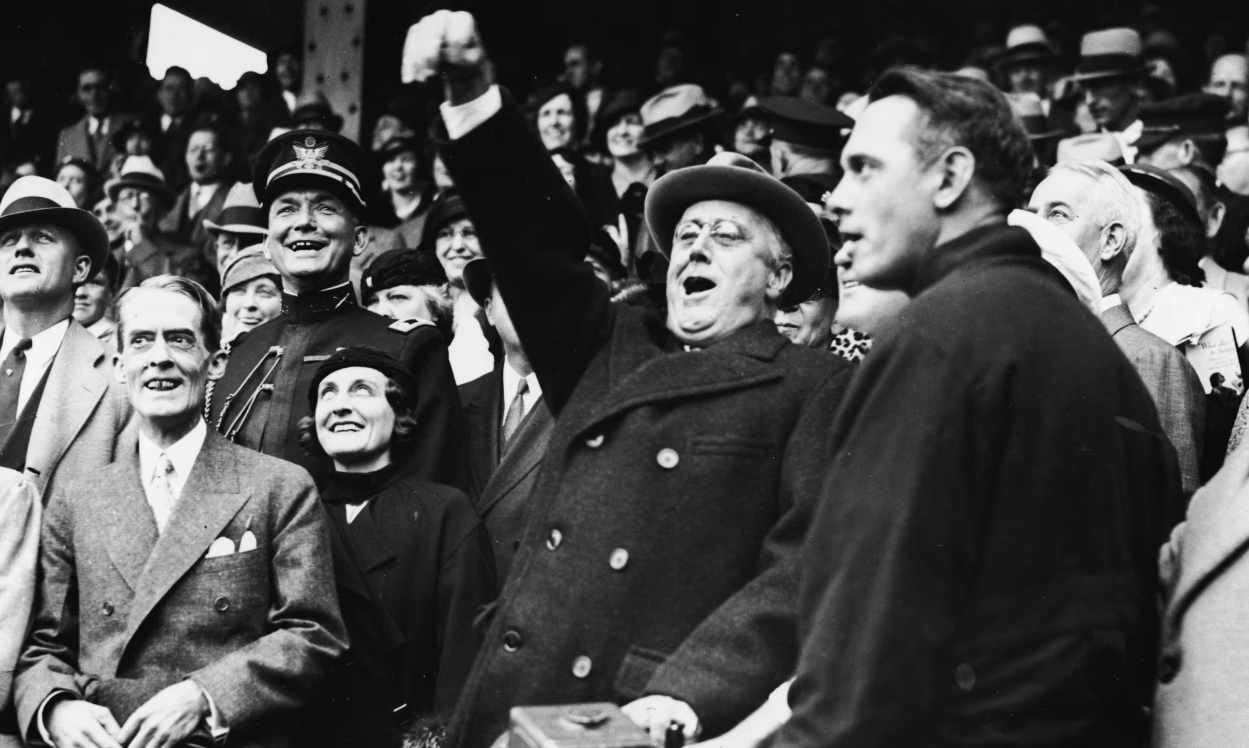
Pitch perfect? FDR throws out the ceremonial first pitch of Major League Baseball’s 1933 World Series (contested by New York Giants and Washington Senators) at Griffith Park, Washington, D.C.
.
The cons
.
♦ Perhaps inevitably, FDR endured a sticky second term, thanks to a backlash to his eye-wateringly high public spending and unprecedented expansion of the federal government. Not just from small-government, low-spending Republicans either; his relationship with the relatively conservative Vice President John Nance Garner had soured; so the latter was ditched for deeply liberal Henry Wallace. All this ensured resurgent Republicans were able to stymie some New Deal objectives, while the US entered recession again in 1937. As noted above, it’s widely believed the necessary transfer to a war-economy ultimately reversed the country’s financial fortunes, as opposed to Roosevelt’s domestic policies.
♦ Although being good at leading, Roosevelt wasn’t good at sharing. With VP Wallace proving just too liberal for the then very ‘big tent’ Democratic party, it was little-known Harry Truman who was forced on FDR as a compromise running mate for the final fourth election in 1944. No problem, right, given Roosevelt was all over everything like a rash? Wrong. When time caught up with him and he died in April 1945, the war was yet to be won and the untested Truman was thrust into power, facing the ultimate test. FDR hadn’t even told him an atomic bomb was being built.
♦ Every President has a genuine black spot on their record, Roosevelt’s must be the decision, during the war years, to intern 110,000 Japanese-Americans (and, to a greatly lesser extent, some of German or Italian ancestry). In general, his was an administration largely on the side of minorities, what with its generous economic relief programs for the desperately poor and frail, and increased government employment for black and Native Americans. Yet, certainly by today’s standards, the internment policy seems unnecessary and cruel.
♦ Despite being re-elected three times by the people, FDR’s holding on to the Presidency for 12 years was, at the time, likened by some to the dominance of a dictator, albeit a benevolent one. Indeed, in the wake of these three terms, the nation’s politicos eventually concluded anyone holding that much power for that long again probably wasn’t the best idea and introduced a two-term limit for the Presidency via 1951’s Twenty-Second Amendment.
.
.
The elections
.
1932 US Presidential Election
(November 8th 1932)
Electoral College vote ~ Roosevelt: 472 votes/ Hoover (Republican; incumbent): 59 votes
States won ~ Roosevelt: 42/ Hoover: 6
Popular vote ~ Roosevelt: 22.8 million votes/ Hoover: 15.7 million votes
Popular vote percentage ~ Roosevelt: 57.4%/ Hoover: 39.6%
Result: Roosevelt elected by landslide
.
1936 US Presidential Election
(November 3rd 1936)
Electoral College vote ~ Roosevelt: 523 votes/ Landon (Republican): 8 votes
States won ~ Roosevelt: 46/ Landon: 2
Popular vote ~ Roosevelt: 27.7 million votes/ Landon: 16.7 million votes
Popular vote percentage ~ Roosevelt: 60.8%/ Landon: 36.5%
Result: Roosevelt re-elected by landslide
.
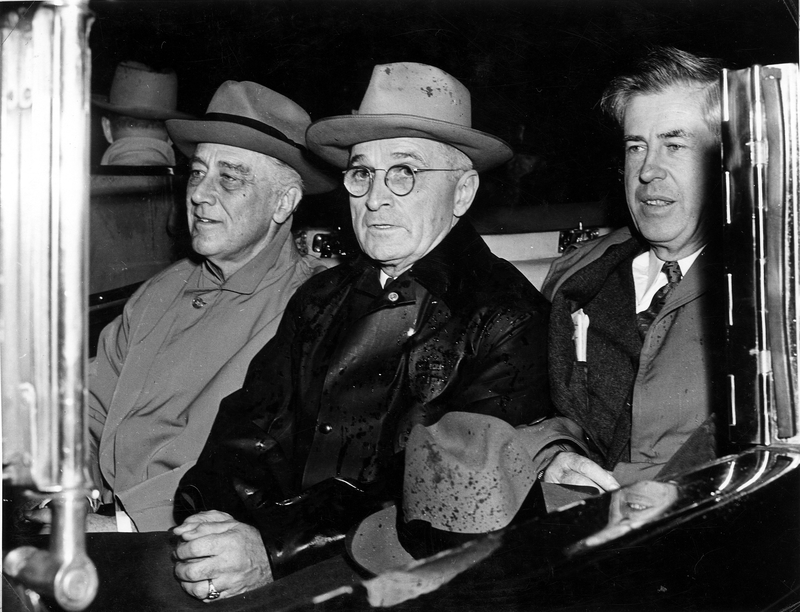
Two into three won’t go: FDR and his long-standing, two-term Vice President Henry Wallace (right) are joined by the man who replaced the latter on the Democrats’ 1944 election ticket, Vice-President Elect Harry Truman (centre), for maybe not the most carefree car journey in November 1944
.
1940 US Presidential Election
(November 5th 1940)
Electoral College vote ~ Roosevelt: 449 votes/ Wilkie (Republican): 82 votes
States won ~ Roosevelt: 38/ Wilkie: 10
Popular vote ~ Roosevelt: 27.3 million votes/ Wilkie: 22.3 million votes
Popular vote percentage ~ Roosevelt: 54.7%/ Wilkie: 44.8%
Result: Roosevelt re-elected by landslide
.
1944 US Presidential Election
(November 7th 1944)
Electoral College vote ~ Roosevelt: 432 votes/ Dewey (Republican): 99 votes
States won ~ Roosevelt: 36/ Dewey: 12
Popular vote ~ Roosevelt: 25.6 million votes/ Dewey: 22.0 million votes
Popular vote percentage ~ Roosevelt: 53.4%/ Dewey: 45.9%
Result: Roosevelt re-elected by landslide
.
.
The experts’ view
.
“FDR’s legacy, his ‘shadow’, established the bulk of today’s US domestic institutions and largely defined the structure of postwar international relations we have lived with since his death … Right or wrong, good or bad, successful or unsuccessful – we are still in Franklin Delano Roosevelt’s world.” ~ Warren F. Kimball¹
“FDR was only one man, surrounded by able and ambitious advisers (many with different agendas). He usually hedged his bets because he did not have a master plan, only assumptions and guiding principles. The man whom Frances Perkins [US Secretary of Labor, 1933-45] called the worst administrator she ever knew had to rely on others to carry out his hopeful schemes. Although determined to make final decisions himself, he often waited for outside events, as in the case of Pearl Harbor, to assert his leadership.” ~ John Garry Clifford¹
“What is remembered [of him best] is the image FDR cultivated of jaunty optimism, complete with smile and cigarette holder. His effervescent leadership style may have special appeal when counterposed to contemporary events that can deprive Americans of a cherished self-image as a virtuous nation. We can remember FDR as representing the best in ourselves, when we rose to our ideals of ‘liberty and justice for all’ in a crisis.
This confidence in our principles and aspirations, and in FDR’s contribution to an American capacity to overcome crises, surely has an element of nostalgia, but it helps explain why politicians of all stripes have continued to invoke FDR.” ~ Mark Leff¹
.
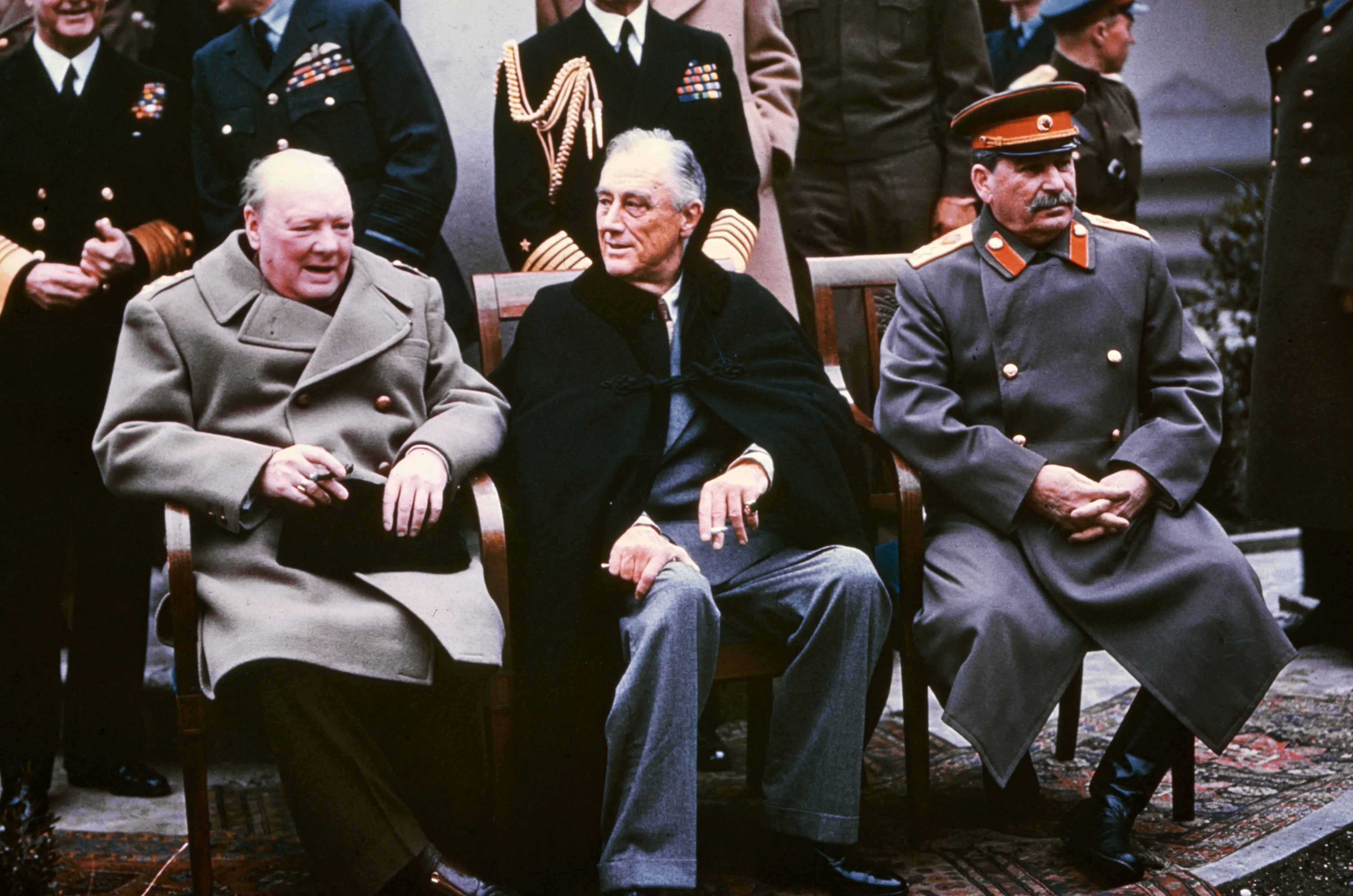
The big three: UK Prime Minister Winston Churchill (l), FDR and Soviet premier Joseph Stalin (r) pose for pictures in iconic pose during February 1945’s legendary Yalta Conference of the WWII allies
.
George’s view
.
The idea of blithely stating so-and-so is your favourite leader of a country strikes me, I must admit, a tad twee, even infantile, and doing so here isn’t a precedent I’m exactly comfortable setting for this (intended) series of posts. But, dang it, FDR *is* my favourite American President. To my mind, he stands head and shoulders above others of the 20th and 21st Centuries and he’s surely up there with the all-time greatest, alongside Washington, Lincoln and his cousin Teddy.
At the point in history he took on the role, around the middle of the 20th Century, he was basically the identikit ideal American President. Patrician and (despite the illness he was concealing) well-groomed, he was also possessed of genuine confidence in thought and deed, and resolute in speech – and in wit.
Yet, perhaps in contrast to his easygoing, good-living and twinkle-eyed public persona (and, indeed, his old-fashioned ‘acceptable’ philandering), the illness he endured and its cruelty had, it seems, burnished a kindness in him, which undoubtedly guided his progressive principles and that simple desire to do what’s right.
And, naturally, what he managed to do can’t be understated. The stakes for his country were immeasurably high when he was in office, yet he took the bull by the horns and guided the United States through and out of both the Great Depression and the Second World War. So much so that, by VJ Day in August ’45, the US had emerged from economic bedlam and total war not just less bedraggled than others of the world’s powers, but as the Free World’s richest and its undisputed leader.
Now, of course, Roosevelt didn’t do all this alone. He wasn’t WWII’s sum-total US military contribution nor did he turn the US into the West’s sole superpower – it was the men and women of America who did that.
However, he was the man who called the shots, made the ultimate decisions, appointed (and fired) the experts and military commanders, cajoled, arm-twisted, pivoted and stood firm, and inspired and reassured the US public through it all, more intimately than any other President had before. And he did all of that for 12 years. With polio, without being able to walk and in a body that was giving up on him.
So, to sum up Franklin D. Roosevelt’s Presidential pre-eminence, consider this. On April 12th 1945, Harry Truman might well have paused in the Oval Office, for a second or two, and reflected he’d just become the most powerful man on Planet Earth. No man who’d preceded FDR as US President could have ever thought, let alone, said the same.
.
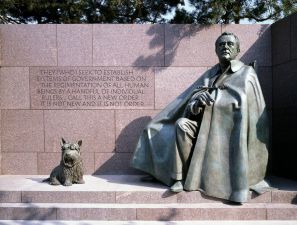
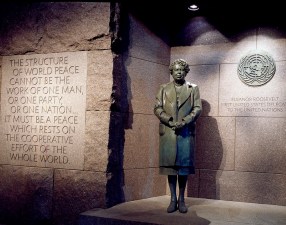
Etched in stone: the memorials of Eleanor Roosevelt (right) and FDR (along with faithful friend Fala, left) located in Washington, D.C. and featuring some of the wisest words either of them ever uttered
.
The quotes
.
♦ “The only thing we have to fear is fear itself.” (March 4th 1933)
♦ “Among American citizens, there should be no forgotten men and no forgotten races.” (October 26th 1936)
♦ “In these days of difficultly, Americans everywhere must and shall choose the path of social justice … the path of faith, the path of hope, and the path of love toward our fellow man.” (October 2nd 1932)
♦ “The test of our progress is not whether we add more to the abundance of those who have most; it is whether we provide enough for those who have too little.” (January 20th 1937)
♦ “No country, however rich, can afford the waste of its human resources. Demoralization caused by vast unemployment is our greatest extravagance. Morally, it is the greatest menace to our social order.” (September 30th 1934)
♦ “They [who] seek to establish systems of government based on the regimentation of human beings by a handful of individual rulers … call this a new order. It is not new and it is not order.” (March 15th 1941)
♦ “We have faith that future generations will know that here, in the middle of the 20th Century, there came a time when men of good will found a way to unite, and produce, and to fight the forces of ignorance, and intolerance, and slavery, and war.” (February 12th 1943)
♦ “More than an end to war, we want an end to the beginnings of all wars.” (from a speech intended to be delivered on April 12th 1945)
.
.
Reference:
¹ Koch, C. M. (2006). ‘A New FDR Emerges: Historians, Teachers, Authors Take a Fresh, Sometimes Critical, Look at Roosevelt’. National Archives. https://www.archives.gov/publications/prologue/2006/winter/fdr-emerges.html (Accessed 27 May 2024).
.













 George's Journal